
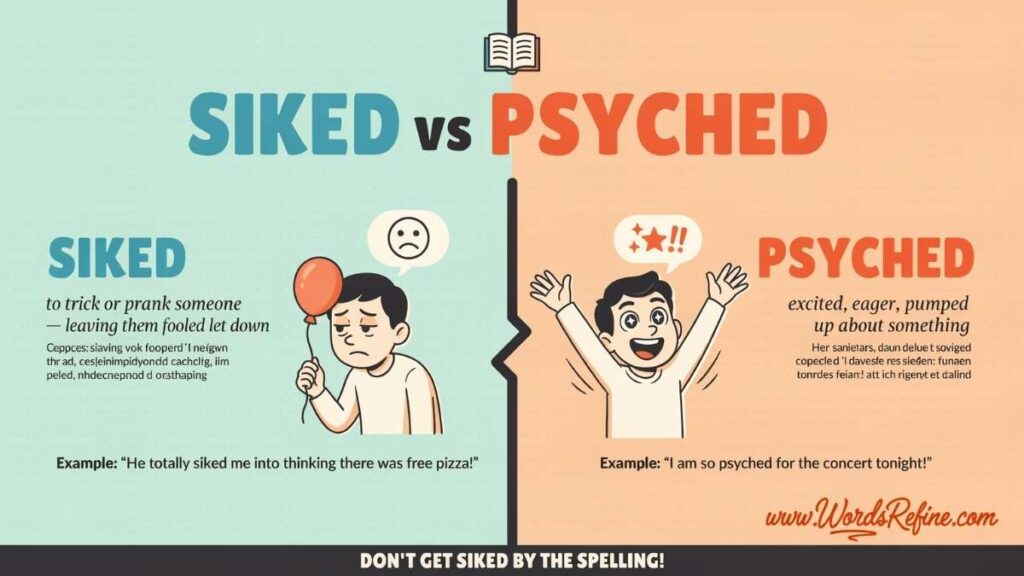
Have you ever typed “siked” when you meant “psyched” and wondered if English had decided to play a spelling prank? You’re not alone. The confusion between siked vs psyched is common because both can sound identical in speech. However, their meanings and uses are different. Psyched is the spelling when you mean excited, enthusiastic, or prepared. Sike, on the other hand, is informal slang used when you reveal that you were joking or tricking someone. In this guide, you well learn the difference between siked vs psyched, understand what the expression means, and discover how to use them correctly without letting a spelling mistake steal the excitement.
Siked vs Psyched The Quick Answer
If you’re asking “siked vs psyched which is correct” when you mean “excited,” use psyched.
Correct: I’m psyched for the concert.
Incorrect for this meaning: I’m siked for the concert.
Cambridge Dictionary defines psyched as an informal adjective meaning “excited.” Dictionary.com also gives it meanings involving eager anticipation and being mentally prepared for something challenging.
So, if your sentence means “I’m excited,” “I’m eager,” or “I’m ready for this,” choose psyched.
There’s another wrinkle, though. Sike isn’t simply a nonsense spelling. It has separate dictionary uses, including an older noun referring to a small stream or ditch. In modern slang, it can also represent the sound-based spelling of psych.
| Meaning | Word to use |
|---|---|
| Excited or eager | psyched |
| Mentally prepared | psyched / psyched up |
| Mentally prepare someone | psych someone up |
| Unsettle or intimidate someone | psych someone out |
| A joking “gotcha!” expression | psych! |
| Informal spelling of “psych!” | sike! |
| An older word for a small stream or ditch | sike |
What Does “Psyched” Mean?
The psyched meaning is fairly simple: excited, enthusiastic, eager, or mentally prepared.
Cambridge Dictionary labels psyched as mainly US informal and defines it as “excited.” Dictionary.com also recognizes the word in contexts involving eager anticipation and mental preparation.
For example:
I’m psyched about the concert.
She’s psyched for her vacation.
We’re psyched to start the project.
The players were psyched up before the final.
The exact shade of meaning depends on context.
If someone says, “I’m excited about the trip,” the statement is fairly neutral. If they say, “I’m psyched about the trip,” the sentence sounds more energetic and enthusiastic.
Psyched Can Mean More Than “Excited”
One useful detail often gets overlooked: psyched can describe mental preparation as well as excitement.
Imagine a runner standing at the starting line. The runner might feel nervous, focused, energized, and ready to compete. Saying the runner is psyched up suggests that the person has deliberately prepared mentally for the challenge.
The same idea works for athletes, performers, students, speakers, and anyone facing an important task.
For example:
The team was psyched up before the championship game.
Here, psyched up doesn’t merely mean that the players were happy. It suggests that they were energized and mentally prepared.
Dictionary.com includes this sense of being mentally prepared for something challenging.
Learn the difference between confusing more English words
Dreamt vs Dreamed Which One Is Correct?
What Does “Siked” Mean?
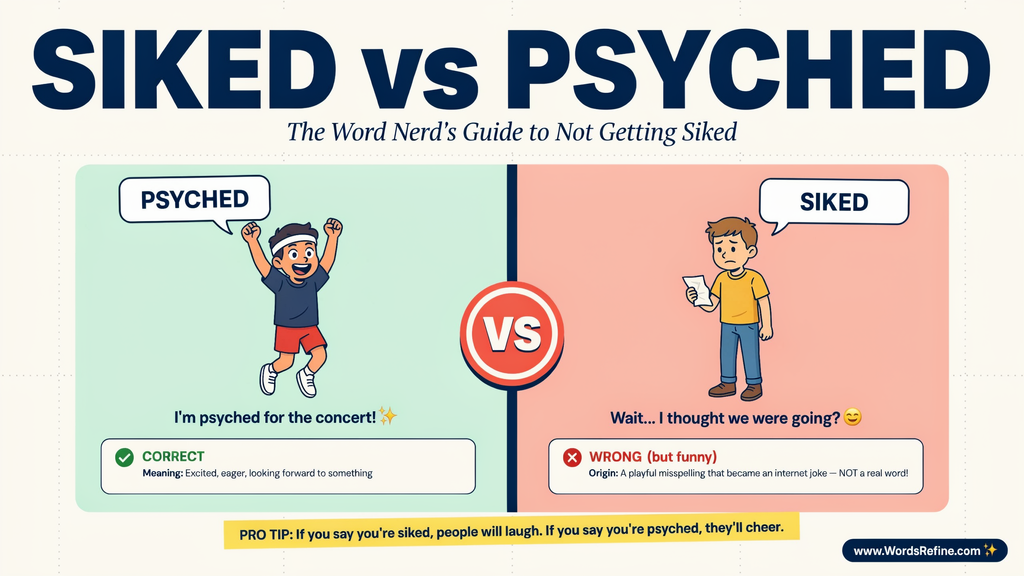
The siked meaning depends on the context because siked can appear for more than one reason.
If someone writes:
I’m siked for the concert.
they almost certainly mean:
I’m psyched for the concert.
In that sentence, siked is not the standard spelling for “excited.”
However, saying that siked can never occur as an English word would also be too broad. Wiktionary records siked as a past-tense and past-participle form of an older verb sike, associated with a sense meaning to sigh or sob.
Therefore, the most accurate rule is:
Siked is not the standard spelling of psyched when you mean excited.
That small distinction matters. English contains plenty of words that can look incorrect in one context but be legitimate in another.
Siked vs Psyched Side-by-Side Comparison
The easiest way to understand siked vs psyched is to compare their meanings and grammatical roles.
| Feature | Psyched | Siked |
|---|---|---|
| Standard spelling for “excited” | Yes | No |
| Means excited or eager | Yes | Not as the standard form |
| Can describe mental preparation | Yes | No |
| Related to psych | Yes | Not in the standard spelling |
| Can function as a form of psych | Yes | No |
| Can appear as a form of sike | No | Yes |
| Common in casual communication | Yes | Yes, particularly as a slang spelling |
| Best choice for formal writing | Usually replace with a more neutral word | Avoid for the “excited” meaning |
The important point isn’t simply that one spelling has a p and the other has an s.
The real difference is meaning and word history.
Psyched belongs to the psych word family. Siked can belong to a different use of sike or appear as a phonetic spelling when someone intends the slang sike.
Why Do People Confuse Siked and Psyched?
Pronunciation causes most of the trouble.
English spelling has a habit of keeping historical letters even when speakers stopped pronouncing them. Psyched is a good example.
The opening p is silent. The word is pronounced /saɪkt/.
Someone who only hears the word might reasonably think:
“If the p isn’t pronounced, why is it there?”
That’s where siked enters the picture.
A listener hears the sound and writes what seems logical. This creates a phonetic spelling rather than the established spelling.
The same issue occurs with psych. Its spelling preserves the psych- word family even though the initial p isn’t pronounced.
So the useful connection is:
psych → psyched
not:
sike → psyched
Once that connection becomes familiar, the spelling becomes much easier to remember.
Why Is “Psyched” Spelled With “Psy”?
The spelling makes more sense when you look at the history of the psych word family.
The family ultimately connects with the Greek word psykhe, associated with the soul, spirit, life, and mind. English later developed words such as psyche, psychology, and psychological from this family.
The verb psych developed several meanings in English. Etymological records trace early uses to the early 20th century and later uses involving psychological influence, preparation, and unsettling someone.
The modern adjective psyched developed from this psych family.
Dictionary.com dates the adjective psyched to the mid-20th century and identifies it as psych + -ed.
So although psyched may look strange when you first encounter it, its spelling isn’t random.
It keeps the connection to psych.
A Simple Memory Trick
Use this:
psych → psyched
If you mean excited, think of psych first. Then add -ed.
That gives you:
psyched
It may look unusual at first. Once you connect it with psych, however, the spelling becomes much easier to remember.
Learn the difference between commonly mixed-up more words
Mobil vs Mobile Which one Is Correct?
How to Use “Psyched” Correctly
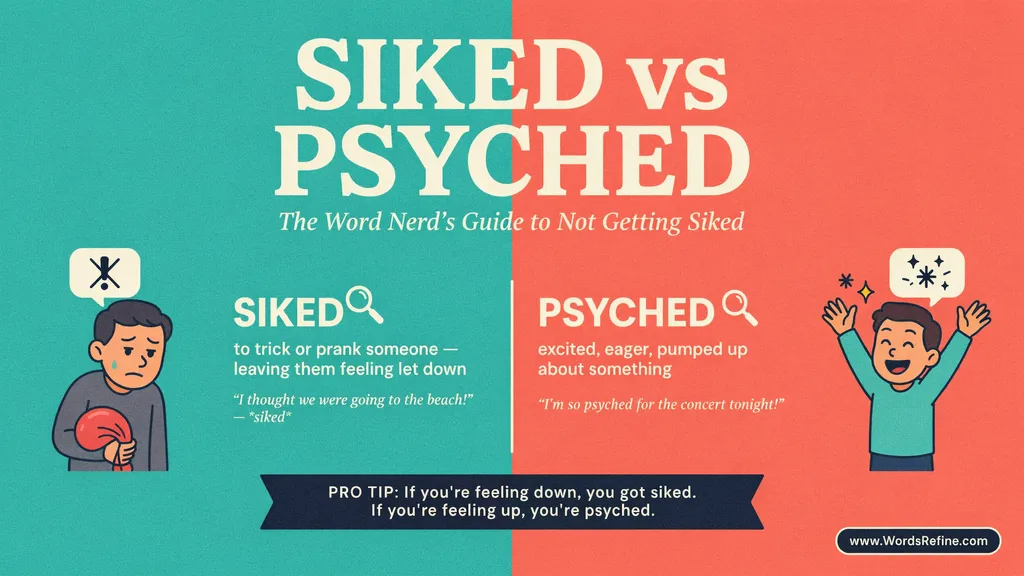
Once you know that psyched means excited, eager, or mentally prepared, using it in a sentence becomes much easier. The word often appears with a preposition or an infinitive, depending on what you want to say.
Psyched for Something
Use psyched for something when you feel excited about an upcoming event, activity, or experience.
For example:
I’m psyched for the concert tonight.
She’s psyched for her vacation next month.
The kids are psyched for the school trip.
We’re all psyched for the big game.
In each sentence, psyched expresses strong enthusiasm about something that is about to happen.
You could replace psyched with excited in these examples, but psyched sounds more casual and energetic.
Psyched About Something
You can also use psyched about when you want to explain what is making you excited.
For example:
I’m psyched about my new job.
He’s psyched about the opportunity.
They’re psyched about moving into their new apartment.
She’s psyched about the upcoming competition.
Both psyched for and psyched about are natural in informal English. The choice depends on the sentence and what sounds most natural in context.
Psyched to Do Something
Use psyched to followed by a verb when you want to say that you’re excited about doing something.
For example:
I’m psyched to see the new movie.
She’s psyched to start college.
We’re psyched to work with the new team.
He’s psyched to perform on stage.
This structure is especially common in everyday conversation.
Psyched Up
Psyched up has a slightly different emphasis. It usually means mentally prepared, energized, or excited before an important event.
For example:
The coach psyched the players up before the match.
I’m getting psyched up for my presentation.
She psyched herself up before walking onto the stage.
The phrase often suggests deliberate mental preparation. You aren’t simply excited. You’re getting yourself into the right mental state for what comes next.
Psyched vs Psych Don’t Mix Them Up
Psyched and psych are closely connected, but they don’t perform the same role in a sentence.
Psych can function as a verb. Depending on the expression, it can mean to mentally prepare someone, influence someone psychologically, or unsettle someone.
Psyched can be the past tense or past participle of psych. It can also work as an adjective meaning excited or mentally prepared.
Compare these examples:
The coach psyched the players up before the game.
The players were psyched before the game.
The first sentence uses psyched as a verb. The second uses psyched as an adjective.
The difference becomes even clearer with common expressions such as psych up and psych out.
Psyched Up vs Psyched Out A Crucial Difference
These two expressions look almost identical, but they describe very different situations.
Psyched up means excited, energized, or mentally prepared.
Psyched out means mentally unsettled, intimidated, confused, or thrown off.
Consider these examples:
The runner was psyched up before the race.
The runner was psyched out by the pressure.
In the first sentence, the runner feels ready and energized.
In the second, the pressure has affected the runner’s confidence or concentration.
That small word, up or out, completely changes the meaning.
What Does “Psych Yourself Out” Mean?
To psych yourself out means to make yourself nervous, doubtful, or mentally unsettled, usually before doing something important.
For example:
Don’t psych yourself out before the interview.
I started to psych myself out before the presentation.
She was prepared for the exam, but she psyched herself out by worrying too much.
In simple terms, you psych yourself out when your own thoughts start working against you.
It’s like tripping over your own shoelaces just before the finish line.
What Does “Psych Yourself Up” Mean?
Psych yourself up has the opposite meaning.
It means to mentally prepare and encourage yourself before an important event or challenge.
For example:
I need to psych myself up before the competition.
She psyched herself up before giving her speech.
He listened to music to psych himself up for the game.
When you psych yourself up, you’re trying to build confidence, energy, and focus.
When you psych yourself out, you’re doing the opposite.
Why “Sike!” Causes More Confusion
The word sike creates another spelling trap because it sounds similar to psych.
In informal slang, psych! can be used after someone says something surprising or misleading to reveal that they were joking or tricking another person.
For example:
“I bought you a new car.”
“Seriously?”
“Psych!”
The expression tells the listener that the previous statement wasn’t genuine.
Sike is a phonetic spelling of this slang expression. You may see it in texts, memes, comments, gaming chats, and other casual online conversations.
For example:
“You’re my favorite person.”
“Sike!”
The spelling sike is informal and shouldn’t be confused with psyched.
Psych and sike can therefore be connected in slang, while psyched belongs to the same broader word family as psych but has a different grammatical role and meaning.
Is Sike a Word?
This question has a surprisingly complicated answer.
Sike can appear as a word in English, but that doesn’t mean it is the standard spelling of every word that sounds like it.
In modern slang, sike is commonly used as an informal spelling of psych in the expression “sike!” It usually signals that someone was joking, teasing, or deliberately misleading another person.
Sike also has older dictionary-recorded meanings that are unrelated to this slang use. In some varieties of English, it has been used as a noun for a small stream, ditch, or similar watercourse.
So, context matters.
If someone writes:
“Sike! I didn’t really eat your last cookie.”
that’s slang.
If an older text uses sike to describe a stream or ditch, that’s a different word with a different history.
Is Siked a Correct Spelling?
If you’re asking whether siked is the correct spelling of psyched when you mean excited, the answer is no.
Write:
I’m psyched for the weekend.
Don’t write:
I’m siked for the weekend.
However, siked can occur in English in other contexts. It can appear as a form related to the older word sike and may also appear online as an informal phonetic spelling connected with the slang sike.
Therefore, the safest rule is simple.
Use psyched when you mean excited or mentally prepared.
Use sike when you intentionally mean the informal slang expression or another established meaning of the word.
Learn the difference between tricky grammar more words
Fiancé vs Fiancée What’s the Difference and which is Correctly?
Common Siked vs Psyched Mistakes
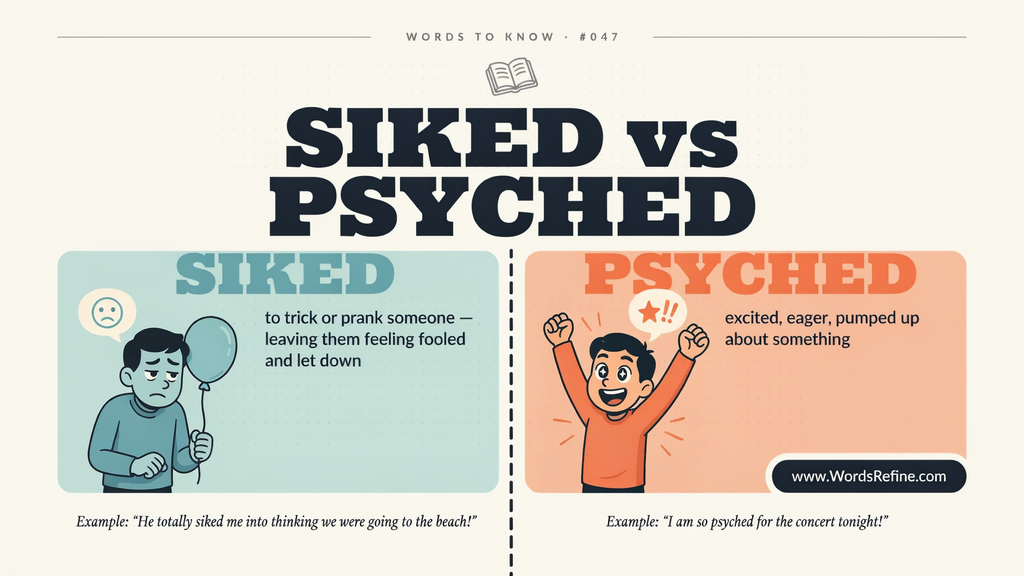
The most common mistake happens when people spell the word according to how it sounds.
For example:
Incorrect for the meaning “excited”:
I’m siked about the trip.
Correct:
I’m psyched about the trip.
Another common mistake involves psyched up.
Incorrect:
The team was siked up before the game.
Correct:
The team was psyched up before the game.
You may also see confusion between psych out and psyched out.
For example:
She psyched herself out before the interview.
This means she became mentally unsettled or nervous.
Meanwhile:
The coach psyched the team up before the match.
This means the coach helped the team become energized and mentally prepared.
These expressions may look similar, but their meanings are not interchangeable.
Siked vs Psyched in Real Sentences
Seeing the words in context makes the difference much easier to remember.
Excitement
I’m psyched for the concert.
She’s psyched about her new apartment.
We’re psyched to visit the city.
These sentences all describe enthusiasm or excitement.
Anticipation
The children were psyched for the school trip.
He’s psyched about the upcoming tournament.
They’re psyched to meet the new coach.
In these examples, psyched shows that someone is looking forward to something.
Mental Preparation
The athletes psyched themselves up before the race.
She psyched herself up before the interview.
The team was psyched up for the final match.
Here, the focus shifts from simple excitement to mental preparation.
Professional Context
Psyched is common in casual speech, but you should think about your audience before using it in professional or academic writing.
For example, this sounds natural in a casual workplace message:
I’m psyched to start working on the project.
In a formal report, a more neutral option would be:
I’m excited to begin the project.
You could also write:
I’m eager to begin the project.
The meaning stays similar, but the tone changes.
Is “Psyched” Slang?
Psyched is informal, but calling it simply slang can be misleading.
It is an established English word that dictionaries recognize. The word is especially common in conversational American English and other informal contexts.
For example:
I’m psyched about the trip.
That sentence sounds perfectly natural in a conversation with friends.
However, you might choose excited, eager, or enthusiastic in a formal report, academic essay, business document, or official statement.
The key difference is register.
Informal doesn’t automatically mean incorrect.
English has many perfectly legitimate words that sound too casual for certain situations.
Learn the difference between commonly g confusing ord pairs
Any time vs anytime meaning Difference with Examples ?
Is “Psyched” Appropriate in Formal Writing?
Psyched is grammatically valid, but it can sound casual.
If you’re writing an academic essay, formal report, application, or professional document, consider whether a more neutral word would fit better.
Instead of:
I’m psyched about the research opportunity.
You could write:
I’m enthusiastic about the research opportunity.
Or:
I’m eager to participate in the research project.
However, if you’re writing dialogue, a personal blog, a casual article, or an informal message, psyched can sound completely natural.
The goal isn’t to avoid the word. It’s to match the word to the situation.
Does American or British English Change the Spelling?
The spelling psyched doesn’t change simply because you switch between American and British English.
You may encounter differences in vocabulary, pronunciation, frequency, or style between varieties of English, but psyched remains the established spelling when the word means excited or mentally prepared.
So you shouldn’t switch from psyched to siked because you’re writing for a British audience.
The spelling issue isn’t really about American versus British English.
It’s about standard spelling versus a phonetic or slang spelling.
How to Remember Psyched vs Siked
Here’s an easy memory trick:
Think of psych.
Then add -ed.
Psych → psyched
If you’re talking about excitement, enthusiasm, or mental preparation, psyched is the word you want.
For example:
I’m psyched for the concert.
The team is psyched up for the final.
She’s psyched to start her new job.
If you remember the connection between psych and psyched, you won’t need to guess based on pronunciation.
The silent p may be annoying, but it isn’t going anywhere.
When “Siked” Can Actually Appear in English
There is one important detail worth remembering.
Siked isn’t always a meaningless typo.
English has older and less common uses of sike, and siked can occur as a related verb form in historical or dialectal contexts. You may also encounter siked online as a phonetic spelling associated with the slang expression sike.
That doesn’t make siked an alternative spelling of psyched.
Context decides what the writer means.
If someone says:
I’m siked for the concert.
they almost certainly intended:
I’m psyched for the concert.
But if a historical text uses siked in connection with an older sense of sike, it belongs to a different word altogether.
That distinction prevents an overly simple rule from creating another mistake.
When you mean excited, use psyched.
1.When you mean mentally prepared, use psyched or psyched up.
2.When you mean mentally prepare someone, use psych someone up.
3.When you mean mentally unsettle or intimidate someone, use psych someone out.
4.When someone uses “sike!” to reveal a joke or trick, sike is an informal slang spelling.
5.When you’re writing formally, consider replacing psyched with excited, eager, or enthusiastic if the context calls for a more neutral tone.
The easiest spelling rule remains:
Psych → psyched
That one connection clears up most of the confusion between siked and psyched.
Learn the difference between often confused words
Choose vs Chose Difference and which one is Correct?
Which One Is Correct?
If you’re trying to decide between siked vs psyched, the correct choice depends on what you mean.
When you want to say that someone is excited, eager, enthusiastic, or mentally prepared, use psyched.
For example:
I’m so psyched about the concert.
She’s psyched to start her new job.
The team was psyched up before the game.
In these sentences, psyched is the standard spelling.
Siked isn’t the standard spelling of psyched. You may still see siked online because people sometimes spell slang according to pronunciation. However, that doesn’t make it the correct spelling when you mean excited.
A simple rule can help: if you can replace the word with excited, psyched is usually the spelling you need.
Siked vs Psyched Meaning in Context
Context makes the difference much easier to understand.
Consider this sentence:
I’m psyched for the weekend.
Here, the speaker is excited about the weekend.
Now consider:
“Sike! I was only joking.”
Here, sike is an informal slang expression used to reveal that the previous statement was a joke or trick.
These words may sound similar, but they aren’t interchangeable.
Psyched describes someone’s emotional or mental state.
Sike is usually an informal expression used to playfully surprise, tease, or trick someone.
That difference becomes especially important when you’re writing rather than speaking. Spoken language gives you pronunciation and tone. Written language has to rely on spelling and context.
Psyched vs Sike Don’t Let the Similar Sound Fool You
The Psyched and sike may sound similar, but they belong to different uses of English.
Psyched is connected with psych and is used to describe excitement, enthusiasm, or mental preparation.
Sike is commonly seen as an informal spelling of the slang expression psych! It can also refer to older English meanings unrelated to the modern slang expression.
For example:
I’m psyched for the trip.
“Sike! You actually believed me?”
The first sentence describes excitement.
The second sentence reveals a joke.
Using sike in the first sentence would create a spelling error for the intended meaning.
Which One Should You Use?
If you’re writing the slang expression that means “gotcha” or “I was joking,” you may see both psych and sike.
Psych is the spelling directly connected to the established word psych.
Sike is an informal phonetic spelling that reflects how the expression sounds.
For example:
“I’m moving to another country.”
“Wait, what?”
“Psych!”
The same joke might appear online as:
“Sike!”
Because this is slang, spelling can vary in casual communication. However, that flexibility doesn’t extend to psyched.
If you mean excited, write psyched.
Syke vs Sike Are They the Same?
Syke and sike can both appear in English, but they don’t always have the same meaning.
In modern internet slang, sike is commonly used for the informal expression meaning that someone was joking or tricking another person.
Syke may also appear as an alternative spelling in some contexts, especially when people write words according to their pronunciation.
However, neither syke nor sike should replace psyched when you mean excited.
For example:
Correct: I’m psyched for the concert.
Not standard for this meaning: I’m sike for the concert.
Not standard for this meaning: I’m syke for the concert.
The spelling psyched remains the clear choice when you’re talking about excitement.
Siked vs Psyched Pronunciation
One reason this confusion continues is pronunciation.
Psyched is pronounced approximately like “siked.” The p is silent.
That means someone who hears the word before seeing it written might naturally assume that it begins with s.
This is a common problem in English. Pronunciation and spelling don’t always cooperate.
English has words such as psychology, pneumonia, knight, and doubt, all of which contain letters that aren’t pronounced as a learner might expect.
Psyched follows the same general pattern.
The pronunciation may sound like siked, but the established spelling is psyched.
Siked vs Psyched Examples
Examples make the difference easier to remember.
I’m psyched about my vacation.
She’s psyched to meet the new team.
We’re psyched for the final match.
He was psyched up before his performance.
They were psyched about the opportunity.
These sentences all use psyched to express excitement or mental preparation.
Now compare the slang use of sike:
“I got you a gift.”
“Really?”
“Sike!”
The two expressions may sound similar when spoken, but their functions are completely different.
Siked vs Psyched Meme Culture
The confusion between siked and psyched appears frequently in memes, social media posts, comments, and casual online conversations.
Internet communication often favors sound-based spellings because people type quickly and imitate the way words sound.
That’s why you may encounter variations such as sike, syke, and other informal spellings.
A meme might use siked as a joke because the spelling itself has become part of the confusion.
However, memes aren’t style guides.
Something can be funny, recognizable, and widely used online without being the standard spelling in edited English.
If you’re writing an article, school assignment, business message, or professional document, use psyched when you mean excited.
Is Psyched a Proper English Word?
Yes. Psyched is an established English word.
It is recognized as an informal adjective meaning excited, enthusiastic, eager, or mentally prepared. It can also function as the past tense or past participle of psych in expressions such as psyched someone up or psyched someone out.
For example:
I’m psyched about the opportunity.
The coach psyched the players up.
She psyched herself out before the interview.
Although psyched has an informal tone, it isn’t simply internet slang or a random abbreviation.
It has an established place in English vocabulary.
What Does Psyched Mean in Slang?
In casual English, psyched usually means very excited or enthusiastic about something.
For example:
I’m so psyched for the concert!
That sentence means:
I’m really excited about the concert.
The word can sound more energetic than simply saying excited.
Depending on the context, psyched can also suggest that someone feels mentally ready for a challenge.
For example:
She’s psyched for the competition.
This could mean that she is excited about competing, mentally prepared, or both.
What Does Psych Someone Out Mean?
To psych someone out means to make them nervous, uncertain, distracted, or mentally unsettled.
For example:
The opponent tried to psych him out before the match.
The speaker used a difficult question to psych the candidate out.
She tried not to let the pressure psych her out.
The expression often involves psychological pressure.
It doesn’t necessarily describe serious manipulation. In everyday English, it can refer to something as simple as intimidating an opponent or making someone lose confidence.
What Does Get Psyched Mean?
Get psyched means to become excited, energized, or mentally prepared for something.
For example:
Get psyched because the concert starts in an hour!
The players got psyched before the championship game.
I’m getting psyched for my vacation.
The expression is informal and usually appears in enthusiastic or conversational situations.
Can You Use Psyched in Everyday Conversation?
Absolutely.
Psyched works naturally in conversations, texts, social media posts, casual emails, and other informal situations.
For example:
I’m psyched to see you tomorrow.
We’re psyched about the new restaurant.
She’s really psyched for the trip.
However, your audience still matters.
If you’re writing a formal academic paper, legal document, or official report, excited, eager, or enthusiastic may fit the tone better.
Good writing isn’t only about choosing a grammatically correct word. It’s also about choosing a word that suits the situation.
Can You Use Sike in Formal Writing?
Usually, no.
Sike is strongly associated with informal slang, especially in online conversations and casual speech.
You might use it when writing dialogue for a character or discussing internet slang. You might also mention it in an article about language and vocabulary.
However, it generally doesn’t belong in a formal essay or professional report unless you’re specifically discussing the term itself.
For example:
He texted, “Sike!” after pretending to give away his favorite jacket.
Here, sike is appropriate because you’re reporting the exact slang expression.
Learn the difference between basic English word mistakes
Discrete vs Discreet What the Difference and which is Correctly?
Why Do People Spell Psych as Sike?
The main reason is pronunciation.
Psych is pronounced with a silent p, so it sounds like “sike.”
When people hear an unfamiliar word, they sometimes spell it according to its sound. Online communication makes this even more common because informal writing often reflects speech rather than traditional spelling.
That’s why sike became a recognizable slang spelling.
It isn’t necessarily the result of someone simply not knowing how to spell psych. In many casual contexts, the alternative spelling is intentional.
The important distinction is that sike can represent slang psych, but siked should not replace psyched when you mean excited.
A Simple Rule to Remember
When you’re unsure, ask yourself one question:
Am I talking about excitement or a joke?
If you’re talking about excitement, enthusiasm, anticipation, or mental preparation, use psyched.
I’m psyched for the trip.
If you’re revealing a joke or playful trick, you may see sike or psych.
“Sike! I never bought the tickets.”
That quick meaning check can save you from the spelling trap.
Practice Session Siked vs Psyched
Fill in each blank with the correct word: psyched, psych, psyched up, psyched out, sike, or siked.
- I’m really ________ about our weekend trip.
- The players were ________ before the championship game.
- She’s ________ to start her new job next week.
- Don’t ________ yourself out before the interview.
- The coach tried to ________ the team up before the final.
- I’m so ________ for the concert tonight.
- “I just bought you a new car.” “________! I’m only joking.”
- He was ________ by the pressure and couldn’t concentrate.
- We’re ________ about getting the opportunity to travel.
- She listened to her favorite music to get ________ for the competition.
- The opponent tried to ________ him out before the match.
- I’m ________ to see the new movie this weekend.
- “You have to clean the entire house.” “________! I was kidding.”
- The students were ________ about their upcoming school trip.
- He started to ________ himself out before giving the presentation.
- The team got ________ before walking onto the field.
- She was ________ about meeting her favorite author.
- I’m ________ for the vacation. I’ve been waiting for it all year.
- The speaker tried to ________ the audience out with a difficult question.
- “I ate the last slice of pizza.” “Seriously?” “________!”
- They were ________ to begin the new project.
- The boxer tried to ________ his opponent out before the fight.
- She was completely ________ after hearing that she had won the competition.
- He ________ himself up before going on stage.
- If you mean “excited,” the correct spelling is ________, not “siked.”
Answers
- psyched
- psyched up
- psyched
- psych
- psych
- psyched
- Sike
- psyched out
- psyched
- psyched up
- psych
- psyched
- Sike
- psyched
- psych
- psyched up
- psyched
- psyched
- psych
- Sike
- psyched
- psych
- psyched
- psyched
- psyched
Here’s a trusted source for clear word meanings:
FAQs
Is “siked up” the correct spelling?
No, not when you mean excited or mentally prepared. The standard expression is “psyched up.” For example, “The players were psyched up before the game.”
What is another word for “sike”?
Depending on the context, alternatives for the slang expression “sike” include “psych,” “just kidding,” “gotcha,” or “I’m joking.” The exact choice depends on how the expression is being used.
What does “sike” mean in slang?
“Sike” is an informal slang expression used to reveal that a previous statement was a joke, trick, or playful deception. It is often used after deliberately making someone believe something that isn’t true.
What does “spetch” mean?
“Spetch” isn’t a standard spelling of psyched, psych, or sike. If you encountered it online, its meaning depends on the specific context and may be a typo, username, slang variation, or phonetic spelling.
What is “pysch”?
“Pysch” is generally a misspelling of “psych.” The spelling “psych” is used in words and expressions such as “psych yourself up,” “psych someone out,” and “psych!” as an informal expression.
What does “PSH” mean in slang?
“PSH” is an informal written expression that can show disbelief, dismissal, annoyance, or a sarcastic reaction. Its exact meaning depends on the surrounding conversation and tone.
What does “psyched” mean in slang?
In casual English, “psyched” usually means very excited, enthusiastic, or eager about something. It can also describe someone who feels mentally prepared for an event or challenge.
What does “psyched” really mean?
“Psyched” generally means excited, enthusiastic, eager, or mentally prepared. For example, “She’s psyched about the trip” means that she is very excited about it.
Is “sike” a cuss word?
No. “Sike” isn’t generally considered a cuss word. It is an informal slang expression commonly used to show that someone was joking, teasing, or trying to trick another person.
What does “I am psyched” mean?
“I am psyched” means “I am excited” or “I am very eager about something.” It can also suggest that you feel mentally ready for an upcoming challenge or event.
Do you say “sike” vs “psych”?
Both can appear in informal communication, but they have different spelling backgrounds. “Psych!” is the established spelling connected with the word psych, while “sike!” is a common phonetic slang spelling that reflects its pronunciation.
What does “saik” mean?
“Saik” is not the standard spelling of the common slang expression usually written as “sike” or “psych.” If you see “saik” online, it may be an informal phonetic variation or a context-specific spelling.
Is “sike” a synonym for “psych”?
In slang, “sike” can function as a phonetic spelling of “psych!” when the expression means that someone was joking or tricking another person. However, sike and psych aren’t interchangeable in every context because psych has other established meanings.
When did “sike” become slang?
The modern slang use of “sike” developed as a phonetic spelling of “psych!” in informal speech and writing. Its popularity grew through casual conversation and later through youth culture and online communication.
What is “sikey”?
“Sikey” is an informal form that may appear in slang or online writing, but it isn’t the standard spelling used in formal English. Its meaning depends on how the writer is using it.
What does “sike nah” mean?
“Sike nah” is an informal expression that can mean something like “just kidding, no” or “I was joking.” It is mainly used in casual online communication and depends heavily on context.
How do you say “sike”?
“Sike” is pronounced with one syllable and rhymes with words such as “like” and “bike.” Its pronunciation is one reason people sometimes use it as a phonetic spelling of “psych!”
When did people start saying “sick” as slang?
“Sick” has been used as slang for something impressive, excellent, or exciting for decades, especially in youth and subcultures. This slang meaning is separate from the spelling confusion between sike and psyched.
What is the meaning of “syke”?
“Syke” can have different meanings depending on context. In informal modern writing, it may appear as a spelling variation of “sike,” while older English uses can have unrelated meanings. It shouldn’t be used as a replacement for psyched when you mean excited.
Conclusion
The confusion between siked vs psyched is a classic case of English spelling refusing to sound as helpful as it should. Both words can sound almost identical, but they don’t carry the same standard usage.
When you mean excited, enthusiastic, or mentally ready, use psyched. You can be psyched about a vacation, psyched to start a new job, or psyched up before a big game. The spelling may look unusual, but that silent p is part of the word.
Sike, on the other hand, belongs mainly to informal slang. It’s used when you reveal that you were joking or deliberately fooled someone. Siked is not the standard spelling when you mean excited.
So, before you type “I’m siked for the concert,” give that silent p its moment. Write “I’m psyched for the concert.” Your spelling will be correct, your meaning will be clear, and the grammar police can finally put down the siren.

Diora AJS she is an experienced blogger and passionate English language enthusiast at Words Refine. With a keen eye for language and a love for clear communication, she writes practical content about grammar, word meanings, usage, and commonly confused terms. Her goal is to make English easier to understand through clear explanations and relatable examples, helping readers write accurately and communicate with confidence.