

Have you ever paused over ambassador vs embassador and wondered whether one tiny letter could cause so much trouble? You’re not alone. The two spellings look almost identical, and the word embassy makes embassador seem perfectly reasonable. However, there’s a catch: ambassador is the standard spelling in modern English, while embassador is generally considered an old or nonstandard form. That small spelling trap can easily sneak into emails, assignments, articles, and professional documents. Fortunately, the rule is simple once you know it. Let’s clear up the confusion, explore the meaning, usage, pronunciation, and spelling of ambassador, and make this tricky word much easier to remember.
Ambassador vs Embassador Quick Answer
The correct modern English spelling is ambassador.
Correct: ambassador
Incorrect in standard modern English: embassador
If you’re wondering embassador or ambassador which is correct, the answer is ambassador.
The spelling remains the same in standard American and British English. You don’t switch to embassador when writing for a British audience.
For example:
- The ambassador met with government officials.
- She was appointed ambassador to the foreign country.
- The athlete became a brand ambassador.
- He serves as a goodwill ambassador for the organization.
In each example, ambassador is the standard spelling.
Ambassador correct spelling
The ambassador correct spelling is:
A-M-B-A-S-S-A-D-O-R
The first three letters are amb, not emb.
That small difference causes the entire spelling problem.
If you’re writing a formal email, academic assignment, résumé, business article, or professional document, use ambassador.
Embassador correct spelling
If you’re searching for the embassador correct spelling, it’s important to separate historical usage from modern usage.
Embassador can be found in some older English texts and historical sources. However, it isn’t the standard spelling used in modern English.
Therefore, contemporary writing should use ambassador rather than embassador.
What Does Ambassador Mean?
The ambassador meaning centers on the idea of representation.
An ambassador is someone who officially or publicly represents another country, organization, brand, or cause.
In diplomacy, an ambassador is a senior diplomatic representative who represents one government in another country or in certain international settings. The role can involve communication, negotiation, relationship-building, and representing the interests of the ambassador’s home country.
The word also has broader uses.
For example, a company might appoint someone as a brand ambassador to promote its products. An organization might appoint a public figure as a goodwill ambassador to support a cause.
A simple ambassador definition is:
An ambassador is an authorized representative of a country, organization, brand, or cause.
The context determines exactly what kind of representative the word describes.
Ambassador meaning in English
In modern English, ambassador can refer to:
- A diplomatic representative
- A government official representing a country abroad
- A representative of an organization
- A brand ambassador
- A goodwill ambassador
- Someone who publicly represents or promotes a cause
For example:
The ambassador met with the foreign minister.
Here, ambassador refers to a diplomatic official.
Now compare that with:
Maya became an ambassador for the literacy campaign.
In this sentence, the person represents and promotes a cause rather than serving as a diplomatic official.
Learn the difference between confusing more English words
Capital vs Capitol Which One Is Correct?
Ambassador vs Embassador Side-by-Side Comparison
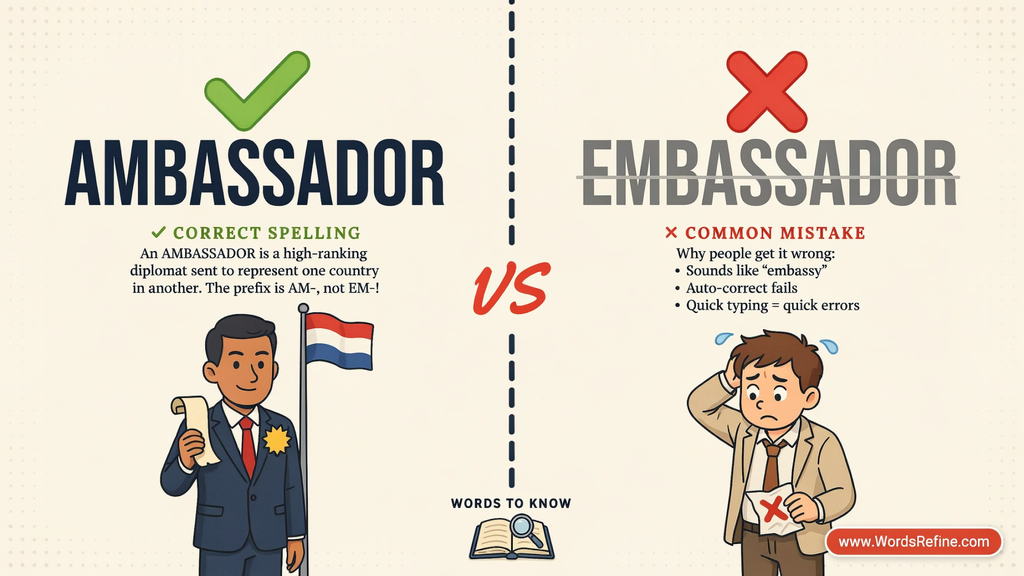
The ambassador vs embassador difference isn’t really a difference between two modern meanings. Instead, it’s primarily a difference between the standard spelling and a nonstandard or historical form.
| Word | Standard modern English? | Meaning | Recommended today? |
|---|---|---|---|
| Ambassador | Yes | A representative of a country, organization, brand, or cause | Yes |
| Embassador | Generally no | Usually intended to mean ambassador | No |
This makes the ambassador vs embassador question fairly simple.
There isn’t a modern rule saying that ambassador refers to a diplomat while embassador refers to another type of representative. If someone writes embassador, they usually mean ambassador.
Embassador vs ambassador which is correct?
Ambassador is the correct standard form.
So, if you’re asking what is the correct spelling ambassador vs embassador, remember this:
Use ambassador in modern English.
That applies to diplomatic writing, business writing, academic work, marketing copy, and everyday communication.
Why Do People Spell Ambassador as Embassador?
Here’s where the confusion makes perfect sense.
The word embassy refers to a diplomatic mission. An ambassador is the official representative connected with that diplomatic relationship.
Because these words appear together so often, it’s easy to assume they should share the same beginning.
They don’t.
Compare:
- ambassador
- embassy
The difference is only one letter, but that letter matters.
Consider this sentence:
The ambassador met officials at the embassy.
Both words belong naturally in the same sentence. That close connection can make embassador look like a logical spelling.
However, English spelling doesn’t always work like a matching-parts puzzle. Related words can develop different spellings over time.
The embassy connection
The easiest way to avoid the mistake is to remember that the two words identify different things.
Ambassador = a person or representative.
Embassy = a diplomatic mission or its offices.
For example:
The ambassador attended the meeting.
The person attended the meeting.
The embassy issued a statement.
The diplomatic mission issued the statement.
So, even though the words are closely related in diplomatic vocabulary, you shouldn’t combine their spellings.
Is Embassador a Word?
One common search question is is embassador a word?
The answer needs a little context.
Embassador does appear in historical English sources. Therefore, it isn’t simply an invented spelling with no history.
However, that doesn’t mean it’s an accepted modern alternative to ambassador.
If the question is:
Is embassador an accepted modern spelling?
The practical answer is no.
If the question is:
Can embassador be found in older English?
Yes, historical sources can contain the form.
That distinction is important because English has many older spellings that aren’t recommended in current writing.
For present-day English, ambassador is the form to use.
Is embassador an old spelling?
Yes, historical usage can show variants of the word that differ from today’s standard spelling.
Before modern spelling conventions became more firmly established, English writers had more variation in how they spelled words. A historical document may therefore contain a form that looks unusual today.
That doesn’t make it the right choice for a modern article, essay, email, or business document.
For present-day English, ambassador is the form to use.
Is embassador an archaic spelling?
Embassador can be discussed as an older or obsolete spelling found in historical English.
However, there’s an important distinction between historical existence and modern correctness.
A word can appear in older writing without being a standard spelling today.
Think of it this way: an old spelling is a piece of language history. It isn’t automatically a spelling recommendation.
Therefore:
- Historical usage: embassador may appear.
- Modern standard English: ambassador is preferred.
- Professional writing today: use ambassador.
Learn the difference between commonly mixed-up more words
Loose vs Lose Difference and which is Correctly?
Ambassador Definition and Meaning in Different Contexts
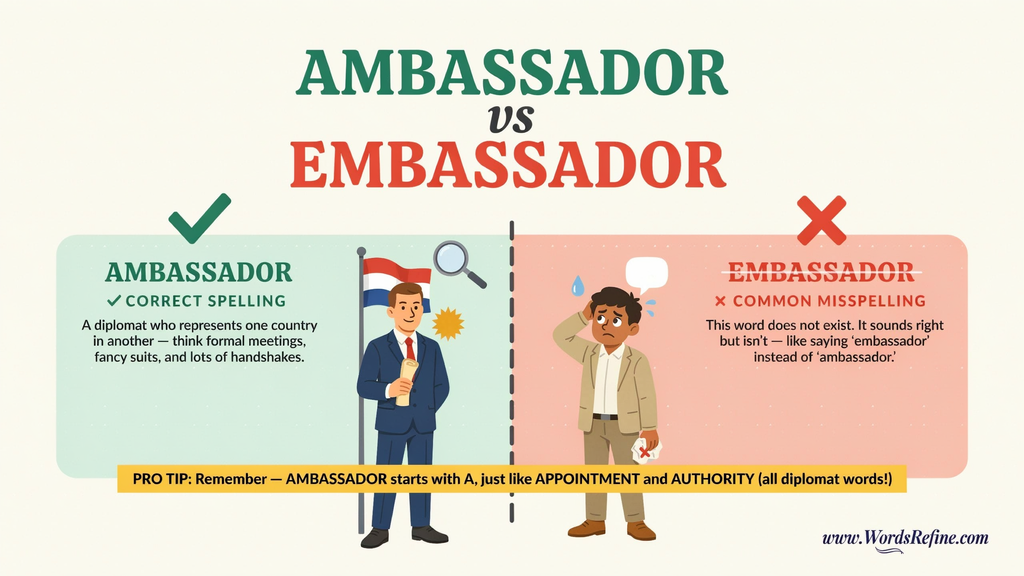
The word ambassador becomes easier to understand when you see how widely it is used.
Diplomatic ambassador
A diplomatic ambassador represents a country in another country or represents a government in certain international settings.
The position can involve responsibilities such as:
- Representing the sending government
- Communicating with the host government
- Supporting diplomatic relations
- Participating in official meetings
- Helping facilitate negotiations
- Reporting developments to the home government
- Attending official events
- Building relationships with government and community leaders
The exact ambassador role depends on the country, diplomatic mission, assignment, and institutional structure.
Government official
An ambassador is generally a senior government representative in diplomatic contexts.
For example:
The ambassador discussed trade relations with senior government officials.
Here, the word clearly refers to a government representative involved in international relations.
Brand ambassador
A brand ambassador represents a company, product, or brand.
Unlike a diplomatic ambassador, a brand ambassador doesn’t represent a foreign government. Instead, the person helps promote or publicly represent a business.
A brand ambassador might:
- Appear in advertising
- Promote products
- Attend company events
- Create promotional content
- Talk about the brand publicly
- Connect a brand with a particular audience
For example:
The athlete became a brand ambassador for a global sports company.
Here, ambassador has a marketing meaning.
Goodwill ambassador
A goodwill ambassador represents or promotes a cause, organization, or humanitarian effort.
These representatives may use their public visibility to raise awareness or encourage support for an organization’s work.
For example:
The actress was appointed a goodwill ambassador for the organization.
Again, the word means representative, but the setting isn’t traditional diplomacy.
Learn the difference between tricky grammar more words
Ambassador vs Embassy What’s the Difference?
The ambassador vs embassy distinction is one of the most useful differences to learn.
| Word | Refers to | Example |
|---|---|---|
| Ambassador | A person who represents a country or organization | The ambassador met with the minister. |
| Embassy | A diplomatic mission or its official offices | She contacted the embassy. |
Embassy and ambassador difference
An ambassador is a person.
An embassy is a diplomatic mission and commonly refers to the official office through which that mission operates.
For example:
The ambassador spoke with government officials.
But:
The embassy released a statement.
The two words are related, but they’re not interchangeable.
This distinction also explains why embassador can look tempting. Since embassy starts with em-, writers sometimes carry that spelling into ambassador.
Don’t let the extra e sneak into ambassador.
How to Spell Ambassador Correctly
If you’re wondering how to spell ambassador, focus on the opening:
AMBASSADOR
The first part is AMB, not EMB.
A useful memory trick is to associate the spelling with the idea of an official representative:
AMBassador = representative
You can also write the word out a few times if it’s a spelling you frequently use:
1ambassador
2ambassador
3ambassador
After enough exposure, the unusual-looking middle section becomes much easier to recognize.
A simple spelling test
Which sentence looks correct?
The embassador arrived at the embassy.
Or:
The ambassador arrived at the embassy.
The second sentence is correct.
Notice how both ambassador and embassy can appear together:
The ambassador arrived at the embassy.
That’s the combination worth remembering.
Ambassador Pronunciation
Ambassador pronunciation can vary slightly by accent, but the word has its main stress toward the beginning.
In American English, a simple learner-friendly approximation is:
am-BASS-uh-der
The unstressed vowels can become less distinct in natural speech. That’s one reason the spelling may not be obvious when you hear the word.
This creates a common language-learning problem: people sometimes spell words according to how they sound.
English doesn’t always cooperate.
For ambassador, the pronunciation doesn’t give you a reliable reason to add an e. The spelling still begins with amb-.
Ambassador Examples in Sentences
Here are several ambassador examples showing the word in different contexts.
Diplomatic examples
The ambassador met with the foreign minister to discuss regional cooperation.
The government appointed a new ambassador to represent the country abroad.
The ambassador attended an official reception with senior diplomats.
International relations examples
The ambassador played an important role in strengthening diplomatic relations.
Foreign officials met with the ambassador during the international summit.
Brand ambassador examples
The athlete became a brand ambassador for a global sports company.
The company selected a popular actor as its new brand ambassador.
Goodwill ambassador examples
The organization appointed her as a goodwill ambassador.
Figurative examples
The teacher became an ambassador for reading in her community.
These examples show why ambassador has a broader meaning than simply “diplomat.” The core idea remains the same: someone represents something or someone else.
Embassador Examples in a Sentence
If you’re searching for embassador examples in a sentence, it’s better to use them as examples of the spelling mistake rather than examples of recommended usage.
For example:
Incorrect: The embassador met with the foreign minister.
Correct: The ambassador met with the foreign minister.
Another example:
Incorrect: She became a brand embassador.
Correct: She became a brand ambassador.
And:
Incorrect: The embassador attended the diplomatic reception.
Correct: The ambassador attended the diplomatic reception.
The correction is consistent: replace embassador with ambassador when writing modern standard English.
Ambassador vs Embassador in British and American English
One reason people search for “ambassador spelling in American English” and “ambassador spelling in British English” is that English sometimes uses different spellings in the two varieties.
For example, American English uses color, while British English commonly uses colour. Similarly, traveled is standard in American English, while travelled is common in British English.
Ambassador doesn’t follow this pattern.
Both American English and British English use ambassador as the standard spelling.
You don’t change ambassador to embassador simply because you’re writing for a British or American audience.
For example:
- American English: The ambassador met with government officials.
- British English: The ambassador met with government officials.
- American English: She became a brand ambassador.
- British English: She became a brand ambassador.
The spelling remains the same.
So, if you’re wondering whether ambassador vs embassador changes between American and British English, the answer is no. Standard modern English uses ambassador in both varieties.
Ambassador spelling in American English
In American English, ambassador is the standard spelling for both diplomatic and broader uses.
You’ll find it in government documents, news reports, academic writing, business communication, and everyday English.
For example:
The ambassador arrived in Washington for a series of diplomatic meetings.
The company hired a famous athlete as a brand ambassador.
Both sentences use the correct spelling.
Ambassador spelling in British English
British English also uses ambassador.
The spelling doesn’t become embassador simply because British English sometimes preserves older spellings or uses different word forms.
For example:
The ambassador attended the official reception.
The ambassador discussed international cooperation with government representatives.
Once again, ambassador is the standard modern spelling.
Learn the difference between commonly g confusing ord pairs
Lay vs Lie Difference and which is correct?
Why Is Ambassador Spelled Without E?
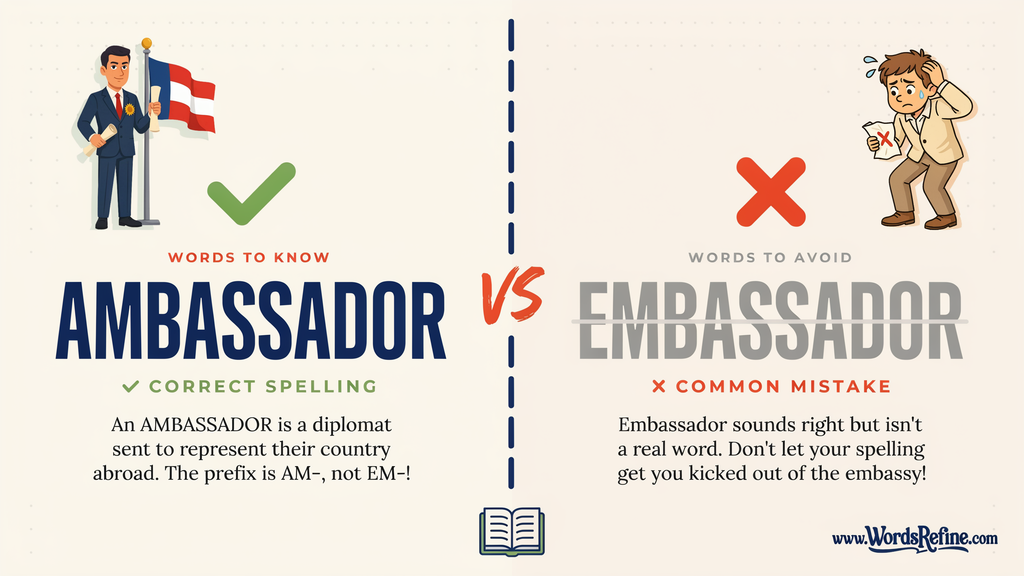
The question “why is ambassador spelled without e?” often comes from a perfectly reasonable assumption.
People see embassy and ambassador together and naturally connect the two spellings.
However, English spelling doesn’t always work like a family photo where every relative has to look alike.
Ambassador developed through older forms associated with sending a representative or messenger. Over time, its spelling became established as ambassador in modern English.
Embassy has its own historical development and spelling pattern.
That means you shouldn’t use embassy as a spelling guide for ambassador.
The two words are related, but they followed different spelling paths.
A useful memory trick
Remember this simple pattern:
Ambassador starts with amb.
Embassy starts with emb.
The words are closely connected to diplomacy, but their spellings are different.
You can remember the sentence:
The ambassador works through the embassy.
That sentence gives you both spellings in the correct form.
Common Mistakes With Ambassador vs Embassador
The most common mistake is replacing amb with emb.
For example:
Incorrect: The embassador arrived yesterday.
Correct: The ambassador arrived yesterday.
Another common mistake appears when the word is used as a professional title.
Incorrect: She was appointed as the new embassador.
Correct: She was appointed as the new ambassador.
The same problem appears in business writing.
Incorrect: The company welcomed its new brand embassador.
Correct: The company welcomed its new brand ambassador.
You may also see the misspelling in informal posts, résumés, school assignments, and social media captions.
Although a spelling mistake usually doesn’t change the intended meaning, it can make formal writing look less polished.
Mistaking embassy for ambassador
Another common problem occurs when writers mentally combine the two words.
They may remember:
Embassy = diplomatic office
Then accidentally create:
Embassador = diplomatic representative
The meanings are connected, but the spellings are not.
A simple distinction helps:
An ambassador is a person.
An embassy is a diplomatic mission or its official premises.
For example:
The ambassador spoke to reporters.
The embassy issued a statement.
Once you separate the person from the institution, the spelling becomes much easier to remember.
Ambassador vs Embassy vs Diplomat
These words often appear together, so understanding their differences can prevent confusion.
| Word | Basic meaning | Example |
|---|---|---|
| Ambassador | A senior representative, especially one representing a country abroad | The ambassador met with the minister. |
| Embassy | A diplomatic mission or its official offices | She contacted the embassy. |
| Diplomat | A person involved in diplomacy and international relations | The diplomat participated in the negotiations. |
These terms overlap in diplomatic contexts, but they aren’t interchangeable.
An ambassador is a specific diplomatic representative.
A diplomat is a broader term for someone involved in diplomacy.
An embassy is an institution or diplomatic mission, not a person.
For example:
The ambassador entered the embassy with several diplomats.
Each word has a different role in the sentence.
Diplomat vs Ambassador Are They the Same?
Not exactly.
An ambassador is generally a senior diplomatic representative. Diplomat is a broader term that can describe people working in different areas of diplomacy.
In simple terms, an ambassador can be a diplomat, but not every diplomat is an ambassador.
Think about it like a workplace.
A company may have hundreds of employees, but only some hold executive positions.
Similarly, a diplomatic service may include many diplomats, while ambassadors occupy particular senior representative positions.
This distinction becomes useful when you’re writing about international relations, government officials, or diplomatic missions.
What Is the Role of an Ambassador?
The ambassador role can vary depending on the country, assignment, and diplomatic mission.
However, ambassadors commonly represent their governments, maintain official relationships, communicate with host-country officials, and support diplomatic objectives.
Their responsibilities may include:
- Meeting government officials.
- Representing their country at official events.
- Supporting diplomatic communication.
- Discussing political, economic, cultural, or security matters.
- Helping strengthen relations between countries.
- Supporting negotiations and official discussions.
- Communicating information between governments.
- Building relationships with local institutions and communities.
An ambassador doesn’t simply attend formal dinners and pose for photographs.
Diplomatic work can involve communication, negotiation, relationship building, policy discussions, public events, and crisis response.
The exact responsibilities depend on the ambassador’s assignment and the structure of the diplomatic mission.
What Is a Brand Ambassador?
A brand ambassador represents a company, product, or brand publicly.
Unlike a diplomatic ambassador, a brand ambassador doesn’t represent a foreign government.
Instead, the person helps promote the brand and connect it with a particular audience.
Companies may work with athletes, actors, musicians, creators, experts, or other public figures as brand ambassadors.
For example:
A professional athlete became a brand ambassador for a sportswear company.
A brand ambassador might appear in advertising campaigns, attend promotional events, use the company’s products, or create content connected with the brand.
The term can also describe someone who represents a company without being famous.
An employee, customer, creator, or industry expert may serve as a brand ambassador depending on the company’s program.
Learn the difference between often confused words
Whoever vs Whomever How to Use Each Word Correctly?
Brand ambassador vs spokesperson
These terms can overlap, but they aren’t always identical.
A spokesperson generally communicates official messages on behalf of an organization.
A brand ambassador often has a broader promotional or relationship-building role.
For example, a spokesperson might give an official statement about a company announcement, while a brand ambassador might participate in campaigns, events, product promotion, and public engagement.
The exact role depends on how the organization defines the position.
What Is a Goodwill Ambassador?
A goodwill ambassador represents or promotes a cause, organization, or humanitarian mission.
The role often focuses on increasing public awareness and encouraging support.
For example:
The organization appointed the actress as a goodwill ambassador.
A goodwill ambassador might attend events, speak publicly about a cause, participate in campaigns, or help bring attention to an important issue.
Here, ambassador still carries its central meaning of representation.
The person acts as a public representative for a particular organization, campaign, or cause.
Ambassador Synonym and Related Words
If you’re looking for an ambassador synonym, the best choice depends on the context.
Related words include:
- Representative
- Diplomat
- Envoy
- Delegate
- Spokesperson
- Advocate
- Emissary
- Messenger
However, these words aren’t exact replacements in every situation.
For example, diplomat is broader than ambassador.
A spokesperson focuses mainly on communicating official messages.
An advocate supports a cause or position.
An envoy may represent a government or organization for a particular purpose.
Therefore, don’t replace ambassador with a synonym automatically. Choose the word that accurately describes the role.
Ambassador Word Origin and Etymology
The history of ambassador helps explain why its spelling may look unusual.
The word entered English through forms connected with diplomatic representation and the idea of a messenger or representative sent on behalf of another person or government.
Like many English words, ambassador developed through several languages before reaching its modern English form.
That history matters because modern spelling doesn’t always reveal where a word came from.
It also explains why trying to spell ambassador by copying the beginning of embassy can lead you astray.
English contains many related words that don’t share identical spelling patterns.
So, when you see ambassador, learn it as its own established spelling rather than trying to reconstruct it from embassy.
Ambassador Usage in a Sentence
The easiest way to understand a word is often to see how it works in real sentences.
Here are several ambassador examples:
The ambassador met with senior government officials.
She was appointed ambassador to represent her country abroad.
The ambassador attended a diplomatic reception.
The government welcomed the newly appointed ambassador.
The ambassador discussed trade relations with foreign officials.
The athlete became a brand ambassador for the company.
The organization named her a goodwill ambassador.
The teacher became an ambassador for literacy in her community.
Each sentence uses ambassador to describe someone who represents a country, organization, company, or cause.
Embassador Examples in a Sentence
If you search for “embassador examples in a sentence,” remember that these examples should generally be treated as spelling-error corrections rather than recommended modern usage.
Incorrect:
The embassador met with the foreign minister.
Correct:
The ambassador met with the foreign minister.
Incorrect:
She became a brand embassador.
Correct:
She became a brand ambassador.
Incorrect:
The embassador attended the diplomatic reception.
Correct:
The ambassador attended the diplomatic reception.
Incorrect:
He works as an embassador for the organization.
Correct:
He works as an ambassador for the organization.
The pattern is consistent. In modern standard English, use ambassador.
See the Mistake, Fix the Mistake
A quick correction exercise can make the spelling easier to remember.
Wrong:
The embassador arrived at the embassy.
Right:
The ambassador arrived at the embassy.
Wrong:
The company announced its new brand embassador.
Right:
The company announced its new brand ambassador.
Wrong:
The foreign embassador met with government officials.
Right:
The foreign ambassador met with government officials.
Wrong:
She wants to become an embassador.
Right:
She wants to become an ambassador.
Notice something useful here.
The word embassy can appear in the same sentence as ambassador without changing its spelling.
The ambassador can arrive at the embassy.
That combination is one of the easiest ways to remember the difference.
Learn the difference between basic English word mistakes
Vender vs Vendor Which one Is Correct?
Ambassador in Professional and Academic Writing
When you’re writing a résumé, cover letter, academic assignment, business report, article, or formal email, use ambassador.
Professional writing leaves little room for spelling guesses, especially when you’re discussing an official title.
For example:
The ambassador participated in the international conference.
The company appointed a new brand ambassador.
The student researched the role of an ambassador in international relations.
These examples use the standard spelling and fit naturally into formal writing.
Using embassador in a professional document may look like a simple typo. Still, repeated spelling errors can distract readers from the main point.
That’s why learning the correct form matters.
Ambassador Position and Title
Ambassador can refer to an official diplomatic position or title.
For example:
She was appointed ambassador to France.
The ambassador addressed the visiting delegation.
He served as ambassador for several years.
The exact appointment process and title structure can vary between governments.
In broader contexts, organizations may also use ambassador as a title for people representing a brand, campaign, program, university, or cause.
For example:
She is a student ambassador for the university.
He serves as a community ambassador.
The company hired several brand ambassadors.
So, ambassador isn’t limited to international diplomacy.
Its central idea remains representation.
Ambassador Car A Different Meaning
If you encounter the phrase ambassador car, don’t confuse it with the diplomatic meaning of ambassador.
Ambassador has also been used as a name for automobile models.
In that context, Ambassador functions as a model name rather than a reference to a diplomatic representative.
For example, someone discussing an Ambassador car is talking about a vehicle, not a government representative.
This is another useful reminder that context matters.
The same word can have different uses while keeping the same spelling.
A Quick Rule for Remembering Ambassador
If you only remember one thing, remember this:
Ambassador starts with amb.
Not emb.
A simple memory sentence is:
The ambassador works at the embassy.
Now look carefully at the two words:
ambassador
embassy
They’re related, but their beginnings are different.
If you write embassador in modern English, stop and check the spelling.
The correct form is ambassador.
Once you remember that small difference, this particular spelling trap becomes much easier to avoid.
Quick Recap Ambassador vs Embassador
The confusion between ambassador vs embassador is mainly a spelling issue rather than a difference in meaning.
Ambassador is the standard modern English spelling.
Embassador may appear in older historical texts, but it isn’t the normal spelling for contemporary English.
Ambassador can refer to a diplomatic representative, a brand representative, a goodwill representative, or someone who publicly represents an organization or cause.
Embassy refers to a diplomatic mission or its official premises.
Diplomat is a broader term for someone involved in diplomacy.
The easiest spelling trick is simple:
Ambassador starts with amb.
Embassy starts with emb.
When you’re writing in modern American or British English, choose ambassador.
Once you remember that small difference, you can confidently leave embassador behind and give ambassador the spelling it deserves.
What Grammar Checkers and Dictionaries Tell You
When you’re unsure whether to write ambassador vs embassador, a dictionary or spelling checker can help settle the question quickly.
Modern English recognizes ambassador as the standard spelling.
Embassador may appear in historical sources or older texts that preserve earlier forms of English. However, that doesn’t make it the preferred spelling for modern writing.
This distinction matters because a spelling can appear in historical material without being a normal choice today.
For everyday English, academic work, professional communication, and formal writing, ambassador is the form you should use.
Spelling tools may also flag embassador as an error and suggest ambassador instead. If your writing software makes that correction, it’s pointing you toward the standard modern form.
In other words, you don’t need to debate the spelling every time you type it.
Use ambassador.
Is Embassador a Real Word?
This question can be confusing because “real word” can mean different things.
If you mean, “Has embassador ever appeared in English?” the answer is yes. Historical texts can contain the form.
If you mean, “Is embassador a standard spelling that I should use in modern English?” the answer is no.
That distinction clears up much of the confusion.
English contains many words and spellings that appeared in earlier periods but later became uncommon, obsolete, or replaced by other forms.
So, finding embassador in an old document doesn’t mean you should use it in a modern email.
For contemporary writing, ambassador is the standard choice.
Is Embassador an Archaic Spelling?
Embassador can be described as an older or historical spelling associated with earlier English usage.
However, the practical point matters more than the label.
If you’re writing modern English, use ambassador.
Historical spellings can be useful when you’re reading older documents, studying language history, or examining original texts.
The problem begins when an older spelling accidentally slips into modern writing.
For example, a historical document might preserve embassador exactly as it appeared at the time.
A modern article discussing that document would normally use ambassador when referring to the word in present-day English.
Context makes the difference.
Why Does Embassador Look Correct?
The spelling embassador looks convincing because English readers already know many words that begin with emb.
Consider words such as embassy, embark, embellish, embrace, and embed.
The beginning emb is perfectly familiar in English.
Then there’s embassy, a word closely connected with ambassador.
It’s easy to think:
Embassy → embassador
Unfortunately, English doesn’t always reward that kind of logical shortcut.
The standard spelling is ambassador.
This is one of those cases where memorizing the established form is more useful than creating a spelling rule from related words.
Learn the difference between everyday English mistakes
Simular vs Similar Which One Is Correct?
Ambassador vs Embassador Difference in Meaning
There isn’t normally a meaningful modern difference in meaning between ambassador vs embassador.
When someone writes embassador today, they usually intend the same meaning as ambassador.
The important difference is standard usage.
| Form | Modern standard spelling | Typical meaning |
|---|---|---|
| Ambassador | Yes | A representative of a country, organization, brand, or cause |
| Embassador | No | Usually an intended or historical form of ambassador |
So, the issue isn’t that one word means diplomat while the other means something completely different.
The problem is that ambassador is the established modern form.
What Does Ambassador Mean in English?
In English, ambassador generally refers to someone who represents a country, organization, brand, or cause.
The exact meaning depends on the context.
The In diplomacy, an ambassador represents a government in another country or in an international setting.
In business, a brand ambassador represents a company or product.
In humanitarian work, a goodwill ambassador may promote a cause or organization.
The central idea remains the same:
An ambassador represents someone or something.
That simple idea makes the word easier to understand across different contexts.
Ambassador Meaning in International Relations
In international relations, an ambassador is an important diplomatic representative.
An ambassador may communicate with officials in the host country, represent the sending government at official events, support diplomatic discussions, and help maintain relationships between governments.
For example:
The ambassador discussed regional cooperation with government officials.
The ambassador also attended meetings focused on international relations.
The exact responsibilities depend on the diplomatic mission and the country involved.
Still, representation remains at the heart of the role.
Ambassador vs Diplomat
Although ambassador and diplomat are related terms, they shouldn’t always be treated as synonyms.
Diplomat is a broader term.
An ambassador is generally a senior diplomatic representative, while diplomats can serve in many different positions.
For example:
The diplomat worked at the embassy.
The ambassador met with the foreign minister.
Both sentences can be correct, but they describe different roles within diplomatic work.
This distinction becomes useful when you’re writing about government, foreign policy, international relations, or diplomatic services.
Ambassador vs Envoy
Envoy is another word that sometimes appears alongside ambassador.
An envoy is a representative sent for a particular purpose or mission.
Depending on the context, an envoy may have a specific assignment rather than the broader ongoing role associated with an ambassador.
For example:
The government sent an envoy to discuss the agreement.
The ambassador continued regular diplomatic meetings with officials.
Both people represent a government, but the terms can describe different roles.
That’s why ambassador shouldn’t automatically be replaced with envoy.
Ambassador Synonyms Which Ones Actually Fit?
There isn’t one perfect synonym for ambassador in every sentence.
Possible alternatives include representative, diplomat, envoy, emissary, spokesperson, delegate, and advocate.
However, each word carries a slightly different meaning.
Representative is the broadest option.
Diplomat relates specifically to diplomacy.
Envoy often suggests a representative sent for a particular mission.
Spokesperson focuses on communicating official messages.
Advocate emphasizes support for a cause or position.
Emissary can refer to someone sent to represent another person or group.
The best synonym depends on what the ambassador is actually doing.
Ambassador Examples in Formal Writing
Formal writing often uses ambassador when discussing government, diplomacy, business, or public representation.
Consider these examples:
The ambassador attended the international conference.
The government appointed a new ambassador to represent the country.
The ambassador met with senior officials to discuss regional cooperation.
The company announced its new brand ambassador.
The organization appointed a goodwill ambassador to support its campaign.
These examples show how flexible the word can be.
The same spelling works across diplomatic, commercial, humanitarian, and educational contexts.
Ambassador in Academic Writing
Students may encounter ambassador in assignments about international relations, diplomatic history, government, or foreign affairs.
For example:
The ambassador played an important role in diplomatic relations.
The researcher examined the responsibilities of an ambassador.
The article discusses how ambassadors represent their governments abroad.
If you’re writing an academic paper, remember that ambassador begins with amb.
Writing embassador may be treated as a spelling error even when the intended meaning is obvious.
Ambassador in Business Writing
The word also appears frequently in marketing and business communication.
For example:
The company launched a new brand ambassador program.
The brand ambassador appeared in the company’s latest campaign.
The university selected several student ambassadors.
The company’s ambassadors interacted with customers at the event.
Here, ambassador refers to someone who represents a company, brand, or institution rather than a foreign government.
Again, the spelling remains ambassador.
Learn the difference between more words people mix up
Loosing vs Losing Which Is Correct? Meaning, Spelling, and Usage
How to Remember the Correct Spelling of Ambassador
Spelling tricks work best when they’re short enough to remember.
Try this:
Ambassador = AMB + ASSADOR
The important part is the beginning.
AMB.
Not EMB.
Another useful sentence is:
The ambassador visited the embassy.
Say it slowly and look at the spelling.
Ambassador begins with amb.
Embassy begins with emb.
You don’t have to make the two words match simply because they appear in the same diplomatic setting.
A Second Memory Trick
Think of the phrase:
Ambassador = official representative.
The first three letters, amb, can remind you of the word’s established spelling.
The goal isn’t to invent a complicated spelling rule.
It’s simply to make ambassador familiar enough that embassador starts to look unusual.
How to Pronounce Ambassador
The pronunciation of ambassador can vary slightly depending on accent.
In American English, a learner-friendly pronunciation is often written as:
am-BASS-uh-der
The strongest stress generally falls on the second syllable.
In natural speech, some vowel sounds may become weaker, which can make the word sound different from how it looks on the page.
However, pronunciation doesn’t change the spelling.
Whether you’re speaking American English or British English, the standard written form is ambassador.
Ambassador Pronunciation vs Embassador Pronunciation
If someone writes embassador, they may pronounce it as though the word begins with em.
That pronunciation can reinforce the spelling mistake.
The standard word is ambassador, so it’s better to learn the complete word rather than reconstructing it from embassy.
When learning the word, pay attention to both its sound and spelling.
Say:
am-BASS-uh-der
Then write:
ambassador
Repeating the sound and spelling together can make the correct form easier to remember.
Is Ambassador the Correct Spelling?
Yes.
Ambassador is the correct standard spelling in modern English.
Use it when you’re talking about a diplomatic representative, brand representative, goodwill representative, student representative, or another person who officially represents an organization, group, country, or cause.
For example:
She became a brand ambassador.
The ambassador met with government officials.
He was appointed ambassador to the country.
The organization selected her as a goodwill ambassador.
In each case, ambassador is the standard spelling.
Is Embassador a Correct Spelling?
In modern standard English, embassador is generally not the spelling you should use.
You may encounter it in historical writing or older sources, but contemporary writers should use ambassador.
So, if you’re completing a school assignment, writing a professional email, preparing a résumé, publishing an article, or creating business content, choose ambassador.
That simple choice keeps your spelling aligned with modern standard English.
Ambassador vs Embassador Quick Test
Let’s make the choice simple.
Which sentence is correct?
A. The embassador attended the meeting.
B. The ambassador attended the meeting.
The answer is B.
Now try another:
A. She became a brand embassador.
B. She became a brand ambassador.
Again, B is correct.
One more:
A. The ambassador arrived at the embassy.
B. The embassador arrived at the embassy.
The correct sentence is A.
These examples reveal the main rule:
Use ambassador in modern standard English.
When Should You Use Ambassador?
Use ambassador when a person represents a country, government, organization, brand, institution, or cause.
For example:
The ambassador represented the country at the ceremony.
The brand ambassador promoted the new product.
The university appointed a student ambassador.
The organization selected a goodwill ambassador.
The teacher became an ambassador for literacy.
In each case, the person serves as a representative.
When Should You Avoid Embassador?
In contemporary standard English, avoid embassador unless you’re deliberately discussing or reproducing a historical spelling.
For ordinary writing, there’s no advantage to choosing embassador.
Use ambassador instead.
This applies to academic assignments, business documents, résumés, professional emails, news articles, websites, marketing content, social media posts, and everyday communication.
If a spelling checker underlines embassador, the suggested correction to ambassador is normally the one you want.
Practice Session ambassador vs embassador
Fill in each blank with the correct word.
- The ________ met with senior government officials to discuss international relations.
- She was appointed ________ to represent her country abroad.
- The company hired a famous athlete as its new brand ________.
- The government welcomed the newly appointed ________ at the official reception.
- The ________ attended a meeting with the foreign minister.
- The organization selected her as a goodwill ________.
- The student became a university ________ and helped welcome new students.
- The ________ arrived at the embassy.
- The company announced its new brand ________ during the marketing campaign.
- The ________ discussed trade relations with foreign officials.
- The ________ represented the country at the ceremony.
- The teacher became an ________ for literacy in her community.
- The word ________ refers to a person who represents a country, organization, brand, or cause.
- The ________ spoke with reporters after the diplomatic meeting.
- The government appointed a new ________ to strengthen diplomatic relations.
- The brand hired her as a social media ________.
- The ________ attended the international conference.
- The ________ addressed the visiting delegation.
- The organization appointed him as a goodwill ________ for its campaign.
- The university introduced its new student ________ program.
- The ________ visited the embassy for an official meeting.
- The athlete became a global brand ________ after signing the agreement.
- The ________ discussed the agreement with government officials.
- The ________ represents the interests of the country in diplomatic settings.
- The standard modern spelling is ________, not embassador.
Answers
- ambassador
- ambassador
- ambassador
- ambassador
- ambassador
- ambassador
- ambassador
- ambassador
- ambassador
- ambassador
- ambassador
- ambassador
- ambassador
- ambassador
- ambassador
- ambassador
- ambassador
- ambassador
- ambassador
- ambassador
- ambassador
- ambassador
- ambassador
- ambassador
- ambassador
Here’s a trusted source for clear word meanings:
FAQs
Is ambassador the correct spelling?
Yes. Ambassador is the standard spelling in modern English. It is used for a diplomatic representative as well as for people who represent brands, organizations, universities, or causes.
Is embassador a word?
Embassador has appeared in older English texts, but it isn’t the standard spelling used in modern English. For contemporary writing, use ambassador.
What is the difference between ambassador vs embassador?
The main difference is spelling and standard usage. Ambassador is the accepted modern spelling, while embassador is generally considered an obsolete, historical, or nonstandard form.
Why do people spell ambassador vs embassador?
People often spell ambassador vs embassador because of the word embassy. Since embassy relates to diplomacy and begins with emb, writers may mistakenly assume ambassador should begin the same way.
How do you spell ambassador correctly?
The correct spelling is ambassador: A-M-B-A-S-S-A-D-O-R. Remember that it begins with amb, not emb.
How do you pronounce ambassador?
Ambassador is commonly pronounced approximately as am-BASS-uh-der in American English. The strongest stress usually falls on the second syllable.
Is ambassador spelled the same in American and British English?
Yes. Ambassador has the same standard spelling in both American and British English. The word does not change to embassador in either variety.
What does ambassador mean in English?
An ambassador is a person who officially represents a country, organization, brand, institution, or cause. In diplomacy, an ambassador generally represents a government in another country or international setting.
What is an ambassador in simple words?
An ambassador is a representative who speaks or acts on behalf of a country, organization, brand, or cause.
What is the difference between an ambassador and an embassy?
An ambassador is a person who represents a country or organization. An embassy is a diplomatic mission or its official offices. For example, an ambassador may work at or represent an embassy.
Is an ambassador the same as a diplomat?
Not exactly. Ambassador is a specific diplomatic role, usually involving senior representation, while diplomat is a broader term for someone who works in diplomacy.
What is a brand ambassador?
A brand ambassador is a person who publicly represents and promotes a company, product, or brand. Companies may choose celebrities, athletes, creators, employees, or other representatives for this role.
What is a goodwill ambassador?
A goodwill ambassador is someone who represents or promotes an organization, cause, or humanitarian effort. The role often involves raising awareness and encouraging public support.
Can ambassador be used for someone who does not work in government?
Yes. Ambassador can describe people who represent brands, universities, organizations, campaigns, and causes. For example, a university may appoint a student ambassador to represent the institution.
What is an ambassador synonym?
Depending on the context, related words include representative, diplomat, envoy, emissary, spokesperson, delegate, and advocate. However, these words don’t always have exactly the same meaning.
Can embassador be used in modern writing?
It’s best to avoid embassador in modern writing. Although the form can appear in historical sources, ambassador is the standard spelling for contemporary English.
How can I remember the spelling of ambassador?
Remember the simple contrast: ambassador starts with amb, while embassy starts with emb. The sentence “The ambassador visited the embassy” can help you remember both spellings.
Is “embassador” an old spelling?
Yes, embassador can be found as an older historical form. However, historical usage doesn’t make it the preferred spelling in modern English. Contemporary writing should use ambassador.
Which is correct: ambassador vs embassador?
Ambassador is correct in standard modern English. Embassador is generally treated as an obsolete, historical, or nonstandard form.
What is the plural of ambassador?
The plural of ambassador is ambassadors. For example: “Several ambassadors attended the international meeting.”
What is the adjective form of ambassador?
There isn’t a single everyday adjective formed directly from ambassador. Depending on the context, writers commonly use phrases such as diplomatic, ambassadorial, or related terms.
Can ambassador be used as a job title?
Yes. Ambassador can function as an official diplomatic title, such as “Ambassador Smith,” and it can also appear in titles such as brand ambassador, student ambassador, or goodwill ambassador.
What is the easiest way to avoid the ambassador spelling mistake?
Remember that the correct word begins with amb. If you find yourself writing embassador, think of the phrase “The ambassador visited the embassy” and check the first three letters.
Conclusion
The ambassador vs embassador confusion may look like a tiny spelling problem, but that extra e can send your sentence in the wrong direction. The correct modern spelling is ambassador, whether you’re talking about a diplomatic representative, a brand ambassador, or someone representing a cause.
The confusion usually comes from embassy, which begins with emb. It’s an understandable connection, but English doesn’t always make spelling as logical as we’d like. Remember the simple rule: ambassador starts with amb, while embassy starts with emb.
So, before you let embassador sneak into your email, assignment, or article, give it a quick spelling check. One small letter can make a big difference. When in doubt, choose ambassador and let that troublesome extra e stay out of the diplomatic meeting.

Diora AJS she is an experienced blogger and passionate English language enthusiast at Words Refine. With a keen eye for language and a love for clear communication, she writes practical content about grammar, word meanings, usage, and commonly confused terms. Her goal is to make English easier to understand through clear explanations and relatable examples, helping readers write accurately and communicate with confidence.