
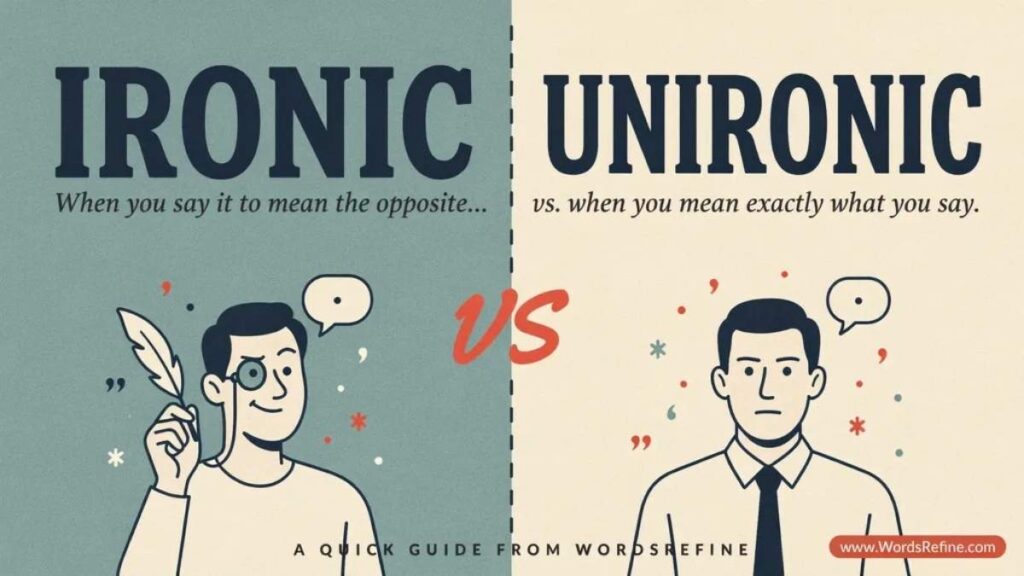
Have you ever described something as ironic when you actually meant that it was sincere? This common confusion can make everyday English surprisingly tricky. Understanding ironic vs unironic becomes much easier when you know how each word relates to meaning, intention, and context. Ironic describes something connected to irony, while unironic describes something expressed sincerely, without an ironic purpose. Although the distinction seems straightforward, modern conversations and online language often blur the line. In this guide, you well learn the ironic vs unironic meaning, explore clear examples, distinguish irony from sarcasm, and understand how to use ironic, unironic, ironically, and unironically correctly in everyday and formal English.
What Does Ironic Mean?
The word ironic describes something connected with irony. Depending on the situation, it can refer to an unexpected contrast between what people expect and what actually happens. It can also describe language in which the intended meaning differs from the literal wording.
For example, imagine a professional swimming instructor who is afraid of water. That contrast could create an ironic situation.
Consider another example. A person spends years warning everyone to back up their computer files. One day, their own computer crashes and they lose everything because they never made a backup. The situation has an ironic quality because the person’s experience conflicts with what they regularly advised others to do.
However, not every unexpected event is ironic.
If you forget your umbrella and it starts raining, that’s unfortunate. It isn’t automatically irony. The event becomes more clearly ironic when there is a meaningful contrast between expectation, behavior, purpose, or outcome.
This distinction is important because “unexpected” and “ironic” aren’t interchangeable.
Ironic Meaning in English
The meaning of ironic changes slightly depending on the context.
In everyday English, people commonly use the word to describe an unexpected result that contrasts with what someone would normally expect. They also use it to describe comments in which the speaker’s intended meaning differs from the literal words.
For example, someone might say, “That’s ironic,” after hearing that a company famous for selling security equipment suffered a major security breach.
The irony comes from the contrast between the company’s purpose and what happened.
In another situation, someone might say, “Oh, that’s just perfect,” after missing an important train. If the speaker clearly means that the situation is anything but perfect, the comment can be ironic.
Therefore, when asking for an ironic definition, it’s better to think about contrast rather than memorize the oversimplified idea that ironic always means “the opposite of what you mean.”
What Does Unironic Mean?
Unironic means sincere rather than ironic.
When someone says something unironically, they genuinely mean it. There isn’t a hidden joke, mocking intention, or ironic layer behind the statement.
For example, suppose someone says, “I unironically love old-fashioned diners.”
The speaker isn’t joking about liking diners. They genuinely enjoy them.
Likewise, if someone says, “Her compliment was unironic,” the sentence tells you that the compliment was sincere. She wasn’t secretly mocking the person.
This is where unironic becomes useful. Sometimes a statement might sound unusual enough that another person could mistake it for a joke. Adding “unironic” makes the speaker’s intention clearer.
Unironic Meaning in English
The meaning of unironic is closely connected with sincerity, genuineness, and earnestness.
Suppose someone says, “That was the best movie I’ve ever seen.”
If the movie is widely considered ridiculous, another person might wonder whether the speaker is joking. The speaker could respond, “No, I mean it unironically.”
That response means, “I’m serious. I genuinely liked it.”
As a result, unironic doesn’t simply mean “serious” in every situation. It specifically clarifies that irony isn’t being used.
That small difference can make the word surprisingly useful.
Learn the difference between confusing more English words
Suffix vs Postfix Which One Is Correct?
The Difference Between Ironic vs Unironic

1The difference between ironic vs unironic becomes clear when you compare intention.
An ironic statement contains an ironic meaning or relies on irony for its effect. An unironic statement is straightforward and sincere.
Imagine that a friend buys an extremely ugly sweater.
You look at it and say, “Wow, that’s beautiful.”
If you’re mocking the sweater, your comment may be ironic or sarcastic.
However, if you genuinely think the sweater looks great, your comment is unironic.
Interestingly, the actual words remain exactly the same. Only the meaning and intention change.
That’s why context plays such a major role.
Tone of voice, facial expression, surrounding conversation, previous statements, and the relationship between speakers can all influence whether an audience understands a statement as ironic or sincere.
Ironic vs Unironic in Everyday Conversation
Everyday conversation provides plenty of examples.
Suppose someone walks into a restaurant after waiting outside in freezing weather and says, “What a warm welcome.”
If the restaurant staff ignored them for twenty minutes, the comment might be ironic.
Now imagine a friend welcomes you with a hug and says, “It’s so good to see you.”
If they genuinely mean it, the statement is unironic.
The same principle works with opinions.
Someone might say, “I love this ridiculous movie.”
That could mean several things. Perhaps they genuinely love it because they think it’s entertaining. Perhaps they’re making fun of it. Without context, the listener may not know.
When the person says, “I unironically love this movie,” the meaning becomes much clearer. They genuinely enjoy it.
Ironic Examples That Show the Meaning Clearly
Consider a fire station that catches fire. The event could be described as ironic because a place designed to respond to fires has experienced one itself.
Another example involves a professional chef who accidentally burns the meal prepared for an important cooking competition. The contrast between the chef’s expertise and the outcome creates an ironic situation.
Verbal irony works differently. Imagine someone arrives at work two hours late and a coworker says, “Nice of you to arrive on time.”
The literal words sound positive. The actual intention is clearly different.
A final example might involve a person who constantly tells friends to stop checking their phones during dinner, only to spend the entire evening answering messages. That contradiction could create an ironic situation.
In each case, the important element is the contrast. Simply being surprising isn’t enough.
Unironic Examples in Real Sentences
Unironic statements are often much more straightforward.
“I unironically love classical music.”
Here, the speaker genuinely enjoys classical music.
“She gave him an unironic compliment.”
This means the praise was sincere.
“He was being completely unironic when he called the design beautiful.”
The speaker genuinely meant what he said.
“I unironically think that restaurant serves the best pancakes in town.”
The person isn’t making a joke about their preference. They genuinely believe it.
Notice that none of these sentences says anything about whether the subject is objectively good or bad. Unironic simply tells you that the person’s intention is genuine.
Ironic vs Unironically Don’t Confuse Grammar
Another common source of confusion is the difference between ironic vs unironically.
Ironic is an adjective. It describes a person, thing, situation, statement, comment, tone, or outcome.
For example, “That was an ironic comment.”
Unironically is an adverb. It describes how someone says, does, or feels something.
For example, “She unironically enjoyed the movie.”
The related forms are easy to separate once you look at their grammatical roles.
Ironic describes something.
Unironic also describes something.
Ironically describes how something is expressed or happens.
Unironically describes how something is expressed or done without irony.
For instance, “It was an ironic joke” uses an adjective. “He told the joke ironically” uses an adverb.
Similarly, “It was an unironic compliment” uses an adjective. “She praised him unironically” uses an adverb.
Ironically vs Unironically
The difference between ironically and unironically is mainly about whether irony is part of the intended meaning.
If someone says something ironically, their words may carry a meaning that differs from their literal wording.
If someone says something unironically, they mean it sincerely.
Imagine a friend wearing an outrageous hat.
You say, “That’s a very subtle hat.”
If you mean that the hat is anything but subtle, you’re speaking ironically.
Now imagine you tell your friend, “That’s a great hat,” because you honestly like it. You’re speaking sincerely.
If the friend assumes you’re joking, you might clarify by saying that you genuinely mean it.
This is one reason unironically appears so often in casual online English. Written messages don’t provide the same vocal clues that face-to-face conversation does.
What Does Unironically Mean?
Unironically means sincerely or without irony.
When someone says, “I unironically enjoy this,” they’re usually emphasizing that their enjoyment is genuine.
The word often appears when a person expects other people to assume that they’re joking.
For example, imagine a television show that became famous for its over-the-top acting and strange costumes. Someone might say, “I unironically love this show.”
That doesn’t necessarily mean the person thinks the show is perfect. It means their affection for it is real.
This distinction has become especially useful in internet culture, where humor, exaggeration, sarcasm, memes, and sincerity often overlap.
How to Use Ironic
When deciding how to use ironic, first ask whether irony actually exists in the situation.
You can use it to describe an ironic situation, such as a fire station burning down.
You can also describe an ironic statement, such as someone saying “Wonderful!” after receiving terrible news when the speaker clearly means the opposite.
The word can also describe tone.
For example, “She answered with an ironic smile” suggests that her expression carried an ironic meaning rather than straightforward sincerity.
However, don’t automatically use ironic whenever something seems strange.
A person accidentally wearing mismatched socks isn’t necessarily experiencing irony. It’s simply an ordinary mistake unless the surrounding circumstances create a meaningful contrast.
How to Use Unironic
Use unironic when you want to emphasize that something is genuine rather than ironic.
For example, you could say, “His admiration for the artist was unironic.”
You could also write, “The movie is an unironic celebration of friendship.”
In both sentences, the word makes sense because the discussion involves the possibility of irony.
However, in ordinary writing, sincere or genuine may sometimes sound more natural.
Compare these sentences:
“She gave an unironic apology.”
“She gave a sincere apology.”
Both can work. The second is usually simpler if the conversation has nothing to do with irony.
Unironic becomes particularly useful when irony itself is part of the discussion.
Learn the difference between commonly mixed-up more words
Trebled vs Tripled Which One Is Correct?
How to Use Unironically

Unironically usually works as an adverb.
For example, you might say, “I unironically listen to that song every morning.”
You could also say, “She unironically recommended the movie.”
Another natural example is, “He unironically wears vintage clothes every day.”
The word tells the reader that the action is genuine rather than performed for humor, mockery, or irony.
In casual conversation, it can also prevent misunderstandings.
Someone might say, “I actually love that ridiculous song.”
If they want to make their sincerity even clearer, they might say, “I unironically love that song.”
Ironic vs Sarcastic Are They the Same?
Ironic and sarcastic often appear together, but they don’t mean exactly the same thing.
Sarcasm commonly involves saying something that appears positive or literal while intending to mock, criticize, or express annoyance.
Irony has a broader meaning.
A situation can be ironic without anyone being sarcastic.
For example, imagine a company that sells products designed to prevent people from losing their belongings. The company’s own warehouse loses an entire shipment because employees misplaced it.
That’s potentially ironic. Nobody has to make a sarcastic remark.
Sarcasm, on the other hand, usually depends on someone’s manner or intention.
Suppose your friend arrives an hour late and you say, “Excellent punctuality.”
That’s sarcastic because the positive wording is being used to criticize the person’s lateness.
The two concepts can overlap, but they shouldn’t be treated as identical.
Situational Irony vs Verbal Irony
Understanding the two major forms of irony can prevent a lot of confusion.
Situational irony involves a contrast between what people expect and what actually happens.
Imagine a swimming instructor who can’t swim. The situation itself creates the contrast.
Verbal irony involves language. A speaker says something that creates a meaning different from the literal wording.
Imagine someone looking at a flooded street and saying, “Perfect beach weather.”
The speaker doesn’t literally mean that the weather is perfect for a beach trip.
These two forms explain why the idea that “ironic means the opposite of what you mean” isn’t always accurate.
That description fits some forms of verbal irony. It doesn’t explain situational irony.
Does Ironic Always Mean Unexpected?
No.
An unexpected event can be ironic, but surprise alone doesn’t create irony.
Suppose you buy a blue shirt because you expect your friend to dislike blue. Your friend happens to love it. That’s unexpected, but it isn’t automatically ironic.
For irony to become relevant, there is usually a stronger contrast involving expectations, behavior, purpose, or meaning.
This is why people sometimes misuse the word ironic.
They see something surprising and immediately call it irony.
A better question is, “What expectation does this event contradict?”
If there is no meaningful contrast, another word such as unexpected, surprising, strange, or coincidental may fit better.
Learn the difference between tricky grammar more words
Hierarchical vs Hierarchal Which One Is Correct?
Is Unironic a Real Word?
Yes. Unironic is a legitimate English word.
Major dictionaries document the word and define it in relation to sincerity and the absence of irony.
The word may feel less familiar than ironic because people don’t need to use it in every conversation. Often, sincere or genuine will do the job perfectly well.
Still, unironic has a specific advantage. It directly addresses the question of whether irony is involved.
If a discussion already centers on irony, saying “unironic” can be more precise than simply saying “sincere.”
Is Unironic the Opposite of Ironic?
In many contexts, yes, unironic works as the practical opposite of ironic.
However, it isn’t a universal opposite in every situation.
Suppose ironic describes an unexpected outcome. The natural contrast might be expected rather than unironic.
If ironic describes a statement that isn’t meant literally, the useful contrast might be literal or straightforward.
If ironic describes a comment that isn’t sincere, then sincere or genuine may be the clearest contrast.
Therefore, context determines the best opposite.
The prefix un- doesn’t magically create a perfect opposite for every possible meaning of ironic. It creates a word that specifically means not involving irony.
Can Something Be Funny and Unironic?
Yes. Absolutely.
Unironic doesn’t mean dull, boring, or humorless.
A person can genuinely think something is funny. A movie can be sincerely funny. A comedian can tell a straightforward joke without relying on irony.
For example:
“I unironically think that comedian is hilarious.”
The speaker isn’t joking about finding the comedian funny. Their opinion is genuine.
This distinction matters because people sometimes associate irony with humor so closely that they assume sincerity and comedy can’t coexist.
They can.
A joke doesn’t need an ironic meaning to make someone laugh.
Ironic vs Unironic in Music, Movies, and Fashion
Music provides an easy example of the distinction.
Someone might listen to an extremely cheesy pop song because they find it amusing. They might enjoy the song partly because it’s ridiculous. That could be an ironic form of enjoyment.
Another person might listen to the same song every morning because they genuinely love it. Their enjoyment can be completely unironic.
Movies work the same way.
Someone might watch a notoriously bad film because they enjoy laughing at its mistakes. Another viewer might honestly consider the film entertaining and meaningful.
Fashion can create the same confusion.
A person might wear an exaggerated vintage outfit as a joke. Another person might dress exactly the same way because they genuinely love the style.
The clothes don’t determine whether the behavior is ironic. The intention and context do.
Learn the difference between confusing word pairs
Taylored vs Tailored Which One Is Correct?
Ironic vs Unironic Synonyms
There aren’t perfect synonyms for either word in every situation.
Depending on context, ironic can be related to words such as wry, satirical, sardonic, paradoxical, or sarcastic. Yet these words carry their own meanings.
Unironic can often be replaced by sincere, genuine, earnest, authentic, straightforward, or serious.
For example, “She gave a sincere answer” is usually clearer than “She gave an unironic answer” when the conversation has nothing to do with irony.
On the other hand, if you’re discussing irony directly, “unironic” can be more precise.
For example, “The actor’s praise was unironic” tells the reader that the praise wasn’t intended as an ironic performance.
Why Unironically Appears So Often Online
Online communication creates a unique problem: tone can disappear.
When someone speaks face-to-face, listeners can hear their voice and see their facial expression. A sarcastic comment can be obvious because of the speaker’s delivery.
Text doesn’t provide those clues.
A sentence like “This is the greatest movie ever made” could be genuine. It could also be an exaggerated joke.
As a result, people sometimes add “unironically” to clarify their intention.
“I unironically love this.”
That sentence essentially tells the reader, “Yes, this sounds ridiculous. No, I’m not joking.”
This explains why the word appears frequently in social media conversations and online communities. It isn’t necessarily complicated vocabulary. Instead, it solves a communication problem.
Which One Should You Use?
When you’re deciding between ironic vs unironic, focus on the meaning rather than the appearance of the words.
Use ironic when irony is part of the situation, statement, tone, or expression.
Use unironic when you want to emphasize that something is genuine rather than ironic.
If neither word seems necessary, choose a simpler word.
For example, if you simply mean that someone is genuine, use sincere or genuine.
If you mean that someone isn’t joking about their opinion in an irony-focused discussion, unironic may be exactly what you need.
Good word choice isn’t about choosing the more unusual term. It’s about choosing the word that communicates your meaning most accurately.
Learn the difference between often confused words
Siked vs Psyched Which One Is Correct?
Common Mistakes With Ironic vs Unironic
One common mistake is calling every surprising event ironic. Surprise isn’t enough. Look for a meaningful contrast between expectation and reality.
Another mistake is assuming that ironic and sarcastic are interchangeable. They can overlap, but sarcasm usually carries a stronger element of mockery or criticism.
A third mistake is thinking that unironic means boring or completely serious. It doesn’t. Something can be sincere and hilarious at the same time.
People also sometimes assume that unironic is an incorrect word because it sounds less familiar. It isn’t. The word has a recognized meaning and a clear grammatical function.
Finally, some writers use unironic when sincere would be clearer. If the reader doesn’t need to know anything about irony, there’s usually no reason to introduce it.
Treating Every Surprise as Ironic
A surprising event isn’t automatically ironic. Irony usually involves a meaningful contrast between what you expect and what actually happens.
Confusing Ironic With Sarcastic
Ironic and sarcastic can overlap, but they aren’t interchangeable. Sarcasm usually involves mockery, criticism, or a sharp tone, while irony is broader.
Thinking Unironic Means Boring or Serious
Unironic doesn’t mean dull or completely serious. Something can be sincere and still be funny, dramatic, or entertaining.
Assuming Unironic Isn’t a Real Word
Some people avoid unironic because it sounds unfamiliar. However, unironic is a valid word with a clear meaning and grammatical function.
Using Unironic When Sincere Is Clearer
Sometimes sincere is the simpler choice. If your sentence doesn’t need to contrast sincerity with irony, using sincere can make your meaning clearer.
Ironic vs Unironic A Quick Comparison
| Word | Meaning | Example |
|---|---|---|
| Ironic | Involving irony | “It was ironic that the fire station burned down.” |
| Unironic | Sincere rather than ironic | “Her admiration was unironic.” |
| Ironically | In an ironic way | “He said it ironically.” |
| Unironically | In a sincere, non-ironic way | “She unironically loves the song.” |
The table captures the basic distinction, but context still matters. English rarely behaves like a neat mathematical equation.
Learn the difference between basic English word mistakes
Ambassador vs Embassador Which Spelling Is Correct?
Practice Session ironic vs unironic
Complete each sentence with the correct form of the word: ironic, unironic, ironically, or unironically.
- It was ______ that the fire station itself caught fire.
- She ______ loves listening to old-fashioned music because she genuinely enjoys it.
- His comment was clearly ______ because he meant something different from the literal words.
- The comedian made an ______ joke about modern technology.
- I ______ think that movie is excellent. I’m being completely sincere.
- It was ______ that the person who always reminded everyone to be punctual arrived late.
- Her compliment was completely ______. She genuinely admired the painting.
- Standing in the pouring rain, he said, “What a wonderful day,” ______.
- The situation became ______ when the technology expert forgot his own password.
- She ______ enjoys wearing vintage clothes even though her friends think the style looks outdated.
- His comment sounded sarcastic, but he was actually being ______.
- It would be ______ to call a swimming instructor who cannot swim an expert swimmer.
- “Great job!” he said ______ after his friend accidentally deleted the entire presentation.
- I ______ love that cheesy song. It’s genuinely one of my favorites.
- The statement wasn’t a joke. She was being completely ______.
- The contrast between everyone’s expectations and what actually happened made the situation ______.
- He wasn’t mocking the movie. He ______ thought it was entertaining.
- The adjective ______ describes something that involves irony.
- The adjective ______ describes something expressed sincerely rather than ironically.
- “Oh, perfect!” she said ______ after discovering that her flight had been canceled.
- The actor’s admiration for the old film was ______ rather than sarcastic.
- It was ______ that a company known for selling security systems experienced a serious security problem.
- He ______ recommended the restaurant because he genuinely thought the food was excellent.
- When someone expresses an opinion sincerely without using irony, the opinion is ______.
- When a statement depends on a contrast between its literal wording and intended meaning, it may be ______.
Answers
- ironic
- unironically
- ironic
- ironic
- unironically
- ironic
- unironic
- ironically
- ironic
- unironically
- unironic
- ironic
- ironically
- unironically
- unironic
- ironic
- unironically
- ironic
- unironic
- ironically
- unironic
- ironic
- unironically
- unironic
- ironic
Here’s a trusted source for clear word meanings:
FAQs
Is it ironic vs unironic?
Use “ironic” when something involves irony. Use “unironic” when someone means something sincerely without irony. For example, “His comment was ironic” means the comment involved irony, while “Her praise was unironic” means she genuinely meant it.
What is another word for “unironic”?
Depending on the context, alternatives for “unironic” include sincere, genuine, earnest, straightforward, serious, and heartfelt. However, “sincere” is usually the most natural choice when you want to emphasize that someone genuinely means what they say.
How do you say “unironically”?
“Unironically” is pronounced with the main stress on the second syllable of the word “ironic.” It means doing or saying something sincerely rather than as a joke, parody, or ironic performance.
What does it mean to be ironically funny?
Something is ironically funny when the humor comes from irony. The joke may involve an unexpected contrast between what people expect and what actually happens. It can also involve saying something that has a different intended meaning from its literal wording.
What does “not ironically” mean?
“Not ironically” means sincerely or genuinely. When someone says they like something “not ironically,” they’re clarifying that they aren’t joking, mocking it, or pretending to enjoy it for humorous effect.
What does it mean to ironically do something?
To do something ironically means to do it while using or creating irony. The person may intentionally adopt a style, behavior, or expression for humorous effect because the action contrasts with its usual meaning or expectations.
Did Jesus use the word “hypocrite”?
The word “hypocrite” appears in the New Testament accounts of Jesus’ teachings. In the Gospel texts, Jesus uses the term to criticize people whose outward behavior does not match their inner intentions or conduct.
Are irony and paradox the same?
No. Irony and paradox are different concepts. Irony involves a meaningful contrast between appearance, expectation, and reality. A paradox is a statement or situation that seems contradictory but can reveal a deeper truth or idea.
What’s a nicer word for hypocrisy?
A softer alternative to “hypocrisy” depends on the situation. Words such as inconsistency, double standard, insincerity, or contradiction may sound less harsh. “Inconsistency” is often the most neutral choice when you want to describe a mismatch between someone’s words and actions.
What is romantic irony?
Romantic irony is a literary technique in which an author or narrator draws attention to the fact that a story is a constructed work of art. The writer may interrupt the narrative, comment on the storytelling process, or create distance between the story and the reader.
What is proleptic irony?
Proleptic irony occurs when the audience knows or learns something about a future outcome before the characters fully understand it. This creates a gap between what the audience knows and what the characters expect.
What are 10 irony examples?
Common examples of irony include a fire station catching fire, a traffic officer receiving a speeding ticket, a weather reporter getting caught in an unexpected storm, a professional chef burning dinner, a fitness expert forgetting to exercise, a dentist developing a severe fear of dentists, a computer expert losing access to their own account, a swimming instructor falling into the pool, a person who hates noise living next to a construction site, and someone warning others about lateness while arriving late themselves.
What is often mistaken for irony?
Sarcasm, coincidence, bad luck, and simple unexpected events are often mistaken for irony. An event isn’t automatically ironic just because the outcome surprises you. True irony usually involves a meaningful contrast between expectation and reality, meaning, or intention.
Is sarcasm the lowest form of wit?
“Lowest form of wit” is an opinion rather than a linguistic rule. Sarcasm can be clever, humorous, subtle, or hurtful depending on how someone uses it. The phrase is commonly associated with criticism of sarcasm, but it doesn’t provide a formal definition of good or bad humor.
What is the opposite of sarcasm?
There isn’t one exact opposite of sarcasm in every situation. Depending on the context, sincerity, directness, earnestness, or genuine praise can function as an opposite. If someone says something sincerely without mockery or hidden criticism, “sincere” is often the clearest description.
Conclusion
Ironic vs unironic may look like two sides of the same coin, but they do very different jobs. Ironic describes something connected to irony, while unironic tells you that someone is being completely sincere. Add ironically and unironically to the mix, and suddenly one small word can change the entire meaning of a sentence.
The easiest way to avoid confusion is to think about intention and context. If someone is joking through irony, ironic or ironically may fit. If they genuinely mean what they say, unironic vs unironically is usually the better choice. Just remember that sarcasm, coincidence, and unexpected events aren’t automatically irony.
So, before you call something ironic, take a second look. Is there a real contrast between expectation and reality? Is the speaker being playful or sincere? Once you spot that difference, these words become much easier to handle. After all, grammar is confusing enough without accidentally saying “unironically” when you meant “ironically.”

Diora AJS she is an experienced blogger and passionate English language enthusiast at Words Refine. With a keen eye for language and a love for clear communication, she writes practical content about grammar, word meanings, usage, and commonly confused terms. Her goal is to make English easier to understand through clear explanations and relatable examples, helping readers write accurately and communicate with confidence.