
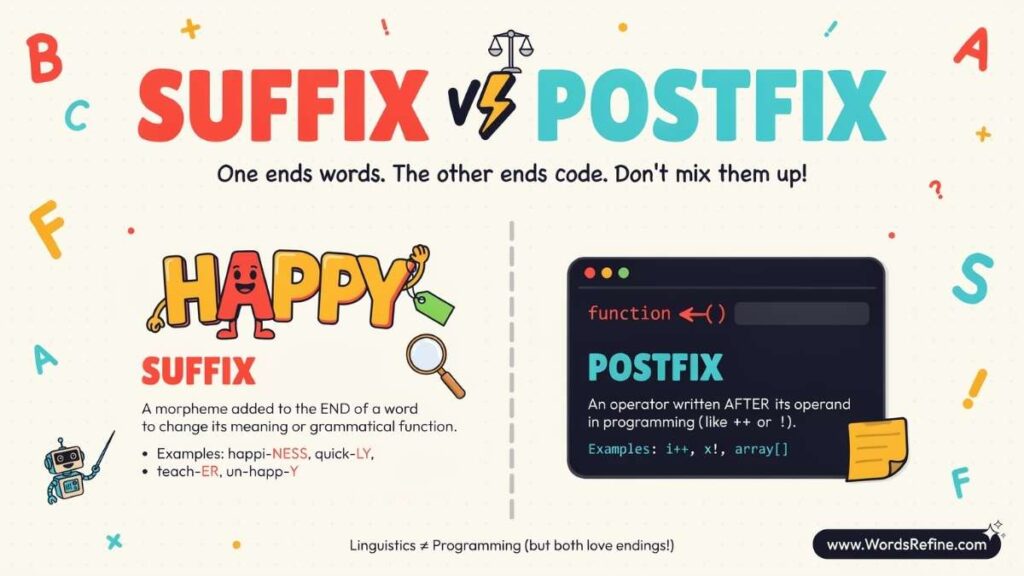
Have you ever come across the terms suffix vs postfix and wondered if they are just two names for the same thing? You are not alone. The suffix vs postfix confusion often happens because both terms suggest that something comes after something else. However, they belong to very different contexts. A suffix works with words, roots, and stems, while postfix is mainly used in programming, mathematics, and technical notation. For example, “ness” is a suffix in “happiness,” while ++ is a postfix operator in x++. Once you understand this simple difference, choosing the right term becomes much easier. Let’s clear up the confusion and make both terms easy to remember.
Suffix vs Postfix The Quick Answer
The easiest way to understand the suffix vs postfix difference is to look at what each term describes.
A suffix is attached to the end of a word or stem. It can change the meaning of a word, its grammatical category, or its grammatical form.
A postfix comes after an operand or expression in a technical notation system. It commonly appears in programming and mathematical expressions.
Consider these examples:
- happy + ness = happiness
- walk + ed = walked
- x++ = postfix increment
- 2 3 + = postfix notation
The first two examples belong to language. The last two belong to programming or mathematical notation.
Although suffix and postfix both involve something appearing after something else, they don’t perform the same function.
What Is a Suffix?
Suffix Definition
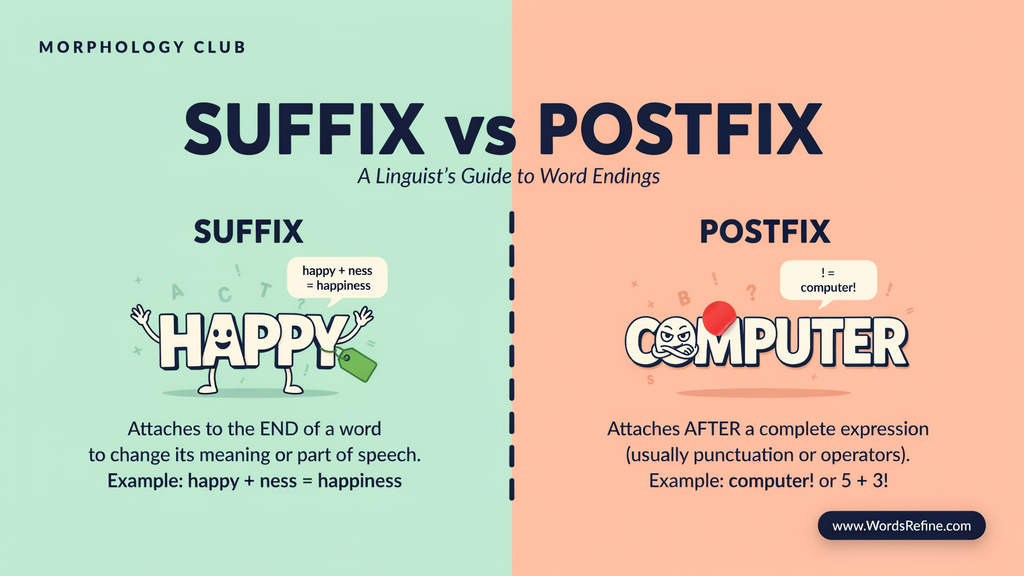
A suffix is a linguistic element added to the end of a word, stem, or base. This is the basic suffix definition used in linguistics and grammar.
For example:
- kind + ness = kindness
- help + ful = helpful
- care + less = careless
- quick + ly = quickly
- teach + er = teacher
In each example, the ending contributes something to the resulting word.
A suffix isn’t simply any collection of letters that happens to appear at the end of a word. It usually has a recognizable linguistic role. Depending on the suffix, it can create a new word or express grammatical information.
That distinction matters because English has many words whose final letters aren’t necessarily functioning as suffixes.
What Is a Suffix in Linguistics?
If you’re wondering what is a suffix from a linguistic perspective, the answer goes beyond saying that it is a word ending.
A suffix can be a morpheme. A morpheme is a meaningful unit of language. When a suffix joins a root word or stem, it can contribute meaning or grammatical information.
For example:
happy + ness = happiness
Here, -ness changes the adjective happy into the noun happiness.
Similarly:
walk + ed = walked
Here, -ed changes the form of the verb to express past time.
So, a suffix can influence either word formation or grammar. Sometimes it does both in ways that depend on the particular word and context.
Suffix in Grammar How Suffixes Work
Suffixes play an important role in English grammar and word formation. However, they don’t all do the same job.
Some suffixes create new words. Others change the grammatical form of an existing word.
Derivational Suffixes
A derivational suffix usually helps create a new word or changes the grammatical category of a word.
Consider these examples:
- happy → happiness
- kind → kindness
- teach → teacher
- care → careful
- child → childish
The change can be significant.
For instance, happy is an adjective, while happiness is a noun. The suffix -ness helps create that new noun.
Likewise, teach is a verb, while teacher is a noun referring to a person who teaches.
Therefore, derivational suffixes are closely connected with word formation.
Inflectional Suffixes
Inflectional suffixes work differently. They usually change the grammatical form of a word rather than create a completely new word.
For example:
- book → books
- walk → walked
- walk → walking
- run → runs
- write → written
The suffix -s can mark plural nouns or third-person singular verbs. The suffix -ed can mark past tense in regular verbs, while -ing appears in several grammatical constructions.
In other words, suffixes can carry grammatical information as well as contribute to word formation.
Learn the difference between confusing more English words
Further vs Farther The Simple Difference and Each Correctly?
Suffix Examples in Words
When you look for suffix examples in words, you’ll find them throughout everyday English.
| Base or stem | Suffix | New word | Main function |
|---|---|---|---|
| happy | -ness | happiness | Forms a noun |
| kind | -ness | kindness | Forms a noun |
| help | -ful | helpful | Adds meaning |
| care | -less | careless | Adds meaning |
| quick | -ly | quickly | Forms an adverb |
| teach | -er | teacher | Forms a noun |
| walk | -ed | walked | Shows past tense |
| walk | -ing | walking | Forms an -ing form |
| book | -s | books | Shows plural |
These common suffix examples show why the term belongs naturally to grammar and linguistics.
For instance, when you see happiness, you can identify happy as the base and -ness as the suffix. The suffix changes both the form and the grammatical role of the word.
What Does Postfix Mean?
Postfix Definition
The postfix definition is based primarily on position.
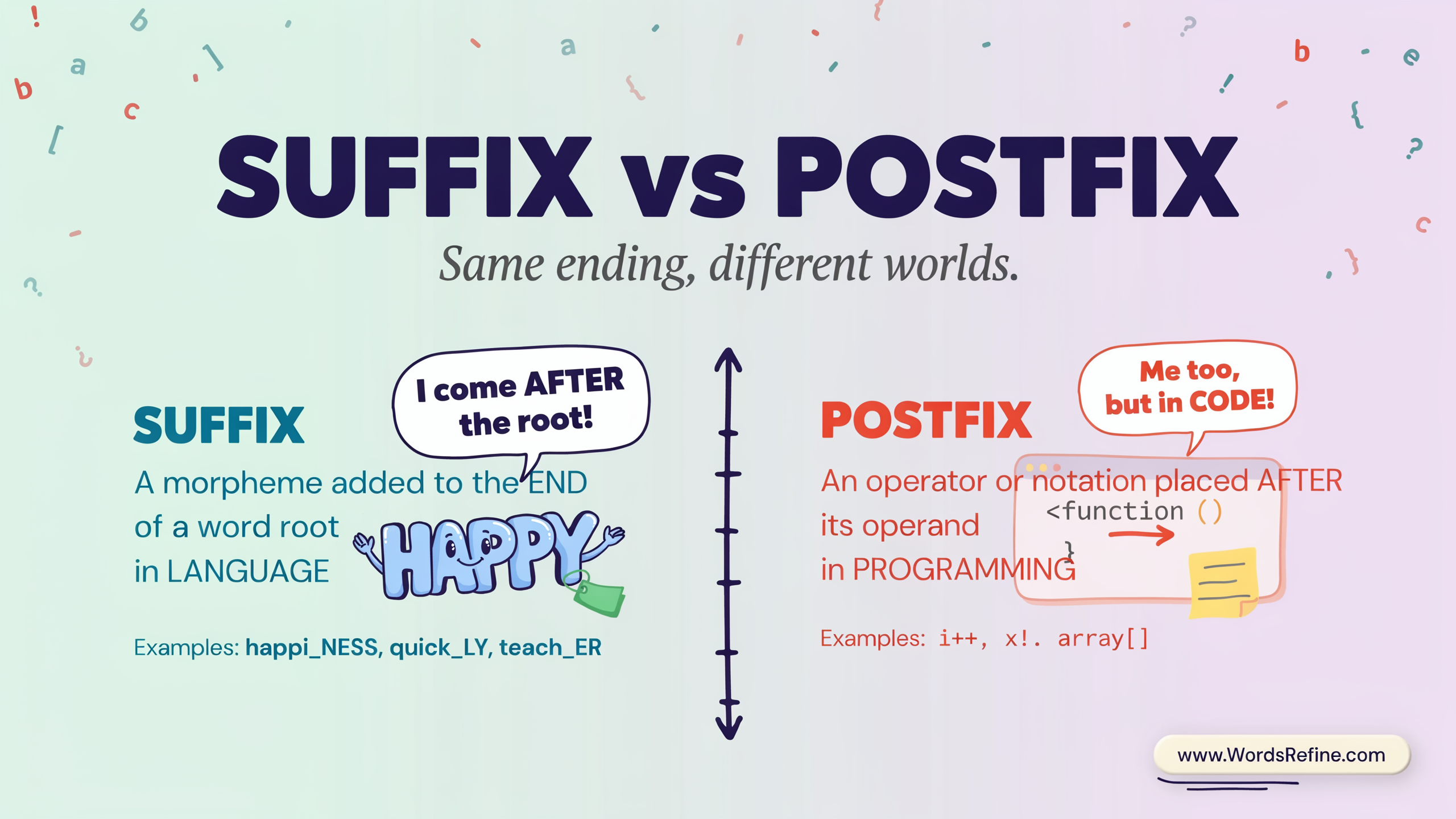
In technical contexts, postfix describes an operator or notation element that appears after the operand or operands it affects.
For example:
x++
The ++ comes after x. Therefore, it is a postfix operator.
Postfix also appears in mathematical and computational notation.
For example:
2 3 +
This expression represents the same basic addition as 2 + 3. The difference is that the operator comes after the operands.
Consequently, postfix is not simply another name for a linguistic suffix. It belongs to a different technical system.
What Is Postfix in Computer Science?
If you’re asking what is postfix in computer science, there are two closely related ideas to understand.
First, postfix can describe the position of an operator after its operand.
Second, postfix notation places operators after the operands they operate on.
These ideas are closely connected, although they aren’t exactly the same thing.
For example:
x++
uses a postfix increment operator.
Meanwhile:
2 3 +
uses postfix notation.
Both examples follow the same basic positional idea. Something associated with an operation appears after the relevant value or values.
Postfix Meaning in Computer Programming
The postfix meaning in computer programming becomes clearer when you compare postfix and prefix operators.
Consider:
x++
and:
++x
The first uses a postfix increment operator. The second uses a prefix increment operator.
The position of the operator can affect how an expression is evaluated.
For example, suppose x starts at 3.
With:
let y = x++;
y receives 3, while x becomes 4.
With:
let y = ++x;
x becomes 4 before the value is assigned to y, so y receives 4.
The distinction can look tiny on the page. However, in a real program, that small difference can change the result of an entire expression.
What Is a Postfix Operator?
A postfix operator is an operator written after its operand.
Two familiar examples are:
- x++
- x–
The first is a postfix increment operator.
The second is a postfix decrement operator.
The word postfix tells you where the operator appears. It doesn’t mean that the operator is a suffix in the linguistic sense.
That difference is important.
In grammar, a suffix attaches to a word or stem. In programming, a postfix operator follows an operand and participates in expression evaluation.
Postfix Expression and Postfix Notation
A postfix expression places an operator after the values or expressions it operates on.
For example:
2 3 +
means:
2 + 3
A slightly larger postfix expression is:
2 3 + 4 *
This represents:
(2 + 3) × 4
The order becomes easier to see when you break the expression into stages.
First, 2 and 3 are combined with +.
That gives 5.
Next, 5 and 4 are combined with *.
That gives 20.
Therefore, the complete expression produces 20.
Postfix notation is also commonly associated with Reverse Polish Notation, often shortened to RPN.
Learn the difference between commonly mixed-up more words
Capital vs Capitol Which One Is Correct?
How Postfix Notation Uses a Stack
One reason postfix notation matters in computer science is that it can be evaluated naturally with a stack.
Imagine a stack of plates. You place one plate on top of another. When you remove one, you take the top plate first.
A stack in computer programming works on the same basic principle: last in, first out.
Take this postfix expression:
2 3 +
The evaluation works like this:
| Input | Action | Stack |
|---|---|---|
| 2 | Put 2 on the stack | 2 |
| 3 | Put 3 on the stack | 2, 3 |
| + | Add 2 and 3 | 5 |
The answer is 5.
Now consider:
2 3 + 4 *
The process becomes:
| Input | Action | Stack |
|---|---|---|
| 2 | Push 2 | 2 |
| 3 | Push 3 | 2, 3 |
| + | Add 2 and 3 | 5 |
| 4 | Push 4 | 5, 4 |
| * | Multiply 5 by 4 | 20 |
The final result is 20.
This shows why postfix notation can be useful for expression evaluation. The order of operations becomes explicit instead of relying on parentheses and conventional precedence rules.
Suffix vs Postfix Examples
The best suffix vs postfix examples show the difference through context.
Suffix Examples
Here are several straightforward examples:
- happy + ness = happiness
- kind + ness = kindness
- care + less = careless
- teach + er = teacher
- walk + ed = walked
Each added element belongs to word formation or grammar.
Postfix Examples
Now look at technical examples:
- x++
- x–
- 2 3 +
- 2 3 + 4 *
- 2 3 4 * +
These examples involve operators and expression notation rather than English word formation.
The distinction becomes much easier when you ask one simple question: “Am I discussing a word or an operation?”
If you’re discussing a word, suffix is usually the answer.
If you’re discussing an operator or formal expression, postfix may be the appropriate term.
Is Postfix a Suffix?
The question is postfix a suffix has a straightforward answer in ordinary usage: no.
A suffix is a linguistic element attached to a word or stem.
A postfix is generally a positional term used in technical notation.
For example:
happy + ness
contains a suffix.
By contrast:
x++
uses a postfix operator.
The two terms share a basic idea of placement, but their functions differ.
Therefore, calling -ness a postfix would not be the normal choice in an English grammar discussion.
Likewise, describing ++ in x++ as a suffix would make a programming explanation less precise.
Learn the difference between tricky grammar more words
Loose vs Lose Difference and which is Correctly?
Is Postfix the Same as Suffix?
No. The answer to is postfix the same as suffix is generally no.
The confusion comes from their literal structure.
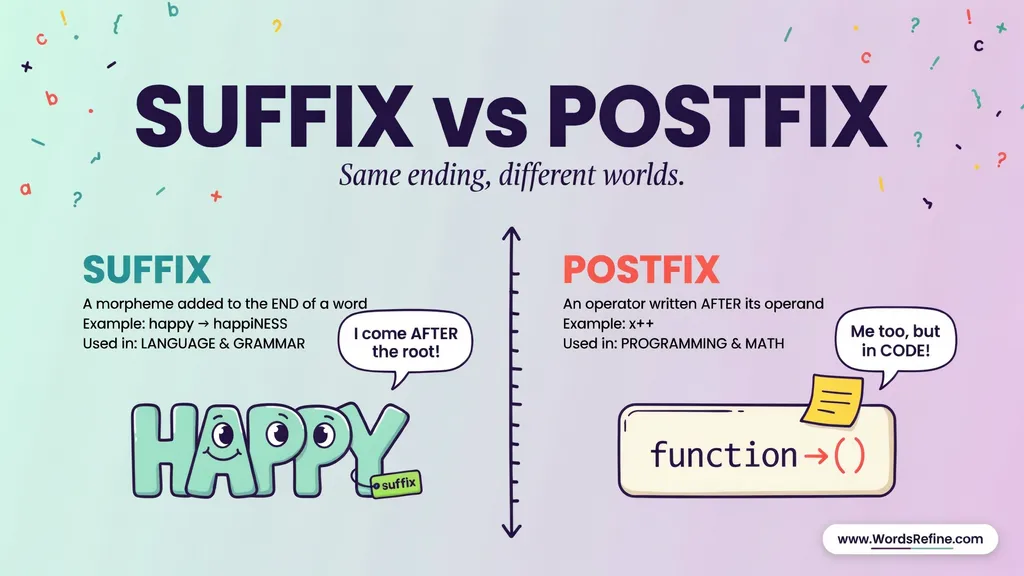
The word suffix refers to something that comes after a word or stem. The word postfix also suggests something that comes after something else.
However, terminology isn’t determined by position alone.
A linguistic suffix has a role in morphology and grammar.
A postfix operator has a role in expression syntax and evaluation.
That’s why the terms shouldn’t be treated as universal synonyms.
Suffix vs Prefix
To understand suffix even better, it helps to compare it with prefix.
A prefix appears before a word or stem.
A suffix appears after a word or stem.
For example:
un + happy = unhappy
happy + ness = happiness
Here, un- is a prefix and -ness is a suffix.
Both are types of affix.
The difference is their position.
A prefix comes before the base. A suffix comes after it.
Prefix vs Postfix
Programming uses the words prefix and postfix in a similar positional way.
Consider:
++x
The operator appears before x, so it is a prefix operator.
Now consider:
x++
The operator appears after x, so it is a postfix operator.
Therefore:
- Prefix means the operator comes first.
- Infix means the operator comes between operands.
- Postfix means the operator comes afterward.
This is why prefix vs postfix becomes an important distinction in programming.
Learn the difference between confusing word pairs
Lay vs Lie Difference and which is correct?
Suffix vs Postfix vs Prefix
The three terms can look confusing because they all describe position.
However, their usual applications make the difference much easier to remember.
| Term | Position | Common context | Example |
|---|---|---|---|
| Prefix | Before | Grammar and programming | unhappy, ++x |
| Suffix | After a word or stem | Grammar and linguistics | happiness |
| Postfix | After an operand or expression | Programming and mathematics | x++, 2 3 + |
| Infix | Between operands | Mathematics and programming | 2 + 3 |
Therefore, the broader prefix postfix suffix distinction is really about both position and context.
What Does Suffix Mean in Grammar?
The question what does suffix mean in grammar can be answered simply: a suffix is an ending attached to a word or stem that contributes meaning or grammatical information.
For example:
walk → walked
The ending -ed changes the grammatical form of the verb.
Likewise:
cat → cats
The ending -s marks plural number.
So, suffixes can help show tense, number, word class, or other grammatical information.
What Is Postfix in Grammar?
The phrase postfix in grammar isn’t normally the standard term for an English word ending.
English grammar generally uses suffix when discussing endings that attach to roots or stems.
Therefore, if you’re writing about English word formation, phrases such as “English suffixes,” “suffix formation,” “derivational suffix,” and “inflectional suffix” are more appropriate than calling those endings postfixes.
Postfix vs Suffix in Programming
The postfix vs suffix in programming distinction is particularly important.
Suppose a programmer writes:
x++
The ++ isn’t a suffix in the grammatical sense. It is a postfix operator.
Now compare:
x–
This uses a postfix decrement operator.
The operator’s placement can affect expression evaluation, especially when the expression is part of a larger statement.
For example:
let total = count++;
The program can use the current value of count before increasing it.
That behavior is different from:
let total = ++count;
Here, the increment occurs before the value is used by the expression.
Consequently, postfix isn’t just a fancy way of saying “at the end.” It describes a specific technical structure.
Postfix vs Suffix in Mathematics
The postfix vs suffix in math distinction follows the same basic principle.
Mathematical notation can classify operators according to where they appear.
An operator can be:
- Prefix, when it comes before the operand.
- Infix, when it appears between operands.
- Postfix, when it comes after the operand.
Postfix notation is therefore about mathematical notation and operator placement.
A simple postfix expression is:
2 3 +
Its infix equivalent is:
2 + 3
The operation remains addition. Only the notation changes.
This is why postfix vs suffix in mathematics isn’t really a debate over two interchangeable terms. Suffix belongs mainly to linguistic terminology, while postfix describes a mathematical or formal notation pattern.
Infix vs Postfix
The difference between infix and postfix is especially useful when learning programming or computer science.
Infix notation is familiar because people normally write arithmetic this way:
2 + 3
The operator appears between the operands.
Postfix notation changes the order:
2 3 +
The operator moves to the end.
Consider a more complicated expression:
(2 + 3) × 4
Its postfix form is:
2 3 + 4 *
The parentheses disappear because the postfix order already tells you how the operations should be performed.
This is one reason postfix expressions can be convenient for certain computational processes.
Learn the difference between often confused words
Infix to Postfix Example
Take this expression:
2 + 3 × 4
Because multiplication has higher precedence than addition, the expression means:
2 + (3 × 4)
The postfix form is:
2 3 4 * +
The multiplication happens first because 3 and 4 appear before the multiplication operator.
Then 2 combines with the result through the addition operator.
This demonstrates an important point about postfix notation: the order of the symbols carries information about the order of operations.
Postfix Programming Examples
Postfix appears in several programming situations, although its exact use depends on the programming language.
Common examples include:
- x++
- x–
- count++
- index–
- value++
These examples use postfix increment or decrement operators.
However, not every programming language supports these operators in the same way. Some languages use different syntax or don’t provide these operators at all.
Therefore, when discussing programming, it’s best to connect postfix to a particular language or notation system rather than treating it as a universal coding rule.
Common Mistakes With Suffix and Postfix
Calling Every Ending a Postfix
A common mistake is assuming that anything at the end of something must be called a postfix.
For example, calling -ness a postfix in the word happiness isn’t standard English grammar terminology.
The appropriate term is suffix.
Calling a Postfix Operator a Suffix
The opposite mistake appears in programming.
For example:
x++
should be described as using a postfix increment operator.
Calling ++ a suffix doesn’t explain its programming role.
Treating the Two Terms as Complete Synonyms
Although both terms involve something appearing afterward, they belong to different areas of terminology.
A suffix belongs primarily to morphology and grammar.
A postfix belongs primarily to programming, mathematics, and formal notation.
Confusing Prefix and Postfix
Compare:
++x
with:
x++
The first is prefix.
The second is postfix.
That small positional difference can affect the result of an expression.
When to Use Suffix
Use suffix when you’re discussing:
- English grammar.
- Linguistics.
- Morphology.
- Word formation.
- A word ending that functions as an affix.
- Derivational suffixes.
- Inflectional suffixes.
- A root word or stem combined with an ending.
- Changes in grammatical form.
- Changes in word meaning.
For example:
“The suffix -ness turns many adjectives into nouns.”
That is a natural and accurate grammatical explanation.
Learn the difference between basic English word mistakes
Whoever vs Whomever How to Use Each Word Correctly?
When to Use Postfix
Use postfix when you’re discussing:
- Programming operators.
- Increment and decrement operators.
- Postfix notation.
- Reverse Polish Notation.
- Mathematical operator placement.
- Expression parsing.
- Expression evaluation.
- Stack-based evaluation.
- Formal expression syntax.
- Computer science notation.
For example:
“The expression x++ uses a postfix increment operator.”
That sentence uses the technical term correctly.
A Simple Way to Remember the Difference
Here’s an easy memory trick:
Words usually have suffixes.
Operators and formal expressions can have postfix forms.
Think about this example:
happy + ness = happiness
The ending belongs to a word. Therefore, it’s a suffix.
Now look at:
x++
The operator comes after the operand. Therefore, it’s postfix.
Finally:
2 3 +
The addition operator comes after its operands. Therefore, this uses postfix notation.
Once you separate language from technical notation, the distinction becomes much easier.
Suffix vs Postfix Quick Comparison
| If you’re talking about | The usual term |
|---|---|
| Word endings | Suffix |
| English morphology | Suffix |
| Root word plus ending | Suffix |
| Word formation | Suffix |
| Inflection | Suffix |
| Derivation | Suffix |
| x++ | Postfix operator |
| x– | Postfix operator |
| 2 3 + | Postfix notation |
| Reverse Polish Notation | Postfix notation |
| Operator after an operand | Postfix |
| Operator before an operand | Prefix |
| Operator between operands | Infix |
This comparison makes the choice fairly simple.
If the subject is a word, suffix will usually fit.
If the subject is an operator or formal expression, postfix is more likely to be the right term.
What Is the Difference Between Suffix vs Postfix?
The answer comes down to function, context, and terminology.
A suffix is a linguistic unit added to the end of a word, stem, or root. It can change meaning, word class, or grammatical form.
A postfix is a technical positional term. It describes an operator or notation element that comes after an operand or operands.
For example:
happy + ness = happiness
Here, -ness is a suffix.
On the other hand:
x++
uses a postfix operator.
Likewise:
2 3 +
uses postfix notation.
The two terms may look similar because both involve something coming after something else. Nevertheless, they describe different concepts.
Which One Is Correct?
Neither word is automatically correct in every situation.
The correct choice depends on what you’re describing.
1.If you’re discussing a word ending, use suffix.
2.If you’re discussing an operator placed after an operand, use postfix.
3.If you’re discussing an arithmetic expression in which operators appear after operands, use postfix notation.
4.If you’re discussing an operator that appears before its operand, use prefix.
5.If you’re discussing an operator between operands, use infix.
The safest approach is to focus on the field first. Once you know whether you’re talking about language, programming, or mathematics, the terminology becomes much easier to choose.
Learn the difference between commonly misused words
Vender vs Vendor Which one Is Correct?
Practice Session Suffix vs Postfix
Fill in each blank with the correct word or phrase: suffix, postfix, prefix, infix, postfix operator, or postfix notation.
- The ending “-ness” in “happiness” is a ________.
- In “unhappy,” “un-” is a ________.
- In the expression “x++,” the “++” is a ________.
- The word “walked” contains the ________ “-ed.”
- In postfix notation, the operator comes ________ the operands.
- The expression “2 3 +” is written in ________ notation.
- In “careless,” “-less” is a ________.
- In programming, “x–” contains a ________ operator.
- In “2 + 3,” the plus sign is an ________ operator because it appears between the operands.
- In “++x,” the increment operator is a ________ operator.
- The word “teacher” contains the ________ “-er.”
- A linguistic element added to the end of a word or stem is called a ________.
- The expression “2 3 + 4 *” is an example of ________ notation.
- In “kindness,” the ending “-ness” helps form a new word. Therefore, it is a ________.
- The operator in “count++” appears after the variable, so it is a ________ operator.
- English grammar commonly uses the term ________ for word endings such as “-ed,” “-ing,” and “-ness.”
- In “unfair,” “un-” appears before the base word, so it is a ________.
- In postfix notation, operands usually appear ________ the operator.
- “2 + 3” is an example of ________ notation.
- “2 3 +” represents the same basic calculation as “2 + 3,” but it uses ________ notation.
- The ending “-ly” in “quickly” is a ________.
- In “x++,” the increment operator appears after “x.” This makes it a ________ operator.
- A ________ is mainly discussed in linguistics, grammar, and word formation.
- A ________ is mainly used when discussing programming or mathematical operator placement.
- If you are talking about “happy + ness,” use the word ________. If you are talking about “x++,” use the word ________.
Answers
- Suffix
- Prefix
- Postfix operator
- Suffix
- After
- Postfix
- Suffix
- Postfix
- Infix
- Prefix
- Suffix
- Suffix
- Postfix
- Suffix
- Postfix
- Suffix
- Prefix
- Before
- Infix
- Postfix
- Suffix
- Postfix
- Suffix
- Postfix
- Suffix, postfix
Here’s a trusted source for clear word meanings:
FAQs
Is postfix used in English grammar?
No. Postfix isn’t a standard term for an English word ending. In English grammar and linguistics, the usual term is suffix. For example, “-ful” is a suffix in “helpful.”
Can a suffix be called a postfix?
Not usually. Although both ideas involve something appearing at the end, suffix has a specific linguistic meaning. Postfix is mainly used in technical contexts such as programming and mathematical notation.
Does postfix change the meaning of a word?
No. A postfix operator or postfix notation doesn’t work like a linguistic suffix. A suffix can change a word’s meaning or grammatical role, while postfix describes the position of an operator or symbol in a technical expression.
What does postfix mean in programming?
In programming, postfix usually describes an operator placed after its operand. For example, x++ uses the postfix increment operator because ++ comes after x.
What is a postfix increment?
A postfix increment increases a variable after its current value is used in an expression. For example, if x is 5, y = x++ assigns 5 to y and then changes x to 6.
What is the difference between x++ and ++x?
x++ is postfix because the increment operator follows the variable. ++x is prefix because the operator comes before the variable. In an expression, the two forms can produce different results because they apply the increment at different points in evaluation.
Is -ed a suffix or a postfix?
“-ed” is a suffix. It attaches to a verb to form a past-tense or past-participle form, depending on the construction. For example, “walk” becomes “walked.”
Is -ing a suffix or a postfix?
“-ing” is a suffix in English. It appears at the end of forms such as “running,” “reading,” and “working” and contributes to the grammatical form of the word.
Is -ness a suffix or a postfix?
“-ness” is a suffix. It can turn an adjective into a noun, as in “happy” becoming “happiness” or “kind” becoming “kindness.”
Is x++ a suffix?
No. The ++ in x++ is a postfix increment operator. It belongs to programming syntax rather than English word formation.
Is postfix notation the same as infix notation?
No. In infix notation, the operator appears between operands, as in 2 + 3. In postfix notation, the operator appears after the operands, as in 2 3 +.
Why is postfix notation also called Reverse Polish Notation?
Postfix notation is commonly called Reverse Polish Notation, or RPN, because it places operators after their operands. This arrangement can represent expressions without relying on parentheses in the same way traditional infix notation does.
Can postfix notation contain more than one operator?
Yes. A postfix expression can contain several operators. For example, 2 3 + 4 * represents (2 + 3) * 4.
Does a suffix always create a new word?
No. Some suffixes create new words, while others change grammatical forms. For example, “-ness” creates a noun in “happiness,” while “-ed” changes the form of “walk” to “walked.”
What is the easiest way to remember suffix vs postfix?
Think about the thing receiving the ending. If you’re talking about a word, stem, or root, use suffix. If you’re talking about an operator or formal expression that comes after an operand, use postfix.
Can the word postfix be used outside programming?
Yes. Postfix can also describe a form of mathematical or formal notation in which an operator follows its operands. However, it isn’t the normal term for an ending in everyday English grammar.
Is a suffix always made of letters?
In ordinary English examples, suffixes are usually represented by letters added to a word or stem, such as “-ly,” “-ness,” or “-ed.” In linguistics, however, a suffix is defined by its grammatical or morphological function rather than simply by how the letters look.
What happens when a suffix changes a word’s part of speech?
A derivational suffix can change the grammatical category of a word. For example, “happy” is an adjective, while “happiness” is a noun. The suffix “-ness” helps create that change.
What is a real-world example of postfix notation?
Postfix notation appears in computer science and expression-processing systems. The arithmetic expression 5 + 2 can be written as 5 2 + in postfix notation.
Should I use suffix or postfix when writing about English words?
Use suffix. If your topic involves English word formation, grammar, morphology, roots, or stems, suffix is the appropriate term. Reserve postfix for technical contexts involving operators and notation.
Conclusion
The suffix vs postfix confusion becomes much easier once you stop treating these two terms like grammatical twins. A suffix belongs to the world of words, grammar, and linguistics. It appears at the end of a word or stem, as in “happiness,” “walked,” or “quickly.” Postfix, on the other hand, belongs mainly to programming, mathematics, and formal notation. In x++, the operator comes after the operand, making it a postfix operator. In postfix notation, expressions such as 2 3 + place the operator after the numbers.
So, when you’re talking about word endings, choose suffix. When you’re talking about operators or technical expressions that come afterward, choose postfix. They may look like cousins at the language party, but they definitely don’t do the same job. Once you know the context, choosing the right term becomes almost as easy as adding the right ending to a word.

Diora AJS she is an experienced blogger and passionate English language enthusiast at Words Refine. With a keen eye for language and a love for clear communication, she writes practical content about grammar, word meanings, usage, and commonly confused terms. Her goal is to make English easier to understand through clear explanations and relatable examples, helping readers write accurately and communicate with confidence.