

If you have ever been unsure about cadaver vs corpse you are not alone. Both terms can refer to a dead human body, yet they are not always used in the same situations. Cadaver is primarily associated with medical education, anatomy, scientific research, and dissection, while corpse is more common in forensic, historical, literary, and general contexts. Using one in place of the other may not make your sentence grammatically wrong, but it can affect its tone and precision. This guide explains the meaning, differences, common usage mistakes, and appropriate contexts for each term, helping you choose between cadaver vs corpse with greater accuracy, confidence, and clarity.
Cadaver vs Corpse The Quick Answer
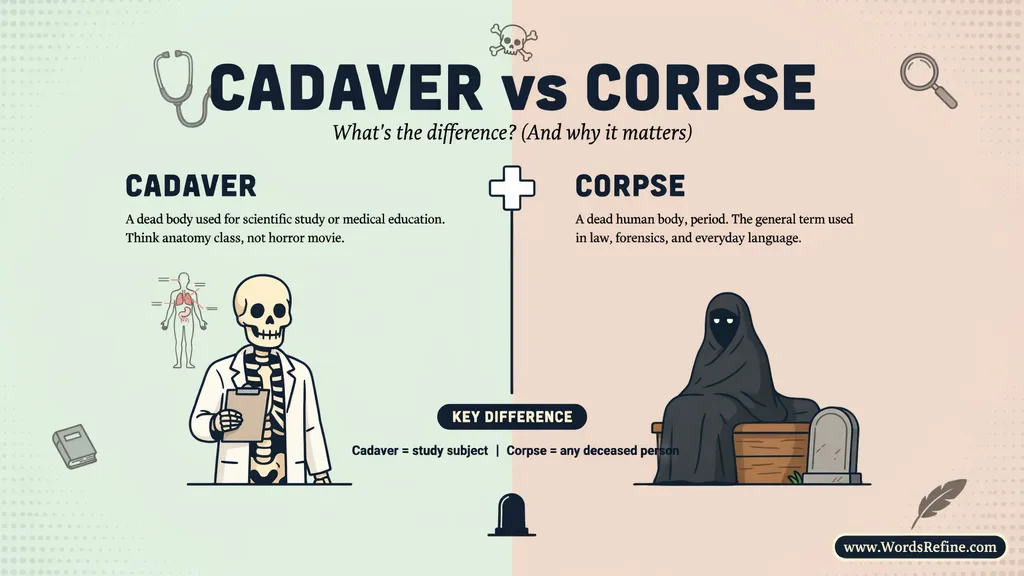
Cadaver means a dead human body, especially when that body is being discussed in a medical, anatomical, educational, or scientific setting. The word often appears in discussions about anatomy, dissection, medical education, research, and body donation.
Corpse also refers to a dead body, usually that of a person. However, it has a broader range of use. You might see corpse in a forensic investigation, historical account, mystery novel, news report, or description of a death.
Then there’s dead body. It’s the simplest and most direct expression of the three. It doesn’t sound especially technical, formal, or dramatic.
A useful way to remember the distinction is this:
Cadaver
A clinical or academic term commonly associated with anatomy and medical study.
Corpse
A direct term for a dead person’s body that works in many general, forensic, historical, and literary contexts.
Dead body
A plain everyday expression that simply describes what it means.
Therefore, there isn’t a grammar rule that says one is right and the other is wrong. Instead, context determines which word sounds more natural.
What Does Cadaver Mean?
A cadaver is a dead human body. However, the word carries a strong connection to medicine and anatomy.
For example, imagine a group of medical students standing around an anatomy table. They’re examining muscles, nerves, blood vessels, and organs as part of their studies. In that setting, cadaver is the natural word.
You could technically call the body a corpse, but that wouldn’t capture the professional setting as neatly. Cadaver immediately tells the reader that the body is being discussed in an anatomical or medical context.
That specialized association explains why you’ll often encounter phrases such as cadaver dissection, cadaver lab, cadaver study, and cadaver anatomy.
Cadaver in Medical Terms
When people ask what cadaver means in medical terms, the answer remains fairly simple. It refers to a dead human body, particularly when medical professionals, researchers, or students are studying it.
The word itself doesn’t mean “body used for dissection” in every possible situation. Instead, its strong connection with medical study makes that meaning especially common.
For example:
“The medical students examined the cadaver during their anatomy class.”
The sentence immediately creates a medical and educational setting.
By contrast, saying “The medical students examined the dead body during their anatomy class” would still make sense, but it sounds less like professional terminology.
Learn the difference between confusing more English words
Cancell vs Cancel Which one Is Correct?
Why Do Medical Students Use Cadavers?
Medical students study cadavers because real human anatomy can be far more complex than a diagram suggests.
A textbook can show where a nerve usually runs. A real body can reveal how that structure relates to surrounding muscles, blood vessels, bones, and organs. Students can also encounter natural anatomical variations that diagrams cannot fully represent.
Dissection gives students an opportunity to understand the human body in three dimensions. That experience can complement lectures, textbooks, medical imaging, models, and digital learning tools.
For that reason, cadaver-based education has remained an important part of anatomy teaching in many medical programs.
Cadaver Used for Medical Study and Research
A cadaver can be used for more than introductory anatomy lessons. Medical schools and research institutions may use donated bodies for anatomical education, surgical training, procedural practice, and scientific research.
Researchers can also study preserved tissues and anatomical structures to better understand the human body.
Body donation plays an important role here. People may voluntarily donate their bodies for medical education or scientific research. Such programs depend on informed consent and respectful handling of donors.
The terminology may sound clinical, but the educational process still involves a person who chose to contribute to medicine and education after death.
What Does Corpse Mean?
A corpse is a dead body, usually referring to the body of a person.
Unlike cadaver, corpse doesn’t strongly suggest a medical classroom or anatomy laboratory. Instead, it can appear in many different settings.
For example:
“The investigators found a corpse inside the abandoned building.”
That sentence sounds natural because the situation involves a death investigation rather than medical education.
You might also see corpse in historical writing, fiction, forensic discussions, or descriptions of decomposition.
Corpse in Medical and Forensic Contexts
Although cadaver has a stronger medical association, corpse can still appear in professional and forensic writing.
Forensic investigators deal with deceased people and their bodies as part of investigations. Depending on the context, they may use terms such as body, corpse, deceased, decedent, or human remains.
Each term can serve a slightly different purpose.
For example, body is broad and neutral. Corpse is more direct. Deceased can focus on the person who died. Human remains can cover a broader range of physical remains.
Therefore, corpse isn’t an incorrect medical word. It simply doesn’t carry the same specialized anatomical association as cadaver.
Corpse in Literature and Storytelling
Corpse also appears frequently in fiction.
Mystery stories, crime novels, historical accounts, and gothic literature often use the word because it creates a clear and sometimes stark image.
Compare these two sentences:
“The detective found a dead body.”
“The detective found a corpse.”
Both communicate the basic idea. However, the second sentence has a stronger literary or dramatic feel.
That difference matters when choosing vocabulary. A word can be technically correct while still sounding slightly out of place for the tone you’re trying to create.
Cadaver vs Corpse Side-by-Side Comparison
| Feature | Cadaver | Corpse |
|---|---|---|
| Basic meaning | A dead human body | A dead body, usually a human body |
| Common setting | Medical, anatomical, academic, scientific | General, forensic, historical, literary |
| Medical school | Very common | Less common |
| Anatomy laboratory | Very natural | Less typical |
| Forensic investigation | Possible | Common |
| Everyday conversation | Less common | Possible |
| Tone | Clinical or technical | Direct, formal, or stark |
| Anatomical research | Common | Less typical |
| Fiction | Possible | Very common |
The important point is that both words can refer to the same basic thing. The difference comes from how the speaker or writer frames that body.
What Is the Difference Between Cadaver vs Corpse?
The difference between cadaver vs corpse is mainly a difference in context and tone.
Both words can describe a dead human body. However, cadaver is closely connected with anatomy, medical education, dissection, and scientific study. Corpse has a broader general meaning and often appears when someone is describing a dead person’s body without focusing on medical education.
Think about the setting.
A professor in an anatomy laboratory might say:
“The students will examine the cadaver today.”
A detective might say:
“The investigators examined the corpse.”
A family member speaking in ordinary conversation might simply say:
“They found a dead body.”
All three sentences can refer to a deceased person’s body. The wording changes because the circumstances change.
That is the heart of the cadaver vs corpse difference.
Cadaver vs Corpse vs Dead Body
Adding dead body to the comparison makes the distinction much easier to understand.
Cadaver vs Dead Body
The difference between cadaver and dead body is mainly about register.
Dead body is ordinary and straightforward. It doesn’t tell the reader why the body is being discussed.
Cadaver sounds more specialized.
For example:
“The hikers reported finding a dead body.”
This sounds like ordinary reporting.
“The medical students studied a cadaver.”
This immediately suggests an anatomy course.
Neither sentence is grammatically better than the other. Each one simply fits a different situation.
Corpse vs Dead Body
The same idea applies to corpse and dead body.
“The police found a dead body.”
This sounds direct and neutral.
“The police found a corpse.”
This can sound more formal, stark, or dramatic.
Again, the difference isn’t correctness. It’s the feeling and context attached to the word.
Learn the difference between commonly mixed-up more words
Waving vs Waiving Which One Is Correct ?
Cadaver vs Corpse vs Dead Body
The easiest practical distinction is to think about what you want the reader to notice.
1If the focus is medical education or anatomy, cadaver is usually the natural choice.
2If the focus is a dead person’s body in a forensic, historical, or literary setting, corpse may fit better.
3If the goal is simple everyday communication, dead body is often the clearest option.
Why Do People Confuse Cadaver vs Corpse?
The confusion makes sense because the basic definitions overlap.
If two dictionaries describe words using similar meanings, it can be tempting to assume that the words are completely interchangeable. English doesn’t always work that neatly.
Synonyms often share a core meaning while developing different associations over time.
For example, begin and commence both describe starting something. However, they don’t sound equally natural in every sentence.
Cadaver vs corpse work in a similar way.
Cadaver sounds more clinical and anatomical. Corpse sounds more general and direct.
Once you recognize that distinction, the confusion becomes much easier to avoid.
Is a Cadaver the Same as a Corpse?
Broadly speaking, yes.
A cadaver is a dead human body, and a corpse is also a dead human body. Therefore, asking “Is a cadaver the same as a corpse?” produces a basically affirmative answer.
However, the words aren’t always equally suitable.
Imagine a university anatomy laboratory. Calling the body a cadaver makes sense because the students are studying human anatomy.
Now imagine a detective investigating a death. Calling the body a corpse may sound more natural.
The physical body hasn’t changed simply because the vocabulary has changed. The context has.
That distinction is important when answering questions such as “Are cadaver vs corpse the same thing?” They overlap in meaning, but their typical usage differs.
When Should You Use Cadaver?
Use cadaver when the subject involves anatomy, medical education, dissection, scientific study, or professional examination of a dead human body.
Anatomy Education
Cadaver works naturally when medical students study the structure of the human body.
“The anatomy students examined the cadaver during laboratory class.”
Medical Research
The term also fits research involving human anatomical structures or tissues.
“Researchers examined cadaveric tissue as part of the study.”
Dissection
Cadaver is particularly natural when discussing dissection.
“The students performed a careful cadaver dissection.”
Body Donation
The word can also appear when discussing bodies donated for medical education.
“The university received donated bodies through its anatomical donation program.”
In each example, the context makes the choice feel natural.
Learn the difference between tricky grammar more words
Wisp vs Whisp Which One Is Correct?
When Should You Use Corpse?

Use corpse when you need a direct term for a dead person’s body and the context isn’t specifically focused on anatomical education.
Forensic Investigation
Corpse can fit naturally in descriptions of forensic work.
“Investigators examined the corpse as part of the case.”
Historical Writing
The word can also appear in accounts of historical deaths.
“Workers discovered the corpse beneath the collapsed structure.”
Fiction
Corpse is common in mystery, crime, horror, and historical fiction.
“The detective entered the room and discovered a corpse near the window.”
General Description
Although corpse can sound somewhat stark, it remains a standard English word for a dead body.
Therefore, you don’t need to avoid it simply because it sounds serious.
Learn the difference between confusing word pairs
Compair vs Compare Which One Is Correct?
Cadaver vs Human Remains

Human remains is related to cadaver, but the two terms aren’t always interchangeable.
Human remains is a broader expression. It can refer to the physical remains of a deceased person, including situations where the remains no longer form an intact body.
The phrase is common in forensic science, archaeology, disaster recovery, and legal contexts.
For example:
“Investigators recovered human remains from the site.”
That statement doesn’t necessarily tell the reader that an intact body was found.
By contrast:
“Medical students examined a cadaver.”
That sentence strongly suggests an intact human body being used for anatomical education.
Consequently, cadaver vs human remains is a distinction worth remembering. Human remains is broader.
Cadaver vs Deceased
Cadaver and deceased aren’t interchangeable because they refer to different things.
Deceased generally describes a person who has died.
For example:
“The deceased person’s family was notified.”
Here, the focus remains on the person.
Cadaver refers to the physical body.
“The cadaver was prepared for anatomical study.”
The distinction becomes even clearer when you replace deceased with body. A deceased person is not simply another word for a cadaver because a person and that person’s physical body aren’t identical concepts.
The same reasoning applies to corpse vs deceased.
Cadaver vs Carcass
Cadaver and carcass should also be kept separate.
Carcass generally refers to the body of a dead animal. The word is especially common in contexts involving wildlife, agriculture, hunting, food production, or decomposition.
For example:
“The researchers examined the animal carcass.”
For a dead human body, cadaver vs corpse is normally more appropriate.
So, the practical distinction is simple. Cadaver generally refers to a dead human body in a medical or anatomical context, while carcass usually refers to a dead animal.
Does Cadaver Mean Dead Person?
Not exactly.
A cadaver refers to the physical body of a person who has died. It doesn’t mean the person themselves.
This distinction may seem small, but precise writing depends on it.
For example:
“The deceased was identified by investigators.”
Here, the subject is the person.
“The cadaver was examined by specialists.”
Here, the subject is the physical body.
Similarly, corpse refers to the body, not the person’s identity, personality, memories, or life.
Does Corpse Mean Dead Body?
Yes.
Corpse commonly means the body of a dead person.
However, corpse isn’t necessarily the best choice for every situation.
1If you’re writing about medical students studying anatomy, cadaver will usually sound more appropriate.
2If you’re describing a body discovered during an investigation, corpse may sound more natural.
3If you’re speaking casually, dead body may be simpler.
Is Cadaver More Respectful Than Corpse?
Neither word is automatically respectful or disrespectful.
However, they can create different impressions.
Cadaver tends to sound clinical and detached. That quality can make it appropriate for medical education because students need precise terminology when studying anatomy.
Corpse can sound more direct or emotionally stark. That doesn’t make the word offensive. It simply gives the sentence a different tone.
In discussions of body donation, writers may instead use phrases such as donated body, donor, or deceased person when they want to emphasize the individual rather than the anatomical material being studied.
Context matters more than choosing a word that sounds artificially formal.
Cadaver vs Corpse in Academic Writing
Academic writing values precision. Therefore, the best term depends on the subject being discussed.
1If the paper discusses anatomy education, cadaver is likely to be appropriate.
2If the paper examines forensic investigation, corpse may appear naturally.
3If the research discusses unidentified physical remains, human remains may be more accurate.
4If the discussion centers on an individual who died, deceased person may be preferable.
There is no universal rule requiring academic writers to use cadaver whenever they discuss death.
Instead, choose the term that communicates the exact idea without adding unnecessary emotional weight or technical language.
Cadaver vs Corpse Tone Makes a Difference
Words don’t exist in a vacuum.
Imagine a university brochure discussing anatomy education.
“Students study donated cadavers.”
That sounds professional and expected.
Now imagine the same brochure saying:
“Students study donated corpses.”
The sentence is understandable, but corpse creates a much harsher image. It may distract from the educational purpose of the passage.
Now consider a crime novel:
“The detective discovered a corpse in the basement.”
Here, corpse works beautifully because the word supports the serious and dramatic atmosphere.
This is why good word choice isn’t simply about finding a synonym. It’s about finding the word that fits the moment.
Common Mistakes With Cadaver vs Corpse
Treating One Word as Correct and the Other as Wrong
Both cadaver vs corpse are legitimate English words.
The real question is whether the chosen word fits the context.
Assuming Cadaver Always Means a Dissected Body
A cadaver is a dead human body. The word is strongly associated with medical study, but its meaning isn’t limited to a body that has already undergone dissection.
Using Cadaver Everywhere
Technical vocabulary isn’t automatically better vocabulary.
If you’re writing a simple report about a body discovered at a location, dead body may be clearer.
Assuming Corpse Is Always Offensive
Corpse can sound blunt or stark, but it isn’t inherently rude.
Its effect depends on the sentence, audience, and subject.
Confusing Corpse With Carcass
Corpse generally refers to a dead person. Carcass generally refers to a dead animal.
Writing “Dead Corpse”
A corpse is already a dead body, so dead corpse usually adds unnecessary repetition.
Instead of:
“The investigators found a dead corpse.”
write:
“The investigators found a corpse.”
Simple is better.
Medical Example
“The anatomy students carefully examined the cadaver.”
Here, cadaver is the natural choice because the body is part of medical education.
Forensic Example
“Investigators examined the corpse during the death investigation.”
Here, corpse fits the investigative setting.
Everyday Example
“The hikers reported finding a dead body near the trail.”
Dead body works because the speaker isn’t using specialized terminology.
Research Example
“Scientists analyzed cadaveric tissue during the experiment.”
Cadaveric fits because the sentence concerns scientific research involving tissue from a deceased body.
Literary Example
“The detective discovered a corpse beside the old fireplace.”
Corpse works because the sentence has a narrative and dramatic quality.
Learn the difference between often confused words
Performing vs Preforming Which One Is Correct?
How to Use Cadaver in a Sentence
If you’re wondering how to use cadaver in a sentence, keep the surrounding context in mind.
“The medical students studied the cadaver during their anatomy course.”
“The university opened a new cadaver laboratory.”
“The researchers examined cadaveric tissue.”
“The donated cadaver helped students understand human anatomy.”
“The surgical trainees practiced the procedure using cadaver-based instruction.”
These examples all place the word in a setting where its clinical association feels natural.
How to Use Corpse in a Sentence
Corpse works well when you’re describing a dead person’s body in a general, forensic, historical, or literary context.
“Detectives discovered a corpse inside the abandoned building.”
“The archaeologists uncovered a preserved corpse.”
“The novel begins with the discovery of a corpse.”
“The investigators examined the corpse for evidence.”
“The story describes the gradual decomposition of the corpse.”
The surrounding vocabulary helps establish the intended tone.
Cadaver Pronunciation and Corpse Pronunciation
Pronunciation can be another small hurdle when learning these words.
Cadaver is pronounced approximately /kəˈdæv.ɚ/ in American English. The main stress falls on the second syllable.
Corpse is pronounced approximately /kɔrps/ in American English.
The word corpse can feel difficult because of the cluster of consonant sounds at the end. Try not to add an extra vowel sound between those final sounds.
If you’re learning these words for academic or professional English, practicing them aloud can make them much easier to use naturally.
A Simple Case Study One Body, Different Words
Imagine that a person dies unexpectedly and the body is recovered.
At first, a witness might say:
“They found a dead body.”
That is plain and easy to understand.
Later, investigators might refer to the body as a corpse while discussing the death investigation.
Eventually, if the body was voluntarily donated for anatomical education, a medical school might refer to it as a cadaver.
The body itself hasn’t changed simply because different words are being used.
What changed was the context.
This example captures the practical cadaver corpse difference better than any complicated grammar rule.
What Are Cadavers Used For?
Cadavers can support several areas of medical education and research.
Human Anatomy Education
Medical students can use cadavers to study muscles, nerves, blood vessels, organs, bones, and other structures.
Dissection Training
Dissection allows students to examine anatomical relationships directly instead of relying entirely on illustrations or models.
Surgical Education
Some training programs use cadaver-based instruction to help healthcare professionals understand anatomy and practice certain procedures.
Anatomical Research
Researchers can examine human anatomical structures and natural variations through donated bodies and tissues.
Medical Research
Cadaver-based studies can contribute to research involving anatomy, surgical techniques, biomechanics, and other areas of medical science.
The exact role of cadavers varies by institution and program. Modern education also combines traditional anatomy with imaging, simulation, digital models, and other technologies.
Learn the difference between basic English word mistakes
Inquiries vs Queries What’s the Difference ?
Why Are Cadavers Important in Medical Education?
One major reason is simple: human bodies aren’t identical.
A textbook may present the standard arrangement of an anatomical structure. A real human body can reveal variations in size, shape, position, branching, or relationship with nearby structures.
For students, seeing those variations can make anatomy more concrete.
Cadaver study can also connect classroom knowledge with three-dimensional reality. Instead of simply memorizing the names of structures, students can observe how those structures exist together.
That experience can be especially valuable when learning complex regions of the body.
Body Donation and Anatomical Education
Behind every donated body is a person who made a decision to contribute to education or research.
That fact has become increasingly important in discussions about anatomy education.
Medical schools and anatomy programs often establish rules governing consent, preservation, access, handling, and final disposition. Students may also receive guidance about professional conduct and respectful treatment of donors.
Therefore, while cadaver is a clinical term, the educational process doesn’t have to be emotionally detached.
A thoughtful anatomy program recognizes both sides of the subject: the scientific value of the body and the human life that came before it.
Which Word Should You Use?
The answer depends on your sentence.
Use Cadaver for Medical and Anatomical Contexts
Choose cadaver when you’re discussing anatomy classes, dissection, medical education, anatomical research, surgical training, or a body donated for scientific study.
For example:
“The students examined the cadaver during their anatomy laboratory.”
Use Corpse for General or Forensic Descriptions
Choose corpse when you’re describing a dead person’s body in a forensic investigation, historical account, mystery story, or other general context.
For example:
“Investigators discovered a corpse inside the building.”
Use Dead Body for Plain Everyday Language
Choose dead body when you want the most straightforward expression.
For example:
“The police reported finding a dead body.”
Use Human Remains for Broader Formal Contexts
Choose human remains when the physical material left after death may not constitute an intact body or when the context calls for broader forensic, archaeological, or formal terminology.
For example:
“Investigators recovered human remains from the site.”
Learn the difference between commonly misused words
Lend vs Lent What’s the Difference and When to Use Each?
Practice Session Cadaver vs Corpse
Fill in each blank with the correct word.
The medical students studied the human ______ during their anatomy class.
The investigators discovered a ______ at the scene of the crime.
The surgeon used a donated ______ to practice the procedure.
The police carefully examined the ______ for evidence.
The family was informed about the death of their ______ relative.
The anatomy professor explained how the ______ would be used for educational purposes.
The documentary described the discovery of an ancient ______.
The veterinarian examined the animal ______ after the accident.
The researchers conducted an anatomical study using a preserved ______.
The forensic team transported the ______ to the medical examiner’s office.
The phrase “dead ______” is common in everyday conversation.
The medical school received a donated ______ through its body donation program.
The archaeologists uncovered human ______ at the excavation site.
The anatomy students carefully examined the ______ during dissection.
The detective found the ______ inside the abandoned building.
In a medical textbook, the term ______ is more likely to appear than the phrase “dead body” when discussing anatomical study.
The news report referred to the unidentified ______ found near the river.
The doctor spoke respectfully about the ______ patient and the importance of treating the family with care.
The researchers used the donated ______ to study variations in human anatomy.
The farmer discovered the ______ of a cow in the field.
The forensic report described the condition of the ______ after decomposition had begun.
The professor explained that a ______ is a dead human body commonly discussed in medical or anatomical settings.
The word ______ is often used in forensic investigations and crime reports.
When referring broadly to bones, tissues, or other physical evidence left after death, the term human ______ may be appropriate.
The simplest everyday expression for the physical body of someone who has died is “dead ______.”
Answers
Cadaver
Corpse
Cadaver
Corpse
Deceased
Cadaver
Corpse
Carcass
Cadaver
Corpse
Body
Cadaver
Remains
Cadaver
Corpse
Cadaver
Corpse
Deceased
Cadaver
Carcass
Corpse
Cadaver
Corpse
Remains
Body
Here’s a trusted source for clear more words Comparison:
FAQs
What is the simplest definition of a cadaver?
A cadaver is a dead human body, especially one used for medical education, anatomical study, dissection, or scientific research.
What is the simplest definition of a corpse?
A corpse is the physical body of a person who has died. The word commonly appears in general, forensic, historical, and literary contexts.
Is cadaver a medical term?
Yes. Cadaver is commonly used as a medical, anatomical, and scientific term when professionals discuss a human body after death, particularly in education or research.
Is corpse a medical term?
Corpse can appear in medical and forensic writing, but it isn’t as specifically associated with anatomical education as cadaver. Its meaning is broader and often more direct.
Can doctors use the word corpse?
Yes. Doctors, forensic professionals, and other specialists can use corpse when the context calls for it. However, cadaver is often more natural when discussing anatomy, dissection, or medical training.
Can a donated body be called a cadaver?
Yes. A donated human body used for anatomical education or research is commonly called a cadaver in that setting.
Why is the word cadaver common in anatomy classes?
Cadaver has a clinical and academic tone, which makes it suitable for discussing human anatomy, dissection, and medical training without focusing on the circumstances of death.
Can cadaver describe an animal?
Generally, no. In standard modern usage, cadaver usually refers to a dead human body. Carcass is the more common term for the body of a dead animal.
What is the difference between a cadaver and human remains?
Cadaver usually refers to an entire dead human body, particularly in medical or anatomical contexts. Human remains is broader and can refer to bones, tissues, fragments, or other physical remains of a deceased person.
What is the difference between cadaver and deceased?
Cadaver refers to the physical body after death. Deceased refers to the person who has died and often works as a noun or adjective depending on the sentence.
Can you use cadaver vs corpse in the same sentence?
Yes. Both words can refer to a dead human body, but using them together may highlight a change in context. For example, a body may be described as a corpse in a forensic investigation and later as a cadaver when used for anatomical education.
Is “dead corpse” correct English?
The phrase is understandable, but it is usually unnecessary because corpse already means a dead body. “Corpse” or “dead body” is normally enough.
Is “dead cadaver” correct English?
It is generally redundant. A cadaver is already a dead human body, so adding dead usually doesn’t provide useful information.
What is another word for cadaver?
Depending on the context, alternatives include dead body, corpse, human remains, or anatomical specimen. However, these terms aren’t always interchangeable because each carries a slightly different meaning or tone.
What is another word for corpse?
Possible alternatives include cadaver, dead body, and human remains. The best choice depends on whether you’re writing for a medical, forensic, everyday, or formal audience.
Is cadaver more formal than corpse?
Cadaver generally sounds more clinical or academic. Corpse can sound more direct and is common in forensic, historical, and literary descriptions.
Which word is better for an anatomy textbook: cadaver vs corpse?
Cadaver is usually the more natural choice because anatomy textbooks commonly discuss human bodies in the context of anatomical study, dissection, and medical education.
Which word is better for a crime report: cadaver vs corpse?
Corpse is commonly used in crime and forensic descriptions. However, cadaver can also be appropriate when the writing takes a clinical or scientific approach.
Does cadaver refer only to a preserved body?
No. A cadaver doesn’t have to be preserved. The word refers to a dead human body, while preservation or embalming describes how that body has been treated.
Does corpse always mean a human body?
In modern standard usage, corpse most commonly refers to a dead human body. When discussing a dead animal, carcass is generally the more appropriate term.
Are cadaver and dead body interchangeable?
They can overlap in meaning, but they aren’t identical in tone. Dead body is plain and everyday, while cadaver is more specialized and strongly associated with medical or anatomical contexts.
Are cadaver vs corpse synonyms?
They are near-synonyms because both can refer to a dead human body. However, their typical contexts differ, so replacing one with the other doesn’t always produce the same tone.
When should you avoid using the word cadaver?
You may want to avoid cadaver in casual conversations about someone’s death because it has a clinical tone. In everyday situations, dead body or another respectful expression may sound more natural.
When should you avoid using the word corpse?
You may want to avoid corpse in sensitive personal communication because it can sound stark or impersonal. A phrase such as deceased person or the person’s body may fit better depending on the situation.
Conclusion
Choosing between cadaver vs corpse depends largely on context, tone, and purpose. Both words can refer to a dead human body, but they carry different associations. Cadaver is primarily a clinical and academic term commonly used in anatomy, medical education, scientific research, and dissection. Corpse is broader and more direct, making it common in forensic investigations, historical accounts, literature, and general descriptions.
A useful way to remember the distinction is to consider the setting. In an anatomy laboratory, medical students typically study a cadaver. and In a forensic investigation, professionals may refer to the body as a corpse. In everyday communication, dead body is often the simplest and clearest expression.
One common mistake is assuming that cadaver vs corpse are completely interchangeable. Although their meanings overlap, their typical contexts and tones differ. It’s also best to avoid redundant expressions such as “dead corpse” or “dead cadaver,” since both terms already refer to a body after death.
Once you understand these differences, choosing the appropriate word becomes straightforward. Use cadaver when the context is medical, anatomical, or scientific. Use corpse when the context is general, forensic, historical, or literary. By considering your audience and the purpose of your writing, you can use both terms accurately, naturally, and professionally.

Diora AJS she is an experienced blogger and passionate English language enthusiast at Words Refine. With a keen eye for language and a love for clear communication, she writes practical content about grammar, word meanings, usage, and commonly confused terms. Her goal is to make English easier to understand through clear explanations and relatable examples, helping readers write accurately and communicate with confidence.