
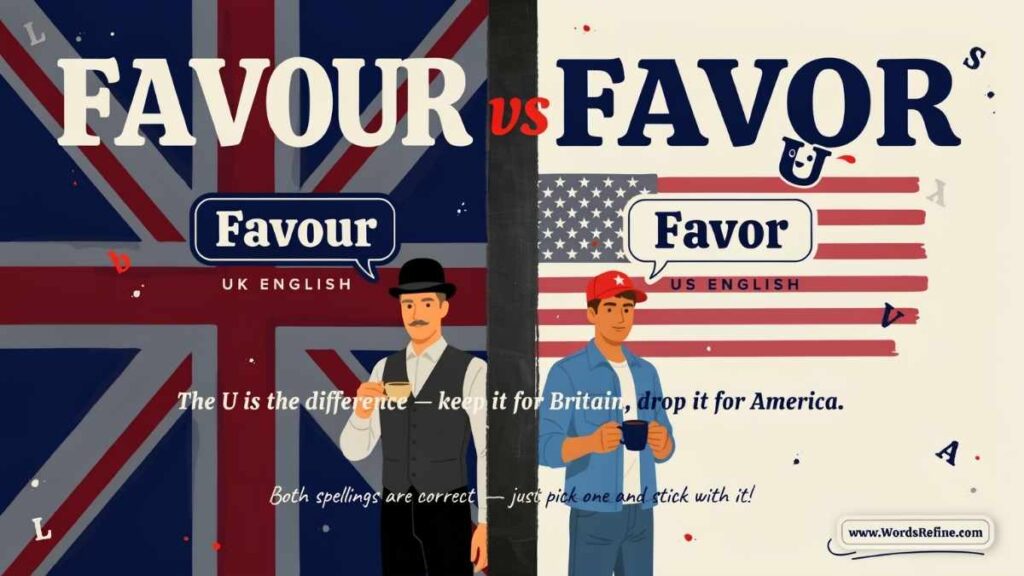
The difference between favour vs favor comes down to one small letter, but that tiny detail can cause plenty of confusion. Should you write “favor” without a “u” or use “favour” instead? Both spellings are correct, so the answer depends on your audience. American English uses “favor,” while British English prefers “favour.” Although the two words share the same meaning and pronunciation, mixing their spellings can make your writing inconsistent. The good news is that you don’t need to memorize a long list of grammar rules to get it right. This guide explains their meanings, spelling differences, common mistakes, and everyday usage, helping you choose the right spelling with confidence.
Favour vs Favor Quick Answer
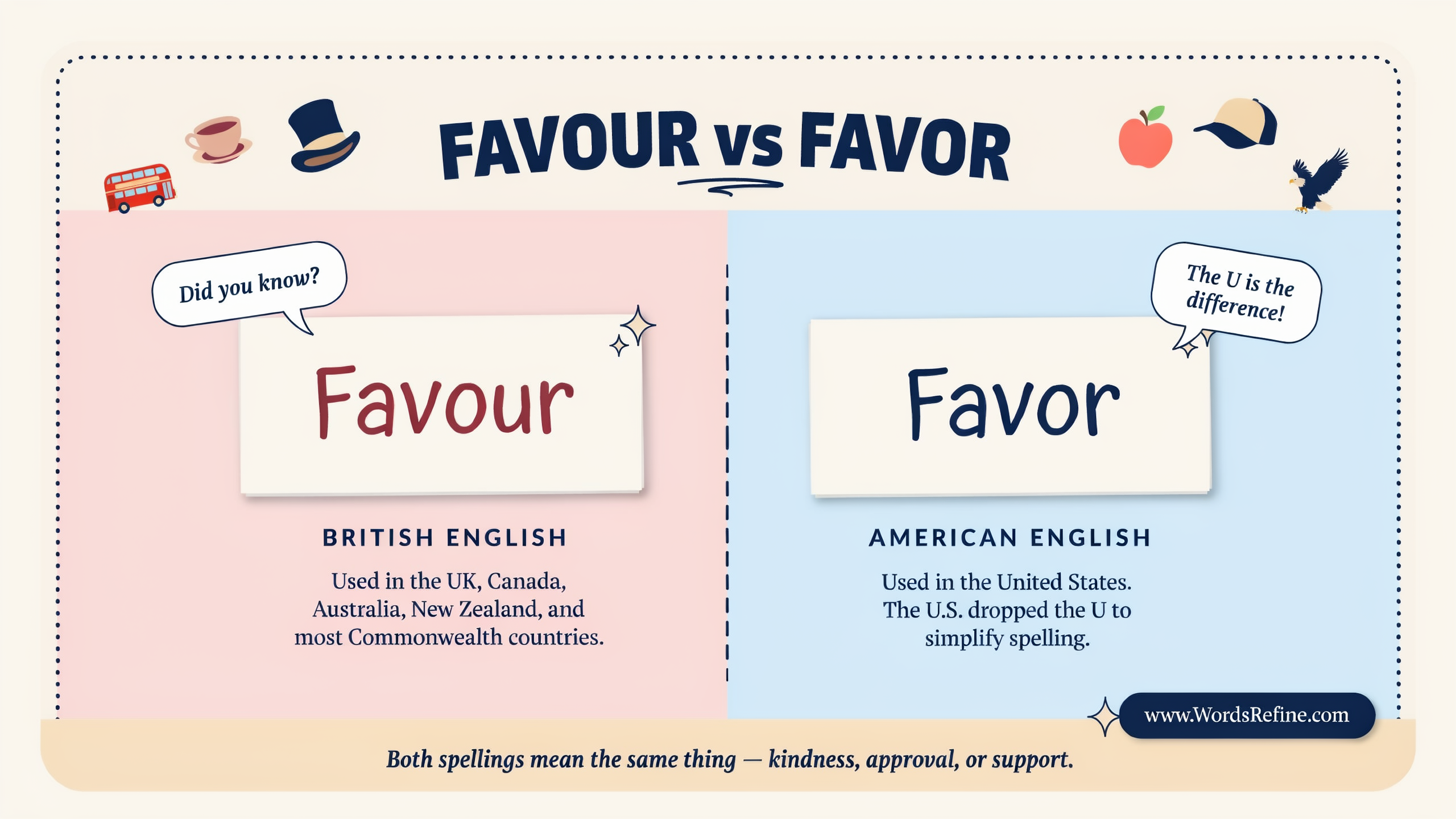
Favor is the standard American English spelling, while favour is the standard British English spelling. Both words express kindness, support, approval, or preference. The only difference is their spelling.
| Feature | Favor | Favour |
|---|---|---|
| English variety | American English | British English |
| Meaning | Kindness, support, or preference | Same |
| Part of speech | Noun and verb | Noun and verb |
| Pronunciation | Same | Same |
| Example | Can you do me a favor? | Can you do me a favour? |
| Related adjective | Favorable | Favourable |
| Related noun | Favoritism | Favouritism |
In simple terms, use favor when writing for an American audience and favour when following British spelling conventions.
What Is the Difference Between Favour vs Favor?
The difference between favour and favor lies entirely in regional spelling. Both words describe an act of kindness, a preference, approval, or support for someone or something.
For example, an American might say, “My neighbor did me a huge favor by watering my plants.” In British English, the same sentence would use “favour” instead.
The meaning doesn’t change, and neither does the sentence structure. Only the spelling reflects the writer’s preferred variety of English.
This difference also appears in words such as color and colour, honor and honour, and labor and labour. American English generally drops the additional u, while British English retains it.
However, not every English spelling difference follows this exact pattern. Some words have their own historical rules, so it’s helpful to learn common spelling pairs individually.
Learn the difference between tricky grammar more words
Discrete vs Discreet What the Difference and which is Correctly?
What Does Favor Mean?
In American English, favor can function as both a noun and a verb. Its meaning depends on the context in which you use it.
Favor as a Noun
As a noun, favor can describe an act of kindness, a sign of approval, support, or a special advantage.
An act of kindness is one of its most common meanings. For example, when someone helps you carry your groceries or gives you a ride to work, they’re doing you a favor.
Examples:
- Could you do me a favor and pick up my package?
- Sarah asked her coworker for a small favor.
- Thank you for the favor you did for my family.
Favor can also express approval or support for an idea, person, or decision.
For example:
- Most committee members expressed favor toward the new proposal.
- The coach showed favor toward players who practiced regularly.
- Public opinion shifted in favor of the environmental policy.
In other situations, favor describes an advantage or special treatment.
For example:
- The manager showed favor to experienced employees.
- The new agreement gave the company a financial advantage.
- The final decision worked in favor of the defendant.
Favor as a Verb
As a verb, favor means to prefer, support, approve of, or treat someone or something positively.
For example:
- I favor the second option because it’s more affordable.
- The committee favors candidates with practical experience.
- This neighborhood favors walking because most shops are nearby.
- The teacher tends to favor students who participate actively.
In each sentence, favor expresses a preference or a positive attitude toward someone or something.
What Does Favour Mean?
Favour has exactly the same meanings as favor. The only difference is that British English and several other English varieties generally include the additional u.
Favour as a Noun
As a noun, favour refers to a helpful action, approval, support, or preferential treatment.
For example:
- Could you do me a favour and close the window?
- She asked her friend for a personal favour.
- The proposal received considerable favour among the committee members.
- The team benefited from the referee’s decision in its favour.
These examples show how British English uses favour in everyday conversations and formal writing.
Favour as a Verb
As a verb, favour means to prefer, support, or treat someone or something positively.
For example:
- I favour the traditional approach to teaching.
- The council favours improvements to public transportation.
- The company tends to favour applicants with relevant experience.
- The evidence favours the second explanation.
As you can see, the spelling changes, but the grammar and meaning remain the same. You can switch between the two forms without changing the sentence structure.
Learn the difference between confusing word pairs
Further vs Farther The Simple Difference and Each Correctly?
Why Do Favour vs Favor Have Different Spellings?
The spelling difference between favour and favor has a long history. It developed as English evolved in Britain and America, particularly during the 18th and 19th centuries.
The Influence of British English
British English traditionally retained the u in many words influenced by French spelling. Words such as favour, colour, honour, and labour became established forms in British writing.
Over time, British dictionaries, schools, publishers, and institutions helped preserve these spellings. As a result, the additional u became a familiar feature of British English.
Noah Webster and American Spelling Reforms
Meanwhile, American English gradually developed its own spelling preferences. Noah Webster, an American lexicographer, played an important role in promoting spelling reforms during the late 18th and early 19th centuries.
Webster supported simpler and more consistent spelling. His dictionaries helped popularize forms such as favor, color, and honor.
Although he didn’t create every difference between American and British English, his work influenced the development of American spelling conventions.
Consequently, favor became the standard American spelling, while favour remained the preferred British form.
British English vs American English Which Spelling Should You Use?
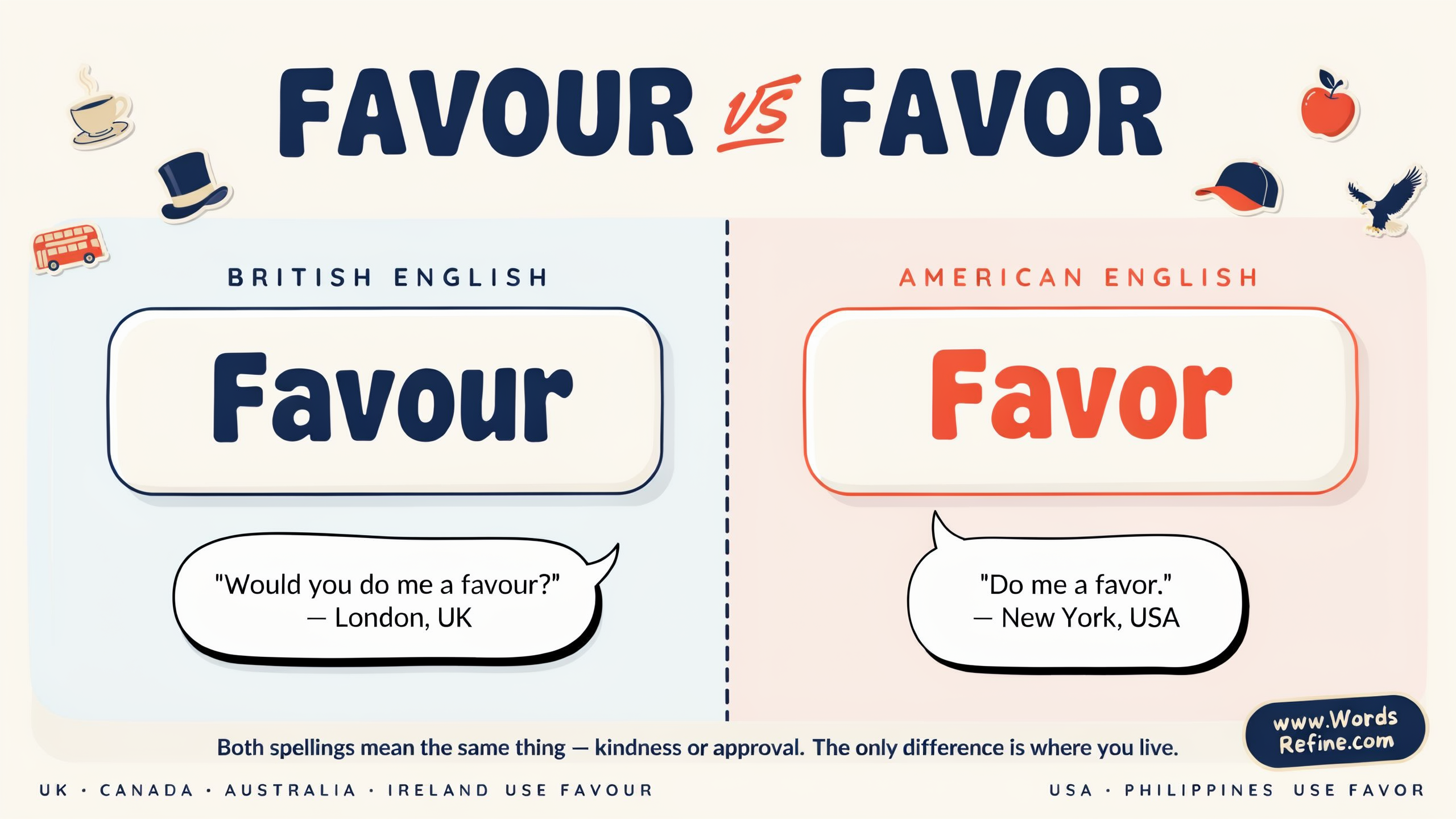
Choosing between favor and favour depends on your audience and the spelling conventions you follow. Both forms are correct, but using the expected spelling helps your writing look natural and consistent.
| English variety | Common spelling | Example |
|---|---|---|
| American English | Favor | Please do me a favor. |
| British English | Favour | Please do me a favour. |
| Canadian English | Favour | Could you do me a favour? |
| Australian English | Favour | She asked for a small favour. |
| New Zealand English | Favour | He did us a great favour. |
| Indian English | Favour | They requested a special favour. |
These are general preferences rather than absolute rules. Individual organizations, universities, and publications may follow different style guides.
Learn the difference between tricky English words with easy explanations
Capital vs Capitol Which One Is Correct?
Favor in American English
In the United States, favor is the standard spelling. American dictionaries, newspapers, educational materials, and professional publications generally use the version without u.
For example:
- Could you do me a favor before you leave?
- The manager decided to favor the more experienced applicant.
- The new schedule is favorable to working parents.
- The company is known for treating employees fairly rather than showing favoritism.
When writing for an American audience, use favor, favorable, favorite, and favoritism to maintain consistent spelling.
Favour in British English
In the United Kingdom, favour is the standard spelling. British publications and educational institutions generally retain the u in this word and its related forms.
For example:
- Could you do me a favour before you leave?
- The manager decided to favour the more experienced applicant.
- The new schedule is favourable to working parents.
- The organization discourages favouritism in hiring decisions.
Similarly, British spelling conventions appear in many other English-speaking regions, including Australia and New Zealand.
Favour vs Favor in Australian and New Zealand English
Australian and New Zealand English generally follow British spelling conventions. Therefore, favour is the usual spelling in both countries.
For example:
- The teacher did us a great favour.
- The proposal received support from several community groups.
- The new policy is favourable to small businesses.
However, some international companies and publications use American spelling to maintain consistency across their content. When writing for a particular organization, its style guide should guide your choice.
Favour vs Favor in Canadian English
Canadian English often uses favour, following the British spelling pattern for words ending in our. You’ll commonly find favour, colour, and honour in Canadian newspapers, books, and official writing.
However, Canadian English also reflects American spelling influences. Some organizations and publications adopt different conventions, especially in technical and commercial writing.
For Canadian readers, favour is generally the expected spelling unless a particular publication or organization specifies otherwise.
Learn the difference between confusing more English words step by step
Lay vs Lie Difference and which is correct?
The Simple Rule to Remember Favour vs Favor
If you often forget which spelling to use, a simple regional reminder can help.
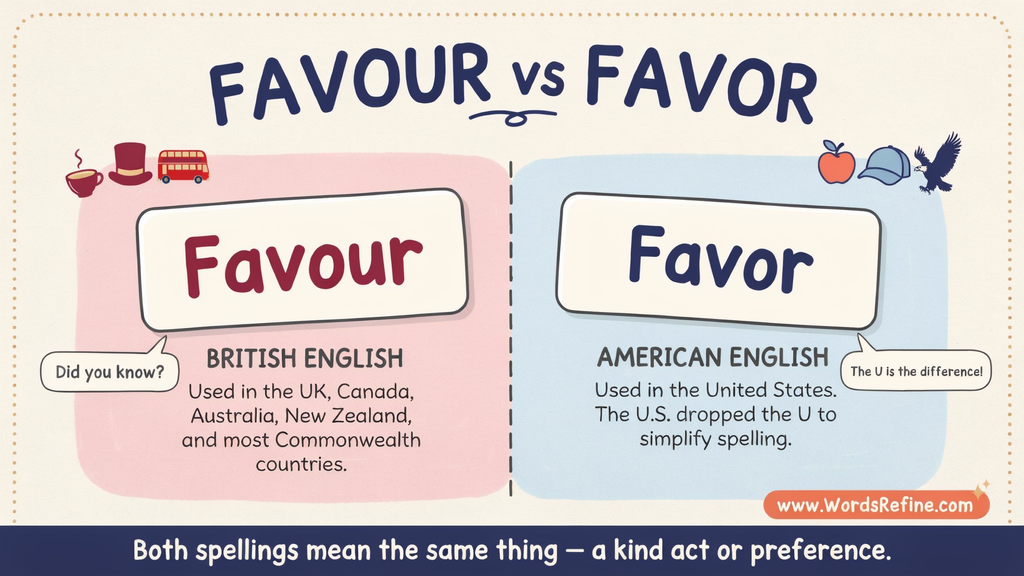
- Favor belongs to American English and follows the spelling used in words such as color and honor.
- Favour belongs to British English and follows the spelling used in words such as colour and honour.
You can also remember the difference by learning related words together.
| American English | British English |
|---|---|
| Favor | Favour |
| Color | Colour |
| Honor | Honour |
| Labor | Labour |
| Favorite | Favourite |
| Favorable | Favourable |
| Favoritism | Favouritism |
Most importantly, remember that this is a spelling difference rather than a grammatical one. Both forms work with the same subjects, verbs, tenses, and sentence structures.
Favour vs Favor in Everyday Sentences
Real examples make spelling rules much easier to understand. The following sentences show how both forms work in everyday communication.
| American English | British English |
|---|---|
| Can you do me a favor? | Can you do me a favour? |
| She asked for a small favor. | She asked for a small favour. |
| I favor the blue design. | I favour the blue design. |
| The decision worked in his favor. | The decision worked in his favour. |
| They received favorable reviews. | They received favourable reviews. |
| Please return the favor tomorrow. | Please return the favour tomorrow. |
Notice that only the spelling changes. The meaning and grammatical structure remain the same.
Favor vs Favour in a Sentence Practical Examples
Let’s look at a few everyday situations to see how the two spellings work.
Asking for help
American English: Would you do me a favor and send the report?
British English: Would you do me a favour and send the report?
Expressing a preference
American English: I favor the first design because it looks cleaner.
British English: I favour the first design because it looks cleaner.
Showing support
American English: Several residents spoke in favor of the proposal.
British English: Several residents spoke in favour of the proposal.
Describing an advantage
American English: The final decision went in our favor.
British English: The final decision went in our favour.
Discussing positive results
American English: The weather conditions were favorable for the event.
British English: The weather conditions were favourable for the event.
These examples demonstrate why regional spelling matters. Even when the meaning is clear, using the expected spelling makes your writing feel more natural to its intended audience.
Learn the difference between commonly confused more words in English
Whoever vs Whomever How to Use Each Word Correctly?
Common Expressions With Favour vs Favor
English has several familiar expressions that use favor or favour. Fortunately, their meanings generally remain the same across regional varieties.
Do Someone a Favor vs Favour
This expression means helping someone by doing something for them.
For example:
- Could you do me a favor and feed the cat?
- She did her colleague a favour by covering an extra shift.
In Favor of or In Favour of
This phrase expresses support for an idea, decision, person, or proposal.
For example:
- The committee voted in favor of the changes.
- Most residents were in favour of building a new community center.
Return the Favor vs Favour
To return a favor means helping someone who previously helped you.
For example:
- You helped me move last weekend, so let me return the favor.
- He offered to return the favour after his friend repaired his bicycle.
Find Favor vs Favour With Someone
This expression means gaining someone’s approval or positive opinion.
For example:
- The proposal found favor with several board members.
- Her practical suggestions found favour with the school principal.
Favor vs Favour Someone With Something
This expression means giving someone something, often as a courtesy, opportunity, or special benefit.
For example:
- The author favored readers with an exclusive preview.
- The host favoured the guests with a warm welcome.
Curry Favor vs Favour
To curry favor means trying to gain someone’s approval through flattery, excessive politeness, or helpful actions.
For example:
- The employee tried to curry favor with the manager.
- He offered expensive gifts to curry favour with influential clients.
In all these expressions, the spelling follows the same regional pattern. American English generally uses favor, while British English uses favour.
Learn the difference between tricky words and use them correctly
Vender vs Vendor Which one Is Correct?
Common Mistakes With Favour vs Favor
Although both spellings are correct, writers sometimes make mistakes when choosing between them. Most of these problems involve regional consistency rather than grammar.
1. Mixing regional spellings: Using favor in one paragraph and favour in another can make a document look inconsistent. Choose one spelling system and follow it throughout.
2. Assuming one spelling is incorrect: Neither form is universally wrong. The correct choice depends on the variety of English you’re using.
3. Using the wrong related spelling: American English uses favorable and favorite, while British English generally uses favourable and favourite.
4. Ignoring language settings: A spellchecker configured for British English may flag favor even when you’re writing for an American audience. Check your language settings before changing your text.
5. Changing quoted material unnecessarily: If you’re quoting a source that uses favour, don’t automatically change it to favor. Preserve the original spelling unless your quotation guidelines allow adjustments.
The key is to recognize the difference between an actual spelling error and a regional variation. A British spelling isn’t incorrect simply because an American spellchecker underlines it.
Favour vs Favor in Professional and Academic Writing
In professional and academic writing, consistency matters just as much as correctness. Your choice between favor and favour should depend on your audience, institution, or publication requirements.
Business Emails
When writing business emails, follow the spelling conventions used by your company or intended reader.
American English:
“Could you do me a favor and review the updated proposal before Friday?”
British English:
“Could you do me a favour and review the updated proposal before Friday?”
Both sentences sound natural in their respective varieties. The spelling simply reflects the audience.
Academic Papers
Academic writing often follows a specific style guide or institutional requirement. Before submitting an assignment, check whether your university expects American or British English.
For example, an American university may expect favor, favorable, and favoritism. In contrast, a British university may prefer favour, favourable, and favouritism.
If your research includes quotations from international sources, preserve their original spelling when required by your citation and quotation guidelines.
Websites and International Publications
Websites often attract readers from different countries. Therefore, consistent spelling becomes especially important.
An American company might use favor throughout its website, even when international customers visit. Similarly, a British publication might retain favour across its articles, newsletters, and promotional materials.
For international content, establish a spelling policy before publishing. This helps writers, editors, and content teams maintain a consistent style.
Consider a company preparing customer service guides for American and British readers. Its American edition might say, “We’d be happy to do you a favor.” Meanwhile, its British edition might say, “We’d be happy to do you a favour.”
Both versions communicate the same message. By adapting the spelling to each audience, the company makes its writing feel familiar without changing its meaning.
What Do Dictionaries and Grammar Checkers Say About Favour vs Favor?
Dictionaries recognize favor and favour as regional spelling forms of the same word. American dictionaries generally list favor as the main spelling, while British dictionaries typically use favour.
Grammar checkers follow similar regional conventions. However, their suggestions depend on the language settings and sometimes the style preferences you’ve selected.
Learn the difference between tricky grammar more words
Sited vs Cited Meaning Differences Examples and Correct Usage
How Spellcheckers Handle the Difference
Tools such as Microsoft Word and Grammarly can identify regional spelling differences when their language settings support the relevant variety of English.
For example:
- A document set to American English will generally accept favor and may flag favour.
- A document set to British English will generally accept favour and may flag favor.
- A document using Canadian English may recognize favour as the expected spelling.
A spelling warning doesn’t always mean you’ve made a mistake. Sometimes, it simply indicates that your software expects a different regional convention.
Before proofreading a long document, check its language settings. This simple step can prevent unnecessary corrections and help you maintain consistent spelling from beginning to end.
Favorable vs Favourable Which Spelling Is Correct?
Both favorable and favourable are correct. The choice depends on regional spelling conventions, just as it does with favor and favour.
The adjective favorable or favourable describes something that produces a positive result, creates an advantage, or shows approval.
For example:
American English: The company received favorable feedback from customers.
British English: The company received favourable feedback from customers.
Other related words follow the same general pattern.
| American English | British English |
|---|---|
| Favor | Favour |
| Favorable | Favourable |
| Favorably | Favourably |
| Favorite | Favourite |
| Favoritism | Favouritism |
| Favored | Favoured |
| Favoring | Favouring |
These forms are useful to learn together because spelling mistakes often happen when writers remember the main word but overlook its related forms.
For instance, writing favour in a British English article and then using favorable in the next paragraph creates an inconsistent pattern. Keeping related words together makes proofreading much easier.
Learn the difference between similar English words the easy way
Buy vs Bye Meaning Differences Examples ?
Favorite vs Favourite Another Common Spelling Difference
The difference between favorite and favourite follows the same regional pattern as favor and favour.
In American English, favorite is the standard spelling. In British English, favourite is generally preferred.
Both words describe a person, thing, or activity that someone likes more than others.
For example:
- American English: Pizza is my favorite food.
- British English: Pizza is my favourite food.
- American English: That was my favorite movie of the year.
- British English: That was my favourite movie of the year.
The same rule applies to favoritism and favouritism. If you’re using British spelling, remember the additional u in the related word forms.
Learn the difference between commonly mixed-up more words
T- Shirt vs Tee Shirt Which One Is Correct and Why?
Practice Favour vs Favor
- Could you do me a ______ and help me carry these boxes?
- She asked her colleague for a small ______ before the meeting.
- In American English, the correct spelling is ______.
- In British English, the preferred spelling is ______.
- Would you mind doing me a ______ and closing the door?
- The teacher showed ______ to students who needed extra time.
- My neighbor did me a ______ by collecting my mail.
- The proposal was in ______ of supporting local businesses.
- Could I ask you for a ______?
- The manager requested the client’s ______ before approving the changes.
- In the United States, write ______ rather than “favour.”
- In the United Kingdom, “favour” is preferred over ______.
- Can you do me a ______ and send me the notes?
- The coach’s ______ helped the young player gain confidence.
- She returned the ______ by helping her friend prepare for the interview.
- “Do me a solid” is an informal way to ask someone for a ______.
- The author used American English and consistently spelled the word ______.
- The British newspaper used the spelling ______ throughout its article.
- Would you please do me a ______ and review this paragraph?
- The committee decided to ______ the proposal after reviewing the details.
- He asked his supervisor for a ______ to leave early.
- The expression “in favor of” means to support or approve of something.
- Could you do me a ______ and water the plants while I’m away?
- The company received public ______ after announcing its community program.
- Whether you write “favor” or “favour,” the meaning stays the same. Only the regional spelling changes.
Answers
- favor
- favor
- favor
- favour
- favor
- favor
- favor
- favor
- favor
- favor
- favor
- favor
- favor
- favor
- favor
- favor
- favor
- favour
- favor
- favor
- favor
- support
- favor
- favor
- No word is needed. The sentence is already complete.
Here’s a trusted source for clear more words Comparison:
FAQs
Do Americans Say Favor or Favour?
Americans use “favor,” while “favour” is the standard spelling in British English. Both spellings have the same meaning and pronunciation; the difference is regional.
Is It God’s Favor or God’s Favour?
Both spellings are correct. Use “God’s favor” in American English and “God’s favour” in British English. The choice depends on the spelling convention you follow.
What Is Another Word for Favor?
The best alternative depends on the context. Words such as “help,” “kindness,” “support,” “assistance,” and “approval” can replace “favor” in different situations. For example, “Could you do me a favor?” can become “Could you help me?”
Which Is Correct: Favor or Favour?
Both “favor” and “favour” are correct spellings. American English uses “favor,” while British English uses “favour.” Choose the spelling that matches your audience and stay consistent throughout your writing.
Which Is Correct: “Make Me a Favor” or “Do Me a Favor”?
“Do me a favor” is the correct expression in standard English. “Make me a favor” is not idiomatic. For example, you can say, “Could you do me a favor and turn off the lights?”
Can I Say “Can You Do Me a Favour”?
Yes. “Can you do me a favour?” is grammatically correct and sounds natural in British English. In American English, write “Can you do me a favor?” instead. Both expressions are common ways to ask someone for help.
Is “Can I Ask You for a Favor?” Correct?
Yes. “Can I ask you for a favor?” is grammatically correct and polite. You can also say, “Could I ask you for a favor?” when you want to sound a little more courteous.
What Is Another Way to Say “Do Me a Favor”?
You can use expressions such as “help me out,” “give me a hand,” or “do something for me.” For example, “Could you give me a hand with these bags?” is a natural alternative in everyday conversation.
How Do I Say I Need a Favor?
You can say, “I need to ask you for a favor,” “Could you help me with something?” or “Would you mind doing me a favor?” These expressions communicate your request clearly while keeping the tone friendly and respectful.
What Is the Golden Rule of Favors?
The golden rule of favors is to ask respectfully, appreciate the help you receive, and avoid making others feel obligated. A favor should be freely given, not treated as a debt. When someone helps you, a sincere thank-you goes a long way.
Can You Please Do Me a Favour?
Yes. “Can you please do me a favour?” is grammatically correct and polite in British English. In American English, use “favor” instead. You can make the request more specific by saying, “Can you please do me a favour and send me the file?”
What Is Another Way to Say “Asking for a Favour”?
Depending on the context, you can say “requesting help,” “asking for assistance,” or “seeking a favor.” In casual conversation, “asking someone for a little help” sounds natural and approachable.
Is “I Need Your Favour” Grammatically Correct?
“I need your favour” is grammatically possible, but it may sound unusual if you simply want someone to help you. “I need to ask you for a favour” is more natural in everyday English. However, “I need your favour” can work when you mean that you need someone’s approval, support, or goodwill.
What Is a Slang Term for Doing a Favor?
“Do me a solid” is an informal expression that means “do me a favor.” For example, “Can you do me a solid and pick up my package?” sounds casual and friendly. It is best suited to informal conversations rather than professional writing.
How Do You Properly Ask for a Favor?
Begin with a polite phrase, explain what you need, and give the other person room to decline. For example, “Could I ask you for a favor? Would you mind reviewing this document when you have a chance?” A clear and considerate request helps you sound respectful without being overly formal.
Learn the difference between confusing more English words
Apprised vs Appraised Which One Is Correct and Why It Matters ?
Conclusion
The difference between favour vs favor is simple both words have the same meaning, but their spellings depend on the type of English you use. American English prefers “favor,” while British English uses “favour.” Once you understand this regional difference, you can avoid common spelling mistakes and write with confidence.
Remember, the extra “u” in “favour” isn’t a grammatical error. It simply belongs to a different spelling tradition. Whether you’re asking someone to do you a favor or writing about God’s favour, consistency is what matters. After all, English already has enough confusing rules without turning one extra letter into a grammar emergency!

Diora AJS she is an experienced blogger and passionate English language enthusiast at Words Refine. With a keen eye for language and a love for clear communication, she writes practical content about grammar, word meanings, usage, and commonly confused terms. Her goal is to make English easier to understand through clear explanations and relatable examples, helping readers write accurately and communicate with confidence.