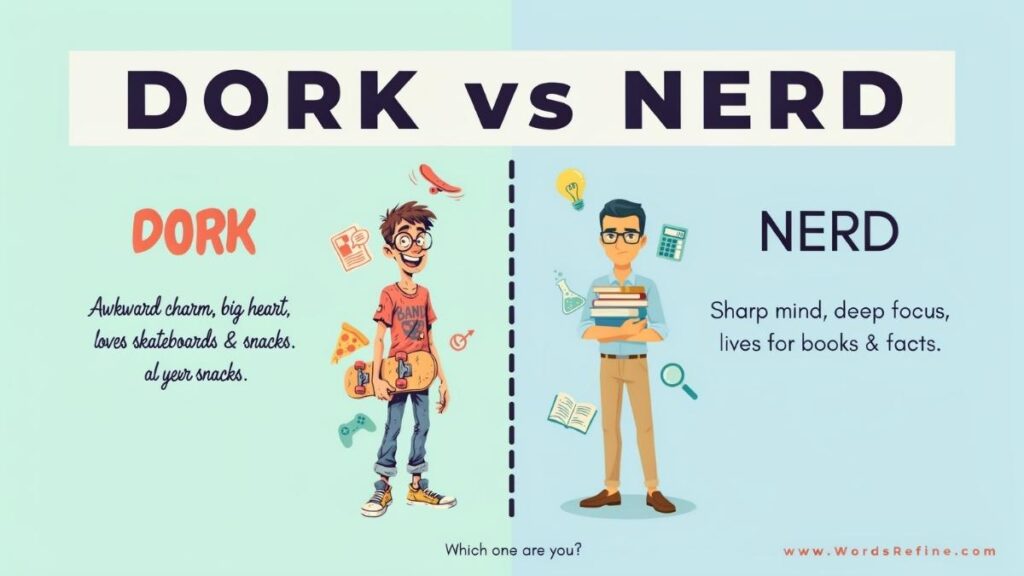
The difference between a dork and a nerd might seem small but these two words describe different personality traits. In the debate over dork vs nerd a nerd is usually someone who loves learning, collecting knowledge, or exploring a particular subject in depth. A dork, on the other hand is often someone who acts goofy awkward, or amusingly unconventional. However, the meanings can overlap, which makes choosing the right word a little tricky. Whether you’re describing a friend who knows every detail about dinosaurs or someone who dances like nobody is watching, understanding these terms helps you communicate clearly without turning a playful comment into an unintended insult.
Dork vs Nerd Quick Answer
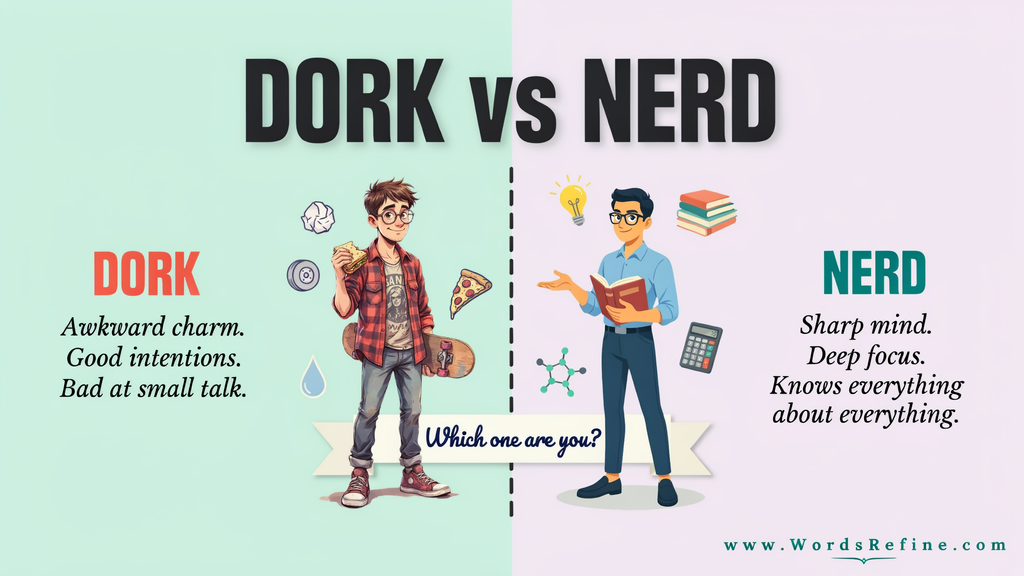
A dork is someone who acts silly, awkward, or unconventional. A nerd is someone who shows deep interest in a subject or has specialized knowledge.
For example, a person who dances dramatically in the middle of a grocery store might be called a dork. Meanwhile, someone who spends hours researching planets, studying astronomy, and discussing space discoveries might be called a nerd.
The main difference is simple. Dork usually describes someone’s behavior, while nerd focuses more on interests, enthusiasm, or knowledge.
Nevertheless, these descriptions can overlap. A person can be passionate about science and still have a wonderfully goofy personality.
What Does Dork Mean?
The word dork is an informal noun commonly used to describe someone who behaves in a silly, awkward, or unconventional way. In everyday American English, it often refers to a person whose actions seem amusingly unusual or socially awkward.
For instance, imagine someone who accidentally waves at a stranger, trips over their own feet, or tells an incredibly silly joke during a serious conversation. Friends might affectionately call that person a dork.
However, the word doesn’t always suggest that someone has poor social skills. Sometimes, people deliberately act goofy because they enjoy making others laugh. In other situations, a person might simply have an unusual personality that others find entertaining.
Consider these examples:
My brother is such a dork. He sings loudly while washing the dishes.
I felt like a dork when I accidentally walked into the wrong classroom.
She’s a lovable dork who makes everyone laugh with her ridiculous jokes.
Stop acting like a dork and come dance with us.
In each sentence, the word describes behavior rather than intelligence. Someone can be highly educated, successful, and socially confident while still acting like a dork from time to time.
Learn the difference between tricky grammar more words
Lend vs Lent What’s the Difference and When to Use Each?
Common Characteristics of a Dork
People often associate dorks with certain personality traits and behaviors. These associations aren’t strict rules, but they help explain how the word works in everyday conversations.
Goofy behavior is one of the most familiar characteristics. A person might make ridiculous jokes, perform silly dances, or turn an ordinary situation into an amusing moment.
Social awkwardness is another common association. Someone might misunderstand a joke, struggle with an unexpected conversation, or accidentally create an embarrassing situation.
A quirky personality can also make someone seem dorky. For example, a person who gives funny names to household objects or talks to their pets as if they’re having serious conversations might be described as a dork.
Still, being shy or introverted doesn’t automatically make someone a dork. These traits describe different aspects of personality. A quiet person may simply prefer smaller gatherings without behaving awkwardly or unusually.
Is Dork an Insult or a Friendly Expression?
Whether dork sounds offensive depends on how someone uses it. Among close friends, the word often works as a playful nickname.
Imagine a friend who spends ten minutes trying to take the perfect selfie but accidentally captures several ridiculous expressions instead. Calling that person a dork might make everyone laugh, including the friend.
However, the same word can sound hurtful when someone uses it to embarrass another person. A stranger calling someone a dork during an argument communicates something very different from a friend using the word affectionately.
Tone, relationships, and circumstances all matter. Therefore, it’s best to consider how the other person might interpret the word rather than assuming every use is harmless.
Learn the difference between confusing word pairs
Socialise vs Socialize Which one Is Correct ?
What Does Nerd Mean?
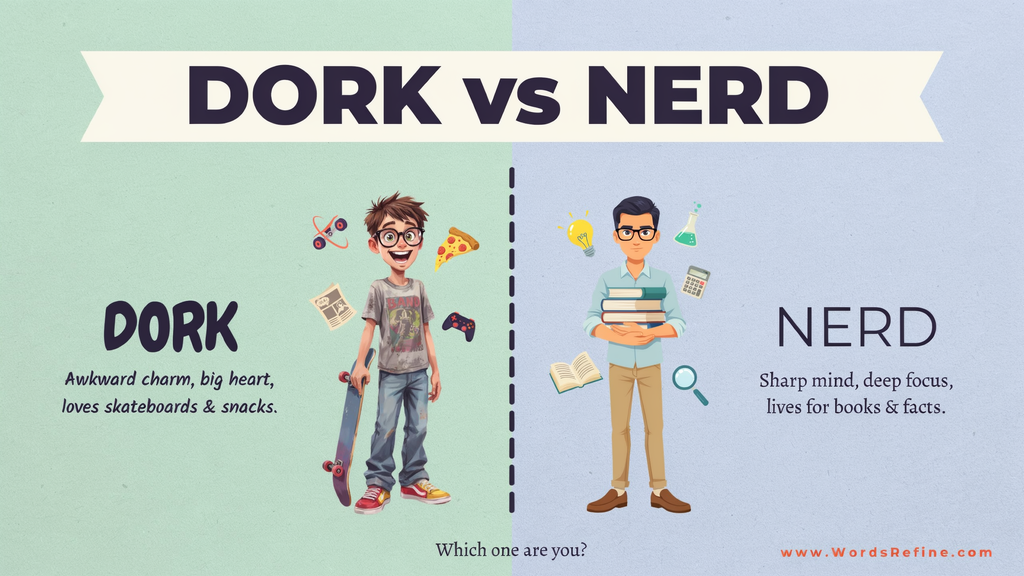
A nerd is someone who has a strong interest in a particular subject, enjoys learning about it, or possesses extensive knowledge in that area. The word traditionally connects with academic interests, science, mathematics, technology, and intellectual curiosity.
However, its meaning has expanded considerably. Today, people can be nerds about almost anything, including movies, sports, music, cooking, history, and video games.
For example, a person who spends weekends reading about ancient civilizations might be called a history nerd. Someone who enjoys building computers and learning about software could be described as a technology nerd.
Here are a few examples:
My sister is a science nerd who loves reading about black holes.
He’s a movie nerd who can recognize famous directors from their filming styles.
I’m a history nerd, so I never miss a documentary about ancient Rome.
Our teacher is a grammar nerd who notices every misplaced apostrophe.
In these examples, nerd describes enthusiasm and specialized knowledge. It doesn’t necessarily tell you whether someone is outgoing, shy, popular, or socially awkward.
Common Characteristics of a Nerd
Nerds are often associated with intellectual curiosity. They enjoy exploring ideas, asking questions, and learning how things work.
Specialized knowledge is another familiar characteristic. A person might spend years developing an understanding of computer programming, astronomy, literature, or another subject.
Many nerds also enjoy activities that challenge their minds. Solving complicated puzzles, researching historical events, studying scientific discoveries, or analyzing fictional stories can all become favorite hobbies.
However, being a nerd doesn’t require exceptional intelligence or outstanding academic results. Someone who enthusiastically learns about a favorite hobby can easily fit the description.
For instance, a person who knows every detail about a popular television series might call themselves a television nerd. Their enthusiasm matters more than whether the subject is traditionally considered academic.
Is Being Called a Nerd a Compliment?
In many situations, yes. The word nerd has developed a positive meaning in modern conversations, particularly among people who proudly embrace their interests.
Someone might describe themselves as a book nerd, gaming nerd, or science nerd without feeling embarrassed. In these situations, the label expresses enthusiasm and personal identity.
However, nerd can still be used negatively. In some social settings, people use it to mock someone’s interests, appearance, or perceived lack of popularity.
The meaning depends on the speaker’s intention and the surrounding conversation. Calling someone a nerd because they understand a complicated scientific concept may express admiration. Using the same word to ridicule their hobbies can turn it into an insult.
Learn the difference between often confused words
Instalments vs Installments Which one Is Correct?
Dork vs Nerd Understanding the Main Differences
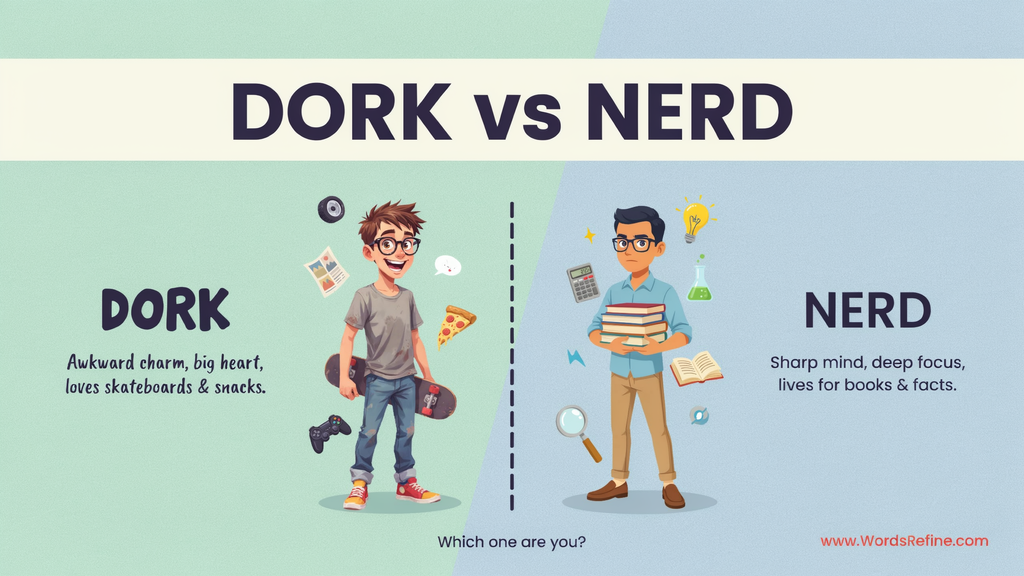
Although dork and nerd sometimes describe the same person, each word emphasizes different qualities.
Personality and Behavior
A dork is generally associated with silly, awkward, or unconventional behavior. A nerd is more closely connected with intellectual interests, enthusiasm, or specialized knowledge.
Imagine two students preparing for a science fair. One spends hours explaining the science behind an experiment and researching how the results relate to other discoveries. The other makes silly jokes, gives the laboratory equipment ridiculous nicknames, and celebrates every successful experiment with an exaggerated dance.
The first student might be called a nerd because of their scientific interests. The second might be called a dork because of their goofy behavior.
Of course, both students could have the same interests and personality traits. These labels simply highlight different aspects of their behavior.
Interests and Hobbies
Nerds are commonly associated with strong interests in particular subjects. Their hobbies might include science, technology, books, gaming, history, or entertainment.
Dorks don’t need a specific hobby or area of knowledge. Their label usually comes from their behavior or the way they interact with others.
For example, someone who memorizes every detail about the solar system might be an astronomy nerd. Meanwhile, someone who performs a dramatic dance in a crowded supermarket might be called a dork.
A person who researches astronomy all evening and then celebrates a discovery with an incredibly silly dance could easily be both.
Social Skills and Stereotypes
Popular culture often portrays nerds as shy, socially awkward, or uncomfortable in social situations. However, these portrayals represent familiar stereotypes rather than universal characteristics.
Many nerds are outgoing, confident, and excellent communicators. Their interests don’t determine their social abilities.
Dorks are also associated with awkwardness, but the word often focuses more directly on unusual or embarrassing behavior. Even then, someone can act dorky intentionally without having any difficulty interacting with others.
It’s important to remember that intelligence, personality, and social skills are separate qualities. Neither word provides a complete description of someone’s character.
Learn the difference between basic English word mistakes
Instinctually vs Instinctively Which One Is Correct ?
Tone and Context
Both words can communicate affection, admiration, humor, or criticism.
For example, saying, “You’re such a dork for wearing sunglasses indoors,” might be a playful comment between friends.
Similarly, saying, “You’re such a nerd for knowing the entire periodic table,” might express surprise or admiration.
However, both statements could sound insulting if delivered with the intention of embarrassing someone. The words themselves don’t determine the emotional meaning. The relationship and situation play an important role.
Dork vs Nerd A Side by Side Comparison
| Feature | Dork | Nerd |
|---|---|---|
| Main meaning | A goofy, awkward, or unconventional person | Someone deeply interested in or knowledgeable about a subject |
| Common association | Silly behavior and social awkwardness | Intellectual curiosity and specialized interests |
| Main focus | Behavior and personality | Knowledge, interests, and enthusiasm |
| Typical examples | Someone who makes ridiculous jokes or acts awkwardly | Someone passionate about science, books, technology, or gaming |
| Tone | Playful, affectionate, or insulting | Positive, neutral, affectionate, or insulting |
| Academic interests | Not necessary | Commonly associated but not required |
| Social skills | Often linked with awkwardness | Sometimes stereotyped as socially awkward |
| Modern usage | Frequently used as friendly teasing | Often embraced as a positive identity |
The comparison shows why the words aren’t exact synonyms. Dork usually describes how someone behaves, while nerd describes what someone enjoys learning about or knows well.
Nevertheless, informal language is flexible. Depending on the situation, either word might communicate the speaker’s intended meaning.
Dork vs Nerd vs Geek vs Dweeb
The confusion becomes more interesting when you introduce geek and dweeb. These words share some meanings with dork and nerd, but each has its own familiar associations.
Learn the difference between commonly misused words
Copyright vs Copywrite Which One Is Correct?
Dork vs Geek
A geek is someone who shows strong enthusiasm for a particular hobby, subject, or interest. The word commonly appears in conversations about technology, gaming, movies, and popular culture.
Traditionally, geek has been associated with enthusiastic participation in hobbies and fan communities. Dork, meanwhile, is more closely associated with silly or awkward behavior.
For example, someone who collects science fiction memorabilia and attends fan conventions might be called a science fiction geek. Someone who accidentally walks into the wrong movie theater and spends several minutes wondering why the story makes no sense might be called a dork.
However, the words can overlap. A person who knows everything about superhero movies and constantly makes ridiculous superhero jokes could be both a geek and a dork.
Nerd vs Geek
The difference between nerd and geek is subtle because modern English frequently uses the words interchangeably.
Traditionally, nerd has stronger connections with academic interests, intellectual curiosity, and specialized knowledge. Geek often emphasizes enthusiasm for hobbies, entertainment, technology, and particular communities.
For example, someone who enjoys solving complicated mathematical problems might be called a mathematics nerd. A person who collects gaming consoles, follows new releases, and attends gaming conventions might be called a video game geek.
However, a video game enthusiast who studies programming and game design could also be described as a nerd. The distinction depends on which aspect of the person’s interests the speaker wants to emphasize.
Dork vs Dweeb
A dweeb is an informal term for someone perceived as awkward, uncool, socially inept, or lacking sophistication.
Like dork, the word can describe someone who doesn’t fit conventional social expectations. However, dweeb often carries a more dismissive or critical tone.
For example, calling a friend a dork for making a ridiculous joke might sound affectionate. Calling someone a dweeb for repeatedly interrupting conversations may sound more judgmental.
Both terms can describe awkward behavior, but their connotations aren’t always identical.
Nerd vs Dweeb
Nerd focuses primarily on interests, knowledge, and enthusiasm. Dweeb focuses more on perceived social awkwardness or uncool behavior.
A student who spends weekends learning computer programming might be called a nerd. Someone who repeatedly makes embarrassing comments while trying to impress classmates might be called a dweeb.
However, neither label establishes someone’s actual intelligence or social abilities. They reflect informal judgments rather than objective personality categories.
Can Someone Be a Dork, Nerd, Geek, and Dweeb?
Yes. These words describe overlapping traits rather than separate personality types.
Imagine a college student named Alex who spends hours programming video games, collects science fiction novels, and enjoys explaining complicated computer systems. Alex also makes ridiculous jokes during serious conversations and occasionally embarrasses himself at social events.
His friends might call him a nerd because of his technical knowledge, a geek because of his gaming interests, or a dork because of his silly behavior. Someone using dweeb might be emphasizing his awkward moments instead.
The same person can fit several descriptions without contradiction. Each word simply draws attention to a different part of the person’s personality or interests.
Learn the difference between everyday English mistakes
Dreamt vs Dreamed Which One Is Correct?
Why People Confuse Dork vs Nerd
The confusion between dork and nerd isn’t surprising. Both words have been associated with people who fall outside certain social expectations, and their meanings have changed over time.
Popular entertainment has played an important role in shaping these associations. Movies and television often portray nerds as intelligent characters who struggle with social situations. These characters may also display goofy behavior, making them seem dorky.
School culture has contributed to similar stereotypes. Students with strong academic interests have sometimes been labeled nerds, while those who behave unusually or awkwardly may be called dorks.
Friendly teasing adds another layer of confusion. Friends might call someone a nerd for obsessing over a favorite television series and a dork for performing an exaggerated dance to its theme song.
Changing slang also affects how people interpret these terms. Words that once carried negative associations can become positive expressions of identity. Nerd is a good example because many people now embrace the label with pride.
Ultimately, the words overlap because people can have several personality traits at once. Someone can be intellectually curious, socially confident, and wonderfully goofy without fitting neatly into a single category.
How to Use Dork vs Nerd in Everyday Conversations
Understanding the definitions is useful, but knowing when to use each word makes the distinction easier to apply.
Use dork when describing someone who behaves in a silly, awkward, or unconventional way.
For example, you might say, “You’re such a dork for wearing sunglasses indoors,” when teasing a close friend about a harmless habit.
You could also say, “My dad is a lovable dork who tells the same jokes every weekend.” Here, the word communicates affection rather than criticism.
Use nerd when describing someone’s enthusiasm, knowledge, or strong interest in a particular subject.
For instance, “My brother is a history nerd who reads about ancient civilizations” highlights his interest in learning.
Similarly, “She’s a computer nerd who enjoys building her own PCs” describes someone who is passionate about technology.
Sometimes, both words could work, but the emphasis changes.
Consider Sarah, who loves gardening and knows the scientific names of dozens of plants. Calling her a gardening nerd highlights her knowledge. Calling her a gardening dork might suggest that she behaves in a funny or unusual way while tending her plants.
When you’re unsure which word to choose, think about the quality you’re describing. If the focus is someone’s interests or knowledge, nerd will often fit. If you’re describing silly or awkward behavior, dork is usually more appropriate.
Real Life Examples of Dork vs Nerd
Everyday situations make the distinction easier to understand. School, workplaces, friendships, and entertainment all provide examples of how these words work.
Dork vs Nerd at School
Imagine two classmates preparing for a science fair. Emma has spent several weeks researching renewable energy and can explain how solar panels convert sunlight into electricity. Her classmates might call her a science nerd.
Meanwhile, Liam keeps making jokes about the school mascot and performs an exaggerated victory dance whenever his experiment works. His friends might call him a dork.
Now imagine Emma also performs ridiculous dances whenever her project succeeds. She could easily be both a nerd and a dork.
These examples show why academic interests and social behavior shouldn’t be treated as opposites.
Dork vs Nerd at Work
Workplaces also provide opportunities to see the difference.
Consider a software development team. One employee spends lunch breaks exploring programming languages and testing new software tools. Coworkers might affectionately call that person a coding nerd.
Another employee makes silly jokes during meetings and celebrates small achievements with dramatic dance moves. That person might be described as a workplace dork.
Although these labels may work in a friendly team, they’re generally unsuitable for performance reviews, formal feedback, or professional evaluations.
In those situations, descriptions such as technically knowledgeable, creative, enthusiastic, or playful communicate more clearly.
Dork vs Nerd Among Friends
Friendships often make these words feel more affectionate.
Imagine a group of friends watching a superhero movie. One person spends the entire evening explaining comic book references and discussing differences between the film and its source material. The group calls that friend a superhero nerd.
Another friend keeps imitating the characters, inventing silly dialogue, and laughing at their own jokes. Everyone calls that person a dork.
Both friends contribute to the group’s enjoyment. Their labels simply reflect different ways of expressing enthusiasm.
Dork vs Nerd in Pop Culture
Movies and television have helped shape modern ideas about nerds and dorks. Fictional characters often combine intellectual interests with awkward or unusual behavior.
Sheldon Cooper from The Big Bang Theory is a familiar example of the traditional nerd stereotype. His scientific knowledge and intense academic interests are central to his character. His unusual social behavior also creates situations that audiences might describe as dorky.
Peter Parker from Spider-Man is another recognizable example. His scientific curiosity, technical abilities, and interest in solving problems connect with the traditional nerd stereotype. However, his personality and social behavior vary across different adaptations.
Napoleon Dynamite from Napoleon Dynamite illustrates traits commonly associated with a dork or dweeb. His unconventional behavior, distinctive interests, and unusual social interactions make him an example of someone who doesn’t fit conventional expectations.
These fictional portrayals help explain how the labels overlap. However, characters in movies and television represent creative interpretations rather than accurate templates for identifying real people.
Learn the difference between more words people mix up
Mobil vs Mobile Which one Is Correct?
Common Mistakes People Make With Dork vs Nerd
Even though dork and nerd are common slang words, people sometimes use them in ways that don’t match their intended meaning.
One common mistake is treating the words as exact synonyms. A nerd usually has a strong interest in a subject, while a dork is commonly associated with goofy or awkward behavior.
Another mistake is assuming every nerd is socially awkward. Intelligence and enthusiasm don’t automatically determine someone’s social skills. Many people with specialized knowledge are confident and outgoing.
Some people also believe that dorks lack intelligence. However, someone can behave ridiculously and still have impressive academic or professional abilities.
Using nerd only for science and technology enthusiasts is another limitation. People can be nerds about music, cooking, sports, literature, history, and countless other subjects.
Finally, assuming both words are always insults can lead to misunderstandings. Friends often use these terms affectionately, and many people proudly identify as nerds.
The easiest way to avoid these mistakes is to focus on the specific quality you’re describing rather than relying on stereotypes.
Common Sentence Mistakes and Corrections
Choosing between dork and nerd isn’t usually a matter of grammatical correctness. Both are valid English words. The challenge is selecting the one that accurately communicates your meaning.
Consider these examples.
Unclear: She’s a dork because she spends every evening studying astronomy.
Clearer: She’s an astronomy nerd because she spends every evening studying the stars.
The revised sentence emphasizes her interest in astronomy rather than suggesting that her behavior is goofy or awkward.
Unclear: He’s a nerd because he tripped over his own feet while entering the classroom.
Clearer: He felt like a dork after tripping over his own feet while entering the classroom.
The second sentence highlights an embarrassing moment rather than a specialized interest.
Another example involves a person who knows everything about a favorite movie franchise.
Original: My brother is a dork because he knows every character in the Marvel universe.
Alternative: My brother is a Marvel nerd because he knows every character in the Marvel universe.
Both sentences are understandable. However, nerd better emphasizes specialized knowledge and enthusiasm.
Now consider someone who constantly makes ridiculous jokes.
Original: My best friend is such a nerd. She keeps making silly jokes during dinner.
Alternative: My best friend is such a dork. She keeps making silly jokes during dinner.
The alternative better captures the friend’s goofy behavior. Nevertheless, the original could still work if the speaker uses nerd as an affectionate nickname.
These examples show that a sentence can be grammatically correct while still using a less precise word.
Dork vs Nerd in American and British English
Both dork and nerd appear in American and British English. Their general meanings are recognizable in both varieties, although familiarity and frequency can vary by speaker and social setting.
In American English, dork is a familiar informal term for someone who behaves awkwardly, foolishly, or amusingly. Nerd is widely used for people with strong intellectual interests or specialized knowledge.
British English also uses nerd, particularly in conversations about technology, academic subjects, gaming, and popular culture. Dork is understood as well, although other expressions, such as geek or plonker, may be preferred in particular contexts.
For example, an American speaker might say, “He’s a total computer nerd who builds custom gaming PCs.”
A British speaker might say, “She’s a science nerd who spends her weekends reading about astronomy.”
Both examples sound natural, and neither word belongs exclusively to one country.
The main distinction between dork and nerd remains broadly similar across both varieties. Regional differences may influence which slang expressions sound most natural, but they don’t create completely different definitions.
Learn the difference between tricky English words with easy explanations
Fiancé vs Fiancée What’s the Difference and which is Correctly?
Dork vs Nerd in Professional and Academic Writing
Although dork and nerd are useful in casual conversations, they aren’t usually the best choices for formal writing.
Both words are informal. Depending on the situation, they can sound playful, judgmental, or overly familiar.
For example, consider this sentence in a professional report:
“Jordan is a computer nerd who understands complicated software systems.”
The sentence communicates enthusiasm and technical knowledge, but it sounds casual. A more professional alternative would be:
“Jordan has extensive technical knowledge and demonstrates strong expertise in software systems.”
Similarly, consider this sentence:
“Alex is a dork who makes awkward jokes during presentations.”
A more constructive alternative would be:
“Alex frequently uses humor during presentations and occasionally struggles to judge the audience’s response.”
The revised versions explain the relevant characteristics without relying on potentially insulting labels.
Depending on the intended meaning, useful alternatives include enthusiast, specialist, expert, intellectual, eccentric person, and socially awkward person.
However, both words can work perfectly well in fictional dialogue, personal essays, interviews, humor writing, and other contexts where conversational language adds personality.
An Easy Way to Remember the Difference
Still mixing up the two? A simple memory trick can help.
Think of dork as a word associated with goofy behavior. Think of nerd as a word associated with passionate interests or specialized knowledge.
Imagine two people at a bookstore.
One person spends an hour comparing books about astronomy, discussing the differences between planets, and explaining the latest space discoveries. That’s a familiar example of a nerd.
The other person walks into the bookstore wearing a superhero cape, accidentally knocks over a display, and turns the incident into a dramatic performance. That’s a familiar example of a dork.
Of course, the two people could be the same person. Someone might love astronomy and have an unusually goofy personality.
Keep these distinctions in mind when choosing between the words. Think dork when the main focus is silly, awkward, or unconventional behavior. Think nerd when the main focus is enthusiasm, knowledge, or intellectual interests.
Most importantly, remember that both words can be affectionate, neutral, or insulting depending on the situation.
Learn the difference between confusing more English words
Any time vs anytime meaning Difference with Examples ?
Practice session Dork vs Nerd
- Jake is a computer ______ who spends hours learning new programming languages.
- My brother made a silly joke at dinner, and everyone called him a ______.
- Sarah is a science ______ who loves reading about space and astronomy.
- You are such a ______ for wearing mismatched socks to school.
- Mark is a history ______ who can explain almost every major historical event.
- My best friend is a lovable ______ who always makes us laugh.
- Emily is a math ______ who enjoys solving difficult equations for fun.
- He acted like a total ______ when he tripped over his own shoelaces.
- Daniel is a movie ______ who knows every detail about classic films.
- Stop being a ______ and help me carry these boxes.
- My cousin is a gaming ______ who knows everything about his favorite video games.
- Everyone laughed when Tom wore a superhero costume to the office party. He can be such a ______.
- Lisa is a book ______ who spends most of her free time reading and studying.
- My uncle is a lovable ______ who tells terrible jokes but never stops trying.
- The young ______ won the school science competition with an impressive project.
- You do not have to be a ______ to enjoy learning about technology.
- Alex is a cheerful ______ who often says unusual things without realizing how funny they sound.
- Our class ______ helped everyone understand the complicated physics lesson.
- My friend is a bit of a ______ because he gets excited about the smallest things.
- The science ______ stayed after class to ask the teacher several questions.
- Ben is a comic-book ______ who collects rare editions and knows the stories by heart.
- I felt like a complete ______ when I waved at someone who was not waving at me.
- The history ______ spent the weekend researching ancient civilizations.
- My younger sister called me a ______ after I danced around the kitchen.
- Whether someone is a ______ or a ______, the label does not define their personality.
- Nerd
- Dork
- Nerd
- Dork
- Nerd
- Dork
- Nerd
- Dork
- Nerd
- Dork
- Nerd
- Dork
- Nerd
- Dork
- Nerd
- Nerd
- Dork
- Nerd
- Dork
- Nerd
- Nerd
- Dork
- Nerd
- Dork
- Nerd / Dork
Here’s a trusted source for clear more words Comparison:
FAQs
What did people call nerds in the 1950s?
In the 1950s, people often used terms like bookworm, egghead, and square to describe someone who was highly studious, intellectual, or uninterested in popular trends. These words reflected the social attitudes of the time.
What does Gen Z call nerds?
Gen Z still uses nerd and geek, often in a positive or playful way. Depending on the context, terms like brainiac may also describe someone who is especially intelligent or passionate about a subject.
What is a modern slang term for “dork”?
Common alternatives to dork include goofball, dweeb, and weirdo. While goofball usually sounds friendly, dweeb and weirdo can feel more insulting.
What is the opposite of a dork?
There is no exact opposite of dork. Depending on the context, words like cool, smooth, or socially confident may describe someone who seems less awkward or more comfortable in social situations.
What does “dork” mean in slang?
In everyday slang, dork describes someone who seems awkward, goofy, or unusually enthusiastic about their interests. It can be a lighthearted nickname among friends or a mild insult when used to mock someone.
Is “dork” a swear word?
No. Dork is generally considered a mild insult rather than a swear word. Its meaning depends on the speaker’s tone and the relationship between the people involved.
What kind of person is a dork?
A dork is often someone who acts silly, feels socially awkward, or enthusiastically embraces interests that others might consider unusual. The term can describe a person who makes goofy jokes, gets excited about a hobby, or simply marches to the beat of their own drum.
What does it mean when a woman calls you a dork?
When a woman calls you a dork, she might be teasing you affectionately, joking about something silly you did, or expressing genuine irritation. Her tone, body language, and your relationship offer more clues than the word itself.
Is being called a nerd a sign of flirting?
Not necessarily. Calling someone a nerd can be playful or affectionate, especially when two people share a comfortable relationship. However, the word alone is not enough to establish romantic interest.
What is another word for “dork”?
Depending on the intended meaning, alternatives include goofball, dweeb, geek, nerd, and klutz. Goofball suggests silliness, klutz describes clumsiness, and nerd or geek often refers to someone with strong intellectual or hobby-related interests.
Learn the difference between commonly mixed-up more words
Choose vs Chose Difference and which one is Correct?
Conclusion
Understanding the difference between dork vs nerd is easier once you know what each word emphasizes. A nerd is typically someone with deep knowledge or enthusiasm for a particular subject, while a dork is often someone who acts goofy, awkward, or delightfully unconventional. Although the two words sometimes overlap, they aren’t interchangeable in every situation.
So, the next time someone calls you a dork for laughing at your own jokes or a nerd for explaining the science behind your favorite movie, don’t take it too seriously. You might simply have a personality that refuses to fit into a neat little box. After all, the world has plenty of room for curious minds, awkward moments, and wonderfully weird people. And honestly, life would be pretty boring without them.

Diora AJS she is an experienced blogger and passionate English language enthusiast at Words Refine. With a keen eye for language and a love for clear communication, she writes practical content about grammar, word meanings, usage, and commonly confused terms. Her goal is to make English easier to understand through clear explanations and relatable examples, helping readers write accurately and communicate with confidence.