
Expiry vs expiration may seem interchangeable, but choosing the right word can make your writing clearer and more precise. Both terms refer to the end of a period of validity, although their usage varies by region and context. This difference can cause confusion when discussing product labels, contracts, subscriptions, or official documents. Understanding expiry vs. expiration helps you recognize when each term is appropriate and avoid common language mistakes. In this guide, you’ll explore their meanings, key differences, and practical uses through clear explanations and relevant examples. By the end, you’ll know how to use both words correctly and confidently in everyday and formal writing.
Expiry and Expiration The Quick Answer
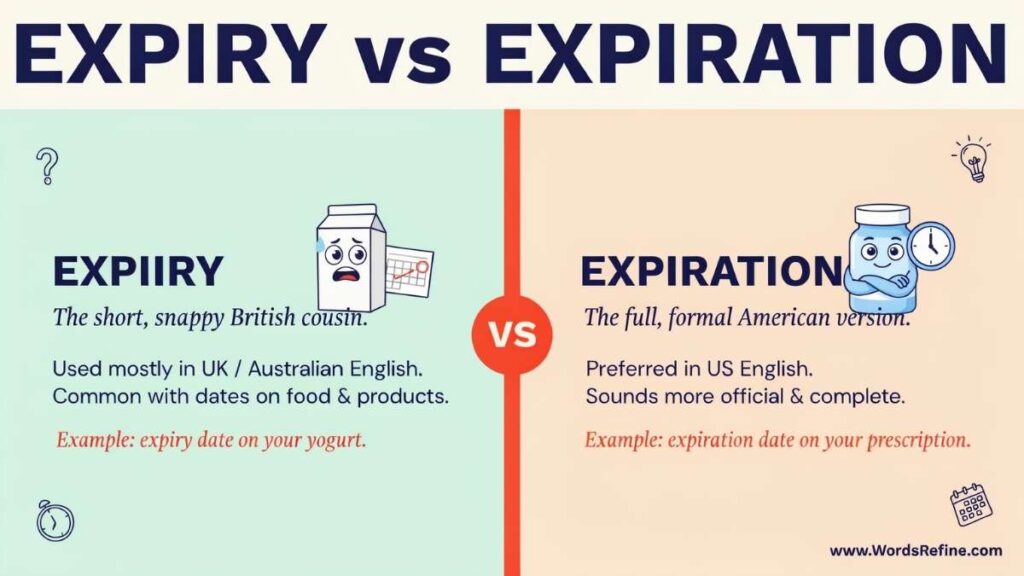
The main difference between expiry vs expiration lies in how and where people use them. Both nouns refer to the end of a period during which something remains valid, effective, or suitable for use.
Expiry is especially common in British English and other varieties influenced by British usage. You’ll often encounter it in expressions such as expiry date, passport expiry, and contract expiry.
Expiration, on the other hand, is more common in American English. It frequently appears in phrases such as expiration date, expiration of a contract, and credit card expiration.
Here’s a quick comparison of the two words.
| Feature | Expiry | Expiration |
|---|---|---|
| Meaning | The end of a period of validity or usefulness | The end of a period of validity or usefulness |
| Common regional preference | British and Commonwealth English | American English |
| Part of speech | Noun | Noun |
| Common expression | Expiry date | Expiration date |
| Typical contexts | Product labels, documents, and contracts | Product labels, legal documents, and contracts |
| Verb form | Expire | Expire |
| Plural | Expiries | Expirations |
| Grammatical status | Correct English | Correct English |
The easiest way to remember the difference is to consider your audience. Use expiry when writing for readers who are familiar with British English. Choose expiration when writing for an American audience. However, if a company style guide or official document already specifies a particular term, follow that wording.
For example, a British writer might say, “The expiry date on your passport is approaching.” An American writer might express the same idea as, “The expiration date on your passport is approaching.”
Both sentences are grammatically correct and communicate the same message.
What Does Expiry Mean?
Expiry refers to the end of a period during which something remains valid, effective, or suitable for use. It identifies the point when a particular period comes to an end.
The meaning of expiry is straightforward, although its exact application depends on the context. A product may have an expiry date, a passport may reach its expiry, and a membership may have an expiry period.
Consider these examples:
The expiry date on this carton of milk is October 12.
Please check your passport’s expiry before booking an international flight.
The insurance policy’s expiry is listed in the final section.
We received a reminder about the expiry of our annual membership.
In each sentence, expiry identifies the end of a period or the date associated with it.
Expiry Definition and Pronunciation
Expiry is a noun formed from the verb expire. It refers to the act or point of ending, particularly when a period of validity comes to a close.
In common British pronunciation, expiry is pronounced /ɪkˈspaɪəri/. The word has three syllables, with the main stress on the second syllable. American speakers also recognize and use it, although they often prefer expiration in everyday situations.
Learn the difference between confusing more English words
Dork vs Nerd Meaning Differences Examples?
How to Use Expiry in a Sentence
The correct use of expiry depends on the sentence’s structure and meaning. It commonly appears after possessive nouns or in expressions that identify a date or period.
For example, the expiry of an agreement allows both parties to renegotiate. Similarly, you might check the expiry date before purchasing a product or notice that your work permit is nearing expiry.
Expiry functions as a noun in these examples. Therefore, it cannot replace the verb expire when describing something that is approaching the end of its validity.
Consider the difference:
Correct: The membership expires next month.
Correct: The membership’s expiry is next month.
Incorrect: The membership expiry next month.
The final example lacks a verb and doesn’t form a complete sentence in ordinary prose. However, membership expiry can work perfectly well as a short heading or label.
What Does Expiration Mean?
Expiration refers to the ending of a period during which something remains valid, effective, or usable. It shares the same basic meaning as expiry but appears more frequently in American English.
The word is especially familiar in everyday American expressions involving product labels, financial services, official documents, and agreements.
For example, the expiration date is printed near the bottom of the package. You might also receive a notice about the expiration of your lease or discover that your credit card expiration date is approaching.
In each case, expiration identifies the end of a validity period or the event of something reaching that point.
Expiration Definition and Pronunciation
Expiration is a noun that describes the act or process of ending, or the point at which a specified period comes to an end.
In common American pronunciation, expiration is pronounced /ˌek.spəˈreɪ.ʃən/. It has four syllables, with the main stress on the third syllable.
Unlike expiry, expiration is often preferred in American administrative and technical language. For example, US forms commonly request a credit card’s expiration date rather than its expiry date.
How to Use Expiration in a Sentence
You can use expiration when discussing the end of a validity period, the conclusion of an agreement, or the date when something stops being valid.
For example, the expiration of a warranty may leave a customer responsible for repair costs. Similarly, a company might send a reminder about the expiration of a software license.
In everyday writing, expiration frequently appears in the expression expiration date. In formal writing, it can also follow the word of to identify what has ended.
It’s also important to remember that expiration is a noun, while expire is a verb.
The permit will expire in December.
The expiration of the permit is scheduled for December.
Both sentences are correct. The first sounds more direct, while the second uses a noun phrase that may suit formal or administrative writing.
Learn the difference between commonly mixed-up more words
favour vs Favor Meaning Differences Spelling and Examples ?
Expiry vs Expiration in American and British English
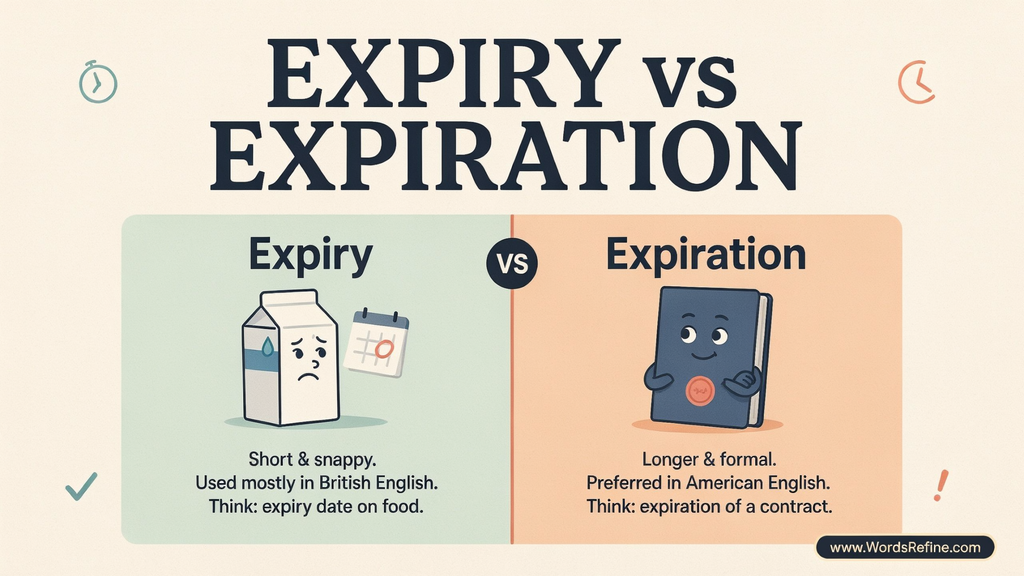
English varies depending on where people use it. Some differences involve spelling, such as color and colour, while others involve vocabulary, such as truck and lorry. The distinction between expiry and expiration follows a similar pattern.
Expiry in British English
In British English, expiry is a familiar choice in everyday communication and formal writing. It commonly appears on product packaging, official documents, and administrative forms.
For example, the expiry date is printed on the medicine bottle. You might also hear someone say, “Please renew your passport before its expiry.”
Similarly, a contract may end upon expiry unless both parties agree to extend it. A prepaid card may also display a clearly marked expiry date.
British English uses expire as a verb as well. A passport expires, a contract expires, and a coupon expires. The noun expiry simply refers to the ending or the date associated with it.
Expiration in American English
American English generally favors expiration, particularly in product labeling, financial services, and administrative communication.
For example, you might see an expiration date on a milk carton or find your driver’s license expiration date printed on your card. Businesses also commonly use expressions such as expiration of an agreement and expiration of a warranty.
Although expiration is the usual American preference, expiry remains a recognized English word in the United States. You may encounter it in technical documents, international communication, or writing influenced by British English.
Why Do Americans and British Speakers Prefer Different Terms?
The difference reflects established language conventions rather than separate meanings. Both words developed from the same verb, expire, which comes from Latin roots associated with breathing out or coming to an end.
Over time, expiry became especially established in British and Commonwealth usage, while expiration gained wider acceptance in American English.
Regional preferences also spread through education, publishing, institutions, and product labeling. As a result, people often choose the word they’ve encountered most frequently.
When writing for a particular audience, these preferences can help you make your language sound more natural. Nevertheless, they’re not strict grammatical rules. Both terms are acceptable across English varieties.
Expiry Date vs Expiration Date
An expiry date and an expiration date generally identify the same thing: the date associated with the end of a product’s or document’s validity period.
The difference becomes particularly noticeable in these expressions because each region tends to favor one form.
| Expression | Typical usage | Example |
|---|---|---|
| Expiry date | British and Commonwealth English | The expiry date is printed on the bottle. |
| Expiration date | American English | Check the expiration date before using the product. |
| Date of expiry | British-style and international wording | The date of expiry appears on the application. |
| Date of expiration | American formal and administrative writing | The date of expiration is recorded in the system. |
Both expiry date and expiration date are grammatically correct. Neither expression is inherently more accurate in every situation.
However, the meaning of a date depends on what it refers to. A food label, medicine package, passport, and credit card don’t necessarily use dates in the same way.
Expiry vs Expiration on Food Labels
Food packaging often displays dates to help consumers understand freshness, quality, or safe handling. However, an expiration date and a best-before date aren’t automatically interchangeable.
A best-before date generally concerns the period during which food is expected to retain its intended quality when stored properly. Depending on the food and local regulations, it may remain suitable after that date.
A use-by date can indicate a more important safety deadline for certain perishable foods. Its precise meaning depends on the product and applicable food-labeling rules.
Imagine buying a carton of fresh milk with a date printed on its packaging. That date helps you understand how long the product is expected to remain suitable under the manufacturer’s stated conditions. However, it doesn’t mean that every carton suddenly becomes unsafe at midnight on the printed day.
When checking food labels, pay attention to the exact wording rather than assuming every date means the same thing. Follow storage instructions, including refrigeration requirements. Also, remember that harmful contamination isn’t always detectable through changes in appearance or smell.
The expressions food expiry date and food expiration date may describe the same kind of date in everyday conversation. Nevertheless, the label’s actual wording and local food-safety guidance matter more than the choice between these two nouns.
Learn the difference between confusing word pairs
Sited vs Cited Meaning Differences Examples and Correct Usage
Expiry vs Expiration on Medicines
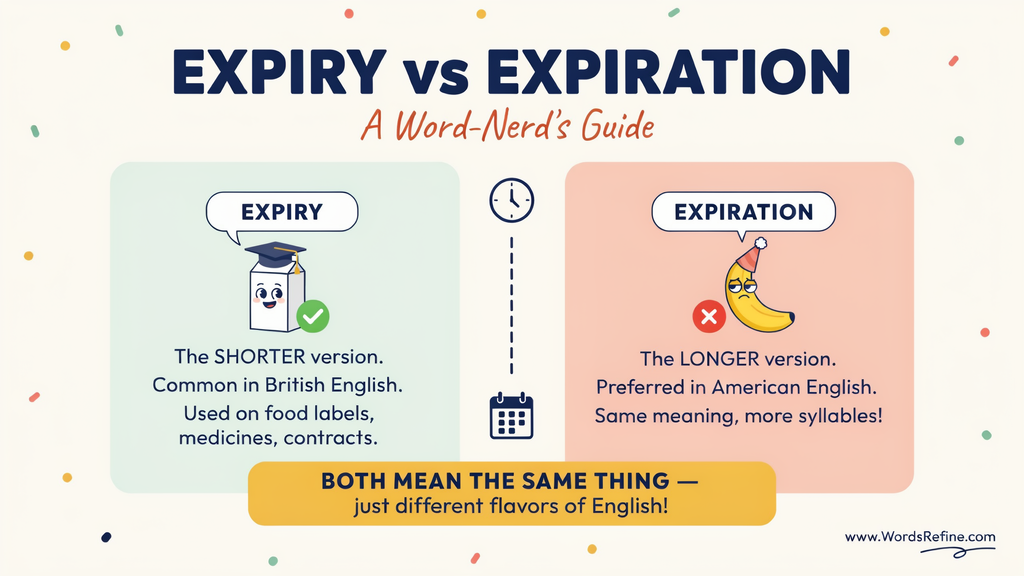
Medicine packaging uses dates to communicate important information about a product’s expected quality and effectiveness.
A medicine’s expiration date generally identifies the period during which the manufacturer expects it to meet its specifications when stored according to the stated conditions.
For example, a prescription bottle might display an expiration date, while a pharmacy label may include a separate instruction about how long the dispensed medicine should be used.
These dates shouldn’t be confused. The manufacturer’s expiration date and a pharmacy’s beyond-use date can serve different purposes.
Consider these examples:
The medicine expiry date is printed on the original packaging.
The medication expiration date appears on the manufacturer’s label.
The pharmacist explained when the prepared liquid medicine should be discarded.
Both medicine expiry date and medication expiration date are understandable expressions. The appropriate choice depends on the audience and the terminology used by the pharmacy or manufacturer.
Most importantly, don’t assume that an expired medication remains safe or effective simply because it looks normal. If you’re unsure about a medicine’s date or whether you can still use it, ask a pharmacist or healthcare professional.
Expiry vs Expiration on Cosmetics and Skincare
Cosmetic products also have limited periods of expected quality and suitability. However, their date information can look different from food or medicine labels.
Some products display a printed expiration date. Others include a period-after-opening symbol, commonly shown as an open jar with a number followed by the letter M.
For example, a symbol marked 12M generally indicates that the product is intended to be used within 12 months after opening, subject to its instructions and applicable requirements.
This distinction matters because an unopened product and an opened product may have different recommended periods of use.
Consider a moisturizer with a printed date and a separate 12M symbol. The printed date provides one reference point, while the symbol communicates the recommended period after opening. The product’s instructions determine how to interpret both.
Whether a label uses expiry or expiration, the practical concern remains the product’s recommended period of use.
Expiry vs Expiration in Contracts and Official Documents
Legal and administrative writing frequently uses both terms. However, the wording of an agreement can have consequences beyond ordinary vocabulary preferences.
For example, a contract expiry date might be June 30. An American document could express the same information as a contract expiration date. Similarly, an agreement might expire at the end of the month, triggering a review of its terms.
In everyday conversation, these expressions communicate similar information. However, in a legal document, the exact wording of the agreement determines the rights and obligations of the parties.
A contract might distinguish between its expiration date, an automatic renewal provision, and an early termination clause. These concepts aren’t interchangeable.
For this reason, avoid replacing established contractual language simply to make a document sound more natural. If you’re drafting or interpreting an agreement, pay attention to its defined terms and relevant clauses.
The same principle applies to passports, driver’s licenses, insurance policies, warranties, and other official documents. Their expiry or expiration dates identify important deadlines, but the consequences of reaching those dates depend on the applicable rules.
Learn the difference between tricky grammar more words
T- Shirt vs Tee Shirt Which One Is Correct and Why?
Expiry vs Expiration Examples in Everyday Sentences
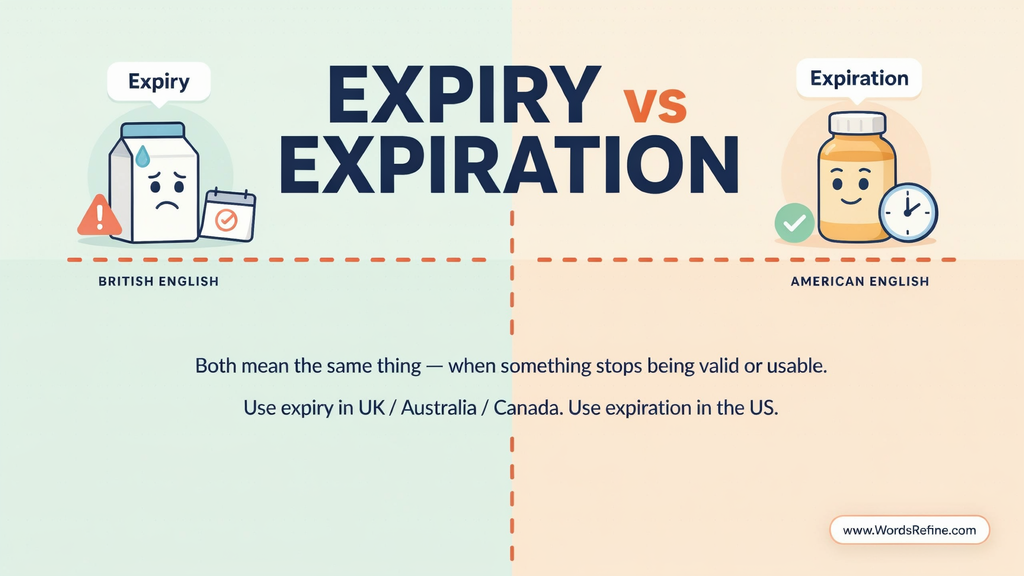
Examples make the difference easier to understand. Both words can fit naturally into many of the same sentence structures, although regional preferences influence which version sounds more familiar.
| Context | Using expiry | Using expiration |
|---|---|---|
| Food | The milk’s expiry date is tomorrow. | The milk’s expiration date is tomorrow. |
| Passport | Check your passport’s expiry before traveling. | Check your passport’s expiration before traveling. |
| Contract | The contract’s expiry is approaching. | The contract’s expiration is approaching. |
| Subscription | The subscription expiry is listed in your account. | The subscription expiration is listed in your account. |
| Insurance | The policy’s expiry is noted in the document. | The policy’s expiration is noted in the document. |
| Membership | Your membership expiry is next week. | Your membership expiration is next week. |
| Software | The license expiry is displayed in the settings. | The license expiration is displayed in the settings. |
Some examples sound more natural with date included, especially in everyday conversation. Others work better with the verb expire.
Consider a few more sentence pairs.
The gift card expires at the end of December.
The gift card’s expiry is at the end of December.
Both sentences are correct. The first is more direct, while the second uses a noun and may suit a short notice or administrative description.
Your subscription expires tomorrow.
Your subscription’s expiration date is tomorrow.
Again, both are correct. The first emphasizes the event, while the second highlights the specific date.
The passport expiry date is printed on the identification page.
The passport expiration date is printed on the identification page.
The choice between these sentences depends mainly on regional preference and the terminology used by the relevant authority.
When to Use Expiry vs Expiration
Choosing between expiry and expiration becomes easier when you consider your audience, the type of writing, and the terminology already in use.
Use expiry when writing in British English or for an audience familiar with British and Commonwealth conventions. It also works well when a style guide prefers the shorter form or when an official document already uses that terminology.
On the other hand, use expiration when writing for an American audience or preparing American business documents, forms, and product descriptions. It may also be the natural choice when discussing an expiration date in a context where that expression is already established.
Correct Usage of Expiry
The noun expiry works naturally in sentences that describe the end of a validity period.
For example, the expiry of an insurance policy may require immediate attention. You might check the expiry date before purchasing a product or receive a warning about the upcoming expiry of a software license.
Expiry can also appear in headings, labels, and short administrative descriptions. A database, for instance, might contain a field called Expiry Date.
Correct Usage of Expiration
The noun expiration works in similar grammatical structures.
For example, the expiration of a temporary permit may require a new application. A credit card’s expiration date might appear on the back of the card, while a website administrator could receive an alert about an upcoming domain expiration.
Both nouns can appear in formal and informal writing. The main consideration is whether the expression sounds natural for your intended audience.
Expiry vs Expiration vs Best Before Date
One common source of confusion is the assumption that expiry date, expiration date, and best-before date always mean exactly the same thing.
They don’t.
Although people sometimes use these expressions loosely in conversation, food labeling makes distinctions that matter.
| Term | General meaning | Typical context |
|---|---|---|
| Expiry date | The date associated with the end of a period of validity or use | Products, documents, and other items |
| Expiration date | The date associated with the end of a period of validity or use | American product labels, documents, and services |
| Best-before date | A date associated with expected product quality | Packaged foods |
| Use-by date | A date that can indicate a safety-related deadline | Certain perishable foods |
| Shelf life | The period a product is expected to remain suitable under specified conditions | Food, cosmetics, medicines, and other products |
Imagine three products sitting on a kitchen counter: a box of cereal, a carton of milk, and a bottle of medicine.
Their dates don’t necessarily serve the same purpose. The cereal’s best-before date may relate primarily to quality. The milk’s label may communicate a different deadline depending on local requirements. The medicine’s expiration date concerns the period during which the manufacturer expects it to meet established specifications.
This is why understanding the product matters more than memorizing a single definition.
Expiry and expiration are alternative nouns. Best-before and use-by communicate different types of date information. Don’t treat them as interchangeable without checking the label and relevant guidance.
Learn the difference between often confused words
Envisage vs Envision Meaning Differences Examples ?
Expiry vs Expiration in Technology and Digital Services
The difference between expiry and expiration isn’t limited to physical products or official documents. Both words appear frequently in technology, software, and online services.
Domain Expiry and Domain Expiration
A domain name has a registration period. When that period ends, the domain may enter a renewal or expiration process, depending on the registrar and applicable policies.
For example, the domain expiry date might appear in the registrar’s dashboard. An administrator may also receive a notification that the domain expiration date is approaching.
The expressions domain expiry and domain expiration describe the same general event. However, a domain’s expiration doesn’t necessarily mean it becomes immediately available to someone else. Renewal grace periods and other procedures can affect what happens next.
Software License Expiry vs Expiration
Software licenses may include a fixed validity period. When that period ends, access to certain features or services may change.
For example, a software license might expire at the end of the month. An application could display a warning about license expiration, reminding the company to renew its access.
Some systems also use temporary access tokens, authentication credentials, and security certificates with defined validity periods.
In these contexts, expiry and expiration are both recognizable terms. The exact terminology often depends on the software provider and technical documentation.
Subscription Expiry vs Expiration
Online subscriptions provide another familiar example.
A streaming service might notify users that their subscription expires on a particular date. An American billing system might instead display a subscription expiration date.
Both expressions communicate when the current subscription period ends. However, automatic renewal settings can change what happens next.
For example, a subscription may reach its expiration date and renew automatically because the customer has an active payment arrangement.
The important distinction is between the end of the current validity period and the separate process of renewal.
Common Mistakes With Expiry vs Expiration
Even though both words are correct, writers sometimes use them in ways that create confusion or awkward sentences.
Treating Expiry as Incorrect
One frequent mistake is assuming that expiry isn’t a proper English word because expiration is more familiar in American English.
That’s not true. Expiry is a standard English noun used in British English and other varieties. American writers can also use it when the context calls for it.
The important point is that regional preference doesn’t determine grammatical correctness. Both words are acceptable, and neither is universally wrong.
Confusing the Noun With the Verb
Another common mistake involves using expiry or expiration where the verb expire belongs.
Consider these examples:
Incorrect: My passport expiry next year.
Correct: My passport expires next year.
Correct: My passport’s expiry is next year.
The first sentence lacks a main verb. The second uses expires correctly, while the third uses the noun expiry in a complete sentence.
The same distinction applies to expiration.
Incorrect: The contract expiration next month.
Correct: The contract expires next month.
Correct: The contract’s expiration is next month.
Learn the difference between basic English word mistakes
Apprised vs Appraised Which One Is Correct and Why It Matters ?
Mixing Regional Forms Without a Reason
Using expiry in one paragraph and expiration in the next isn’t automatically a grammatical error. However, switching terms without a clear reason can make a document feel inconsistent.
For example, an American product guide might use expiration date throughout its instructions, then suddenly refer to expiry dates in a warning.
A consistent approach makes the text easier to follow. Choose the term that suits your audience and apply it throughout the document unless you’re quoting a source or reproducing official wording.
Confusing Expiration With Expired
The words expiration and expired are related, but they perform different grammatical functions.
Expiration is a noun referring to the ending of a period. Expired is the past-tense and past-participle form of the verb expire. It can also function as an adjective.
For example, the expiration date is printed on the package. The package expired last week. An expired membership no longer provides access.
Understanding this distinction helps you build clear sentences without confusing an event, an action, and the resulting state.
Learn the difference between commonly misused words
Vaccum Vs Vacuum Which One Is Correct and Why It Matters ?
Practice session Expiry vs Expiration
- The ______ date on my passport is approaching, so I need to renew it.
- Please check the ______ date before using the product.
- The bank sent me a reminder about the ______ of my debit card.
- The ______ of the contract means both parties must review their agreement.
- This coupon is no longer valid because its ______ date has passed.
- The company announced the ______ of its service agreement.
- Always check the ______ date printed on medicine packaging.
- My gym membership is close to its ______, so I plan to renew it.
- The ______ date on the certificate is clearly visible.
- The website sent an email warning me about my subscription’s upcoming ______.
- The store removed the product from its shelves after its ______ date.
- The lawyer reviewed the ______ of the lease before discussing an extension.
- My driver’s license is approaching its ______ date.
- The policy remains active until its ______ date.
- The notice explained the ______ of the temporary permit.
- The customer received a reminder before the ______ of the warranty.
- The British packaging uses the phrase “best before” instead of an ______ date.
- The company offered a renewal option before the ______ of the agreement.
- The passport office reminded travelers to check their documents’ ______ dates.
- The ______ of the offer is clearly stated in the terms and conditions.
- The membership renewal must be completed before the ______ date.
- The contract includes a clause explaining what happens after its ______.
- The pharmacist asked me to check the medicine’s ______ date.
- The insurance company sent a notice about the upcoming ______ of my policy.
- The product label displays its ______ date near the barcode.
Answers
- Expiration
- Expiry
- Expiration
- Expiration
- Expiration
- Expiration
- Expiry
- Expiry
- Expiration
- Expiration
- Expiry
- Expiration
- Expiration
- Expiration
- Expiry
- Expiration
- Expiration
- Expiration
- Expiry
- Expiration
- Expiry
- Expiration
- Expiry
- Expiration
- Expiry
Here’s a trusted source for clear more words Comparison:
FAQs
Do we say “expiry date” or “expiration date”?
Both “expiry date” and “expiration date” are correct. “Expiration date” is more common in American English, while “expiry date” is widely used in British English and other varieties. Both phrases refer to the date when something reaches the end of its validity period.
Is expiry the same as expiration?
Yes. “Expiry” and “expiration” have the same basic meaning: the end of a period during which something remains valid. The main difference is regional preference. “Expiration” is more common in American English, while “expiry” is often preferred in British English.
What does an expiry date mean?
An expiry date tells you when a product, document, agreement, or other item reaches the end of its stated validity period. What happens after that date depends on the item. For example, a passport may no longer be valid for travel, while a food product may have a date related to its quality or safety.
What is another word for expiry?
Depending on the context, alternatives to “expiry” include “expiration,” “end,” “termination,” and “lapse.” A subscription may reach its end date, while a permit may lapse. These terms have slightly different meanings, so choose one that fits your sentence.
How do you use “expiry” in a sentence?
Use “expiry” when referring to the end of a period of validity. For example: “Please check the expiry of your membership before renewing it.” You can also use the common phrase “expiry date,” as in “The expiry date is printed on the package.”
What does an expiry date of “10 2026” mean?
An expiry date displayed as “10 2026” generally refers to October 2026. For many products, a month-and-year date means the item remains valid through the end of that month. However, date-labeling practices vary by product and location, so check the packaging or manufacturer’s instructions for clarification.
What is the difference between “expired” and “outdated”?
“Expired” means something has passed its stated validity period. “Outdated” means something is no longer current or useful because newer information, products, or methods have replaced it. For example, an expired coupon is no longer valid, while an outdated guide may contain old information even if it has no expiry date.
What is the opposite of expiry?
There is no single opposite of “expiry” that works in every context. Words such as “renewal,” “extension,” “continuation,” and “validity” can express the opposite idea, depending on the sentence. For example, renewing a license extends its validity and prevents it from expiring at the original date.
How is “expiry” pronounced?
“Expiry” is pronounced ik-SPY-ree, with the stress on the second syllable. It has three syllables and begins with a short “ik” sound.
Why do people say “expired” instead of “died”?
“Expired” is sometimes used as a formal or softened way to say that a person has died. The word has historical connections to breathing out, which helps explain its association with death. In everyday conversation, “died” is clearer and more common, while “expired” can sound clinical or overly formal when referring to a person.
Learn the difference between everyday English mistakes
Effort vs Affort Which One Is Correct and How to Use It?
Conclusion
Understanding the difference between expiry vs expiration is simple once you know how each word works. Both describe the end of a period of validity, but their usage often depends on regional preferences. “Expiration” is more common in American English, while “expiry” is widely used in British English. The trick is to choose the term that fits your audience and sentence. After all, confusing these two words won’t make your passport expire any faster, but it might leave your writing looking a little past its prime! With the right examples and a bit of practice, you can use both terms confidently and avoid common grammar mistakes.

Diora AJS she is an experienced blogger and passionate English language enthusiast at Words Refine. With a keen eye for language and a love for clear communication, she writes practical content about grammar, word meanings, usage, and commonly confused terms. Her goal is to make English easier to understand through clear explanations and relatable examples, helping readers write accurately and communicate with confidence.