
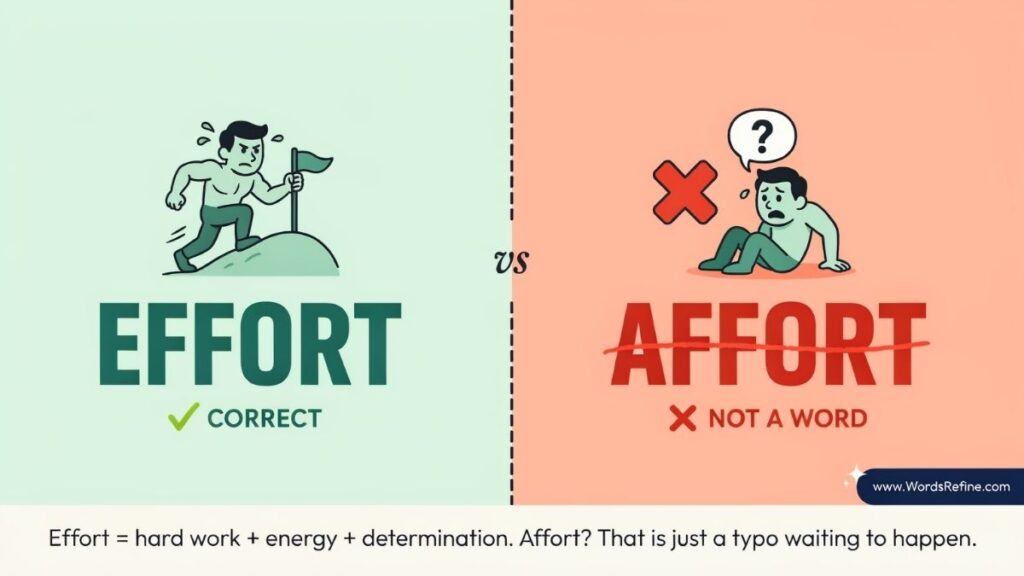
Confusing effort vs affort is a common spelling mistake, but the difference becomes simple once you understand the words. In this guide to effort vs affort you well learn which form is correct and how to use it accurately. “Effort” is a noun that refers to the work, energy, or determination needed to accomplish something. “Afford,” on the other hand, is a verb meaning to have enough money, time, or resources for something. “Affortis not the standard spelling of either word. By learning their meanings and uses, you can avoid this small but noticeable mistake and write with greater accuracy and confidence.
Effort vs Affort The Quick Answer
Effort is the correct word when you mean the work, energy, exertion, or attempt involved in doing something. Affort is not the standard spelling for this meaning.
For example, you would write:
She made a real effort to improve her writing.
You would not write:
She made a real affort to improve her writing.
However, there’s another word that often gets mixed into this confusion: afford.
For example:
I can’t afford a new computer right now.
Here, afford has nothing to do with effort or hard work. It means having enough money or financial ability to buy something.
The same word can also refer to having enough time or the practical ability to do something:
We can’t afford to waste another hour.
Therefore, when deciding between effort vs affort, choose effort if you mean work or an attempt. If the sentence concerns money, time, or the ability to do something, afford may be the word you need.
What Does Effort Mean?
Effort is a noun that refers to the physical or mental energy you use to accomplish something. It can also describe an attempt to achieve a particular result.
In everyday language, effort often means the amount of work involved in getting something done. That work might be physical, such as lifting a heavy box, or mental, such as studying for an examination.
For example:
Learning a new language takes effort.
The word effort tells us that learning requires time, concentration, practice, and mental energy.
Similarly, consider this sentence:
She made an effort to arrive on time.
Here, effort means an attempt. The sentence tells us that she tried to arrive on time.
Importantly, effort does not guarantee success. Someone can make a tremendous effort and still fail. The word describes the energy or attempt invested in an action, not necessarily the final result.
That distinction is useful because it explains why we can talk about effort even when something doesn’t work out.
For instance, a student might study for several hours and still receive a disappointing grade. The student made an effort, even though the outcome wasn’t what they hoped for.
Learn the difference between confusing more English words
Flyer vs Flier Which one Is Correct?
Is Affort a Word?
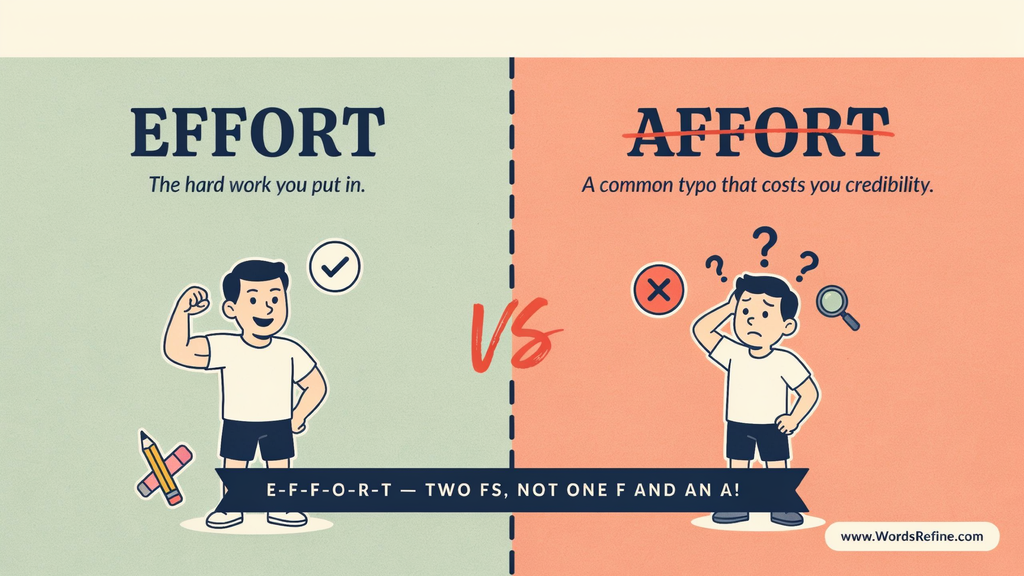
In standard English, affort is not the spelling you should use for the meaning associated with effort or afford.
When people write affort, they usually intend to write either effort or afford. The intended word depends on the sentence.
For example:
He put a lot of affort into the project.
The correct word is effort because the sentence describes work and energy.
On the other hand:
I can’t affort that expensive car.
The intended word is afford because the sentence concerns the ability to pay.
Therefore, asking what does affort mean doesn’t lead to a useful standard definition. Instead, look at the context and determine whether the writer means effort or afford.
This is also why questions such as is affort a word in English or is affort a real word often arise. The spelling looks believable, but resemblance alone doesn’t make a form a standard English word.
Effort vs Affort Difference
The difference between effort vs affort is slightly unusual because these aren’t really two competing standard words.
Effort is a standard English noun. Affort is generally a misspelling.
The distinction becomes clearer when you place effort beside afford.
| Word | Grammar | Main meaning | Example |
|---|---|---|---|
| Effort | Noun | Work, energy, exertion, or an attempt | She made an effort. |
| Afford | Verb | Have enough money, time, or ability | I can afford it. |
| Affort | Not standard for these meanings | Usually a spelling mistake | Avoid this spelling. |
Consequently, the real vocabulary comparison is usually effort versus afford, rather than effort versus affort.
Effort vs Afford The Difference That Matters
The Effort vs afford may look similar, but their meanings are completely different.
Effort describes what you put into something. Afford describes what you have the means or ability to do.
Consider these two sentences:
She put considerable effort into the project.
She couldn’t afford to spend another month on the project.
The first sentence focuses on work and energy. The second focuses on available time.
The distinction becomes even clearer when money enters the picture.
He made a great effort to buy the house.
He couldn’t afford to buy the house.
The first sentence describes the work or determination involved in trying. The second describes whether he had enough financial resources.
Therefore, if you’re wondering whether to use effort or afford, think about the meaning before thinking about the spelling.
If the sentence concerns hard work, energy, exertion, or an attempt, effort is probably right.
If it concerns money, time, resources, or practical ability, afford is probably right.
Learn the difference between commonly mixed-up more words
Reoccurrence vs Recurrence Which One Is Correct ?
Why Do People Write Affort?
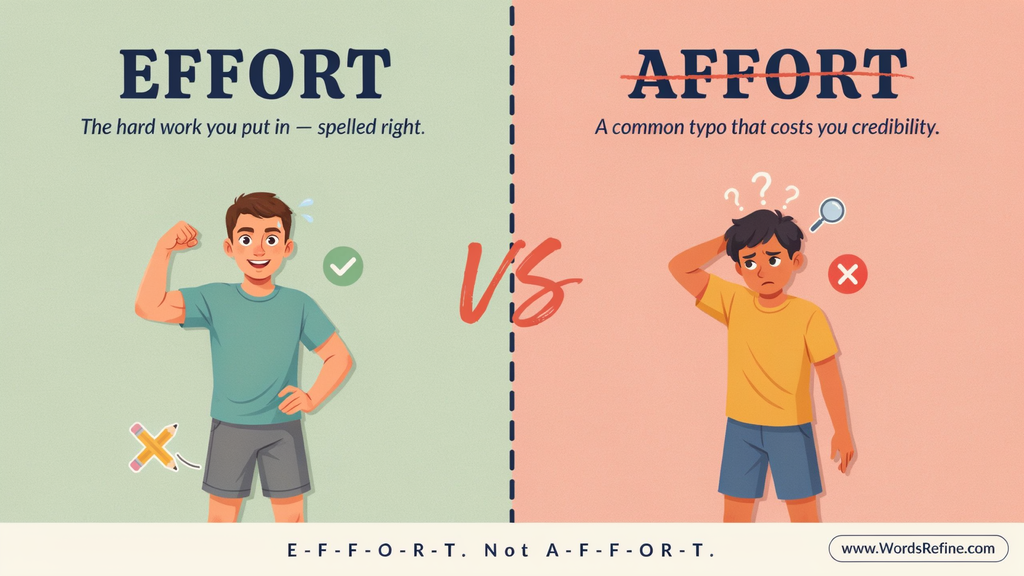
There are several reasons this spelling mistake can happen.
First, effort and afford look very similar. Both begin with a short vowel sound followed by ff, and both contain ort near the end. When someone writes quickly, the brain can easily blend the two patterns.
Second, pronunciation can contribute to spelling confusion. English spelling doesn’t always provide an obvious letter-by-letter guide to pronunciation. When a word is heard quickly in conversation, a writer may reproduce what they think they heard rather than the standard spelling.
Finally, people may mentally combine the two legitimate words. Effort means work or an attempt, while afford refers to having the means or ability to do something. Because both words appear frequently in everyday English, their spellings can occasionally collide.
The result is affort, a form that looks plausible but doesn’t serve as the standard spelling of either word.
How to Spell Effort Correctly
If you’re wondering how to spell effort, the answer is straightforward:
E-F-F-O-R-T.
The correct spelling of effort begins with e, contains two f’s, and ends with t.
A useful way to remember it is to connect effort with energy. Both ideas are closely related. When you make an effort, you use energy, time, concentration, or hard work to accomplish something.
For example:
The task required a lot of effort.
The spelling should always be effort in this context.
Common mistakes include writing affort or efford. Neither spelling should replace the standard form.
How to Spell Afford Correctly
The correct spelling of afford is A-F-F-O-R-D.
Notice the final letter. Effort ends with t, while afford ends with d.
This small difference separates two words with very different meanings.
For example:
She put effort into her studies.
She couldn’t afford the tuition.
The first sentence describes work and dedication. The second concerns financial ability.
Therefore, remembering the final letter can help you avoid the common mistake. If you mean work, think effort. If you mean having enough money, time, or ability, think afford.
Learn the difference between tricky grammar more words
Waving vs Waiving Which One Is Correct ?
Common Mistakes With Effort vs Afford
One common mistake occurs when writers use affort instead of effort.
For example:
She put a great deal of effort vs affort into her research.
The correct version is:
She put a great deal of effort into her research.
The sentence describes work and energy, so effort is the natural choice.
Another mistake occurs when someone uses afford where effort is needed.
For example:
He made a great afford to help his neighbor.
That sentence is incorrect because afford is a verb. The natural expression is:
He made a great effort to help his neighbor.
The opposite mistake happens too:
I can’t effort a new car.
The correct sentence is:
I can’t afford a new car.
Here, the meaning involves money, so afford is required.
These mistakes may look small on the page. Nevertheless, they can change the meaning or make an otherwise polished sentence look careless.
Effort Examples in Everyday Sentences
Effort appears in many ordinary situations because nearly every difficult task requires some combination of time, energy, concentration, or determination.
For example:
She made an effort to call her grandmother every weekend.
Learning to cook well takes practice and effort.
He put extra effort into preparing for the interview.
The team made a considerable effort to finish the project on time.
Writing the report required more effort than expected.
The children showed great effort during the competition.
These examples show how flexible the word can be. Effort can describe physical work, mental concentration, personal dedication, or a deliberate attempt.
It can also describe something that feels difficult:
Getting out of bed after such a long day was an effort.
In this sentence, effort refers to the difficulty involved in performing the action.
Affort Examples and Why They Are Incorrect
Because affort isn’t the standard spelling for these meanings, examples containing it should be treated as corrections rather than proper usage.
For example:
She made a lot of affort to improve.
The correct version is:
She made a lot of effort to improve.
Likewise:
The job required considerable affort.
should become:
The job required considerable effort.
If the intended meaning concerns money, however, the correction may be afford instead:
I can’t affort this laptop.
becomes:
I can’t afford this laptop.
This is why context matters. Simply replacing every instance of affort with effort isn’t always enough. You first need to determine what the writer intended to say.
Common Expressions With Effort
Effort appears in several familiar expressions, and learning these patterns can make correct usage feel much more natural.
Make an effort means to try to do something.
Please make an effort to arrive on time.
Put effort into something means to invest work, energy, or attention in it.
She put a lot of effort into learning the new software.
Make every effort means to try as hard as reasonably possible.
The staff will make every effort to resolve the issue.
Extra effort refers to additional work beyond what is normally expected.
His extra effort made a noticeable difference.
A team effort describes work contributed by several people toward a shared goal.
Finishing the project early was a real team effort.
These expressions are common in both everyday and professional English, so becoming familiar with them can help strengthen your word choice.
Learn the difference between confusing word pairs
Wisp vs Whisp Which One Is Correct?
What Does Put Effort Mean?
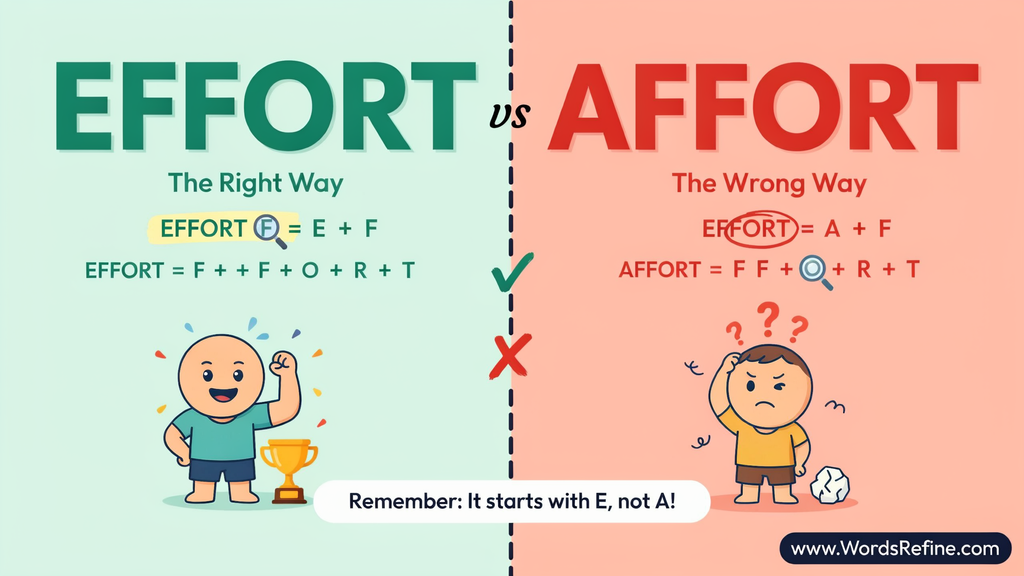
The phrase put effort generally refers to investing time, energy, work, or attention in something. More commonly, you’ll see the complete expression put effort into something.
For example:
She put a lot of effort into her presentation.
This means she invested significant time and energy in preparing it.
Likewise:
He put extra effort into improving his writing.
The sentence emphasizes the additional work he gave to the task.
The amount of effort can also vary:
1.It took little effort.
2.It took considerable effort.
3.It required enormous effort.
4.It required almost no effort.
These expressions allow you to describe not just whether someone worked on something but also how much energy the task required.
Effort as a Noun
Effort functions primarily as a noun. It can describe general work or a specific attempt.
When it refers to work or energy in a general sense, it often appears without a plural form.
For example:
The project required a lot of effort.
Here, effort refers to the overall amount of work required.
However, when the word refers to separate attempts, the plural form efforts can be appropriate.
For example:
She made several efforts to contact the company.
Now the sentence describes several individual attempts.
This distinction is useful in academic and professional writing because it allows you to describe an action more precisely.
Effort vs Efforts
Use effort vs affort when you are talking about work or energy generally.
The job requires considerable effort.
Use efforts when you’re talking about separate attempts or actions.
Her efforts to improve customer service were successful.
The difference may seem subtle, but context makes it clear.
If you can count the individual attempts, efforts often makes sense. If you are describing the overall work or energy involved, effort is usually the better choice.
Learn the difference between often confused words
Compair vs Compare Which One Is Correct?
Effort vs Attempt
Effort vs attempt can sometimes work as synonyms, but they don’t always emphasize the same idea.
Attempt focuses primarily on trying to accomplish something.
Effort can focus more strongly on the energy or work invested in that attempt.
Compare these sentences:
His attempt to repair the computer failed.
His effort to repair the computer was impressive.
The first sentence focuses on whether he succeeded.
The second highlights the work he put into the task.
Depending on the context, effort can also refer to exertion without emphasizing an attempt at all.
For example:
Moving the furniture required considerable effort.
Here, effort refers to physical exertion rather than an attempt in the narrower sense.
Effort Synonyms and Related Words
Several words can express an idea similar to effort, although each carries its own shade of meaning.
Attempt emphasizes trying to accomplish something.
Exertion emphasizes physical or mental energy.
Work emphasizes the labor involved.
Energy emphasizes the power used to accomplish something.
Endeavor suggests a serious or sustained attempt.
Striving emphasizes continued effort toward a goal.
The best synonym depends on the sentence. For instance, exertion works naturally when discussing exercise, while attempt is often better when describing an unsuccessful try.
Afford Meaning and Usage
Afford is a completely legitimate English verb. It usually describes having enough money, time, or resources to do something or obtain something.
For example:
I can’t afford a new car.
The sentence means the speaker doesn’t have enough money to buy one.
However, afford isn’t limited to financial situations.
We can’t afford to waste time.
Here, the issue is time.
The company can’t afford to lose another customer.
Here, the idea concerns practical consequences and what the company can reasonably accept.
Afford can also appear before a noun:
She can afford the rent.
Or before a to-infinitive:
She can afford to take a few days off.
These patterns are common and useful in everyday English.
Learn the difference between basic English word mistakes
Performing vs Preforming Which One Is Correct?
Afford Synonyms
The best synonym for afford depends on the context.
When money is involved, afford can sometimes be replaced by pay for or have the money for.
For example:
I can’t afford the repair.
I can’t pay for the repair.
When time is involved, afford can sometimes mean have enough time for.
We can’t afford to wait.
We don’t have enough time to wait.
In other contexts, afford can mean be able to manage or have the means to do something.
However, synonyms don’t always match perfectly. Therefore, it’s better to understand the original meaning before replacing the word.
Difference Between Effort vs Afford
The difference between effort vs afford becomes much easier to remember when you consider their grammatical roles.
Effort is a noun. Afford is a verb.
Effort describes something you put into an activity. Afford describes something you have the means or ability to do.
For example:
She made an effort to finish early.
She could afford to finish early.
The first sentence describes an attempt. The second suggests that circumstances allowed it.
A simple test can help.
If you can replace the word with hard work, energy, or attempt, use effort.
If you can replace it with have enough money, have enough time, or be able to, use afford.
Effort vs Affort in Professional Writing
Correct word choice becomes particularly important in professional writing because small errors can distract readers.
Consider this sentence:
The research team invested significant effort vs affort in collecting the data.
The meaning is understandable, but the spelling is incorrect.
A polished version is:
The research team invested significant effort in collecting the data.
Now consider:
The department cannot effort another delay.
The correct version is:
The department cannot afford another delay.
In the first example, effort is a noun describing work. In the second, afford is a verb describing what the department can tolerate or manage.
The distinction matters in reports, emails, applications, academic assignments, resumes, and other forms of written communication.
Clear writing doesn’t require complicated vocabulary. It requires accurate word choice.
Effort in American English
American English uses effort with the same basic spelling and meaning discussed throughout this article.
There is no standard American spelling in which effort becomes affort.
Likewise, afford remains afford.
Some English words do have different American and British spellings, but this isn’t one of those cases. The difference here comes from spelling confusion rather than regional variation.
That means writers shouldn’t treat affort as an American alternative to effort. It isn’t the standard spelling.
A Simple Way to Remember Effort vs Afford
When you’re unsure whether to write effort or afford, focus on the meaning instead of the letters.
Effort is what you put into something.
Afford is what you have the means or ability to do.
For example:
You put effort into studying.
You afford the cost of studying only if you have enough money or resources.
A quick memory trick is:
Effort means energy.
Afford means ability or means.
Affort means stop and check the sentence.
This simple distinction can prevent most mistakes.
Learn the difference between commonly misused words
Tomatoes vs Tomatos Which one Is Correct?
Effort vs Affort Practice
Choose the word that makes sense in each sentence.
She made a serious effort to improve her grades.
We can’t afford another delay.
The project required considerable effort.
I can’t afford that expensive computer.
He put extra effort into preparing the presentation.
They couldn’t afford to take another week off.
Her effort impressed everyone on the team.
The rescue required enormous physical effort.
Learning a new skill takes patience and effort.
The company cannot afford to ignore the problem.
The important point isn’t simply memorizing the answers. Notice why each word fits. Effort describes work, energy, or an attempt, while afford describes the ability or means to do something.
Learn the difference between everyday English mistakes
Inquiries vs Queries What’s the Difference ?
Practice Session Effort vs Affort
- She made a great ______ to finish the project on time.
- I can’t ______ to buy a new laptop right now.
- His hard work and ______ were finally recognized.
- We need to make an ______ to improve customer service.
- They couldn’t ______ to waste any more time.
- The team’s combined ______ helped complete the project.
- She made several ______ to solve the problem.
- Can you ______ to take a few days off?
- He put a lot of ______ into learning English.
- The correct spelling for the noun meaning “work or energy” is ______.
- The correct verb for having enough money or resources is ______.
- She didn’t make much ______ to understand the instructions.
- We should make every ______ to meet the deadline.
- The company cannot ______ to ignore customer complaints.
- His ______ was obvious from the quality of his work.
- They made repeated ______ to repair the damaged equipment.
- She worked hard, but her ______ was not enough to complete the task.
- I don’t think we can ______ another expensive purchase this month.
- “Affort” is usually a misspelling of ______ or ______.
- The students showed considerable ______ during the final examination.
- The organization made several ______ to support the local community.
- You need to put more ______ into your writing.
- We can’t ______ to lose valuable time.
- Her extra ______ made a noticeable difference.
- After years of careful saving, they could finally ______ the trip.
Answers
- effort
- afford
- efforts
- effort
- afford
- effort
- efforts
- afford
- effort
- effort
- afford
- effort
- effort
- afford
- effort
- efforts
- effort
- afford
- effort, afford
- effort
- efforts
- effort
- afford
- effort
- afford
Here’s a trusted source for clear more words Comparison:
FAQs
Is “affort” ever correct in standard English?
No. “Affort” is not a standard English spelling. If you mean work, energy, or an attempt, the correct word is “effort.” If you mean having enough money, time, or resources for something, use “afford.”
Why do people spell “effort” as “affort”?
The mistake usually happens because “effort” and “afford” sound somewhat similar, especially in quick speech. Since both words are familiar, it’s easy to blend their sounds and accidentally write “affort.”
Is “effort” a noun or a verb?
“Effort” is a noun. It refers to the work, energy, or determination someone uses to achieve something. For example, “Her effort helped the team complete the project.”
Can “effort” be plural?
Yes. You can use “effort” as a singular noun or “efforts” when referring to several attempts or actions. For example, “The team made several efforts to resolve the issue.”
Is “make efforts” grammatically correct?
Yes, “make efforts” is grammatically correct. However, “make an effort” is often more natural when you’re referring to one particular action or a general willingness to try.
What does “effort” mean in a relationship?
In a relationship, “effort” refers to the time, attention, care, and actions someone puts into maintaining the relationship. Communicating, making time for each other, and showing consideration can all be examples of effort.
What does “effort” mean in the workplace?
In the workplace, “effort” refers to the time, energy, concentration, and work someone puts into completing a task or achieving a goal. For example, “The project required considerable effort from the entire team.”
Is “effort” always used positively?
No. “Effort” is a neutral word. It can describe successful work, unsuccessful attempts, or insufficient work depending on the context. For example, “The effort was unsuccessful” describes the result without suggesting that making an effort was wrong.
What is the difference between effort and energy?
“Effort” refers to the work or exertion required to do something, while “energy” can refer to physical strength, mental vitality, or the capacity to perform an activity. For example, completing a difficult assignment may require significant effort, while enough energy helps you stay focused.
Can “effort” be used in formal writing?
Yes. “Effort” works well in formal, academic, professional, and everyday English. For example, “The researchers made a significant effort to verify the results.”
What does “with little effort” mean?
“With little effort” means something can be done without requiring much work, energy, or difficulty. For example, “She completed the task with little effort.”
What does “without effort” mean?
“Without effort” means something happens or is accomplished without requiring much noticeable work or exertion. For example, “The machine moved the object without effort.”
Can an effort fail?
Yes. An effort describes an attempt or the work put into achieving something, so it does not have to succeed. For example, “The rescue effort failed despite careful planning.”
Is “effortful” a real English word?
Yes. “Effortful” is a valid English adjective. It describes something that requires considerable effort, concentration, or mental work. Although it is less common in everyday conversation, it can appear in formal or academic writing.
Learn the difference between more words people mix up
Lend vs Lent What’s the Difference and When to Use Each?
Conclusion
Effort vs affort may look like close relatives, but in standard English, only one belongs in your sentence: effort. It means the work, energy, or determination you put into doing something. Meanwhile, affort is simply a common spelling mistake, often caused by mixing up effort with afford.
The good news is that the confusion is easy to fix. When you mean hard work or an attempt, choose effort. When you mean having enough money, time, or resources, choose afford. In other words, you can make an effort to save money, but you need to afford something before you can buy it.
So, the next time “affort” tries to sneak into your sentence, don’t let it fool you. Give it a polite grammatical goodbye and choose the word that actually fits. A little attention to spelling can make a big effort in keeping your writing clear and correct.

Diora AJS she is an experienced blogger and passionate English language enthusiast at Words Refine. With a keen eye for language and a love for clear communication, she writes practical content about grammar, word meanings, usage, and commonly confused terms. Her goal is to make English easier to understand through clear explanations and relatable examples, helping readers write accurately and communicate with confidence.