

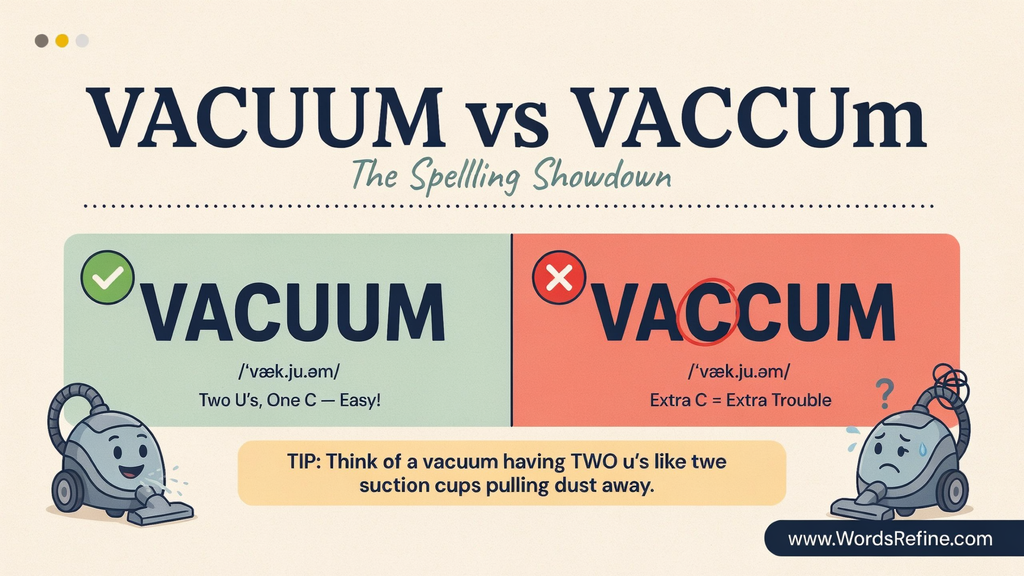
The spelling difference between vaccum vs vacuum may look minor, yet it can easily lead to mistakes in everyday writing. If you often hesitate over vaccum vs vacuum the answer is simple: “vacuum” is the correct spelling. It follows the unusual pattern of one c followed by two u’s, which is why the word can be tricky to remember. “Vaccum is simply a common misspelling created by replacing one of those u’s with another c. In this guide, you well learn what “vacuum” means, how it is pronounced, how it functions in a sentence, and why remembering its spelling can help you write more accurately and confidently.
Vaccum vs Vacuum The Quick Answer
When you compare vaccum vs vacuum, there is no difference in meaning to sort out. One spelling is correct and the other isn’t.
Vacuum is the correct form.
Vaccum is incorrect.
The correct spelling is:
Vacuum
The incorrect spelling is:
Vaccum
At first glance, vaccum may look perfectly reasonable. In fact, that’s what makes the mistake so easy to overlook. The eye can move across the word quickly without noticing that one c has replaced one of the u’s.
However, the correct letter pattern is easy to remember:
V-A-C-U-U-M
There is one c and two u’s.
This also answers the common question, “Is vaccum correct?” No. The standard English spelling is vacuum.
Likewise, if you’re wondering whether it is vacuum vs vaccum, choose vacuum every time.
What Does Vacuum Mean?
The word vacuum has more than one meaning, although all of its uses are connected by the idea of an empty space, an absence, or the familiar cleaning machine.
In science, a vacuum refers to a space containing very little matter. A perfect vacuum would contain no matter at all, although completely perfect vacuum vs vaccum are difficult to create in practical settings.
For example:
The experiment was performed inside a vacuum chamber.
Here, vacuum has a scientific meaning.
The word can also describe an absence of something. For instance, if a company loses an important leader and nobody immediately takes that person’s place, someone might describe the situation as a leadership vacuum.
In that case, the word doesn’t refer to air or a machine. Instead, it describes a gap created by someone’s absence.
The everyday meaning is probably the one you encounter most often. A vacuum can refer to a machine that removes dust, dirt, hair, and other debris from floors and surfaces.
For example:
I bought a new vacuum for the living room.
The same word can also describe the action of cleaning with that machine.
I need to vacuum the floor.
So, depending on the sentence, vacuum can work as a noun or a verb.
Learn the difference between confusing more English words
Socialise vs Socialize Which one Is Correct ?
Vacuum as a Noun
As a noun, vacuum can refer to a physical space with very little or no matter.
It can also describe an absence or gap.
Finally, in ordinary conversation, Americans often use vacuum as a shortened form of vacuum cleaner.
For example:
The vacuum is in the closet.
The scientist created a vacuum inside the chamber.
Her departure left a vacuum in the department.
Although these sentences use the same word, the meaning changes according to context.
That flexibility is one reason vacuum is such a useful English word.
Vacuum as a Verb
Vacuum can also function as a verb.
When you vacuum, you clean something with a vacuum cleaner.
For example:
I vacuum the house every Saturday.
She vacuumed the carpet before the guests arrived.
They are vacuuming the hallway right now.
The verb changes naturally depending on tense and subject. You can write vacuum, vacuums, vacuumed, or vacuuming.
Notice that the spelling remains connected to the original word. The unusual double-u pattern doesn’t suddenly disappear when you use the word as a verb.
That is important because forms such as vaccumed and vaccuming are also incorrect.
The correct forms are vacuumed and vacuuming.
Vacuum Cleaner and Its Meaning
A vacuum cleaner is a machine that uses suction to collect dirt, dust, hair, and other small particles from surfaces.
In everyday American English, people often shorten vacuum cleaner to vacuum.
For example:
The vacuum cleaner is broken.
The vacuum is broken.
Both sentences can communicate the same basic idea.
The spelling remains vacuum in either case.
Therefore, if you’re writing about cleaning floors, carpets, furniture, or other surfaces, remember that vacuum keeps the same spelling.
Learn the difference between commonly mixed-up more words
Instalments vs Installments Which one Is Correct?
The Correct Vacuum Spelling
The easiest way to remember the spelling is to break the word into parts:
Vac + u + u + m
Put those pieces together and you get vacuum.
The middle is the important part.
1.It is not vaccum.
2.It is not vacum.
3.It is not vacume.
4.It is vacuum.
One c.
Two u’s.
That simple pattern is more useful than trying to memorize a complicated spelling rule.
Why Is Vacuum So Easy to Misspell?
Some English words seem almost designed to test your patience. Vacuum is one of them.
The spelling contains two consecutive u’s, which isn’t a pattern people see constantly in everyday English. As a result, writers sometimes replace the unusual sequence with something that looks more familiar.
That is where vaccum comes from.
The mistake can happen even when someone knows the word perfectly well. Fast typing makes the problem more likely because people often type familiar words by recognizing their overall shape rather than consciously thinking about every individual letter.
In other words, your brain may know the word while your fingers take a tiny shortcut.
Unfortunately, the shortcut produces vaccum.
Why Do People Spell Vacuum vs Vaccum?
The most obvious reason is the unusual arrangement of letters.
When you say the word aloud, you don’t hear two clearly separated u’s. The pronunciation doesn’t give you a neat letter-by-letter guide.
The standard pronunciation in American English is commonly represented as /ˈvæk.juːm/. Because the spoken form doesn’t highlight the written sequence v-a-c-u-u-m, remembering the spelling requires some visual memory.
That’s why reading the word regularly can help.
Once you’ve seen vacuum often enough, the correct form begins to look natural. Eventually, vaccum starts to look strange.
That’s a useful stage to reach because familiar spelling patterns are easier to recognize than reconstruct from scratch.
Learn the difference between tricky grammar more words
Copyright vs Copywrite Which One Is Correct?
Is Vaccum a Word?
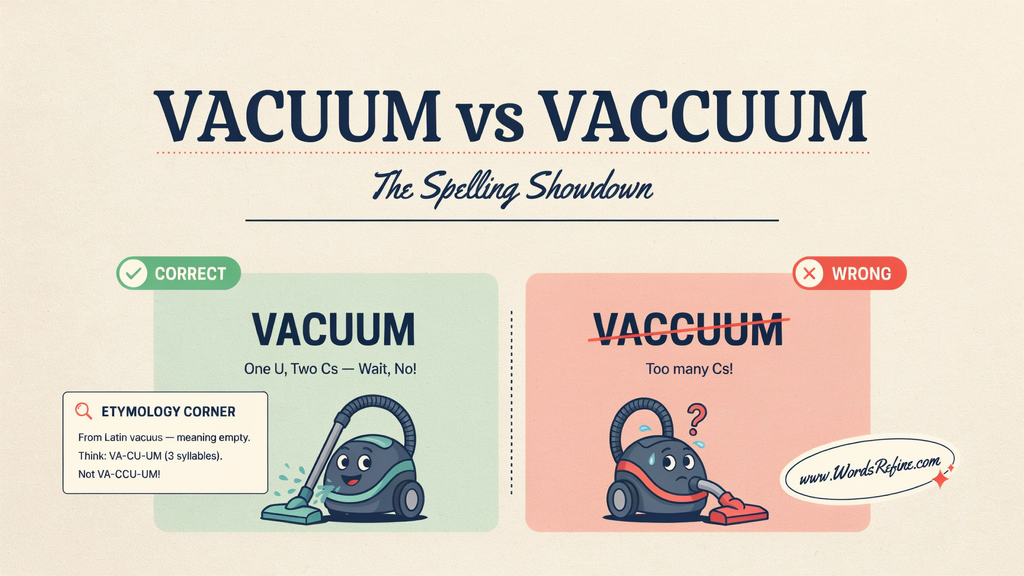
Vaccum is not the standard spelling of the English word vacuum.
You may still see it online, of course. People make spelling mistakes everywhere. Social media posts, comments, messages, search queries, and informal writing aren’t automatically proof that a spelling is correct.
For example, someone might write:
I need to vaccum the bedroom.
The intended meaning is obvious, but the spelling is still wrong.
The corrected sentence is:
I need to vacuum the bedroom.
So, if you’re asking, “Is vaccum a word?” the practical answer is no when you’re using it as the spelling of the standard English word vacuum.
Is Vacume Correct?
Vacume is another common misspelling.
It may look reasonable because English contains many words ending in similar patterns. However, vacuum doesn’t follow that pattern.
The correct form is vacuum.
For example:
Incorrect: The vacume cleaner is in the garage.
Correct: The vacuum cleaner is in the garage.
Similarly:
Incorrect: I need to vacume the carpet.
Correct: I need to vacuum the carpet.
The important point is that vacume isn’t an alternative spelling. It’s simply another spelling error.
Learn the difference between confusing word pairs
Dreamt vs Dreamed Which One Is Correct?
Vacuum Pronunciation and Spelling
Pronunciation can explain some of the confusion surrounding this word.
Vacuum is generally pronounced with two syllables. The first syllable carries the main stress, while the second contains the long u sound.
Because the spelling contains two u’s but the pronunciation doesn’t make those letters individually obvious, writing the word from sound alone can be tricky.
That doesn’t mean the spelling is unpredictable once you know it. In fact, the visual pattern is quite stable.
Vacuum always begins with vac and ends with uum.
That gives you a useful mental frame:
Vac + uum
Once you recognize that shape, the word becomes much easier to reproduce correctly.
Common Mistakes With Vacuum
The most common errors usually involve changing, removing, or adding letters.
Vaccum replaces one of the u’s with a second c.
Vacum drops one of the u’s.
Vacume changes the ending.
Vaccuum adds an unnecessary c while keeping the double u.
None of these forms is the standard spelling.
The correct form remains vacuum.
These mistakes are worth knowing because recognizing them can make proofreading much easier. If you see vaccum, vacum, or vacume in your own writing, you’ll immediately know what needs fixing.
Vacuum in Different Forms
Once you know the base spelling, the other forms become much easier.
The present-tense verb is vacuum.
For example:
I vacuum the kitchen every morning.
With a third-person singular subject, it becomes vacuums.
He vacuums the office every Friday.
The past tense is vacuumed.
She vacuumed the carpet yesterday.
The present participle is vacuuming.
They are vacuuming the stairs.
These forms may look slightly unusual because the original word already ends with a pair of vowels. Still, the standard spellings follow the normal grammatical forms.
Learn the difference between often confused words
Mobil vs Mobile Which one Is Correct?
Vacuum in American and British English
Unlike some English words, vacuum does not have a separate standard American and British spelling.
American English uses vacuum.
British English also uses vacuum.
So, if you’re wondering whether vaccum might be acceptable in British English, it isn’t.
There can be differences in vocabulary surrounding the word. For example, British English commonly uses hoover as a verb for cleaning with a vacuum cleaner. However, that doesn’t change the spelling of vacuum.
The spelling remains the same.
This distinction matters because some spelling differences really do depend on the variety of English being used. Color and colour are a familiar example. Vacuum isn’t one of them.
Vacuum in Science and Everyday Life
The word appears in two very different areas of daily language.
At home, you might vacuum the floor, empty the vacuum, or buy a new vacuum cleaner.
In science, you might read about a vacuum chamber, vacuum pump, vacuum pressure, or vacuum system.
The meanings aren’t unrelated. They all connect to the idea of removing matter or using suction.
For instance, a vacuum cleaner creates a pressure difference that helps move air and debris into the machine. In physics, a vacuum refers to a region with very little matter.
So although the household and scientific uses seem worlds apart, the word has a common underlying idea.
Vacuum in Figurative Expressions
Vacuum also appears in figurative language.
One familiar expression is “in a vacuum.”
When someone says a decision wasn’t made in a vacuum, they mean it wasn’t made separately from surrounding circumstances.
For example:
The company didn’t make the decision in a vacuum.
That means the decision was influenced by other events, people, or conditions.
Another common expression is leadership vacuum.
For example:
The sudden resignation created a leadership vacuum.
Here, vacuum means an empty space in a figurative sense.
These expressions show how a physical idea can develop into a broader metaphor. An empty physical space becomes a useful way to describe an absence of leadership, information, authority, or support.
Learn the difference between basic English word mistakes
Fiancé vs Fiancée What’s the Difference and which is Correctly?
Examples of Vacuum in Everyday Sentences
Seeing the word in different situations makes the spelling easier to remember.
I need to vacuum the living room before dinner.
She vacuumed the carpet yesterday.
The vacuum vs vaccum cleaner is sitting beside the stairs.
He bought a new vacuum for his apartment.
Please vacuum under the sofa.
They are vacuuming the hallway.
Each sentence uses the same core spelling even though the grammatical form or context changes.
Examples of Vacuum in Scientific Sentences
The laboratory uses a vacuum chamber for the experiment.
The pump removes air from the container.
The sample was placed under vacuum conditions.
The researchers studied the material in a controlled vacuum.
These examples use the scientific sense of the word. Here, vacuum refers to a space in which much of the matter or gas has been removed.
Examples of the Figurative Meaning
The company faced a leadership vacuum after the director resigned.
The report was written without considering the broader situation, almost as if it existed in a vacuum.
The sudden change created an information vacuum.
In these examples, vacuum refers to an absence rather than an actual empty physical space.
Learn the difference between everyday English mistakes
Any time vs anytime meaning Difference with Examples ?
How to Correct Vaccum in a Sentence
Consider this sentence:
I need to vaccum the kitchen.
The meaning is clear, but the spelling needs correction.
The polished version is:
I need to vacuum the kitchen.
Now consider another example:
The scientist placed the sample inside a vaccum chamber.
The corrected version is:
The scientist placed the sample inside a vacuum chamber.
The same correction applies when the word changes form.
Incorrect:
She vaccumed the bedroom.
Correct:
She vacuumed the bedroom.
Incorrect:
They are vaccuming the hallway.
Correct:
They are vacuuming the hallway.
The lesson is simple. Fix the base word first, then build the grammatical form from vacuum.
Vacuum Spelling in Professional Writing
Spelling matters more in some settings than others.
A typo in a casual text message may not cause much trouble. However, repeated spelling errors can distract readers in an academic paper, business report, instruction manual, product description, or technical document.
Vacuum is particularly common in technical writing because the word appears in science and engineering.
You might see phrases such as vacuum chamber, vacuum vs vaccum pump, vacuum seal, and vacuum system.
In such contexts, precision matters.
A technical document should not force readers to wonder whether an unusual spelling is intentional. Clear writing removes that distraction.
The same principle applies to everyday professional communication. If you’re writing instructions for cleaning equipment, describing a product, or preparing a report, use the standard spelling.
A Simple Way to Remember Vacuum
Here’s the easiest memory trick:
Vacuum has one c and two u’s.
Say the pattern to yourself as you write it:
Vac-u-um.
You don’t need a complicated mnemonic. You just need to notice the unusual part.
Another helpful trick is to compare the correct and incorrect forms visually:
Vacuum
Vaccum
The first contains one c followed by two u’s.
The second contains two c’s followed by one u.
Once you train yourself to look for that middle section, the error becomes much easier to catch.
Learn the difference between commonly misused words
Choose vs Chose Difference and which one is Correct?
Practice Session Vaccum Vs Vacuum
- The correct spelling is ________.
- “Vaccum” is a common spelling ________ of “vacuum.”
- Please use the ________ cleaner to remove the dirt from the carpet.
- The correct spelling contains two consecutive ________.
- A ________ is a space containing little or no matter.
- She used the vacuum to ________ the living room floor.
- The word “vacuum” can function as both a noun and a ________.
- He bought a new ________ cleaner for his apartment.
- Which spelling is correct: “vacuum” or “________”?
- The phrase “vacuum cleaner” refers to an appliance that uses suction to collect ________ and debris.
- In British English, a vacuum cleaner is commonly called a ________.
- The spelling “vaccum” should be replaced with “________” in formal writing.
- The word “vacuum” contains the letter sequence “u-________.”
- A vacuum can describe an empty ________ or a lack of something.
- The technician used a vacuum pump to create a ________.
- If you want to describe the act of cleaning with a vacuum cleaner, “vacuum” can be used as a ________.
- The phrase “in a vacuum” can describe something considered without its surrounding ________.
- She accidentally typed “vaccum” instead of “________.”
- A robot ________ can clean floors without being pushed by hand.
- The correct form is “vacuum cleaner,” not “________ cleaner.”
- The verb “vacuum” means to clean something using a ________ cleaner.
- Remember the spelling pattern: v-a-c-u-________-m.
- The scientist created a partial ________ inside the chamber.
- Although “vaccum” may look familiar, it is not the standard English ________.
- Before submitting your article, check that every use of “vacuum” has the correct ________.
Answers
- vacuum
- mistake
- vacuum
- u’s
- vacuum
- clean
- verb
- vacuum
- vaccum
- dust
- hoover
- vacuum
- u
- space
- vacuum
- verb
- context
- vacuum
- vacuum
- vaccum
- vacuum
- u
- vacuum
- spelling
- spelling
Here’s a trusted source for clear more words Comparison:
FAQs
What does “vacuum” mean in slang?
In slang or casual speech, “vacuum” can describe someone or something that seems to absorb or consume a lot of something. For example, a person who eats very quickly might jokingly be called a “vacuum.” The exact meaning depends on the context.
What’s another name for a vacuum?
Another common name for a vacuum cleaner is a hoover. This term is especially common in British English, although vacuum cleaner is also widely understood.
What is vulgar slang for a toilet?
Several vulgar slang terms are used for a toilet, including “loo,” “john,” “crapper,” and other informal expressions. The exact term varies by region, social setting, and level of formality.
How do Mexicans say “take a shower”?
In Mexican Spanish, “take a shower” is commonly expressed as “darse una ducha” or “tomar una ducha.” In everyday Mexican speech, “me voy a bañar,” meaning “I’m going to bathe” or “I’m going to take a shower,” is also very natural.
Why are toilet seats removed in Mexico?
There is no general rule in Mexico requiring toilet seats to be removed. Some public or commercial bathrooms may have toilets without seats because of maintenance, hygiene, vandalism, or local facility practices. It shouldn’t be treated as a standard Mexican custom.
Is it “vacuum” vs “vaccum”?
The correct spelling is “vacuum.” It contains two u’s after the c: v-a-c-u-u-m. “Vaccum” is a common misspelling and is not the standard English spelling.
How do the British say “vacuum”?
British speakers generally pronounce “vacuum” in essentially the same way as American speakers, although accents can affect the exact sound. In everyday British English, “hoover” is also commonly used for a vacuum cleaner and for the act of vacuuming.
What is the Zulu word for “vacuum”?
The appropriate Zulu translation depends on what “vacuum” means in context. If you mean a physical vacuum or empty space, the translation differs from the word for a vacuum cleaner. Therefore, there isn’t one single Zulu word that fits every use of “vacuum.”
What word has two U’s in a row?
“Vacuum” is one of the most familiar English words with two consecutive u’s. The spelling is v-a-c-u-u-m, which is why people sometimes accidentally write “vaccum” or “vacum.”
Why is a vacuum called a hoover?
“Hoover” comes from the Hoover Company, which became strongly associated with vacuum cleaners in Britain. Over time, the brand name became a generic everyday term for a vacuum cleaner in British English.
What letter is double U?
The letter “W” is traditionally called “double-u” because its name developed from a form representing two u’s. In modern English spelling, however, the letter itself is written as W.
What do Brits call vacuums?
Brits commonly call a vacuum cleaner a “hoover.” They may also use “vacuum cleaner,” particularly in formal or technical contexts. As a verb, “hoover” can also mean to clean a floor with a vacuum cleaner.
What is an old vacuum called?
An old-style vacuum cleaner may be described as a vintage vacuum, an antique vacuum, or an old-fashioned vacuum cleaner. Older models can include bulky upright machines, early canister vacuums, and hand-operated designs.
What do the French call a vacuum cleaner?
In French, a vacuum cleaner is called “un aspirateur.” The word comes from the verb “aspirer,” meaning “to suck up” or “to draw in,” which reflects how the appliance works.
What type of vacuum has the best suction?
The strongest suction depends on the vacuum’s design, motor, airflow, filtration system, and cleaning head. A vacuum with a powerful motor does not automatically provide the best cleaning performance because airflow and the ability to maintain suction also matter.
What was the first vacuum called?
Early vacuum-cleaning machines had several different names and designs. One well-known early device was the “Whirlwind,” developed by Ives W. McGaffey in the 1860s. It was manually operated rather than powered by an electric motor.
What are vacuums called that go on their own?
Vacuums that clean without being manually pushed are usually called robot vacuums or robotic vacuum cleaners. They use sensors and programmed navigation to move around a room and clean floors automatically.
What is the normal suction pressure for adults?
There is no single normal suction pressure for all adults because suction depends on the action being performed, the muscles involved, and the measurement method. Mouth suction can be produced by lowering pressure inside the mouth, but everyday suction is not normally described using one fixed value.
How much water can a human mouth hold?
The amount varies from person to person, but an adult mouth can hold only a relatively small amount of liquid comfortably. The actual capacity depends on mouth size, tongue position, jaw movement, and how much liquid a person can safely retain.
What creates suction in your mouth?
Suction in the mouth occurs when the pressure inside the mouth becomes lower than the pressure outside it. Your tongue, lips, cheeks, and jaw help create a temporary seal, allowing you to reduce the pressure and draw in liquid or air.
Learn the difference between more words people mix up
Discrete vs Discreet What the Difference and which is Correctly?
Conclusion
The confusion between vacuum vs vaccum is understandable because the correct spelling looks a little unusual. Two u’s sitting side by side can make your brain want to rearrange the letters. However, “vacuum” is the only standard spelling, while “vaccum” is simply a misspelling.
The easiest way to remember it is to focus on the middle: vacuum has “uu,” not “cc.” Think of it as a tiny spelling vacuum that happily sucks up that extra c. Once you remember v-a-c-u-u-m, the confusion becomes much easier to avoid.
Whether you’re writing about a vacuum cleaner, using “vacuum” as a verb, or describing an empty space, keep the spelling consistent. When in doubt, remember the simple rule: one c, two u’s. Your sentence will stay clean, and your spelling won’t need a rescue mission.

Diora AJS she is an experienced blogger and passionate English language enthusiast at Words Refine. With a keen eye for language and a love for clear communication, she writes practical content about grammar, word meanings, usage, and commonly confused terms. Her goal is to make English easier to understand through clear explanations and relatable examples, helping readers write accurately and communicate with confidence.