
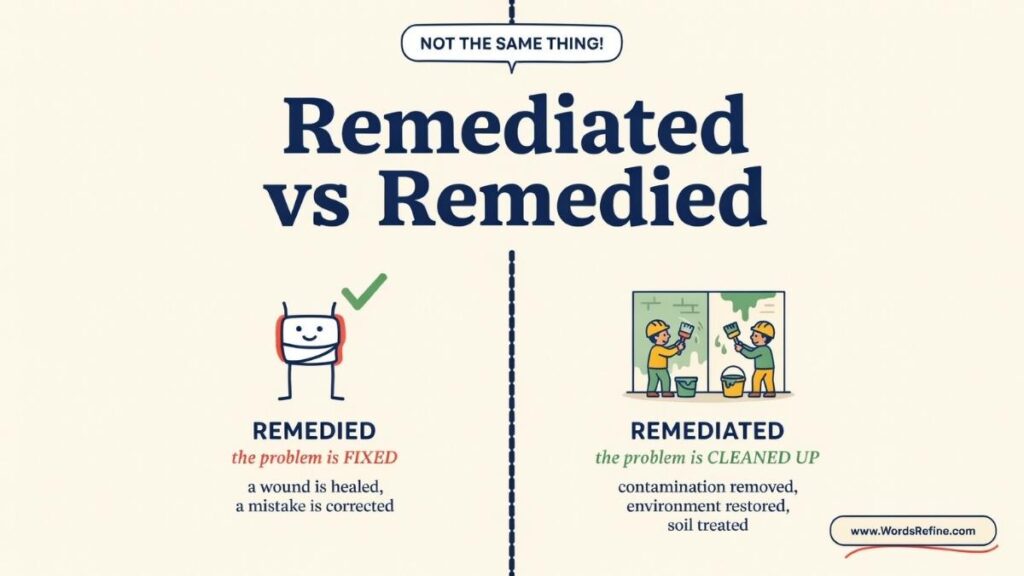
English has a funny habit of giving you several words for nearly the same job, then making sure they do not work exactly the same way. Remediated vs remedied is a perfect example. Both words relate to fixing or correcting a problem, but they come from different verbs and often appear in different contexts. That small distinction can easily trip up even careful writers. Whether you are discussing environmental cleanup, cybersecurity, education, business, or everyday problems, choosing the right word matters. In this guide, you well learn what remediated vs remedied mean, how they differ, and when to use each one naturally. By the end, this confusing pair should feel much easier to handle.
Remediated vs Remedied The Quick Answer
The easiest way to understand the difference is to look at the verbs behind these two words.
Remediated vs remedied comes from remedy. It generally means corrected, fixed, improved, or dealt with a problem.
Remediated comes from remediate. It can also mean corrected or addressed, but it appears particularly often when a problem requires a specific corrective process or specialized intervention.
For example, consider this sentence:
The company remedied the billing error.
Here, the writer simply means that the company corrected the error.
Now consider this sentence:
The environmental team remediated the contaminated soil.
This sentence suggests a more specific process involving environmental cleanup or treatment.
Therefore, neither word is automatically better. Instead, the surrounding context tells you which form works best.
What Does Remedied Mean?
The verb remedy means to correct, improve, or deal with a problem or undesirable situation. It can describe something as simple as correcting an error or as serious as addressing a major deficiency.
The word also works as a noun. A remedy can be a solution, treatment, or course of action intended to correct a problem or provide relief.
For example, a company might remedy a billing error. A manager might remedy a communication problem. A new policy might remedy a weakness in an existing system.
The central idea remains the same: something is wrong, and an action is taken to make the situation better.
Learn the difference between tricky grammar more words
Further vs Farther The Simple Difference and Each Correctly?
Remedied as a Verb Form
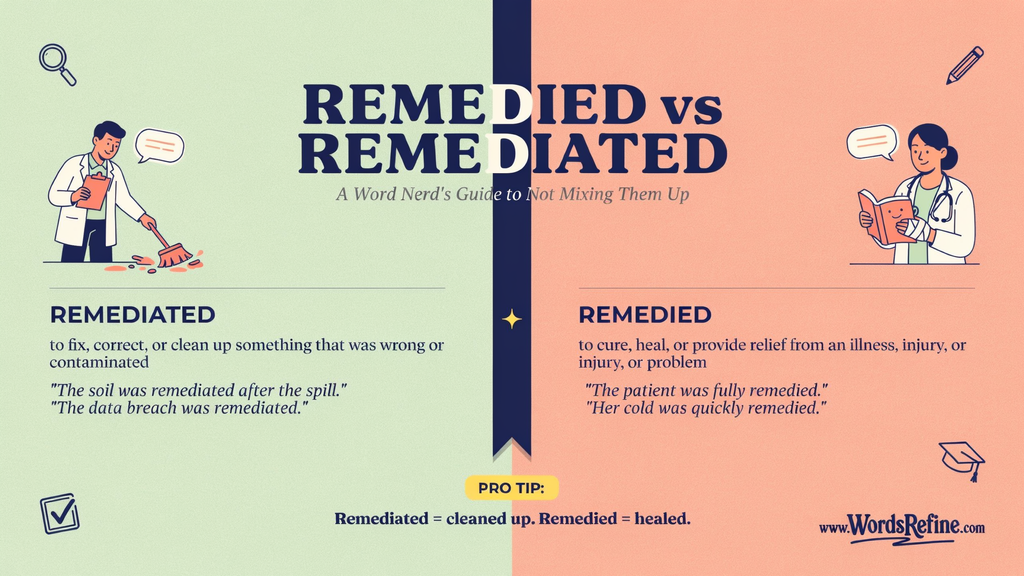
The Remedied is the past-tense and past-participle form of remedy.
The spelling changes because remedy ends in a consonant followed by y. When the past-tense ending is added, the y changes to i.
Remedy becomes remedied.
This same spelling pattern appears in words such as studied, carried, modified, and satisfied.
For example, you could write:
The editor remedied several factual errors before publication.
The technician remedied the equipment problem.
The company has remedied the customer complaint.
In each sentence, remedied tells the reader that someone corrected or addressed an existing problem.
Is Remedied a Word?
Yes. Remedied is a standard English word. It is not an informal variation or an incorrect spelling.
It is simply the past-tense and past-participle form of remedy.
This distinction matters because some writers become uncertain when they see remediated and assume that remedied might somehow be incorrect. There is no reason for that concern. Both forms are established English words, but they belong to different verbs.
What Does Remediated Mean?
Remediate means to correct, improve, or address a problem, deficiency, or harmful condition. Like remedy, it describes corrective action. However, remediate appears particularly often in specialized areas of English.
Environmental science, cybersecurity, information technology, education, compliance, and technical writing all use the word regularly.
For instance, environmental specialists may remediate contaminated soil. Cybersecurity professionals may remediate a security vulnerability. An educational program may remediate a learning deficiency.
In these situations, the word does more than simply say that something was fixed. It often points toward a particular process of identifying, treating, correcting, or reducing the effects of a problem.
Remediated as a Verb Form
Remediated is the past-tense and past-participle form of remediate.
The basic forms are remediate, remediates, remediating, and remediated.
For example:
The security team remediated the vulnerability.
The organization has remediated the technical deficiency.
The contractor remediated the contaminated site.
In each case, remediated describes corrective action that has already taken place.
Learn the difference between confusing word pairs
Capital vs Capitol Which One Is Correct?
Is Remediated a Word?
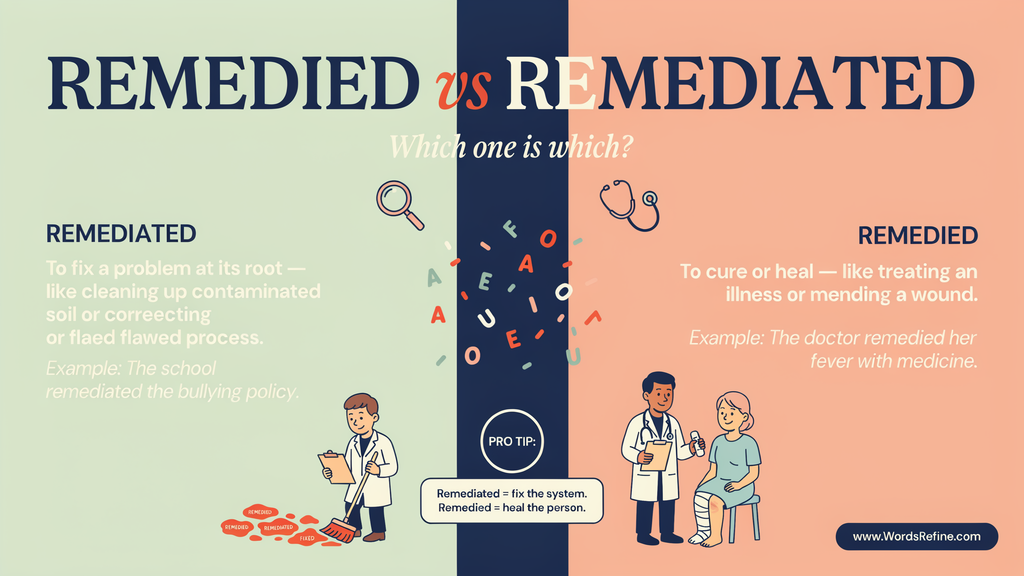
Yes. Remediated is a legitimate English word and the standard past-tense and past-participle form of remediate.
Although some readers may encounter it mainly in professional or technical writing, that does not make it incorrect. Its specialized use has become well established in several fields.
The important point is not whether the word is real. It is. The important question is whether it is the most suitable word for the situation.
Where the Difference Begins
Remedy has a broad range of uses. You can remedy an error, defect, complaint, weakness, shortage, or difficult situation.
For example:
The manager remedied the scheduling problem.
The company remedied the defect before releasing the product.
The new procedure remedied several weaknesses in the old system.
These sentences sound natural because the writer is simply describing a problem and its correction.
Remediate Often Suggests a Defined Process
Remediate also means to correct or address a problem, but it often appears when the corrective action has a more specialized character.
Consider environmental cleanup. Contaminated soil may require testing, removal, containment, treatment, or restoration. Those activities can form part of an environmental remediation process.
Similarly, cybersecurity remediation may involve patching software, changing system settings, removing malicious components, or closing a security vulnerability.
Consequently, remediated often feels more specific when the sentence describes a structured corrective process.
The Difference Between Remediated vs Remedied
Both Words Describe Correction
The main reason these words cause confusion is that their meanings overlap. Both can describe taking action to address something that has gone wrong.
The sentence “The problem was remedied” means that the problem was corrected or addressed.
The sentence “The problem was remediated vs remedied can communicate essentially the same basic idea.
However, the second sentence may sound more technical or specialized. That difference in tone and context is often more important than the dictionary meaning alone.
Context Determines the Better Choice
Suppose a customer receives an incorrect invoice. A natural sentence would be:
The company remedied the billing error.
Now imagine a cybersecurity team discovers a vulnerable server. A natural technical sentence would be:
The IT team remediated the server vulnerability.
The two sentences both describe corrective action. Nevertheless, the context makes one form more natural than the other.
That is why there is no universal rule saying that remedied is correct while remediated is wrong, or vice versa.
Learn the difference between often confused words
Loose vs Lose Difference and which is Correctly?
When to Use Remedied
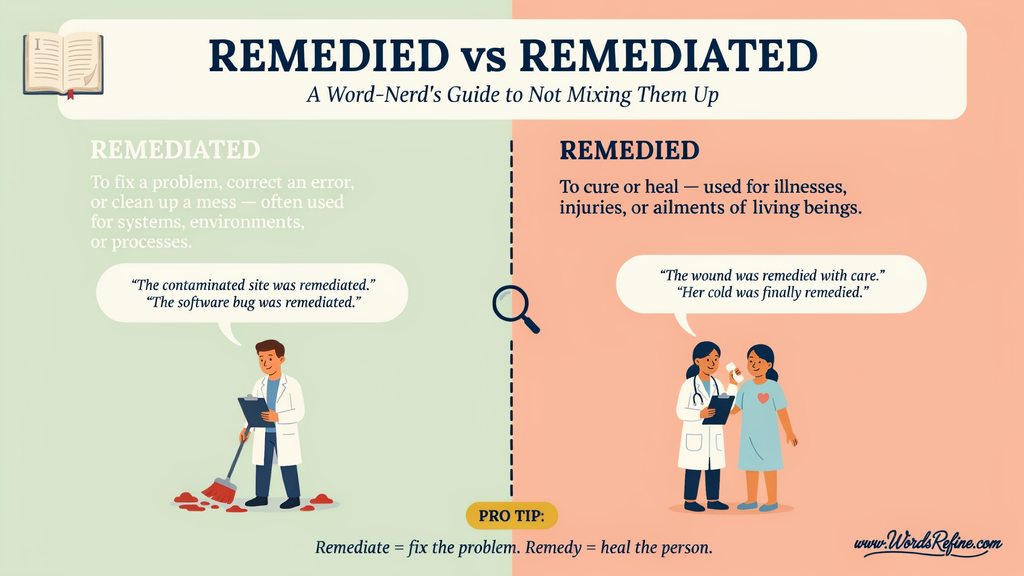
Remedied works particularly well when you are talking about a general problem that someone corrected.
For example:
The manager remedied the communication problem.
The company remedied the customer’s complaint.
The technician remedied the equipment malfunction.
The editor remedied the factual error.
The new policy remedied a weakness in the previous system.
These examples have something in common. None requires a specialized technical process to understand what happened. The important information is simply that the problem was corrected.
Errors and Defects
Remedied is also natural with errors, defects, and shortcomings.
A manufacturer may remedy a product defect. An editor may remedy a factual mistake. A manager may remedy a procedural weakness.
In each case, remedied gives the sentence a clear and professional tone without making the wording unnecessarily technical.
Situations and Complaints
The word can also describe broader circumstances.
For example:
The company quickly remedied the situation.
The customer-service team remedied the complaint.
The new policy remedied several problems with the previous procedure.
Here, the focus is on improving the situation rather than describing a specialized remediation process.
When to Use Remediated
Environmental Cleanup
Environmental remediation is one of the clearest contexts for remediated.
Suppose testing discovers pollutants in soil at an industrial site. Specialists may remove contaminated material, treat the soil, contain pollutants, or use another approved method to address the contamination.
A sentence such as this is natural:
The contractor remediated the contaminated soil before construction began.
The word fits because the situation involves an established environmental process rather than a simple correction.
Cybersecurity and Information Technology
Cybersecurity provides another common setting.
When a security assessment discovers a vulnerability, the organization may patch software, change configurations, restrict access, remove malicious code, or take other corrective measures.
For example:
The security team remediated the vulnerability after completing the assessment.
Here, remediated communicates more than the idea of simply fixing something. It fits the professional process of identifying and addressing a security weakness.
Education
The word also appears in educational contexts.
Students sometimes need targeted instruction to address gaps in their knowledge or skills. Educational programs may therefore use remediation to describe additional support or intervention.
For example:
The program remediated gaps in the students’ foundational mathematics skills.
The word works because the sentence describes a targeted educational intervention rather than a quick correction.
Compliance and Professional Work
Organizations may also use remediated when discussing deficiencies identified through audits, reviews, or regulatory processes.
For example:
The company remediated the control deficiencies identified during the audit.
This wording emphasizes that the organization took corrective action after identifying specific weaknesses.
Learn the difference between basic English word mistakes
Lay vs Lie Difference and which is correct?
Can Remediated vs Remedied Be Interchanged?
When Both Can Work
In some situations, either word can communicate the basic idea of correction.
For example:
The problem was remedied.
The problem was remediated.
Both sentences are understandable and grammatically sound.
However, they don’t necessarily sound equally natural in every context.
The first is broader and more familiar. The second has a more specialized or formal flavor.
When the Difference Matters
Consider a contaminated environmental site.
The contractor remediated the contaminated soil.
That wording fits the specialized context naturally.
Now consider a simple spelling error:
The editor remedied the spelling error.
That sentence is clear and natural.
Although remediated might technically communicate correction in some contexts, it would add a level of technical formality that the sentence doesn’t need.
In other words, the best word isn’t always the most sophisticated one. Good writing chooses the word that communicates the intended meaning clearly.
Remediated vs Remedied in Sentences
The editor remedied the factual error before publication.
The technician remedied the equipment malfunction.
The company remedied the billing problem within a few hours.
The manager remedied the scheduling issue.
The manufacturer remediated vs remedied the product defect before the next production run.
Each example describes a problem that someone corrected. The context doesn’t require the specialized language of remediation.
Examples With Remediated
The environmental team remediated the contaminated site.
The cybersecurity department remediated the exposed server.
The organization remediated the security vulnerability.
The contractor remediated the polluted groundwater.
The school program remediated specific learning gaps.
The company remediated the compliance deficiencies identified during the review.
These examples show why remediated is particularly common in technical and professional contexts.
Remediated vs Remedied in Professional Writing
Business Writing
Business writing benefits from clarity. Therefore, remedied often works well when the subject involves an ordinary business problem.
For example:
The company remedied the billing discrepancy.
There is no need to make this sentence more complicated.
However, if the subject involves compliance or a formal corrective process, remediated may be more appropriate.
The company remediated the control deficiency identified during the audit.
The context changes the most natural choice.
Technical Writing
Technical writing frequently uses remediate because technical teams often need precise terms for corrective action.
A security report might describe a sequence in which a vulnerability was discovered, assessed, remediated, and later verified.
In that setting, remediation is part of the technical vocabulary. Using remediate can therefore make the writing more precise rather than simply more formal.
Academic Writing
Academic writers should focus on the exact idea they want to express.
If a sentence simply means that an intervention corrected a problem, remedied may be sufficient.
If the research discusses a structured remediation program or targeted educational intervention, remediated may fit better.
The strongest academic writing isn’t the writing with the biggest words. It is the writing that uses precise words for precise ideas.
Remediated vs Remedied in American English
There is no major American-English spelling difference between these two words. Both are established forms in US English.
The real distinction involves usage and context.
Remedied generally feels broader and more familiar. Remediated tends to appear more frequently in specialized professional fields.
Therefore, a writer should not choose remediated simply because it sounds more sophisticated. Likewise, a writer should not avoid remediated just because it sounds technical.
Instead, consider what the sentence is actually trying to say.
Remediated vs Remedied Pronunciation
Remediated contains several syllables, with the primary stress toward the middle of the word. Its pronunciation reflects the longer verb form and should not be confused with the shorter pronunciation of remedied.
Learn the difference between commonly misused words
Whoever vs Whomever How to Use Each Word Correctly?
Remedied Pronunciation
Remedied has fewer syllables and follows the pronunciation pattern associated with remedy.
The difference becomes easier to recognize when the words are spoken naturally rather than compared only on the page.
Remediate Past Tense and Past Participle
The past tense of remediate is remediated.
The same form also functions as the past participle.
The basic forms are remediate, remediates, remediating, and remediated.
For example:
The team remediated the vulnerability yesterday.
The vulnerability has been remediated.
Therefore, if you are wondering about the remediate past tense and past participle, the answer is remediated.
Remedied Past Tense
The past tense of remedy is remedied.
The past participle is also remedied.
The basic forms are remedy, remedies, remedying, and remedied.
For example:
The company remedied the defect yesterday.
The company has remedied the defect.
The spelling may seem unusual at first, but it follows the normal English spelling pattern in which a final consonant plus y changes to i before certain endings.
Learn the difference between everyday English mistakes
Vender vs Vendor Which one Is Correct?
Common Mistakes With Remediated vs Remedied
The most common mistake is assuming that “remediated” is incorrect simply because “remedied” sounds more familiar. Both words are correct, but they come from different verbs and can suit different contexts. Another mistake is using “remediated” just to make a sentence sound more technical or professional. Instead, choose the word that matches the meaning you want to express. Remember that remedied comes from remedy, while remediated comes from remediate. Keeping that connection in mind makes this confusing pair much easier to use correctly.
Assuming Remediated Is Incorrect
One common mistake is treating remediated as if it were an incorrect or made-up form.
It isn’t. Remediated is the regular past-tense and past-participle form of remediate.
It appears widely in established technical and professional usage.
Assuming Remedied Is Always Better
Another mistake is assuming that remedied should replace remediated in every sentence.
That approach ignores context.
A cybersecurity report, environmental assessment, or compliance document may need the specialized term remediation. In such writing, remediated can be the more precise choice.
Using Remediated Just to Sound Professional
The opposite problem is just as common.
Writers sometimes reach for technical words because they believe those words automatically make writing sound more professional.
They don’t.
If you mean that someone corrected a typo, saying that the typo was remedied is perfectly clear. In many cases, an even simpler word such as corrected would be better.
Professional writing isn’t about making simple ideas sound complicated. It is about making important ideas clear.
Confusing the Base Verbs
The easiest way to avoid the mistake is to remember the relationship between each word and its base verb.
Remedy becomes remedied.
Remediate becomes remediated.
Once the base verbs are clear, the past forms are much easier to recognize.
Remediate vs Remedy, Fix, Repair, and Resolve
Remedy vs Fix
Fix is broad and conversational.
For example:
The technician fixed the problem.
Remedy is somewhat more formal:
The technician remedied the problem.
Both communicate correction, but remedy often fits professional or formal writing better.
Remedy vs Repair
Repair usually suggests restoring something damaged or broken.
For example:
The mechanic repaired the engine.
Remedy has a broader meaning. It can refer to correcting an error, addressing a complaint, improving a situation, or solving a deficiency.
Remediate vs Repair
Remediate often describes addressing a harmful condition, deficiency, or vulnerability rather than physically repairing an object.
A cybersecurity team may remediate a vulnerability without repairing a physical component.
Similarly, an environmental team may remediate contaminated soil through treatment or removal.
Remediate vs Resolve
Resolve generally emphasizes reaching a solution or bringing an issue to an end.
Remediate emphasizes corrective action directed at a problem or deficiency.
For example:
The team resolved the dispute.
The security team remediated the vulnerability.
The difference becomes especially useful when writing about technical or professional processes.
Remediate vs Mitigate
Remediate and mitigate deserve special attention because they can appear together in technical writing.
Mitigate generally means to reduce the severity, impact, or risk of something.
Remediate generally means to correct or address the underlying problem.
For example, a temporary security restriction might mitigate a risk while a software patch remediates the vulnerability.
The distinction is useful because reducing harm and correcting its source are not always the same thing.
Remediation vs Remedy
The same relationship appears between remediation and remedy.
A remedy can be a solution or corrective action.
Remediation often refers to the process of addressing a problem.
For example:
The organization needed a remedy for the recurring defect.
The organization began a remediation program to address the defect.
The first sentence focuses on the solution. The second emphasizes the corrective process.
Learn the difference between more words people mix up
Vaccum Vs Vacuum Which One Is Correct and Why It Matters ?
A Simple Way to Remember the Difference
When you’re unsure whether to use remediated vs remedied, first identify the base verb.
If the base verb is remedy, use remedied.
If the base verb is remediate, use remediated.
Then consider the context.
If you’re talking about an ordinary error, defect, complaint, or general problem, remedied will often sound natural.
If you’re discussing environmental cleanup, cybersecurity, educational intervention, technical deficiencies, or formal compliance action, remediated may fit better.
The easiest memory trick is therefore not a complicated phrase. Just remember the two pairs:
Remedy → remedied.
Remediate → remediated.
Learn the difference between commonly mixed-up more words
Effort vs Affort Which One Is Correct and How to Use It?
Practice Session Remediated vs remedied
Test your understanding by choosing the word that best completes each sentence. Use the correct form of words such as remedial, remediation, remediate, remedy, corrective, or related terms.
- The company introduced ______ measures after discovering a serious safety deficiency.
- The school provided ______ instruction to help students strengthen their basic math skills.
- Environmental ______ began after inspectors found contamination in the soil.
- The technical team worked quickly to ______ the security vulnerability.
- The contractor completed the necessary ______ work before the building reopened.
- The new policy was designed to prevent problems rather than simply provide ______ solutions afterward.
- The organization developed a detailed plan to ______ the damage caused by the system failure.
- The manager requested immediate ______ action after identifying the error.
- The engineers investigated the underlying problem before beginning the ______ process.
- Students who need additional academic support may receive ______ instruction.
- The company hired specialists to handle the environmental ______ of the contaminated site.
- The software update helped ______ several weaknesses in the system.
- The inspection revealed a structural defect that required extensive ______ work.
- The team took immediate action to ______ the issue and restore normal operations.
- The school introduced a ______ program for students who were struggling with essential skills.
- The organization used several corrective measures to ______ the deficiency.
- The damaged equipment required professional ______ before it could be used safely again.
- The environmental agency ordered the company to begin ______ of the affected area.
- The IT department created a plan to ______ the vulnerability without disrupting essential services.
- The manager described the changes as a ______ response to the problem.
- The company’s first priority was to identify the root cause before deciding how to ______ the situation.
- The student received ______ support after an assessment revealed weaknesses in reading comprehension.
- The repair crew carried out ______ work to correct the damage caused by the leak.
- The organization implemented preventive measures so that fewer ______ actions would be necessary in the future.
- After reviewing the evidence, the team determined that further ______ was necessary to address the remaining deficiencies.
Answers
- remedial
- remedial
- remediation
- remediate
- remedial
- remedial
- remediate
- corrective
- remediation
- remedial
- remediation
- remediate
- remedial
- remedy
- remedial
- remediate
- repair
- remediation
- remediate
- remedial
- remedy
- remedial
- remedial
- remedial
- remediation
Here’s a trusted source for clear more words Comparison:
FAQs
What Is Remediation in Simple Terms?
Remediation is the process of fixing, correcting, or improving a problem. It often involves taking specific steps to address an issue and restore a situation to an acceptable condition.
What Is Another Word for Remedial?
Depending on the context, alternatives for “remedial” include corrective, restorative, therapeutic, or reparative. The most suitable synonym depends on whether you’re discussing education, law, business, health, or technical work.
What Does “Remedial Action” Mean?
“Remedial action” refers to steps taken to correct a problem or reduce its harmful effects. For example, a company may take remedial action after identifying a safety, compliance, or technical issue.
What Does “Remedial” Mean in Legal Terms?
In legal language, “remedial” generally refers to something intended to correct a wrong, address a legal harm, or provide an appropriate remedy. A remedial measure may therefore focus on correcting an existing problem rather than preventing one from occurring.
What Does “Remedial” Mean in Simple Terms?
In simple terms, “remedial” means intended to fix or improve something that is not working properly. It can describe an action, treatment, process, or program designed to correct a deficiency.
How Do You Use “Remedial” in a Sentence?
You can use “remedial” to describe an action or measure intended to correct a problem. For example: “The company introduced remedial measures to address the safety concerns.”
What Does It Mean If Someone Is Remedial?
When “remedial” describes a person, it usually refers to someone receiving additional instruction or support to overcome a specific difficulty, particularly in an educational setting. However, calling a person “remedial” can sound outdated or insensitive, so more specific wording is often preferable.
What Is a Synonym for “Remediate”?
Common synonyms for “remediate” include correct, repair, restore, resolve, address, and rectify. The best choice depends on the type of problem and the context in which the word is used.
What Is an Antonym for “Remedial”?
Possible opposites of “remedial” include preventive, proactive, protective, and preventative, depending on the context. While remedial measures respond to an existing problem, preventive measures are designed to stop a problem from developing.
What Is a More Formal Word for “Correction”?
Depending on the context, “rectification,” “amendment,” “adjustment,” “remediation,” or “revision” can provide a more formal alternative to “correction.” Each word carries a slightly different meaning, so the context matters.
What’s Another Way to Say “Corrective Action”?
Professional alternatives include “remedial action,” “corrective measures,” “rectification measures,” “mitigation efforts,” and “response measures.” The appropriate term depends on whether the goal is to fix the problem, reduce its impact, or prevent it from happening again.
What Is Meant by Remedial Work?
Remedial work refers to work carried out to correct a defect, deficiency, damage, or other problem. For example, remedial work on a building might involve repairing structural defects or fixing water damage.
What Is a Remedial Task?
A remedial task is a specific activity performed to correct a known problem or deficiency. It may involve repairing an error, restoring a system, improving performance, or addressing a weakness.
How Do You Say “Redo Professionally”?
In professional writing, “redo” can often be replaced with “revise,” “rework,” “reconstruct,” “refine,” or “undertake again,” depending on the situation. For example, “Please rework the report” sounds more professional than “Please redo the report.”
How Do You Say “Again” in a More Formal Way?
Depending on the sentence, “again” can be replaced with “once more,” “anew,” “subsequently,” or “repeatedly.” However, “again” is already professional and natural in most formal writing, so replacing it is not always necessary.
What Is a More Professional Word for Revamp?
Professional alternatives to “revamp” include “revise,” “redesign,” “restructure,” “modernize,” “refine,” “renew,” and “reconfigure.” The best option depends on whether you are changing the appearance, structure, function, or overall approach.
What Is a Better Word for Resolved?
Depending on the context, alternatives to “resolved” include “addressed,” “rectified,” “settled,” “remedied,” “corrected,” and “reconciled.” For example, “the issue was rectified” emphasizes correction, while “the dispute was settled” emphasizes agreement.
What Is a Stronger Term for Problem-Solving?
Depending on the context, stronger professional terms include “problem resolution,” “issue resolution,” “troubleshooting,” “strategic problem-solving,” and “solution development.” These terms can sound more precise in business, technical, or academic writing.
What Is It Called When You Resolve an Issue?
Resolving an issue can be described as issue resolution, problem resolution, corrective action, remediation, or rectification. The most accurate term depends on whether the issue was fixed, reduced, settled, or prevented from recurring.
What Is a Professional Way to Say Problem-Solving?
Professional alternatives include “issue resolution,” “problem resolution,” “solution development,” “troubleshooting,” and “analytical resolution.” In a résumé or professional profile, a phrase such as “strong issue-resolution skills” can be more specific than simply saying “good at problem-solving.”
What Is a Better Word for Problem Solver?
Depending on the context, you could use “troubleshooter,” “solution-oriented professional,” “strategist,” “analyst,” or “solution developer.” For professional writing, a specific description of the person’s skills is often stronger than using a single label.
What Is Another Way to Say “Solve an Issue”?
You can say “resolve an issue,” “address a concern,” “correct a problem,” “rectify an error,” “remediate a deficiency,” or “settle a matter.” Choose the expression that best matches the type of issue being discussed.
How Can You Say Someone Is Good at Problem-Solving?
You can describe someone as “skilled at resolving complex issues,” “adept at finding practical solutions,” “highly effective at troubleshooting,” or “proficient in analytical problem-solving.” These expressions sound more specific and professional than simply calling someone a “good problem solver.”
What Can I Say Instead of “Solve Problems”?
Depending on the context, you can use “resolve issues,” “address challenges,” “overcome obstacles,” “correct deficiencies,” “develop solutions,” or “troubleshoot problems.” Each phrase highlights a slightly different aspect of handling a difficult situation.
What Are the Four Types of Problem-Solving?
Four commonly discussed approaches are analytical problem-solving, creative problem-solving, critical-thinking-based problem-solving, and collaborative problem-solving. These approaches differ in how people identify problems, evaluate information, generate solutions, and work with others to reach an outcome.
Learn the difference between confusing more English words
Octopus vs Octopi Which Plural Is Correct and Why?
Final Thoughts
English has a talent for making simple ideas unnecessarily interesting, and Remediated vs remedied is a great example. Both words describe fixing, correcting, or addressing a problem, but they come from different verbs and often appear in different contexts.
Remedied is the natural choice when you mean that a problem or situation was corrected. Remediated, on the other hand, often describes a more deliberate process of addressing a deficiency, especially in technical, environmental, educational, or professional contexts.
The easiest way to remember the difference is to follow each word back to its verb remedy becomes remedied, while remediate becomes remediated. Once you spot that connection, this confusing pair becomes much less troublesome. After all, your sentence has enough problems to solve without creating a grammar mystery of its own.

Diora AJS she is an experienced blogger and passionate English language enthusiast at Words Refine. With a keen eye for language and a love for clear communication, she writes practical content about grammar, word meanings, usage, and commonly confused terms. Her goal is to make English easier to understand through clear explanations and relatable examples, helping readers write accurately and communicate with confidence.