

If you have ever hesitated between octopus vs octopi you are not alone. This simple plural has puzzled many English speakers, proving that grammar can be surprisingly slippery, even when the subject has eight arms. So, which form should you choose? Is octopuses correct, or does octopi still belong in English? The answer becomes clearer once you understand the word’s Greek origins and how English handles borrowed nouns. In this guide, you well learn the difference between octopus vs. octopi, discover which plural is preferred in writing, and avoid common mistakes. By the end, this eight-armed grammar puzzle will feel far less mysterious and easier to remember.
What Does Octopus Mean?
An octopus is a marine animal belonging to the cephalopod group. It has a soft body and eight arms equipped with suckers. Octopuses live in oceans around the world and are known for their intelligence, camouflage abilities, flexible bodies, and remarkable problem-solving skills.
The word octopus is a singular noun. When you are talking about one animal, you use octopus. For example, you might say, “The octopus disappeared beneath a rock,” or “An octopus was resting near the reef.”
The moment you refer to more than one animal, however, you need a plural form. That is where octopuses, octopi, and octopodes enter the discussion.
The important point is that octopus itself does not mean several animals. It refers to one animal. Therefore, saying “three octopus” would not normally follow standard English pluralization.
What Is the Plural of Octopus?
The standard English plural form of octopus is octopuses.
That means the simplest pattern is octopus for one animal and octopuses for more than one. This follows a familiar English approach to pluralization rather than attempting to preserve the original Greek grammar.
For example, you could write, “The aquarium has one octopus.” If you are talking about several animals, you could write, “The aquarium has five octopuses.”
This is the most useful answer if you are wondering about the correct plural of octopus for an article, school assignment, report, professional document, or everyday conversation.
However, the story does not end there. Octopi is also used in English, and dictionaries recognize it as a plural form. That does not mean it is the only answer or even the form you need to choose.
The question becomes clearer when you separate modern English usage from the historical origin of the word.
Octopus vs Octopi Understanding the Difference
The phrase octopus vs octopi can create confusion because these words do not represent two competing meanings. Instead, they represent different grammatical forms.
Octopus is singular. Octopi is a plural form.
You could therefore write, “One octopus was hiding among the rocks.” When referring to several animals, you might encounter, “Several octopi were hiding among the rocks.”
The more straightforward modern English version would be, “Several octopuses were hiding among the rocks.”
The animal does not change. The difference lies in the way English speakers have formed the plural.
This also explains why the question octopus or octopi meaning does not really involve two separate definitions. Both forms refer to the same marine animal. The real issue is number and word formation.
Learn the difference between confusing more English words
Trebled vs Tripled Which One Is Correct?
Why Is the Plural Octopuses?
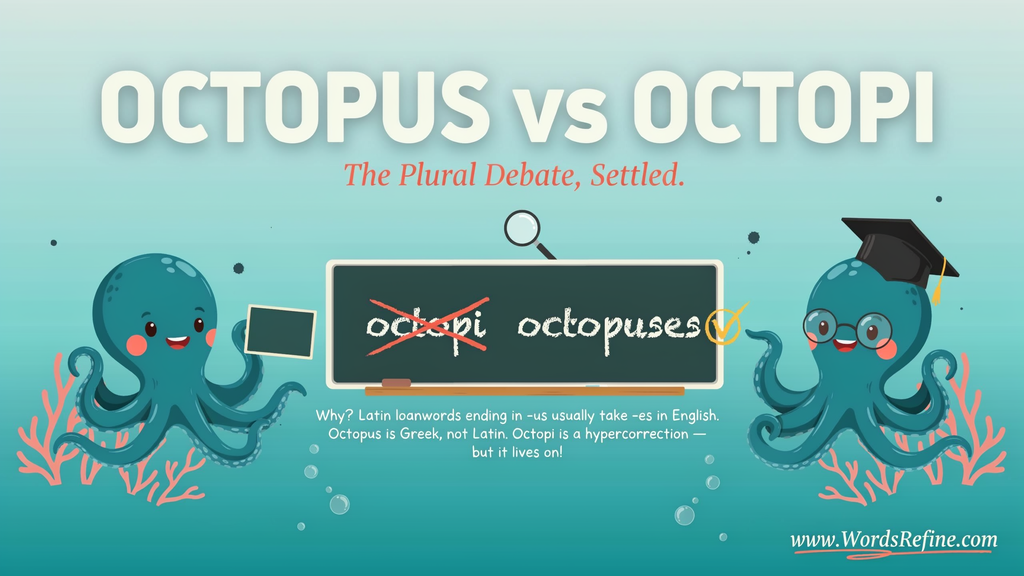
The answer becomes much easier once you look at the Greek origin of octopus.
The word comes from Greek elements associated with the ideas of eight and foot. In simple terms, the original word described something as eight-footed. This connection also explains why octopus belongs to the larger family of cephalopod vocabulary.
The important detail is that octopus did not begin as an ordinary Latin noun. That matters because many English speakers assume that any word ending in us should automatically receive the Latin plural ending i.
That assumption works for some words. For example, fungus becomes fungi, radius becomes radii, and stimulus becomes stimuli. Those examples can make octopus look as though it should follow the same rule.
English, however, does not operate with a single plural rule for every word ending in us.
Consider words such as bus, virus, status, and campus. Their common English plurals are buses, viruses, statuses, and campuses. The ending of the singular word does not automatically determine its plural.
Therefore, the fact that octopus ends in us does not mean its plural must end in i.
The Greek Origin of Octopus
The Greek history of the word explains why the plural question has attracted so much attention.
The word is connected to the Greek elements meaning eight and foot. This same root family appears in words such as pod and cephalopod. In other words, the unusual plural forms are not random accidents. They grew from the linguistic history of the word.
Because octopus passed through a Latinized form before becoming established in English, speakers encountered a word that looked partly familiar and partly foreign.
That created an interesting situation. Some speakers treated it as an English noun and added the ordinary plural ending. Others looked at the us ending and applied a familiar Latin-style pattern. Still others preserved a form closer to the original Greek structure.
Consequently, English ended up with octopuses, octopi, and octopodes.
Language can be messy like that. It does not always tidy itself up just because grammarians would prefer a single neat answer.
Is Octopi Correct?
The question is octopi correct needs a careful answer rather than a simple yes or no.
Octopi is a real and established plural form in English. It has appeared in published writing for a long time, and dictionaries recognize it. Therefore, calling octopi nothing more than a spelling mistake would be too simplistic.
At the same time, octopuses is the standard and straightforward English plural. If you want the clearest choice for general modern writing, octopuses is usually the form to use.
This distinction is important because a word can exist in English without being the preferred choice in every situation.
For example, if you are discussing the history of English vocabulary, octopi may be completely relevant. If you are writing a simple school paper about marine animals, octopuses is likely the more natural choice.
So, if you are asking, is octopi correct, the practical answer is that it is an established alternative plural, while octopuses remains the clearest standard choice.
Learn the difference between commonly mixed-up more words
Hierarchical vs Hierarchal Which One Is Correct?
Why Do People Say Octopi?
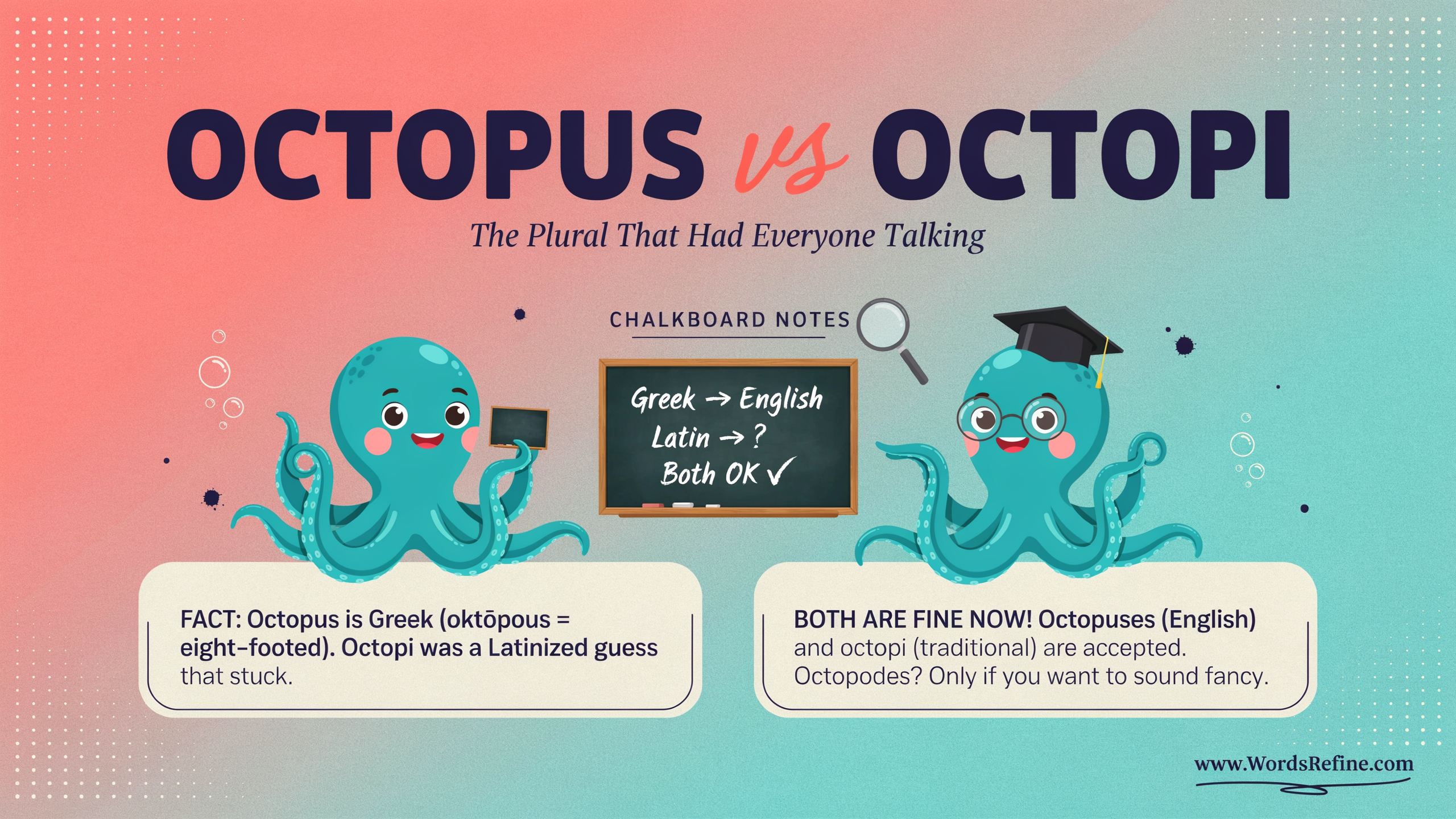
The reason people use octopi is fairly easy to understand.
English contains many words with traditional Latin plurals ending in i. Once people become familiar with patterns such as fungus and fungi or alumnus and alumni, they may naturally assume that octopus should behave the same way.
The visual pattern is persuasive.
Octopus ends in us. Several familiar words ending in us change to i when pluralized. Therefore, octopi feels perfectly logical.
There is just one problem: the history of octopus does not fit that simple Latin pattern.
Even so, language users do not always follow historical etymology when forming new words. Speakers tend to rely on patterns they already know. Over time, those patterns can become established through repeated use.
That helps explain why octopi continues to appear in English.
Is Octopi the Latin Plural of Octopus?
This is one of the most common points of confusion.
It is tempting to call octopus vs octopi the Latin plural of octopus because of the i ending. However, that description oversimplifies the word’s history.
Octopus ultimately comes from Greek material. The Greek-derived plural is associated with octopodes rather than octopi. The form octopi developed because English speakers treated the us ending as though it belonged to a familiar Latin noun pattern.
That distinction makes a difference.
The three forms can therefore be understood as different linguistic paths. Octopuses follows ordinary English pluralization. octopus vs octopi follows a Latin-style pattern that became established in English. Octopodes reflects the Greek plural structure.
Once you see those three paths, the confusion becomes much easier to understand.
What Is Octopodes?
Octopodes is a genuine word rather than a strange spelling mistake.
It reflects the Greek plural structure associated with the original word. Because of that, it often appears in discussions about etymology, classical languages, and the history of English vocabulary.
However, octopodes is extremely uncommon in everyday English.
If someone says, “We saw several octopodes while diving,” the sentence can be understood. Still, most English speakers would naturally say, “We saw several octopuses while diving.”
That difference between linguistic history and ordinary usage is important.
A word can be historically accurate without being the most natural choice for modern communication. When the goal is clarity, octopuses is usually much easier for readers.
Learn the difference between tricky grammar more words
Ambassador vs Embassador Which Spelling Is Correct?
Which Form Should You Use?
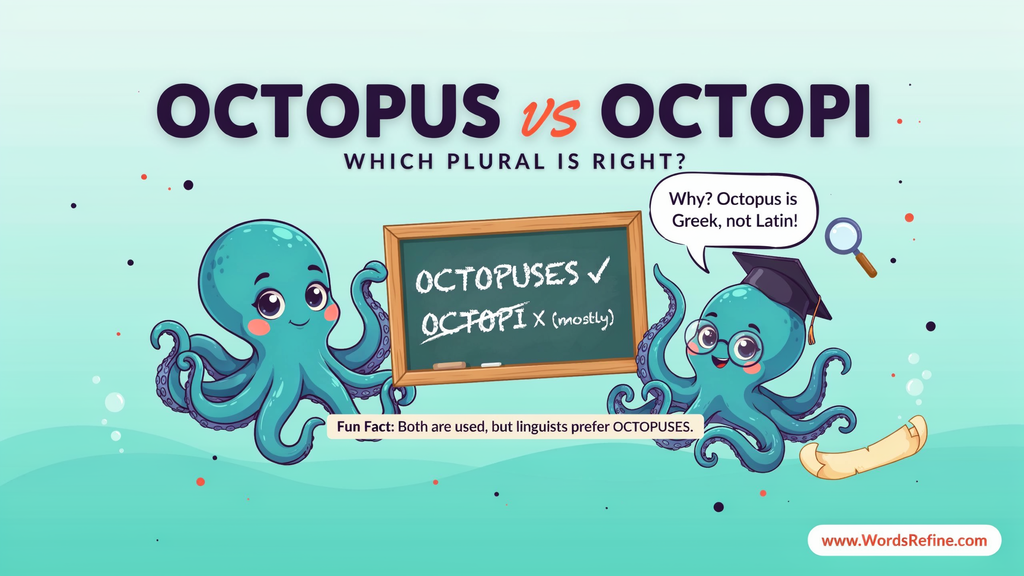
If you need one practical answer, use octopuses.
The form fits ordinary English pluralization, reads naturally, and avoids unnecessary confusion. It works well in formal writing, educational material, professional documents, journalism, and everyday conversation.
For example, “Researchers observed several octopuses near the reef” sounds completely natural.
You could also encounter “Researchers observed several octopi near the reef.” The meaning is clear, and the plural is recognized in English. However, the second version may attract unnecessary attention because readers know that octopuses is the common standard form.
When two forms communicate the same idea, the clearer and more familiar form is often the better choice.
That is why octopuses is such a practical answer to the question of octopuses or octopi.
Octopuses vs Octopi vs Octopodes
The three forms become much easier to remember when their backgrounds are placed side by side.
| Form | Number | Main formation | Modern use |
|---|---|---|---|
| Octopus | Singular | Greek-derived word used in English | Very common |
| Octopuses | Plural | Regular English plural | Standard and widely used |
| Octopi | Plural | Latin-style plural formation | Established alternative |
| Octopodes | Plural | Greek-derived plural | Rare and specialized |
The table reveals an important point. These forms are not simply three spelling choices with exactly the same status.
Octopuses belongs comfortably to ordinary English. octopus vs octopi has a long history of use but comes from a different pluralization approach. Octopodes has a genuine Greek basis but is rarely needed outside specialized discussions.
Therefore, choosing octopuses in normal writing is not about ignoring linguistic history. It is about using the form that fits contemporary English most naturally.
Octopus vs Octopuse Singular or Plural?
The difference between octopus vs octopuses becomes simple once you focus on quantity.
Use octopus when you mean one.
Use octopuses when you mean more than one.
For example, “The diver photographed an octopus near the reef” refers to one animal. “The diver photographed several octopuses near the reef” refers to more than one.
The same principle applies throughout English.
One book becomes several books. One animal becomes several animals. In the case of octopus, the standard English plural simply adds the appropriate plural ending.
The unusual history of the word does not change its basic grammatical function in a modern English sentence.
Common Mistakes With Octopus vs Octopi
One common mistake is assuming that every noun ending in us must have a plural ending in i. English has too many different plural patterns for that rule to work consistently.
Another mistake is treating octopuses as incorrect. It is not. Octopuses is a standard English plural.
A third mistake is calling octopi nothing more than a misspelling. That also goes too far because octopi has been used in English and appears in dictionary records.
Another problem occurs when writers use octopodes simply because it sounds more scholarly. In most everyday writing, the word adds complexity without adding useful meaning.
Finally, some writers switch between octopuses and octopi without any reason. Although both forms can be encountered, consistency usually makes writing easier to follow.
If you choose octopuses for an article, there is generally no reason to alternate with octopi halfway through it.
Learn the difference between confusing word pairs
Simular vs Similar Which One Is Correct?
Octopus Plural in Real Sentences
Real sentences make the distinction easier to remember.
“The octopus moved slowly across the ocean floor” uses the singular form because the sentence refers to one animal.
“The octopuses moved toward the rocks” uses the standard plural because the sentence refers to several animals.
“The researchers studied several octopi” uses the alternative plural form. Readers will understand the sentence, although octopuses would be the more straightforward modern English choice.
“The linguistic discussion examined the forms octopuses, octopi, and octopodes” uses all three forms because the forms themselves are the subject of the sentence.
That final example is particularly useful. Sometimes an unusual word is appropriate precisely because you are discussing the unusual word.
Octopus Plural Spelling and Pronunciation
Spelling and pronunciation can create separate questions.
The singular octopus has a familiar pronunciation in both American and British English, although the vowel sounds differ somewhat between varieties of English.
The plural octopuses follows the normal English plural pattern. Its spelling may look long, but its grammatical role is straightforward.
Octopi has a different ending because the spelling reflects the Latin-style plural pattern. As a result, its pronunciation differs from the standard plural.
Octopodes is more complicated for ordinary readers because the word is uncommon. Many people have never heard it spoken, which is another reason it rarely appears in everyday English.
If clarity matters most, octopuses is the easiest form to read, understand, pronounce, and recognize.
American English and British English
The question of octopus plural forms is not simply a matter of American English versus British English.
Both varieties recognize octopus as the singular noun, and both encounter forms such as octopuses and octopi.
Pronunciation can vary between American and British English. However, that variation does not create a completely different plural system.
Therefore, it would be misleading to say that one country uses octopuses while another exclusively uses octopi.
The more accurate explanation is that English speakers encounter multiple plural forms, while octopuses remains the most straightforward choice for standard modern English.
What Dictionaries and Grammar Sources Say
Different reference sources can appear to disagree because they have different purposes.
A dictionary may record a word because speakers actually use it. A grammar guide may recommend one form because it is clearer or more conventional in modern writing. Those two approaches can coexist.
Oxford Learner’s Dictionaries lists octopuses as the plural of octopus. Dictionary sources also record octopi as a plural form. Grammar resources commonly explain that octopuses follows English pluralization, while octopi developed through a Latin-style interpretation of the word’s ending.
This is why dictionary evidence should be read carefully.
When a source says a form exists, that does not necessarily mean the source recommends it as the first choice in every context. Similarly, when a grammar guide recommends one form, that does not mean every alternative has disappeared from English.
Language is shaped by both rules and usage.
Learn the difference between often confused words
Loosing vs Losing Which Is Correct? Meaning, Spelling, and Usage
Octopus vs Octopi in Formal Writing
For academic assignments, professional documents, educational articles, and most formal writing, octopuses is the safest choice.
Consider the sentence, “The researchers observed several octopuses during the study.”
It is clear, familiar, and unlikely to make the reader stop and wonder about the plural.
Now compare it with “The researchers observed several octopus vs octopi during the study.”
The second sentence is understandable. However, it may prompt a reader to think about the plural form rather than the research itself.
Good writing should keep attention on the subject whenever possible.
That is especially important in scientific and educational writing. When the purpose is to communicate information about a marine animal, there is usually little benefit in making the reader pause over an unusual plural.
How Do You Pluralize Octopus?
The easiest way to pluralize octopus is to use octopuses.
The pattern is simple.
One octopus.
Two octopuses.
Several octopuses.
Many octopuses.
This answers questions such as what is the plural form of octopus, how do you pluralize octopus, what is the plural for octopus, and how do you spell the plural of octopus.
Once that pattern becomes familiar, there is no need to remember an elaborate rule.
The word may have a complicated history, but its everyday English plural does not need to be complicated.
What Is the Correct Plural of Octopus?
The correct plural of octopus in standard modern English is octopuses.
That is the form to choose when you want a clear, familiar, and broadly accepted English plural.
Octopi is also an established alternative. Therefore, it is more accurate to describe it as an alternative plural than to call it an outright nonword.
Octopodes has a legitimate Greek basis as well, although it is rarely used outside specialized contexts.
Consequently, the question of the correct plural form of octopus has a practical answer and a historical answer.
The practical answer is octopuses.
The historical answer is that English has inherited and developed several forms because the word passed through different linguistic traditions.
Is Octopus Plural Octopi?
If you are asking whether octopi can be used as the plural of octopus, the answer is yes. It is an established form in English.
However, if you are asking whether octopus vs octopi is the standard plural that should automatically replace octopuses, the answer is no.
Octopuses remains the simpler and more conventional choice for general English.
This distinction matters because language questions often become too black and white. A word can be accepted in usage while still being less common or less preferred in a particular context.
That is exactly what happens with octopi.
Learn the difference between basic English word mistakes
Inclusivity vs Inclusiveness Which One Is Correct?
Are Octopi vs Octopuses Both Correct?
Both forms are found in English and can function as plurals of octopus.
However, they do not have identical histories.
Octopuses comes from ordinary English pluralization. octopus vs octopi developed from a Latin-style plural pattern. Octopodes comes from the Greek plural structure.
For most readers, octopuses is the easiest form to understand and use.
Therefore, if someone asks whether they should say octopuses or octopi, the practical recommendation is simple: choose octopuses unless there is a specific reason to discuss or use another form.
Can You Say Octopodes?
Yes, you can.
Octopodes is a genuine Greek-derived plural. However, it is uncommon enough that many readers may find it unfamiliar.
If you are writing about Greek grammar, word history, or the development of scientific vocabulary, the form can be useful. Otherwise, it may sound unnecessarily technical.
Modern English generally favors communication that readers can process without stopping to decode an unusual word.
For that reason, octopuses remains the natural choice in most situations.
The Simple Rule to Remember
When the whole discussion starts to feel like a linguistic maze, return to one simple rule.
One octopus.
More than one octopuses.
That is enough for most writing.
Octopi is an established alternative, and octopodes has a legitimate Greek connection. Still, neither form needs to replace the familiar English plural.
The history is fascinating. The practical rule is wonderfully simple.
Learn the difference between commonly misused words
Labelled vs Labeled Which one Is Correct?
Practice Session octopus vs octopi
- The aquarium has several ______ swimming near the coral reef.
- The plural form most commonly used in standard English is ______.
- Some writers use ______ as an alternative plural of octopus.
- The word octopus comes from Greek and means “______.”
- An octopus has ______ hearts.
- Two of an octopus’s hearts pump blood to its ______.
- The third heart pumps blood to the rest of the ______.
- A male octopus has a specialized arm called a ______.
- Octopuses are found in oceans around the ______.
- An octopus uses its arms and suckers to ______ and explore its surroundings.
- The word ______ is the Greek-derived plural of octopus.
- Saying “octopi” as the original Greek plural is ______.
- An octopus belongs to a group of marine animals called ______.
- The hard, beak-like structure of an octopus is used to ______ its prey.
- An octopus can change its color and body pattern to help with ______.
- Some octopus species can live for around ______ years or longer.
- A group of squirrels is commonly called a ______.
- A group of peacocks can traditionally be called an ______.
- A group of lobsters can be called a ______.
- The safest plural to use in formal English is ______.
- The singular form of octopuses is ______.
- An octopus has ______ arms.
- Octopuses are known for their problem-solving and learning ______.
- The plural ______ reflects the Greek origin of the word more closely than octopi.
- When writing about more than one octopus, “octopuses” is generally the most ______ choice.
Answers
- octopuses
- octopuses
- octopi
- eight-footed
- three
- gills
- body
- hectocotylus
- world
- manipulate
- octopodes
- incorrect
- cephalopods
- eat
- camouflage
- three
- scurry
- ostentation
- risk
- octopuses
- octopus
- eight
- abilities
- octopodes
- appropriate
Here’s a trusted source for clear more words Comparison:
FAQs
Does an octopus have 13 hearts?
No, an octopus has three hearts. Two hearts pump blood to the gills, while the third sends oxygen-rich blood throughout the body. Interestingly, the main heart stops beating while the octopus swims.
Which is more correct, octopuses or octopi?
Octopuses is the standard plural in modern English and is the safest choice for everyday, academic, and professional writing. Octopi is also used, but it comes from treating octopus as though it were a Latin word with a plural ending in -i. Octopodes is the Greek-derived plural.
Where do octopuses live?
Octopuses live in oceans throughout the world. Depending on the species, they can be found in shallow coastal waters, coral reefs, rocky seafloors, sandy habitats, underwater caves, and deep ocean environments.
What is the Latin word for octopus?
The word octopus comes from the Greek word oktōpous, meaning “eight-footed.” Although the English word has sometimes been given the plural octopi, octopus is not originally a Latin word. Its Greek-derived plural is octopodes.
What do you do if an octopus grabs you?
Stay calm and avoid pulling forcefully against the animal. Give the octopus space and gently move away rather than trying to fight it. Most octopuses prefer to avoid humans, but wild animals should never be handled unnecessarily.
What is the IQ of an octopus compared to humans?
There is no reliable IQ score that can directly compare an octopus with a human. Human IQ tests are designed for people, so scientists instead study octopus intelligence through behaviors such as problem-solving, learning, memory, exploration, and tool use.
Could an octopus bite a human?
Yes, an octopus can bite a human, although most species generally avoid people. An octopus has a hard beak that it uses to eat prey, and some species also produce venom. For that reason, it’s best to observe wild octopuses without touching or handling them.
Is an octopus leg a penis?
No. An octopus does not have a penis-like leg. Male octopuses have a specialized arm called a hectocotylus, which transfers sperm to the female during mating. Because this arm has a reproductive function, it can sometimes be mistaken for a sexual organ.
What is the natural enemy of an octopus?
Octopuses have several natural predators, depending on their species and habitat. Their predators can include sharks, large fish, seals, sea lions, dolphins, moray eels, and seabirds. Young octopuses are particularly vulnerable because of their small size.
Can an octopus live for 3 years?
Yes, some octopus species can live for three years or longer. However, lifespan varies greatly among species. Some octopuses live for less than a year, while others survive for several years under suitable conditions.
What is a group of lobsters called?
A group of lobsters can be called a risk. However, this collective noun is uncommon in everyday English, so “a group of lobsters” is often the clearest way to describe them.
What is a group of squirrels called?
A group of squirrels is commonly called a scurry. The word describes several squirrels gathered or moving around together.
What is a group of peacocks called?
A group of peacocks can be called an ostentation. However, this traditional collective noun isn’t commonly used in everyday conversation. “A group of peacocks” is perfectly clear and natural.
Learn the difference between everyday English mistakes
Flyer vs Flier Which one Is Correct?
Conclusion
The difference between octopuses vs octopi may seem like a small grammatical detail, but it can easily cause confusion. In modern English, octopuses is the clearest and most widely accepted plural form. Octopi is also used, but it comes from treating the word as though it followed a Latin plural pattern, even though octopus has Greek origins. Octopodes reflects those Greek roots more closely.
For most everyday, academic, and professional writing, octopuses is the safest choice. Once you understand where each form comes from, the confusion disappears. After all, choosing the right plural is much easier than trying to argue with eight arms at once.

Diora AJS she is an experienced blogger and passionate English language enthusiast at Words Refine. With a keen eye for language and a love for clear communication, she writes practical content about grammar, word meanings, usage, and commonly confused terms. Her goal is to make English easier to understand through clear explanations and relatable examples, helping readers write accurately and communicate with confidence.