
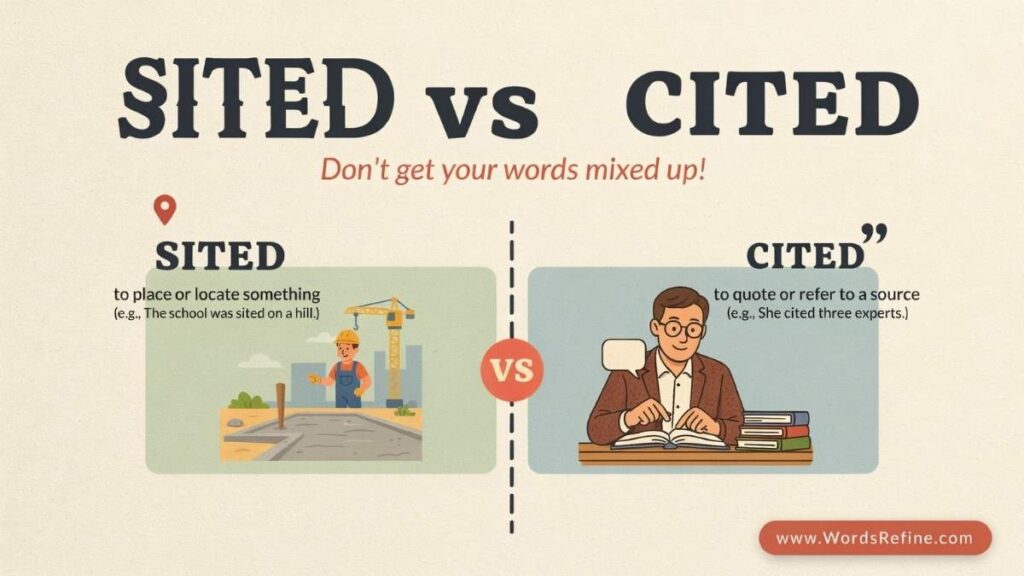
Sited vs cited may look like a small spelling difference, but choosing the wrong word can change the meaning of your sentence. Both words sound alike, which makes them easy to confuse in everyday writing academic papers, and professional documents. However, their meanings are quite different. Sited describes where something is placed or located, while cited refers to mentioning a source, example, or authority to support information. Understanding this distinction can help you avoid common grammar mistakes and communicate more clearly. In this guide, you’ll explore the meanings, differences, and practical examples of sited and cited, along with simple tips for using each word correctly.
Sited vs Cited The Key Difference
The main difference between sited vs cited lies in their meanings. Both are past tense and past-participle forms of different verbs, but they describe entirely different actions.
Sited is the past tense and past participle of site. It means placing or locating something in a particular physical location. Cited is the past tense and past participle of cite. It means quoting, mentioning, referring to, or acknowledging a source, person, example, or piece of evidence.
Consider these examples:
The company sited its new warehouse near the airport.
The journalist cited a government report in her article.
In the first sentence, sited describes where the company placed its warehouse. In the second, cited explains how the journalist used a government report to support her writing.
| Feature | Sited | Cited |
|---|---|---|
| Base verb | Site | Cite |
| Meaning | Placed or located | Quoted, mentioned, or referenced |
| Grammatical form | Past tense and past participle | Past tense and past participle |
| Common contexts | Construction, planning, infrastructure | Research, journalism, law |
| Related noun | Site | Citation |
| Example | The factory was sited near the river. | The researcher cited a scientific study. |
The easiest way to remember the difference is to connect sited with a physical place and cited with a reference or source.
Learn the difference between confusing more English words
Weighed vs Weighted Which One Is Correct ?
What Does Sited Mean?

The word sited comes from the verb site, which means to place or position something in a particular location. It commonly appears in discussions about buildings, construction, infrastructure, land development, and urban planning.
For example, when a city council decides where to construct a new hospital, officials must evaluate several possible locations. Once they select a suitable place, they can describe the hospital as sited there.
In addition, the word often appears in formal and technical writing because it emphasizes the deliberate choice of a location.
Sited Meaning and Word Forms
The definition of sited is straightforward: placed, positioned, or located in a particular place.
It is the regular past-tense and past-participle form of the verb site. Understanding its different forms makes it easier to use the word correctly.
Site is the base verb, meaning to place something in a particular location. Sites is the present-tense form used with he, she, or it. Siting is the present participle or gerund, while sited is the past-tense and past-participle form.
For example, a developer may plan to site a shopping center outside town. A company sites its distribution centers near major highways. Meanwhile, the government may be siting a new public facility in a growing community.
Finally, the research center was sited near the university.
Although sited is similar to located, the two words don’t always communicate exactly the same idea. Located generally describes where something exists, whereas sited often emphasizes the decision or process of choosing its position.
For instance, saying that a school is located near a park simply identifies its position. However, saying that the school was sited near the park can suggest that planners deliberately selected that location.
Examples of Sited in Sentences
Real-world examples make sited word usage much easier to understand.
The new hospital was sited near the city’s main transportation network.
Engineers sited the wind turbines in an area with consistent wind patterns.
The government sited the emergency shelter on elevated ground.
The company has sited its manufacturing facility close to its suppliers.
The proposed bridge was sited at the narrowest point of the river.
Planners are considering where the new school should be sited.
The research station was sited in a remote area to reduce outside interference.
As these examples show, sited is appropriate whenever a sentence describes selecting or establishing a physical location.
What Does Cited Mean?
Cited comes from the verb cite. It means to mention, quote, refer to, or formally acknowledge something as support for a statement or argument.
You’ll often encounter cited in academic writing, journalism, legal documents, business reports, and everyday discussions.
For example, a student who uses information from a scientific article in a research paper should cite the source. This practice gives credit to the original author and allows readers to find the supporting information.
However, cite has several other meanings. A police officer may cite a driver for a traffic violation. Similarly, a journalist may cite an eyewitness, while a speaker may cite an example to explain an idea.
In each case, the word involves referring to something or someone for a particular purpose.
Learn the difference between commonly mixed-up more words
Annual vs Anual Which one Is Correct?
Cited Meaning and Word Forms
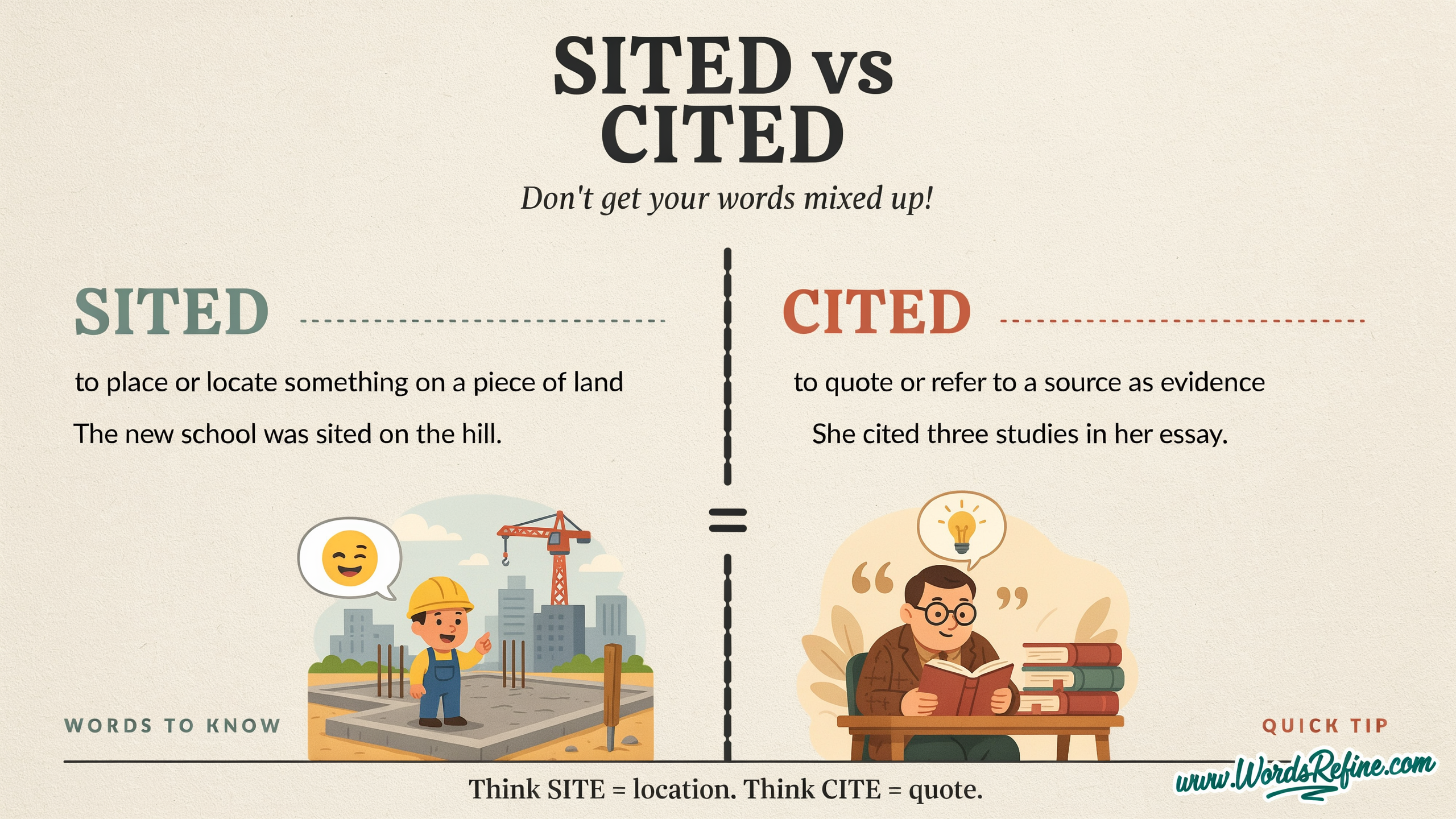
The definition of cited depends on the context, but its central meaning remains consistent.
Cite is the base verb, meaning to refer to or mention something. Cites is its present-tense form for he, she, or it. Citing is the present participle or gerund, while cited is the past-tense and past-participle form.
For example, students cite reliable sources in their research papers. An author cites historical documents in a book. A journalist may be citing official records to support an investigation. Similarly, a professor might have cited a recent study during a lecture.
The word cited can also describe an official charge or formal recognition.
For example, the officer cited the driver for speeding. An organization may be cited for its contribution to environmental protection. Likewise, a court decision might be cited as an important legal precedent.
Therefore, cited can mean referenced, quoted, officially charged, or formally recognized, depending on the sentence.
Examples of Cited in Sentences
The researcher cited five peer-reviewed studies in the report.
The student cited the original author to avoid plagiarism.
The lawyer cited an important court ruling during the hearing.
The newspaper article cited an official government statement.
The teacher cited a practical example to explain the concept.
The report cited financial records as supporting evidence.
The officer cited the motorist for violating the speed limit.
Each example refers to a source, example, authority, or official action rather than the physical placement of something.
Why Do People Confuse Them?
The confusion surrounding sited vs cited begins with pronunciation. In standard American English, both words sound exactly alike. They are homophones, which means they share the same pronunciation but have different spellings and meanings.
Both words are pronounced /ˈsaɪtɪd/. Since speaking doesn’t reveal which spelling belongs in a sentence, writers must rely on context.
Several factors contribute to this confusion. First, their identical pronunciation makes them difficult to distinguish when heard aloud. Second, both words end in -ed and function as past-tense verbs and past participles. As a result, their similar grammatical structures can make them seem interchangeable.
Moreover, both words frequently appear in professional documents. A construction report, for instance, might explain where a building was sited and cite the regulations that governed its placement.
Writing quickly can create another problem. When you’re focused on expressing an idea, it’s easy to type the wrong spelling without noticing the mistake.
Consider this sentence:
The researcher sited three scientific studies in the report.
The correct version is:
The researcher cited three scientific studies in the report.
The first sentence suggests that the researcher physically placed the studies somewhere. The second correctly communicates that the researcher referred to them.
Ultimately, pronunciation tells you how a word sounds, but context helps you determine which spelling to use.
Sited vs Cited vs Sighted Understanding All Three Words
The confusion becomes even more interesting when sighted enters the picture. Like sited and cited, sighted is pronounced /ˈsaɪtɪd/ in standard American English.
However, sighted comes from a third verb: sight. It means to see, notice, or observe something.
Understanding the difference between site, cite, and sight can prevent several common spelling mistakes.
| Word | Root | Meaning | Example |
|---|---|---|---|
| Sited | Site | Placed in a physical location | The factory was sited near the highway. |
| Cited | Cite | Referred to or mentioned | The researcher cited a scientific article. |
| Sighted | Sight | Seen or observed | The hikers sighted an eagle. |
Learn the difference between tricky grammar more words
Instinctually vs Instinctively Which One Is Correct ?
Sighted Meaning and Examples
Sighted is the past-tense and past-participle form of sight. As a verb, it means to see, notice, or observe something.
It commonly appears in wildlife reports, travel accounts, aviation, and descriptions of observations.
For example, tourists sighted dolphins near the coast. Researchers sighted a rare bird during their expedition. A pilot sighted the runway through the clouds, while several hikers sighted a bear near their campsite.
Sighted can also function as an adjective describing someone who has vision. For instance, a sighted person may assist someone who is blind or has low vision.
Therefore, the context determines how the word functions.
Sited, Cited, and Sighted in Sentences
Consider these three sentences:
The university sited its new laboratory near the research park.
The scientist cited a previous experiment to support her findings.
The scientist sighted a rare species during the field experiment.
Although these words sound identical, each sentence describes a different action.
A simple way to remember them is to connect each word with its root. Site means place, cite means reference, and sight means see.
Once you recognize these connections, choosing the correct spelling becomes much easier.
How to Choose Between Sited vs Cited
When deciding between sited or cited, don’t focus on pronunciation. Instead, identify what the sentence is trying to communicate.
Ask yourself one simple question: Is the sentence about placing something somewhere or referring to information?
If it describes a physical location, choose sited. If it refers to a source, example, authority, or piece of evidence, choose cited.
Use Sited When You Mean Placed or Located
Use sited when discussing the physical placement of buildings, facilities, equipment, or other structures.
For example, the new airport was sited outside the residential area. The solar farm was sited on unused agricultural land. Officials sited the water treatment plant near the river, while the company sited its new office close to the city center.
In each case, the word describes a location decision.
A quick substitution test can also help. Replace sited with placed or located. If the sentence retains its intended meaning, sited may be appropriate.
For example:
The new library was sited near the town square.
The new library was located near the town square.
Both sentences make sense, although the first may emphasize the decision to select that location.
Use Cited When You Mean Quoted or Referenced
Use cited when referring to a source, author, study, example, legal case, or other supporting information.
For example, the student cited two books in the introduction. The journalist cited a government official in the article. The lawyer cited a previous court decision, while the researcher cited several experiments to support the conclusion.
Try replacing cited with referenced or mentioned. If the sentence still communicates the intended idea, cited is probably the right choice.
For instance:
The researcher cited a recent scientific paper.
The researcher referenced a recent scientific paper.
Both sentences communicate that the researcher referred to the paper.
However, cited can carry a more formal meaning than mentioned. In academic writing, it often implies proper source attribution rather than a casual reference.
Common Mistakes With Sited vs Cited
Even experienced writers occasionally confuse homophones. Fortunately, most mistakes involving these words follow a few predictable patterns.
| Incorrect Usage | Correct Usage | Explanation |
|---|---|---|
| The student sited three research papers. | The student cited three research papers. | Research papers are referenced, not physically placed. |
| The company cited its factory near the airport. | The company sited its factory near the airport. | The sentence describes a physical location. |
| The journalist sited a government report. | The journalist cited a government report. | The journalist referred to a source. |
| Engineers cited the new bridge near the river. | Engineers sited the new bridge near the river. | The engineers selected a location. |
| The hikers cited a rare bird. | The hikers sighted a rare bird. | The hikers observed the bird. |
One common mistake is assuming that cited always relates to academic references. In reality, the verb also appears in legal, professional, and everyday contexts.
Another mistake is using sited whenever a sentence mentions a place. The word specifically relates to placing or positioning something. Simply identifying where something exists doesn’t always require sited.
For example, saying that the museum is located downtown simply describes its current position. However, saying that the museum was sited downtown during the city’s redevelopment project emphasizes the decision behind its placement.
Understanding this distinction helps you choose the right word without making your sentences sound unnatural.
Learn the difference between confusing word pairs
Ingenuine vs Ungenuine Which One Is Correct ?
Sited vs Cited Examples in Academic, Professional, and Everyday Writing
Understanding grammar rules is helpful, but seeing how words work in realistic situations makes them easier to remember.
The following examples demonstrate the difference between sited and cited across several writing situations.
Sited vs Cited in Academic Writing
Academic writing frequently uses cited because researchers must acknowledge the sources supporting their arguments.
For example, an author may cite several studies about climate change. A research paper may cite evidence from government publications, while a professor might cite a historical document during a lecture.
On the other hand, sited appears when academic writing discusses the physical location of research facilities or field stations.
For instance, the research laboratory was sited near a university hospital. Similarly, the field station was sited in a region with suitable environmental conditions.
Notice the distinction. Academic references require cited, while the physical placement of research facilities calls for sited.
When you cite a source correctly, you help readers identify where information originated. Depending on the required citation style, you may need an in-text citation, a footnote, an endnote, or a complete entry in the bibliography or reference list.
For example, APA and MLA use different citation conventions. Therefore, writers should follow the style required by their institution or publication.
Sited vs Cited in Business and Professional Writing
In business communication, sited often appears in planning documents, infrastructure proposals, and construction reports.
The company sited its distribution center near a major highway.
The proposed manufacturing facility was sited outside the residential district.
Engineers sited the new power station after completing an environmental assessment.
Meanwhile, cited commonly appears in business reports, presentations, and formal documentation.
The financial report cited rising transportation costs.
The consultant cited customer feedback to support the proposal.
The manager cited safety regulations during the meeting.
Both words can appear in the same document without creating any conflict. They simply perform different grammatical jobs.
Sited vs Cited in Everyday Writing
Although these words often appear in formal contexts, they aren’t limited to professional communication.
For example, a family might site its vacation cabin near a lake. A friend might cite a news article during a conversation. Similarly, a city may site a new playground beside a community center, while a teacher may cite a funny example to explain a lesson.
The same basic rule applies regardless of the writing situation. Focus on the action rather than the formality of the sentence.
Learn the difference between often confused words
Ironic vs Unironic Meaning, Differences, and Correct Usage
Sited vs Cited Synonyms and Related Words
Understanding synonyms can expand your vocabulary and help you recognize the difference between similar-looking words.
However, synonyms aren’t always interchangeable. A word that works in one context may sound awkward or change the meaning in another.
Synonyms for Sited
Depending on the context, possible alternatives for sited include located, placed, positioned, situated, and established.
Located describes something found in a particular place. Placed emphasizes putting something in a specific position. Positioned suggests arranging something at a particular location, while situated commonly describes where something exists.
Established can also work in certain contexts, especially when discussing setting up an organization, facility, or business in a particular place.
For example, the hospital was sited near the highway. The hospital was located near the highway. The hospital was positioned near the highway.
Although these sentences are similar, established may suggest creating or setting up the institution rather than simply selecting its physical location.
Synonyms for Cited
Depending on the sentence, possible alternatives for cited include referenced, quoted, mentioned, identified, and invoked.
Referenced means referring to a source or piece of information. Quoted means reproducing someone’s exact words. Mentioned means bringing something up in speech or writing.
Identified can work when naming or pointing out something, while invoked often describes referring to an authority, principle, or precedent to support an argument.
For example, the author cited a scientific study. The author referenced a scientific study. The author mentioned a scientific study.
However, quoted isn’t always a direct synonym for cited. Citing a source doesn’t necessarily mean reproducing its exact wording. A writer can cite a study while paraphrasing its findings.
Most importantly, sited and cited aren’t synonyms of each other. Their different meanings make them unsuitable replacements in ordinary usage.
Sited vs Cited Pronunciation
One reason these words cause so much confusion is that they share the same pronunciation in standard American English.
Both are pronounced /ˈsaɪtɪd/. The pronunciation has two syllables, with the stress on the first syllable. The final -ed ending adds an extra syllable because the base verbs end in the /t/ sound.
This pronunciation pattern also appears in words such as excited and invited, although their first syllables differ.
Since sited and cited sound alike, listening carefully won’t solve the spelling problem. Instead, use the meaning of the sentence to identify the correct word.
Learn the difference between basic English word mistakes
Enflamed vs Inflamed Which One Is Correct ?
British English vs American English Is There a Difference?
The distinction between sited and cited remains the same in both British and American English.
Both varieties use sited to describe the placement of something and cited to refer to a source, example, or authority.
For example, the new hospital was sited outside the city. Similarly, the researcher cited three scientific studies.
Neither spelling changes between these varieties.
Pronunciation may vary slightly depending on a speaker’s regional accent. However, sited and cited remain homophones in standard British and American English.
Therefore, you don’t need to learn separate spelling rules for these words based on the variety of English you’re using.
How to Remember the Difference Between Sited vs Cited
A simple memory trick can save you from repeatedly checking the spelling of these words.
Instead of memorizing complicated grammar explanations, connect each word with a familiar term.
Connect Sited With Site and Location
The word sited contains site, which means a place or location.
Think of a construction site, a building site, or the location of a new facility. Whenever a sentence describes placing a structure or facility somewhere, remember this connection.
Site means place, so sited relates to physical placement.
For example, the developers sited the new shopping center near the highway. This means they selected a physical location for the shopping center.
Connect Cited With Cite and Sources
The word cited contains cite, which means to refer to or mention something.
Think of citations in research papers, references in books, or sources in news articles.
Cite means reference, so cited relates to mentioning or acknowledging information.
For example, the student cited a textbook in the assignment. The student referred to a source rather than placing it somewhere.
Check the Meaning Before You Write
When you’re unsure whether to use sited or cited, try replacing the word with a simpler alternative.
If located or placed makes sense, consider sited. If referenced, quoted, or mentioned makes sense, consider cited. Similarly, if saw or observed makes sense, consider sighted.
This method is particularly useful when proofreading essays, emails, reports, and other documents containing several homophones.
Learn the difference between commonly misused words
Suffix vs Postfix Which One Is Correct?
Practice Session Sited vs Cited
Fill in each blank with the correct word: sited or cited.
- The architect carefully ______ the new library near the city center.
- The student ______ three research papers in her assignment.
- The company ______ its new office close to the airport.
- The professor ______ several studies to support his argument.
- The government ______ the hospital in an area with easy road access.
- The journalist ______ an official report in the article.
- The builders ______ the new shopping mall near the highway.
- The lawyer ______ an earlier court decision during the trial.
- The school was ______ away from the busy main road.
- The author ______ several historical documents in the book.
- The developers ______ the new housing project near public transportation.
- The researcher ______ a recent study to explain the results.
- The factory was ______ outside the residential neighborhood.
- The teacher ______ a famous poem during the discussion.
- The hotel was ______ near the beach to attract tourists.
- The report ______ several examples from real-life situations.
- The museum was ______ in a historic part of the city.
- The student forgot to include the sources she had ______.
- The new sports complex was ______ on the outskirts of town.
- The speaker ______ a well-known author during the presentation.
- The restaurant was ______ in a convenient location near the station.
- The researcher ______ the original source in the final paragraph.
- The company ______ its warehouse close to major shipping routes.
- The article ______ several experts to explain the issue.
- The new community center was ______ near the local park.
Answers
- sited
- cited
- sited
- cited
- sited
- cited
- sited
- cited
- sited
- cited
- sited
- cited
- sited
- cited
- sited
- cited
- sited
- cited
- sited
- cited
- sited
- cited
- sited
- cited
- sited
Here’s a trusted source for clear more words Comparison:
FAQs
What is the difference between sited and cited?
Sited refers to placing or locating something in a specific place. Cited means mentioning a source, example, or authority to support a statement or provide information.
Is it works cited or works sited?
The correct phrase is “works cited.” It refers to a list of sources used in a research paper, essay, or other academic project.
How do you use cited in a sentence?
Use cited when referring to a source, example, or authority. For example: “The researcher cited three studies to support her conclusion.”
What does sited mean in a sentence?
Sited describes something placed or located in a particular position. For example: “The new library was sited near the town center.”
Why are sited and cited often confused?
Sited and cited are homophones, which means they have the same pronunciation but different spellings and meanings. Sited relates to location, while cited refers to mentioning or referencing information.
What is the difference between site, sight, and cite?
Site means a place or location, sight refers to the ability to see or something you see, and cite means to mention or refer to a source, person, or example.
What is the past tense of cite?
The past tense of cite is cited. For example: “The author cited several reliable sources in the article.”
Can sited and cited be used interchangeably?
No. Although sited and cited sound alike, they have different meanings. Use sited when describing where something is located, and cited when referring to a source, example, or authority.
Learn the difference between everyday English mistakes
Trebled vs Tripled Which One Is Correct?
Conclusion
Sited vs cited may sound identical, but they serve two very different purposes. Sited tells readers where something is located, while cited shows where information comes from. Mixing them up can make a sentence confusing, especially in academic writing, professional reports, or everyday communication. Fortunately, remembering the difference is easier than finding a misplaced set of keys. Think of a site as a location and a citation as a reference to a source. Once you understand that simple distinction, choosing the correct word becomes much easier. Keep the meanings in mind, check your sentences, and let sited and cited stay in their proper places.

Diora AJS she is an experienced blogger and passionate English language enthusiast at Words Refine. With a keen eye for language and a love for clear communication, she writes practical content about grammar, word meanings, usage, and commonly confused terms. Her goal is to make English easier to understand through clear explanations and relatable examples, helping readers write accurately and communicate with confidence.