
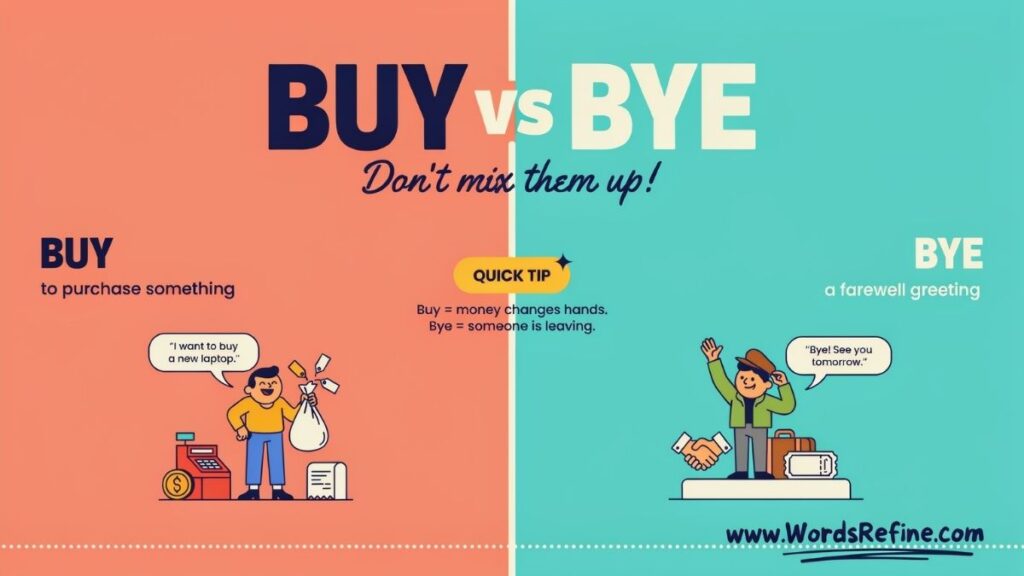
Choosing between buy vs bye may seem like a small writing decision, but mixing them up can change the meaning of an entire sentence. Both words sound the same, yet they serve very different purposes. You use “buy” when purchasing something and “bye” when saying goodbye or referring to a sports tournament’s automatic pass to the next round. Confusing them can turn a simple shopping plan into an unexpected farewell. Luckily, the difference is easy to remember once you understand how each word works. This guide explains their meanings, provides clear examples, and highlights common mistakes so you can use buy and bye correctly in everyday writing.
Buy vs By Quick Answer
Both buy vs bye are correct English words. However, they serve different purposes and cannot be used interchangeably.
Buy is a verb that means to purchase something by paying money or providing something in exchange. Bye is an informal farewell expression that people use when leaving or ending a conversation. In addition, bye has a special meaning in sports tournaments, where it refers to a player or team advancing without competing in a particular round.
Consider these examples:
- I want to buy a new phone before the holidays.
- I said bye to my friends after dinner.
- The package was delivered by the courier.
As you can see, each sentence uses a different word to express a specific meaning. Therefore, the correct choice depends on what you want to say.
What Does Buy Mean?
The word buy means to obtain something in exchange for money or another form of payment. People use it when talking about shopping, business transactions, everyday purchases, and even certain situations involving ideas or beliefs.
For example, whenever you visit a store, order something online, or pay for a product, you’re using the word buy to describe a purchasing action.
Consider these sentences:
- I need to buy groceries for dinner.
- She wants to buy a new laptop.
- We decided to buy tickets for the concert.
- They buy fresh vegetables from a local farmer.
In each example, buy describes an action involving a purchase. However, the word can also have other uses depending on the sentence.
Buy as a Verb
Buy is primarily an irregular verb. It describes the action of purchasing something and changes its form depending on the tense.
| Verb form | Example |
|---|---|
| Base form: buy | I buy coffee every morning. |
| Third-person singular: buys | He buys fresh bread daily. |
| Simple past: bought | She bought a new dress yesterday. |
| Past participle: bought | They have bought a house. |
| Present participle: buying | We are buying groceries now. |
Notice that the past tense of buy is bought, not buyed. This is an important detail for English learners because irregular verbs don’t always follow the usual pattern of adding -ed.
Moreover, buy can appear in both active and passive sentences.
Active: The customer bought the product.
Passive: The product was bought by the customer.
Both sentences describe the same transaction. However, the active sentence emphasizes the customer, while the passive sentence places more attention on the product.
Buy as a Noun
Although people mainly use buy as a verb, it can also function as a noun. In this form, it often describes something purchased at a reasonable price or an item considered worth its cost.
For example:
- This jacket was a great buy.
- That used car looks like a good buy.
- The store advertised its latest buys for the holiday season.
In these sentences, buy refers to a purchase or its value rather than the action of paying for something.
Common Expressions With Buy
English includes several everyday expressions that use buy in both literal and figurative ways.
| Expression | Meaning | Example |
|---|---|---|
| Buy something online | Purchase through an internet store | I buy books online. |
| Buy time | Gain extra time to handle a situation | The team delayed the decision to buy time. |
| Buy into an idea | Accept or believe an idea | She didn’t buy into the proposal. |
| Buy someone a gift | Purchase a present for another person | I’ll buy my brother a gift. |
| A good buy | Something worth its price | This bicycle was a good buy. |
| Buy in bulk | Purchase large quantities at once | They buy rice in bulk. |
Interestingly, not every expression involving buy has anything to do with money. For instance, when someone says, “I don’t buy that explanation,” the speaker means they don’t believe or accept it.
This figurative meaning is common in everyday conversations and informal writing.
What Does Bye Mean?
Bye is an informal farewell expression that people use when leaving someone, ending a phone call, or finishing a conversation. It is closely related to goodbye and works as a shorter, more casual alternative.
For example:
- Bye! See you tomorrow.
- She waved bye before leaving the office.
- We said bye to our neighbors after the party.
- He called to say bye before boarding the plane.
Unlike buy, bye doesn’t describe a purchase. Instead, it signals a departure or the end of an interaction.
Learn the difference between commonly mixed-up more words
Envisage vs Envision Meaning Differences Examples ?
Bye as a Farewell
People use bye in everyday situations, from quick conversations to friendly messages. Imagine meeting a friend for lunch. After finishing your meal, you might say, “Bye! I’ll see you next week.”
In this situation, bye signals that the meeting has ended, even though you expect to see your friend again.
Here are some other common examples:
- Bye for now.
- Okay, bye! Talk to you later.
- Say bye to your grandparents.
- She said goodbye before leaving.
- Bye-bye! Have a wonderful weekend.
Although bye is perfectly acceptable in casual communication, formal situations may call for a more professional closing.
For example, you might use Best regards or Sincerely when signing off on a business email rather than ending it with bye.
Bye in Sports and Competitions
The word bye has another meaning in sports. In a tournament, a bye allows a player or team to advance to the next round without competing in a particular round.
This arrangement often occurs when a tournament has an uneven number of participants or uses a bracket structure that requires some players to move forward without playing an opening match.
Imagine a tennis tournament with seven players in a single-elimination bracket. Depending on the bracket arrangement, one player may receive a first-round bye and move directly into the next round.
In this situation, bye has nothing to do with saying farewell. Instead, it describes a tournament arrangement that allows a participant to skip a round.
Common Expressions With Bye
Several familiar expressions use bye in everyday communication and sports.
| Expression | Meaning | Example |
|---|---|---|
| Say bye | Speak a farewell | Don’t forget to say bye. |
| Bye for now | A temporary farewell | Bye for now. Talk soon. |
| Bye-bye | An informal or playful farewell | The child waved and said bye-bye. |
| Say goodbye | Express farewell | We said goodbye at the station. |
| Get a bye | Advance without playing a round | Our team got a bye in the opening round. |
These examples show how the same word can have different uses depending on the situation. Context makes its intended meaning clear.
Buy vs Bye Key Differences
The difference between buy and bye comes down to meaning, grammatical function, and context. Although both words share the same pronunciation, they perform different jobs in a sentence.
| Feature | Buy | Bye |
|---|---|---|
| Meaning | To purchase something | A farewell or a tournament exemption |
| Part of speech | Primarily a verb; also a noun | Interjection; also a noun in sports |
| Main purpose | Describes purchasing or value | Expresses departure or a tournament arrangement |
| Common context | Shopping, business, everyday transactions | Conversations, messages, sports |
| Example | I want to buy a new watch. | I said bye to my friend. |
| Memory clue | Think of shopping and payment | Think of goodbye |
When comparing buy and bye, remember that neither word is a substitute for the other. The correct choice depends entirely on what you want to communicate.
For example, “I’ll buy you later” doesn’t express a normal farewell. Similarly, “I want to bye a sandwich” contains an incorrect word choice. Both mistakes become easy to fix once you connect each spelling to its meaning.
Learn the difference between tricky grammar more words
Apprised vs Appraised Which One Is Correct and Why It Matters ?
Buy vs Bye vs By Understanding All Three Word
Here’s where things get a little more interesting. Buy and bye aren’t the only words that sound alike. The word by joins them to form a group of three English homophones.
These three words have identical pronunciation in standard English but different spellings, meanings, and grammatical uses.
What Does By Mean?
The word by has several meanings depending on the sentence. Most commonly, it functions as a preposition that expresses who performs an action, how something happens, where something is located, or when something must happen. It can also function as an adverb.
Consider these common uses:
| Use | Meaning | Example |
|---|---|---|
| By agent | Identifies who performs an action | The novel was written by a famous author. |
| By method | Explains how something happens | She travels by train. |
| By location | Indicates a position near something | We sat by the window. |
| By time | Establishes a deadline | Please finish the assignment by Friday. |
| By means | Describes a method used to achieve something | He learned the language by practicing daily. |
In passive voice, by often introduces the person or thing responsible for an action.
For example, in “The cake was baked by my mother,” the phrase by my mother identifies who baked the cake.
However, not every passive sentence needs a by phrase. If the person responsible for an action isn’t important or isn’t known, writers can leave that information out.
Buy vs Bye vs By Example Sentences
Looking at all three words together makes their differences much easier to understand.
| Word | Example sentence | Explanation |
|---|---|---|
| Buy | I’ll buy a coffee before work. | Describes a purchase. |
| Bye | She said bye before leaving. | Expresses farewell. |
| By | The coffee shop is by the library. | Indicates location. |
| Buy | We bought a new television. | Describes a completed purchase. |
| Bye | Bye for now. See you tomorrow. | Ends a conversation. |
| By | The report was prepared by Sarah. | Identifies the person who performed the action. |
Rather than memorizing three unrelated spellings, focus on the role each word plays in its sentence. Once you understand the context, the correct choice becomes much more natural.
Why Do People Confuse Buy vs Bye?
English contains many words that sound alike but have different meanings. Linguists call these words homophones. Buy and bye are classic examples.
Because their pronunciation is identical in standard English, listeners can’t distinguish them by sound alone. Instead, they rely on context when reading or writing.
Several factors make this confusion especially common.
- Identical pronunciation: Both words sound the same, so speaking doesn’t reveal which spelling a writer intends.
- Different spellings: The letters u and y create two distinct written forms for the same sound.
- Fast typing: People often type quickly when sending text messages or chatting online, increasing the chance of choosing the wrong word.
- Autocorrect errors: Spell-checking tools may accept both words because each is correctly spelled in its own context. They don’t always identify the intended meaning.
- Limited proofreading: A sentence can look acceptable at first glance even when it contains the wrong word.
For example, consider this message:
“Okay, I have to buy now. Talk to you tomorrow.”
A basic spell-checker may not flag the sentence because buy is a correctly spelled English word. However, if the writer intends to end the conversation, bye is the correct choice.
The same problem occurs with the sentence “I need to bye some groceries.” The intended meaning is clear, but the spelling doesn’t match the action.
The important lesson is that correct spelling isn’t always correct word choice. A word can be spelled perfectly and still be wrong for the sentence.
Learn the difference between confusing word pairs
Remediated vs Remedied Which One Is Correct ?
Easy Ways to Remember Buy vs Bye
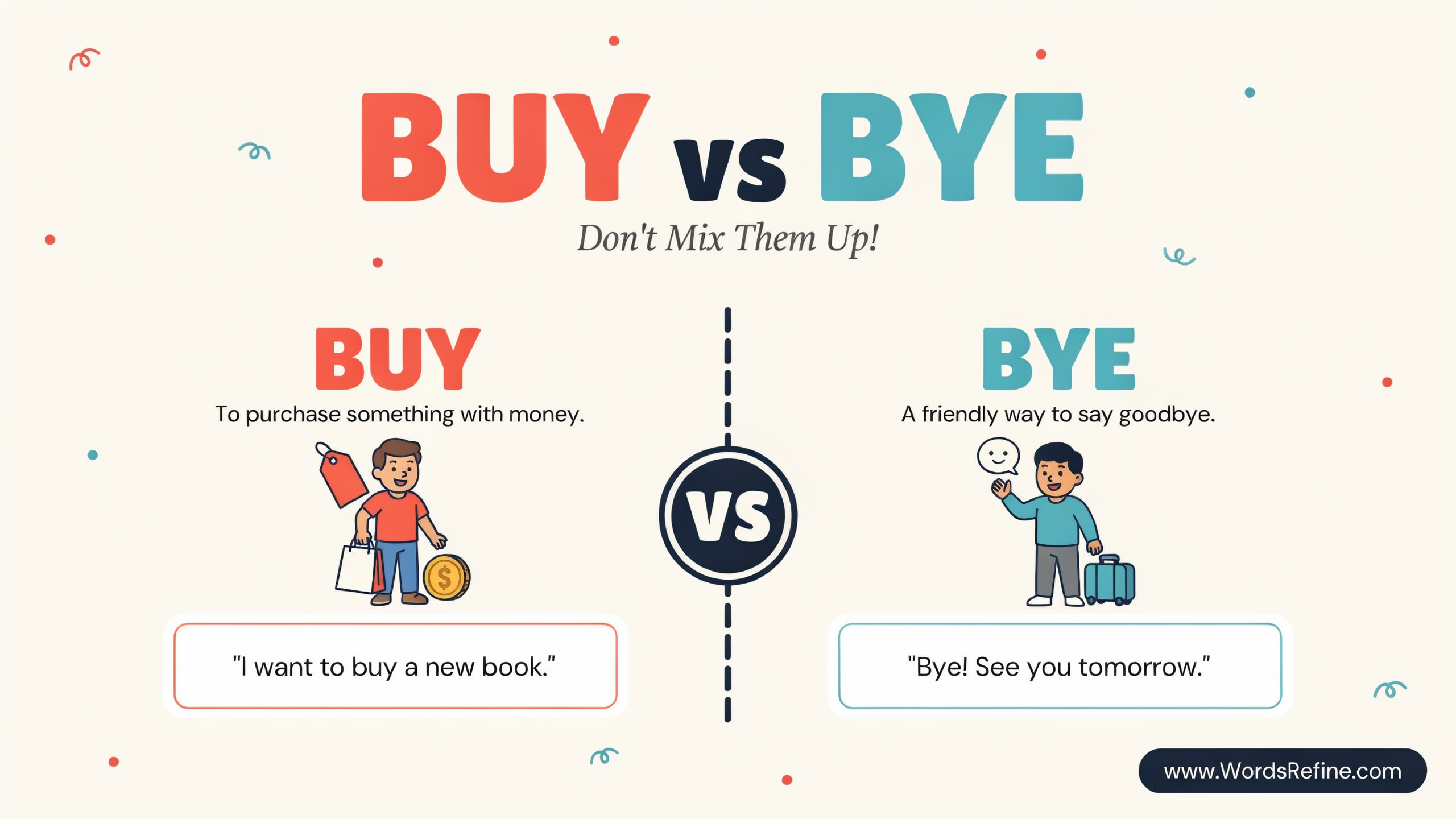
Remembering the difference between buy and bye doesn’t require complicated grammar rules. A few simple associations can help you choose the correct spelling whenever you write.
Remember Buy With Shopping
Connect buy with shopping, money, and purchasing products.
Think about the sentence, “I buy what I need.”
Whenever you’re discussing paying for something, purchasing an item, or making a transaction, buy is usually the word you need.
For example:
- I need to buy a notebook.
- They buy fresh food every weekend.
- She wants to buy a new bicycle.
A useful memory trick is that buy means to pay. Both words begin with the same letter, making the association easy to recall.
Remember Bye With Goodbye
The simplest way to remember bye is to connect it directly to goodbye.
Whenever you want to end a conversation or express a farewell, use bye.
For example:
- Bye! Have a great day.
- I said goodbye to my teacher.
- She waved bye as the bus pulled away.
Since bye appears at the end of goodbye, the connection is easy to remember.
Use the Replace-the-Word Test
When you’re unsure about the correct spelling, replace the word with a synonym.
For buy, try using purchase.
Original: I want to buy a new computer.
Replacement: I want to purchase a new computer.
The sentence still makes sense, so buy is correct.
For bye, try replacing it with goodbye.
Original: I said bye to my cousin.
Replacement: I said goodbye to my cousin.
Again, the sentence makes sense. Therefore, bye is the correct choice.
This method also works with by in many situations, although you’ll need to consider the sentence’s grammatical structure. For example, “The song was written by Alex” identifies the person who wrote the song. Replacing by with purchase or goodbye wouldn’t make sense.
Learn the difference between often confused words
Vaccum Vs Vacuum Which One Is Correct and Why It Matters ?
Common Mistakes With Buy vs Bye
Even experienced English speakers sometimes make homophone mistakes when typing quickly. Fortunately, most errors involving buy and bye are easy to recognize once you understand the intended meaning.
Using Buy Instead of Bye
This mistake often appears in informal messages when someone wants to end a conversation.
Incorrect: I have to buy now. Talk to you tomorrow.
Correct: I have to say bye now. Talk to you tomorrow.
In the corrected sentence, bye expresses the speaker’s departure. The verb buy would suggest a purchasing action and wouldn’t communicate the intended farewell.
Consider another example.
Incorrect: She waved buy before getting into the car.
Correct: She waved bye before getting into the car.
The context makes the correct spelling clear because waving is a common gesture used when saying farewell.
Using Bye Instead of Buy
This error occurs when someone writes bye while describing a purchase.
Incorrect: I want to bye a new pair of shoes.
Correct: I want to buy a new pair of shoes.
The sentence describes an intention to purchase something, so buy is the correct verb.
Consider another example.
Incorrect: We bye groceries every Saturday.
Correct: We buy groceries every Saturday.
The second sentence describes a regular shopping activity. Using bye would change the word’s function and make the sentence incorrect.
Confusing Buy, Bye, and By
The third homophone can make things even more confusing.
Incorrect: I will stop buy your house before saying goodbye.
Correct: I will stop by your house before saying goodbye.
In this sentence, by indicates a visit to a location. It doesn’t describe a purchase or a farewell.
Here’s another example.
Incorrect: The painting was created bye a local artist.
Correct: The painting was created by a local artist.
Here, by identifies the person responsible for creating the painting. The other two words cannot perform that grammatical function.
A quick proofreading habit can prevent these errors. Read each sentence and ask what the word actually means instead of checking spelling alone.
Buy vs Bye in Everyday Conversations and Writing
Although buy and bye have simple definitions, their use changes depending on the situation. Understanding the context helps you choose the right word in conversations, text messages, professional emails, and academic assignments.
Learn the difference between basic English word mistakes
Effort vs Affort Which One Is Correct and How to Use It?
Buy vs Bye in Text Messages and Social Media
Text messages often contain short sentences, abbreviations, and casual expressions. Since people type quickly, homophone mistakes can slip into everyday chats.
Consider these examples:
- “I’ll buy some snacks before the movie.” The sender plans to purchase food.
- “Okay, bye! See you tomorrow.” The sender is ending the conversation.
- “Can you buy me a coffee on your way?” The sender is asking someone to purchase a drink.
- “I have to go now. Bye!” The sender is expressing a farewell.
In informal conversations, bye-bye and bye for now are also common. However, using buy instead of bye can make a message confusing or unintentionally funny.
Buy vs Bye in Emails and Professional Communication

Professional writing requires careful word choice because even small errors can affect clarity.
The word buy frequently appears in business emails involving orders, purchases, products, and customer transactions.
For example:
“Please let me know if you’d like to buy the equipment before the end of the month.”
On the other hand, bye is generally too casual for formal email sign-offs. Instead, writers often use expressions such as Best regards, Sincerely, Kind regards, or Thank you.
For example:
“Thank you for your time. I look forward to hearing from you.
Best regards, Alex”
Although bye isn’t grammatically incorrect in an informal workplace message, a more professional closing usually suits formal business communication.
Buy vs Bye in Academic Writing
In academic writing, the distinction between buy and bye is just as important as it is in everyday communication.
Students may use buy when discussing consumer behavior, economics, shopping habits, or purchasing decisions.
For example:
“Consumers often compare prices before they buy electronic products.”
Meanwhile, bye may appear in academic writing about language, communication, sports, or tournament structures.
For example:
“Under the tournament rules, the highest-seeded team received a bye in the opening round.”
Academic writing doesn’t change the meanings of these words. It simply requires writers to use them accurately and choose a tone appropriate to their subject.
Learn the difference between commonly misused words
Octopus vs Octopi Which Plural Is Correct and Why?
Buy vs Bye in American and British English
One common question about confusing English words is whether their spelling changes between American and British English.
Fortunately, buy and bye have the same standard spellings and core meanings in both varieties.
| Word | American English | British English |
|---|---|---|
| Buy | To purchase something | To purchase something |
| Bye | A farewell or a tournament exemption | A farewell or a tournament exemption |
| By | A preposition or adverb | A preposition or adverb |
The spellings of all three words remain consistent across these varieties.
Pronunciation may vary slightly with regional accents, but buy, bye, and by are homophones in standard American and British English.
For example:
American English: I’ll buy a ticket before I say bye.
British English: I’ll buy a ticket before I say bye.
Both sentences use the same spellings and communicate the same meaning.
The important point is that this confusion isn’t caused by American and British spelling differences. It’s simply a matter of choosing the correct homophone.
Buy vs Bye Real World Examples

Sometimes the easiest way to understand confusing English words is to see them in realistic situations. The following examples demonstrate how buy, bye, and by work in different contexts.
Examples of Buy in Sentences
- I need to buy a birthday present for my sister.
- They plan to buy a house next year.
- You can buy fresh vegetables at the local market.
- My parents bought a new television last weekend.
- She wants to buy groceries before the store closes.
- This secondhand bicycle was a great buy.
- We usually buy our clothing during seasonal sales.
- He decided to buy food for everyone at the picnic.
Each example involves purchasing something or describing the value of a purchase.
Examples of Bye in Sentences
- She waved and said bye before getting into the car.
- Bye for now. I’ll call you tomorrow.
- Our team received a bye in the first round.
- He said goodbye to his friends at the airport.
- The children shouted bye-bye as their grandparents drove away.
- I forgot to say bye before leaving the party.
- She sent a quick bye message before switching off her phone.
These sentences demonstrate the use of bye as a farewell and as a sports term.
Examples of Buy, Bye, and By Together
Using all three homophones in the same sentence provides a useful way to practice their differences.
- I’ll buy some snacks before I stop by your house to say bye.
- She plans to buy a ticket by Friday before saying bye to her coworkers.
- We stopped by the store to buy groceries before saying bye to our neighbors.
- The gift was bought by my brother before he said bye to everyone.
Notice how each word performs a different function, even when it appears alongside the others.
Learn the difference between everyday English mistakes
Sublet vs Sublease Which One Is Correct ?
Practice Buy vs Bye
- I need to _____ a new pair of shoes.
- She waved _____ to her friends before leaving.
- We plan to _____ groceries after work.
- The player said _____ to his teammates.
- My brother wants to _____ a new laptop.
- She said _____ and walked out of the room.
- Where can I _____ a ticket for the concert?
- The coach told the team to say _____ to their opponents.
- I forgot to _____ milk from the store.
- He shouted _____ before getting on the bus.
- They decided to _____ a house near the beach.
- She gave her colleague a quick _____ before heading home.
- We should _____ some snacks for the trip.
- The contestant received a first-round _____ in the tournament.
- I want to _____ a gift for my mother.
- He said _____ to everyone at the party.
- Did you _____ the book I recommended?
- The tennis player advanced to the next round with a _____.
- Let’s _____ some fresh vegetables for dinner.
- She smiled and said _____ as she left.
- I need to _____ a charger for my phone.
- The team earned a _____ to the semifinals.
- They went to the mall to _____ new clothes.
- He whispered _____ before ending the phone call.
- You can _____ the tickets online before the event.
Answers
- buy
- bye
- buy
- bye
- buy
- bye
- buy
- bye
- buy
- bye
- buy
- bye
- buy
- bye
- buy
- bye
- buy
- bye
- buy
- bye
- buy
- bye
- buy
- bye
- buy
Here’s a trusted source for clear word meanings:
FAQs
What does “bbye” mean in a chat?
“Bbye” is an informal variation of “bye” commonly used in text messages and online chats. It means goodbye, while the repeated letters can add a playful, friendly, or affectionate tone.
What is the difference between “buy” and “bye”?
“Buy” is a verb that means to purchase something by paying for it. “Bye” is an expression used when leaving or ending a conversation. Although both words sound alike, they have different meanings and uses.
What does “bye” mean in a text message?
In a text message, “bye” signals that someone is ending a conversation or saying goodbye. Its tone can feel warm, neutral, or abrupt, depending on the wording and the context.
How does Gen Z say goodbye?
Gen Z users may say “later,” “peace,” “catch you later,” “I’m out,” or “byeee” when ending a conversation. These expressions often sound more casual and playful than a simple “goodbye.” Their meaning and tone depend on the conversation and the relationship between the people texting.
What are some cool ways to say goodbye?
If you want a casual alternative to “bye,” try “catch you later,” “see you,” “peace out,” “talk soon,” or “I’m off.” For a more playful message, “byeee” can add warmth and personality. The best choice depends on the situation and the person you’re speaking to.
What does “byeee” mean when a girl texts it to a guy?
When a girl texts “byeee” to a guy, the extra letters may make the goodbye sound playful, friendly, excited, or affectionate. However, the spelling alone does not prove romantic interest. The surrounding conversation and her usual texting style offer better clues about her tone.
When should you use “bye”?
Use “bye” when leaving, ending a phone call, or wrapping up a conversation in person or online. It works well in everyday situations. In a professional email or formal message, however, a closing such as “Best regards,” “Have a great day,” or “Speak soon” may be more suitable.
What does “by the by” mean?
“By the by” means “incidentally” or “by the way.” It introduces an additional thought or a related detail during a conversation. Although the expression is grammatically correct, “by the way” is more common in modern everyday English.
Does “BYE” have an acronym meaning?
In everyday English and texting, “bye” is a word used to say goodbye, not usually an acronym. In a specific organization, online community, or technical context, however, BYE may stand for something else. Its meaning then depends on how and where it is used.
Is “bye” appropriate in a professional message?
“Bye” is understandable in professional communication, but it can sound too casual in formal situations. For a more polished closing, consider “Best regards,” “Have a great day,” or “Speak soon.” Choose a phrase that matches your relationship with the recipient and the tone of your message.
Learn the difference between more words people mix up
Drily vs Dryly Which One Is Correct?
Conclusion
Understanding the difference between buy vs bye is simple once you know what each word does. Buy is all about purchasing something, while bye is what you say when leaving or saying goodbye. Although these words sound exactly alike, their meanings are worlds apart. Mixing them up can turn an ordinary sentence into an amusing mistake. Imagine writing, “I’m going to bye a new phone” when you mean to buy one. Your grammar might accidentally send your shopping plans on an unexpected farewell!
The easiest way to remember the difference is to connect buy with buying things and bye with bidding farewell. With a little practice, you can avoid this common confusion and use both words confidently. After all, good grammar does not have to be complicated. Just remember to buy what you need and say bye when it is time to leave.

Diora AJS she is an experienced blogger and passionate English language enthusiast at Words Refine. With a keen eye for language and a love for clear communication, she writes practical content about grammar, word meanings, usage, and commonly confused terms. Her goal is to make English easier to understand through clear explanations and relatable examples, helping readers write accurately and communicate with confidence.