
Have you ever paused while writing wondering whether to use envisage vs envision? You are not alone. These two words have remarkably similar meanings making the choice feel like a grammar puzzle. Both describe imagining an idea, picturing a possibility, or thinking about the future. However, their usage differs slightly, particularly between American and British English. Understanding envisage vs envision can help you choose the right word without second-guessing every sentence. Whether you are writing an article, planning a project or describing your dreams, knowing the distinction makes your writing clearer and more natural. Let’s explore their meanings, differences, examples, and common mistakes so you can use both with confidence.
Envisage vs Envision Quick Answer
Both envisage vs envision are verbs that mean to imagine, picture, or consider something as a possible future situation. The main difference lies in their typical emphasis and regional usage.
Envisage often emphasizes considering or imagining a possible situation, plan, or outcome. Envision, on the other hand, frequently emphasizes forming a mental picture of something, especially a goal, idea, or future possibility.
For example, consider these sentences:
- The company envisages expanding its operations into three new markets.
- The company envisions a future in which its products reach customers worldwide.
Both sentences describe future possibilities. However, the first focuses on a potential business development, while the second presents a broader picture of the company’s future.
Regional preferences also influence word choice. Envisage is particularly common in British English, whereas envision is more widely used in American English. Nevertheless, both words are correct in either variety.
What Does Envisage Mean?
Envisage is a verb that means to imagine, contemplate, or consider something as a possible situation or future outcome. When you envisage something, you mentally explore an idea or picture how a particular situation might develop.
For example, imagine a student considering a career in medicine. The student might envisage working in a hospital, treating patients, and contributing to medical research. These are possible future experiences rather than guaranteed events.
The word frequently appears in discussions about plans, expectations, potential developments, and hypothetical situations. It can also describe forming an idea of how something might look or work.
Envisage Meaning and Definition
The central meaning of envisage is to form a mental picture of something or consider it as a possibility.
Depending on the context, envisage can express several related ideas. It can mean imagining a future situation, contemplating a possible course of action, considering a realistic opportunity, or picturing how a particular event might unfold.
For instance, consider this sentence:
“Architects envisage a neighborhood with more green spaces and pedestrian-friendly streets.”
Here, envisage suggests that the architects have considered and imagined a possible design for the neighborhood. They are describing a potential development rather than confirming that the project will happen.
Envisage Pronunciation
Envisage is commonly pronounced en-VIZ-ij. It has three syllables, with the main stress on the second syllable.
The final sound resembles the ending in words such as message and village. Once you recognize that pattern, pronouncing envisage becomes much easier.
Envisage Sentence Examples
The following examples show how envisage works in different situations.
- We envisage moving into a larger office next year.
- The directors envisage opening additional branches across the country.
- She envisages becoming a university professor after completing her doctorate.
- Engineers envisage a transportation system powered entirely by renewable energy.
- He envisages a peaceful retirement near the coast.
- The project manager envisages several obstacles during the construction phase.
- Can you envisage living without access to the internet?
As these examples demonstrate, envisage works naturally when discussing future plans, possible developments, and situations that someone is considering.
Learn the difference between tricky grammar more words
Whoever vs Whomever How to Use Each Word Correctly?
What Does Envision Mean?
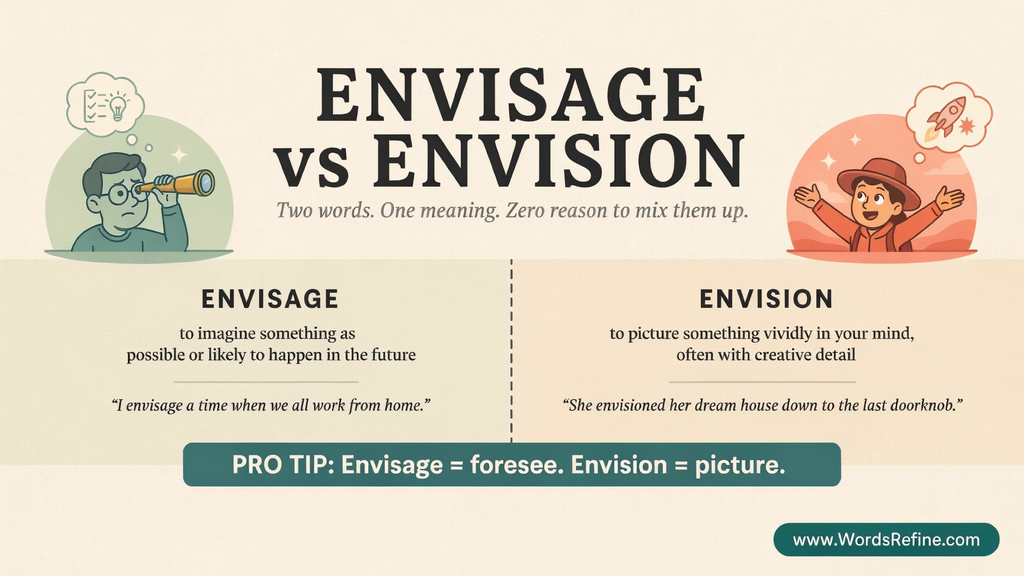
Envision is a verb that means to imagine or form a mental picture of something that may happen or exist. It frequently appears when people describe ambitions, creative ideas, future goals, and desired outcomes.
Imagine an entrepreneur developing a new product. Before building a prototype, the entrepreneur might envision how the product will look, how customers will use it, and what problems it will solve.
That mental picture helps turn an abstract idea into something more concrete.
Although envision often appears in discussions about dreams and ambitions, it isn’t limited to positive situations. You can also envision a difficult scenario, a potential problem, or an undesirable outcome.
Envision Meaning and Definition
The central meaning of envision is to imagine something or form a mental picture of a possible situation.
Depending on the context, envision can mean imagining something that doesn’t currently exist, visualizing a future possibility, developing an idea of how something might work, or picturing a particular outcome.
For example:
“The designer envisions a modern home filled with natural light and open spaces.”
In this sentence, envision emphasizes the designer’s mental picture of a future home.
Envision Pronunciation
Envision is commonly pronounced en-VIZH-un. Like envisage, it has three syllables, with the stress on the second syllable.
The middle consonant has a sound similar to the one in vision and decision. Recognizing this sound can make the word easier to pronounce and remember.
Envision Sentence Examples
Here are some examples of envision in different contexts.
- She envisions a career that combines science and environmental protection.
- The founder envisions a company that makes affordable clean energy available to everyone.
- The artist envisions a sculpture made from recycled materials.
- Researchers envision a future where artificial intelligence helps doctors detect diseases earlier.
- The principal envisions a school where every student has access to personalized learning.
- The team envisions several ways to improve the current system.
- I can’t envision a world without modern communication technology.
Notice how naturally envision connects with goals, creative ideas, and imagined situations. However, these uses aren’t exclusive to this verb. Envisage can also express many of the same ideas.
Learn the difference between confusing word pairs
Vender vs Vendor Which one Is Correct?
Envisage vs Envision Key Differences at a Glance
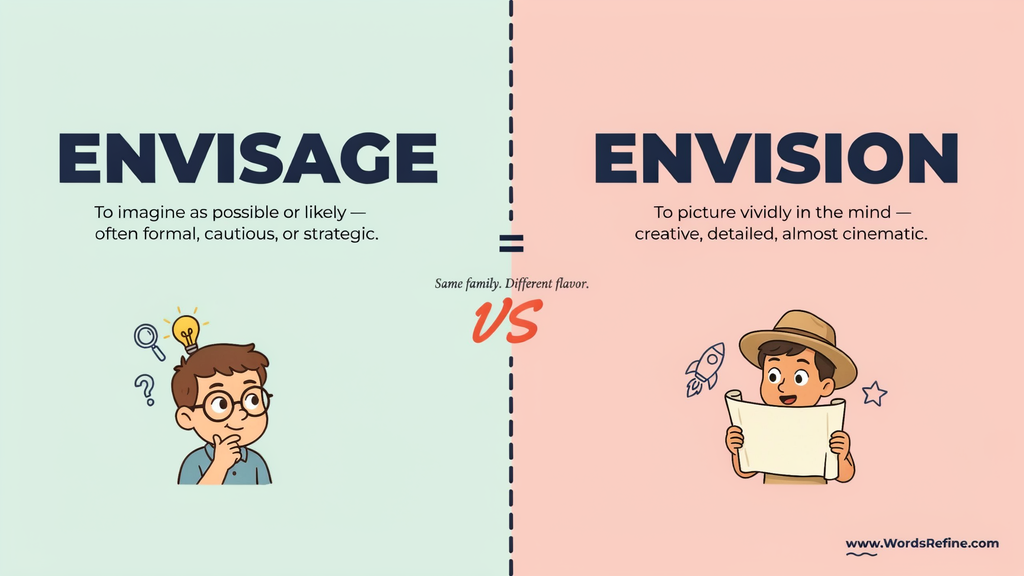
At first glance, envisage and envision seem almost identical. Both describe imagination and future possibilities. However, their typical usage reveals subtle differences.
| Feature | Envisage | Envision |
|---|---|---|
| Part of speech | Verb | Verb |
| Main meaning | To imagine or consider a possible situation | To imagine or form a mental picture |
| Typical emphasis | Potential situations, plans, and outcomes | Mental images, goals, and imagined futures |
| Regional preference | Particularly common in British English | Particularly common in American English |
| Formality | Neutral to formal | Neutral to formal |
| Common contexts | Planning, policies, expectations, and possibilities | Goals, creativity, innovation, and future visions |
| Example | We envisage several changes to the current policy. | We envision a more accessible education system. |
The difference between envisage and envision is often a matter of emphasis rather than a strict difference in definition. For example, a business owner can envisage expanding a company or envision the company’s future growth. Both sentences are grammatically correct.
The distinction becomes more noticeable when a writer wants to emphasize a particular aspect of imagination. Envisage can sound especially natural when discussing a situation someone is considering. Meanwhile, envision often feels natural when describing a clear mental picture or a desired future.
Nevertheless, context matters more than any rigid distinction.
When to Use Envisage
Knowing when to use envisage or envision starts with understanding the situation you’re describing. Envisage is particularly useful when discussing a possible development, considering a future situation, or thinking through the potential consequences of a plan.
It works well in professional discussions, planning documents, academic writing, and everyday conversations.
Envisage for Future Possibilities
Use envisage when you want to describe a future situation that someone considers possible.
For example:
- The city envisages a significant increase in public transportation use.
- Scientists envisage new methods of producing clean energy.
- We envisage a future with fewer traffic problems.
In these sentences, the speakers or organizations are considering possible future developments. They aren’t necessarily claiming that these outcomes will happen.
This distinction matters because imagining a possible outcome doesn’t mean predicting it with certainty.
Learn the difference between often confused words
Ingenuine vs Ungenuine Which One Is Correct ?
Envisage for Plans and Expected Outcomes
Envisage also works naturally when discussing plans and the results someone hopes or expects to achieve.
Consider this example:
“The project manager envisages completing the renovation by the end of March.”
The sentence describes the manager’s view of a possible completion schedule. It doesn’t automatically guarantee that the renovation will finish on time.
Similarly, consider these examples:
- The university envisages introducing new courses next semester.
- The committee envisages several improvements to the existing guidelines.
- The developers envisage creating a residential area with better public facilities.
In professional writing, envisage can help express plans without presenting uncertain outcomes as established facts.
When to Use Envision
When deciding when to use envision instead of envisage, consider whether you want to emphasize a mental picture, a personal ambition, or a creative idea.
Envision is especially useful when discussing what someone imagines a future situation could look like. It appears frequently in conversations about innovation, personal development, leadership, and long-term goals.
Envision for Goals and Ambitions
Use envision when describing a future achievement or situation that someone hopes to experience.
For example:
- She envisions a career that combines science and environmental protection.
- They envision building a successful family business.
- I envision living in a quiet town surrounded by nature.
These examples show how envision connects imagination with aspirations. The speaker pictures a future that may become reality through planning and effort.
However, envision doesn’t always suggest a positive goal. You can also envision failure, conflict, or an unexpected challenge.
For instance, “The manager envisions several difficulties during the transition.”
The verb still describes an imagined future situation rather than a guaranteed event.
Envision for Creative Ideas and Solutions
Creative work often begins with an idea that exists only in someone’s imagination. Envision can describe the process of picturing that idea before turning it into something real.
Consider these examples:
- The architect envisions a building that blends traditional design with modern technology.
- The filmmaker envisions a story set on a distant planet.
- The research team envisions a new approach to reducing plastic waste.
In each sentence, the verb emphasizes the imagined form of a project, design, or solution.
This use also appears in business discussions. A company leader might envision a new customer experience before developing the technology and services needed to deliver it.
British English vs American English
Regional preferences are another reason people confuse these two verbs. Both words belong to standard English. However, their frequency and naturalness can vary between English-speaking regions.
Envisage is widely used in British English and often appears in British newspapers, academic discussions, and professional communication. American English speakers also use it, particularly in formal or carefully considered writing.
Envision is especially common in American English. It appears regularly in American business communication, educational materials, everyday conversations, and discussions about goals and innovation. British English speakers use it too.
Consider these examples:
| British English context | American English context |
|---|---|
| The council envisages a greener city. | The council envisions a greener city. |
| We envisage introducing new services next year. | We envision introducing new services next year. |
| The researchers envisage several possible outcomes. | The researchers envision several possible outcomes. |
These examples illustrate regional preferences rather than strict rules. A British writer can use envision naturally, and an American writer can choose envisage without making a grammatical mistake.
If you’re writing for an international audience, either verb is generally understandable. Consistency with your publication’s preferred variety of English is more important than forcing a regional distinction.
Learn the difference between basic English word mistakes
Apprised vs Appraised Which One Is Correct and Why It Matters ?
Envisage vs Envision Common Grammar Patterns

The difference between envisage and envision isn’t primarily grammatical. Both verbs follow several of the same sentence patterns. Learning these structures makes it easier to use either word correctly.
Envisage vs Envision Something
Both verbs can take a direct object. This construction is useful when describing an imagined object, situation, or future outcome.
For example:
- The architect envisages a building with a rooftop garden.
- The architect envisions a building with a rooftop garden.
- She envisages a different approach to teaching.
- She envisions a different approach to teaching.
In each example, the object directly follows the verb. You don’t need an additional preposition between the verb and the object.
Envisage vs Envision Doing Something
Both verbs can also take a gerund, which is a verb ending in -ing that functions as a noun.
For example:
- We envisage launching the product in June.
- We envision launching the product in June.
- The organization envisages expanding its volunteer program.
- The organization envisions expanding its volunteer program.
This structure is especially useful when discussing plans and possible actions.
Remember that the -ing form follows the verb directly in this construction. For example, “They envisage to expand the company” is not standard usage. Instead, write “They envisage expanding the company.”
Envisage vs Envision That Something Will Happen
Both verbs can introduce a that-clause to describe an imagined or considered situation.
For example:
- We envisage that demand will increase over the next five years.
- We envision that demand will increase over the next five years.
- The researchers envisage that the new treatment could improve patient outcomes.
- The researchers envision that the new treatment could improve patient outcomes.
The word that is often optional when the sentence remains clear.
For example, “She envisions that the project will succeed” can become “She envisions the project will succeed.”
In formal writing, retaining that can make a sentence easier to follow, especially when it contains several clauses.
Learn the difference between basic English word mistakes
Remediated vs Remedied Which One Is Correct ?
Why Do People Confuse Envisage vs Envision?
The confusion surrounding envisage and envision comes from their considerable overlap. Both verbs involve imagination, mental representation, and possible future situations. As a result, writers can often replace one with the other without changing the central meaning.
Several factors contribute to this confusion.
Their definitions are similar because both words can mean imagining or considering something that may happen. In addition, they share sentence structures and have many of the same synonyms, including imagine, picture, and visualize.
Regional preferences add another layer of confusion. British and American English tend to favor different words in many contexts. Furthermore, their subtle differences in emphasis can make one verb sound more natural than the other in a particular sentence.
Another source of confusion is the mistaken belief that envisage refers exclusively to practical planning while envision refers exclusively to creative imagination.
That distinction is too rigid. Someone can envisage an artistic project and envision a practical business plan. The surrounding sentence determines the emphasis.
Common Mistakes With Envisage vs Envision
Even though both verbs are flexible, writers sometimes use them in ways that create confusion or awkward sentences. Most problems involve meaning or sentence structure rather than choosing the supposedly wrong word.
Assuming One Word Is Always Correct
A common misconception is that envisage is wrong in American English or that envision doesn’t belong in British English.
Both assumptions are incorrect. The two verbs are accepted in standard English, although regional preferences can influence which one sounds more familiar.
Confusing Imagination With Prediction
Consider this sentence:
“She envisions that the stock price will definitely rise tomorrow.”
If the intention is to express a firm expectation about a future event, predicts may be more precise.
A clearer alternative is:
“She predicts that the stock price will rise tomorrow.”
Envision describes an imagined situation. Predict more directly expresses a claim about what someone expects to happen.
Using an Incorrect Verb Construction
Consider this sentence:
“They envisage to open a new restaurant.”
The construction is incorrect in standard English because envisage is normally followed by a noun, an -ing form, or an appropriate clause rather than a to-infinitive.
The corrected version is:
“They envisage opening a new restaurant.”
The same pattern applies to envision.
Choosing a Word Based on Formality Alone
Some writers assume that envisage is always formal and envision is always informal. However, both words work in formal and professional writing.
For example, either of these sentences would fit a business report:
“The organization envisages significant improvements over the next decade.”
“The organization envisions significant improvements over the next decade.”
The choice depends on the intended emphasis and the writer’s preferred variety of English.
Overcomplicating a Simple Sentence
Consider this example:
“The designer envisions the possibility of perhaps creating a new product.”
Although the sentence is understandable, it contains unnecessary words.
A clearer version is:
“The designer envisions creating a new product.”
Removing unnecessary wording makes the sentence more direct without changing its central idea.
Correct and Incorrect Sentence Examples
Comparing sentences side by side is one of the easiest ways to recognize grammar problems and improve your writing.
| Incorrect or awkward sentence | Improved sentence | Explanation |
|---|---|---|
| We envisage to build a new school. | We envisage building a new school. | Use a gerund rather than a to-infinitive after envisage. |
| She envisions a plan to perhaps possibly expand the business. | She envisions expanding the business. | Remove unnecessary words for clarity. |
| The team envisage a new strategy. | The team envisages a new strategy. | A singular subject requires envisages in standard present-tense usage. |
| He envision a better future. | He envisions a better future. | A third-person singular subject requires envisions. |
| They envisages a new opportunity. | They envisage a new opportunity. | Use the base form with the plural subject they. |
Notice that these corrections focus on actual grammatical or stylistic issues. Replacing envisage with envision or vice versa doesn’t automatically correct a sentence.
Learn the difference between more words people mix up
Effort vs Affort Which One Is Correct and How to Use It?
Envisage vs Envision Real World Examples in Sentences
The best way to understand these two verbs is to see how they work in familiar situations.
The following paired examples demonstrate their shared meaning while highlighting slight differences in emphasis.
Examples in Everyday Conversations
Imagine discussing future travel plans with a friend.
“I envisage spending the summer exploring different European cities.”
“I envision spending the summer exploring different European cities.”
Both sentences describe an imagined travel plan. The choice depends largely on personal preference and regional usage.
Now consider talking about a future home.
“Can you envisage living in a house surrounded by mountains?”
“Can you envision living in a house surrounded by mountains?”
Both verbs work naturally. Envision may draw slightly more attention to the mental picture, but the overall meaning remains similar.
Examples in Business and Professional Writing
Business communication often involves discussing uncertain developments. Both verbs can help express plans and possibilities without presenting them as guaranteed outcomes.
Consider a company planning to expand.
“The company envisages opening five additional locations over the next two years.”
“The company envisions expanding its presence into five new markets.”
The first example presents a specific expansion plan. The second emphasizes a broader picture of future growth.
Now imagine a management team discussing customer service improvements.
“Management envisages introducing a new customer support system.”
“Management envisions a customer support system that resolves common problems more quickly.”
The first sentence emphasizes a proposed action. The second describes the intended result.
Examples in Academic and Formal Writing
Academic writing often requires careful distinctions between evidence, expectations, and hypothetical situations.
Consider a scientific research project.
“Researchers envisage several possible explanations for the observed results.”
“Researchers envision new experiments that could test the proposed theory.”
Both examples are appropriate. The first considers possible explanations, while the second emphasizes possible research activities.
Similarly, when discussing future developments, either verb can work:
“The study envisages a future in which renewable energy becomes more widely available.”
“The study envisions a future in which renewable energy becomes more widely available.”
In this context, the verbs are interchangeable without a significant change in meaning.
Learn the difference between everyday English mistakes
Octopus vs Octopi Which Plural Is Correct and Why?
Envisage vs Envision Synonyms and Related Words
Understanding synonyms can help you choose a more precise verb. Although envisage and envision share several alternatives, each synonym carries its own nuance.
| Word | Meaning | Example |
|---|---|---|
| Imagine | Form an idea or mental picture | I imagine a quieter life in the countryside. |
| Visualize | Form a mental image, often with visual detail | She visualizes the finished design. |
| Picture | Imagine how something looks or might happen | He pictures himself running a successful business. |
| Contemplate | Think carefully about a possibility | They contemplate moving to another city. |
| Anticipate | Expect or prepare for a future event | We anticipate higher demand next month. |
| Foresee | Recognize or predict a possible future event | Nobody foresaw the sudden change. |
| Conceive | Form an idea or plan | The engineers conceive a new approach to the problem. |
| Consider | Think about an option or possibility | She considers several career paths. |
Envisage vs Imagine
Imagine is a broad, everyday verb that describes forming ideas or mental pictures. Envisage often sounds more deliberate when discussing possible situations or future developments.
For example:
“I imagine living by the ocean.”
“I envisage living by the ocean.”
Both sentences are correct. The second may sound slightly more considered or formal depending on the context.
Envision vs Visualize
Visualize places stronger emphasis on creating a mental image. Envision can describe visual imagination too, but it also covers broader ideas and future possibilities.
For example:
“The artist visualizes every detail of the painting.”
“The artist envisions a series of paintings inspired by nature.”
The first sentence focuses on mental imagery. The second emphasizes a broader creative concept.
Envisage vs Anticipate
The Envisage and anticipate sometimes overlap, but they aren’t exact synonyms.
Envisage describes imagining or considering a possible situation. Anticipate often suggests expecting something or preparing for it.
For example:
“We envisage several possible delays.”
“We anticipate several delays.”
The first sentence presents delays as possibilities under consideration. The second suggests that the delays are expected.
Envision vs Foresee
Envision emphasizes imagining a situation, while foresee emphasizes recognizing or predicting a future possibility.
For example:
“The company envisions a major change in the industry.”
“The company foresees a major change in the industry.”
The first describes an imagined future scenario. The second suggests the company expects the change to happen.
How to Choose Between Envisage vs Envision
If you’re wondering whether to use envisage or envision, start by identifying what you want to communicate. In many sentences, either verb will work. However, a few practical guidelines can make your choice easier.
Use envisage when discussing possible situations, plans, or outcomes, particularly if it feels natural in your variety of English.
Choose envision when emphasizing a mental picture, an ambition, a creative idea, or a desired future.
Consider your audience as well. British readers may be more accustomed to envisage, while American readers may encounter envision more frequently.
If you’re writing for a publication, company, or academic institution, follow its preferred style guide. Consistency is more important than forcing an unnecessary distinction between two similar words.
Finally, avoid replacing a more precise word such as predict or expect with either verb when you need to express a firm expectation.
Ultimately, the difference between envisage and envision in everyday usage is flexible rather than absolute. Neither verb belongs exclusively to one kind of writing or one type of imagined situation.
Learn the difference between commonly mixed-up more words
Sublet vs Sublease Which One Is Correct ?
Practice session Envisage vs Envision
- The architect hopes to ______ a home that combines modern design with everyday comfort.
- She ______ a future where everyone has access to quality education.
- The company did not ______ such a dramatic shift in customer demand.
- Can you ______ how different the city might look in ten years?
- Before starting the experiment, the researchers ______ several possible outcomes.
- He has always ______ himself working as a professional musician.
- The project manager could not have ______ all the challenges the team would face.
- Many students ______ a successful career after graduation.
- The author ______ a world where technology influences every part of daily life.
- I can easily ______ how beautiful the garden will look in spring.
- The team is ______ a new approach to improve workplace communication.
- She never ______ that her small idea would grow into a successful business.
- We ______ a peaceful community with cleaner streets and greener spaces.
- The designer ______ a simple yet elegant layout for the website.
- It is difficult to ______ how artificial intelligence will reshape our daily routines.
- The organizers had not ______ the possibility of severe weather.
- He ______ himself traveling around the world after retirement.
- The company hopes to ______ a more sustainable future.
- Before making a decision, consider the consequences you can ______.
- The filmmaker ______ the entire scene before writing the script.
- They had ______ a smooth launch, but unexpected technical problems caused delays.
- Can you ______ a better way to solve this problem?
- The officials had already ______ several challenges while developing the new policy.
- She ______ a career that would allow her to combine science and creativity.
- The coach asked the players to ______ what success would look like for the team.
Answers
- Envisage
- Envisions
- Envisage
- Envision
- Envisaged
- Envisioned
- Envisaged
- Envision
- Envisaged
- Envision
- Envisaging
- Envisaged
- Envisage
- Envisaged
- Envision
- Envisaged
- Envisioned
- Envision
- Envisage
- Envisioned
- Envisaged
- Envision
- Envisaged
- Envisioned
- Envision
Here’s a trusted source for clear more words Comparison:
FAQs
What is the opposite of envisioned?
The opposite of envisioned depends on the context. Words such as overlooked, ignored, or unanticipated may express the opposite idea. For example, a problem that was not envisioned may have been completely unexpected.
What does envisaged mean in one word?
Envisaged means imagined. It refers to something someone pictured or considered as a possibility, often involving the future.
How do you use envisage in a sentence?
You can use envisage when describing something you imagine or consider possible. For example: “The architect envisaged a bright, spacious home with large windows and an open kitchen.”
What does envision mean in simple terms?
Envision means to imagine or picture something in your mind. It often refers to a goal, plan, or future possibility. For instance, you might envision yourself starting a successful business.
How do you pronounce envisage?
Envisage is pronounced en-VIZ-ij, with the stress on the second syllable. The final sound is similar to the ending of village.
What is another word for envisage?
Common synonyms for envisage include imagine, visualize, picture, foresee, and anticipate. The right alternative depends on the meaning. Use visualize for forming a mental picture and foresee when referring to predicting a future event.
What does it mean to envision something?
To envision something means to form a mental picture of it or imagine how it might happen. For example, a student might envision graduating with honors or pursuing a particular career.
What is another word for envision?
Depending on the context, imagine, visualize, picture, conceive, and dream of can replace envision. Each word carries a slightly different meaning, so choose one that fits the sentence naturally.
What is the opposite of vision?
The opposite of vision varies with its meaning. When vision refers to the ability to see, blindness is a direct opposite. When it describes the ability to plan for the future, lack of foresight or short-sightedness may convey the opposite idea.
What does “not envisaged” mean?
“Not envisaged” means something was not imagined, expected, or considered beforehand. For example: “The team encountered an unexpected delay that had not been envisaged in the original plan.”
What does envisage mean in simple terms?
Envisage means to imagine something or consider it as a possible situation. You might use it when thinking about a future plan, picturing an outcome, or considering how an idea could develop.
What is the difference between imagine and envision?
Imagine is a broad term for creating ideas or mental pictures. Envision usually focuses on picturing a particular possibility, goal, or future outcome. You can imagine a fictional world for entertainment, for example, or envision the kind of career you hope to build.
What is the antonym of envisage?
There is no single antonym of envisage that works in every situation. Depending on the sentence, ignore, disregard, or fail to anticipate may communicate the opposite meaning.
Is envisage the same as envision?
Envisage and envision have nearly identical meanings. Both describe imagining or picturing something, especially a possible future situation. Envisage is more common in British English, while envision is widely used in American English.
What is a more formal word for see?
Words such as perceive, observe, discern, and behold can replace see in certain formal or expressive contexts. However, their meanings differ. If you mean seeing something in your mind rather than with your eyes, visualize is often the more precise choice.
What is the process of envisioning something called?
The process of envisioning something is commonly called visualization or mental imagery. When it involves imagining future goals or possibilities, it may also be described as foresight or future planning.
Learn the difference between confusing more English words
Drily vs Dryly Which One Is Correct?
Conclusion
Understanding the difference between envisage vs envision is easier than it might seem. Both words describe imagining an idea, considering a possibility, or picturing a future outcome. The main distinction is regional usage: envision is more common in American English, while envisage is more frequently used in British English. In most contexts, either word works well.
The key is to choose the word that fits your audience and sentence. With a little practice, you can use both naturally and avoid unnecessary confusion. After all, grammar should help you communicate your ideas, not turn every sentence into a guessing game. So, the next time you picture a goal or imagine a possibility, you’ll know exactly which word to use.

Diora AJS she is an experienced blogger and passionate English language enthusiast at Words Refine. With a keen eye for language and a love for clear communication, she writes practical content about grammar, word meanings, usage, and commonly confused terms. Her goal is to make English easier to understand through clear explanations and relatable examples, helping readers write accurately and communicate with confidence.