Choosing between skiddish vs skittish may seem like a tiny spelling decision but one extra letter can make all the difference. Although both forms look plausible only skittish is correct in standard English. It describes someone or something that is easily frightened, nervous, or quick to startle. Skiddish is a common spelling mistake that can sneak into your writing when you are not paying attention. Whether you are describing a horse startled by a sudden noise or a person who gets nervous in unfamiliar situations, using the right word keeps your meaning clear. Lets explore skiddish vs skittish understand their differences, and clear up this confusing spelling mistake once and for all.
The Quick Answer Skiddish vs Skittish
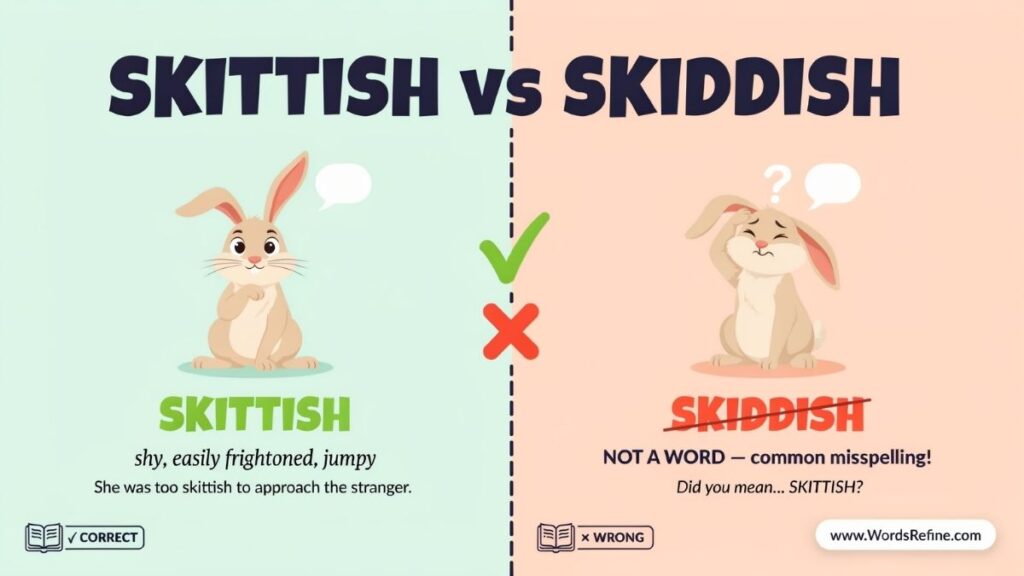
Skittish is the correct standard spelling, with two t’s in the middle. Skiddish is a nonstandard spelling that people often use by mistake.
Although both forms may look reasonable, standard English recognizes skittish as the established adjective. Therefore, if you’re writing an email, completing a school assignment, or preparing professional content, always choose skittish.
| Word | Spelling status | Meaning |
|---|---|---|
| Skittish | Correct standard spelling | Nervous, easily frightened, or quick to react |
| Skiddish | Nonstandard spelling | A common misspelling of skittish |
For example, consider these sentences:
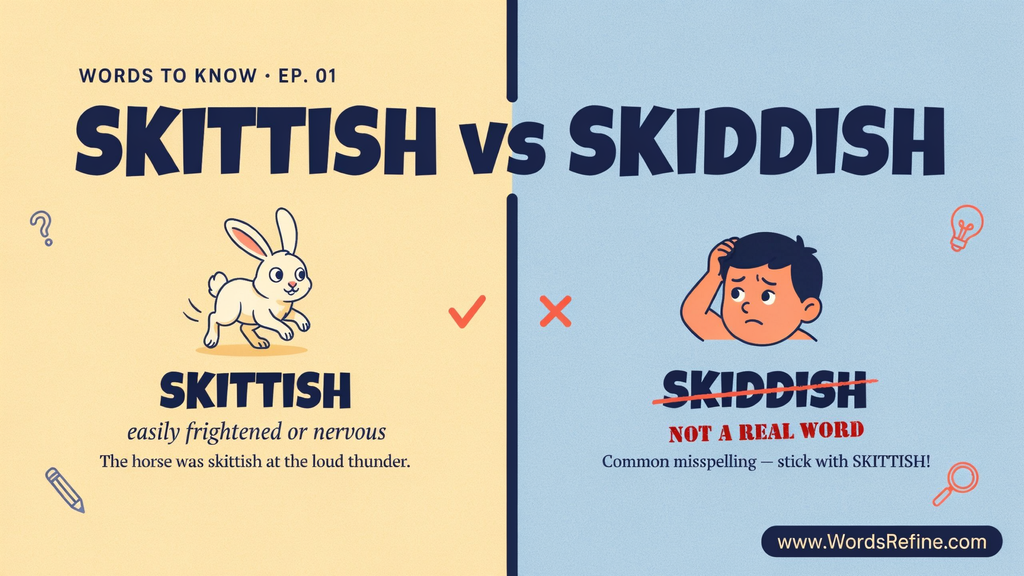
Correct: The skittish puppy hid under the table when the thunder started.
Incorrect: The skiddish puppy hid under the table when the thunder started.
Both sentences communicate the same idea. However, the second contains a spelling mistake.
When choosing between skiddish vs skittish remember that these aren’t two standard words with different meanings. The main difference is spelling.
What Does Skittish Mean?
Skittish describes a person, animal, or situation that shows nervousness, fear, hesitation, or a quick reaction to something unexpected.
In simple terms, someone or something skittish is easily startled, frightened, or unsettled. The word can also describe hesitation when facing unfamiliar experiences or uncertain circumstances.
Consider these examples:
The skittish horse jumped when a branch snapped nearby.
She felt skittish about meeting her new colleagues.
Investors became skittish after the company announced disappointing results.
Each sentence uses the same adjective in a different situation. The horse reacts to a sudden noise, the woman feels uneasy about a social event, and investors hesitate because of financial uncertainty.
Skittish Meaning in Everyday English
In everyday conversation, skittish often describes someone who feels nervous or uncomfortable in a particular situation. It can suggest a tendency to react quickly to unfamiliar people, unexpected events, or possible threats.
For example, imagine attending a crowded event where you don’t know anyone. You might feel uncomfortable, avoid starting conversations, or become unusually alert to what’s happening around you. Someone could describe your behavior as skittish if you seem particularly nervous or easily unsettled.
Here are a few more examples:
Mark gets skittish whenever he has to speak in front of a large audience.
The child seemed skittish during her first day at the new school.
I noticed that my friend grew skittish when the conversation turned to job interviews.
However, skittish doesn’t automatically mean shy, introverted, or socially anxious. Instead, it focuses on nervous reactions, sensitivity, and hesitation.
Learn the difference between commonly mixed-up more words
Octopus vs Octopi Which Plural Is Correct and Why?
Skittish Meaning When Describing Animals
Animals often display skittish behavior when they encounter unfamiliar surroundings, sudden movements, loud noises, or unfamiliar people.
A skittish animal may retreat, freeze, run away, or react sharply to something that doesn’t seem threatening to humans.
A skittish horse might back away from an unfamiliar saddle, become startled by a passing vehicle, or react nervously to sudden movement near its stable.
Similarly, a skittish cat may hide under furniture when visitors arrive or jump at unexpected sounds. It might need time and a quiet environment to feel comfortable.
A skittish dog may avoid strangers, retreat from loud noises, or hesitate when entering unfamiliar places.
Importantly, describing an animal as skittish doesn’t explain exactly why it behaves that way. Its reaction could reflect temperament, unfamiliarity, past experiences, or its immediate surroundings.
Skittish as a Figurative Description
Interestingly, skittish doesn’t always describe literal fear. English speakers also use it figuratively to explain hesitation, uncertainty, or instability.
This usage appears frequently in business and financial discussions.
For example, investors grew skittish after the unexpected announcement. Consumers remained skittish about making large purchases. Financial markets became skittish ahead of the central bank’s decision.
In these examples, investors and consumers aren’t necessarily frightened in the ordinary sense. Instead, they show caution and hesitation because they face uncertainty.
As a result, skittish is useful when describing people or markets that react nervously to changing conditions.
Why Do People Confuse Skiddish vs Skittish?
The confusion between skiddish vs skittish often comes from the relationship between spoken and written English.
English spelling doesn’t always provide a perfect guide to pronunciation. Some words contain sounds that resemble other consonants, especially when people speak quickly or use different regional accents.
The word skittish can be easy to misremember because people may not immediately recognize its exact spelling when they hear it.
The Role of Pronunciation in the Confusion
In American English, the t in skittish is generally pronounced as a clear t sound. Unlike words such as city or butter, it doesn’t normally use the American flapped t in standard pronunciation.
However, fast speech, individual speaking habits, and unfamiliarity with the word can still make its spelling less obvious to some listeners.
This illustrates an important distinction: pronunciation and spelling are connected, but they aren’t interchangeable.
When people rely only on how a word sounds, they may choose a spelling that seems reasonable but isn’t standard.
Familiar Spelling Patterns and Typing Errors
Another possible source of confusion is the familiar ish ending shared by many English adjectives, including childish, selfish, and foolish.
People may remember the general sound of skittish without recalling its exact middle letters. Once the incorrect form skiddish becomes familiar through repeated exposure, it can seem correct at a glance.
Typing habits can also reinforce the problem. Someone who has repeatedly written a misspelling may reproduce it automatically, especially when working quickly.
That’s why proofreading and checking a trusted dictionary remain useful, even when you’re familiar with a word.
Learn the difference between confusing more English words
Drily vs Dryly Which One Is Correct?
Skiddish vs Skittish Meaning Usage and Spelling Differences
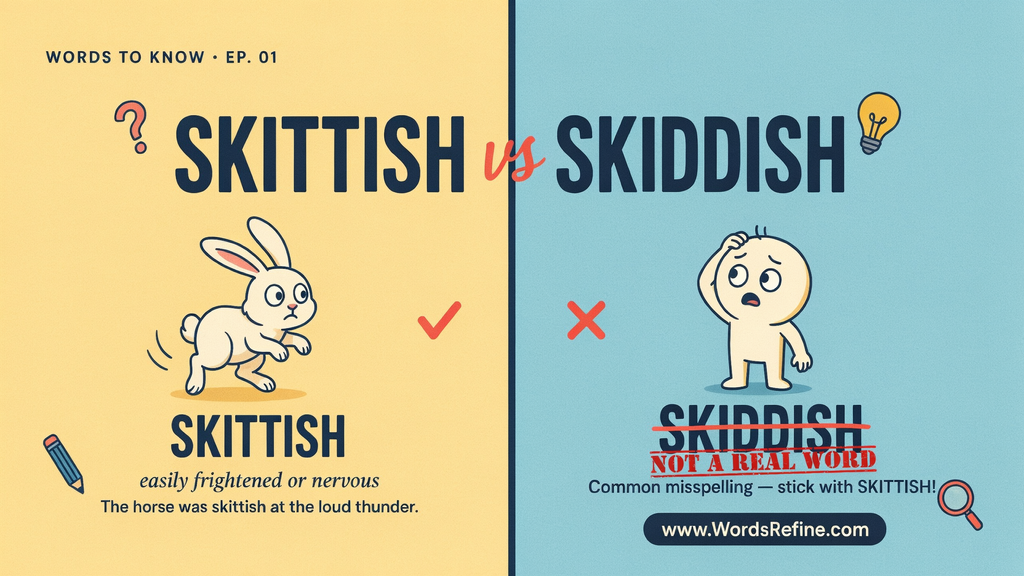
When comparing skiddish vs skittish, the most important point is that the difference concerns standard spelling rather than meaning. Writers who use skiddish usually intend to communicate the same idea as skittish.
The standard word has several related uses. It can describe fear, nervousness, hesitation, or sensitivity to unexpected changes. Its exact meaning depends on the situation.
| Feature | Skittish | Skiddish |
|---|---|---|
| Standard spelling | Yes | No |
| Part of speech | Adjective | Intended as an adjective |
| Meaning | Easily frightened, nervous, or hesitant | Usually intended to mean skittish |
| Formal writing | Appropriate | Avoid |
| Standard dictionary usage | Established entry | Not the standard form |
Is Skiddish a Word or Just a Misspelling?
People often ask whether skiddish is a real word. The answer depends on what you mean by word.
People use skiddish in informal communication, and readers can usually understand what it means. However, it isn’t the accepted standard spelling of the adjective skittish.
A spelling error can become widespread without becoming a standard form. English contains plenty of similar examples. People often confuse definitely with definately or separate with seperate. Familiarity doesn’t make the incorrect forms appropriate in formal writing.
The same principle applies here. If you’re writing for an audience that expects standard English, choose skittish.
Does Skittish Have More Than One Meaning?
Yes. Although its meanings are closely related, skittish can communicate slightly different ideas depending on the context.
Literal nervousness or fear is its most familiar meaning. A skittish animal or person reacts easily to unexpected events.
For example, the skittish puppy ran behind the sofa when the door slammed.
The word can also express hesitation or apprehension about a decision, event, or unfamiliar situation.
For example, Sarah felt skittish about accepting a job in another state.
Finally, skittish can describe figurative instability or sensitivity. In business and finance, it often refers to people or markets that react nervously to uncertainty.
For example, investors grew skittish after the company reported lower-than-expected earnings.
All these meanings share a central idea: a person, animal, or group reacts with nervousness or hesitation rather than remaining comfortable and confident.
Learn the difference between tricky grammar more words
Annual vs Anual Which one Is Correct?
How to Use Skittish Correctly in a Sentence
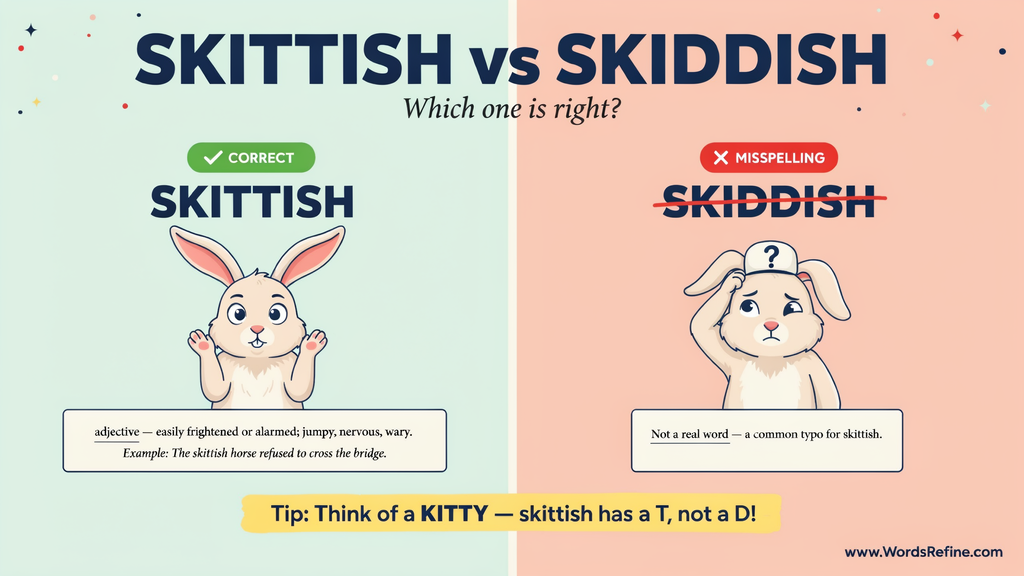
Understanding the definition is only half the job. Knowing how to place skittish naturally in a sentence helps you use it with confidence.
Skittish is an adjective, which means it describes a noun or pronoun. It doesn’t function as a verb or a noun in standard English.
You can use it before a noun, after a linking verb, or within a longer descriptive phrase.
Skittish Before a Noun
When skittish appears directly before a noun, it describes a quality or behavior associated with that person, animal, or thing.
For example, the skittish horse refused to enter the crowded arena. A skittish child held tightly to her mother’s hand. The skittish investor avoided making a sudden financial decision.
In each sentence, skittish gives readers an immediate sense of the subject’s behavior.
This placement is particularly useful in storytelling because it adds descriptive information without requiring a long explanation.
Skittish After a Linking Verb
You can also place skittish after linking verbs such as be, seem, become, and feel.
For example, the dog became skittish after hearing the fireworks. My younger brother seems skittish around unfamiliar people. The horses were skittish during the thunderstorm.
Here, skittish acts as a subject complement. It describes the subject rather than showing an action.
Notice that the word remains unchanged in all these sentences. Unlike some adjectives, it doesn’t require a different form to agree with a plural noun.
Skittish in Different Writing Contexts
The word works in several types of writing, although its tone and meaning can change with the context.
| Context | Example | Purpose |
|---|---|---|
| Everyday conversation | My dog gets skittish around strangers. | Describes nervous behavior |
| Creative writing | The skittish traveler glanced toward the dark alley. | Builds tension and character |
| Animal care | The skittish horse needs a calm environment. | Describes an animal’s response |
| Business | Consumers became skittish about spending. | Communicates hesitation |
| Financial reporting | Investors remained skittish before the announcement. | Describes uncertainty |
| Personal communication | I felt skittish about making the first call. | Expresses apprehension |
One useful writing tip is to choose skittish when nervous reactions or hesitation are central to the meaning. If you simply mean someone is careful, cautious may be more precise.
Skittish vs Similar Words What Is the Difference?
English has many adjectives that describe nervousness, fear, or caution. Although they overlap with skittish, each word carries a slightly different meaning.
Choosing the right synonym can make your writing more accurate and expressive.
| Word | Meaning | Example |
|---|---|---|
| Skittish | Easily frightened, startled, or unsettled | The skittish horse backed away. |
| Nervous | Worried, anxious, or uneasy | He felt nervous before the interview. |
| Jumpy | Easily startled or quick to react | The jumpy dog barked at every sound. |
| Timid | Shy or lacking confidence | The timid child avoided attention. |
| Wary | Alert and cautious about possible danger | The hikers were wary of the unstable bridge. |
| Apprehensive | Anxious about something that may happen | She felt apprehensive about the exam. |
| Fidgety | Restless or unable to remain still | The fidgety student tapped his pencil. |
Learn the difference between confusing word pairs
Instinctually vs Instinctively Which One Is Correct ?
Skittish vs Nervous
Both words describe uncomfortable emotional states, but they don’t always communicate the same thing.
Nervous is a broad term. It can describe worry, anxiety, tension, or uneasiness about an event or situation.
Skittish often emphasizes a tendency to react quickly to unexpected events or to feel unsettled in unfamiliar circumstances.
For example, he felt nervous about his upcoming job interview. However, he became skittish when the interviewer began asking unexpected questions.
The first sentence describes general worry. The second emphasizes a reaction to something that catches him off guard.
Skittish vs Jumpy
The words skittish and jumpy are closely related. Both can describe people and animals that react easily to sudden sounds, movements, or surprises.
However, jumpy often emphasizes immediate physical or emotional reactions. Skittish can describe a broader pattern of nervousness, sensitivity, or hesitation.
For example, the jumpy cat leaped off the couch when a book fell. In contrast, the skittish cat avoided the living room whenever visitors arrived.
The first sentence highlights a sudden reaction. The second describes a more general pattern of nervous behavior.
Skittish vs Timid
Although skittish and timid sometimes describe the same person or animal, their meanings differ.
Timid usually suggests shyness, a lack of confidence, or reluctance to act boldly. Skittish focuses on nervousness, sensitivity, or being easily startled.
For example, the timid child hesitated to raise her hand in class. Meanwhile, the skittish child jumped when the classroom door slammed.
A person can be timid without being easily startled. Likewise, someone can be skittish in a particular situation without having a generally shy personality.
Skittish vs Wary
The distinction between skittish and wary is especially useful when describing animals, people, and decisions.
Wary means cautious or watchful because something might pose a risk. It often suggests that someone is paying attention to possible danger.
Skittish suggests nervousness or an easily triggered reaction. That reaction may occur even when no genuine threat exists.
For example, the wary fox watched the hikers from a safe distance. Meanwhile, the skittish rabbit darted into its burrow when a twig snapped.
The fox appears alert and cautious, while the rabbit reacts suddenly to a sound.
In other words, wary often implies careful awareness, while skittish emphasizes sensitivity and nervous reactions.
Common Mistakes With Skiddish vs Skittish
Even familiar English words can cause spelling and usage problems. The confusion surrounding skiddish vs skittish offers a useful example of how small errors can affect written communication.
Using skiddish instead of skittish is the most common mistake.
Incorrect: The skiddish puppy refused to approach the visitors.
Correct: The skittish puppy refused to approach the visitors.
The standard spelling contains two t’s, not a d.
Another mistake involves treating skittish as a noun.
Incorrect: His skittish made it difficult to approach strangers.
Correct: His skittishness made it difficult to approach strangers.
Skittish is an adjective. The related noun skittishness describes the quality or state of being skittish.
Writers sometimes confuse skittish with shy as well. However, a preference for quiet surroundings doesn’t necessarily indicate nervousness or a tendency to become easily startled.
For example, everyone who prefers quiet evenings may simply enjoy spending time alone. Describing such people as skittish wouldn’t necessarily be accurate.
Similarly, using skittish when cautious is more precise can make a sentence less clear.
Less precise: The experienced driver was skittish about driving through the mountain pass.
More precise: The experienced driver was cautious about driving through the mountain pass.
The second sentence communicates deliberate care more clearly. Nevertheless, skittish could work if the driver felt unusually nervous or hesitant.
Finally, avoid repeating skittish in every sentence. Depending on the context, alternatives such as nervous, jumpy, uneasy, or wary can make your writing more natural.
The key is to choose a synonym that preserves the intended meaning rather than replacing words simply for variety.
Learn the difference between often confused words
Cadaver vs Corpse Which One Is Correct ?
Easy Ways to Remember the Correct Spelling of Skittish
Spelling mistakes become easier to avoid when you have a simple memory trick. Instead of memorizing the word repeatedly without context, connect its spelling to a familiar image or sentence.
The most important detail is the double T in skittish.
A Simple Spelling Trick for Skittish
Try this memorable sentence:
“A skittish kitten gets startled.”
The sentence connects the correct spelling with a familiar situation. Imagine a kitten jumping at the sound of a dropped spoon. When you recall the image, you can also recall the word’s spelling.
Another useful approach is to break the word into smaller parts.
Ski represents the opening three letters. TT reminds you of the two consecutive T’s that are easy to forget. Ish is the familiar adjective ending.
Write skittish a few times while saying it aloud. This simple exercise reinforces the correct spelling through visual and verbal repetition.
If you’re uncertain while writing, pause and check a trusted dictionary rather than relying entirely on memory.
American English vs British English Is Skittish Spelled Differently?
Some English words have different spellings in American and British English. For example, American writers generally use color, while British writers prefer colour.
Fortunately, skittish follows the same standard spelling in both varieties of English.
Whether you’re writing for an American audience or a British one, skittish is the appropriate form.
The word’s meaning also remains essentially the same across these varieties. It can describe easily frightened animals, nervous people, or situations involving hesitation and uncertainty.
Therefore, the confusion between skiddish vs skittish isn’t a regional spelling difference. It is a matter of standard spelling versus a nonstandard form.
Skittish Etymology Where Does the Word Come From?
Understanding a word’s history can make its meaning easier to remember. The origin of skittish is particularly interesting because its modern meaning has developed over time.
Skittish is historically related to skit, an older word associated with sudden movement or a playful or restless action. The adjective developed the sense of being easily startled, excitable, or unpredictable.
Over time, its usage expanded beyond animals and physical reactions. Today, English speakers also use skittish to describe nervous people, hesitant consumers, and uncertain financial markets.
The word’s history helps explain why it can describe both a horse that jumps at a sudden noise and an investor who hesitates during economic uncertainty.
Learn the difference between basic English word mistakes
Mobil vs Mobile Which one Is Correct?
Skittishness and Skittishly Related Word Forms
The adjective skittish has related forms that allow you to express the same basic idea in different grammatical ways.
| Word | Part of speech | Meaning | Example |
|---|---|---|---|
| Skittish | Adjective | Nervous or easily startled | The skittish dog hid behind its owner. |
| Skittishness | Noun | The quality of being skittish | The horse’s skittishness made training difficult. |
| Skittishly | Adverb | In a nervous or easily startled manner | The rabbit moved skittishly through the grass. |
These related forms are useful when you want to avoid repeating the same sentence structure.
For example, instead of writing, “The horse was skittish because it reacted in a skittish way,” you could write, “The horse’s skittishness made it react nervously to sudden movements.”
The second version sounds more natural and avoids unnecessary repetition.
What Dictionaries and Grammar Tools Say About Skittish
When you’re unsure about a spelling, a reliable dictionary offers a straightforward way to verify it. Dictionaries provide established spellings, definitions, pronunciation guides, and examples of how words appear in real sentences.
For skittish, dictionary references can help confirm its meaning and standard usage. Grammar checkers and word processors can also help identify skiddish as a likely spelling error.
However, automated tools aren’t a substitute for understanding a word’s meaning. A spell-checker may flag a word without explaining why it’s incorrect. In addition, some tools may overlook unusual errors or accept words that don’t fit the context.
For dependable results, combine automated proofreading with dictionary checks and a final review of your writing.
Skittish in Real Life Examples
Examples make a word’s meaning easier to understand because they show how it works in natural situations. The following sentences demonstrate how to use skittish in different contexts.
Learn the difference between commonly misused words
Tomatoes vs Tomatos Which one Is Correct?
Skittish Examples About People
She felt skittish around strangers after moving to a new city.
The new student seemed skittish during his first classroom presentation.
My brother gets skittish whenever he has to make an important phone call.
Although Emma usually feels confident, she became skittish when the discussion turned to her future plans.
These examples show how skittish can describe temporary nervousness rather than a permanent personality trait.
Skittish Examples About Animals
The skittish horse refused to cross the unfamiliar wooden bridge.
Our skittish cat hides whenever someone rings the doorbell.
The rescue dog became less skittish after several weeks in its new home.
A sudden movement sent the skittish deer racing into the forest.
In these sentences, skittish highlights an animal’s sensitivity to its surroundings.
Skittish Examples in Business and Finance
Investors grew skittish after the company announced a major leadership change.
Consumers became skittish about spending during a period of economic uncertainty.
The financial market remained skittish ahead of the central bank’s interest rate announcement.
Several buyers grew skittish when the property’s inspection revealed unexpected repairs.
In professional writing, the word helps communicate hesitation without suggesting that someone has completely abandoned a decision.
Skittish Examples in Creative and Descriptive Writing
The skittish traveler glanced nervously at every unfamiliar face.
A skittish rabbit froze beneath the bushes as footsteps approached.
His skittish response suggested that the unexpected question had caught him off guard.
Even the normally playful puppy grew skittish when the fireworks began.
These examples demonstrate how skittish can add atmosphere, show a character’s reaction, and help readers picture a scene.
Synonyms and Antonyms of Skittish
Learning synonyms and antonyms can expand your vocabulary and help you choose more precise words.
However, not every synonym fits every situation. A nervous person, a startled animal, and a hesitant investor may all be described as skittish, but their behavior can require different alternatives.
Learn the difference between everyday English mistakes
Inquiries vs Queries What’s the Difference ?
Synonyms for Skittish
| Synonym | Meaning | Example |
|---|---|---|
| Nervous | Worried or uneasy | She felt nervous before the presentation. |
| Jumpy | Easily startled | The jumpy dog reacted to every noise. |
| Timid | Shy or lacking confidence | The timid child avoided the spotlight. |
| Wary | Cautious about possible danger | The wary fox watched from a distance. |
| Apprehensive | Anxious about something that may happen | He felt apprehensive about the move. |
| Uneasy | Uncomfortable or uncertain | She felt uneasy about the unexpected request. |
| Fearful | Experiencing fear | The fearful puppy hid behind the chair. |
| Easily spooked | Quick to become frightened | The easily spooked horse startled at the sound. |
Antonyms of Skittish
Antonyms express the opposite or a contrasting quality. The most appropriate opposite depends on what skittish means in a particular sentence.
| Antonym | Meaning | Example |
|---|---|---|
| Calm | Peaceful and not easily disturbed | The calm horse stood quietly in the stable. |
| Relaxed | Free from tension | She felt relaxed during the conversation. |
| Confident | Certain of one’s abilities or decisions | The confident speaker answered every question. |
| Fearless | Showing little or no fear | The fearless climber approached the steep trail. |
| Composed | Calm and in control of emotions | He remained composed under pressure. |
| Unflappable | Not easily upset or disturbed | The unflappable manager handled the unexpected delay. |
| Assured | Confident and self-possessed | She gave an assured response. |
| Comfortable | At ease in a situation | The dog became comfortable around its new family. |
Notice that these antonyms aren’t interchangeable. Fearless is a stronger contrast to being easily frightened, while composed works particularly well when describing someone who handles pressure without becoming visibly unsettled.
Learn the difference between more words people mix up
Socialise vs Socialize Which one Is Correct ?
Practice session Skittish vs Skiddish
- The horse became __________ when it heard the thunder.
- My usually calm dog gets __________ around unfamiliar people.
- The __________ kitten hid under the sofa when the door slammed.
- She felt __________ before giving her first presentation.
- The farmer carefully approached the __________ cow.
- Loud noises can make some animals __________.
- After the sudden crash, the __________ driver checked the road.
- The deer looked __________ as hikers approached its hiding place.
- His __________ behavior made it clear that he felt uncomfortable.
- The rescue team moved slowly to avoid frightening the __________ puppy.
- A __________ horse may react suddenly to unexpected movement.
- The child became __________ when the unfamiliar dog barked.
- The __________ bird flew away at the slightest disturbance.
- She grew __________ when the conversation turned to her future.
- The trainer knew how to calm a __________ horse.
- The sudden fireworks made the __________ animals restless.
- He seemed __________ during the job interview, even though he was well prepared.
- The __________ rabbit froze when it noticed the approaching cat.
- The new employee felt __________ in the unfamiliar workplace.
- The construction noise made the __________ dog hide.
- The horse was too __________ to approach the crowded street.
- Her __________ reaction showed that the unexpected question had caught her off guard.
- The wildlife photographer waited patiently for the __________ fox to emerge.
- Even a small movement could startle the __________ deer.
- The word __________ describes someone who is easily frightened or nervous.
Answers
- Skittish
- Skittish
- Skittish
- Nervous
- Skittish
- Skittish
- Nervous
- Skittish
- Skittish
- Skittish
- Skittish
- Skittish
- Skittish
- Apprehensive
- Skittish
- Skittish
- Nervous
- Skittish
- Uneasy
- Skittish
- Skittish
- Nervous
- Skittish
- Skittish
- Skittish
Here’s a trusted source for clear more words Comparison:
FAQs
What does “skittish” mean?
“Skittish” describes someone or something that is easily frightened, nervous, or quick to react to unexpected events. For example, a skittish horse may jump at a sudden noise, while a skittish person may feel uneasy in unfamiliar situations.
What is another word for “skittish”?
Common alternatives to “skittish” include nervous, jittery, jumpy, timid, and apprehensive. Each word has a slightly different meaning. “Jumpy” describes someone who reacts quickly to sudden noises or movements, while “apprehensive” suggests worry about what might happen.
Is “skittish” the same as “shy”?
No. “Skittish” and “shy” describe different behaviors. A shy person may feel uncomfortable around strangers or in social situations. In contrast, a skittish person tends to become nervous or react suddenly to unexpected sounds, movements, or situations.
What is the difference between “skittish” and “panicky”?
“Skittish” describes someone who is easily startled or unsettled, often by minor disturbances. “Panicky” suggests a more intense reaction involving sudden fear or overwhelming anxiety. A skittish person might become uneasy when plans change, while a panicky person may struggle to think clearly during an emergency.
Can “skittish” describe a person?
Yes. “Skittish” can describe a person who is easily startled, nervous, or uncomfortable in uncertain situations. For example, “She became skittish when the conversation turned to her new job.” The word also commonly describes animals that react quickly to unfamiliar people, sounds, or surroundings.
What does “skittish” mean in slang?
“Skittish” has no widely recognized slang meaning that differs significantly from its standard definition. In casual conversation, people may use it to describe someone who seems jumpy, nervous, uneasy, or quick to avoid an uncomfortable situation.
What is a stronger word than “skittish”?
Words such as “fearful,” “terrified,” and “panic-stricken” can express more intense fear than “skittish.” However, the right choice depends on the context. “Skittish” usually suggests nervousness or a tendency to startle, rather than extreme fear.
What is a good word for someone who is easily frightened?
“Jumpy,” “timid,” “nervous,” and “easily startled” are all useful alternatives. Use “jumpy” for someone who reacts strongly to sudden noises or movements. “Timid” describes someone who lacks confidence or avoids taking risks, while “nervous” conveys general uneasiness.
Is “skittish” positive or negative?
“Skittish” is generally neutral to slightly negative. It can describe a natural reaction without implying a personal flaw, especially when referring to animals or unfamiliar environments. However, when used to describe a person, it may suggest that they are overly nervous or easily unsettled.
What is the difference between “skittish” and “hesitant”?
“Skittish” describes nervousness or a tendency to react fearfully, while “hesitant” refers to uncertainty or reluctance to act. For example, someone might be skittish around a barking dog because they feel frightened. Meanwhile, someone might be hesitant to accept a job offer because they need more time to make a decision.
Learn the difference between tricky grammar more words
Instalments vs Installments Which one Is Correct?
Conclusion
Mixing up skittish vs skiddish is an easy mistake but fixing it takes just a little practice. Skittish is the correct spelling and describes someone or something that is easily frightened nervous, or quick to startle. Skiddish may look convincing, but it is simply a spelling error.
Whether you’re talking about a horse startled by thunder, a cat hiding from strangers, or a friend who jumps at every unexpected sound, skittish gets the message across. Keep the correct spelling in mind, and this confusing pair won’t trip you up again. After all, your grammar can stay calm even when the animals are feeling skittish!

Diora AJS she is an experienced blogger and passionate English language enthusiast at Words Refine. With a keen eye for language and a love for clear communication, she writes practical content about grammar, word meanings, usage, and commonly confused terms. Her goal is to make English easier to understand through clear explanations and relatable examples, helping readers write accurately and communicate with confidence.