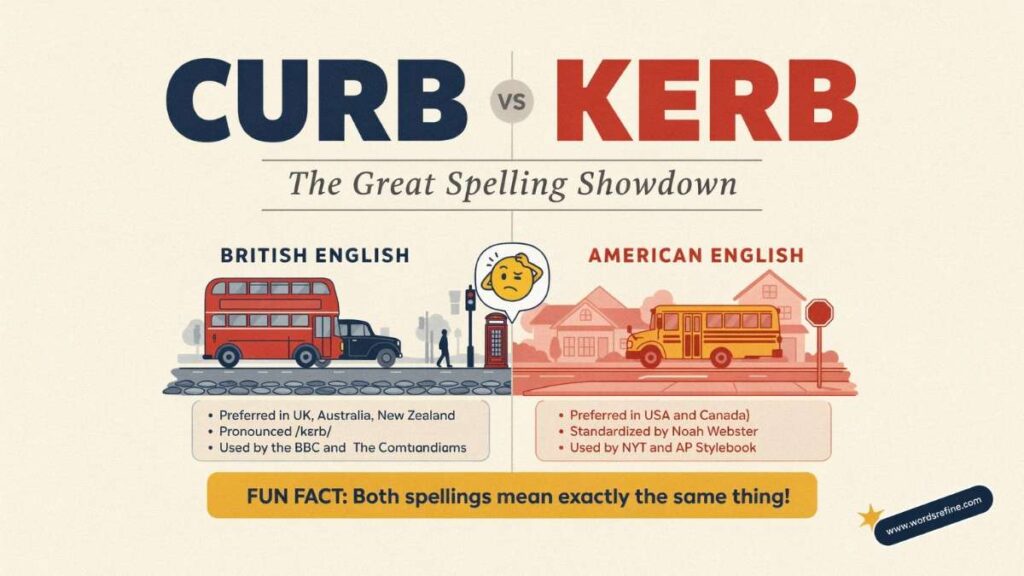
Curb vs kerb often causes confusion because both spellings refer to the raised edge along a road, yet their usage depends on regional English conventions. American English uses “curb,” while British English generally prefers “kerb.” However, the distinction goes beyond spelling. “Curb” also serves as a verb meaning to control, limit, or restrain something, and this form is used in both American and British English. Knowing when to use each spelling can help you avoid common grammatical mistakes and maintain consistency in your writing. Let’s explore their meanings, differences, and practical examples to understand when each form is appropriate.
Quick Answer Curb vs Kerb
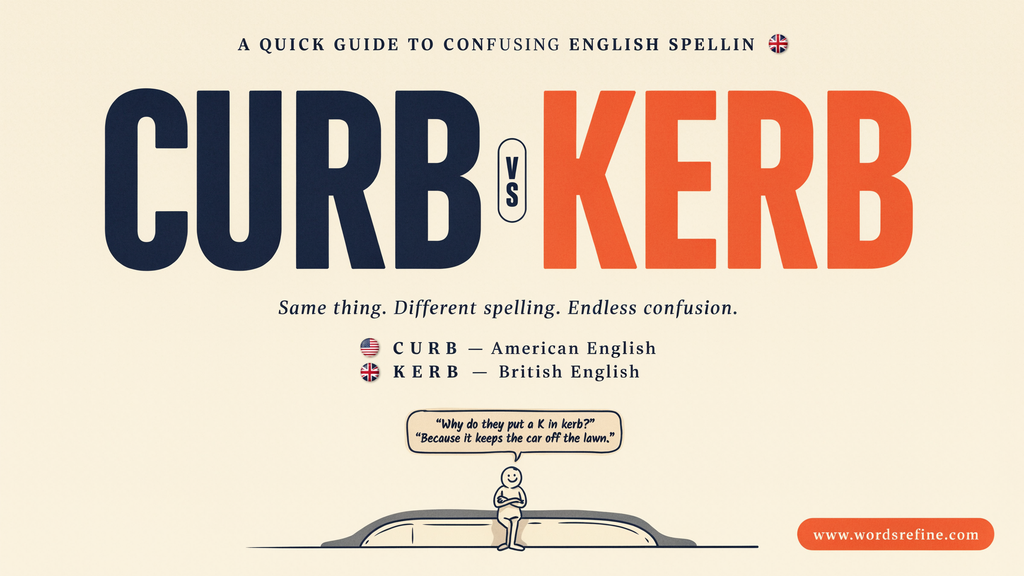
Curb is the standard American English spelling for the raised edge separating a road from a sidewalk. It can also function as a verb meaning to control or limit something.
Kerb is the standard British English spelling for the same roadside structure. It is primarily used as a noun.
Here are two examples:
- American English: The driver parked next to the curb.
- British English: The driver parked next to the kerb.
Both sentences describe the same thing. Only the spelling changes.
Learn the difference between confusing more English words
Hoover vs Hover Meaning Differences Pronunciation?
What Does Curb Mean?
Curb can function as both a noun and a verb. Its meaning depends on how you use it in a sentence.
Curb as a Noun
As a noun, curb refers to the raised stone or concrete edge along a road or sidewalk. It separates the street from the pedestrian area and helps keep vehicles away from the sidewalk.
For example:
- The car stopped beside the curb.
- A cyclist accidentally hit the curb while turning.
- The city repaired the damaged curb outside the school.
- She sat on the curb and waited for her friend.
In American English, curb is the standard spelling for this roadside structure.
Curb as a Verb
Curb also means to control, limit, restrain, or reduce something. You will often see it in everyday conversations, business discussions, news reports, and formal writing.
For example:
- The government introduced new rules to curb pollution.
- You should curb unnecessary spending if you want to save money.
- The company launched a campaign to curb workplace distractions.
- Better planning can help curb delays during construction.
In these sentences, curb has nothing to do with the edge of a road. Instead, it describes an effort to keep something under control.
Common Expressions With Curb
Curb appears in several everyday expressions. Knowing these phrases will help you understand how people use the word in different situations.
Curb your enthusiasm means controlling your excitement or avoiding unrealistic expectations.
Example: Curb your enthusiasm until you receive official confirmation.
Curb spending means reducing the amount of money you spend.
Example: The family decided to curb spending before buying a new house.
Curb appetite means reducing or controlling the desire to eat.
Example: Drinking water before a meal may help curb your appetite.
Curb inflation means taking steps to control rising prices.
Example: The central bank introduced new policies to curb inflation.
Learn the difference between commonly mixed-up more words
Glinda vs Galinda Which One Is Correct and ?
What Does Kerb Mean?
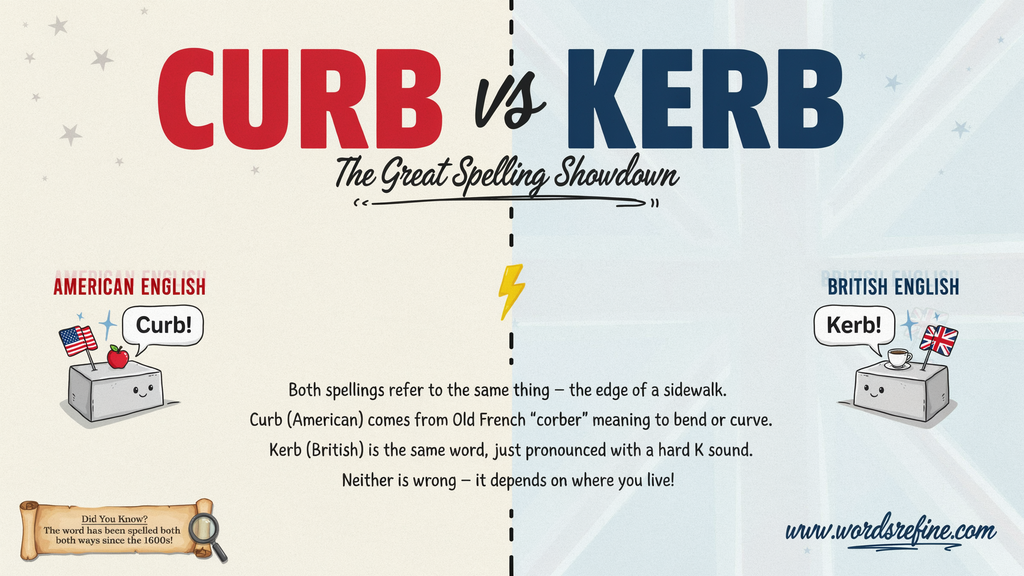
Kerb is the British English spelling of the raised edge between a road and a sidewalk. It refers to the same structure that Americans call a curb.
For example:
- The driver parked close to the kerb.
- Rainwater flowed along the kerb after the storm.
- The construction team replaced the broken kerb.
- A pedestrian stepped down from the kerb to cross the road.
The spelling kerb is standard in British English and is also commonly used in Australia and New Zealand.
Kerb in Road and Street Design
In road construction and urban planning, a kerb serves several practical purposes. It creates a clear boundary between the road and pedestrian areas, helps guide vehicles, and can direct rainwater toward drainage systems.
Kerbs are commonly made from concrete, stone, or other durable materials. Their designs vary depending on the road, surrounding buildings, and drainage requirements.
Here are a few common types:
- Raised kerb: This creates a noticeable separation between the road and sidewalk.
- Dropped kerb: This provides a lower crossing point for pedestrians, wheelchair users, and vehicles entering driveways.
- Barrier kerb: This helps prevent vehicles from moving onto pedestrian areas.
Common Expressions With Kerb
Kerb also appears in several British English expressions related to roads, parking, and property.
Kerbside refers to the area immediately beside a road’s kerb.
Example: The delivery driver left the package near the kerbside.
Kerb appeal describes how attractive a property looks from the street.
Example: Fresh paint and a tidy garden can improve a home’s kerb appeal.
Drop kerb refers to a lowered section of the kerb that provides easier access between the road and sidewalk.
Example: The homeowner requested a drop kerb for the driveway.
Learn the difference between tricky grammar more words
Hoodie vs Hoody Which One Is Correct?
Key Differences Between Curb vs Kerb
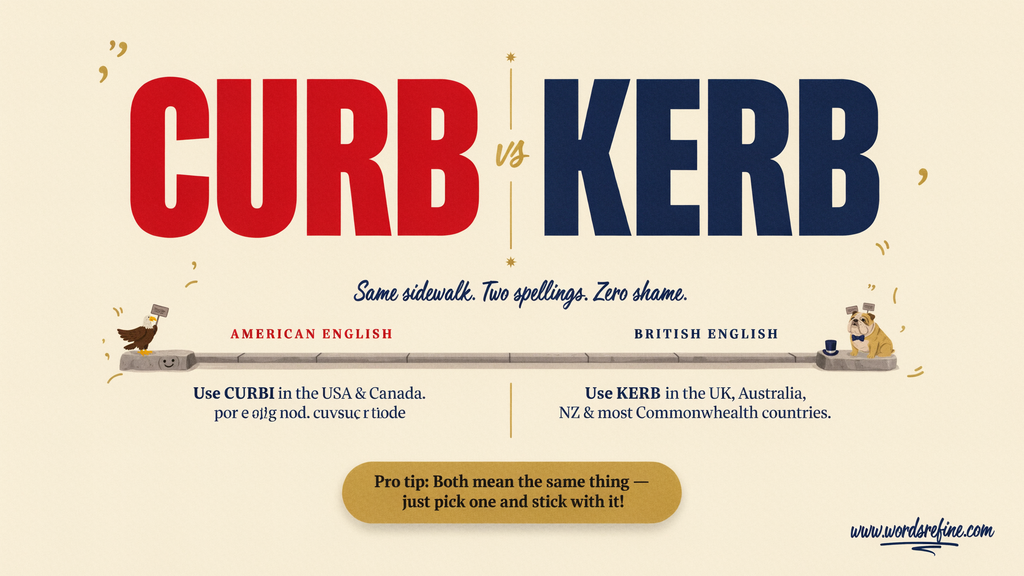
Although curb and kerb look different, they refer to the same roadside structure. The main difference is regional spelling.
| Feature | Curb | Kerb |
|---|---|---|
| Main usage | American English | British English |
| Part of speech | Noun and verb | Primarily noun |
| Roadside meaning | Raised edge beside a road | Raised edge beside a road |
| Verb meaning | To control or limit | Not commonly used with this meaning |
| Example | Park beside the curb. | Park beside the kerb. |
| Common expression | Curb spending | Kerb appeal |
The easiest way to remember the difference is that Americans generally write curb, while British writers use kerb for the roadside structure. However, the verb curb remains the standard spelling in both varieties of English.
Regional Spelling Differences
The choice between curb and kerb depends largely on which variety of English you use. Both spellings describe the same roadside structure, but different countries prefer different forms.
American English
In the United States, curb is the standard spelling. Americans use it in everyday writing, road signs, construction documents, and formal publications.
For example:
- The driver pulled over and parked beside the curb.
- The city plans to replace the damaged curb.
- Please do not park too close to the curb.
American English also uses curb as a verb when referring to controlling or limiting something.
Example: The new policy aims to curb unnecessary expenses.
British English
British English generally uses kerb when referring to the raised edge beside a road or sidewalk.
For example:
- The car stopped beside the kerb.
- The council repaired the damaged kerb.
- She stepped off the kerb and crossed the street.
However, British English still uses curb as a verb when something needs to be controlled or restricted.
Example: The government introduced measures to curb rising costs.
Australian and New Zealand English
Australian and New Zealand English generally follow the British spelling convention. Therefore, kerb is the usual spelling for the raised edge beside a road.
For example:
- The driver parked near the kerb.
- Workers repaired the broken kerb outside the shopping center.
- The council installed a new kerb along the street.
The verb curb remains the standard choice when discussing control or restraint.
Canadian English
Canadian English generally uses curb for the roadside structure, following the American spelling in this case.
For example:
- The vehicle stopped beside the curb.
- The city repaired the damaged curb.
- Drivers should avoid parking too close to the curb.
As a result, Canadian writers usually choose curb rather than kerb.
Curb vs Kerb Example Sentences
Examples make the difference easier to understand. Although the spelling changes between American and British English, the meaning stays the same.
Examples of Curb in American English
- The delivery truck stopped beside the curb.
- A careless driver damaged the curb while parking.
- The city plans to install new curbs along the road.
- He sat on the curb and checked his phone.
- The school introduced rules to curb disruptive behavior.
- The company wants to curb unnecessary expenses.
- Better traffic management could help curb road accidents.
- The government is working to curb inflation.
Examples of Kerb in British English
- The driver parked beside the kerb.
- The council repaired the damaged kerb.
- Rainwater collected along the kerb after the storm.
- She waited near the kerb for her taxi.
- The workers replaced the old kerbs outside the building.
- The homeowner improved the property’s kerb appeal.
- The council approved a dropped kerb for the driveway.
- The delivery van stopped at the kerbside.
Comparing Both Spellings in Sentences
The following examples show how the same sentence changes depending on the spelling convention.
| American English | British English |
|---|---|
| The car stopped beside the curb. | The car stopped beside the kerb. |
| Workers repaired the curb. | Workers repaired the kerb. |
| She sat on the curb. | She sat on the kerb. |
| The driver parked near the curb. | The driver parked near the kerb. |
Remember that these spelling differences apply to the roadside noun. When you use curb as a verb, the spelling remains the same in both varieties.
Learn the difference between confusing word pairs
Heyday vs Hayday Meaning Correct One Differences?
How Do You Pronounce Curb vs Kerb?
Despite their different spellings, curb and kerb have the same pronunciation within a given English accent.
In American English, the word is commonly pronounced /kɝːb/. In British English, it is generally pronounced /kɜːb/.
The main difference comes from regional accents, not spelling. Both words have one syllable and end with the same b sound.
You don’t need to pronounce curb and kerb differently. Just choose the spelling that matches your audience.
Origin and History of Curb vs Kerb
The history of curb and kerb helps explain why English has two spellings for the same roadside feature.
The word curb developed from older forms associated with restraining or controlling something. Its history connects to the idea of a curved strap or restraint used on a horse. Over time, the word gained additional meanings, including controlling behavior and limiting something.
Later, curb also came to describe the raised edge separating a road from a sidewalk.
The spelling kerb emerged as a variant in British English. Eventually, American English settled on curb, while British English generally adopted kerb for the roadside structure.
Today, both spellings remain correct within their respective regional conventions.
Curb Weight vs Kerb Weight
Curb weight and kerb weight refer to the same vehicle measurement. The difference is simply regional spelling.
Curb weight is the standard American spelling, while kerb weight is commonly used in British English and other regions that follow British spelling conventions.
The term describes the weight of a vehicle with its standard equipment and necessary operating fluids, such as engine oil and coolant. It generally excludes passengers and cargo. However, the exact definition can vary depending on the manufacturer or applicable regulations.
For example:
- The car has a curb weight of 3,200 pounds.
- The vehicle’s kerb weight is listed as 1,450 kilograms.
- Always check the manufacturer’s specifications before comparing vehicle weights.
You may encounter either spelling in vehicle specifications, automotive reviews, and technical documents. The measurement itself doesn’t change because of the spelling.
Which Spelling Should You Use Curb vs Kerb?
Choosing between curb and kerb is easy once you know your audience. Both spellings are correct, but the right choice depends on which variety of English you use.
If you’re writing for American readers, use curb when referring to the raised edge beside a road. For British readers, kerb is the usual spelling.
However, when you mean to control, limit, or restrain something, always use curb. This spelling is standard in both American and British English.
For example, an American writer might say, “The driver parked beside the curb.” A British writer would usually write, “The driver parked beside the kerb.”
Both sentences are correct. The important thing is to choose the spelling that suits your readers and use it consistently.
Learn the difference between often confused words
cocoon vs cacoon Which One Is Correct?
Curb vs Kerb in Different Writing Situations
The spelling you choose can also depend on the type of document you’re preparing. Whether you’re writing a casual message or a professional report, consistency makes your work easier to read.
Everyday Writing
In everyday conversations, use the spelling familiar to your readers.
For example, an American might write, “I left my bag near the curb.” A British writer would normally write, “I left my bag near the kerb.”
Neither sentence is wrong. The spelling simply reflects a regional difference.
Academic Writing
Academic writing usually follows a particular style guide or regional convention. If your institution requires American English, use curb. If it follows British English, use kerb for the roadside structure.
Check the required guidelines before submitting your work. Most importantly, avoid switching between the two spellings without a reason.
Road Construction and Engineering
In road construction, transportation, and civil engineering documents, the preferred spelling depends on local terminology and technical standards.
American documents generally use curb, while British documents use kerb. Engineers and contractors should follow the terminology used in their local specifications to keep technical information clear.
Business and Professional Writing
When preparing reports, emails, property descriptions, or company documents, consider who will read them.
For example, an American property listing might mention a concrete curb, while a British estate agent might describe a property’s kerb appeal.
Using the familiar spelling helps your writing sound natural and professional.
Common Mistakes to Avoid
Although the difference between curb and kerb is straightforward, writers sometimes confuse their meanings or use the wrong spelling.
Using Kerb as a Verb
A common mistake is using kerb when you mean to control or limit something.
Incorrect: The company introduced new rules to kerb unnecessary spending.
Correct: The company introduced new rules to curb unnecessary spending.
The verb curb is standard in both American and British English.
Mixing American and British Spellings
Switching between curb and kerb in the same document can make your writing inconsistent.
For example, using curb in one paragraph and kerb in another may confuse readers if you’re not discussing regional spelling differences.
Choose the variety of English that suits your audience and stick with it throughout the document.
Assuming One Spelling Is Incorrect
Some writers believe kerb is a misspelling of curb, while others think the opposite. Neither assumption is correct.
Curb is the standard American spelling for the roadside structure, while kerb is commonly used in British English. Both forms are accepted in their respective varieties.
Confusing the Noun and Verb Meanings
Curb can describe a roadside structure or the act of controlling something. These meanings are different, so the context matters.
For example, in “The bicycle hit the curb,” the word refers to the raised edge of the road. In “The manager tried to curb unnecessary expenses,” it means to control or reduce spending.
Once you understand the context, choosing the correct meaning becomes much easier.
Learn the difference between commonly misused words
Carmel vs Caramel Which One Is Correct?
A Simple Way to Remember Curb and Kerb
You don’t need to memorize complicated grammar rules to remember the difference.
Think of curb as the American spelling and kerb as the British spelling for the roadside structure. Both refer to the same thing, so the choice depends on your audience.
There’s one more detail to remember: curb also works as a verb in both American and British English. Kerb, however, generally appears as a noun.
Learn the difference between basic English word mistakes
Liter vs Litre Which One Is Correct?
Practice Session Curb vs Kerb
- The driver parked his car beside the ______.
- The city plans to repair the damaged ______ along the road.
- The new government policy aims to ______ air pollution.
- She sat on the ______ while waiting for her friend.
- The British driver stopped near the ______.
- The company introduced new rules to ______ unnecessary spending.
- Workers replaced the broken ______ outside the school.
- The government hopes to ______ rising inflation.
- The cyclist accidentally hit the ______ while turning.
- The homeowner improved the property’s ______ appeal with a fresh coat of paint.
- The delivery truck stopped close to the ______.
- The school introduced new rules to ______ disruptive behavior.
- Rainwater collected along the ______ after the storm.
- The council approved a dropped ______ for the driveway.
- Better traffic management can help ______ road accidents.
- The pedestrian stepped down from the ______ to cross the street.
- The company is taking steps to ______ unnecessary expenses.
- The workers installed a new concrete ______ outside the building.
- The driver carefully parked beside the ______.
- The new regulations are designed to ______ excessive noise.
- The city repaired the damaged ______ near the shopping center.
- The government introduced measures to ______ the spread of pollution.
- The homeowner requested a dropped ______ to improve driveway access.
- The children sat on the ______ and watched the passing cars.
- The manager tried to ______ unnecessary costs without affecting the quality of the service.
Answers
- Curb
- Curb
- Curb
- Curb
- Kerb
- Curb
- Kerb
- Curb
- Curb
- Kerb
- Curb
- Curb
- Kerb
- Kerb
- Curb
- Kerb
- Curb
- Curb
- Kerb
- Curb
- Curb
- Curb
- Kerb
- Curb
- Curb
Here’s a trusted source for clear more words Comparison:
FAQs
Is kerb the same as curb?
Yes. Kerb and curb refer to the same raised edge that separates a road from a sidewalk. The only difference is regional spelling. American English uses curb, while British English generally uses kerb.
How do British people say curb?
British people pronounce curb in much the same way as Americans, although the vowel sound may vary with regional accents. In British English, curb is also used as a verb meaning to control, limit, or restrain something.
How do you pronounce kerb?
Kerb is a one-syllable word. It ends with a clear b sound and is pronounced the same as curb within the same accent. The spelling changes, but the pronunciation does not.
How do Canadians spell curb?
Canadians generally use curb when referring to the raised edge beside a road. Canadian English follows the American spelling in this case, although it retains British spellings in other words.
What do Americans call a sidewalk?
Americans use the word sidewalk for the paved path alongside a road where people walk. In British English, the same area is generally called a pavement.
What are driveway curbs called?
The lowered sections of a curb that allow vehicles to enter or leave a driveway are commonly called dropped curbs or driveway curb cuts. In British English, the term dropped kerb is commonly used.
Do Australians say curb vs kerb?
Australians generally use kerb when referring to the raised edge beside a road or sidewalk. However, they use curb when describing the act of controlling, limiting, or restraining something.
What words do British and Americans spell differently?
British and American English have several spelling differences. For example, British English uses colour, centre, travelled, and organise, while American English uses color, center, traveled, and organize. These differences reflect the spelling conventions of each variety.
When did curbs become a thing?
Raised edges along roads became increasingly common as towns developed organized streets, drainage systems, and pedestrian pathways. Early curbs often used stone, while concrete became popular as road construction improved. Their main purposes were to separate vehicles from pedestrian areas and help manage roadside drainage.
What is curb slang for?
In informal language, curb can sometimes mean rejecting, dismissing, or getting rid of someone or something. For example, the expression “put someone to the curb” can suggest treating someone as unwanted or ending a relationship. The intended meaning depends on the context.
Learn the difference between more words people mix up
Don’ts vs Donts Which One Is Correct?
Conclusion
Curb vs kerb may look like two different words, but they share the same meaning when referring to the raised edge beside a road. The difference lies in regional spelling: Americans use curb, while British writers generally prefer kerb. Australian and New Zealand English usually follow the British convention, whereas Canadian English favors curb.
The real trick is remembering that curb also works as a verb in both American and British English. You can park beside a kerb, but you can curb your spending, control your excitement, or curb unnecessary noise. Using kerb for these actions would be a spelling mistake.
Once you understand the distinction, there’s little reason to get stuck between the two. Just consider your audience, choose the appropriate spelling, and keep your writing consistent. After all, grammar shouldn’t become a roadblock when the difference is only one letter!

Diora AJS she is an experienced blogger and passionate English language enthusiast at Words Refine. With a keen eye for language and a love for clear communication, she writes practical content about grammar, word meanings, usage, and commonly confused terms. Her goal is to make English easier to understand through clear explanations and relatable examples, helping readers write accurately and communicate with confidence.