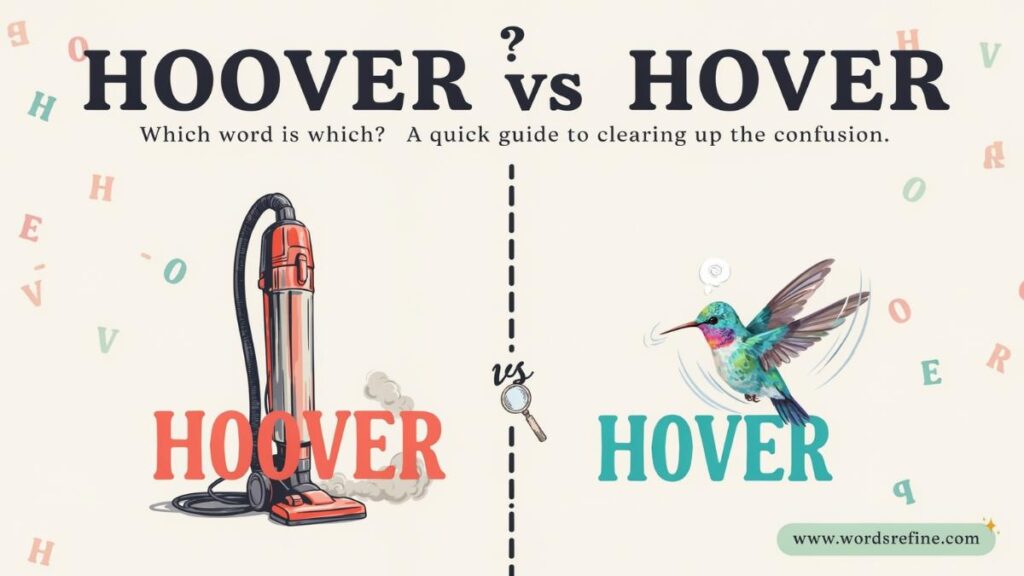
Have you ever mixed up Hoover vs Hover ? Although these words look and sound similar, they have very different meanings. One describes a helicopter floating above the ground, while the other refers to cleaning floors and carpets with a vacuum cleaner. Confusing them can lead to amusing misunderstandings, leaving readers wondering whether something is flying through the air or getting a much-needed cleaning. Understanding the difference between Hoover vs Hover helps you avoid this common vocabulary mistake and use each word correctly. Let’s explore their meanings, pronunciations, everyday uses, and practical examples to make the distinction simple and memorable.
Quick Answer Hoover vs Hover
The difference between hoover and hover is straightforward once you understand what each word describes. Both are correct English words, but they serve different purposes.
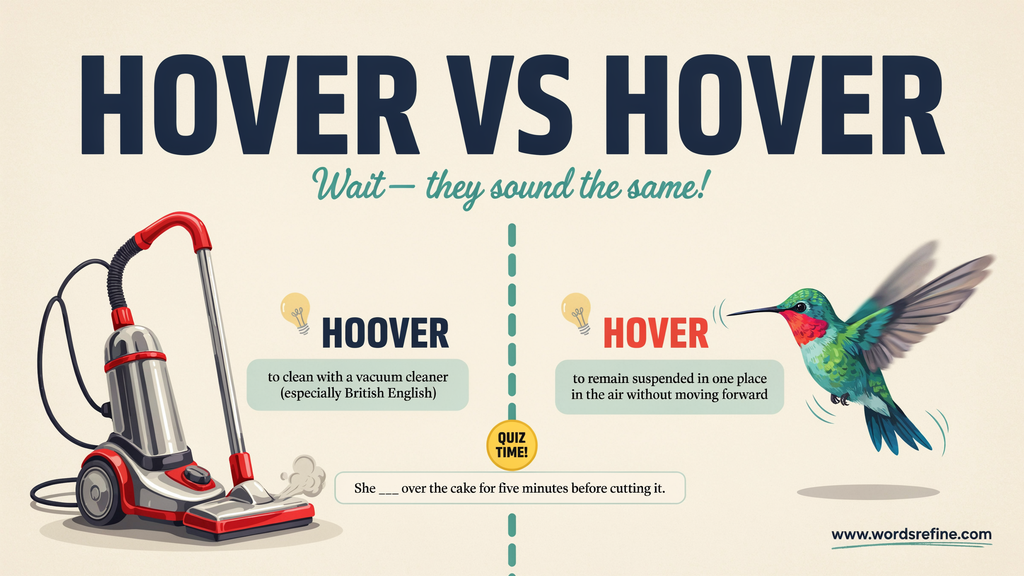
Hoover means to clean something using a vacuum cleaner. It is particularly common as a verb in British English. The word can also refer to a vacuum cleaner itself.
Hover means to remain suspended in the air, stay in approximately the same position, or linger near someone or something. It also describes positioning a computer mouse pointer over an item without clicking.
Consider these examples:
I need to hoover the living room before the guests arrive.
The helicopter hovered above the building.
The first sentence describes household cleaning, while the second explains how an aircraft remains in the air.
Therefore, neither spelling is incorrect. However, they aren’t interchangeable. When discussing vacuum cleaning, use hoover in British English. When describing something staying suspended or lingering nearby, use hover.
Learn the difference between confusing more English words
Fead vs Feed Which One Is Correct?
What Does Hoover Mean?
The word hoover has an interesting connection to household appliances. It originated from the Hoover vacuum cleaner brand, whose name eventually became associated with vacuum cleaning itself.
In British English, people commonly use hoover as both a noun and a verb. For example, someone might ask you to bring the hoover from the cupboard or remind you to hoover the bedroom before leaving the house.
Interestingly, the word doesn’t always refer to a particular manufacturer’s product. Someone might own a vacuum cleaner made by another company and still casually call it a hoover.
Hoover as a Noun
As a noun, hoover commonly refers to a vacuum cleaner, particularly in British English.
For example, the hoover might be sitting in the utility room, waiting to be used. Someone might also ask whether you’ve bought a new hoover for the upstairs bedrooms.
Here are some natural examples:
The hoover is in the cupboard.
We bought a new hoover for the house.
The old hoover needs a replacement filter.
Please put the hoover away after cleaning.
Notice that the word doesn’t necessarily identify the manufacturer. People often use it as a general household term for a vacuum cleaner.
However, Hoover with a capital H identifies the actual brand when used as a proper name.
Hoover as a Verb
As a verb, hoover means to clean something using a vacuum cleaner. It usually describes removing dust, dirt, crumbs, and other small particles from carpets, floors, furniture, and similar surfaces.
For example, you might hoover the living room before visitors arrive or hoover the stairs after noticing a layer of dust.
Consider these sentences:
I hoover the carpets every Saturday.
She is hoovering the living room before her parents arrive.
We need to hoover the stairs because they’ve collected dust.
He hoovered the entire apartment after the renovation.
Could you hoover the bedroom while I clean the kitchen?
The word also appears in the expression hoover up. This phrase can describe sucking something into a vacuum cleaner. However, people also use it informally when talking about consuming or collecting something quickly.
For instance, a vacuum cleaner might hoover up crumbs from the kitchen floor. Similarly, children might hoover up their favorite cookies before dinner.
Although the second example doesn’t involve an actual vacuum cleaner, it uses the same idea of quickly taking something in.
Hoovering in Relationships What Does It Mean?
Interestingly, hoovering has another informal meaning in discussions about relationships and emotional manipulation.
In this context, hoovering describes attempts to draw someone back into a relationship after a breakup or separation. A person might repeatedly send messages, make emotional promises, apologize, or suddenly show affection in an effort to regain someone’s attention.
The expression comes from the image of a vacuum cleaner sucking something inward.
For example, someone might repeatedly contact a former partner after a breakup and promise to change their behavior. If these attempts are intended to pull the former partner back into the relationship, people may describe the behavior as hoovering.
However, this relationship-related meaning is different from ordinary household cleaning. It is also an informal behavioral term rather than a clinical diagnosis.
Learn the difference between commonly mixed-up more words
May As Well vs Might As Well Meaning Differences?
What Does Hover Mean?
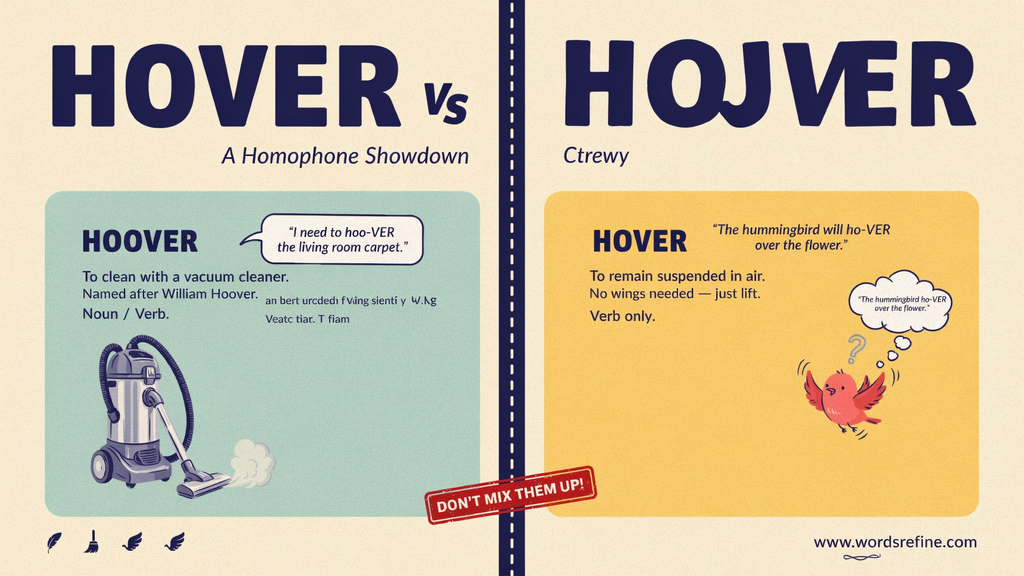
Unlike hoover, the word hover has nothing to do with vacuum cleaners. It describes something that remains suspended in the air, stays in approximately the same position, or lingers close to a person or place.
The word has several everyday applications. A hummingbird can hover above a flower, a helicopter can hover over a building, and someone might hover near a doorway while waiting for an invitation to enter.
Furthermore, hover has an important meaning in technology. When you position a computer mouse pointer over a button without clicking it, you are hovering over that button.
Hover in the Air
One of the most familiar meanings of hover involves remaining in the air without landing.
Birds, helicopters, drones, and certain other aircraft can hover by maintaining enough lift or thrust to counteract gravity.
For example, a hummingbird may hover above a flower while collecting nectar. Similarly, a helicopter might hover above a rescue location while its crew prepares for landing.
Consider these examples:
A hummingbird hovered above the flower.
The helicopter hovered over the rescue site.
The drone hovered above the ground while its camera recorded the area.
The aircraft remained hovering until the runway became available.
However, a hovering object doesn’t always remain perfectly motionless. Wind, air currents, and small adjustments can cause slight movements.
For instance, a helicopter may shift slightly while maintaining its position above a landing area. It still counts as hovering because it remains approximately in the same place.
Hover Around Someone or Something
The word hover also describes someone who stays close to a person, object, or location.
This usage often suggests that someone is waiting, watching, supervising, or lingering without taking direct action.
For example, a manager might hover around employees during an inspection. Similarly, guests might hover near the entrance while waiting for their friends.
Here are a few more examples:
The manager hovered around the employees during the inspection.
A few guests hovered near the entrance while waiting for their friends.
The children hovered around the kitchen when they smelled fresh cookies.
She hovered outside the office because she wanted to speak with the director.
Depending on the situation, hovering can sound helpful, curious, protective, or intrusive.
A parent might hover near a young child to make sure everything is safe. However, a manager who constantly hovers over employees may appear controlling or unwilling to trust the team.
Hover in Technology and Computing
In computer terminology, hover describes positioning a mouse pointer over an item on a screen without clicking it.
This action often triggers a visual response known as a hover effect.
For example, when you move your computer cursor over a website button, its color might change. A small information box might also appear to explain what the button does.
Common examples include moving a pointer over an icon to display a tooltip, placing a cursor over a navigation menu to reveal additional options, or hovering over a link to preview its destination.
Similarly, a website might display additional product information when someone moves the mouse pointer over a photograph.
The important distinction is that hovering doesn’t require clicking. A click activates an element or performs an action, while hovering simply positions the pointer over it and may trigger a visual response.
On touchscreen devices, traditional mouse-hover behavior works differently because users interact through taps and gestures rather than a continuously positioned mouse pointer.
Learn the difference between confusing word pairs
Finaly vs Finally Which One Is Correct?
Hoover vs Hover Side-by-Side Comparison
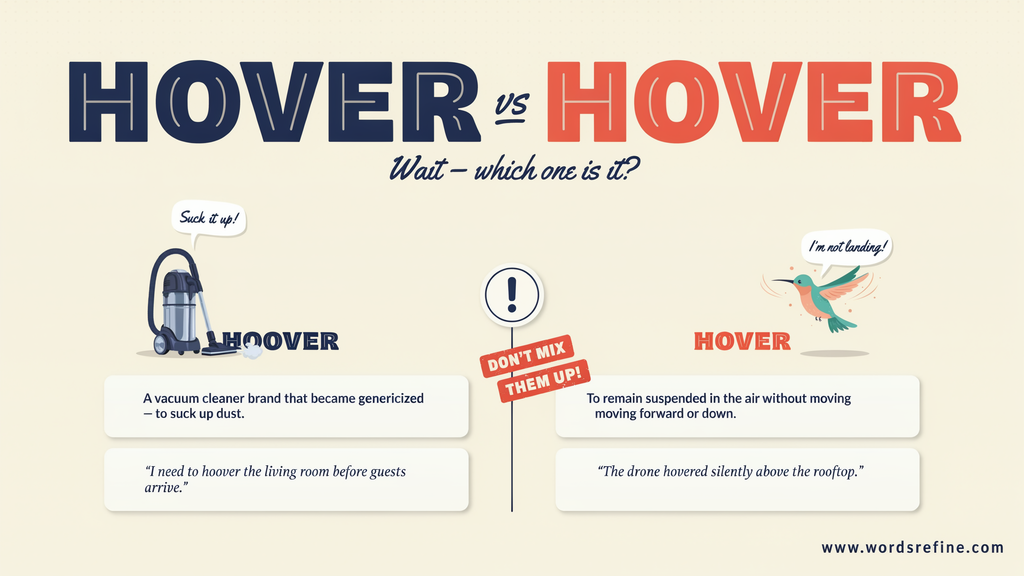
Although hoover and hover look similar, their meanings, grammatical functions, and everyday applications are different.
| Feature | Hoover | Hover |
|---|---|---|
| Main meaning | To clean using a vacuum cleaner | To remain suspended or linger nearby |
| Part of speech | Noun and verb | Primarily a verb |
| Common context | Household cleaning | Movement, position, and technology |
| British English | Commonly used for vacuuming | Used for remaining in the air or nearby |
| American English | Mainly associated with the vacuum cleaner brand | Commonly used in everyday English |
| Physical action | Removing dirt through suction | Staying suspended without landing |
| Technology | Not generally used for mouse-pointer actions | Describes positioning a cursor over an element |
| Example | Please hoover the carpet. | The bird hovered above the tree. |
The easiest way to remember the difference is to associate hoover with a cleaning appliance and hover with something staying in the air.
Key Differences Explained
The difference becomes even clearer when you examine how each word works in everyday sentences.
First, their meanings are completely different. Hoover describes an action involving vacuum cleaning, while hover describes a position or movement in which something remains suspended or stays close to a particular place.
For example, Dad hoovered the hallway before dinner, while a drone hovered above the garden.
Second, their grammatical uses differ. Hoover works as both a noun and a verb. You can say that the hoover needs a new filter or that you need to hoover the bedroom.
Hover primarily functions as a verb. You might describe a helicopter hovering above a building or someone hovering near the entrance.
Third, their everyday contexts aren’t the same. Hoover generally appears in conversations about cleaning, vacuum cleaners, and removing dirt. Hover appears in discussions about flying objects, people lingering nearby, changing levels, and computer interfaces.
Finally, their regional usage differs. British speakers commonly use hoover as a general term for vacuum cleaning, while Americans usually prefer vacuum or vacuum cleaner.
However, hover has essentially the same meaning in both varieties of English.
Why Do People Confuse Hoover vs Hover?
At first glance, the confusion seems understandable. Both words have similar spelling, begin with the same three letters, and differ by only one vowel in the final part of the word.
However, their similar appearance doesn’t make them synonyms.
One reason people confuse them is unfamiliarity with British English. American readers may recognize Hoover primarily as a vacuum cleaner brand. Therefore, a sentence such as “Could you hoover the stairs?” might seem unusual to someone unfamiliar with British vocabulary.
Another reason is pronunciation. Although the words have different vowel sounds, people who encounter them mainly in writing may overlook that distinction.
Fast typing can also contribute to mistakes. Someone writing about a helicopter might accidentally type hoovered instead of hovered. Similarly, an unfamiliar British expression might cause a writer to select the wrong spelling.
Fortunately, the context usually makes the intended meaning clear. If a sentence discusses carpets, dust, and cleaning, hoover is likely the correct choice in British English. If it describes a bird, aircraft, or computer pointer, hover is generally the appropriate word.
Learn the difference between tricky grammar more words
Blond vs Blonde What’s the Difference?Anyway vs Anyways Meaning Usage and Examples ?
Hoover vs Hover Pronunciation How Do You Say Them?
The pronunciation of hoover and hover is another important difference. Although both words contain two syllables, their vowel sounds aren’t the same.
| Word | British IPA | American IPA | Approximate pronunciation |
|---|---|---|---|
| Hoover | /ˈhuːvə/ | /ˈhuːvɚ/ | HOO-vuh |
| Hover | /ˈhɒvə/ | /ˈhʌvɚ/ | HOV-uh |
These pronunciations represent common standard varieties. Regional accents may produce slight differences.
Hoover Pronunciation in English
In standard British and American English, hoover begins with a long OO sound, similar to the vowel in food or moon.
The first syllable receives the stress.
The double O represents a long vowel sound. It isn’t pronounced like the vowel in hover.
Hover Pronunciation in English
Hover begins with a different vowel sound.
In British English, the first syllable contains the /ɒ/ sound, similar to the vowel in hot. In standard American English, it uses /ʌ/, as in cup.
The first syllable also receives the stress.
A useful pronunciation tip is to remember that hoover has a long OO sound, while hover has a shorter vowel. Recognizing this difference can help you distinguish the words when speaking.
Hoover vs Hover Origin and Etymology
Although these words look similar, they developed through different linguistic histories. Their origins explain why their meanings have nothing in common.
Origin of the Word Hoover
The word Hoover comes from the surname of William Henry Hoover, an American businessman associated with the development and commercial success of vacuum cleaners.
However, William Hoover didn’t invent the original machine.
The invention came from James Murray Spangler, an Ohio janitor and inventor who developed a portable electric vacuum cleaner. Spangler later worked with Hoover, who acquired the patent and helped establish commercial production.
The Hoover brand eventually became strongly associated with vacuum cleaning. As the product became familiar, people began using its name as a general term for the appliance and the action of using one.
The verb meaning to vacuum developed from this brand association.
This process is an example of a genericized trademark. It happens when a brand name becomes widely used as an everyday term for a product or activity.
Other familiar examples include Kleenex, which people often use when referring to facial tissues, and Band-Aid, which many Americans use when talking about adhesive bandages.
Google is another familiar example because people frequently use it as a verb meaning to search online.
These examples show how successful brand names can become part of everyday vocabulary.
Origin of the Word Hover
Unlike Hoover, the word hover doesn’t come from a company or household appliance.
It has a much older linguistic history, with roots in Middle English. Its historical development is associated with lingering, hovering, or remaining in a suspended position.
Today, dictionaries recognize several related meanings, including remaining in one place in the air, staying close to someone or something, remaining around a particular level, and positioning a computer cursor over an element.
These meanings share the idea of staying in or near a particular position rather than moving away.
The important point is that hover developed independently of the Hoover brand. Their similar spelling is coincidental.
Learn the difference between often confused words
Anyway vs Anyways Meaning Usage and Examples ?
British English vs American English Does Hoover vs Hover Change?
Regional vocabulary plays an important role in understanding hoover and hover. Although both words are recognized in English, speakers don’t always use hoover in the same way.
Hoover in British English
In British English, hoover is a familiar everyday word for a vacuum cleaner.
People commonly use it as both a noun and a verb.
For example, someone might say, “I need to buy a new hoover,” or “Please hoover the bedroom.”
Other natural examples include:
I hoover the house twice a week.
She’s hoovering the stairs.
We need to hoover the living room before the guests arrive.
A British speaker might naturally say, “I’ll hoover the living room,” without thinking about the original brand name.
Hoover in American English
In American English, Hoover is widely recognized as the name of a vacuum cleaner brand.
However, Americans generally use vacuum as the verb for cleaning floors and carpets.
For example:
I need to vacuum the bedroom.
She vacuumed the living room yesterday.
Please get the vacuum cleaner from the closet.
An American might understand the sentence “I need to hoover the carpet,” but it would sound less typical than “I need to vacuum the carpet.”
Does Hover Change Between British and American English?
Not significantly.
Both British and American speakers use hover to describe something remaining suspended in the air, staying nearby, or positioning a computer cursor over an item.
For example, a helicopter can hover above a building, a bird can hover over flowers, and a computer pointer can hover over a button.
The main regional difference involves pronunciation rather than meaning.
Learn the difference between basic English word mistakes
Onto vs On To What’s the Difference ?
Common Mistakes When Using Hoover vs Hover
Even experienced writers sometimes confuse words with similar spellings. Fortunately, a few practical distinctions can prevent most mistakes.
Using Hover When You Mean Vacuum
This mistake usually happens when someone describes household cleaning.
Incorrect: I need to hover the carpet before my parents arrive.
Correct: I need to hoover the carpet before my parents arrive.
The corrected sentence uses hoover because the speaker plans to remove dirt with a vacuum cleaner.
In American English, vacuum would sound more natural.
Using Hoover When You Mean Staying in the Air
A helicopter doesn’t clean the sky. It hovers.
Incorrect: The helicopter hoovered above the hospital.
Correct: The helicopter hovered above the hospital.
The corrected sentence describes an aircraft maintaining its position in the air.
Confusing the Hoover Brand With the Common Verb
The Hoover brand name takes a capital H because it identifies a company and its products.
However, when hoover functions as an established verb meaning to vacuum, writers generally use lowercase.
For example, “My parents bought a Hoover vacuum cleaner” identifies the brand, while “I need to hoover the bedroom” describes an action.
Assuming Hoover and Hover Are Interchangeable
These words aren’t synonyms. Their similar spelling doesn’t give them the same meaning.
Incorrect: She hovered the living room after dinner.
Correct: She hoovered the living room after dinner.
Incorrect: The drone hoovered above the field.
Correct: The drone hovered above the field.
Remember the action before choosing the spelling. Cleaning calls for hoover in British English, while staying suspended calls for hover.
Confusing Hoovering With Relationship-Related Hovering
Relationship-related hoovering and ordinary hovering describe different behaviors.
For example, an ex-partner who repeatedly sends messages to restart a relationship may be described as hoovering.
Meanwhile, someone who stands near another person while waiting for attention may be described as hovering.
Understanding the context prevents these expressions from becoming confused.
Hoover vs Hover Incorrect and Correct Sentence Examples
Sometimes the easiest way to understand a spelling difference is to see what happens when you use the wrong word.
Consider these examples:
| Incorrect sentence | Correct sentence | Explanation |
|---|---|---|
| I need to hover the living room. | I need to hoover the living room. | Hoover describes vacuum cleaning in British English. |
| The helicopter hoovered above the building. | The helicopter hovered above the building. | Hover describes remaining in the air. |
| She hovered the carpet to remove dust. | She hoovered the carpet to remove dust. | The sentence describes vacuuming. |
| The bird hoovered above the trees. | The bird hovered above the trees. | Birds can remain suspended in the air. |
| He needs to hoover the mouse over the icon. | He needs to hover the mouse over the icon. | Hover describes positioning a computer pointer. |
| The vacuum cleaner hovered up the crumbs. | The vacuum cleaner hoovered up the crumbs. | Hoover up describes sucking up debris. |
These examples reveal a simple pattern: the intended action determines the correct word.
Real-World Hoover vs Hover Examples
Understanding dictionary definitions is useful, but real sentences show how these words work in everyday situations.
Hoover Examples in Everyday Sentences
The cleaner hoovered the office carpet before the meeting.
My brother forgot to hoover the stairs this morning.
We bought a new Hoover vacuum cleaner for our house.
She hoovers the living room every weekend.
The machine hoovered up the small pieces of paper.
I need to empty the hoover before using it again.
The children hoovered up their snacks before lunchtime.
He spent the afternoon hoovering the entire apartment.
Notice that these examples include both noun and verb forms. The expressions hoover the carpet, hoover the living room, and hoover up the crumbs all describe cleaning or suction-related actions.
Hover Examples in Everyday Sentences
A hummingbird hovered above the red flower.
The helicopter hovered over the rescue area.
The drone hovered near the building’s entrance.
My dog hovered around the kitchen while I prepared dinner.
The manager hovered over the employees during the inspection.
The temperature hovered around the freezing point.
Move your mouse pointer to hover over an icon.
A small information box appeared when I hovered over the link.
These examples show that hover doesn’t always involve flying. It can describe people, numbers, computer pointers, and other things that remain near a particular position or level.
A Practical Example One Letter Two Different Actions
Imagine a British family preparing their home before a weekend gathering.
The father asks his daughter to hoover the living room. She takes the vacuum cleaner from the cupboard and starts removing dust from the carpet.
Meanwhile, a small drone outside the window hovers above the garden. It remains in approximately the same position while recording the family’s outdoor preparations.
Both actions happen at the same time, but they have nothing in common.
The daughter hoovers the carpet, while the drone hovers above the garden.
This simple situation captures the entire difference between the two words. One involves suction and cleaning. The other involves maintaining a position in the air.
A Simple Trick to Remember Hoover vs Hover
Remembering the difference doesn’t require complicated grammar rules. A simple association can help you choose the correct spelling whenever you hesitate.
Associate Hoover With a Vacuum Cleaner
Think of the Hoover brand and its connection to household cleaning.
Whenever you describe vacuuming, remember hoover.
For example, you might hoover the carpet, hoover the bedroom, or hoover up the crumbs.
If you’re describing a cleaning appliance or the action of removing dirt with suction, hoover is the relevant word in British English.
Associate Hover With Staying in One Position
Think of a hummingbird staying above a flower or a helicopter remaining in the air.
Whenever you describe something suspended or lingering nearby, choose hover.
For example, a bird might hover above the ground, someone might hover near the entrance, or a computer pointer might hover over an icon.
Use This Quick Memory Test
Ask yourself one simple question: Is something being vacuumed, or is something staying in position?
If the action involves vacuuming, choose hoover in British English.
If something remains suspended in the air or stays nearby, choose hover.
This simple rule works in ordinary conversations, school assignments, emails, and professional writing.
Learn the difference between everyday English mistakes
Shined vs Shone Which One Is Correct?
Hoover vs Hover in Professional and Academic Writing
Choosing the correct word matters in professional writing because a small spelling mistake can change the meaning of an entire sentence.
However, regional vocabulary also deserves attention. A word that sounds natural in a British household conversation might not be the best choice for an American business document.
Hoover in Formal Writing
In British English, hoover is an accepted verb. However, vacuum or vacuum-clean may be preferable when writing for an international audience.
For example, “The cleaning staff will hoover the conference room” sounds natural in British English.
However, “The cleaning staff will vacuum the conference room” may be easier for an international audience to understand.
When referring to a particular manufacturer, capitalize the brand name.
For example, “The company installed Hoover vacuum cleaners throughout the building.”
Hover in Academic and Technical Writing
The word hover is common in technical, scientific, and descriptive writing.
For example, an aircraft might maintain a hovering position above a landing zone. A drone might hover at a fixed altitude during image collection. Similarly, a mouse pointer might display additional information when users hover over an icon.
In scientific writing, hover can describe an aircraft’s position or an object’s movement through the air.
In website documentation, it describes a specific user-interface interaction.
Unlike hoover, hover doesn’t carry a special regional meaning that requires an alternative in American English.
What Do Dictionaries Say About Hoover vs Hover?
Reliable dictionaries help clarify the accepted meanings and regional uses of both words.
The Cambridge Dictionary explains the meanings of hover, including remaining in the air, lingering nearby, and staying around a particular level.
The Collins Dictionary identifies the British noun and verb meanings associated with hoover and vacuum cleaners.
Merriam-Webster provides American English definitions and usage guidance for commonly confused vocabulary.
The official Hoover website also provides historical information about the vacuum cleaner brand.
These references help distinguish established vocabulary from informal or regional expressions.
Quick Recap Hoover vs Hover at a Glance
Still deciding whether to write hoover or hover? The following comparison should settle the question.
| Question | Hoover | Hover |
|---|---|---|
| What does it mean? | To clean using a vacuum cleaner | To remain suspended or linger nearby |
| Is it a verb? | Yes | Yes |
| Is it a noun? | Yes | Not commonly in standard everyday usage |
| Is it associated with a brand? | Yes | No |
| Is it common in British English? | Yes | Yes |
| Is it used in American English? | Recognized, but less common as a cleaning verb | Yes |
| What is its past tense? | Hoovered | Hovered |
| What is its continuous form? | Hoovering | Hovering |
The distinction is simple. Hoover relates to vacuum cleaning, while hover describes staying suspended or remaining nearby.
A vacuum cleaner hoovers up dust, while a helicopter hovers above the ground. Once you understand that difference, choosing the correct word becomes much easier.
Learn the difference between commonly misused words
Bougie vs Boujee Meaning Origin Spelling and Examples ?
Practice Session Hoover vs Hover
- The helicopter began to ______ above the landing area.
- Please ______ the living room before the guests arrive.
- A hummingbird can ______ in one place while feeding.
- Move your mouse over the icon and ______ without clicking.
- My mother asked me to ______ the carpet after lunch.
- The drone continued to ______ above the field.
- Could you ______ the bedroom before you leave?
- The bird seemed to ______ effortlessly above the flowers.
- I need to use the ______ to remove dust from the rug.
- The pilot managed to ______ the aircraft over the runway.
- Please ______ the stairs because they are covered in dust.
- The computer menu appears when you ______ over the button.
- We watched the balloon ______ above the trees.
- He used the vacuum cleaner to ______ the entire apartment.
- The aircraft can ______ at a fixed altitude.
- Don’t ______ around me while I’m trying to work.
- She decided to ______ the sofa to remove the pet hair.
- The eagle appeared to ______ in the sky before diving.
- You can ______ over the image to see more information.
- I usually ______ the hallway twice a week.
- The drone was able to ______ close to the building.
- Please get the ______ from the storage room.
- The plane seemed to ______ above the clouds.
- My brother forgot to ______ the bedroom before leaving.
- The cursor changes when you ______ over the link.
Answers
- Hover
- Hoover
- Hover
- Hover
- Hoover
- Hover
- Hoover
- Hover
- Hoover
- Hover
- Hoover
- Hover
- Hover
- Hoover
- Hover
- Hover
- Hoover
- Hover
- Hover
- Hoover
- Hover
- Hoover
- Hover
- Hoover
- Hover
Here’s a trusted source for clear more words Comparison:
FAQs
How do you pronounce hover in American English?
In American English, hover is pronounced HUV-er, with the first syllable sounding like the vowel in “cup.” The emphasis falls on the first syllable. Unlike hoover, which has a long OO sound, hover uses a shorter vowel.
What does hoover mean in urban slang?
In informal slang, hoovering can describe sucking something up or consuming something quickly. In relationship discussions, it can also refer to attempts to draw someone back into a relationship after a breakup. The intended meaning depends on the situation.
What is the difference between hover vs hoover?
Hover means to remain suspended in the air, stay close to someone or something, or position a computer pointer over an item. Hoover means to clean using a vacuum cleaner, particularly in British English. For example, a drone hovers above a garden, while someone hoovers the carpet.
How do you pronounce Hoover?
Hoover is pronounced HOO-ver. Its first syllable has a long OO sound, similar to the vowel in “moon.” The emphasis falls on the first syllable in both British and American English.
What do Mexicans call a vacuum cleaner?
In Mexico, a vacuum cleaner is commonly called an aspiradora. This Spanish word refers to an appliance that removes dust and dirt from floors, carpets, and furniture. For example, “Necesito comprar una aspiradora” means “I need to buy a vacuum cleaner.”
Do Americans say Hoover or vacuum?
Americans generally say vacuum or vacuum cleaner when referring to household cleaning. Hoover is primarily recognized as a vacuum cleaner brand in the United States. In contrast, British speakers commonly use hoover as both a noun and a verb.
What do the French call a vacuum cleaner?
In French, a vacuum cleaner is called an aspirateur. For example, “Je dois passer l’aspirateur” means “I need to vacuum.” The expression passer l’aspirateur is the natural French way to describe vacuuming.
What is the number one best vacuum cleaner?
There isn’t one universally best vacuum cleaner because the right choice depends on your flooring, budget, household size, and cleaning needs. A good model should provide strong suction, effective filtration, easy maintenance, and useful attachments. Comparing individual models is more helpful than choosing based on brand popularity alone.
Is Hoover better than Bissell?
Hoover and Bissell both offer household cleaning appliances, but neither brand is automatically better in every category. Hoover offers upright, cordless, and carpet-cleaning machines, while Bissell is particularly well known for carpet cleaners and products designed for pet owners. The better option depends on the specific models, cleaning performance, features, and maintenance costs.
Is Hoover still a good vacuum brand?
Yes, Hoover remains a recognized household cleaning brand with products designed for different cleaning needs. However, performance and durability vary between models. Before purchasing, compare suction power, filtration, maneuverability, maintenance requirements, and customer reviews to find a vacuum that meets your expectations.
Learn the difference between more words people mix up
Aluminum vs Aluminium Which One Is Correct?
Conclusion
Hoover vs hover may seem like interchangeable words, but their meanings tell two very different stories. Hover describes something floating in the air or staying near a particular object, whereas hoover means cleaning with a vacuum cleaner, especially in British English. The easiest way to remember the difference is simple: birds hover above trees, while people hoover the floors beneath them. Mixing up these words might give your readers a funny mental picture, but it can also make your writing unclear. Once you understand their meanings, pronunciation, and everyday uses, choosing the correct word becomes second nature. So, let your words hover in the right context and leave the hoover to the cleaning!

Diora AJS she is an experienced blogger and passionate English language enthusiast at Words Refine. With a keen eye for language and a love for clear communication, she writes practical content about grammar, word meanings, usage, and commonly confused terms. Her goal is to make English easier to understand through clear explanations and relatable examples, helping readers write accurately and communicate with confidence.