
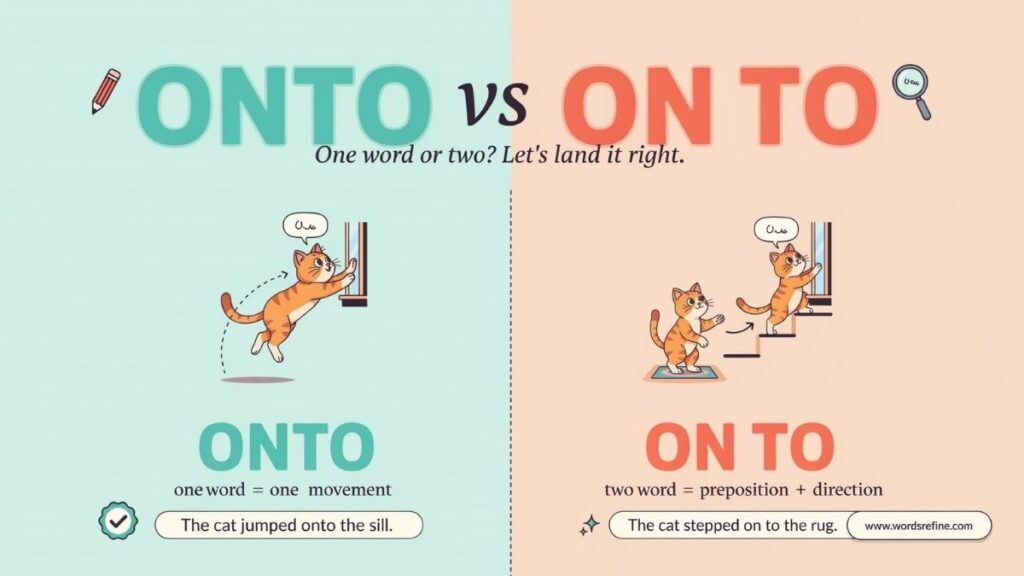
The difference between onto vs on to may seem like a tiny detail, but that little space can change how your sentence works. Should you write “jump onto the bed” or “move on to the next chapter”? Both forms are correct, but they serve different purposes. Mixing them up can make an otherwise clear sentence confusing. Fortunately, choosing between “onto” and “on to” isn’t as tricky as it looks. This guide explains the difference with simple examples, highlights common grammar mistakes, and provides a practice session to help you use both forms correctly and write with confidence.
Quick Answer Onto vs On To
The main difference between onto vs on to lies in their meaning and grammatical function.
Onto is a preposition that commonly describes movement to a surface, position, or location. It can also express awareness of something, such as a secret or plan.
On to consists of two separate words. The word on often belongs to the preceding verb or expression, while to introduces a destination, another stage, or an action.
Consider these examples:
The cat jumped onto the table.
We moved on to the next chapter.
The detective was onto the suspect’s plan.
She went on to become a successful teacher.
In the first sentence, onto describes movement to a surface. In the second, on to expresses progression to another chapter. The third sentence uses onto to describe awareness, while the fourth shows how someone progresses to a later stage of life.
The easiest way to remember the difference is to focus on the sentence’s meaning. If something moves to a surface or position, onto often works. If someone continues an activity or proceeds to the next step, on to is usually the better choice.
However, this distinction isn’t absolute. Some expressions, including hold onto and hold on to, allow both forms without changing the basic meaning.
Learn the difference between confusing more English words
Peak vs Pique Differences Examples and Correct Usage ?
What Does Onto Mean?
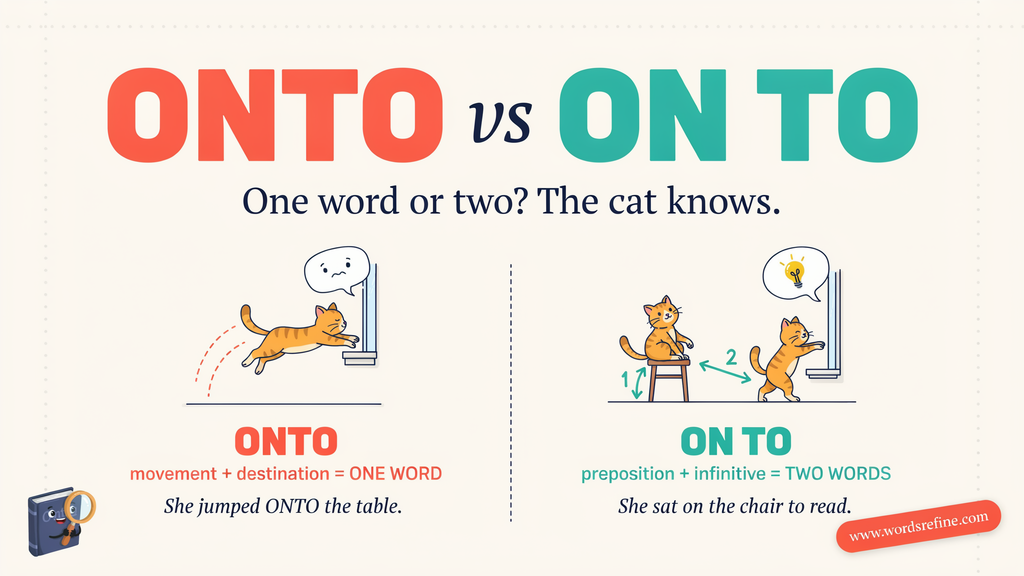
Onto is a preposition that commonly describes movement toward or arrival at a surface, position, or place. It connects an action with the destination that the action reaches.
For example, imagine a cat sitting on the floor. When the cat jumps onto a chair, its position changes. The word onto describes that movement.
You can use onto in many everyday situations.
The child climbed onto the chair.
She placed the envelope onto the desk.
The squirrel jumped onto the fence.
The ball rolled onto the sidewalk.
In each example, someone or something moves to a particular surface or position. Therefore, onto helps explain where the action leads.
However, the word doesn’t always describe physical movement. It also appears in expressions involving awareness, suspicion, and understanding.
Onto as a Preposition
As a preposition, onto connects a verb or action to a destination. It usually appears before a noun or noun phrase, creating a prepositional phrase.
Consider the sentence, “The boy stepped onto the platform.”
The phrase onto the platform identifies the destination of the boy’s movement. Without that phrase, the sentence would still be grammatical, but the reader wouldn’t know where the boy stepped.
Here are some more examples.
A passenger stepped onto the bus.
The worker climbed onto the roof.
The dog jumped onto the sofa.
The book fell onto the floor.
The gymnast landed onto a padded mat.
These examples demonstrate how onto connects movement with a destination. The destination doesn’t have to be a flat surface. Someone can climb onto a ledge or step onto a raised platform.
It’s also useful to distinguish between on and onto. The word on often describes an existing position, while onto usually emphasizes movement toward that position.
For example, the sentence “The keys are on the counter” describes where the keys are. In contrast, “She put the keys onto the counter” explains how they got there.
The difference is small but important. One sentence describes a location, while the other describes an action.
Onto Meaning Becoming Aware of Something
Onto also has a figurative meaning. When someone says they’re onto another person, they usually mean they’ve recognized suspicious behavior, discovered a secret, or figured out what someone is doing.
For example, the teacher was onto the students’ plan to skip class.
The detective knew the suspect was lying and was onto him.
My sister is onto my surprise party plans.
In these sentences, onto doesn’t describe physical movement. Instead, it expresses awareness or understanding.
You might also hear someone say, “She’s onto something.” This means she’s discovered a useful idea, noticed an important clue, or recognized a promising opportunity.
Similarly, when someone says, “I’m onto you,” they’re suggesting that they understand what you’re doing, even if you’re trying to keep it secret.
These expressions are common in everyday American English. Although the meaning is figurative, the spelling remains onto because it functions as a single preposition.
Learn the difference between commonly mixed-up more words
Labor Day vs Labour Day Meaning and Usage ?
What Does On To Mean?
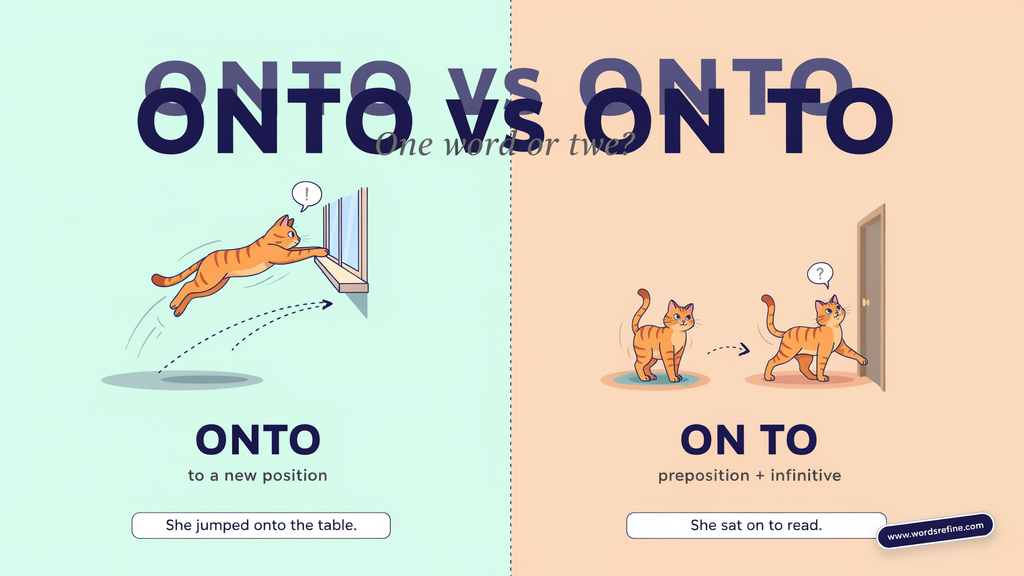
On to consists of two separate words that perform different grammatical roles. In many sentences, on belongs to the preceding verb or expression, while to introduces a destination, recipient, next stage, or action.
For example, consider this sentence:
After finishing the report, Maya moved on to the presentation.
Here, moved on means that Maya finished one activity and continued to another. The phrase to the presentation identifies what she tackled next.
Now compare it with this sentence:
Maya moved the folder onto the desk.
In this case, onto connects the folder’s movement with its destination.
The difference becomes clearer when you examine the entire sentence instead of focusing on the words individually.
On To as Two Separate Words
On to commonly appears when someone continues an activity, progresses through a sequence, or changes to another subject.
For example, let’s move on to the next question.
He read on to find out how the story ended.
The team went on to win the championship.
After discussing the budget, we moved on to staffing.
She held on to the railing during the storm.
The last example deserves special attention because both hold onto and hold on to are accepted forms. The word on belongs to the expression hold on, while to introduces the object being held.
This shows why meaning alone doesn’t always determine whether the words should be combined. You must also consider the grammatical structure.
On To Before an Infinitive
Another common use of on to appears when to introduces a verb in its base form, known as an infinitive.
Consider this sentence:
After completing her training, she went on to manage the entire department.
The expression went on indicates continuation or progression. The words to manage introduce the next action.
Here are some additional examples.
He went on to explain the results.
She went on to become a respected researcher.
The athlete went on to break the national record.
The company went on to launch three additional products.
In each example, on belongs to the preceding expression, while to introduces an action that follows.
Therefore, when you’re deciding between onto vs on to, check whether to introduces an infinitive. If it does, the two-word construction is often appropriate.
Onto vs On To Understanding the Main Differences
The difference between onto vs on to becomes easier to recognize when you compare their grammatical functions.
Onto is one word and commonly acts as a preposition that describes movement toward a surface or position. It can also express awareness of a situation.
On to consists of two words. The word on often belongs to a preceding verb phrase, while to introduces what follows.
For example, the sentence “The child climbed onto the bed” describes physical movement. Meanwhile, “The child went on to win the race” describes what happened afterward.
Both sentences are correct because each form serves a different purpose.
Onto Describes Movement or Position
Use onto when you want to show that someone or something moves toward a surface or position.
The puppy jumped onto the bed.
The mechanic climbed onto the truck.
She stepped onto the stage.
The ball rolled onto the sidewalk.
In each sentence, onto connects the movement with its destination.
A useful question to ask is where the person or object moved. If the answer identifies a surface or position reached through the action, onto may be the correct choice.
However, remember that onto doesn’t simply mean on. The former usually emphasizes movement, while the latter often describes location.
On To Expresses Continuation
On to often appears when someone progresses to another task, topic, or stage.
For example, we moved on to the final section.
The speaker went on to discuss the results.
She held on to the handle.
The students carried on to the next activity.
In these sentences, on belongs to an expression such as move on, go on, hold on, or carry on. The word to introduces the next part of the sentence.
This pattern is especially useful when working with phrasal verbs. A phrasal verb combines a verb with a particle, such as on, to create a particular meaning.
Learn the difference between tricky grammar more words
Traveled vs Travelled Which one Is Correct in English?
A Simple Way to Choose the Correct Form
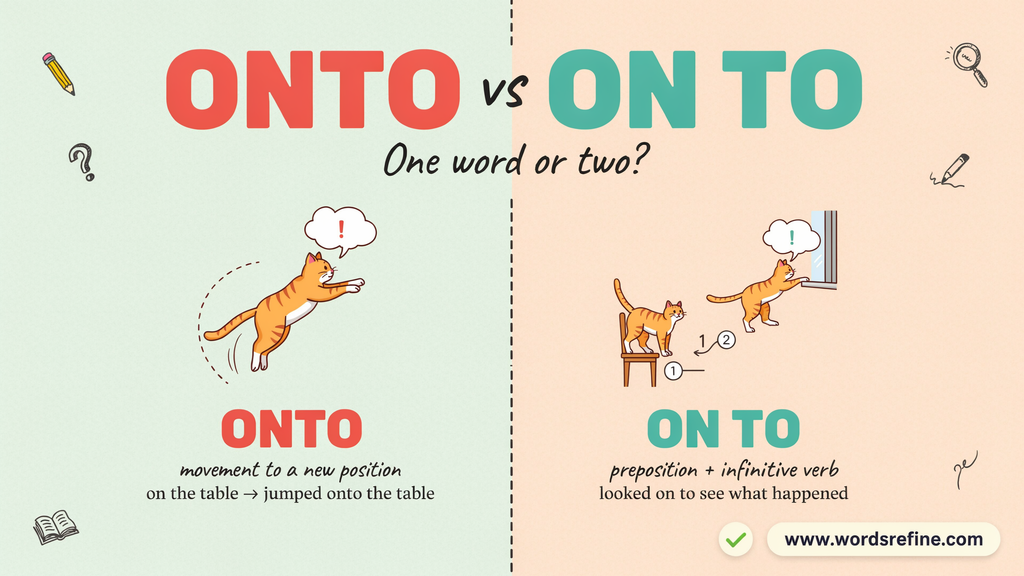
When you’re unsure whether to use onto vs on to, examine the sentence’s structure.
First, ask whether the sentence describes movement to a surface or position. If it does, onto is often appropriate.
For example, “The cat jumped onto the counter” describes a cat moving to the counter’s surface.
Next, check whether on belongs to the preceding verb or expression. If it does, on to may be correct.
For example, “Let’s move on to the next topic” describes progression from one subject to another.
You can also try replacing onto with to a position on when describing physical movement. The sentence “The cat jumped onto the table” roughly means that the cat jumped to a position on the table.
This test can help clarify the meaning, although it won’t work naturally in every situation. Treat it as a helpful guide rather than a strict rule.
Onto vs On To in Everyday Expressions
Some expressions cause more confusion than others because both spellings may be possible. Understanding how these phrases work will help you choose the right form more confidently.
Moving Onto vs Moving On To
Both forms can be correct, but they often describe different actions.
Moving onto the stage means physically stepping onto the stage.
Moving on to the next stage means progressing to another phase of an activity.
For example, the singer walked onto the stage.
After the opening performance, the event moved on to the next act.
The first sentence describes physical movement. The second describes a transition in a sequence.
Therefore, when deciding between moving onto and moving on to, consider whether you’re describing a physical destination or progression to another activity.
Onto the Next vs On To the Next
When discussing the next task, question, chapter, or stage, on to the next is generally the clearer choice.
For example, let’s move on to the next question.
She finished the first chapter and moved on to the second.
We can move on to the next phase of the project.
After reviewing the first proposal, the committee moved on to the next.
Although onto the next appears in informal writing, on to the next makes the grammatical structure clearer when you’re describing progression.
By contrast, onto the platform describes movement toward a physical surface. It doesn’t communicate the same meaning as moving on to the next item in a sequence.
Hold Onto vs Hold On To
Both hold onto and hold on to are accepted in standard English.
For example, you can write, “Hold onto the railing” or “Hold on to the railing.” Both sentences tell someone to maintain a firm grip.
The same applies to figurative expressions.
Hold onto your dreams.
Hold on to your dreams.
Both sentences communicate the idea of keeping your dreams alive rather than giving them up.
The difference often comes down to editorial preference. Some dictionaries and style guides accept the combined form, while others also recognize or prefer the two-word construction.
If you’re writing for a publication or organization, follow its style guide. Otherwise, choose the form that fits your sentence and use it consistently.
Learn the difference between often confused words
Absence vs Absense Correct Spelling Meaning and Usage ?
Adding Onto vs Adding On To
Both adding onto and adding on to can appear in standard English, depending on the sentence.
Use adding onto when emphasizing an extension to an existing structure or object.
For example, the family plans to add onto their house next summer.
The sentence describes enlarging the house by adding another section.
The two-word form may also appear when on functions separately within the sentence.
For example, the editor decided to add on to the explanation.
This means the editor decided to provide additional material.
In many cases, you can make the sentence more direct by using add to, expand, or extend. These alternatives can reduce ambiguity without changing the intended meaning.
Passed Onto vs Passed On To
When discussing the transfer of responsibility, information, or an object to another person, passed on to is generally the clearest choice.
For example, the responsibility was passed on to the new manager.
The disease was passed on to several family members.
The first sentence describes a transfer of responsibility, while the second describes transmission.
Passed onto can also appear in certain contexts, especially when a writer emphasizes movement to a position. However, when the meaning involves passing something along to another person, passed on to is a reliable choice.
Step Onto vs Step On To
Use step onto when describing movement to a surface or position.
She stepped onto the platform.
He stepped onto the bus.
The child stepped onto the wet grass.
In these examples, onto identifies where the person moved.
The phrase step on to may occur in sentences where on belongs to a preceding expression and to introduces what follows. However, it is less common than step onto when describing physical movement.
For example, instead of writing, “She stepped on to the next part of the trail,” you could write, “She moved on to the next part of the trail.” The second sentence communicates progression more naturally.
Get Onto vs Get On To
The meaning of get onto depends on context.
1Get onto the bus means to board the bus.
2Get onto the roof means to climb or move to the roof.
3Get onto the problem can mean to begin dealing with it.
The detective is onto the suspect means the detective has recognized suspicious behavior or uncovered information.
Meanwhile, get on to can appear when a sentence describes progression to another item or activity.
For example, let’s get on to the next item on the agenda.
Here, the phrase indicates that the discussion is moving forward.
Log Onto vs Log On To
Both log onto and log on to appear in everyday writing, especially when people discuss websites, accounts, and computer systems.
For example, log on to your account.
She logged on to the company portal.
He logged onto the website.
Many style guides prefer log on to when log on functions as a verb phrase and to introduces the website or service. However, log onto is also widely used.
When writing technical instructions, follow your organization’s preferred terminology. Above all, make the instructions clear and consistent.
Sign Onto vs Sign On To
The same principle applies to sign onto and sign on to.
For example, employees must sign on to the internal system before starting work.
Here, sign on functions as the verb phrase, while to the internal system identifies the destination.
Sign onto also appears in common usage, particularly when writers treat the system as the destination of the action. Nevertheless, sign on to the system is a clear choice for formal instructions.
Learn the difference between confusing word pairs
Want vs Wont Meaning Differences and Usage ?
Common Mistakes With Onto vs On To
Even experienced writers sometimes confuse these expressions because they sound alike and occasionally overlap in meaning. Fortunately, a few simple checks can prevent most mistakes.
Using Onto for Every Kind of Movement
Not every sentence involving movement requires onto.
For example, “We moved onto the next question” is less clear when the intended meaning is that the group is progressing through a sequence.
A better choice is “We moved on to the next question.”
The revised sentence clearly expresses progression rather than movement to a physical surface.
Assuming On To Is Always Wrong
Some writers believe that onto is the only correct form. However, this rule ignores the grammatical function of on to.
Consider this sentence: “The researcher went on to publish several books.”
The construction is correct because went on expresses continuation, while to publish introduces the next action.
Treating Onto vs On To as Interchangeable
Although certain expressions allow both forms, the words aren’t interchangeable in every situation.
For example, the child climbed onto the roof.
The child went on to climb another mountain.
The first sentence describes movement to a surface. The second describes progression to another activity.
Changing the spelling without considering the meaning can make the sentence confusing.
Ignoring Phrasal Verbs
Phrasal verbs often contain a verb and a particle that work together to create a particular meaning.
Common examples include hold on, move on, go on, carry on, and pass on.
When to follows one of these expressions, don’t automatically combine the words into onto. Instead, check whether on belongs to the preceding verb phrase.
Choosing Based on Sound Alone
Because onto vs on to sound identical in everyday speech, pronunciation won’t help you distinguish them.
Instead, examine the sentence structure and intended meaning. A quick grammatical check can prevent a small spelling choice from creating unnecessary confusion.
Is Onto One Word or Two?
Onto is one word, while on to consists of two words. Both forms are correct in standard English when used appropriately.
The confusion arises because they can appear in similar contexts.
For example, the child jumped onto the bed.
The child went on to win the race.
In the first sentence, onto acts as a preposition that describes movement to a surface. In the second, on belongs to went on, while to win introduces the next action.
The important point is that the correct choice depends on the grammatical construction, not simply on how many words look right.
Is On To Ever One Word?
No. When the sentence requires the two-word construction on to, the words remain separate.
For example, the students moved on to the next lesson.
The students climbed onto the stage.
Both sentences are correct because each uses the appropriate form.
Rather than counting words or relying on appearance, identify the role of on and examine what follows to. That approach will help you choose the correct spelling more reliably.
Learn the difference between everyday English mistakes
Councillor vs Counsellor Difference Spelling and Usage ?
Onto vs On To in American and British English
Some writers assume that onto belongs to American English while on to belongs to British English. However, the distinction isn’t that simple.
Both American and British English use onto vs on to. The choice generally depends on grammatical function, meaning, and editorial preference rather than a national spelling rule.
For example, writers in both varieties of English can use onto to describe physical movement, as in “The cat jumped onto the table.”
Likewise, both varieties use on to when the sentence expresses progression, as in “We moved on to the next topic.”
Individual dictionaries, publishers, and style guides may differ in their treatment of expressions such as hold onto and log on to. These differences reflect editorial conventions rather than a strict division between American and British usage.
If you’re writing for an American audience, follow standard American English conventions and any style guide required by your publication. The same principle applies to British English.
Ultimately, consistency and clarity matter more than assuming one form belongs exclusively to a particular country.
How to Remember the Difference Between Onto vs On To
If the distinction still feels confusing, remember this simple idea: onto often points to a position, while on to often points to what happens next.
Think about a cat jumping onto the counter. The counter is the destination.
Now consider a student moving on to the next question. The student is progressing through a sequence.
You can also use a few practical checks when editing your writing.
Look for a surface or position. If someone or something moves to a table, roof, stage, or platform, onto is often appropriate.
Look for continuation. If someone moves forward in a discussion, task, or activity, on to is often the better choice.
Check the verb phrase. If on belongs to an expression such as go on or hold on, consider whether the sentence requires two separate words.
Finally, examine the entire sentence. Some expressions allow both forms, so no single test works in every situation.
You don’t need to memorize every possible expression. Once you recognize the grammatical pattern, you can apply the same reasoning to unfamiliar sentences.
Onto vs On To Practice Exercises
Now it’s time to test your understanding. Complete each sentence with onto vs on to. Pay attention to the intended meaning rather than choosing the form that looks more familiar.
The puppy jumped onto the sofa.
After the introduction, the speaker moved on to the main topic.
The detective realized that the suspect was hiding something and was onto him.
She went on to explain the results to the committee.
The climber stepped onto the narrow ledge.
We should move on to the next question.
He held on to the railing while climbing the stairs.
The child placed the toy onto the shelf.
After completing the first stage, the team went on to the final round.
The cat climbed onto the roof.
The manager passed the responsibility on to her assistant.
The researcher went on to publish several important studies.
Please log on to the company portal.
The students moved on to the next lesson.
The dog leaped onto the bed.
My brother thinks he’s fooling everyone, but I’m onto him.
The family plans to add onto their house.
After discussing the budget, the committee moved on to staffing.
Notice that some sentences, particularly those involving hold on and add onto, may allow alternative constructions. The goal is to recognize the intended meaning and understand why a particular form works.
Learn the difference between commonly misused words
skepticism vs scepticism Meaning Spelling and Correct Usage
Practice Session: Onto vs On To
- The little boy climbed ______ the bed.
- Let’s move ______ the next question.
- The detective knew he was ______ something suspicious.
- Please pass the message ______ your supervisor.
- The cat jumped ______ the kitchen counter.
- After finishing the report, Sara moved ______ her next assignment.
- Hold ______ your receipt in case you need a refund.
- The basketball player leaped ______ the court.
- We went ______ discuss the results with the manager.
- The puppy climbed ______ its owner’s lap.
- Once you finish this chapter, move ______ the next one.
- The teacher knew the students were ______ to something.
- She stepped ______ the stage to accept her award.
- He held ______ the railing while climbing the stairs.
- The teacher moved ______ the final topic.
- The child spilled juice ______ the carpet.
- Please pass the documents ______ the accounting department.
- The hikers continued ______ the next trail after lunch.
- The journalist knew she was ______ an important story.
- The dog jumped ______ the sofa and fell asleep.
- After discussing the budget, the team moved ______ the hiring plan.
- Hang ______ your keys so you don’t lose them.
- The actor walked ______ the stage as the audience applauded.
- She went ______ explain why the decision mattered.
- The detective was finally ______ the truth.
Answers
- Onto
- On to
- Onto
- On to
- Onto
- On to
- On to
- Onto
- On to
- Onto
- On to
- On to
- Onto
- On to
- On to
- Onto
- On to
- On to
- Onto
- Onto
- On to
- On to
- Onto
- On to
- Onto
Here’s a trusted source for clear more words Comparison:
FAQs
Which is correct: “pass it on to” or “pass it onto”?
“Pass it on to” is generally preferred when you mean to give something to another person. For example, “Please pass it on to your manager.” Here, “on” belongs to the phrasal verb “pass on,” while “to” identifies the recipient.
What does “I am onto you” mean?
“I am onto you” means you suspect someone is hiding something or trying to deceive you. For example, “You keep changing your story, but I’m onto you.” It suggests that you’ve noticed suspicious behavior.
Is it “onto” or “in to”?
Both forms are correct, but they have different uses. “Onto” often describes movement to a surface or position, as in “The cat jumped onto the couch.” Use “in to” when “in” belongs to the preceding verb and “to” begins another phrase, as in “She came in to talk.”
Which is correct: “hang on to” or “hang onto”?
Both forms are correct. “Hang on to” is common when you mean to keep something or maintain your grip on it. For example, “Hang on to your ticket until the event ends.” You can also write “Hang onto your ticket.”
Is “onto” a single word?
Yes, “onto” is a single word. It commonly indicates movement to a surface or position, as in “She climbed onto the stage.” It can also describe becoming aware of a secret or deception, as in “The detective is onto the suspect.”
Is it “I’m onto you” or “I’m on to you”?
Both forms can be correct. “I’m onto you” is the more common choice when you mean you suspect someone is being dishonest. “I’m on to you” can express the same idea, depending on the style guide or writer’s preference.
Is it “onto us” or “on to us”?
The correct form depends on the meaning. Use “onto us” when describing movement toward a surface or position associated with “us,” although this construction is uncommon. Use “on to us” when “on” belongs to the preceding verb or expression and “to us” identifies the recipient or target. The surrounding sentence determines the best choice.
What does “to be on to” mean?
“To be on to” can mean to suspect or discover something, especially a secret or deception. For example, “The teacher is on to the students’ prank.” The expression can also appear when someone progresses to another subject or task, as in “She moved on to the next assignment.”
Which is correct: “moved on to” or “moved onto”?
Both can be correct, but they have different uses. “Moved on to” usually describes progressing to another activity, topic, or stage: “He moved on to the next question.” “Moved onto” usually describes physical movement to a surface or position: “He moved onto the platform.”
Is it correct to say “I moved on” or “I’ve moved on”?
Both are correct. “I moved on” describes a completed action in the past, while “I’ve moved on” emphasizes a change that matters in the present. For example, “I moved on after graduation” describes a past event. “I’ve moved on from that experience” emphasizes that it no longer affects you in the same way.
What is another word for “move onto”?
The best alternative depends on the context. If you mean progressing to another task, use “proceed to,” “continue to,” or “advance to.” If you mean physically moving onto a surface, use “step onto,” “climb onto,” or “get onto.” For example, “Let’s proceed to the next topic” clearly expresses a transition.
Learn the difference between basic English word mistakes
Moustache vs Mustache Meaning Spelling and Usage ?
conclusion
the difference between “onto” vs “on to” helps you avoid common grammar mistakes and express your ideas clearly. Use “onto” to describe movement to a surface or position, or to indicate that someone suspects a secret. Use “on to” when “on” belongs to the preceding verb or when you move to another task or topic. Although the difference is just a space, choosing the correct form keeps your writing accurate and easy to follow. With a little practice, you’ll master this tricky pair. Now, move on to your next writing challenge with confidence!

Diora AJS she is an experienced blogger and passionate English language enthusiast at Words Refine. With a keen eye for language and a love for clear communication, she writes practical content about grammar, word meanings, usage, and commonly confused terms. Her goal is to make English easier to understand through clear explanations and relatable examples, helping readers write accurately and communicate with confidence.