Anyway vs anyways may look almost identical, but choosing between them can leave even confident writers second-guessing themselves. Both forms appear in everyday conversations, but they differ in tone and suitability for formal writing. So, is “anyways” a real word, or should you stick with “anyway”? The answer is simpler than you might think. Understanding the difference between anyway vs. anyways helps you avoid common grammar mistakes and communicate more naturally. In this guide, you well explore their meanings, see how people use them in different situations, and practice choosing the right word. Because even a tiny word deserves a little attention!
Quick Answer Anyway vs Anyways
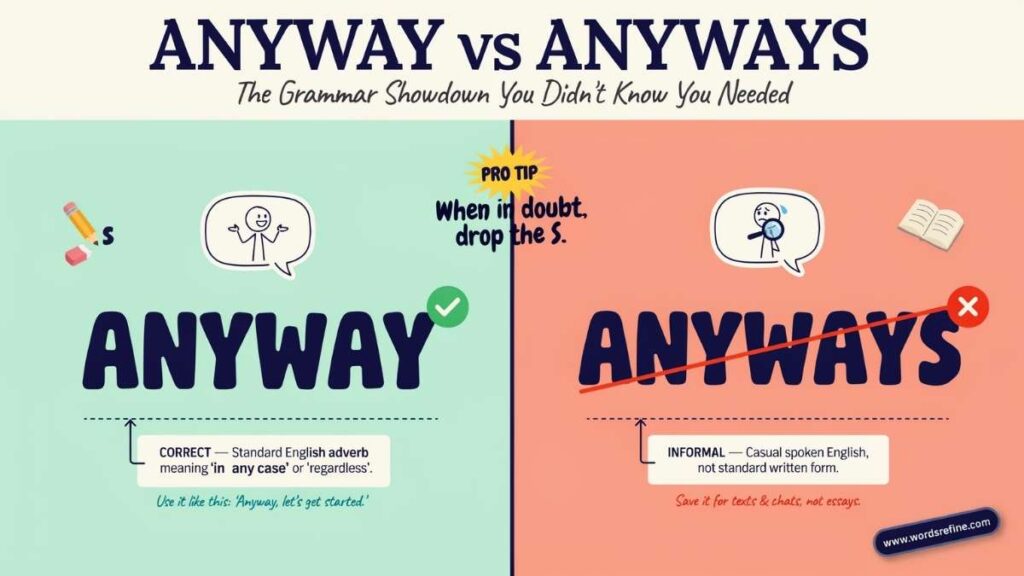
Anyway is the standard form and the safest choice when you want clear, polished English. Anyways is an informal variant that people use in everyday speech and casual writing.
| Feature | Anyway | Anyways |
|---|---|---|
| Meaning | Regardless or in any case | Usually the same |
| Standard usage | Accepted in formal and informal English | Primarily informal |
| Academic writing | Appropriate | Generally avoided |
| Business emails | Recommended | May sound too casual |
| Everyday conversation | Natural | Also natural in many contexts |
| Beginning a sentence | Yes | Yes, especially in informal contexts |
| Example | We went anyway. | Anyways, we went. |
Consider these examples:
Anyway: “The weather forecast looked terrible, but we went hiking anyway.”
Anyways: “Anyways, let’s order some food before the restaurant closes.”
In the first sentence, anyway shows that the weather didn’t change the decision. In the second, anyways helps the speaker move the conversation forward.
The practical rule is simple. When you’re unsure which word to choose, use anyway. It works in almost any context and won’t sound out of place in professional writing.
Learn the difference between confusing more English words
Temporary vs Temporarily Meaning Difference and Correct Usage?
What Does Anyway Mean?
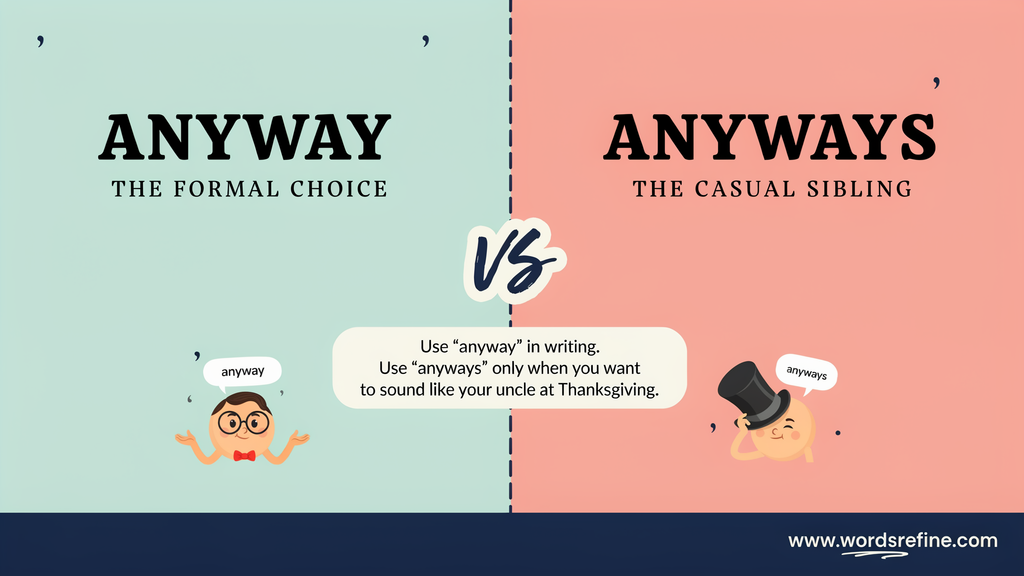
Anyway is an adverb that commonly means regardless, in any case, or despite that. It helps explain that an action will happen despite a problem, brings a conversation back to its main point, or signals that a speaker wants to move on.
The meaning of anyway depends on the context. Sometimes it emphasizes that a decision won’t change. At other times, it acts as a conversational bridge between two ideas.
For example:
“I didn’t feel hungry, but I ate dinner anyway.”
“Anyway, let’s talk about your new job.”
“We might miss the first few minutes, but we’ll go anyway.”
“I wasn’t interested in the offer anyway.”
In the first and third examples, anyway means that an action happens despite a circumstance. and In the second, it shifts the conversation. In the fourth, it suggests that the offer wasn’t important to the speaker.
Anyway Meaning Regardless or In Any Case
One of the most common uses of anyway is to show that something happens despite an obstacle, objection, or unexpected situation.
Consider this example: “Although the tickets were expensive, we bought them anyway.”
The high price might have discouraged the speakers, but it didn’t stop them from buying the tickets. Here, anyway emphasizes that the outcome remains the same.
You can use the word in similar situations:
“It was cold outside, but we played soccer anyway.”
“She knew the task would be difficult, yet she tried anyway.”
“The store was crowded, so we decided to shop anyway.”
“I knew he might disagree, but I told him anyway.”
In these sentences, anyway connects an action with a circumstance that could have prevented it. The obstacle doesn’t disappear. Instead, the action continues despite it.
Depending on the sentence, you can sometimes replace anyway with regardless or in any case. However, the best alternative depends on the meaning you want to convey.
Anyway as a Conversation Transition
In spoken English, anyway often works as a transition that helps organize a conversation. Speakers use it to return to a topic, change direction, or wrap up a discussion.
For example, consider this sentence: “Anyway, where were we before the phone rang?”
Here, anyway doesn’t mean that something happened regardless of an obstacle. Instead, it helps the speaker return to an earlier topic.
People also use it when they want to change subjects or bring someone’s attention back to the main point.
“Anyway, we should get going.”
“Anyway, enough about work. How was your vacation?”
“Anyway, as I was saying, the meeting starts at nine.”
“Anyway, I’ll send you the details tomorrow.”
Without anyway, these sentences would still make sense. However, the word helps the conversation flow more naturally, especially when the speaker wants to move from one subject to another.
Anyway to Emphasize a Point
Sometimes, anyway adds emphasis to a statement or suggests that a particular detail doesn’t matter much to the speaker.
For example, “I didn’t want to attend the party anyway.”
This sentence suggests that the speaker had little interest in attending, regardless of what happened. Depending on the situation, the statement might sound neutral, dismissive, defensive, or reassuring.
Consider a few more examples:
“I didn’t need the extra chair anyway.”
“He wasn’t going to listen anyway.”
“We have enough time anyway.”
In the first sentence, the chair wasn’t necessary. and In the second, the speaker believes listening was unlikely. In the third, the available time supports the point being made.
Context matters because anyway doesn’t automatically communicate frustration or indifference. The surrounding words, the situation, and the speaker’s tone all help determine the intended meaning.
Learn the difference between commonly mixed-up more words
Saucey vs Saucy Meaning Differences and Correct Usage ?
What Does Anyways Mean?
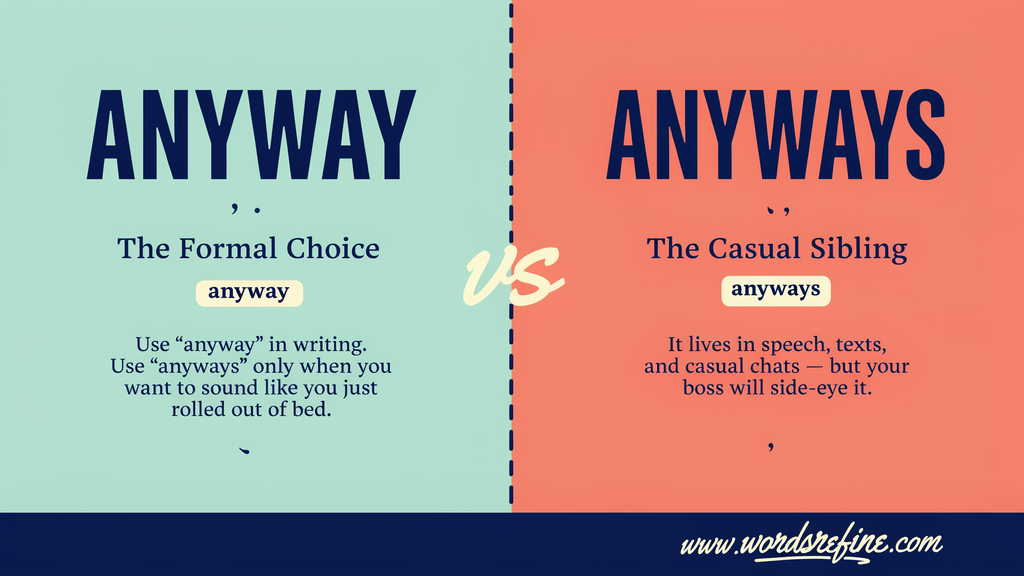
Anyways is an informal variant of anyway. It generally carries the same meanings, including regardless and in any case. It can also serve as a transition in conversation.
For example:
“Anyways, I’ll see you after work.”
“I wasn’t going to use that ticket anyways.”
“Anyways, let’s get back to the movie.”
“It was a long drive, but we went anyways.”
These sentences are easy to understand. In many cases, you could replace anyways with anyway without changing the basic meaning.
The main difference is usage and tone rather than a completely different definition. In edited articles, formal reports, academic assignments, and professional messages, anyway is usually the better choice. In relaxed conversations and informal messages, anyways may sound perfectly natural.
Is Anyways a Real Word?
Yes, anyways is a recognized English word. Dictionaries identify it as an informal variant of anyway. It isn’t simply a spelling mistake that every writer must avoid.
However, a word’s existence doesn’t mean it fits every situation. English contains plenty of words and expressions that people use comfortably in conversation but avoid in formal writing.
For example, people often use gonna in everyday speech as a shortened form of going to. However, writers generally choose going to in formal prose. Similarly, anyways is familiar and widely used, yet anyway remains the more conventional choice in edited writing.
This distinction helps answer two common questions: Is anyways a word, and is anyways grammatically correct?
The answer depends partly on what you mean by correct. Anyways is a recognized word and appears in informal speech, but it isn’t the preferred choice for most formal writing. That doesn’t make every use of it grammatically wrong.
Calling anyways an informal variant is more accurate than claiming it isn’t English. Its suitability depends on the audience, tone, and purpose of the sentence.
Why Do People Say Anyways?
People use anyways for several reasons, including habit, conversational style, and regional or social language patterns.
In everyday speech, speakers don’t always choose words according to formal writing conventions. Instead, they use expressions that feel natural to them and to the people they’re talking to.
For example, a friend might say, “Anyways, are we still meeting at six?”
The word helps the speaker return to a practical question. Nobody needs to stop the conversation to debate whether anyways belongs in an academic essay.
People also use informal expressions to signal familiarity or a relaxed mood. Still, not everyone uses anyways, and its frequency varies among speakers and communities.
The important point is that informal language isn’t automatically incorrect language. However, effective writing requires you to recognize when an informal expression suits your audience and when a more standard alternative would serve you better.
Learn the difference between tricky grammar more words
Stary vs Starry Meaning Differences Examples and Correct ?
Anyway vs Anyways Key Differences
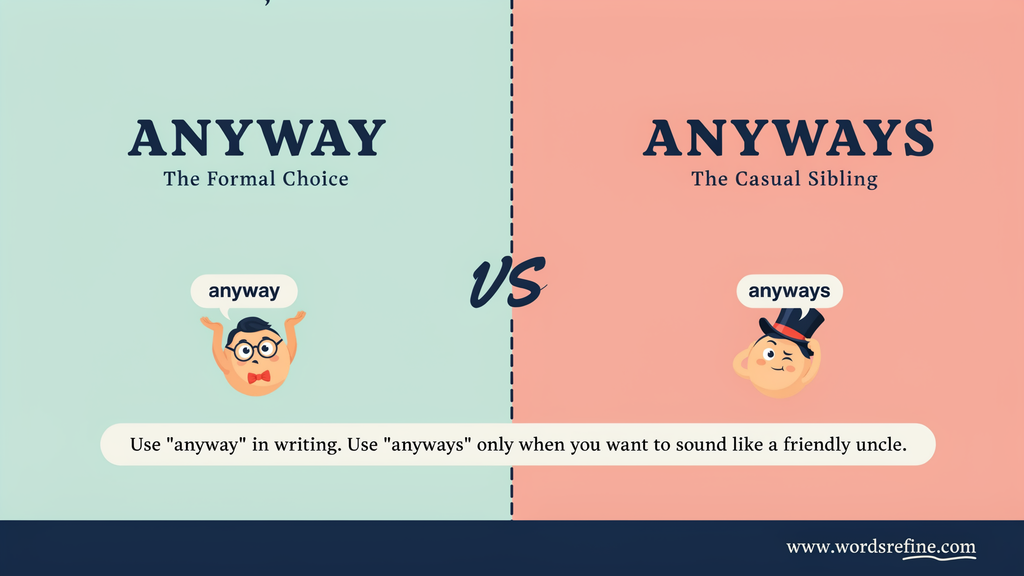
The difference between anyway vs anyways becomes easier to understand when you compare their meanings, tone, and typical settings.
Both words can express the idea of continuing despite a circumstance. Both can introduce a new topic, and both can appear at the beginning or end of a sentence. Nevertheless, they don’t have exactly the same status in standard written English.
| Comparison | Anyway | Anyways |
|---|---|---|
| Meaning | Regardless or in any case | Usually the same |
| Grammatical role | Adverb; also used as a conversational marker | Informal adverbial variant; also used as a conversational marker |
| Tone | Neutral and versatile | More conversational |
| Formality | Suitable for formal and informal contexts | Primarily informal |
| Standard written English | Established standard form | Less conventional in edited prose |
| Best general choice | Yes | When the informal tone suits the context |
Meaning and Grammar
Both words can appear in sentences with essentially the same meaning.
“She decided to apply anyway.”
“She decided to apply anyways.”
In either sentence, the speaker means that she applied despite a circumstance that might have discouraged her.
Likewise, both can introduce a conversational transition.
“Anyway, let’s start the meeting.”
“Anyways, let’s start the meeting.”
The difference is subtle. The first sounds neutral and fits professional communication more easily. The second sounds more casual.
Standardness and Tone
Standard English favors anyway in edited prose. That doesn’t mean every use of anyways is an error. It means anyway is the more widely appropriate option when writing for a broad audience.
Think of word choice as a matter of fit. You might use relaxed language with a close friend but choose more neutral wording when addressing a client. The meaning can stay the same while the tone changes.
Learn the difference between confusing word pairs
Scrapped vs Scraped Differences Examples and Correct Usage?
Anyway vs Anyways A Practical Example
Imagine that a project deadline has passed, and a colleague asks whether the team should still submit its work.
A neutral response might be: “We missed the deadline, but we should submit the report anyway.”
A casual response to a friend might be: “Anyways, we should send it in and see what happens.”
Both sentences communicate the idea of proceeding. However, the first uses anyway vs anyways to show that the missed deadline won’t stop the team from submitting the report. The second uses anyways as an informal transition into a suggestion.
This example also shows why you shouldn’t treat the two forms as interchangeable in every sentence without considering context. They often overlap in meaning, but their tone and placement can differ.
Anyway vs Anyways in American English and British English
The question of anyway vs anyways in British English versus American English often causes unnecessary confusion. Neither word belongs exclusively to one variety of English. Both forms occur in American and British usage, although anyway remains the safer standard choice in both.
The difference is better understood as a matter of formality and usage preference than as a spelling rule that separates the United States from the United Kingdom.
Anyway vs Anyways in American English
In American English anyway vs anyways is common in everyday conversation, professional writing, news articles, and academic work. Americans also use anyways in informal speech and casual messages.
For example:
“Anyway, I’ll email you the information this afternoon.”
“We were tired, but we finished the game anyway.”
“Anyways, what time are you coming over?”
The first two examples use the standard form in contexts ranging from professional to casual. The third reflects an informal conversational style.
If you’re writing for an American audience, anyway is the most reliable choice. It works naturally in almost any context without drawing attention to the writer’s level of formality.
Anyway vs Anyways in British English
British English also uses anyway as the standard form. Some speakers use anyways in conversation, but it isn’t a uniquely British spelling or a word restricted to British English.
For example:
“Anyway, we’d better get moving.”
“I didn’t think it would rain, but we went anyway.”
“Anyways, I’ll see you tomorrow.”
All three sentences are understandable in British English. However, the third has a more informal tone.
The same practical rule applies on both sides of the Atlantic: use anyway in formal writing and choose anyways only when its conversational tone suits the situation.
Learn the difference between often confused words
Tinder vs Tender Differences Examples and Correct Usage?
When Should You Use Anyway vs Anyways?
Choosing between anyway vs anyways doesn’t require a complicated grammar test. Start by considering where you’re writing, who will read your words, and how formal you want to sound.
Use anyway when you need a neutral, widely accepted expression. and Use anyways when you’re deliberately writing informal dialogue or reproducing a speaker’s natural conversational style.
Use Anyway in Formal and Professional Writing
In formal writing, consistency and clarity matter more than reproducing every habit of everyday speech. That’s why anyway is generally preferable in academic papers, business emails, reports, applications, and published articles.
Consider these examples:
Academic writing: “The findings remain relevant even when the smaller sample is excluded.”
Business email: “The meeting is scheduled for Thursday, so I’ll send the agenda anyway.”
Professional report: “The team continued testing anyway because the initial results were inconclusive.”
Formal correspondence: “Anyway, I appreciate your time and consideration.”
The last example is understandable, but anyway at the beginning of a formal letter may sound conversational. Depending on the intended meaning, a more precise transition such as nevertheless or in any case might suit the sentence better.
This illustrates an important point about anyway versus anyways in formal writing: choosing the standard form solves only one part of the problem. You should also consider whether the word itself suits the tone and structure of your document.
Use Anyways in Casual Conversation
In casual conversation, people often prioritize a natural flow over formal conventions. In that setting, anyways can sound relaxed and familiar.
For example:
“Anyways, did you finish that show?”
“I wasn’t going to buy it anyways.”
“Anyways, let’s grab lunch.”
“It was getting late, but we stayed anyways.”
These examples demonstrate informal usage. The word can introduce a new topic, reinforce a decision, or bring a conversation back to its main point.
You don’t need to avoid it in every text message or casual exchange. Just remember that a conversational expression may not suit a professional document.
Can You Start a Sentence With Anyway?
Yes, you can start a sentence with anyway. It often works as a transition that introduces a new point, returns to an earlier subject, or signals that a speaker wants to move forward.
For example:
“1Anyway, let’s discuss the budget.”
“2Anyway, I found the keys under the sofa.”
“3Anyway, we should leave before traffic gets worse.”
When anyway functions as an introductory transition, a comma usually follows it. However, punctuation isn’t a rule that applies mechanically to every possible sentence. It depends on how the word functions in context.
Can You Start a Sentence With Anyways?
Yes, you can start a sentence with anyways, especially in casual conversation and informal writing.
For example:
1“Anyways, what happened after the game?”
2“Anyways, I’ll text you when I arrive.”
3Anyways, let’s stop arguing about it.”
The punctuation works much like it does with anyway. When the word introduces a transition, writers commonly place a comma after it.
Still, if you’re writing an essay, a formal email, or a business report, replace anyways with anyway unless you’re quoting someone or deliberately preserving an informal voice.
Learn the difference between basic English word mistakes
Jibe vs Jive What’s the Difference?
Anyway vs Anyways Examples in Everyday English
Sometimes the easiest way to understand a word is to see how it behaves in real sentences. The following examples cover several common situations.
Examples of Anyway in Sentences
| Sentence | Meaning or function |
|---|---|
| “It was raining, but we went anyway.” | We went despite the rain. |
| “I didn’t want dessert anyway.” | Dessert wasn’t wanted or necessary. |
| “Anyway, let’s return to the main topic.” | The speaker redirects the conversation. |
| “She knew the task was difficult but tried anyway.” | The difficulty didn’t stop her. |
| “Anyway, I’ll call you tomorrow.” | The speaker moves the conversation forward or closes it. |
| “We should prepare anyway, just in case.” | Preparation is worthwhile despite uncertainty. |
| “Anyway, that’s how the problem started.” | The speaker returns to or summarizes a point. |
These examples show how anyway can express persistence, introduce transitions, and add emphasis. The surrounding sentence tells you which meaning applies.
Examples of Anyways in Sentences
The following examples use the informal variant in familiar situations.
| Sentence | Meaning or function |
|---|---|
| “Anyways, let’s order pizza.” | The speaker changes the subject or suggests an action. |
| “I didn’t need the extra notebook anyways.” | The notebook wasn’t necessary. |
| “Anyways, how was your trip?” | The speaker introduces a new topic. |
| “It was expensive, but I bought it anyways.” | The speaker bought it despite the cost. |
| “Anyways, I’ll see you after class.” | The speaker moves the conversation forward or toward a close. |
| “We were late, but we went anyways.” | The delay didn’t stop them. |
In many of these sentences, anyway would work just as well. The informal form mainly changes the tone rather than the central meaning.
Anyway vs Anyways in Conversation
Consider these short conversations.
Conversation about a change of plans:
“Are we still going to the beach?”
“The forecast says it might rain.”
“Anyway, let’s check the weather again before we decide.”
Here, anyway helps move the conversation toward the next step. It doesn’t mean the speakers have already decided to go regardless of the weather.
Conversation between friends:
“Did you finish the movie?”
“No, I fell asleep halfway through.”
“Anyways, do you want to watch something else?”
In this example, anyways signals a shift in topic. It suits the relaxed tone of the conversation.
Conversation about a difficult decision:
“I know the drive will take three hours, but I’m going anyway.”
“Fair enough. Let me know when you arrive.”
The final example uses anyway to emphasize that the speaker intends to go despite the long drive.
The lesson is straightforward: look at what the word does in the sentence. Its function may matter more than the extra s at the end.
Common Mistakes Anyway vs Anyways
Even experienced writers sometimes confuse these words or use them in ways that don’t suit the situation. Fortunately, a few simple rules can help you avoid the most common problems.
Treating Anyways as Always Incorrect
One common mistake is assuming that anyways is never a real word. As explained earlier, it is an established informal variant of anyway.
The problem isn’t that the word cannot exist in a sentence. The problem is using an informal expression where standard written English is expected.
Less suitable for a formal email: “Anyways, I’ll send the report tomorrow.”
Better for a formal email: “Anyway, I’ll send the report tomorrow.”
Both are understandable, but the second is more appropriate for professional communication.
Learn the difference between commonly misused words
Foward vs Forward Meaning Spelling and Correct Usage
Assuming Anyway vs Anyways Have Different Meanings
Another mistake is believing that anyway vs anyways express entirely different ideas. In most ordinary contexts, they have the same basic meaning.
“I went anyway.”
“I went anyways.”
Both sentences indicate that the speaker went despite some circumstance. The difference lies mainly in usage and tone.
Confusing Anyway With Any Way
This is a more significant distinction because anyway and any way can have different grammatical functions and meanings.
Anyway is an adverb or conversational marker meaning regardless or in any case.
Any way is a two-word expression that usually refers to a method, manner, or possible route.
For example:
“Anyway, we found a solution.”
Here, anyway introduces a transition.
“Is there any way to fix this computer?”
Here, any way refers to a possible method of fixing the computer.
The expressions may sound similar, but their meanings aren’t interchangeable.
Adding Unnecessary Punctuation
Writers sometimes place commas wherever they see anyway, even when the sentence structure doesn’t call for them.
When anyway begins a sentence as a transition, a comma is usually appropriate.
“Anyway, we need to leave now.”
When it appears at the end of a sentence, you generally don’t need a comma before it.
“We need to leave now anyway.”
Always consider the word’s role in the sentence rather than adding punctuation automatically.
Anyway vs Anyways Synonyms and Alternatives
If you’re repeating anyway too often, a suitable synonym can make your writing more precise. However, not every alternative works in every context.
The best choice depends on whether you mean regardless, despite that, or simply want to move the conversation forward.
Alternatives for Anyway Meaning Regardless
| Alternative | Meaning and use | Example |
|---|---|---|
| Regardless | Without being affected by a circumstance | “Regardless of the cost, we need a solution.” |
| In any case | Whatever the circumstances | “In any case, we’ll finish by Friday.” |
| Even so | Despite the fact just mentioned | “The task was difficult. Even so, she completed it.” |
| Nevertheless | Despite what has been said | “The evidence was limited. Nevertheless, the team proceeded.” |
| Nonetheless | Despite that; nevertheless | “The forecast was poor. Nonetheless, they continued.” |
| In any event | Whatever happens or whatever the circumstances | “In any event, we should prepare a backup plan.” |
| At any rate | In any case; often used to return to a point | “At any rate, we need to make a decision.” |
These expressions overlap with anyway, but they aren’t always exact substitutes. For instance, nevertheless often creates a more formal contrast, while even so emphasizes a contrast between two statements.
Learn the difference between everyday English mistakes
Broke vs Broken Meaning Differences and Correct Usage ?
Alternatives for Anyway as a Conversation Transition
When you use anyway to change the subject or return to an earlier point, consider these alternatives.
Moving on: “Moving on, let’s discuss the next item.”
To return to the point: “To return to the point, we need more evidence.”
That said: “That said, we should consider another option.”
Back to the question: “Back to the question, when can you start?”
These expressions can make your meaning more specific. Rather than relying on one transition word throughout an article, choose the expression that best describes the relationship between your ideas.
Learn the difference between more words people mix up
Cloth vs Clothe Differences Examples and Correct Usage ?
Practice Session Anyway vs Anyways
- I was tired, but I finished my homework ______.
- Thank you for offering to help ______.
- We missed the bus, but we arrived on time ______.
- The meeting was canceled. ______, we still need to finish the report.
- I don’t think he’ll agree, but I’ll ask him ______.
- She wasn’t feeling well. ______, she decided to attend the event.
- I appreciate your advice ______.
- The restaurant was expensive, but the food was delicious ______.
- I know it’s late, but can we talk for a minute ______?
- The plan didn’t work as expected. ______, we learned something useful.
- He forgot his umbrella, but he made it home safely ______.
- I don’t want to argue about it ______.
- The weather looks bad, but we’re going hiking ______.
- ______, let’s return to the main topic.
- I wasn’t sure about the decision, but I supported it ______.
- She apologized, and I accepted her explanation ______.
- The deadline is approaching. ______, we need to stay focused.
- I know you disagree, but I’ll explain my reasons ______.
- We didn’t win the game, but we enjoyed ourselves ______.
- ______, there’s no point in worrying about something we can’t change.
- He had already eaten, but he joined us for dinner ______.
- I appreciate the invitation, but I can’t attend ______.
- The instructions were confusing. ______, we managed to complete the task.
- I thought the store was closed, but I checked ______.
- ______, let’s focus on what we can do next.
Answers
- anyway
- anyway
- anyway
- Anyway
- anyway
- Anyway
- anyway
- anyway
- anyway
- Anyway
- anyway
- anyway
- anyway
- Anyway
- anyway
- anyway
- Anyway
- anyway
- anyway
- Anyway
- anyway
- anyway
- Anyway
- anyway
- Anyway
Here’s a trusted source for clear more words Comparison:
FAQs
How can you say “anyway” politely?
You can use phrases such as “in any case,” “regardless,” or “that said,” depending on the context. For example, instead of saying, “Anyway, let’s move on,” you could say, “With that in mind, let’s move on.”
Is “thank you anyway” vs “thank you anyways” correct?
“Thank you anyway” is the more standard choice and works well in both casual and professional situations. “Thank you anyways” is also used in informal conversation, but “thank you anyway” is generally the safer option.
Is “anyways” a slang term?
“Anyways” is an informal variant of “anyway.” Although people frequently use it in everyday speech, it isn’t limited to slang. In formal writing, however, “anyway” is usually preferred.
Does “anyways” exist as a word?
Yes, “anyways” is a recognized English word. It serves the same basic purpose as “anyway,” but it has a more informal tone. Its acceptance as a word doesn’t mean it’s the best choice for every situation.
Why do people say “anyways” instead of “anyway”?
People often say “anyways” because they hear it in everyday conversations and adopt it as part of their speaking habits. Regional speech patterns and personal preferences can also influence word choice. Although both forms appear in conversation, “anyway” remains the more widely preferred option in formal English.
Learn the difference between confusing word pairs
Teams vs Teams Meaning Differences Accounts and Features ?
conclusion
The difference between “anyway vs anyways” is easier to understand than it might seem. Both forms appear in everyday English, but “anyway” is the standard choice for professional emails, academic writing, and formal communication. “Anyways” is more common in casual conversations and informal messages. To avoid confusion, consider your audience and the tone you want to convey. With a little practice, you’ll know which form sounds right for each situation. Remember, grammar isn’t about making every sentence complicated; it’s about communicating clearly. When in doubt, choose “anyway.” It’s simple, widely accepted, and one less grammar question to worry about!

Diora AJS she is an experienced blogger and passionate English language enthusiast at Words Refine. With a keen eye for language and a love for clear communication, she writes practical content about grammar, word meanings, usage, and commonly confused terms. Her goal is to make English easier to understand through clear explanations and relatable examples, helping readers write accurately and communicate with confidence.