
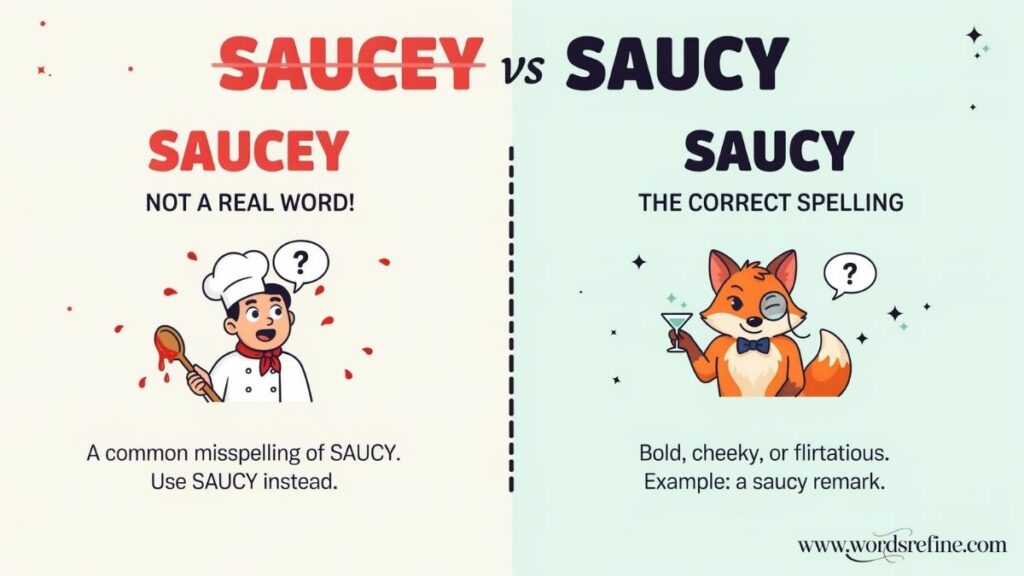
Choosing between Saucey vs Saucy may seem like a small spelling issue, but it can leave even confident writers second-guessing themselves. Both versions look plausible, especially when you’re thinking about a delicious meal covered in sauce. However, saucy is the standard spelling in English. It describes food rich in sauce, someone with a cheeky personality, or a bold remark that adds a little spice to a conversation. Although saucey sometimes appears in informal writing, it isn’t the usual choice in standard English. So, how can you avoid this common mistake? Let’s explore the meanings, examples, and correct usage of saucy.
Saucey vs Saucy Quick Answer?
Saucey vs Saucy is the correct standard spelling. It describes food with plenty of sauce or someone who behaves in a cheeky, bold, playful, or suggestive way.
Saucey is generally a nonstandard spelling when used as the ordinary adjective. It may still appear intentionally in brand names, usernames, and creative expressions.
For example, “The saucy pasta had a rich tomato sauce” uses the correct spelling. Likewise, “She made a saucy remark during the conversation” is correct.
The simple rule is easy to remember: sauce becomes saucy when you drop the final e before adding y.
Saucey vs Saucy Which Is Correct?
Saucy is the correct standard Saucey vs Saucy spelling in both American and British English. It works as an adjective and has several meanings depending on the context. When describing food, it refers to something rich in or covered with sauce. When describing a person, it can mean cheeky, bold, mischievous, or slightly disrespectful.
Saucy can also describe flirtatious behavior or suggestive humor. The meaning depends on how someone uses the word and the situation in which it appears.
Consider these examples:
Correct: The chef prepared a saucy chicken dish with a rich tomato sauce.
Incorrect in standard usage: The chef prepared a saucey chicken dish with a rich tomato sauce.
Correct: Her saucy reply made everyone at the table laugh.
Incorrect in standard usage: Her saucey reply made everyone at the table laugh.
The difference may seem small, but spelling matters. In an article, school assignment, professional email, or business report, using the standard form helps your writing look polished and reliable.
The Simple Rule for Spelling Saucy
The easiest way to remember the correct spelling is to look at the relationship between sauce and saucy.
When forming the adjective, English drops the final e from sauce before adding y.
Sauce becomes saucy.
This pattern also appears in words such as shine and shiny, as well as noise and noisy. Although English spelling has plenty of exceptions, these examples offer a useful reminder that a word doesn’t always keep its final e when you add a suffix.
If you’re ever unsure how to spell saucy, remember to drop the e before adding y. That small change gives you the standard spelling.
Learn the difference between confusing more English words
Wisp vs Whisp Which One Is Correct?
What Does Saucy Mean?
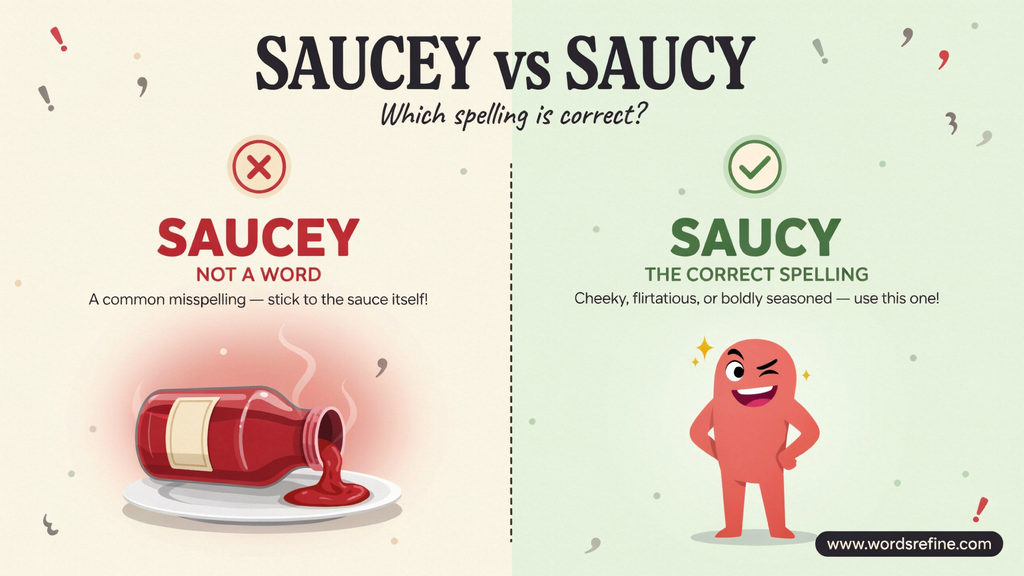
The meaning of saucy changes with the context. Sometimes it describes food, while in other situations it refers to a person’s attitude, behavior, or choice of words.
In everyday English, saucy commonly has three meanings.
1When describing food, it means containing plenty of sauce or having a sauce-rich texture.
2When describing a person, it means cheeky, bold, mischievous, or playfully disrespectful.
3When describing humor or conversation, it can mean flirtatious, teasing, or suggestive.
These meanings are related through the same adjective, but they aren’t interchangeable. A saucy pasta dish has nothing to do with cheeky behavior. Likewise, a saucy remark may have no connection to food.
Saucy Meaning in English
In everyday conversation, saucy often describes someone who speaks or behaves with cheeky confidence. The person might make a clever comeback, tease a friend, or say something that pushes the limits of good manners.
For example, imagine a child who answers a parent’s question with a witty but slightly disrespectful response. The parent might call the child saucy. The word could express amusement, mild annoyance, or both.
Similarly, a comedian might use saucy humor to entertain an audience with playful or suggestive jokes.
Saucy can also describe someone with a lively, mischievous personality. Such a person might enjoy teasing others, making unexpected comments, or challenging people in a lighthearted way.
However, the word doesn’t always carry a positive meaning. A saucy remark between friends might be funny, but the same comment could sound rude during a serious meeting. Context makes all the difference.
Saucy Meaning in Food
When describing food, saucy refers to a dish that contains plenty of sauce or has a moist, sauce-covered texture. The sauce might coat the ingredients, surround them on a plate, or provide much of the dish’s flavor.
For example, saucy pasta might feature noodles covered in tomato sauce. Saucy barbecue ribs might have a generous coating of sticky glaze. Meanwhile, a saucy curry might contain a rich gravy that blends spices, tomatoes, onions, and other ingredients.
It’s important to understand that saucy doesn’t automatically mean spicy. A creamy pasta dish can be saucy without containing chili peppers. Likewise, a mild tomato-based meal can be saucy without any noticeable heat.
The word also doesn’t describe one particular flavor. Depending on the recipe, saucy food can taste sweet, savory, smoky, tangy, creamy, or spicy.
In cooking, the adjective helps readers picture the food’s consistency and the role its sauce plays in the dish.
Saucy Person Meaning
When saucy describes a person, it usually suggests cheekiness, boldness, or a willingness to speak freely. A saucy person might tease a friend, challenge a suggestion with a clever response, or make a mischievous comment.
For example, a saucy child might answer an adult with an unexpected comeback. A saucy friend might tease everyone during dinner. In a comedy, a saucy character might use witty remarks to keep a conversation lively.
The word can express affection, amusement, or criticism. A playful comment might earn a laugh among friends, while a disrespectful remark could make the speaker seem insolent.
Therefore, a saucy personality isn’t necessarily rude. The meaning depends on the person’s intentions, the audience, and the situation.
Saucy Girl Meaning
The phrase saucy girl generally describes a girl or woman who appears cheeky, bold, playful, or mischievous. Depending on the context, it can also suggest flirtatious behavior or a teasing personality.
For example, a writer might describe a fictional character as a saucy girl because she responds with clever remarks and refuses to feel embarrassed easily.
In a lighthearted story, the phrase might sound affectionate. However, it can also seem old-fashioned, patronizing, or suggestive, depending on how someone uses it.
Saucy doesn’t simply mean beautiful or attractive. Instead, it describes a person’s manner, attitude, or behavior.
Saucy Attitude Meaning
A saucy attitude combines confidence with cheekiness. Someone displaying this attitude might challenge another person, tease a friend, or respond with a remark that sounds slightly disrespectful.
Imagine a student who says, “I would have finished the assignment earlier if the instructions hadn’t been so confusing.”
The comment might make the class laugh, but it also challenges the teacher’s instructions. Depending on the classroom atmosphere, the teacher might find it amusing or consider it disrespectful.
This example shows why context matters. Saucy can describe playful confidence, but it can also suggest that someone has crossed a line.
Learn the difference between commonly mixed-up more words
Cadaver vs Corpse Which One Is Correct ?
Saucy Remark and Saucy Comment Meaning
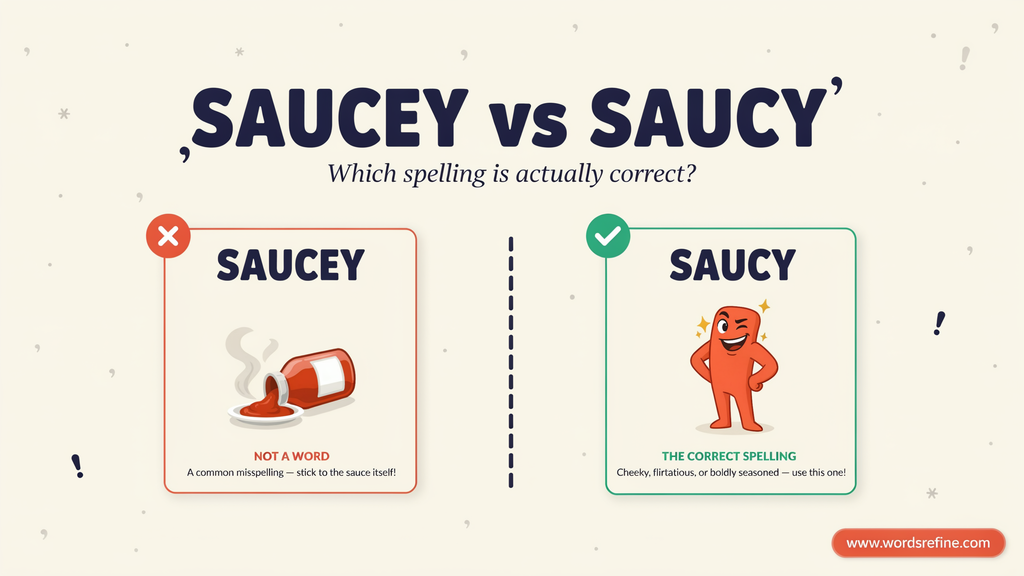
A saucy remark vs saucy comment is a cheeky, bold, teasing, or sometimes suggestive statement. Such a remark often adds humor by challenging expectations or gently testing social boundaries.
For example, Mia might tell her friend, “You’re looking very pleased with yourself. Should we arrange a parade?”
Her response is saucy because it playfully mocks her friend’s confidence. The comment isn’t necessarily offensive. Its humor comes from the teasing tone.
In another situation, a Saucey vs Saucy remark might carry a flirtatious meaning. In that case, the word suggests playful provocation rather than simple cheekiness.
However, a saucy comment can also sound insulting when someone uses it to embarrass another person or undermine their authority. The surrounding conversation helps determine how readers interpret it.
Is Saucey a Word?
People often wonder whether saucey is a real word. The answer depends on what they mean by real word.
In ordinary English writing, saucey is a nonstandard spelling when someone intends to use the adjective saucy. It isn’t the accepted spelling for describing food with plenty of sauce, a cheeky person, or a suggestive joke.
However, businesses, creators, and individuals sometimes choose unusual spellings for names, usernames, and creative projects. A restaurant might use Saucey as its official name because the spelling looks distinctive or connects with its menu.
That choice doesn’t change the standard spelling of the adjective.
For example, a restaurant might advertise saucy noodles on its menu while using Saucey House as its business name. The first is an ordinary adjective, while the second is a proper name whose spelling should be preserved.
The distinction is simple: use saucy in standard prose, but keep Saucey when it forms part of an official name.
Can Saucey Be Used in Informal Writing?
You might encounter saucey in social media captions, online comments, text messages, or playful brand names. People sometimes experiment with spelling to create a particular voice or make a name stand out.
However, seeing a spelling online doesn’t automatically make it a standard alternative.
If you’re writing a casual caption such as “These wings are so saucy,” you should still use saucy. The standard spelling works perfectly well in relaxed conversation and doesn’t sound overly formal.
An intentional spelling choice can make sense when it serves a clear purpose. A username, fictional character, or business may use Saucey as a distinctive name. In ordinary writing, though, saucy remains the better choice.
Saucy vs Saucey A Side-by-Side Comparison
The difference between saucy vs saucey becomes clearer when you compare their spelling and usage.
| Feature | Saucy | Saucey |
|---|---|---|
| Standard spelling | Yes | No, not for the ordinary adjective |
| Part of speech | Adjective | Usually a nonstandard spelling when intended as the adjective |
| Food-related meaning | Rich in or covered with sauce | Not standard in this meaning |
| Personality-related meaning | Cheeky, bold, or mischievous | Not standard in this meaning |
| Suggestive meaning | Can describe flirtatious or provocative humor | Not standard in this meaning |
| Formal writing | Appropriate when the meaning fits | Avoid unless preserving an intentional name |
| Brand or username | Can be used | Can be an intentional spelling choice |
When deciding which spelling to use, consider the purpose of the word. If you’re describing a meal, a person’s attitude, or a cheeky comment, choose saucy. If you’re referring to a business that officially spells its name Saucey, preserve the name as written.
This isn’t a case of American and British spelling differences. Both varieties use saucy as the standard adjective.
Learn the difference between tricky grammar more words
Ironic vs Unironic Meaning, Differences, and Correct Usage
Why Do People Confuse Saucey vs Saucy?
The confusion often starts with the noun sauce. Because Saucey vs Saucy looks like sauce with a y added, the spelling seems logical at first glance.
However, English spelling doesn’t always follow the patterns that feel most natural. In this case, the established adjective drops the final e, producing saucy.
Several things can make the mistake more common.
Visual familiarity plays a role. Writers may prefer saucey because it keeps the original noun intact.
Online exposure can also contribute to confusion. Readers may see nonstandard spellings in captions, comments, usernames, and advertisements. After seeing a form repeatedly, they may begin to assume it’s correct.
Branding creates another source of confusion. Companies sometimes choose unusual spellings to make their names memorable. Readers may then mistake those choices for standard English spelling.
Finally, some writers simply aren’t familiar with the word’s formation. Once they learn that sauce becomes saucy, the spelling is much easier to remember.
The best solution is to learn the established form rather than rely on appearance alone. A spelling can look reasonable without being correct according to standard English conventions.
How to Remember the Correct Spelling of Saucy
You don’t need a complicated grammar lesson to remember saucy. A simple connection between the noun and the adjective will usually do the trick.
Start with sauce. Remove the final e and add y. The result is saucy.
You can reinforce the rule by remembering this sentence:
“The saucy chef served a saucy dish and made a saucy joke.”
The first use describes the chef’s behavior. The second describes the food. The third describes the joke. The spelling stays the same even though the meaning changes.
You can also use a quick proofreading check. When describing food with plenty of sauce, write saucy. When describing a cheeky person or a playful remark, write saucy as well. If you’re reproducing a business name that intentionally uses Saucey, preserve its official spelling.
This simple habit can help you avoid the mistake in emails, essays, articles, captions, and everyday messages.
Saucy Examples How to Use Saucy in a Sentence
Examples make the different meanings easier to understand. Although the context changes, the spelling remains the same.
Examples About Food
Food writers often use saucy to describe meals with plenty of sauce, a moist texture, or a generous coating of flavor.
The restaurant is famous for its saucy barbecue ribs.
I added more tomato sauce to make the pasta saucy.
The chicken stayed tender beneath its rich, saucy glaze.
We served the saucy meatballs over a bed of rice.
Her recipe produces a saucy curry with a flavorful gravy.
The chef paired the grilled vegetables with a saucy tomato base.
These noodles taste best when the sauce coats every strand.
Notice that saucy doesn’t identify the ingredients or flavor by itself. Instead, it describes the amount or consistency of the sauce. Words such as creamy, smoky, tangy, and spicy can provide additional details.
Examples About Personality
When saucy describes a person, it often conveys cheekiness, confidence, or mild disrespect.
The saucy child answered his father with a clever comeback.
Her saucy attitude made the family dinner more entertaining.
He gave the coach a saucy grin after scoring the winning goal.
The character’s saucy personality made her stand out in the novel.
My friend made a saucy comment about my terrible dancing.
The saucy teenager challenged the rule with a sarcastic question.
These examples show that saucy can describe a person directly or modify a related noun, such as attitude, personality, or comment.
Examples About Humor and Flirting
Saucy can also describe humor that feels playful, flirtatious, or suggestive.
The comedian included a few saucy jokes in the show.
Their saucy conversation made the other guests smile.
She responded with a saucy remark that caught him off guard.
The romantic comedy relies on saucy humor and playful banter.
His saucy expression suggested that he had another joke ready.
The magazine published a saucy story aimed at adult readers.
The tone matters in each example. A saucy comment may fit a comedy or a conversation among friends. In a workplace email or an academic paper, the same wording might feel out of place.
Learn the difference between confusing word pairs
Trebled vs Tripled Which One Is Correct?
Correcting Saucey in a Sentence
Because saucey is generally a nonstandard spelling of saucy, the following examples show how to correct it in ordinary writing.
Incorrect: The saucey pasta tasted delicious.
Correct: The saucy pasta tasted delicious.
Incorrect: She made a saucey remark during dinner.
Correct: She made a saucy remark during dinner.
Incorrect: His saucey attitude surprised the teacher.
Correct: His saucy attitude surprised the teacher.
Incorrect: The saucey wings were covered in barbecue glaze.
Correct: The saucy wings were covered in barbecue glaze.
These corrections apply to ordinary prose. If Saucey appears in the official name of a product or business, don’t change it simply because the spelling differs from the standard adjective.
Saucy Pronunciation How Do You Say Saucy?
In American English, saucy is commonly pronounced SAW-see. The word has two syllables, with the stress on the first syllable.
The first syllable sounds like saw for many American speakers, while the second rhymes with see.
When someone writes saucey to represent the intended adjective, the pronunciation would generally remain the same. However, the standard written form is still saucy.
Pronunciation can help you recognize the word when you hear it, but it won’t help you distinguish the two spellings because they are generally pronounced alike in this context.
When proofreading, focus on the written form. Saucy is the standard adjective.
Saucy Synonyms What Other Words Can You Use?
The best synonym for saucy depends on what you’re trying to describe. A word that works for a cheeky remark may sound strange when describing pasta.
1For food, sauce-rich, sauce-covered, and well-sauced can describe a dish with plenty of sauce.
2For a person, cheeky, sassy, mischievous, and impudent may express different shades of bold or playful behavior.
3For flirtatious or provocative language, teasing, suggestive, flirtatious, and risqué may be more precise.
These words aren’t interchangeable in every situation. Insolent, for example, usually carries a stronger negative judgment than saucy. Mischievous suggests playful troublemaking, while suggestive points toward an implied meaning that may be romantic or sexual.
Choose a word that matches the tone you want instead of replacing saucy automatically.
Saucy vs Sassy
Saucy and sassy overlap when they describe a cheeky or bold person. Both can suggest confidence, playful defiance, or a willingness to answer back.
However, sassy often emphasizes spirited confidence and sharp wit. Saucy can carry a stronger sense of impudence, flirtation, or suggestiveness.
For example, a sassy response might show that someone won’t be intimidated. A saucy response might sound playfully provocative or slightly cheeky.
The distinction isn’t absolute. In casual conversation, the words can describe similar behavior.
Saucy vs Cheeky
Cheeky often describes behavior that is mildly disrespectful but amusing or daring. Saucy can carry the same meaning, although it may also suggest flirtatious or provocative humor.
A child who makes a clever comment to a parent might be called cheeky. An adult who makes a playful, suggestive remark might be described as saucy.
British English uses cheeky particularly often in everyday conversation, but saucy is also a standard word in both American and British English.
Saucy vs Bold
Bold describes confidence, courage, or a willingness to take risks. It doesn’t necessarily imply cheekiness or disrespect.
A bold speaker might challenge an unpopular decision during a professional meeting. A saucy speaker might make a cheeky remark about that decision.
The difference lies in the tone. Boldness can be serious and admirable, while sauciness often adds humor, impudence, or playful provocation.
Saucy vs Spicy
Although saucy and spicy sometimes appear in food descriptions, they refer to different qualities.
Saucy describes food with plenty of sauce or a sauce-rich consistency. Spicy usually describes food with strong spices or noticeable heat, particularly from chili peppers.
For example, saucy pasta might have a thick tomato sauce without any chili. Spicy pasta might contain hot peppers and deliver a strong kick. A curry can be both saucy and spicy if it has a generous gravy and plenty of chili.
A dish can be saucy, spicy, both, or neither. The words describe different characteristics.
Learn the difference between often confused words
Hierarchical vs Hierarchal Which One Is Correct?
Saucy in Cooking What Makes Food Saucy?
In cooking, saucy usually describes a dish in which sauce plays a prominent role. The sauce might coat the ingredients, pool around them, or provide much of the dish’s moisture and flavor.
A saucy tomato sauce might cling to pasta or cover meatballs. and A saucy stir-fry might coat vegetables and noodles in a glossy mixture. A saucy curry might contain enough gravy to accompany rice or bread.
The adjective doesn’t define a precise amount of liquid. One recipe may describe a dish as saucy because its ingredients sit in a generous gravy. Another may use the word because a thick glaze coats every piece of food.
If you want to describe a dish more precisely, combine saucy with another adjective.
A rich and saucy sauce emphasizes depth of flavor and a generous consistency.
Thick and saucy gravy highlights the texture and amount of gravy.
Light and saucy pasta suggests a noticeable sauce without a heavy coating.
Sweet and saucy ribs describes both the sauce’s flavor and its generous coating.
Creamy and saucy noodles highlights a smooth texture and plenty of sauce.
These combinations help readers imagine the dish more clearly. They also explain why saucy works well in restaurant menus, recipes, and food reviews.
Saucy in Formal and Informal Writing
The right choice depends on whether you’re using the ordinary adjective or reproducing an intentional name. The setting also affects whether saucy itself is the best word.
Saucy in Everyday Conversation
In casual conversation, saucy works well when the context makes its meaning clear. You might describe your favorite meal as saucy or call a friend’s playful comeback a saucy remark.
The word often sounds lively and expressive. However, it can also feel old-fashioned, cheeky, or suggestive depending on the speaker and situation.
Saucy in Professional Communication
Saucy can fit professional writing when the subject calls for it. A restaurant reviewer might praise a saucy dish, while a marketing writer might describe a comedy as saucy.
However, the adjective may sound too casual in a formal report or a sensitive workplace discussion. In those situations, more precise language often works better.
For example, “The restaurant serves saucy noodles” works well in casual writing. In a detailed food review, “The restaurant serves noodles coated in a rich sesame sauce” gives the reader a clearer picture.
Similarly, instead of saying that someone made a saucy comment, you might describe the comment as cheeky or suggestive, depending on its meaning.
The goal isn’t to avoid saucy entirely. It’s to choose language that fits your audience and purpose.
Saucy in Academic Writing
Academic writing usually benefits from precise, neutral language. If you’re discussing food, describe the sauce’s texture, ingredients, or role in the dish. If you’re analyzing dialogue, explain whether a character’s language is cheeky, flirtatious, insolent, or suggestive.
For example, instead of writing, “The character makes a saucy remark,” an academic analysis might say, “The character uses a suggestive remark to challenge the other speaker’s authority.”
This wording explains what the remark does rather than relying on a broad adjective.
Regardless of the writing style, use saucy when the adjective fits. Don’t use saucey as an informal spelling simply because the writing feels relaxed.
American English vs British English Does the Spelling Change?
No. Saucy is the standard spelling in both American and British English.
Some English words have accepted regional spelling differences. For example, American English generally uses color, while British English uses colour. The distinction between saucey vs saucy doesn’t work that way.
Both American and British writers use saucy to describe food, cheeky behavior, and suggestive humor. The tone or frequency of particular expressions may vary between communities, but the standard spelling remains the same.
If you’re writing for an American audience, use saucy. If you’re writing for a British audience, use saucy as well.
You don’t need to change the spelling when adapting an article from one variety of English to the other.
Learn the difference between basic English word mistakes
Taylored vs Tailored Which One Is Correct?
Common Mistakes With Saucey vs Saucy
Even though the spelling rule is simple, several related mistakes can affect meaning and tone.
One common error is using Saucey vs Saucy instead of saucy. For example, “The restaurant’s saucey ribs were delicious” should read, “The restaurant’s saucy ribs were delicious.”
Another mistake is assuming that saucy only describes food. In reality, the adjective can also describe a person’s attitude, behavior, or remarks.
Writers sometimes confuse saucy with spicy as well. A sauce-rich dish isn’t necessarily hot, and a spicy dish doesn’t necessarily contain much sauce. If you mean that food contains chili peppers, spicy may be more accurate.
It’s also a mistake to assume that saucy always carries a negative meaning. The word can suggest disrespect, but it can also describe playful confidence or amusing cheekiness.
Finally, avoid correcting an intentional brand name without checking its official spelling. If a company uses Saucey as its name, preserve that spelling when referring to the business.
The setting matters, too. A saucy comment might fit a comedy script or a conversation among friends, but it may not suit a formal apology or a serious workplace email. When in doubt, choose a more precise word that conveys your meaning without creating the wrong impression.
Learn the difference between commonly misused words
Siked vs Psyched Which One Is Correct?
Practice Session Saucy vs Saucey
- The chef prepared a rich and ______ pasta dish.
- Mia gave her brother a ______ reply.
- The waiter served the chicken with a ______ tomato sauce.
- Everyone laughed at the boy’s ______ comment.
- This recipe needs more ______ to improve its flavor.
- Her ______ attitude made the conversation more entertaining.
- The teacher warned the student against making ______ remarks in class.
- We ordered a ______ burger with extra sauce.
- He gave his friend a ______ smile after telling the joke.
- The actress delivered a ______ line that surprised the audience.
- My grandmother called me a ______ child when I talked back playfully.
- The restaurant is famous for its ______ barbecue ribs.
- His ______ response sounded funny rather than rude.
- The little girl made a ______ remark that made everyone smile.
- The chef added a flavorful dressing to the salad, making it extra ______.
- She is known for her confident and ______ personality.
- The boy received a warning for his ______ behavior.
- The sandwich tasted better with a rich, ______ filling.
- His ______ sense of humor kept the group entertained.
- The customer requested a more ______ curry.
- Her ______ reply showed that she was not afraid to speak her mind.
- The actor played a character with a bold and ______ personality.
- We enjoyed the pasta because it was creamy and ______.
- He made a ______ joke that everyone remembered.
- Remember that “saucy” is the standard spelling, not “______.”
Answers
- Saucy
- Saucy
- Saucy
- Saucy
- Sauce
- Saucy
- Saucy
- Saucy
- Saucy
- Saucy
- Saucy
- Saucy
- Saucy
- Saucy
- Saucy
- Saucy
- Saucy
- Saucy
- Saucy
- Saucy
- Saucy
- Saucy
- Saucy
- Saucy
- Saucey
Here’s a trusted source for clear more words Comparison:
FAQs
What is another word for saucy?
Synonyms for saucy include cheeky, sassy, bold, impudent, and playful. The best choice depends on whether you mean a person’s behavior, a remark, or food with plenty of sauce.
What does saucy mean when describing someone’s personality?
A saucy personality is bold, cheeky, and playfully disrespectful. A saucy person may tease others or make witty remarks without intending to offend them.
What does the phrase “saucy boy” mean?
A saucy boy is someone who acts cheeky, mischievous, or unusually bold. The phrase often describes a boy who talks back playfully or makes teasing comments.
What does it mean when someone gets saucy?
When someone gets saucy, they start acting more cheeky, sassy, or bold. They might make a sharp remark, tease someone, or respond with playful attitude.
What did saucy mean in older English?
In older English, saucy often meant impudent, insolent, or disrespectfully bold. People used it to describe someone who spoke or behaved too boldly, especially toward someone in authority.
What is a saucy attitude?
A saucy attitude involves cheeky confidence, teasing remarks, or playful defiance. Depending on the situation, it can seem funny and charming or rude and disrespectful.
How do you use saucy in a sentence?
You can use saucy to describe food, a person’s behavior, or a remark. For example, “She gave him a saucy reply that made everyone laugh.”
What does saucy mean in urban slang?
In informal slang, saucy can describe someone who acts confident, sassy, stylish, or flirtatious. Its exact meaning depends on the speaker and the context.
What does “saucy girl” mean?
A saucy girl is a girl or woman who acts cheeky, confident, playful, or flirtatious. The phrase can sound affectionate or critical, depending on how someone uses it.
What does “saucey” mean in slang?
Saucey is an informal alternative spelling sometimes used online to suggest confidence, style, swagger, or a playful attitude. However, saucy is the standard spelling in ordinary English.
What does “I’m so saucy” mean?
“I’m so saucy” usually means “I’m feeling bold, cheeky, or sassy.” In some contexts, it can also suggest that the speaker feels stylish, confident, or flirtatious.
What does saucy mean?
Saucy has several meanings. It can describe food containing plenty of sauce, a cheeky or bold person, or a playful and slightly provocative remark. The surrounding sentence helps determine the intended meaning.
Is Saucy the same as KFC?
No. Saucy and KFC are not the same thing. Saucy is an English word that can describe food or behavior, while KFC is a fast-food restaurant brand known for its fried chicken.
Learn the difference between more words people mix up
Ambassador vs Embassador Which Spelling Is Correct?
Conclusion
Choosing between saucy vs saucey is easier than it looks. Saucy is the standard spelling for food full of sauce, a cheeky personality, or a bold remark. Saucey may appear in informal online writing, but saucy remains the correct choice in standard English.
To remember the difference, think of how sauce changes when you add a y: you drop the final e to form saucy. This simple spelling rule can help you avoid a common mistake. Whether you’re describing a delicious pasta dish or a friend who always has a witty comeback, saucy gets the message across. After all, a little attitude can be charming, a flavorful sauce can make a meal memorable, and the wrong spelling can leave your writing in a bit of a stew!

Diora AJS she is an experienced blogger and passionate English language enthusiast at Words Refine. With a keen eye for language and a love for clear communication, she writes practical content about grammar, word meanings, usage, and commonly confused terms. Her goal is to make English easier to understand through clear explanations and relatable examples, helping readers write accurately and communicate with confidence.