
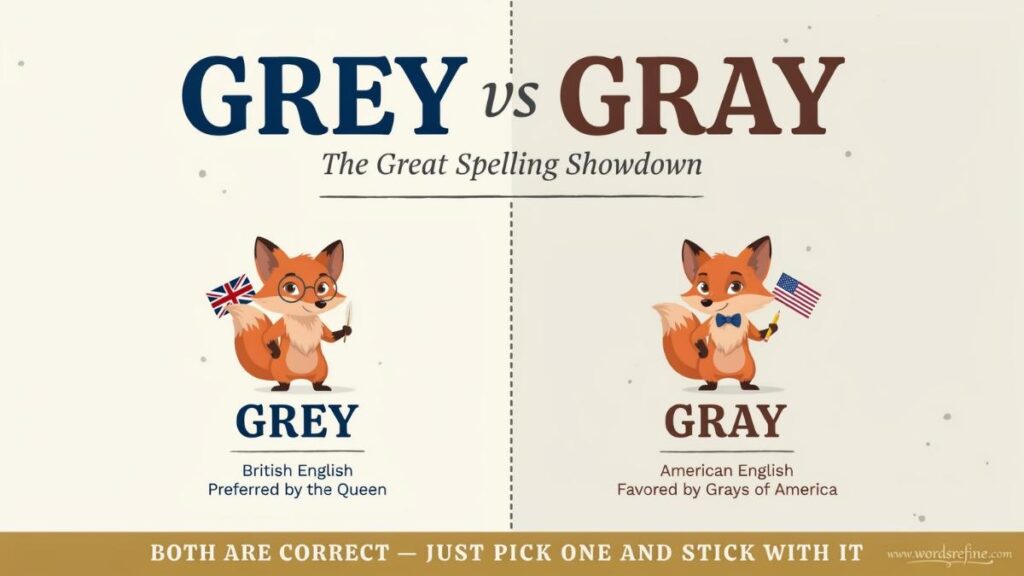
Grey vs gray? Although these words differ by just one letter, they can leave even confident writers second-guessing their spelling. Is one correct and the other a mistake? Not quite! Both spellings are correct, but their use depends on regional English conventions. American writers generally prefer gray, whereas British and Australian writers favor grey. Despite this small difference, both words have the same meaning and pronunciation. In this guide, you’ll learn how to distinguish grey vs gray, understand where each spelling belongs, and avoid common mistakes. After all, choosing a color shouldn’t feel like solving a spelling mystery!
Quick Answer Grey vs gray
Both grey vs gray are correct spellings of the color between black and white. The main difference comes down to regional preferences.
Gray is the standard spelling in American English, while grey is the preferred spelling in British English. Canadian, Australian, and Irish English generally favor grey as well, although gray also appears in these regions.
For example, an American writer might describe a house as having a beautiful gray exterior. Meanwhile, a British writer would generally use grey exterior.
Both sentences communicate the same meaning. Neither spelling represents a different shade or changes the pronunciation.
If you’re writing for American readers, choose gray. However, if your audience lives primarily in the United Kingdom, grey is the better choice. Most importantly, use the same spelling throughout your writing.
Learn the difference between confusing more English words
Glinda vs Galinda Which One Is Correct and ?
What Does Grey or Gray Mean?
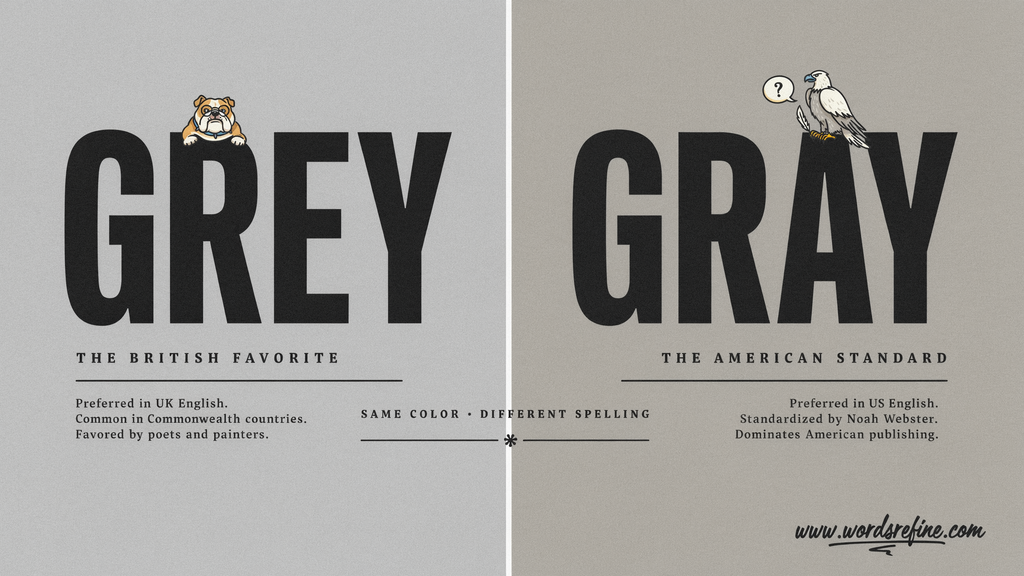
Grey or gray refers to a neutral color between black and white. Unlike bright colors such as red, blue, or yellow, gray doesn’t have one distinctive appearance. Instead, it comes in a wide range of light and dark shades.
For instance, light gray can look almost white, while charcoal gray appears much darker. Depending on its undertones, the color may also have hints of blue, green, brown, or purple.
Both spellings describe exactly the same color.
Examples include:
- The clouds turned dark gray before the storm.
- She wore a light grey sweater to work.
- The living room has soft gray walls and white furniture.
- His grey jacket matched his black shoes.
- A silver-gray car pulled into the driveway.
Gray as a Noun and an Adjective
Both gray and grey can function as nouns and adjectives. The meaning depends on how you use the word in a sentence.
As an adjective, the word describes the color or appearance of something.
For example, the cat has beautiful gray fur. She bought a grey handbag, and dark gray curtains covered the windows.
As a noun, the word identifies the color itself.
For example, gray is a popular choice for modern interiors. Similarly, an artist might mix black and white to create a particular shade of grey.
The Figurative Meaning of Grey vs Gray
Beyond its use as a color, grey or gray also appears in figurative expressions. One familiar example is gray area or grey area.
A gray area describes a situation that isn’t clearly defined or doesn’t fit neatly into one category. It often involves uncertainty, unclear rules, or questions without straightforward answers.
For example, a company’s policy might allow employees to work remotely without explaining whether they can work from another country. That missing detail creates a gray area.
Similarly, you might encounter a grey area when discussing legal questions, workplace responsibilities, or ethical decisions.
The expression uses color as a metaphor. Black and white often represent clear opposites, while gray represents the uncertain space between them.
Learn the difference between commonly mixed-up more words
Hoodie vs Hoody Which One Is Correct?
The Origin and History of Grey vs Gray
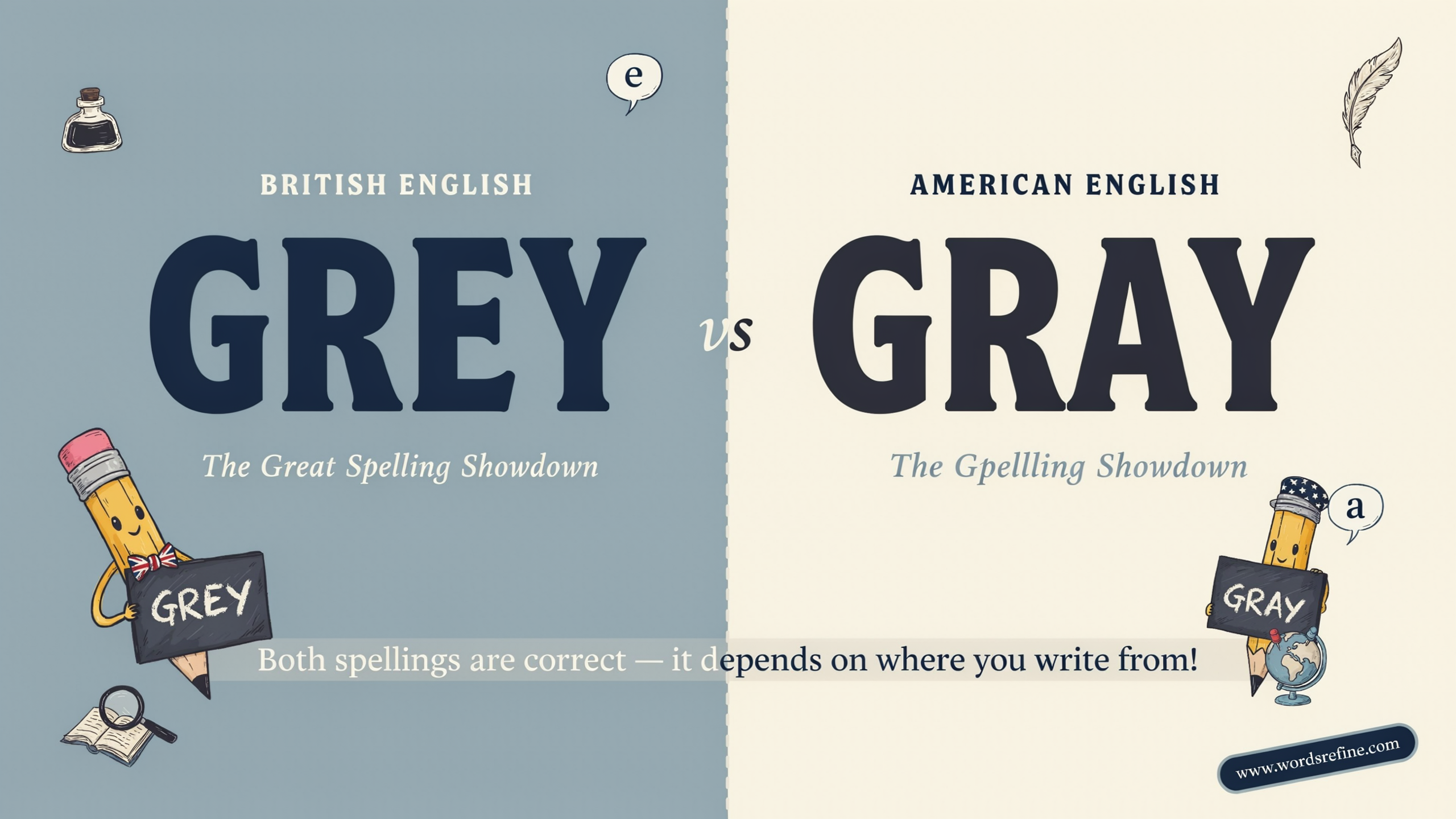
Although grey and gray look different, they share the same linguistic roots. Both developed from the Old English word grǣg, which described the color between black and white.
Over time, English spelling changed considerably. Writers used different forms of the word, which gradually developed into the modern spellings we recognize today.
The difference never represented two separate colors. Instead, it developed through regional spelling habits.
How Did Gray Become the American Spelling?
American English gradually adopted gray as its preferred spelling. During the 18th and 19th centuries, American dictionaries and spelling reform movements helped establish more consistent writing conventions.
Noah Webster played an important role in standardizing American English. His dictionaries promoted several spelling preferences that distinguished American writing from British conventions.
Although Webster didn’t introduce every difference between the two varieties, his work helped strengthen the preference for spellings such as gray.
Today, American dictionaries, including Merriam-Webster, recognize gray as the primary American spelling while also acknowledging grey as an alternative.
How Did Grey Become the British Spelling?
British English retained grey as its preferred form. The spelling became established in British dictionaries, newspapers, books, and everyday communication.
Unlike American English, which generally favors gray, British English continues to use grey in ordinary writing.
For example, British writers describe a cloudy sky as grey, while American writers describe the same sky as gray.
Both versions are correct. The difference simply reflects the spelling conventions used in each region.
Grey vs Gray in American and British English
The easiest way to understand the difference between grey and gray is to consider your audience.
English doesn’t have one universal spelling system for every country. Instead, different regions follow established conventions. American and British English are two familiar examples.
| English variety | Preferred spelling | Example |
|---|---|---|
| American English | Gray | A gray cat |
| British English | Grey | A grey cat |
| Canadian English | Generally grey | A grey building |
| Australian English | Generally grey | A grey jacket |
| Irish English | Generally grey | A grey morning |
These preferences provide useful guidance, although individual publications and established names may follow different conventions.
Learn the difference between tricky grammar more words
Heyday vs Hayday Meaning Correct One Differences?
Grey vs Gray in American English
In the United States, gray is the standard spelling.
If you’re writing an American article, school assignment, business email, or professional document, gray is generally the appropriate choice.
For example, you might write that the walls are painted light gray, your grandfather’s hair has turned gray, or dark gray clouds covered the sky.
American dictionaries, including Merriam-Webster, recognize gray as the preferred form.
Therefore, if your readers primarily live in the United States, use gray unless a specific name, quotation, or title requires grey.
Grey vs Gray in British English
In the United Kingdom, grey is the preferred spelling.
British writers use it in everyday communication, formal documents, newspapers, educational materials, and literature.
For example, the grey horse ran across the field. He bought a grey coat for winter, and her hair began turning grey as she grew older.
British dictionaries generally recognize grey as the preferred form.
Therefore, if you’re wondering how to spell grey in the UK, use the version with an E.
Grey vs Gray in Canadian English
Canadian English generally favors grey, following British spelling conventions for this particular word.
For example, a Canadian writer might describe a building as having a grey stone exterior or mention that someone has a few grey hairs near their temples.
However, Canadian English isn’t simply British English with a different accent. It combines British and American influences, so you may encounter gray in Canadian publications, product names, and technical contexts.
When writing for a Canadian audience, check the relevant dictionary or publication guidelines if consistency matters.
Grey vs Gray in Australian and Irish English
Australian English generally prefers grey, following the traditional British spelling convention.
For example, Australian writers might describe grey clouds disappearing by lunchtime or someone wearing a grey suit to an interview.
Irish English also generally favors grey in standard writing.
Nevertheless, individual publications, businesses, and proper names may preserve alternative spellings. These regional preferences describe common usage rather than rules that every writer must follow.
Learn the difference between confusing word pairs
cocoon vs cacoon Which One Is Correct?
Grey vs Gray Side-by-Side Comparison
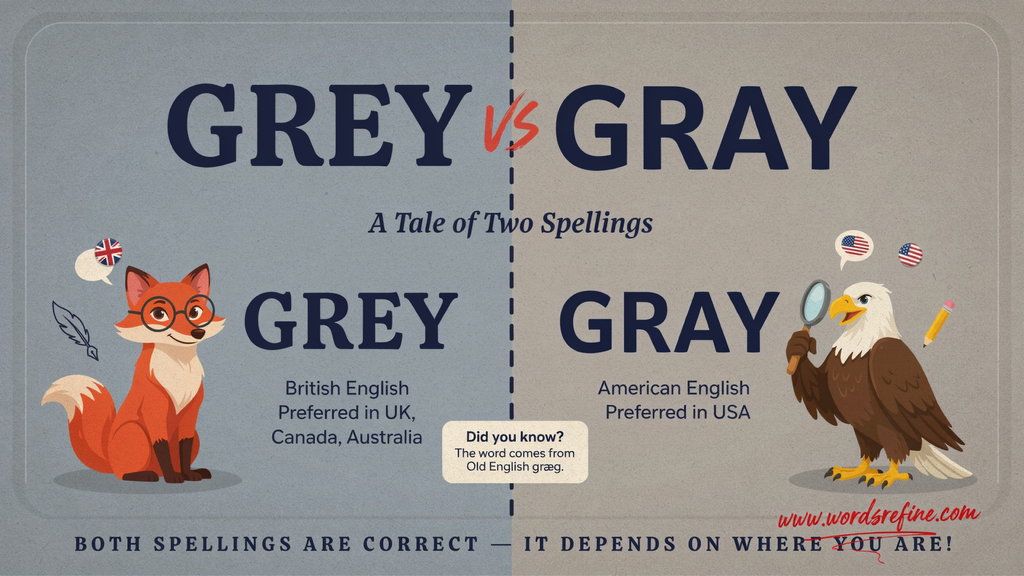
Sometimes a simple comparison explains more than several paragraphs. The following table highlights the main differences.
| Feature | Gray | Grey |
|---|---|---|
| Preferred region | United States | United Kingdom |
| Meaning | Color between black and white | Color between black and white |
| Pronunciation | /ɡreɪ/ | /ɡreɪ/ |
| Grammatical function | Noun and adjective | Noun and adjective |
| Comparative | Grayer | Greyer |
| Superlative | Grayest | Greyest |
| Present participle | Graying | Greying |
| Common derivative | Grayish | Greyish |
| Hair description | Gray hair | Grey hair |
| Figurative expression | Gray area | Grey area |
As the comparison shows, the spelling changes, but the meaning and pronunciation remain the same.
Grey vs Gray Pronunciation
One reason people wonder about these spellings is that they look different. However, both words have exactly the same standard pronunciation.
The pronunciation is /ɡreɪ/.
The word begins with a hard G sound, followed by the long A sound found in day. It ends with the same sound you hear in words such as say and play.
There is no standard pronunciation difference that corresponds to the different spellings.
In other words, whether you write grey or gray, you pronounce it the same way.
Grey vs Gray in Everyday Writing
Although the spelling difference is regional, both forms appear in everyday situations.
You might describe someone’s hair, a piece of clothing, a cloudy afternoon, or the color of a building. In all these cases, your spelling choice should follow the English variety you’re using.
| Context | American English | British English |
|---|---|---|
| Clothing | Gray sweater | Grey sweater |
| Weather | Gray clouds | Grey clouds |
| Animals | Gray cat | Grey cat |
| Furniture | Gray sofa | Grey sofa |
| Hair | Gray hair | Grey hair |
| Buildings | Gray walls | Grey walls |
| Vehicles | Gray car | Grey car |
Notice that the meaning doesn’t change. Only the spelling does.
Grey vs Gray Hair?
Both gray hair and grey hair are correct.
American English generally uses gray hair, while British English prefers grey hair.
The expression describes hair that has lost some of its natural pigment and appears gray or silver. This change commonly happens with age, although genetics and individual biology influence when it occurs.
For example, an American writer might say that their grandfather started getting gray hair in his early forties. Meanwhile, a British writer might describe someone’s grandmother as having beautiful grey hair.
The related verb forms follow the same regional preferences.
| American English | British English |
|---|---|
| Gray | Grey |
| Graying | Greying |
| Grayed | Greyed |
| Grayer | Greyer |
| Grayest | Greyest |
For example, an American writer might say, “His hair is graying,” while a British writer might write, “His hair is greying.”
Both sentences are correct.
Gray Area or Grey Area?
The expressions gray area and grey area are equally correct. Your preferred spelling depends on your regional English convention.
A gray area describes something uncertain, unclear, or difficult to classify.
Imagine a workplace policy that allows employees to work remotely but doesn’t explain whether they can work from another country. That missing detail creates a gray area.
Similarly, a contract might contain unclear responsibilities, or a law might leave room for different interpretations.
The expression is especially common in discussions about law, business, ethics, education, and personal decisions.
It uses color as a metaphor. Black and white represent clear distinctions, while gray represents uncertainty or a situation that falls somewhere between two positions.
Grey vs Gray in Color Descriptions
When describing colors, both spellings work in exactly the same way.
Gray is a neutral color between black and white. However, it comes in many variations that create different visual effects.
Some familiar shades include light gray, dark gray, charcoal gray, slate gray, and silver-gray.
Light gray walls can make a small room feel brighter, while charcoal gray furniture creates a darker and more dramatic appearance. Similarly, slate gray often has a subtle blue undertone, while silver-gray fabric can produce a shiny, metallic effect.
These shades are useful in interior design, fashion, painting, and digital graphics.
The color terminology remains the same regardless of whether you use the American spelling gray or the British spelling grey.
Learn the difference between often confused words
Arised vs Arose Which Is Correct?
Grey vs Gray Related Words and Their Spellings
The spelling difference doesn’t disappear when you add suffixes or change the grammatical form. Several related words follow the same American and British patterns.
Understanding these variations will help you avoid inconsistencies when writing longer sentences or articles.
Grayish vs Greyish
Both grayish and greyish are correct.
The suffix ish means somewhat or slightly. Therefore, grayish or greyish describes something that has a little of the color gray.
For example, the sky had a grayish appearance before the rain started. An old photograph might have a greyish tint, while someone’s blue eyes may sometimes look grayish in dim light.
American English generally prefers grayish, while British English generally uses greyish.
Grayer vs Greyer
When comparing two things, use grayer in American English and greyer in British English.
Both forms are comparative adjectives. They describe something that has more gray or grey than another object.
For example, today’s sky looks grayer than yesterday’s. Similarly, someone might notice that their hair became greyer as they grew older.
The spelling follows the same regional pattern as the original adjective.
Grayest vs Greyest
The superlative form also follows the regional spelling difference.
Grayest is preferred in American English, while greyest is preferred in British English.
A superlative adjective describes the highest degree of a particular quality.
For example, an artist might select the grayest shade in a collection. Similarly, someone might describe January as the greyest month of the year.
Graying vs Greying
The words graying and greying describe something gradually becoming gray or grey.
They can refer to hair, skies, photographs, or other objects.
For example, an American writer might say that someone’s hair is graying naturally. A British writer might describe the same change as greying.
Both forms are correct when used according to their respective regional conventions.
Learn the difference between basic English word mistakes
Carmel vs Caramel Which One Is Correct?
Special Cases Grey vs Gray in Names Science and Expressions
Although regional spelling conventions provide a reliable guide, some words and names have established spellings that don’t necessarily follow the usual pattern.
These exceptions matter because changing a proper name or technical term can create an error even when the alternative spelling looks reasonable.
Gray Matter or Grey Matter?
Both gray matter and grey matter are correct regional spellings.
The term refers to areas of the brain and spinal cord that contain a high concentration of neuronal cell bodies and other nervous system components.
Gray matter plays an important role in processing information, movement, memory, and other brain functions.
American scientific writing generally uses gray matter, while British writing generally prefers grey matter.
For example, scientists study gray matter to understand brain structure and function. Similarly, neurological research may examine changes in grey matter associated with certain conditions.
Earl Grey or Earl Gray?
The established name is Earl Grey, not Earl Gray.
Earl Grey is a type of tea traditionally flavored with bergamot oil, which gives it a distinctive citrus aroma.
The name comes from Charles Grey, the 2nd Earl Grey, a British prime minister in the 19th century.
Although American English uses gray for the color, the tea retains its established name.
For example, someone might order a cup of Earl Grey tea or enjoy its distinctive bergamot flavor in the afternoon.
Writing Earl Gray would incorrectly change the traditional name of the tea.
Greyhound or Grayhound?
The correct spelling of the dog breed is greyhound.
A greyhound is a tall, slender dog known for its speed, narrow body, and long legs. Historically, people bred greyhounds for hunting and coursing.
The spelling remains greyhound in both American and British English.
For example, someone might adopt a retired greyhound from an animal rescue organization or watch a greyhound run across a field.
Even though Americans normally write gray, they still use greyhound.
This is a good example of why established word spellings don’t always follow regional color conventions.
Grey’s Anatomy or Gray’s Anatomy?
The correct title of the popular American medical television drama is Grey’s Anatomy.
The series premiered in 2005 and follows the professional and personal lives of doctors working at a fictional hospital.
Although the show originated in the United States, its title uses Grey rather than Gray.
This spelling is part of the official title and should remain unchanged.
Writing Gray’s Anatomy would change the program’s established name.
Gray The Radiation Measurement Unit
In science, gray has a meaning that goes beyond the color.
The gray, represented by the symbol Gy, is the SI unit of absorbed radiation dose. It measures how much energy ionizing radiation deposits in a given mass of material.
One gray equals one joule of absorbed energy per kilogram.
1 Gy = 1 J/kg
The unit was named after British physicist Louis Harold Gray, who made important contributions to radiation physics.
Medical professionals use absorbed radiation dose measurements when discussing radiation treatments.
In this scientific context, the spelling is always gray, regardless of whether the writer follows American or British English.
Grayling The Fish
A grayling is a freshwater fish belonging to the genus Thymallus. The European grayling, known scientifically as Thymallus thymallus, is a well-known species found in rivers and streams across parts of Europe.
The word grayling retains its established spelling. It doesn’t change to greyling simply because someone writes in British English.
This is another useful reminder that regional spelling preferences don’t automatically apply to every word containing gray or grey.
Common Mistakes When Using Grey vs Gray
Although the difference seems simple, writers sometimes make avoidable mistakes when choosing between these spellings.
Understanding the common problems will help you use both forms correctly.
Assuming One Spelling Is Always Wrong
One of the biggest mistakes is believing that grey is incorrect because American English uses gray, or that gray is incorrect because British English prefers grey.
Both are standard English spellings.
The correct choice depends on the regional writing convention you’re following.
Mixing Both Spellings in the Same Article
Imagine reading an article that begins with gray hair but later describes grey furniture and gray clouds.
Unless the article has a specific reason for switching between English varieties, the inconsistency can distract readers.
Instead, choose one spelling convention and apply it throughout your writing.
An American article should generally use gray hair, gray furniture, gray clouds, and gray area.
Similarly, a British article should use grey hair, grey furniture, grey clouds, and grey area.
Changing the Spelling of Proper Names
Not every word follows the usual regional spelling pattern.
Names such as Earl Grey, Greyhound, and Grey’s Anatomy have established spellings.
Changing these names to match your preferred color spelling can introduce an actual error.
Therefore, check the official spelling of names, titles, brands, and scientific terms before changing them.
Assuming Gray and Grey Describe Different Shades
Another common misconception is that gray means a darker shade while grey means a lighter one.
There is no standard English rule supporting this distinction.
Both words describe the same color range. The difference is written rather than visual.
Ignoring Your Publication’s Writing Guidelines
Professional publications often follow specific style guides.
For example, an American publication may require gray, while a British publisher may prefer grey.
Even international organizations may have their own spelling policies.
Therefore, follow the requested writing guidelines rather than switching spellings based on personal preference.
How to Remember the Difference Between Grey vs Gray
If you regularly forget which spelling to use, a simple memory trick can help.
Gray has the letter A, just like America. Grey has the letter E, just like England.
This trick makes the general regional preferences easier to remember.
For example, if you’re writing for readers in New York, choose gray. However, if your audience is primarily in London, grey is the usual choice.
Remember that this is a memory aid rather than an absolute rule. Established names such as Earl Grey and Greyhound retain their traditional spellings even in American writing.
Another helpful approach is to remember that American English generally uses shorter forms in familiar spelling pairs, such as color instead of colour and favorite instead of favourite.
The same regional preference helps explain gray.
When Should You Use Grey vs Gray?
Choosing between grey and gray doesn’t need to be complicated. Your audience and writing purpose should guide your decision.
| Writing situation | Recommended spelling |
|---|---|
| American blog posts | Gray |
| American academic papers | Gray |
| American business documents | Gray |
| British blog posts | Grey |
| British academic papers | Grey |
| British newspapers | Grey |
| Canadian publications | Generally grey |
| Australian publications | Generally grey |
| Scientific radiation measurements | Gray |
| Official names and titles | Preserve established spelling |
Which Spelling Should You Use for American Readers?
If your readers primarily live in the United States, use gray.
This applies to articles, educational materials, business communication, product descriptions, and general writing.
For example, you might describe a gray color palette that works well in modern homes, explain how gray hair develops, or discuss a gray area in a business agreement.
Which Spelling Should You Use for British Readers?
If you’re writing for a British audience, use grey.
For example, you might describe a grey color palette, discuss someone’s grey hair, or explain an unclear rule as a grey area.
Following British spelling conventions helps your writing feel consistent and familiar to local readers.
Which Spelling Should You Use for International Readers?
When writing for an international audience, consistency matters more than choosing one spelling for everyone.
If your publication follows American English, use gray throughout your articles. If it follows British English, use grey.
You don’t need to alternate between spellings to accommodate readers from different countries. Both forms are widely recognized.
If you’re unsure which spelling a publication expects, consult its editorial guidelines or preferred dictionary.
Learn the difference between more words people mix up
Liter vs Litre Which One Is Correct?
Practice Session Grey vs Gray
- The sky turned ______ as the storm approached.
- My grandfather’s hair has become completely ______.
- American English generally uses ______ instead of grey.
- The British artist painted the walls ______.
- She wore a beautiful ______ coat to the office.
- The painter mixed different shades of ______ for the background.
- The American magazine featured a model with ______ eyes.
- The British writer described the morning as cold and ______.
- His beard is gradually turning ______.
- The designer chose a ______ sofa for the living room.
- Australian English generally follows the spelling ______.
- The company selected a ______ color for its logo.
- The old photograph had a faded ______ appearance.
- She bought a pair of ______ boots for winter.
- The British newspaper described the clouds as ______.
- The new car comes in a metallic ______ finish.
- The sky looked ______ before the rain began.
- In the United States, ______ is the preferred spelling.
- The British author consistently used ______ throughout the novel.
- His once-dark hair is now mostly ______.
- The designer paired navy blue with ______ for a modern look.
- The Australian magazine featured a stylish ______ dress.
- The artist used a light shade of ______ to paint the ceiling.
- A few ______ strands appeared in her hair.
- Both grey and ______ are correct spellings of the same color.
Answes
- Gray / Grey
- Gray / Grey
- Gray
- Grey
- Gray / Grey
- Gray / Grey
- Gray
- Grey
- Gray / Grey
- Gray / Grey
- Grey
- Gray
- Gray / Grey
- Gray / Grey
- Grey
- Gray / Grey
- Gray / Grey
- Gray
- Grey
- Gray / Grey
- Gray / Grey
- Grey
- Gray / Grey
- Gray / Grey
- Gray
Here’s a trusted source for clear more words Comparison:
FAQs
How do Australians spell grey?
Australians generally use grey with an “e,” following the British English spelling. Although gray is also understood, grey remains the preferred form in Australian English.
How do British people spell grey?
British English uses grey rather than gray. Both spellings refer to the same color and share the same pronunciation. The difference is purely regional.
Does gray go with every color?
Gray works well with many colors, including navy blue, blush pink, mustard yellow, and forest green. However, the right combination depends on the shade of gray and the overall look you want to create.
What colors should you avoid pairing with gray?
No color is strictly off-limits when pairing it with gray. However, combining gray with similarly dull or muddy shades can make a room or outfit look flat. Instead, choose colors that provide enough contrast to create a balanced appearance.
What are some attractive names for shades of gray?
Some popular names for gray shades include charcoal, slate, ash, silver, graphite, pewter, smoke, and stone. Each describes a slightly different tone, ranging from light and silvery to deep and dark.
Learn the difference between basic English word mistakes
There vs Their the Difference and Using Each Word Correctly?
Conclusion
The choice between grey vs gray may look confusing, but the rule is refreshingly simple. Both spellings refer to the same color, sound identical, and have the same meaning. The only difference is regional: American English prefers gray, while British and Australian English generally favor grey. Therefore, neither spelling is incorrect. Just choose the version that matches your audience and use it consistently. Once you know this small spelling difference, you can stop second-guessing yourself and focus on what really matters. After all, grammar shouldn’t leave you feeling grey!

Diora AJS she is an experienced blogger and passionate English language enthusiast at Words Refine. With a keen eye for language and a love for clear communication, she writes practical content about grammar, word meanings, usage, and commonly confused terms. Her goal is to make English easier to understand through clear explanations and relatable examples, helping readers write accurately and communicate with confidence.