
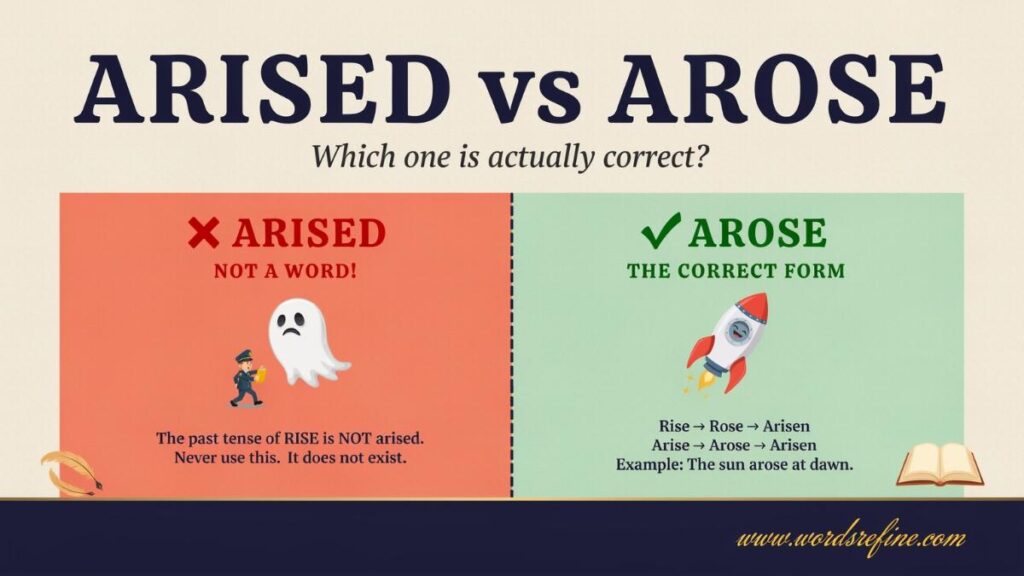
Have you ever written “arised” and questioned whether it was grammatically correct? You’re not alone. The confusion between arised vs arose often catches writers off guard because adding “ed” seems perfectly reasonable. However, English has its share of irregular verbs that refuse to follow the usual rules. “Arise” is one of them, with three forms: arise, arose, and arisen. Each has a distinct grammatical role, and using the wrong form can make an otherwise clear sentence sound awkward. Let’s examine their meanings, differences, and practical examples so you can avoid this common mistake and express yourself with confidence.
Arised vs Arose Quick Answer
The correct spelling arised vs arose depends on the grammatical form you need. However, arose is always the standard simple past form of arise.
Here’s an easy way to remember the difference:
Arise is the base form. For example, unexpected difficulties arise during major projects.
Arose is the simple past tense. For example, unexpected difficulties arose during the project.
Arisen is the past participle. For example, unexpected difficulties have arisen during the project.
What about arised? It is a nonstandard form that results from applying regular past-tense rules to an irregular verb.
Remember the sequence arise, arose, arisen. It follows the same vowel-changing pattern as rise, rose, risen.
Learn the difference between commonly mixed-up more words
Hustle vs Hussle Which One Is Correct?
What Does Arise Mean?
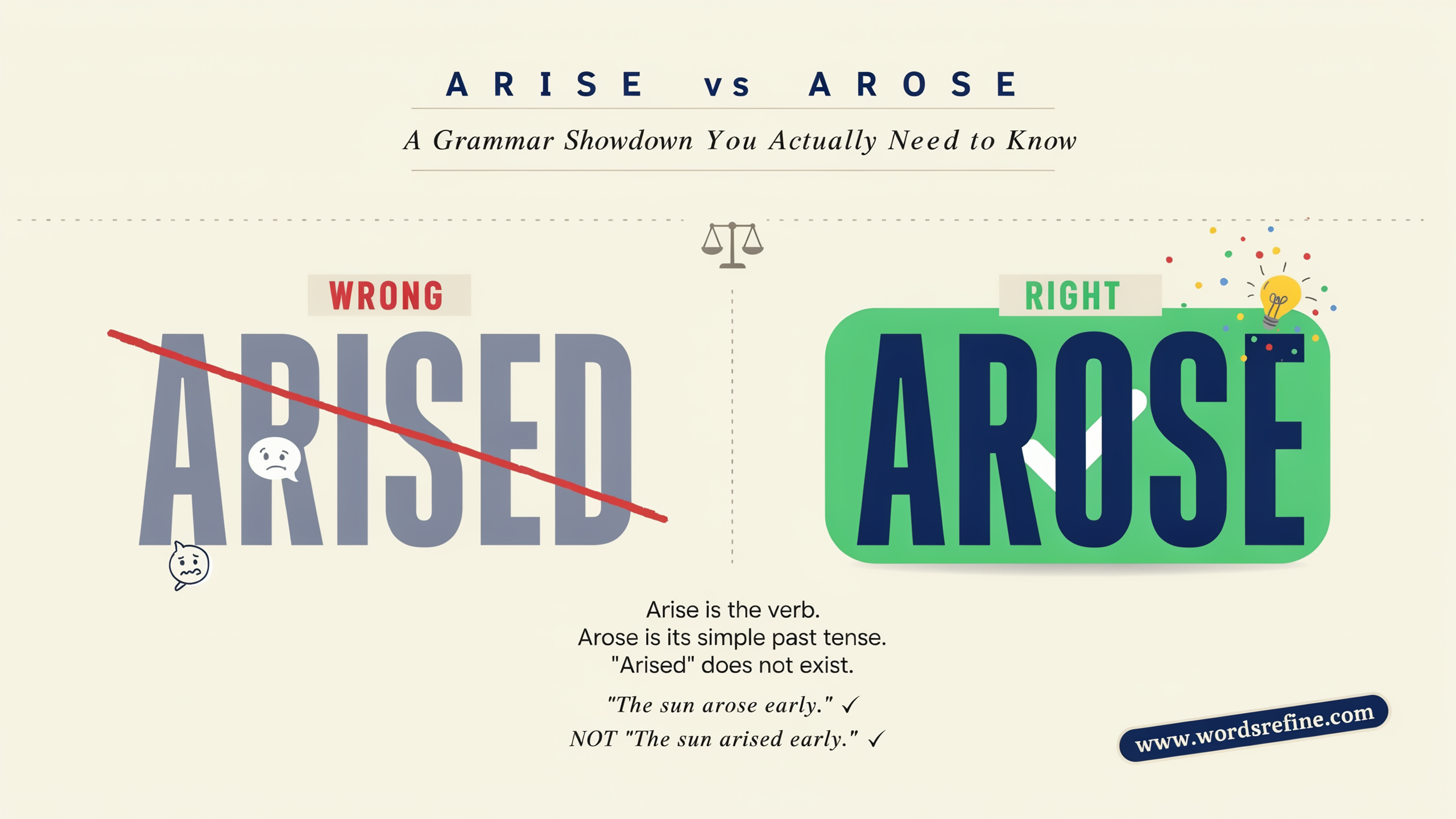
The verb arise means to emerge, occur, develop, originate, or come into existence. It describes something that begins to happen, becomes noticeable, or develops from a particular situation.
Unlike verbs that describe deliberate actions, arise often focuses on events or circumstances that happen without someone intentionally causing them.
For example:
Questions may arise after the presentation.
Unexpected expenses arise during home renovations.
New opportunities arise when businesses expand.
A disagreement arose because of a misunderstanding.
In each sentence, something develops or becomes noticeable. The verb doesn’t necessarily suggest that someone deliberately created the situation.
Different Meanings of Arise
Although arise has several related meanings, its use generally falls into four categories.
To occur or happen
Use arise when an event, problem, or situation occurs.
Example: Technical difficulties may arise during an online examination.
Here, the verb describes something that happens, potentially without warning.
To emerge or develop
Use arise when something becomes noticeable or begins to take shape.
Example: New concerns arose after the company announced its expansion plans.
The concerns developed in response to new information.
To originate from a particular cause
The verb can also explain where something comes from or what causes it.
Example: Most disagreements arise from poor communication.
In this context, arise connects an outcome to its source.
To get up or rise
In a more traditional or formal sense, arise can describe getting out of bed or standing up.
Example: She arose early to prepare for the journey.
This meaning is less common in everyday American conversation, where people generally prefer get up or stand up.
Learn the difference between confusing word pairs
Liter vs Litre Which One Is Correct?
What Does Arose Mean?
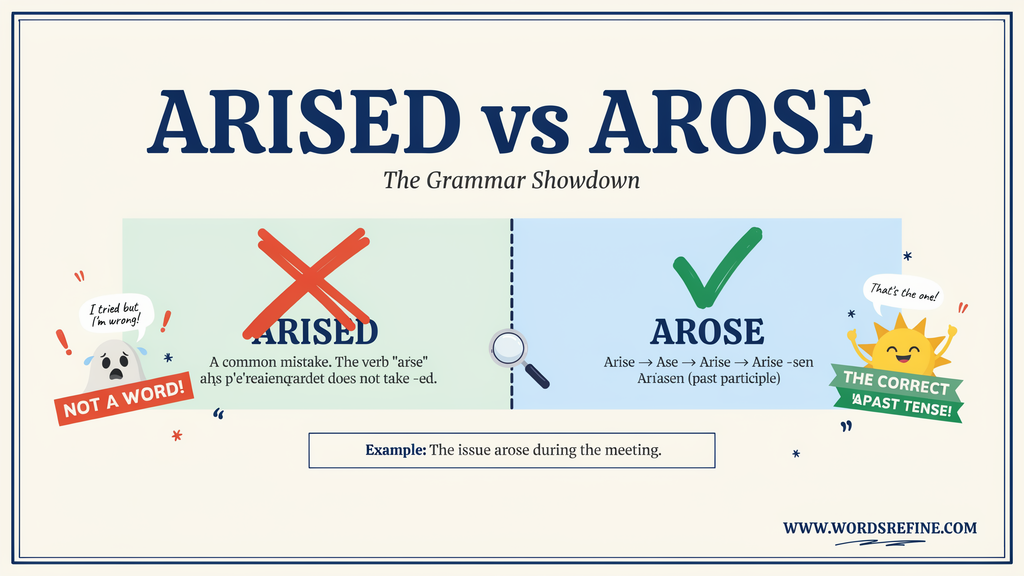
Arose is the simple past tense of arise. It describes something that happened, appeared, developed, or came into existence at an earlier time.
The word has the same basic meanings as arise. However, its tense places the event in the past.
For example:
A disagreement arose during the discussion.
Several questions arose after the announcement.
An unexpected opportunity arose last month.
A technical problem arose while we were installing the software.
Each sentence describes an event that occurred in the past.
Arose Meaning in Different Contexts
Understanding the meaning of arose becomes easier when you examine how writers use it in different situations.
When describing a problem
Example: A serious financial problem arose after the company lost its biggest client.
The problem developed following a specific event.
When describing questions or concerns
Example: Several questions arose when the researchers presented their findings.
The questions appeared as a result of the presentation.
When describing opportunities
Example: An excellent opportunity arose when the organization expanded its services.
The opportunity became available at a particular time.
When explaining a cause
Example: The disagreement arose from conflicting expectations.
This sentence identifies the source of the disagreement.
When describing physical movement
Example: The audience arose when the speaker entered the room.
Here, arose describes people standing up. Although grammatically correct, stood up would sound more natural in most everyday American conversations.
How to Use Arose in a Sentence
When learning how to use arose in a sentence, look for an event that began or happened in the past.
The following examples show how the word works in different sentence structures:
| Sentence | Meaning |
|---|---|
| A new problem arose yesterday. | A problem developed in the past. |
| Several concerns arose during the interview. | Concerns appeared during an earlier event. |
| An opportunity arose after the merger. | An opportunity became available. |
| The disagreement arose from a simple misunderstanding. | The misunderstanding caused the disagreement. |
| A question arose about the project’s budget. | A question developed. |
| Fresh challenges arose as the business expanded. | New difficulties developed over time. |
Notice that arose doesn’t need an auxiliary verb such as has or had when it functions as the simple past tense.
For example:
Correct: A problem arose during the meeting.
Incorrect: A problem has arose during the meeting.
The second sentence incorrectly combines has with the simple past form. The correct construction is has arisen, which we’ll examine shortly.
Learn the difference between commonly mixed-up more words
Don’ts vs Donts Which One Is Correct?
Is Arised a Word?
The question deserves a little clarification.
People sometimes write or say arised because they assume that every verb forms its past tense by adding -ed. However, arised is not an accepted standard conjugation of arise.
It’s best described as a nonstandard or incorrect past-tense form rather than a legitimate alternative to arose.
Consider the following comparison:
| Incorrect form | Correct form |
|---|---|
| A problem arised yesterday. | A problem arose yesterday. |
| Several concerns arised during the meeting. | Several concerns arose during the meeting. |
| An opportunity arised last year. | An opportunity arose last year. |
| A question arised unexpectedly. | A question arose unexpectedly. |
The mistake doesn’t usually come from misunderstanding the meaning. Instead, it comes from applying a familiar grammatical pattern to a verb that doesn’t follow it.
Why Do People Confuse Arised vs Arose?
English contains thousands of regular verbs, so adding ed feels like a natural instinct.
For example:
Work becomes worked.
Open becomes opened.
Help becomes helped.
Explain becomes explained.
However, irregular verbs don’t follow this predictable pattern.
Consider these examples:
Write becomes wrote and written.
Speak becomes spoke and spoken.
Break becomes broke and broken.
Rise becomes rose and risen.
Arise becomes arose and arisen.
The similarity between arise vs rise also helps explain why arose is correct. Both verbs share the same irregular vowel-changing pattern.
Another source of confusion is the verb raise, which follows a regular pattern:
Raise becomes raised and raised.
Because raise and arise look and sound similar, writers sometimes assume they have identical conjugation rules. They don’t.
The solution is simple: learn irregular verbs as complete groups rather than guessing their past forms.
Arise Arose vs Arisen Understanding the Three Verb Forms
One of the easiest ways to avoid confusing arised vs arose is to understand all three principal forms of arise. Each form has a specific grammatical role. Once you recognize those roles, you’ll know which word belongs in your sentence.
The three forms are arise, arose, and arisen.
This sequence represents the base form, simple past tense, and past participle. English uses each form differently depending on the tense and sentence structure.
Arise (Present Tense and Base Form)
Arise is the base form of the verb. Writers use it in the simple present tense, after modal verbs, and in infinitive constructions.
For example:
Problems arise when employees don’t communicate clearly.
New opportunities arise during periods of change.
Questions may arise after the discussion.
We expect several challenges to arise during construction.
The word also appears with different subjects in the simple present tense:
| Subject | Correct form | Example |
|---|---|---|
| I | Arise | I arise early every morning. |
| You | Arise | You arise from your seat when the ceremony begins. |
| We | Arise | We arise early during our travels. |
| They | Arise | They arise before sunrise. |
| He/She/It | Arises | A problem arises when the system fails. |
Notice that arises takes an -s when the subject is a third-person singular noun or pronoun. This follows the normal subject-verb agreement rule.
Arose (Simple Past Tense)
Arose is the simple past tense of arise. Use it when an event occurred or a situation developed at a particular time in the past.
For example:
A misunderstanding arose during the conversation.
Several complications arose after the surgery.
An unexpected vacancy arose last week.
A serious concern arose when the results arrived.
The simple past form remains arose regardless of the subject.
For instance:
I arose early.
She arose early.
They arose early.
You don’t add -s or -ed to the word.
Arisen (Past Participle)
Arisen is the past participle of arise. Unlike arose, it generally needs an auxiliary verb such as has, have, or had.
You’ll commonly find it in the present perfect and past perfect tenses.
Present perfect tense
Use has arisen or have arisen to describe something that developed in the past and remains relevant to the present.
Examples:
A serious issue has arisen with the new software.
Several questions have arisen since the announcement.
New opportunities have arisen for small businesses.
Past perfect tense
Use had arisen when one past event happened before another past event.
Examples:
Several problems had arisen before the manager arrived.
A disagreement had arisen before the negotiations began.
The need for additional staff had arisen months earlier.
The distinction matters because arose and arisen aren’t interchangeable.
Compare:
Correct: A new problem arose yesterday.
Correct: A new problem has arisen since yesterday.
Incorrect: A new problem has arose since yesterday.
The first sentence uses the simple past. The second uses the present perfect. The third combines two incompatible verb forms.
Learn the difference between often confused words
There vs Their the Difference and Using Each Word Correctly?
Arise vs Arose vs Arisen Comparison Table
| Feature | Arise | Arose | Arisen |
|---|---|---|---|
| Verb form | Base form | Simple past | Past participle |
| Main use | Present or infinitive constructions | Completed past events | Perfect tenses |
| Auxiliary needed? | Depends on construction | No | Usually yes |
| Example | Problems arise regularly. | Problems arose yesterday. | Problems have arisen recently. |
Remember: arise describes what happens generally or may happen. Arose describes what happened in the past. Arisen works with auxiliary verbs to create perfect-tense constructions.
How to Use Arose Correctly in Different Contexts
Although arose follows one grammatical rule, its meaning can vary depending on the situation. It works particularly well in professional, academic, and formal writing because it can describe developments without making a sentence unnecessarily long.
Here are several practical situations where using arose makes sense.
Arose When Describing Problems
Problems don’t always announce themselves politely. Sometimes they appear halfway through a project, just when everything seems to be running smoothly.
Use arose to describe a difficulty that developed in the past.
Examples:
A technical issue arose during the software update.
Several financial problems arose after the company expanded.
A scheduling conflict arose when two meetings overlapped.
An unexpected complication arose during the construction process.
In these examples, arose communicates that a problem developed or appeared.
Arose When Discussing Questions or Concerns
Use arose when questions, doubts, or concerns emerged after an event or discussion.
Examples:
Several questions arose after the teacher explained the assignment.
Concerns arose about the accuracy of the research.
A debate arose over the proposed changes.
Questions arose regarding the company’s financial statements.
This construction works particularly well in academic writing and business reports.
Arose When Describing Opportunities
Not everything that arises creates a problem. Opportunities can arise too.
Examples:
A promising career opportunity arose after graduation.
Several investment opportunities arose during the economic recovery.
An opportunity arose to collaborate with an international organization.
New possibilities arose after the company introduced its latest product.
The verb helps describe opportunities that became available without suggesting that someone deliberately created them.
Arose When Explaining Causes or Situations
Arose can also connect an outcome to its source.
Examples:
The disagreement arose from a lack of communication.
The confusion arose because both documents contained different figures.
The conflict arose from competing business interests.
The misunderstanding arose after someone shared incomplete information.
Notice the common construction: arose from.
It identifies the source or cause of a particular situation. You can also use arose because of when you want to explain the reason more directly.
Arose When Describing Physical Movement
The verb arise can describe someone getting up or standing. Its past form, arose, works in the same way.
Examples:
The audience arose when the national anthem began.
The guests arose to welcome the speaker.
She arose from her chair and approached the window.
However, this meaning sounds more formal or literary than ordinary American conversation. In everyday speech, stood up or got up usually sounds more natural.
Learn the difference between basic English word mistakes
Per Say vs Per Se Which One Is Correct?
Common Mistakes When Using Arised vs Arose
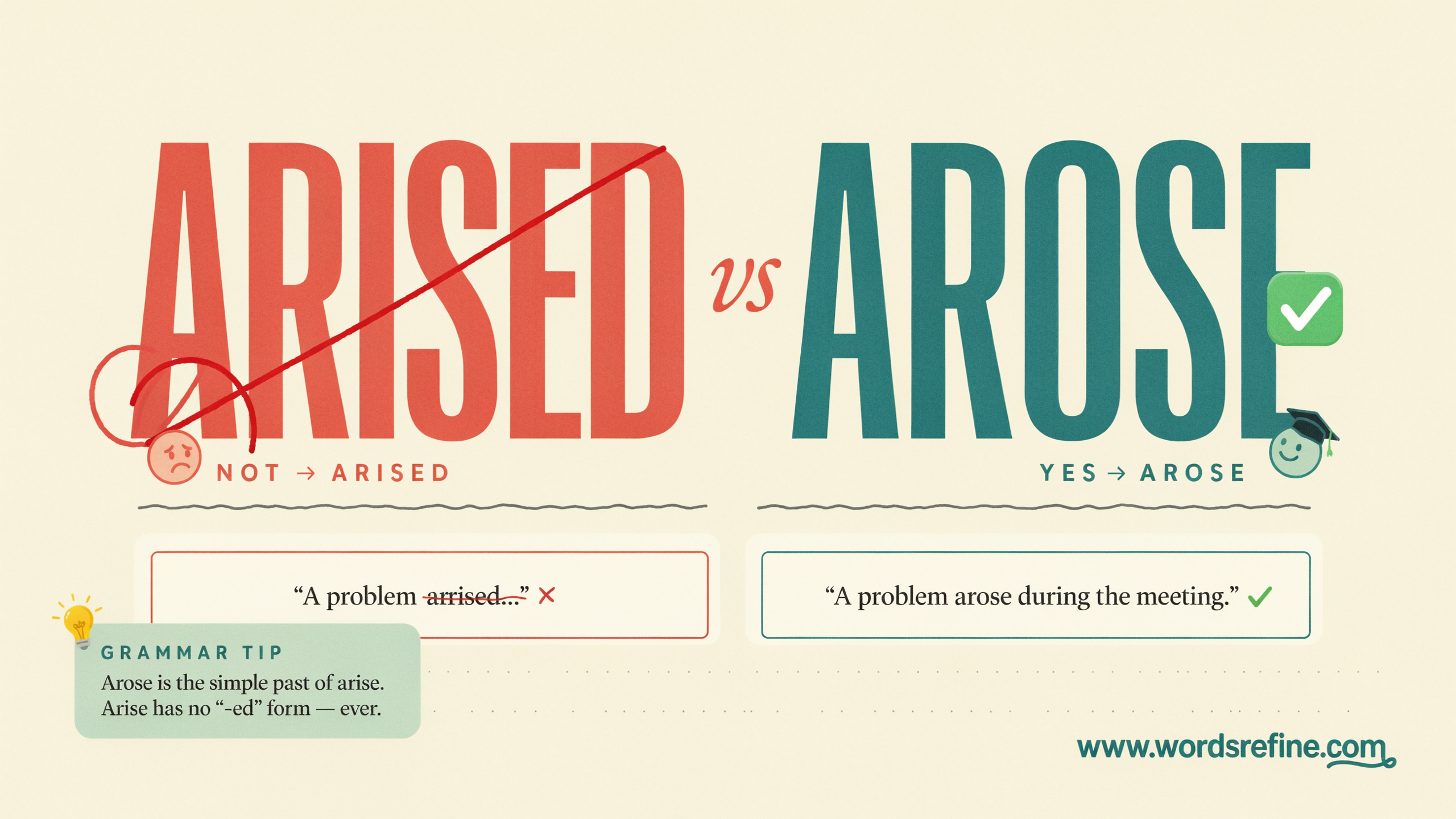
Even writers who understand irregular verbs can occasionally mix up their forms. The problem arised vs arose often appears when a sentence contains an auxiliary verb, a past time expression, or another similar looking word.
Here are the mistakes worth watching for.
Adding ed to Arise
This is the most common error.
Incorrect: An unexpected opportunity arised last month.
Correct: An unexpected opportunity arose last month.
Why? Because arise is an irregular verb. Its simple past form changes to arose rather than taking an -ed ending.
Confusing Arose With the Past Participle Arisen
Although both forms describe past events, they perform different grammatical jobs.
Incorrect: Several issues have arose since the launch.
Correct: Several issues have arisen since the launch.
Why? The auxiliary have requires the past participle arisen, not the simple past form arose.
Compare these sentences:
1A problem arose during the launch.
2A problem has arisen since the launch.
3A problem had arisen before the launch ended.
Each sentence uses a different tense construction.
Using Arose With Has, Have, or Had
This mistake deserves special attention because it appears frequently in informal writing.
Incorrect: A serious concern has arose.
Correct: A serious concern has arisen.
Incorrect: Several complications had arose before the meeting.
Correct: Several complications had arisen before the meeting.
The rule is straightforward: use arose as the simple past form and arisen after perfect-tense auxiliaries.
Treating Arise as a Regular Verb
Writers sometimes assume that arise behaves like organize, recognize, or realize.
However, those verbs use regular past-tense forms:
Organize becomes organized.
Recognize becomes recognized.
Realize becomes realized.
Arise follows a different pattern:
Arise becomes arose and arisen.
Don’t let the similar spelling of these verbs trick you into applying the wrong conjugation.
Confusing Arise With Raise and Rise
These three verbs have related meanings, but their grammatical functions differ.
For example:
A problem arose during the discussion.
The sun rose above the horizon.
The company raised its prices.
Each sentence uses a different verb for a different purpose. The next section explains the distinction in more detail.
Arised vs Arose in Everyday Sentences
Grammar becomes easier when you see how a word works in realistic situations. The following examples show how to correct common mistakes across different types of communication.
| Situation | Incorrect sentence | Correct sentence |
|---|---|---|
| Workplace | A conflict arised between the departments. | A conflict arose between the departments. |
| Academic writing | Several questions arised during the lecture. | Several questions arose during the lecture. |
| News reporting | Concerns arised after the announcement. | Concerns arose after the announcement. |
| Social media | A problem arised with my account. | A problem arose with my account. |
| Business email | An unexpected delay arised yesterday. | An unexpected delay arose yesterday. |
| Casual conversation | A misunderstanding arised between us. | A misunderstanding arose between us. |
| Storytelling | A strange situation arised that evening. | A strange situation arose that evening. |
Case Study Correcting a Business Report
Imagine that a project manager is preparing a report about delays in a software development project.
The original report says:
“Several technical issues arised during testing, and additional concerns have arose regarding system performance.”
The sentence contains two verb-conjugation mistakes.
Here’s the corrected version:
“Several technical issues arose during testing, and additional concerns have arisen regarding system performance.”
Why does this correction work?
Arose describes technical issues that developed during the past testing period.
Have arisen describes concerns that developed earlier and remain relevant now.
This example demonstrates why understanding the difference between simple past and past participle matters. One incorrect verb can weaken an otherwise professional report.
A Quick Editing Test
When you encounter arised, ask yourself whether the sentence describes something that happened in the past.
If it does, replace arised with arose.
However, if the sentence contains has, have, or had, check whether you need arisen instead.
For example:
A problem arised yesterday becomes A problem arose yesterday.
A problem has arised recently becomes A problem has arisen recently.
This simple editing habit can prevent many common grammar mistakes.
Arise vs Rise vs Raise What’s the Difference?
If arise, rise, and raise seem confusing, you’re not alone. These verbs share similar meanings and spellings. However, they don’t work the same way in a sentence.
The most important distinction involves whether the verb requires a direct object.
Arise and rise generally function as intransitive verbs. That means they don’t take a direct object.
Raise is normally transitive. It takes a direct object that receives the action.
Arise, Arose, Arisen
Use arise when something occurs, emerges, or develops. It can also describe getting up.
Its principal forms are:
Arise → Arose → Arisen
Examples:
Questions arise during difficult discussions.
A disagreement arose during negotiations.
Several concerns have arisen recently.
The verb often describes situations rather than deliberate actions.
Rise, Rose, Risen
Rise means to move upward, increase, or get up from a lying or seated position.
Its principal forms are:
Rise → Rose → Risen
Examples:
The sun rises in the east.
The temperature rose yesterday.
Food prices have risen significantly.
You can use rise when something moves upward or increases without someone directly lifting or increasing it.
Raise, Raised, Raised
Raise means to lift, increase, collect, or bring something to a higher level.
Its principal forms are:
Raise → Raised → Raised
Examples:
She raises her hand to ask a question.
The company raised employee salaries.
They have raised enough money for the project.
Unlike rise, raise normally requires an object.
For example, you raise your hand, raise a question, or raise the price of a product.
Arise vs Rise vs Raise Comparison Table
| Verb | Simple past | Past participle | Main meaning | Example |
|---|---|---|---|---|
| Arise | Arose | Arisen | To emerge or occur | A problem arose. |
| Rise | Rose | Risen | To move upward or increase | The temperature rose. |
| Raise | Raised | Raised | To lift or increase something | She raised her hand. |
A useful way to remember the difference is to focus on the action.
Arise means something develops or happens.
Rise means something moves upward on its own.
Raise means someone or something lifts or increases another thing.
Consider these three sentences:
A new issue arose during the meeting.
The temperature rose during the afternoon.
The manager raised the office temperature.
The first describes an emerging issue. The second describes an increase. The third identifies someone causing that increase.
This distinction is especially useful when comparing arise and rise in formal writing.
Learn the difference between more words people mix up
Roll Call vs Role Call Which One Is Correct?
Arised vs Arose Synonyms and Alternative Words
Sometimes the best way to improve a sentence is to replace a verb with a more specific alternative. Although arose is grammatically correct, you don’t need to repeat it throughout an entire article or report.
The right synonym depends on what you want to communicate.
Synonyms for Arose
| Synonym | Meaning | Example |
|---|---|---|
| Occurred | Happened at a particular time | An unexpected event occurred during the ceremony. |
| Emerged | Became noticeable or developed | New evidence emerged during the investigation. |
| Appeared | Became visible or noticeable | A problem appeared after the update. |
| Developed | Gradually came into existence | A disagreement developed between the partners. |
| Originated | Began from a particular source | The conflict originated from a misunderstanding. |
| Surfaced | Became known or noticeable | Several concerns surfaced during the review. |
| Materialized | Became real or happened | An unexpected opportunity materialized last week. |
| Manifested | Became evident through signs or actions | The problem manifested during testing. |
| Came about | Happened or developed | The change came about after several discussions. |
| Cropped up | Appeared unexpectedly; informal | A few technical problems cropped up yesterday. |
Choosing the Right Synonym
Not every synonym works in every sentence.
For example, occurred and happened are suitable when describing an event. Meanwhile, emerged and surfaced often work better when something gradually becomes noticeable.
Compare:
1A serious issue arose during testing.
2A serious issue emerged during testing.
3A serious issue surfaced during testing.
All three sentences are grammatically correct, but they carry slightly different shades of meaning.
Emerged suggests that the issue became apparent. Surfaced often suggests that someone discovered something that had previously remained hidden.
Choose the word that communicates the intended meaning most accurately.
Does American or British English Use Arised vs Arose?
Some English spelling differences arised vs arose depend on geographical location. For example, American English generally uses color, while British English prefers colour. Similarly, organize and organise reflect different regional spelling conventions.
However, arised and arose isn’t one of those differences.
Both American and British English use arose as the standard simple past tense of arise. Both also use arisen as the past participle.
| Verb form | American English | British English |
|---|---|---|
| Base form | Arise | Arise |
| Simple past | Arose | Arose |
| Past participle | Arisen | Arisen |
| Nonstandard form | Arised | Arised |
The spelling and conjugation remain the same across these varieties.
You might occasionally encounter arised in informal online writing, learner English, or unedited material. However, that doesn’t make it a recognized American or British alternative.
If you’re writing an academic paper, business report, article, or professional email, use arose for the simple past and arisen for perfect-tense constructions.
Learn the difference between more words people mix up
Here Here vs Hear Hear Which One Is Correct?
Practice Session Arise Arose vs Arisen
1. A serious problem ______ during the final stage of the project.
2. Several questions ______ after the presentation.
3. A new opportunity may ______ when you least expect it.
4. An unexpected issue has ______ with the payment system.
5. The disagreement ______ because of a misunderstanding.
6. New challenges often ______ when a business expands.
7. A strange noise ______ from the basement last night.
8. Several concerns have ______ since the policy changed.
9. If a problem ______, report it immediately.
10. A question ______ during yesterday’s discussion.
11. Many opportunities ______ from meaningful connections.
12. A conflict had ______ before the manager arrived.
13. The need for additional training ______ after the review.
14. Unexpected difficulties may ______ during the journey.
15. A serious misunderstanding ______ between the two colleagues.
16. New questions have ______ about the company’s decision.
17. Whenever a disagreement ______, try to resolve it calmly.
18. A fresh idea ______ while we were discussing the project.
19. Several complications had ______ before the event began.
20. A similar situation ______ during the previous meeting.
21. Problems sometimes ______ when instructions are unclear.
22. An important issue ______ during the investigation.
23. New concerns may have ______ after the announcement.
24. A chance to improve the process ______ unexpectedly.
25. If any difficulty has ______, discuss it with your supervisor.
Answers
- Arose
- Arose
- Arise
- Arisen
- Arose
- Arise
- Arose
- Arisen
- Arises
- Arose
- Arise
- Arisen
- Arose
- Arise
- Arose
- Arisen
- Arises
- Arose
- Arisen
- Arose
- Arise
- Arose
- Arisen
- Arose
- Arisen
Here’s a trusted source for clear more words Comparison:
FAQs
Which is correct “rose” vs “arose”?
Both “rose” vs“arose” are correct, but they come from different verbs. “Rose” is the past tense of “rise,” which means to move upward or increase. “Arose” is the past tense of “arise,” which means to happen, appear, or develop.
For example: The sun rose over the mountains. A problem arose during the meeting.
Is it “arised” vs “arose”?
“Arose” is the correct past tense of “arised vs arose .” “Arised” is not a standard form in modern English. Therefore, write, “A new opportunity arose,” rather than “A new opportunity arised.”
What is another word for “arised”?
Because “arised” is nonstandard, use “arose” instead. Depending on the context, suitable alternatives include “appeared,” “occurred,” “emerged,” and “developed.” Choose the word that best expresses what happened in your sentence.
Is “arose” a past tense?
Yes. “Arose” is the simple past tense of “arise.” It describes something that happened, appeared, or developed in the past.
For example: A disagreement arose during the discussion.
Which is correct: “I eat” or “I eats”?
“I eat” is correct because the subject “I” takes the base form of the verb. Use “eats” with third-person singular subjects such as “he,” “she,” and “it.”
For example: I eat breakfast early, but my brother eats breakfast later.
When should you use “arose” instead of “arisen”?
Use “arose” for an action or event that happened in the past. Use “arisen” as the past participle, usually with “has,” “have,” or “had.”
For example: A problem arose yesterday. Several problems have arisen this week.
What is another word for “arose”?
The best synonym depends on the sentence. “Appeared” works when something became visible, “occurred” describes an event, and “emerged” suggests that something came into view or developed. You can also use “developed” when describing a situation that took shape.
For example: A new concern arose during the meeting. A new concern emerged during the meeting.
How do you pronounce “arose”?
“Arose” has two syllables, with the emphasis on the second syllable. Say it naturally, giving the second syllable more stress. Avoid placing equal emphasis on both syllables.
How do you use “arose” in a sentence?
Use “arose” when a problem, question, opportunity, disagreement, or situation appeared or developed in the past.
For example: Several questions arose after the teacher explained the assignment.
Can you use “arose” with “has” or “have”?
No. “Arose” is the simple past tense, while “arisen” is the past participle used with “has,” “have,” or “had.”
For example: “A new issue has arisen” is correct, whereas “A new issue has arose” is incorrect.
Learn the difference between basic English word mistakes
Fead vs Feed Which One Is Correct?
Conclusion
The difference between arised vs arose may seem like a tiny grammar detail, but choosing the correct form makes your writing clearer and more natural. Remember, arise follows an irregular pattern: arise, arose, arisen. There’s no need to add an extra -ed and hope the verb cooperates! Use arose when describing something that happened in the past, and arisen when forming perfect tenses with has, have, or had. Once you understand this pattern, you can avoid a common grammar mistake with confidence. After all, problems may arise, questions may arise, and even grammar confusion may arise but arised should never arise in your writing!

Diora AJS she is an experienced blogger and passionate English language enthusiast at Words Refine. With a keen eye for language and a love for clear communication, she writes practical content about grammar, word meanings, usage, and commonly confused terms. Her goal is to make English easier to understand through clear explanations and relatable examples, helping readers write accurately and communicate with confidence.