
Hustle vs hussle? One small spelling difference can create a surprisingly big confusion. Whether you are talking about working hard, chasing your dreams, or earning extra money through a side hustle, choosing the correct word matters. Hustle is the standard English spelling, while hussle is generally considered a misspelling unless it appears in a proper name. However, there’s more to this word than spelling alone. Hustle can describe ambition and determination, but it can also refer to dishonest ways of making money. Let’s explore hustle vs. hussle, look at clear examples, and learn how to avoid common spelling mistakes with confidence.
Hustle vs Hussle The Quick Answer
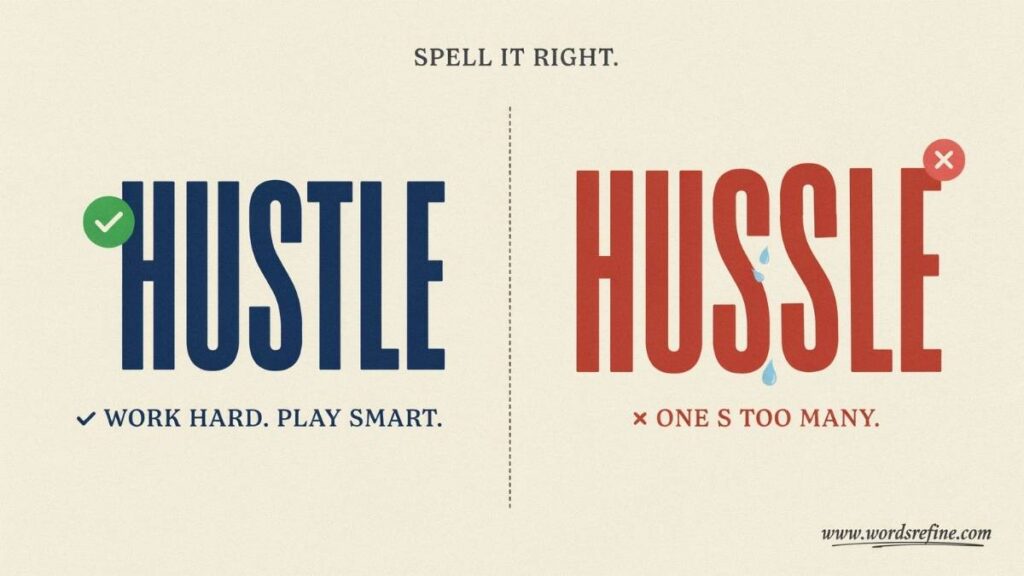
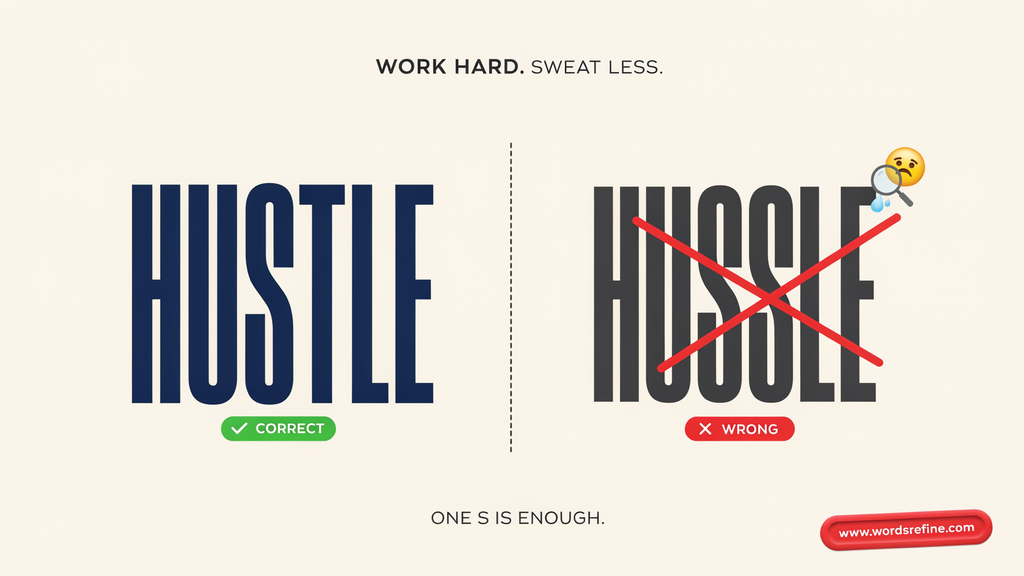
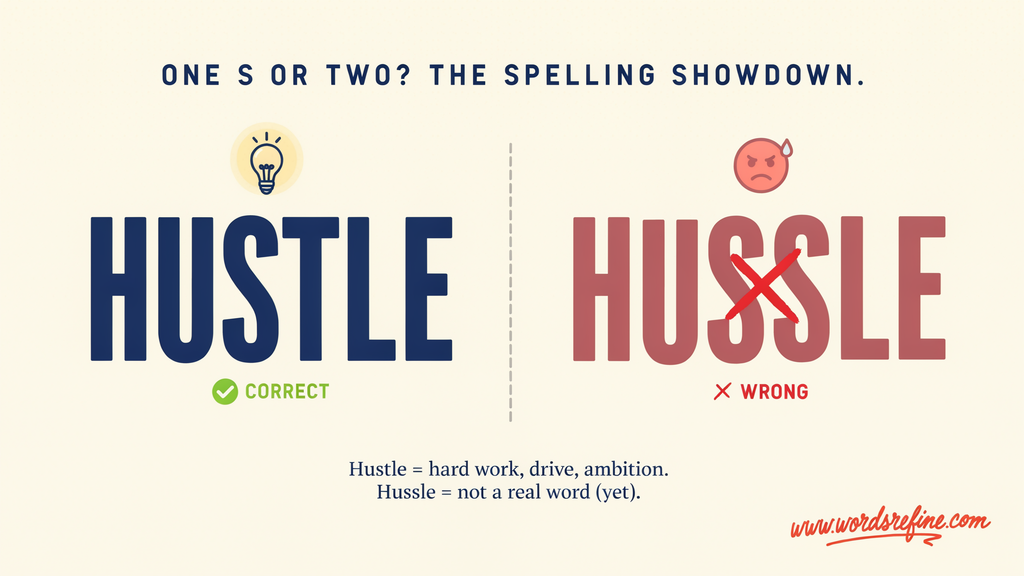
When choosing between hustle vs hussle remember that hustle is the standard spelling. It contains one s followed by a t, while hussle replaces the t with another s.
Unlike words such as color and colour, this isn’t a difference between American and British English. Both varieties use hustle as the standard spelling.
Consider these examples:
Correct: Maya started a side hustle to earn extra money.
Incorrect in standard usage: Maya started a side hussle to earn extra money.
Correct: We need to hustle if we want to catch the train.
Incorrect in standard usage: We need to hussle if we want to catch the train.
As these examples show, the spelling remains the same regardless of the situation. However, if Hussle appears in a person’s name or an established brand, preserve that spelling when referring to the name.
How Do You Spell Hustle Correctly?
The correct spelling is H-U-S-T-L-E. Breaking the word into individual letters can help you avoid the common mistake of replacing the t with another s.
A simple way to remember it is to connect hustle with bustle. Both words contain the same ending, and both can describe activity or movement.
For example, a team might hustle to finish a project before the deadline. Meanwhile, restaurant workers might hustle to serve customers during a busy evening. In another situation, an entrepreneur might rely on hard work and hustle to build a business.
Although the meaning changes slightly in each example, the spelling stays the same.
Learn the difference between commonly mixed-up more words
Vaccum Vs Vacuum Which One Is Correct and Why It Matters ?
Is Hustle Spelled With a T?
Yes, hustle contains a t between the s and the l. That letter is part of the standard spelling, even if you sometimes overlook it when writing quickly.
The t also remains in related forms such as hustled and hustling.
For example, she hustled to finish her presentation, while her colleagues are hustling to prepare for an upcoming meeting. In both cases, the spelling follows the same pattern.
What Does Hustle Mean?
The meaning of hustle depends on how you use it. Sometimes it describes quick movement. In other situations, it refers to hard work, business activity, or even dishonesty.
As a verb, hustle can mean to move quickly, work energetically, encourage someone to act faster, or obtain money through certain activities. As a noun, it can describe determined effort, a way to earn money, or a dishonest scheme.
For instance, saying that a student hustled to finish an assignment suggests urgency and effort. However, saying that someone hustled a customer may suggest pressure or deception.
The surrounding words usually make the intended meaning clear.
Hustle as a Verb
When hustle functions as a verb, it describes an action. That action might involve physical movement, determined work, or encouraging someone to do something quickly.
Consider these examples:
We hustled across the parking lot before the rain started.
The manager told the team to hustle because the store was closing soon.
She hustled to find new clients for her growing business.
The salesperson hustled customers into buying products they didn’t need.
The first sentence describes quick movement, while the second emphasizes urgency. The third highlights initiative and effort. By contrast, the final sentence suggests aggressive or potentially dishonest behavior.
Therefore, hustle doesn’t always carry the same tone. Context determines whether it sounds positive, neutral, or negative.
Hustle as a Noun
As a noun, hustle refers to the effort, activity, or scheme itself rather than the action of performing it.
For example, someone might admire an athlete’s hustle because the athlete keeps working hard throughout a game. Similarly, a person might describe freelance photography as a side hustle because it provides additional income.
However, the noun can also have a negative meaning. In informal English, a hustle may refer to a deceptive plan someone uses to obtain money or an advantage.
Consider these examples:
Her hustle helped her turn a weekend hobby into a profitable business.
His daily hustle includes a full-time job and freelance photography.
The police warned residents about a hustle involving fake charity donations.
Although all three sentences use the same word, their meanings differ. The first two describe productive work, while the last refers to deception.
Learn the difference between confusing more English words
Expiry vs Expiration Which One Is Correct?
What Does Hustle Mean in American English?
In American English, hustle commonly describes hard work, energetic action, determination, or an effort to make money. The word also appears frequently in sports, business, entertainment, and everyday conversation.
For example, a basketball coach might praise a player for showing hustle when the player chases loose balls and works hard on defense. Similarly, an entrepreneur might talk about the hustle required to build a company.
In everyday conversation, a parent might tell a child to hustle when they’re running late for school. In this situation, the word simply means to move faster.
Hustle also appears in expressions such as side hustle, hustle culture, and hustle and bustle. Each phrase has an established meaning that readers can understand from context.
British English uses hustle as well. Although the word’s tone and frequency may vary by situation, its spelling remains the same.
How Do You Pronounce Hustle?
In standard American English, hustle is pronounced /ˈhʌs.əl/. It has two syllables, with the stress on the first syllable.
The first vowel sounds like the vowel in cup. The final syllable contains a reduced vowel sound, similar to the unstressed ending in many everyday English words.
The t belongs to the word’s consonant sequence, although speakers may pronounce it less distinctly in fast, connected speech. The exact sound can vary slightly by accent and speaking speed.
Hustle also sounds different from hassle. The words have different vowel sounds, even though some speakers may pronounce them in ways that make the distinction less obvious.
Is Hussle a Real Word?
The answer depends on how the spelling is used. In ordinary English writing, hussle isn’t the standard spelling of hustle. However, people sometimes use it intentionally in proper names, brands, artistic identities, or informal online expressions.
For example, the late American rapper Nipsey Hussle used Hussle as his professional name. In that context, the spelling is intentional and should remain unchanged. Writing his name as Nipsey Hustle would incorrectly alter his chosen name.
This distinction matters because proper names don’t always follow standard spelling patterns. A business may choose an unusual spelling for its brand, while an artist may adopt a distinctive name. Such choices don’t change the conventional spelling of the underlying English word.
Learn the difference between tricky grammar more words
Dork vs Nerd Meaning Differences Examples?
What Does Hussle Mean?
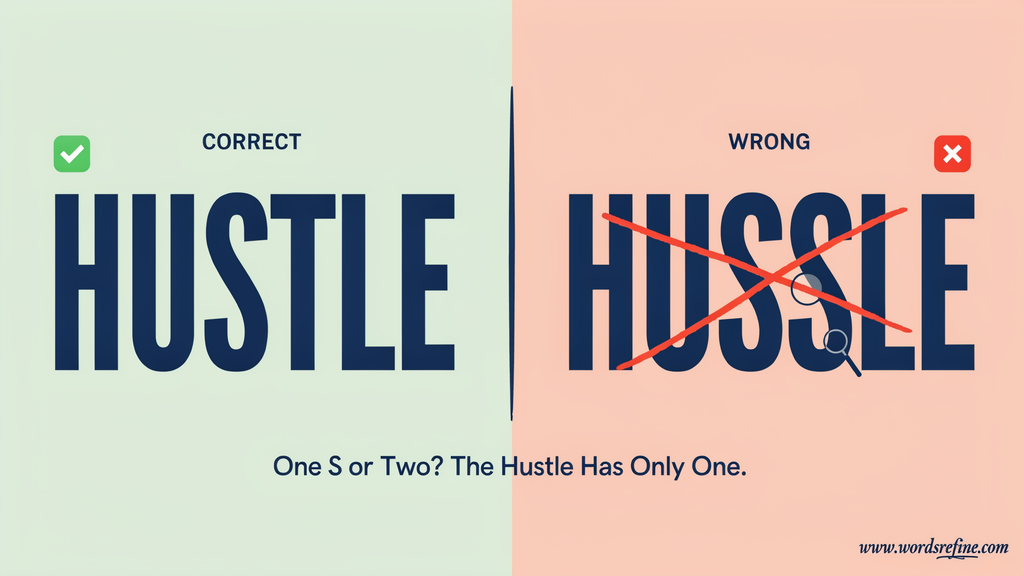
When someone types hussle in an ordinary sentence, they usually intend to write hustle. The intended meaning generally comes from the standard word rather than from a separate, established definition of hussle.
For example, someone might write, “Keep up the hussle and you’ll reach your goals.” The meaning is clear, but standard English calls for hustle.
On the other hand, if Hussle appears in a person’s name, company name, or title, it may have a specific identity-related meaning. In those situations, follow the official spelling instead of automatically correcting it.
Is Hussle a Slang Word?
Hussle sometimes appears in informal messages and online posts as a deliberate variation of hustle. However, it’s more accurate to describe it as a nonstandard spelling or stylized form than to assume it has a separate slang definition.
The standard word hustle already has several informal meanings. It can describe working hard, making money, pursuing opportunities, or engaging in dishonest activity. There’s no need to change its spelling to express those ideas.
Although people may understand hussle in a casual message, standard spelling matters in school assignments, professional emails, articles, and business documents. Unless the spelling belongs to a proper name, use hustle.
Can Hussle Be Used in a Sentence?
Yes, but the context determines whether the spelling is appropriate.
For example, the sentence “The documentary explores the life and career of Nipsey Hussle” correctly preserves a professional name.
By contrast, “She started a weekend hussle selling handmade candles” uses a nonstandard spelling of the ordinary word. The corrected sentence is “She started a weekend hustle selling handmade candles.”
The difference isn’t about whether readers can understand the sentence. They probably can. Instead, it concerns whether the spelling follows standard English conventions or intentionally reproduces a name or stylistic choice.
Hustle vs Hussle Key Differences
Although the two spellings look similar, they don’t serve the same purpose in standard writing. Hustle is the conventional English word, while hussle generally appears as a misspelling or intentional name.
| Feature | Hustle | Hussle |
|---|---|---|
| Standard English spelling | Yes | No, not for the ordinary word |
| Common meaning | Energetic work, quick movement, or a money-making activity | Usually intended to mean hustle |
| Formal writing | Appropriate when the meaning fits | Generally inappropriate unless part of a proper name or exact title |
| American English | Standard | Nonstandard for the ordinary word |
| British English | Standard | Nonstandard for the ordinary word |
| Names and branding | Can be used | Can be used when intentionally chosen |
| Example | She has the hustle to build a business. | Nipsey Hussle was a professional name. |
The most useful rule is straightforward: use hustle for the ordinary English word and preserve Hussle when the spelling belongs to an established name or intentional title.
This distinction also helps when editing. A spell-checker may flag hussle as an error in ordinary prose. However, you should still check the context before changing a person’s name or a quoted title.
Learn the difference between confusing word pairs
favour vs Favor Meaning Differences Spelling and Examples ?
Hustle vs Hassle Meaning and Pronunciation
Another common spelling problem occurs when writers confuse hustle with hassle. Unlike hustle vs hussle these are two distinct English words with different meanings.
Hustle generally relates to energetic effort, quick movement, or earning money. Hassle means trouble, inconvenience, or something that causes irritation.
Consider these examples:
“I had to hustle to catch the train.” This means you moved quickly.
“Getting a refund turned into a hassle.” This means the process became troublesome.
“Her side hustle pays for her college books.” This refers to additional income.
“The paperwork is such a hassle.” This describes an annoying task.
The difference becomes clearer when you compare the words in similar situations. You might hustle to finish a report before a deadline, but repeated computer problems could make finishing that report a hassle.
Are Hustle vs Hassle Pronounced the Same?
No. In standard American English, hustle has the vowel sound /ʌ/, as in cup, while hassle has /æ/, as in cat.
Their consonant patterns also difference Hustle vs Hussle contains a t sound, while hassle does not.
Although fast speech and regional accents can make sounds less distinct, the words have different pronunciations and meanings. If you want to describe determined effort, choose hustle. If you mean inconvenience, choose hassle.
How to Use Hustle in a Sentence
The easiest way to understand hustle is to see how it works in different situations. It can describe physical movement, workplace effort, entrepreneurial activity, or dishonest behavior. The surrounding words help readers understand the intended meaning.
| Example sentence | Meaning of hustle |
|---|---|
| We need to hustle or we’ll miss the bus. | Move quickly |
| The players showed hustle throughout the game. | Energetic effort |
| She used her design skills to build a side hustle. | An additional income source |
| The salesperson tried to hustle tourists into buying fake tickets. | Pressure or deceive someone |
| He hustled all week to finish the project. | Work energetically |
| The coach praised the team’s hustle on defense. | Determination and effort |
These examples show why hustle is more versatile than a simple synonym for work. Depending on the sentence, it can emphasize speed, effort, ambition, or questionable behavior.
Learn the difference between often confused words
Sublet vs Sublease Which One Is Correct ?
How Is Hustle Used as a Verb?
When hustle functions as a verb, it describes what someone does. The sentence often identifies a person or group performing the action.
For example, “The volunteers hustled to prepare the community center before the event.” Here, the verb emphasizes quick, purposeful activity.
You can also use it with an object. In “The driver hustled the passengers toward the exit,” the verb suggests urging or moving people along quickly. Depending on the context, this construction can sound forceful.
In informal speech, hustle can also mean earning money through determined effort. For instance, “He hustles for extra income by repairing bicycles on weekends.”
What Is the Past Tense of Hustle?
The past tense of hustle is hustled. To form it, add d to the base word because hustle already ends in e.
Examples include:
She hustled to finish the presentation.
They hustled through the airport to reach their gate.
He hustled for months to attract new customers.
The present participle is hustling, as in “They’re hustling to launch their new business.” In both forms, the t remains part of the spelling.
What Are Synonyms for Hustle?
The best synonym depends on the meaning you want to express. No single replacement works in every situation.
| Meaning | Useful synonyms |
|---|---|
| Move quickly | Hurry, rush, dash |
| Work energetically | Strive, labor, work hard |
| Show determination | Persevere, push, press on |
| Earn money through effort | Work, sell, earn, pursue opportunities |
| Encourage someone to move | Urge, hurry, move along |
| Deceive or exploit someone | Swindle, cheat, con |
For example, rush may work better when you mean moving quickly, while persevere emphasizes continued effort despite difficulty. If you’re describing fraud, swindle communicates the negative meaning more precisely.
Therefore, choose the synonym that matches your intended meaning rather than replacing hustle automatically.
Hustle Meaning in Slang
In casual conversation, hustle often describes the effort someone puts into earning money, reaching a goal, or creating opportunities. It can suggest ambition, resourcefulness, and a willingness to work hard.
For example, a person who works a regular job during the week and sells handmade jewelry on weekends might describe the extra work as part of their hustle. Similarly, an athlete might talk about hustling to improve their performance.
However, the word doesn’t always praise someone’s effort. In some contexts, it describes aggressive sales tactics, manipulation, or dishonest ways of making money.
Learn the difference between basic English word mistakes
Drily vs Dryly Which One Is Correct?
What Does Hustle Hard Mean?
The expression hustle hard means to work energetically, pursue a goal with determination, or make a serious effort to achieve something.
For example, “She hustled hard to build her catering business while working full-time.” The sentence emphasizes her effort and commitment.
The phrase often appears in motivational messages, business discussions, and social media captions. However, working harder doesn’t automatically guarantee success. Planning, skill, good judgment, and rest also matter.
What Does It Mean to Hustle for Money?
To hustle for money means to actively seek ways to earn income. The phrase often describes people who take on additional work, pursue freelance projects, sell products, or develop small businesses.
For instance, a college student might tutor other students, deliver groceries, and design websites to cover living expenses. Someone else might repair bicycles after work to supplement a regular salary.
Nevertheless, the expression can also describe dishonest activity. If someone uses deception to obtain money, hustle may refer to a scam or fraudulent scheme. Context determines whether the phrase describes legitimate work or questionable behavior.
What Does Hustle and Bustle Mean?
The expression hustle and bustle refers to the busy activity, movement, and noise associated with crowded or active places.
For example, “After spending a week in the hustle and bustle of downtown Chicago, Lena enjoyed a quiet weekend in the countryside.”
The phrase usually describes a lively environment rather than an individual’s work ethic. A crowded airport, a busy shopping district, or a bustling restaurant might all have plenty of hustle and bustle.
Although hustle and bustle share a sense of activity, the complete expression has its own established meaning.
What Does Side Hustle Mean?
A side hustle is work or a small business that someone pursues alongside a primary job, studies, or another main commitment. It typically provides additional income, although some people also use side hustles to develop skills or explore a business idea.
Common examples include freelance writing, tutoring, selling handmade products, photography, pet sitting, and providing consulting services.
The phrase has become common in conversations about personal finance and entrepreneurship. However, a side hustle doesn’t necessarily involve starting a formal company. Someone can earn extra income from occasional freelance assignments without establishing a full-time business.
What Is the Correct Spelling of Side Hustle?
The correct standard expression is side hustle, not side hussle.
For example, “My side hustle helps me pay for college” uses the correct spelling. By contrast, “My side hussle helps me pay for college” contains a spelling error in ordinary English.
The spelling stays the same whether you’re writing a business plan, updating your résumé, or posting about a new income source.
Learn the difference between commonly misused words
Weighed vs Weighted Which One Is Correct ?
Side Hustle Examples
Consider three practical situations.
A graphic designer works for a company during the day and creates logos for independent clients in the evening. The freelance work is a side hustle because it supplements the designer’s main income.
Similarly, a teacher sells handmade candles online during weekends. The business qualifies as a side hustle because the teacher runs it alongside a primary job.
In another example, a software developer builds websites for small businesses outside regular working hours. These projects generate additional income and help the developer strengthen professional skills.
Together, these examples illustrate the common idea behind a side hustle: additional work that fits around a person’s main responsibilities.
Hustle Culture vs Hussle Culture?
The standard expression is hustle culture. It describes a mindset that places heavy emphasis on constant work, productivity, ambition, and professional achievement.
Supporters may associate hustle culture with discipline, persistence, and taking initiative. Critics, however, point out that it can encourage overwork and make people feel guilty about resting.
For example, an entrepreneur who works late to prepare for a product launch may be demonstrating dedication. On the other hand, someone who regularly sacrifices sleep and personal relationships because they believe they must always be productive may be experiencing the unhealthy side of hustle culture.
The phrase doesn’t automatically praise or criticize hard work. Its meaning depends on how the writer uses it.
Common Mistakes With Hustle vs Hussle
Even though the main spelling rule is simple, several related mistakes can confuse readers. Understanding Hustle vs Hussle them will help you choose the right word in everyday and professional writing.
Using hussle in ordinary sentences is one of the most common mistakes. The standard spelling is hustle, so write “She hustled to meet the deadline” rather than “She hussled to meet the deadline.”
Another mistake is assuming hussle is a British spelling. British writers also use hustle, and the additional s doesn’t represent a standard regional variation.
Writers sometimes treat hustle vs hussle as interchangeable. However, they aren’t interchangeable in standard prose. Preserve Hussle only when it belongs to a name, brand, or other intentional form.
Confusing hustle with hassle can also change the meaning of a sentence. You might hustle to finish your work, but a complicated process can become a hassle.
Finally, remember that hustle doesn’t always describe positive behavior. Although it can suggest determination, it can also refer to manipulation or deception. Therefore, check the context before interpreting its meaning.
A Practical Example Choosing Hustle in a Business Article
Imagine that a small-business owner wants to describe how she built her company while holding a full-time job.
Her original sentence reads, “Her weekend hussle helped her turn a hobby into a profitable business.”
The intended meaning is clear, but hussle is incorrect in ordinary English. A corrected version reads, “Her weekend hustle helped her turn a hobby into a profitable business.”
Now consider a different sentence: “The article examines the career of Nipsey Hussle.”
Here, Hussle is correct because it forms part of the artist’s professional name. Changing it to Hustle would alter the name rather than correct an ordinary spelling error.
These examples demonstrate an important editing principle: correct spelling errors, but don’t automatically alter intentional names or titles. Context matters just as much as the dictionary entry.
Learn the difference between everyday English mistakes
T- Shirt vs Tee Shirt Which One Is Correct and Why?
Practice Session Hustle vs Hussle
- We need to ______ if we want to finish the project on time.
- She started a side ______ to earn extra income.
- Successful entrepreneurs often ______ to achieve their goals.
- The coach encouraged the players to ______ during practice.
- Hard work and determination are essential to the ______.
- I admire her ______ and dedication to building her business.
- We need to ______ or we’ll miss the train.
- Many people start a side ______ to supplement their income.
- He had to ______ to finish his assignments before the deadline.
- ______ culture emphasizes constant work and productivity.
- She built her business through creativity, patience, and ______.
- The manager asked everyone to ______ and prepare the room for the event.
- He used a dishonest ______ to trick people out of their money.
- If you want to achieve your dreams, you must work hard and ______.
- They had to ______ through the crowded station to catch their train.
- Her daily ______ helped her grow her small business.
- In everyday conversation, “Let’s ______” can mean “Let’s hurry up.”
- He turned his hobby into a profitable side ______.
- In standard English, ______ is the usual spelling of the word meaning energetic effort.
- She continued to ______ despite facing several challenges.
- Nipsey ______ was the stage name of a well-known American rapper.
- The team showed determination and ______ throughout the competition.
- He tried to ______ his way into getting a better deal.
- The expression “I love the ______” describes enjoying the effort involved in pursuing success.
- Instead of waiting for an opportunity, she decided to ______ and create one herself.
Answers
- Hustle
- Hustle
- Hustle
- Hustle
- Hustle
- Hustle
- Hustle
- Hustle
- Hustle
- Hustle
- Hustle
- Hustle
- Hustle
- Hustle
- Hustle
- Hustle
- Hustle
- Hustle
- Hustle
- Hustle
- Hussle
- Hustle
- Hustle
- Hustle
- Hustle
Here’s a trusted source for clear more words Comparison:
FAQs
Is hussle correct?
Hussle is generally considered a misspelling of hustle in standard English. However, it can appear in proper names and stylized spellings, such as the name of rapper Nipsey Hussle.
What does hustle mean in slang?
In slang, hustle often means working hard, pursuing your goals, or finding ways to make money. Depending on the context, it can also refer to using clever or dishonest tactics to get what you want.
What does hustle girl mean?
A hustle girl is an informal term for a woman who works hard, pursues her ambitions, and looks for opportunities to earn money or build success. The phrase usually conveys determination and independence, although its meaning depends on the context.
What is another slang word for hustle?
Common alternatives include grind, hustle hard, work the angles, and make moves. Grind usually emphasizes consistent hard work, while make moves suggests taking action to achieve a goal. The best alternative depends on the situation.
Is hustle good or bad?
Hustle can have either a positive or negative meaning. Positively, it describes hard work, ambition, and resourcefulness. Negatively, it can refer to deception, pressure, or dishonest ways of making money. Context determines the meaning.
What does hustle man mean?
A hustle man is an informal term for a man who works hard to make money or find opportunities. In some contexts, it can describe someone who earns money through street activities or dishonest schemes, so the phrase may carry either a positive or negative connotation.
Is hustle a real word?
Yes, hustle is a standard English word used as both a noun and a verb. It can mean working energetically, moving quickly, pursuing money-making opportunities, or using dishonest tactics. Hussle, by contrast, is not the standard spelling for these meanings.
What does hustle mean in life?
In life, hustle usually means putting consistent effort into your goals, taking initiative, and making the most of available opportunities. It often describes the determination to improve your career, finances, skills, or personal circumstances.
What does “I love the hustle” mean?
“I love the hustle” means someone enjoys the effort, excitement, and determination involved in working toward success. It can express enthusiasm for business, hard work, competition, or the process of building something meaningful.
What does “Let’s hustle” mean?
“Let’s hustle” means “Let’s hurry up” or “Let’s get moving.” Depending on the situation, it can also encourage people to work harder, act quickly, or make progress toward a shared goal.
Learn the difference between more words people mix up
Envisage vs Envision Meaning Differences Examples ?
Conclusion
The difference between hustle vs hussle may be just one letter, but that extra “s” can sneak into your writing and cause unnecessary confusion! Hustle is the standard spelling for working hard, moving quickly, pursuing opportunities, or earning money. Hussle is generally considered a misspelling, except when it appears in a proper name, such as Nipsey Hussle.
Next time you write about your side hustle, career ambitions, or determination to succeed, remember to choose hustle. Your goals deserve your hard work, and your writing deserves the right spelling. After all, you want to hustle toward success, not struggle with a spelling mistake!

Diora AJS she is an experienced blogger and passionate English language enthusiast at Words Refine. With a keen eye for language and a love for clear communication, she writes practical content about grammar, word meanings, usage, and commonly confused terms. Her goal is to make English easier to understand through clear explanations and relatable examples, helping readers write accurately and communicate with confidence.