
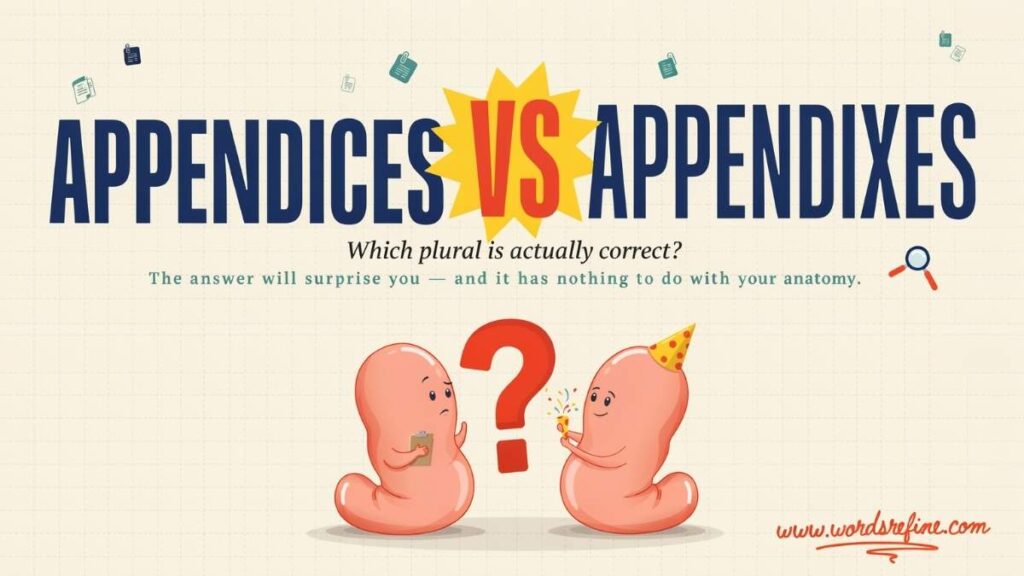
Have you ever paused while writing a report, wondering whether to use appendices vs appendixes? You are not alone. This spelling puzzle can leave even experienced writers second guessing themselves. The good news is that both words are correct plural forms of appendix, so neither will earn you a grammar penalty. However, understanding when to use each form can make your writing clearer and more professional. Whether you are preparing a research paper, academic thesis, or business report, this guide explains the difference between appendices and appendixes, explores their proper usage, and provides practical examples to help you avoid common mistakes with confidence.
Appendices vs Appendixes The Quick Answer
Both appendices vs appendixes are grammatically correct plural forms of appendix. Neither spelling is universally more correct than the other.
| Word | Meaning | Example |
|---|---|---|
| Appendix | One supplementary section | The report includes an appendix. |
| Appendices | Two or more supplementary sections | The report includes three appendices. |
| Appendixes | Two or more supplementary sections | The report includes three appendixes. |
| Appendix’s | The possessive form of appendix | The appendix’s final section contains the survey results. |
The main difference lies in how the words form their plurals. Appendices follows a traditional Latin pattern, whereas appendixes follows standard English pluralization rules.
For example, a research paper might include two appendices containing survey questions and additional data. Another writer could call those sections appendixes without making a grammatical mistake.
However, if your university, publisher, or workplace specifies one spelling, follow that requirement. Consistency matters more than choosing one form simply because it looks more formal.
Learn the difference between confusing more English words
Apprised vs Appraised Which One Is Correct and Why It Matters ?
What Does Appendices Mean?
Appendices is the plural form of appendix. In books, reports, research papers, and other documents, an appendix is a section that contains additional information supporting the main text.
Writers use appendices to provide useful details without interrupting the main discussion. These sections can include questionnaires, extended tables, technical explanations, interview transcripts, and detailed calculations.
For example, a researcher studying customer satisfaction might discuss the main findings in the body of a report. The researcher could then place the complete questionnaire and additional statistical tables in separate appendices.
This arrangement keeps the report readable while allowing interested readers to examine the supporting material.
The word also appears in anatomy. The vermiform appendix is a small, narrow pouch attached to the large intestine. Its plural can be appendices or appendixes, although medical writing often uses appendices.
The meaning depends on the context, but the grammatical relationship remains the same: appendix is singular, and appendices is plural.
What Does Appendixes Mean?
Appendixes has the same basic meaning as appendices when referring to multiple supplementary sections or anatomical structures.
The difference comes from the way English forms plurals. Many nouns ending in x take es when they become plural. For example, box becomes boxes, and fox becomes foxes. Following this pattern, appendix becomes appendixes.
Consider a technical manual that contains two extra sections. One section explains installation procedures, while the other lists troubleshooting steps. The writer could describe these sections as appendixes.
Similarly, a business report might contain appendixes with supporting calculations, additional financial tables, or detailed explanations of a particular method.
Although appendixes may appear less familiar to some readers, it remains an accepted spelling. You don’t need to avoid it simply because another writer prefers appendices.
What Is the Difference Between Appendices vs Appendixes?
The difference between appendices vs appendixes is primarily grammatical and stylistic rather than semantic. Both words describe multiple appendices or supplementary sections, and both are accepted plural forms of appendix.
Appendices reflects a traditional Latin-derived plural pattern. Appendixes follows the standard English method of adding an ending to form a plural.
In everyday writing, the two forms generally communicate the same meaning. However, the spelling you choose can reflect the conventions of a particular publication or organization.
Learn the difference between commonly mixed-up more words
Remediated vs Remedied Which One Is Correct ?
Meaning and grammar
Both forms function as plural nouns. Neither changes the meaning of the singular word appendix.
For example, these sentences communicate the same information:
The report contains three appendices.
The report contains three appendixes.
In both cases, the reader understands that the report includes three supplementary sections.
Formal and academic writing
Appendices is common in academic, scholarly, and technical documents. Writers often encounter it in research papers, dissertations, textbooks, and formal reports.
However, that does not make appendixes incorrect or unprofessional. A writer can use either form unless a specific style guide or institutional requirement directs otherwise.
Which spelling should you choose?
If you’re preparing a thesis, follow your university’s formatting guidelines. If you’re writing for a publisher, check its editorial requirements. For an ordinary report or personal project, choose either spelling and use it consistently.
There’s no need to treat the choice as a strict grammar test. Both forms are correct.
Learn the difference between tricky grammar more words
Effort vs Affort Which One Is Correct and How to Use It?
When to Use Appendices vs Appendixes
Choosing between the two plural forms becomes easier when you consider your document’s purpose and audience.
Use appendix for one section
When your document contains just one supplementary section, use appendix.
For example, “The report includes an appendix containing the original survey questions.”
The singular form makes sense because the report has only one additional section.
Use appendices for multiple sections
Choose appendices when you want to use the traditional Latin-derived plural.
For example, “The dissertation includes three appendices containing interview questions, extended tables, and additional calculations.”
This form is common in academic writing and works well in formal reports.
Use appendixes for multiple sections
Choose appendixes when you prefer the regular English plural form or when your publication requires it.
For example, “The technical manual contains two appendixes covering maintenance and troubleshooting.”
The sentence is grammatically correct. The spelling does not make the manual less formal or less professional.
Keep your spelling consistent
Once you’ve chosen a form, stick with it throughout the document unless a particular title, quotation, or official requirement calls for a different spelling.
For example, using appendices in one chapter and appendixes in another may distract readers unnecessarily. Consistent wording makes your document easier to follow and gives it a more polished appearance.
Appendices vs Appendixes in Academic Writing
Academic writing often includes supporting information that would make the main discussion too long or difficult to follow. Appendices provide a practical place for that material.
A research paper, thesis, or dissertation might include raw data, survey instruments, interview questions, detailed calculations, or supplementary figures. Instead of interrupting the argument with every technical detail, the writer places the additional material at the end and directs readers to it when necessary.
For example, a dissertation about student study habits might present its main findings in the results chapter. The complete questionnaire and an extended set of statistical tables could appear in separate appendices.
Appendices is a familiar choice in scholarly writing, but appendixes is also grammatically acceptable. Your institution’s formatting instructions should guide the final decision.
Appendix in a research paper
In a research paper, an appendix usually contains information that supports the study but isn’t essential to understanding the main argument.
Useful material may include survey questions, interview protocols, detailed calculations, or supplementary data tables.
However, not every extra detail belongs in an appendix. The material should help readers verify, understand, or explore the research more thoroughly.
Appendix in a thesis or dissertation
A thesis or dissertation may contain several supplementary sections. When that happens, writers often label them individually.
For example:
1.Appendix A: Survey Questionnaire
2.Appendix B: Interview Questions
3.Appendix C: Additional Statistical Tables
These labels help readers locate specific information quickly. They also make it easier to reference supporting material from the main text.
Even so, check your university’s requirements before deciding how to label the sections or which plural form to use.
Learn the difference between confusing word pairs
Instinctually vs Instinctively Which One Is Correct ?
Appendix in a business report
Business reports may use appendices to present financial calculations, detailed budgets, survey results, technical specifications, or supporting documents.
For example, a company evaluating a new marketing campaign might summarize the campaign’s performance in the main report. An appendix could contain the complete survey results and detailed cost breakdowns.
This approach keeps the main report focused while preserving the information readers may need for further analysis.
Examples of Appendices vs Appendixes in Sentences
Examples make the difference between the two forms easier to understand. Both spellings work in ordinary sentences when the writer refers to multiple supplementary sections.
Examples using appendices
“The research paper includes two appendices with the survey questions and supporting data.”
“The author referred readers to the appendices for a detailed explanation of the research methods.”
“The dissertation’s appendices contain additional statistical tables.”
“Please review the appendices before submitting the final report.”
Each sentence uses appendices as a plural noun.
Examples using appendixes
“The technical manual contains two appendixes with maintenance instructions.”
“The report’s appendixes provide additional financial information.”
“The author placed the detailed calculations in the appendixes.”
“The book includes several appendixes that explain its research methods.”
These sentences are also grammatically correct. The spelling differs, but the meaning remains the same.
Learn the difference between often confused words
Ingenuine vs Ungenuine Which One Is Correct ?
How to use appendix vs appendices in a sentence
Use appendix when referring to one section and either appendices or appendixes when referring to more than one.
For example, “The report includes an appendix with the original data” refers to one section.
By contrast, “The report includes three appendices with the original data, survey questions, and calculations” refers to three sections.
The same distinction applies to appendixes. Once you understand the singular and plural forms, choosing the correct word becomes straightforward.
How to Use Appendices in a Report or Research Paper
A well-organized appendix makes a report more useful without overwhelming readers. However, adding supplementary material requires more than placing extra pages at the end.
First, decide which information belongs in the main text and which material works better as supporting documentation. Essential findings and explanations should remain in the main discussion. Detailed material that supports those findings can go in an appendix.
Next, organize the additional information logically. If your report contains several supplementary sections, give each one a clear title. Then refer to the relevant section wherever readers need more information.
For example, a report might state, “The complete questionnaire appears in Appendix A.” This reference tells readers exactly where to find the supporting material.
Finally, check that your appendix labels, page numbers, and table of contents agree. Small inconsistencies can make a well-researched document harder to navigate.
How to label multiple appendices
When a document contains multiple supplementary sections, you can label them with letters or numbers according to the required format.
For example:
1.Appendix A: Survey Questions
2.Appendix B: Interview Transcripts
3.Appendix C: Supporting Calculations
If your style guide uses numbered appendices instead, follow that convention. The key is to make every section easy to identify.
How to reference multiple appendices in a report
In the main text, direct readers to the specific appendix that contains the information they need.
For example, “Additional demographic data appear in Appendix C.”
If you want to refer to several sections together, you could write, “Appendices A and B contain the questionnaire and interview protocol.”
These references help readers move between the main discussion and its supporting material without searching through the entire document.
Appendix in a table of contents
If your document requires a table of contents, list the appendix sections according to the applicable formatting rules.
For example:
Appendix A: Survey Questions …….. 35
Appendix B: Additional Data …….. 39
Appendix C: Calculations …….. 42
The labels and page numbers should match the actual sections. If the document contains only one appendix, simply list that section using the required title.
Whether you use appendix, appendices, or appendixes depends on the number of sections and your chosen or required wording.
Learn the difference between basic English word mistakes
Cadaver vs Corpse Which One Is Correct ?
Common Mistakes When Using Appendices vs Appendixes
Even experienced writers sometimes confuse these forms. Fortunately, most mistakes are easy to correct.
One common mistake is assuming that appendixes is misspelled. It isn’t. Both plural forms are accepted, so you shouldn’t mark appendixes as incorrect simply because appendices looks more familiar.
Another mistake is using the plural form for a single section. If a report contains only one supplementary section, call it an appendix rather than appendices or appendixes.
Inconsistent spelling can also make a document look untidy. Although both forms are correct, switching between them without a reason may confuse readers.
Writers sometimes place too much information in appendices as well. Supplementary sections should support the main discussion rather than replace explanations readers need to understand the central argument.
Finally, don’t confuse an appendix with a reference list. A reference list identifies the sources used in a document, while an appendix provides additional supporting material. A document may need both.
Appendix vs Appendix’s Understanding the Difference
The Appendix appendices, appendixes, and appendix’s may look similar, but each has a specific grammatical role.
Appendix is the singular noun. It refers to one supplementary section or anatomical structure.
Appendices and appendixes are plural nouns. Both refer to more than one appendix.
Appendix’s is the possessive form. It shows that something belongs to one appendix.
For example, “The appendix’s final page contains the additional chart” indicates that the chart appears on a page belonging to one appendix.
By contrast, “The appendices contain additional charts” indicates that multiple supplementary sections contain the charts.
The apostrophe matters because it changes the grammatical meaning. Don’t use appendix’s when you simply need the plural form.
Appendix vs Annex vs Addendum
Appendix, annex, and addendum can all describe additional material, but they aren’t always interchangeable.
An appendix usually provides supporting information attached to a larger document. It might contain a questionnaire, extended calculations, or technical details.
An annex is also supplementary material, but its precise meaning depends on the field and document type. It often refers to an attached section or separate supporting document, particularly in legal, administrative, and international contexts.
An addendum is material added to a document after its original preparation or publication. It may provide a correction, clarification, or new information that wasn’t included earlier.
For example, a research paper might include an appendix containing survey questions. A contract might contain an annex with detailed specifications. A report issued before all the findings were available might later receive an addendum.
The best term depends on what the additional material does and the conventions of the document.
Learn the difference between commonly misused words
Ironic vs Unironic Meaning, Differences, and Correct Usage
Practice Session Appendices vs Appendixes
- The plural of appendix can be written as __________ or __________.
- The research paper includes three __________ with additional data.
- The author placed the survey questions in __________ A.
- Both appendices and appendixes are __________ plural forms of appendix.
- An appendix provides supporting information at the end of a larger __________.
- The researcher included the complete questionnaire in the report’s __________.
- When a document contains multiple appendices, each one should have a clear __________.
- In academic writing, you should follow your institution’s required formatting __________.
- The report includes extra charts and tables in its __________.
- The heading “__________ A: Interview Questions” identifies a specific section of a document.
- When referring to an appendix in general, you usually write the word with a __________ letter.
- In the heading “Appendix B,” the word Appendix begins with a __________ letter.
- An appendix can contain information that would interrupt the flow of the main __________.
- The word appendices is pronounced uh-PEN-duh-__________.
- Writers can use letters or numbers to distinguish multiple __________.
- A supplement or attachment may serve a purpose similar to an appendix, depending on the __________.
- The human appendix is attached to the __________, the first part of the large intestine.
- The appendix is usually located in the lower-__________ area of the abdomen.
- Some people are born without an appendix, while others have it removed through __________.
- Dogs and cats generally lack the distinct vermiform appendix found in __________.
- The sentence “The report includes two appendixes” uses a grammatically __________ plural form.
- In the heading “Appendix A,” the word Appendix forms part of a specific __________.
- Writers should label supporting sections consistently throughout a research __________.
- The words appendices and appendixes have the same basic __________.
- Before submitting your paper, make sure every appendix is labeled correctly and referenced in the main __________.
Answers
- Appendices; appendixes
- Appendices
- Appendix
- Correct
- Document
- Appendix
- Label or title
- Guidelines
- Appendix
- Appendix
- Lowercase
- Capital
- Text
- Seez
- Appendices
- Context
- Cecum
- Right
- Surgery
- Humans
- Correct
- Title or label
- Paper
- Meaning
- Text
Here’s a trusted source for clear more words Comparison:
FAQs
What is the plural of appendix?
The plural of appendix is either appendices or appendixes. Both forms are correct and refer to more than one appendix.
What is another word for appendix?
Depending on the context, alternatives include supplement, attachment, and supplementary material. However, these terms aren’t always interchangeable because an appendix usually forms a supporting section of a larger document.
How do you label appendices?
Label multiple appendices using letters or numbers, depending on your required format. For example, you might use Appendix A: Survey Questions and Appendix B: Additional Data. Keep the labels consistent throughout the document.
How do you pronounce appendices?
Appendices is pronounced uh-PEN-duh-seez, with the main stress on the second syllable.
Should appendix be capitalized?
Capitalize Appendix when it appears in a specific label or title, such as Appendix A: Survey Questions. Use lowercase when referring to it generally, as in “The report includes an appendix.”
How many people are born without an appendix?
Some people are born without a vermiform appendix, while others have it removed through surgery. However, a single reliable figure covering both groups isn’t readily established.
Which animals do not have an appendix?
Many mammals, including dogs and cats, lack the distinct vermiform appendix found in humans. However, appendix-like structures have evolved in several mammalian groups, so the answer depends on how the structure is defined.
Which organ is closest to the appendix?
The appendix is attached to the cecum, the first part of the large intestine. It usually lies in the lower-right abdomen, near the small intestine, although its exact position varies among individuals.
Learn the difference between everyday English mistakes
Enflamed vs Inflamed Which One Is Correct ?
Conclusion
When it comes to appendices vs appendixes, you can put your spelling worries aside. Both forms are correct, and both mean more than one appendix. Appendices is the traditional Latin-based plural, often preferred in academic writing, while appendixes follows the familiar English rule of adding “-es.”
The important thing is to know your audience, follow any required style guidelines, and stick to one spelling throughout your document. Neither form deserves a red pen simply because it looks different.
So, the next time you finish a report or research paper, give your supporting sections clear labels and make sure they contain useful information. Your appendix should help readers find what they need, not send them on a grammatical treasure hunt. After all, your readers came for the information, not an unexpected spelling quiz!

Diora AJS she is an experienced blogger and passionate English language enthusiast at Words Refine. With a keen eye for language and a love for clear communication, she writes practical content about grammar, word meanings, usage, and commonly confused terms. Her goal is to make English easier to understand through clear explanations and relatable examples, helping readers write accurately and communicate with confidence.