

Stint vs stent is a small spelling distinction that can make a big difference in meaning. A stint refers to a period spent doing a particular job or activity, while a stent is a medical device that helps keep a narrowed artery or another body passage open. Although the words look nearly identical, using one in place of the other can leave readers scratching their heads. After all, a short stint at work has little to do with a procedure performed by a cardiologist! Fortunately, learning their definitions, recognizing their differences, and practicing with examples will help you use stint and stent correctly and confidently.
Stint vs Stent Quick Answer
Both stint and stent are correct English words, but they serve different purposes.
Stint refers to a period spent doing a particular job, activity, or task. It can also mean to limit something or be sparing with a resource.
Stent refers to a medical device that helps keep a blood vessel, duct, or another body passage open.
Consider these examples:
After a three-year stint in the Navy, Marcus began a civilian career.
The cardiologist placed a stent in the patient’s narrowed coronary artery.
In the first sentence, stint describes a period of military service. In the second, stent refers to a medical device.
Therefore, when deciding whether to use stint or stent, consider what you want to describe. If you’re talking about work, service, or limiting resources, use stint. However, if you’re referring to a medical device, stent is the correct choice.
Learn the difference between confusing more English words
Choose vs Chose Difference and which one is Correct?
Stint vs Stent Meaning and Definition
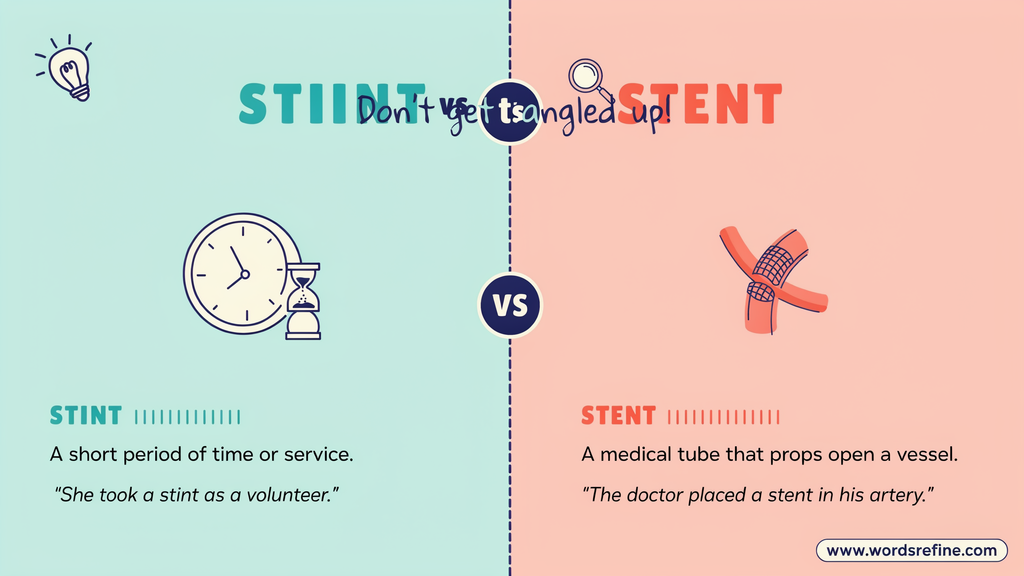
Although these words differ by only one letter, their meanings are quite distinct. Understanding each definition will make it easier to recognize the correct spelling in context.
What Does Stint Mean?
A stint usually refers to a limited period spent doing a job, fulfilling a role, or participating in an activity. It can describe a short assignment or several years of professional experience.
For instance, a journalist might complete a stint at a local newspaper before joining a national publication. Similarly, an athlete might have a stint with a particular team, while a sailor might serve a stint in the Navy.
However, stint has another meaning as a verb. It can mean to limit, restrict, or be sparing with something.
For example, the school refused to stint on laboratory equipment because students needed safe and reliable tools.
In this sentence, stint doesn’t describe a period of time. Instead, it refers to limiting spending on an important resource. Since the school refused to cut back, it chose to provide the equipment students needed.
Learn the difference between commonly mixed-up more words
Capital vs Capitol Which One Is Correct?
What Does Stent Mean?
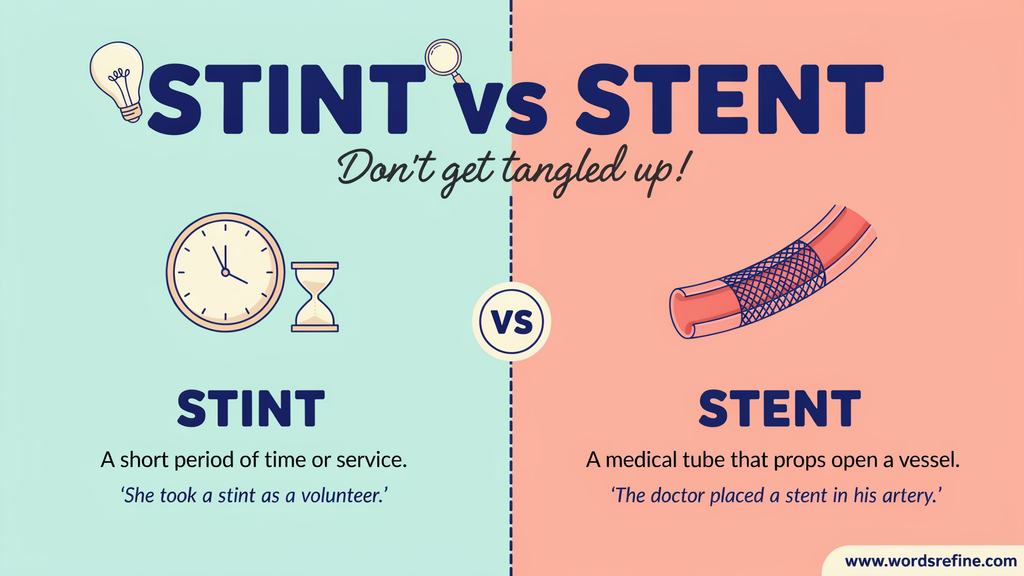
A stent is a medical device that helps keep a blood vessel, duct, or another body passage open. Depending on its design and location, it can support blood flow or help fluids move through the body.
Stents come in different materials and designs. Some use metal mesh, while others use plastic or specialized materials suited to a particular medical purpose. Certain stents expand after placement, whereas others have different structures designed for specific body passages.
For example, after examining a patient’s narrowed artery, a cardiologist may recommend placing a coronary stent.
Here, stent refers to a physical medical device. It has nothing to do with a job, a period of service, or limiting resources.
The term appears frequently in discussions about coronary artery disease, kidney stones, urinary obstruction, and certain procedures involving blood vessels in the brain.
Stint vs Stent Spelling Differences
The spelling difference between stint vs stent is simple. Stint contains the letter i, while stent contains the letter e.
Both words have five letters and share the same first and last two letters. Nevertheless, that single vowel changes the word’s meaning.
Neither spelling is an American or British variation of the other. Both American and British English use stint for a period of work and stent for a medical device.
Stint as a Noun and Verb
One important feature of stint is that it can function as both a noun and a verb. Recognizing its grammatical role helps you understand how its meaning changes with context.
Stint as a Noun
As a noun, stint describes a period spent in a job, role, or activity. The duration can be short or long, depending on the situation.
Common expressions include a brief stint, a two-year stint, a career stint, a stint in the Navy, and a stint abroad.
For example, her brief stint as a restaurant manager taught her how to handle customer complaints.
Similarly, Daniel completed a two-year stint in the Navy before studying engineering.
The coach also had a successful stint with the national team.
In each sentence, stint refers to a period of involvement. It doesn’t automatically suggest that someone performed poorly, left early, or disliked the experience.
Instead, the surrounding context explains what the person did and how long the experience lasted.
Stint as a Verb
As a verb, stint means to restrict something, provide less than is needed or expected, or be sparing with a resource.
The expression stint on commonly appears when someone limits spending, effort, care, or another resource.
For example, the builders didn’t stint on quality materials.
She never stints on praise when her team does excellent work.
The company shouldn’t stint on safety equipment.
However, the meaning changes slightly in a sentence such as, he stinted on food during the trip to save money.
In the first three examples, the negative construction emphasizes that someone didn’t hold back. In the final example, stinted means the person restricted spending on food.
This distinction is particularly useful in workplace communication, business writing, and everyday conversation.
Learn the difference between tricky grammar more words
Loose vs Lose Difference and which is Correctly?
Stent in Medical Terminology
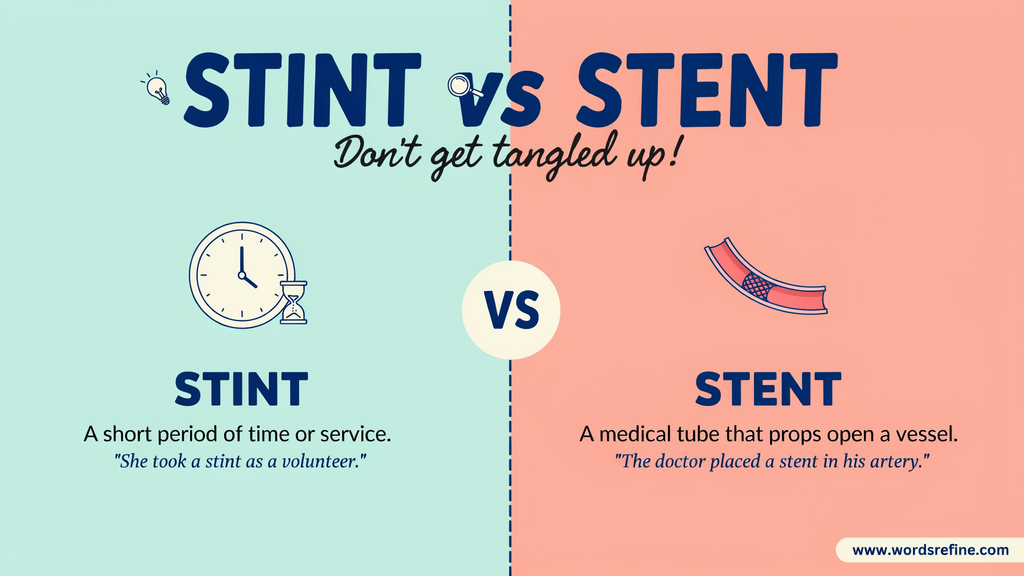
A stent is more than a small tube. Its structure and function depend on where a medical team places it and what problem the device needs to address.
What Is a Stent Used For?
A stent helps keep a narrowed or obstructed passage open. Doctors may recommend one when a blood vessel or another body passage needs support to maintain adequate flow.
For example, stents may help support blood flow through certain narrowed coronary arteries. Ureteral stents can help urine drain from the kidney to the bladder. In other cases, stents may help maintain drainage through selected bile ducts or support blood flow in other blood vessels.
However, not every blockage requires a stent. Doctors consider the underlying condition, the location of the narrowing, available treatments, and the patient’s circumstances before recommending a procedure.
Common Types of Stents
Different stents serve different purposes, and their names often identify the body passage where doctors use them.
A coronary stent is placed in a coronary artery, which supplies blood to the heart muscle. It can help keep a narrowed artery open and support blood flow. Doctors often place coronary stents during a procedure called percutaneous coronary intervention, which may include angioplasty.
A ureteral stent helps urine travel from the kidney to the bladder. Doctors may use one when a kidney stone, swelling, or another condition obstructs the ureter. These stents are often temporary and require removal or replacement according to the treatment plan.
Other vascular stents may be used in selected blood vessels outside the coronary arteries. Their purpose is to support blood flow when a particular condition or procedure calls for them.
A biliary stent helps maintain drainage through a bile duct when a blockage interferes with the normal flow of bile.
Although these devices share a general purpose, a stent designed for one body passage isn’t automatically suitable for another. The medical team chooses the device based on the patient’s anatomy and treatment needs.
How Is a Stent Placed?
The placement procedure depends on the type of stent and the body passage involved. Doctors generally use specialized instruments and imaging or other guidance to position the device accurately.
For a coronary stent, a clinician usually guides a thin catheter through a blood vessel to the narrowed coronary artery. A balloon may then expand to widen the affected area. The stent is positioned and expanded to support the artery, after which the clinician checks the result and removes the catheter.
Coronary stent placement is generally performed through a minimally invasive catheter-based procedure rather than open-heart surgery. However, the exact approach depends on the patient’s condition and treatment plan.
A ureteral stent follows a different route. A clinician typically places it through the urinary tract using a cystoscope or another suitable technique. Its purpose is to support urine drainage rather than maintain blood flow through a coronary artery.
Learn the difference between confusing word pairs
Lay vs Lie Difference and which is correct?
What Are the Risks of Stent Placement?
Although stents can provide important benefits, they also carry risks. The specific complications depend on the device, its location, the procedure, and the patient’s health.
Potential complications include bleeding or infection related to the procedure. Certain vascular stents can develop blood clots or become narrowed again. In other cases, a stent may move or become blocked. Ureteral stents can cause discomfort, urinary urgency, or blood in the urine.
After coronary stent placement, patients may need medication to reduce the risk of blood clots. They should follow their clinician’s instructions and never stop prescribed antiplatelet medication without medical guidance.
Recovery also varies. Some people return to routine activities relatively quickly after an uncomplicated coronary procedure, while others need more time. Ureteral stents may cause discomfort while in place, and their removal schedule depends on the reason for placement.
Consequently, anyone considering a stent procedure should discuss its benefits, risks, and follow-up requirements with the treating medical team.
Stint vs Stent in Kidney, Heart, and Brain Contexts
People often search for the correct spelling after hearing a doctor use the word or reading it in a medical report. Fortunately, the body part and surrounding medical terms usually make the intended word clear.
Stint vs Stent in Kidney?
When referring to a medical device that helps urine drain from the kidney, stent is the correct spelling.
Some people write kidney stint because they confuse the words or mishear the medical term. However, kidney stint isn’t the standard name for this device.
For example, the urologist placed a ureteral stent to help urine drain while the patient received treatment for a kidney stone.
The word ureteral refers to the ureter, the tube that carries urine from the kidney to the bladder. A ureteral stent may help maintain drainage when a stone or swelling interferes with the normal flow of urine.
Stint vs Stent for Kidney Stones?
The correct term is stent. A ureteral stent may be used before, during, or after kidney stone treatment, depending on the circumstances.
For instance, a doctor may place a stent to relieve an obstruction or support drainage after a procedure. The stent doesn’t necessarily remove the stone itself. Instead, it helps urine pass through the affected passage.
The following sentence uses the wrong word: The patient received a stint for kidney stones.
A correct version would be: The patient received a stent to help urine drain after treatment for a kidney stone.
The timing and duration of stent placement depend on the patient’s condition and the clinician’s treatment plan.
Stint vs Stent for the Heart
When writing about a device placed in a heart artery, use stent. The more precise term for a device placed in a coronary artery is coronary stent.
For example, the cardiologist inserted a coronary stent to help maintain blood flow through the narrowed artery.
A heart stent isn’t the same thing as a stint in a medical career. One is a physical device, while the other would describe a period of work or service.
It’s also important to distinguish the device from the procedure. A stent is the device, whereas angioplasty is a procedure used to widen a narrowed blood vessel. Doctors often use both terms when explaining coronary treatment.
Stint vs Stent in Brain?
In certain neurological and vascular procedures, stent is also the correct spelling. A brain stent may refer to a device placed in a blood vessel in or near the brain to support blood flow or help treat a specific vascular condition.
The exact device and its purpose depend on the diagnosis. Some procedures use specialized stents, and not every brain or blood vessel condition requires one.
For example, the specialist explained how the stent could help support the affected blood vessel.
In this medical context, stent refers to the device. Stint would be correct only if the sentence described a period of work, service, or another activity.
Learn the difference between often confused words
Whoever vs Whomever How to Use Each Word Correctly?
Stint vs Stent Pronunciation
The words stint and stent differ by one vowel sound. Their similar appearance can make them easy to confuse, especially when someone encounters the medical term for the first time.
In standard American English, stint is pronounced /stɪnt/, while stent is pronounced /stɛnt/. The vowel in stint sounds like the vowel in sit, whereas the vowel in stent sounds like the vowel in set.
These words aren’t homophones in standard American English because their vowel sounds differ. Instead, they’re commonly confused words that look and sound similar.
To practice the difference, say these phrases aloud: a short stint, a medical stent, a stint in the Navy, and a stent in an artery.
Pronunciation can help you recognize the words. However, context remains important. If you’re unsure which spelling belongs in a sentence, first identify whether you’re discussing a period of activity or a medical device.
Stint vs Stent Examples in Sentences
Realistic examples make the distinction easier to remember. The following sentences show how each word works in everyday English.
A career example: She completed a two-year stint at the company. Here, stint describes a period of employment.
A military example: His stint in the Navy prepared him for civilian life. The word refers to a period of service.
A sports example: The player had a brief stint with the local team. In this case, stint describes a limited period of involvement.
A spending example: The school didn’t stint on safety equipment. The verb means to limit or be sparing with resources.
A heart example: The cardiologist placed a stent in the coronary artery. Here, stent names a medical device.
A kidney example: A ureteral stent helped urine drain around the obstruction. The word refers to a device that supports drainage.
A medical research example: Researchers studied outcomes after stent placement. The sentence uses stent in a medical context.
A workplace example: The manager refused to stint on employee training. Here, stint means to restrict or economize on something.
Short Stint at a Job
After a short stint at the marketing agency, Lena accepted a position with a technology company.
In this example, stint describes a period of employment. It doesn’t explain whether Lena performed well or why she left the agency.
Stint on Safety Equipment
The construction company didn’t stint on protective equipment.
The verb stint means to be sparing with something. Therefore, the sentence explains that the company didn’t limit its spending on protective equipment.
Medical Stent Placement
The surgeon explained the benefits and risks of stent placement before the procedure.
The noun stent refers to the medical device, while stent placement describes the process of positioning it.
Learn the difference between basic English word mistakes
Learn the difference between commonly misused words
Vender vs Vendor Which one Is Correct?
A Simple Case Study One Letter, Two Meanings
Imagine an editor reviewing two sentences in a health magazine.
The original sentence reads: The patient received a stint to keep the artery open.
The corrected sentence reads: The patient received a stent to help keep the artery open.
The correction matters because stint doesn’t name a medical device.
Now consider a different example.
The original sentence reads: The doctor completed a two-year stent at the hospital.
The corrected sentence reads: The doctor completed a two-year stint at the hospital.
In the second example, stint describes the doctor’s period of employment. Using stent instead would introduce an unrelated medical meaning.
These examples show why spelling checks alone aren’t enough. Both words are legitimate English words, so a spelling tool may accept either one. Writers must check the intended meaning as well.
Common Mistakes When Using Stint vs Stent
Even experienced writers occasionally confuse words that look alike. Fortunately, a few simple checks can prevent most stint and stent spelling mistakes.
Using Stent to Describe a Job
Incorrect: He completed a five-year stent as a naval officer.
Correct: He completed a five-year stint as a naval officer.
The sentence describes a period of military service, so stint is the appropriate word. The expression stint in the Navy is also correct.
Using Stint in Medical Writing
Incorrect: The patient needed a stint to help keep the narrowed artery open.
Correct: The patient needed a stent to help keep the narrowed artery open.
Medical writing requires accurate terminology because the distinction affects meaning. A stent is a device used in certain treatments, while a stint describes a period of activity or the act of restricting something.
Learn the difference between everyday English mistakes
Trebled vs Tripled Which One Is Correct?
Assuming Stint vs Stent Are Regional Spellings
Neither word belongs exclusively to American or British English. Both varieties use stint for a period of work and stent for a medical device.
For example, an American newspaper and a British medical publication can both correctly use the phrase coronary stent. Likewise, writers in either country can describe someone’s brief stint abroad.
Trusting Spellcheck Without Checking Meaning
A spellchecker may accept stint when you intended to write stent because both words are spelled correctly in isolation.
For instance, a sentence about a coronary procedure might contain the wrong word without triggering a spelling warning.
To avoid this mistake, ask yourself whether you’re describing a period of work or service, limiting a resource, or referring to a physical medical device. Your answer should make the correct word clear.
How to Remember Stint vs Stent
A simple memory trick can help you distinguish these commonly confused words.
Remember stint as a period of time and stent as a medical device.
A stint might describe a period in a job, a stint in the Navy, or a two-year stint abroad. In contrast, a stent might refer to a coronary stent, a ureteral stent, or another medical device.
You can reinforce the difference with two short sentences.
She began a new stint at work.
The doctor inserted a stent.
The first sentence describes a period of activity, while the second identifies a medical device.
When you encounter either word in an unfamiliar sentence, look at the surrounding vocabulary. Terms such as career, assignment, Navy, and employment often point to stint. Words such as artery, kidney, catheter, and placement often point to stent.
These clues aren’t absolute rules. Nevertheless, they provide a useful starting point when you’re deciding which spelling to use.
Learn the difference between more words people mix up
Hierarchical vs Hierarchal Which One Is Correct?
Practice Session Stint vs Stent
- The cardiologist inserted a _____ to help keep the narrowed artery open.
- She completed a three-year _____ as a hospital administrator.
- The patient received a coronary _____ to improve blood flow to the heart.
- He began his acting _____ after graduating from college.
- The doctor explained how the _____ would help support the artery.
- During his brief _____ abroad, he learned a new language.
- A _____ may help keep a narrowed blood vessel open.
- She served a short _____ as team leader.
- The surgeon discussed the possible risks of placing a _____.
- He had a successful _____ with a professional soccer team.
- The patient was advised to take prescribed medication after receiving a heart _____.
- My uncle had a brief _____ in the military before becoming a teacher.
- A ureteral _____ can help urine flow from the kidney to the bladder.
- Her _____ as a journalist lasted nearly ten years.
- The medical team monitored the patient after inserting the _____.
- He completed a summer _____ at a local law firm.
- The doctor checked whether the _____ was working properly.
- After a short _____ in sales, she moved into marketing.
- A _____ can help keep a treated artery open.
- His latest _____ as a coach ended when the season finished.
- The patient asked how long recovery might take after receiving a heart _____.
- She had a brief _____ on a popular television show.
- Doctors may place a _____ in a narrowed coronary artery.
- After his _____ in the navy, he returned to university.
- The cardiologist explained why a _____ might be appropriate for the patient.
Answers
- Stent
- Stint
- Stent
- Stint
- Stent
- Stint
- Stent
- Stint
- Stent
- Stint
- Stent
- Stint
- Stent
- Stint
- Stent
- Stint
- Stent
- Stint
- Stent
- Stint
- Stent
- Stint
- Stent
- Stint
- Stent
- Remember the Difference
Here’s a trusted source for clear more words Comparison:
FAQs
How serious is having a stent put in?
Having a heart stent placed is a significant medical procedure, but it is generally safe when performed for the right medical reasons. A stent helps keep a narrowed coronary artery open and improves blood flow to the heart. However, complications can occur, and the risks depend on the patient’s overall health, the severity of the blockage, and whether the procedure is planned or performed during a heart attack.
How long is bed rest after a stent?
After heart stent placement, patients usually rest for a few hours while medical staff monitor their condition and check the insertion site for bleeding. Some patients return home the same day, while others need to stay overnight. Recovery depends on how the stent was inserted and the patient’s health. Always follow your doctor’s instructions about rest and returning to normal activities.
Can you live 30 years after stent surgery?
Yes, some people live 30 years or longer after receiving a heart stent. However, a stent treats a narrowed artery rather than curing the underlying coronary artery disease. Taking prescribed medications, eating a heart-healthy diet, exercising as recommended, avoiding smoking, and attending regular checkups can help support long-term heart health.
Can life go back to normal after a stent?
Yes, many people return to their usual activities after recovering from heart stent placement. The recovery period varies depending on the procedure, the reason for the stent, and the person’s overall health. Your doctor may recommend gradually increasing physical activity, participating in cardiac rehabilitation, and continuing prescribed medications to help reduce the risk of future heart problems.
How painful is getting a stent?
Most patients receive local anesthesia to numb the area where the catheter enters the body. As a result, they may feel pressure or mild discomfort rather than significant pain during the procedure. Some people experience temporary chest discomfort afterward. However, severe or new chest pain after stent placement requires immediate medical attention.
What is the average age for a heart stent?
There is no single average age for receiving a heart stent. The procedure is more common among older adults because the risk of coronary artery disease increases with age. However, younger adults may also need a stent because of heart disease or other cardiovascular problems. Doctors consider symptoms, test results, the location and severity of the blockage, and overall health rather than age alone.
What should you not do after having a stent put in?
After heart stent placement, avoid heavy lifting and strenuous activity for the period recommended by your medical team. Follow instructions for caring for the catheter insertion site and ask when it is safe to drive, exercise, or return to work. Most importantly, never stop taking prescribed antiplatelet medication without consulting your doctor. Stopping these medicines too soon can increase the risk of a blood clot forming inside the stent.
At what percentage of blockage is a stent required?
A stent is not required at one specific percentage of artery blockage. Doctors consider the severity and location of the narrowing, symptoms, blood-flow test results, and whether the patient has had a heart attack. A blockage of around 70% or more may warrant treatment in certain coronary arteries, but the decision depends on the individual case. Some blockages can be managed with medication and lifestyle changes, while others require a procedure to restore blood flow.
Are you awake when a stent is put in your heart?
Yes, most patients remain awake during heart stent placement. Doctors typically use local anesthesia to numb the catheter insertion site and may give medication to help the patient relax. General anesthesia is usually unnecessary. Throughout the procedure, the medical team monitors the patient’s condition and provides instructions as needed.
Learn the difference between often confused words
Siked vs Psyched Which One Is Correct?
Conclusion
Stint vs stent differ by just one letter, but their meanings are completely different. A stint refers to a period spent doing a job or activity, while a stent is a medical device that helps keep a narrowed artery or another body passage open. Confusing them can turn a simple career story into an unexpected medical discussion!
Fortunately, remembering the difference is easy: a stint involves time, while a stent relates to medical treatment. Once you understand their meanings and practice using them in sentences, you can avoid this common spelling mistake. After all, you want to describe your stint at work accurately, not give your sentence an accidental medical procedure!

Diora AJS she is an experienced blogger and passionate English language enthusiast at Words Refine. With a keen eye for language and a love for clear communication, she writes practical content about grammar, word meanings, usage, and commonly confused terms. Her goal is to make English easier to understand through clear explanations and relatable examples, helping readers write accurately and communicate with confidence.