
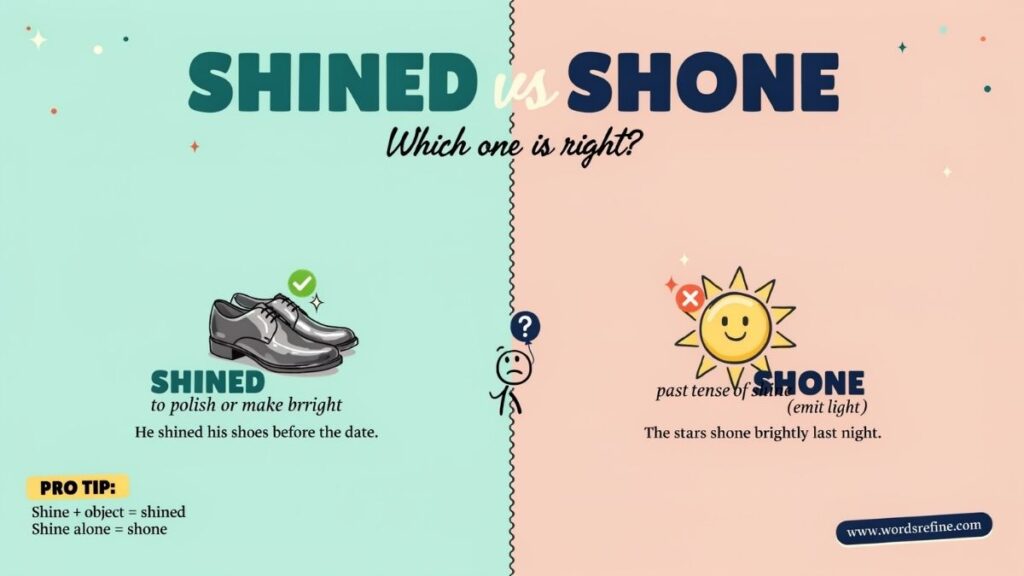
Shined vs shone can leave even confident writers wondering which word fits best. Should you write that the sun shone brightly or that someone shined a flashlight into a dark room? Both forms are correct, but they often serve different purposes. Understanding when to use each one helps you avoid common grammar mistakes and express your ideas clearly. Fortunately, the distinction is simpler than it sounds. From polishing shoes to describing sunlight or a person’s talent, a few practical examples can make the difference clear. Let’s explore shined vs shone and learn how to use both forms naturally and confidently.
Shined vs Shone Quick Answer
Both shined and shone are correct past-tense forms of shine. However, each form tends to appear in different situations.
Shined commonly describes directing a light toward something or polishing an object to make it gleam. Shone usually describes light that radiates, illuminates a place, or reflects from a surface. It can also describe a quality that stands out.
Consider these examples:
| Sentence | Explanation |
|---|---|
| She shined a flashlight into the basement. | She directed the light toward a particular place. |
| He shined his shoes before the interview. | He polished his shoes. |
| The sun shone through the clouds. | The sun gave off light. |
| Her confidence shone during the presentation. | Her confidence stood out. |
These examples illustrate common usage patterns rather than strict rules that cover every situation. In some contexts, shined and shone overlap.
So, if you’re wondering which is correct, shined or shone, the answer is that both are correct. The best choice depends on what you want to say.
Learn the difference between commonly mixed-up more words
Compair vs Compare Which One Is Correct?
What Does Shined Mean?
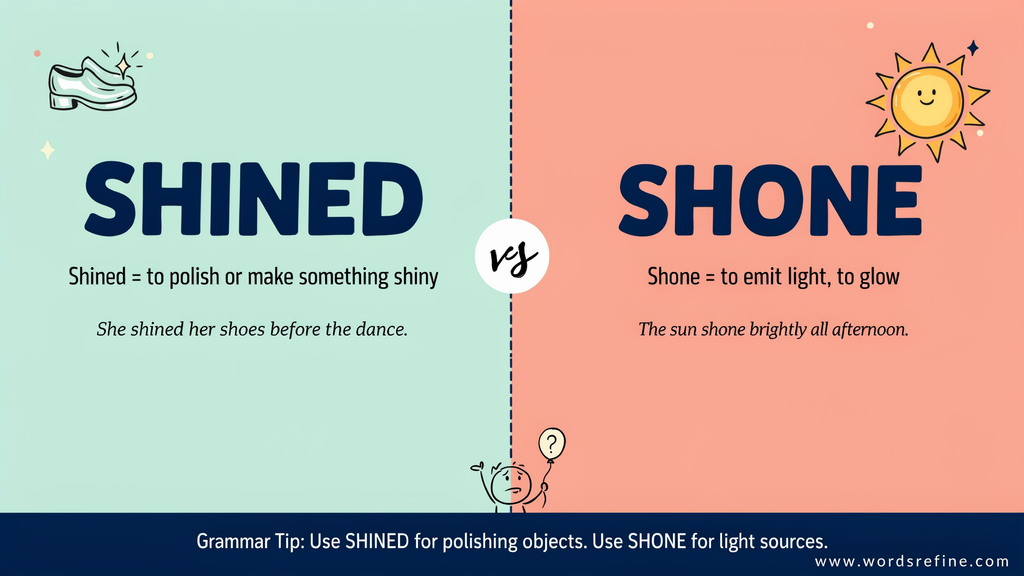
Shined is the simple past tense and past participle of shine. People commonly use it when someone directs a light source toward a target or polishes an object to improve its appearance.
Shined Meaning and Usage
The meaning of shined depends on the sentence, but two common uses stand out.
The first involves directing light. For example, a person might use a flashlight to illuminate a dark room, inspect a broken machine, or look beneath a parked car.
The second involves polishing an object. Someone might shine a pair of shoes, a silver tray, or a brass handle to make the surface look cleaner and brighter.
Here are a few examples:
She shined a flashlight into the attic.
The security guard shined a light beneath the parked car.
He shined his shoes before the job interview.
Maria shined the silver tray until it gleamed.
In each sentence, shined describes an action. Someone directs a light source or works on an object’s surface.
How to Use Shined in a Sentence
One helpful way to understand shined is to look at the action described by the verb.
In the sentence “She shined a flashlight at the ceiling,” the flashlight is the object of the verb. The sentence explains how she directed the beam.
Similarly, “He shined his shoes” describes the act of polishing his footwear. The shoes are the object receiving that action.
However, the meaning doesn’t come from the object alone. Context also matters. A person can shine a flashlight to illuminate something, while another person can shine shoes to make them look polished.
For example, the technician shined a work light into the engine compartment. Before the ceremony, the attendant shined the guest’s leather boots.
Both sentences use shined correctly, even though the actions differ.
Is Shined the Past Tense of Shine?
Yes. Shined is a correct past-tense form of shine. It can also function as a past participle.
For example:
Present: She shines her shoes every Sunday.
Past: She shined her shoes yesterday.
Present perfect: She has shined her shoes several times this month.
The form shined is especially natural when describing polishing or directing a light source. However, it isn’t automatically the best choice whenever a sentence contains an object. The intended meaning and common usage still guide the decision.
Learn the difference between commonly mixed-up more words
Performing vs Preforming Which One Is Correct?
What Does Shone Mean?
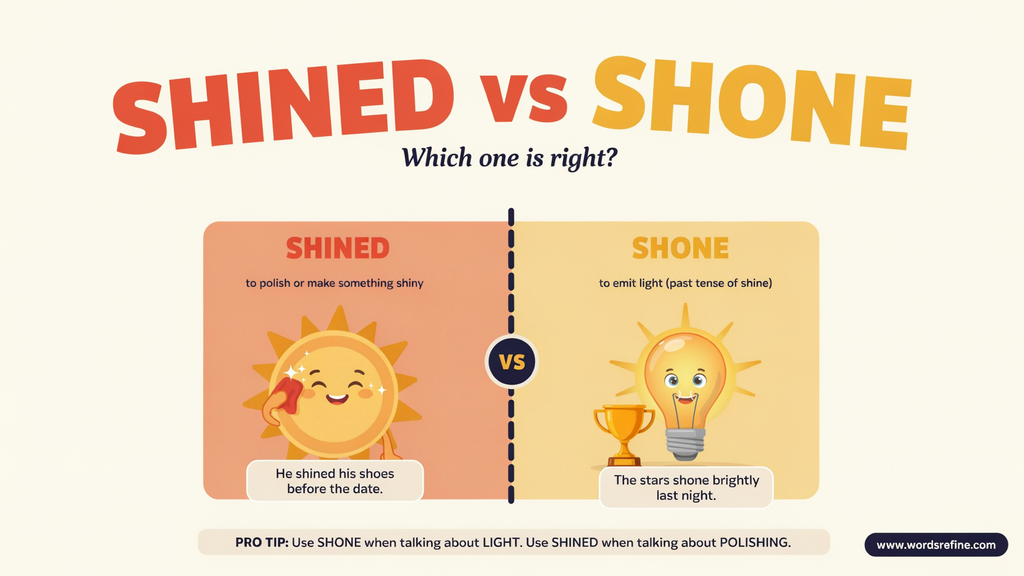
Shone is another correct past-tense form of shine. It commonly describes light that gives off brightness, spreads across a scene, or makes something visible. It also appears in figurative expressions about talent, kindness, confidence, and other qualities that stand out.
Shone Meaning and Usage
The meaning of shone usually centers on brightness or prominence.
The sun shone brightly over the countryside.
The stars shone above the quiet lake.
The moon shone through the bedroom window.
A warm light shone from the cottage.
Her kindness shone through during a difficult moment.
The first four examples describe literal light. The final sentence uses shone figuratively to explain that someone’s kindness became especially noticeable.
This figurative meaning appears frequently in everyday English. When someone says that a person’s talent, courage, or generosity shone, they mean that the quality stood out, much like a bright light in a dark room.
How to Use Shone in a Sentence
To understand how shone works, pay attention to what the subject does.
In “The stars shone brightly,” the stars provide the light. In “The candle shone in the darkness,” the candle illuminates its surroundings.
Here are some additional examples:
The lighthouse shone across the harbor.
Sunlight shone through the curtains.
The polished mirror shone beneath the overhead lights.
His leadership shone during the emergency.
Her artistic talent shone at the exhibition.
Notice that the mirror can shine even though it reflects light rather than producing its own. The verb can describe visible brightness without requiring the object to generate light itself.
Therefore, you don’t need to use shined simply because the sentence mentions an object. The key is to understand whether you’re describing an action, an appearance, or a figurative quality.
Is Shone the Past Tense of Shine?
Yes. Shone is a standard past-tense form of shine. It can also function as a past participle, particularly in British English and in many familiar expressions.
For example:
Present: The sun shines through the window.
Past: The sun shone through the window.
Present perfect: The sun has shone through the window all morning.
American English also uses has shone. Some American speakers and writers use has shined in certain contexts, especially when describing polishing or directing light.
Consequently, shone isn’t exclusively British English, nor is it simply a more formal version of shined. Its suitability depends on the sentence and the meaning you want to express.
Learn the difference between tricky grammar more words
Tomatoes vs Tomatos Which one Is Correct?
The Main Difference Between Shined vs Shone
The easiest way to understand the difference between shined vs shone is to consider the action or event you’re describing.
Shined often emphasizes what someone did. Shone often emphasizes the light or brightness that appeared. This guideline works well in many situations, although actual English usage allows some overlap.
When to Use Shined
Use shined when describing actions such as directing a light source or polishing an object.
The guard shined a flashlight at the gate.
He shined his shoes before the ceremony.
She shined the brass handle with a soft cloth.
In these examples, someone performs an action involving a target or an object. The verb often takes a direct object, which means the action directly affects something.
For instance, “He shined his shoes” tells you what he did to the shoes. The sentence describes a deliberate action rather than simply stating that the shoes looked bright.
When to Use Shone
Use shone in many descriptions of light and figurative brightness.
The sun shone through the clouds.
The stars shone brightly above the mountains.
A lantern shone in the distance.
Her patience shone through during the crisis.
His talent shone throughout the competition.
In these sentences, the verb describes light that appears or a quality that stands out. The focus isn’t on someone polishing an object or aiming a flashlight.
Learn the difference between confusing word pairs
Inquiries vs Queries What’s the Difference ?
Can Shined vs Shone Be Used Interchangeably?
Sometimes, but not always.
For example, “She shined a flashlight into the room” is natural in American English. “She shone a flashlight into the room” is also used, particularly in British English and other varieties.
However, “He shined his shoes” is the usual choice when describing the act of polishing them in contemporary American English. “He shone his shoes” is possible in some usage, but it sounds less typical to many American readers.
Similarly, “The sun shone brightly” is a conventional way to describe sunlight. Although “The sun shined brightly” also appears in English usage, many readers find shone more natural in this context.
Therefore, consider the intended meaning, the variety of English you’re writing in, and the way the sentence sounds.
Shined vs Shone in American and British English
The difference between shined and shone isn’t simply a matter of American versus British spelling. Both forms occur in both varieties of English, although speakers may favor different forms in particular contexts.
| Context | American English | British English |
|---|---|---|
| Polishing shoes | He shined his shoes. | He shined his shoes. |
| Describing sunlight | The sun shone brightly. | The sun shone brightly. |
| Directing a light | She shined a flashlight at the wall. | She shone a torch at the wall is also common. |
| Describing talent | Her talent shone through. | Her talent shone through. |
These examples show common preferences rather than exclusive regional rules. British speakers may use shone in some situations where American speakers prefer shined, particularly when describing a directed beam of light.
However, both forms remain understandable across English varieties. If you’re writing for an American audience, shined is a natural choice for polishing shoes and many actions involving directed light. Shone is generally preferred for familiar descriptions of sunlight, stars, and figurative radiance.
For British readers, shone may sound more natural in some descriptions of directed light. Even so, the sentence’s meaning matters more than a rigid rule based on nationality.
Do Americans Say Shined vs Shone?
Americans use both forms. Someone might say, “I shined my shoes,” and then read a weather report stating, “The sun shone all afternoon.”
The forms aren’t divided by national borders. Instead, speakers follow familiar patterns that have developed through everyday usage.
For consistent American English writing, use shined for polishing and many directed-light actions, and use shone for descriptions of radiating light and figurative brightness. If a publication follows a particular style guide, apply its recommendations consistently.
Learn the difference between often confused words
Lend vs Lent What’s the Difference and When to Use Each?
Is It the Sun Shined or the Sun Shone?
When describing sunlight, “the sun shone” is usually the more natural choice in standard written English.
The sun shone brightly over the beach.
The sun shone through the clouds after the storm.
The morning sun shone across the garden.
These sentences describe the sun giving off light. They don’t describe someone performing an action on the sun.
But is it incorrect to say “the sun shined”? Not necessarily. The form appears in English usage, although it sounds less conventional to many readers in ordinary descriptions of sunlight.
Compare these examples:
| Sentence | Explanation |
|---|---|
| The sun shone all afternoon. | A natural description of sunlight. |
| The sun shined all afternoon. | Understandable, but less conventional for many readers. |
| She shined a flashlight toward the path. | Describes someone directing a light source. |
| The sunlight shone through the leaves. | Describes light illuminating a scene. |
The distinction becomes clearer when you change the subject. In the first two sentences, the sun provides the light. In the third, a person directs a flashlight.
That difference helps guide the choice. When you’re describing a sunny day, shone is usually the safest and most natural option.
Learn the difference between basic English word mistakes
Socialise vs Socialize Which one Is Correct ?
Is It Shined a Light or Shone a Light?
Both expressions occur in English, and the best choice depends on how you use them.
Shined a Light Directing a Beam
Use shined a light when describing someone directing a light source toward a target. This wording is particularly natural in American English.
The officer shined a light into the abandoned building.
She shined a flashlight under the bed.
The technician shined a light on the damaged wire.
In each sentence, a person controls the light source and directs it toward a particular place.
Shone a Light Literal and Figurative Uses
Shone a light also appears in descriptions of directed light. In addition, it works naturally in the figurative expression shine a light on something.
The researcher shone a light into the narrow passage.
The investigation shone a light on weaknesses in the system.
The report shone a light on the challenges facing local schools.
In the last two examples, no physical beam is necessary. The expression means to reveal information, draw attention to a problem, or help people understand something that was previously unclear.
Learn the difference between commonly misused words
Instalments vs Installments Which one Is Correct?
Which Is Correct Shined vs Shone a Light?
Both can be correct. For a straightforward American English sentence about someone using a flashlight, shined a light is a safe and natural choice. For a figurative expression about revealing information, shone a light on is a familiar option.
However, neither expression should be treated as the only grammatical possibility in every context. Regional preferences and editorial conventions can influence the choice.
Shined vs Shone for a Person?
When describing a person, shone often works well if you mean that someone’s qualities became noticeable or impressive.
Her confidence shone during the interview.
His kindness shone through in difficult circumstances.
The young musician’s talent shone on stage.
Their determination shone throughout the competition.
In each sentence, shone has a figurative meaning. It suggests that a quality stood out, much as a bright light stands out in a dark room.
The expression doesn’t mean that a person physically emitted light. Instead, it uses brightness as a metaphor for a quality that others could clearly see.
However, shined is appropriate when a person performs an action involving light or polishing.
She shined a flashlight toward the lost hiker.
He shined the actor’s shoes before the performance.
The subject’s identity doesn’t determine the verb form. The meaning of the sentence does.
Shined vs Shone Comparison Table
The following table summarizes the main distinctions.
| Feature | Shined | Shone |
|---|---|---|
| Grammatical role | Past tense and past participle of shine | Past tense and past participle of shine |
| Common use | Polishing an object | Describing emitted or visible light |
| Another common use | Directing a light source | Figurative brightness or prominence |
| Example | He shined his shoes. | The stars shone brightly. |
| Flashlight example | She shined a flashlight at the door. | She shone a flashlight at the door is also possible. |
| Figurative example | Less common for qualities standing out | Her talent shone during the show. |
| Regional use | Common in American English | Common in American and British English |
This comparison provides a general guide rather than a list of absolute restrictions. English usage includes overlap, particularly in expressions involving directed light.
Learn the difference between everyday English mistakes
Copyright vs Copywrite Which One Is Correct?
Shined, Shone, and Shining Understanding the Verb Forms
The verb shine belongs to a group of English verbs with more than one accepted past-tense form. Understanding its conjugation helps explain why shined and shone both exist.
Shine Verb Forms
| Verb form | Word | Example |
|---|---|---|
| Base form | Shine | Stars shine at night. |
| Third-person singular present | Shines | The sun shines through the window. |
| Present participle | Shining | The lamp is shining brightly. |
| Simple past | Shined or shone | The sun shone yesterday. |
| Past participle | Shined or shone | The sun has shone all morning. |
The exact form you choose may depend on the meaning and the variety of English.
Is Shine a Regular or Irregular Verb?
Shine has both a regular past-tense form, shined, and an irregular form, shone. Regular verbs usually form the past tense by adding -ed, as in walk and walked. Irregular verbs don’t always follow that pattern, as in go and went.
Because shine accepts both forms, it doesn’t fit neatly into the simple pattern of a verb with only one standard past-tense form.
This explains why neither shined nor shone is automatically wrong. The choice depends on the sentence and established usage.
What Is the Past Participle of Shine?
The past participle of shine can be shined or shone.
The past participle often appears with helping verbs such as has, have, or had.
He has shined his shoes.
The sun has shone through the clouds.
She had shined the metal before the guests arrived.
The stars had shone brightly before the storm rolled in.
In contemporary American English, has shined is particularly natural when the meaning involves polishing or directing light. Has shone is common in descriptions of light and brightness.
However, don’t confuse shone with shown. Although the words look similar, they belong to different verbs.
Shine: The moon shone brightly.
Show: She has shown remarkable patience.
That distinction matters because shown isn’t a past-tense or past-participle form of shine.
Learn the difference between more words people mix up
Dreamt vs Dreamed Which One Is Correct?
Common Mistakes With Shined vs Shone
Even experienced writers sometimes hesitate over these forms. Most mistakes happen when people memorize one rule and apply it to every sentence.
Assuming Shined Is Always Wrong
Some writers believe shone is the only correct past tense of shine. That’s not true.
“He shined his shoes before the wedding” is standard English. So is “She shined a flashlight into the garage.”
Shined has established uses, particularly when the verb describes polishing or directing light.
Assuming Shone Is Only British English
Although shone is common in British English, American writers use it too. “The sun shone through the clouds” sounds natural in American English.
Don’t label shone as British-only or shined as American-only. Both forms appear across English varieties.
Writing the Sun Shined Automatically
When describing ordinary sunlight, the sun shone is usually the more idiomatic choice.
For example, “The sun shone brightly on our first morning at the lake” reads naturally. Although the sun shined is understandable and appears in usage, it may sound less conventional to many readers.
Confusing Shone With Shown
This mistake involves two different verbs.
Incorrect: The moon has shown brightly all night.
Correct: The moon has shone brightly all night.
Correct: She has shown us the photographs.
Use shone for shine and shown for show.
Ignoring the Meaning of the Verb
Don’t choose shined or shone based on the noun alone. Instead, consider what the verb describes.
“She shined the flashlight” focuses on her action. “The flashlight shone through the darkness” focuses on the light it produced.
That small shift in meaning makes a big difference.
Learn the difference between commonly mixed-up more words
Mobil vs Mobile Which one Is Correct?
Shined vs Shone in Everyday Sentences
These examples show how the two forms work in everyday communication.
| Context | Example sentence | Preferred form |
|---|---|---|
| Weather | The sun shone all afternoon. | Shone |
| Night sky | The stars shone above the mountains. | Shone |
| Moonlight | The moon shone through the curtains. | Shone |
| Polishing shoes | He shined his shoes before work. | Shined |
| Using a flashlight | She shined a flashlight into the shed. | Shined |
| Figurative praise | Her generosity shone through. | Shone |
| Workplace achievement | His skills shone during the presentation. | Shone |
| Reflective surface | The silver tray shone under the lights. | Shone |
| Cleaning metal | He shined the brass handle. | Shined |
| Figurative investigation | The report shone a light on the problem. | Shone |
A Practical Example Choosing the Right Form
Imagine an editor reviewing three sentences in a travel article.
Sentence A: “The sun shined over the mountain village.”
The meaning is clear, but “The sun shone over the mountain village” is the more conventional choice for a description of sunlight.
Sentence B: “The guide shone his flashlight toward the trail.”
This sentence is grammatical. However, for a general American audience, “The guide shined his flashlight toward the trail” may sound more familiar.
Sentence C: “Before leaving, the guide shone his hiking boots.”
This sentence may puzzle readers because shone isn’t the usual choice for polishing boots in contemporary American English. “The guide shined his hiking boots” is more natural.
The lesson is simple: grammar involves more than identifying a technically possible form. Natural word choice depends on meaning, context, and established usage.
Learn the difference between often confused words
Fiancé vs Fiancée What’s the Difference and which is Correctly?
Practice Session Shined vs Shone
- The sun _____ brightly over the countryside.
- He _____ his shoes before attending the wedding.
- She _____ a flashlight into the dark basement.
- The moon _____ through the clouds last night.
- Her confidence _____ during the interview.
- The mechanic _____ a light under the car to inspect the damage.
- The stars _____ brightly in the clear night sky.
- He _____ the flashlight toward the broken window.
- She _____ her boots until they looked brand-new.
- The morning sunlight _____ through the bedroom curtains.
- The police officer _____ a torch into the abandoned building.
- His natural talent _____ during the competition.
- The jeweler _____ the silver necklace before displaying it.
- A bright light _____ from the lighthouse across the sea.
- She _____ a flashlight on the missing keys.
- The athlete’s determination _____ throughout the tournament.
- He _____ his leather shoes before the job interview.
- The evening sun _____ over the quiet lake.
- The technician _____ a light into the machine to examine its parts.
- Her kindness _____ through her thoughtful actions.
- The polished brass handle _____ under the hallway lights.
- The security guard _____ a flashlight across the parking lot.
- The candle _____ softly in the dark room.
- He _____ his boots before stepping onto the stage.
- Her personality _____ through during the group discussion.
Answers
- Shone
- Shined
- Shined
- Shone
- Shone
- Shined
- Shone
- Shined
- Shined
- Shone
- Shined
- Shone
- Shined
- Shone
- Shined
- Shone
- Shined
- Shone
- Shined
- Shone
- Shone
- Shined
- Shone
- Shined
- Shone
Here’s a trusted source for clear more words Comparison:
FAQs
What does “shined” mean?
“Shined” is the past tense and past participle of “shine.” It can describe directing light toward something or polishing an object to make it brighter. For example, “She shined a flashlight into the hallway” or “He shined his shoes before the interview.”
Should I use “shined” vs “shone”?
Both “shined” and “shone” are correct past-tense forms of “shine.” Use “shined” when describing polishing or directing a beam of light. Use “shone” more often when light glows or a quality becomes noticeable. However, the best choice depends on the sentence and common usage.
What is another word for “shined”?
The best synonym depends on the context. “Glowed,” “gleamed,” “sparkled,” and “radiated” describe light or brightness, while “polished” means making an object smooth or shiny. For example, “The stars shined” could become “The stars sparkled,” while “She shined her shoes” could become “She polished her shoes.”
Do you say “shined through” or “shone through”?
Both forms are used, but “shone through” is especially common when describing a quality, feeling, or characteristic that becomes noticeable. For example, “Her confidence shone through during the presentation.” In this figurative sense, “shone through” is often the more natural choice.
Is “shined” a valid Scrabble word?
Yes, “shined” is a valid English word and is accepted in standard Scrabble word lists. It is a form of the verb “shine.” However, if you’re playing
Learn the difference between commonly misused words
Any time vs anytime meaning Difference with Examples ?
Conclusion
The difference between shined vs hone can make your writing clearer and more natural. Use shined when someone polishes an object or directs a beam of light. Use shone more often when describing glowing light or a quality that stands out. Although these patterns are helpful, both forms are correct, so let the context guide your choice.
With a little practice, you’ll know which word fits without second-guessing every sentence. After all, grammar doesn’t need to be a bright idea every time, but choosing the right word certainly helps your writing shine!

Diora AJS she is an experienced blogger and passionate English language enthusiast at Words Refine. With a keen eye for language and a love for clear communication, she writes practical content about grammar, word meanings, usage, and commonly confused terms. Her goal is to make English easier to understand through clear explanations and relatable examples, helping readers write accurately and communicate with confidence.