
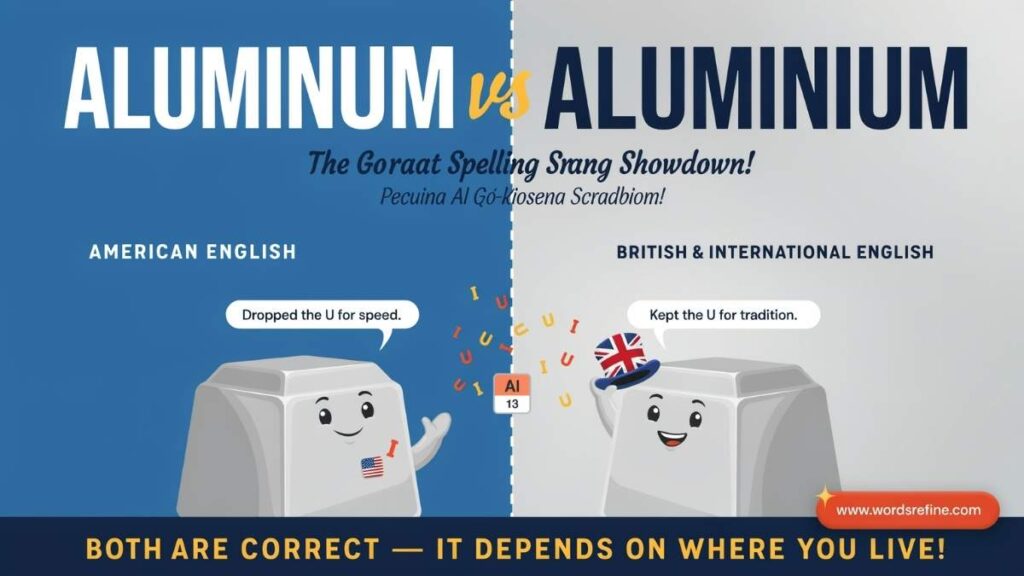
The difference between aluminum vs aluminium may look like a minor spelling detail but that extra i can leave writers wondering which version is correct. Fortunately, both spellings are accepted. American English uses aluminum, while British English and Australian English generally use aluminium. Despite this difference, both words refer to the same lightweight metal found in beverage cans, kitchen foil, airplanes and building materials. So, why do these spellings differ, and which one should you use? Understanding their origins and regional preferences will help you avoid common spelling mistakes, write with confidence, and keep this little linguistic mystery from becoming a metal-sized headache.
Aluminum vs Aluminium Quick Answer
Aluminum is the standard spelling in American English. Aluminium is the standard spelling in British English and is also widely used in Australia, New Zealand, and other countries that follow British spelling conventions.
Both words refer to the same chemical element. Its chemical symbol is Al, and its atomic number is 13. Therefore, the difference affects spelling, not meaning, properties, or use.
| Feature | Aluminum | Aluminium |
|---|---|---|
| Standard usage | American English | British English |
| Meaning | A lightweight chemical element and metal | The same chemical element and metal |
| Chemical symbol | Al | Al |
| Atomic number | 13 | 13 |
| Common spelling pattern | Ends in -um | Ends in -ium |
For example, an American writer would usually write, “The company manufactures aluminum cans.” A British writer would generally write, “The company manufactures aluminium cans.”
Both sentences are correct. The important thing is to choose the spelling that suits your audience and use it consistently.
Learn the difference between confusing more English words
Internet vs Internet Which One Is Correct?
What Is the Difference Between Aluminum vs Aluminium?
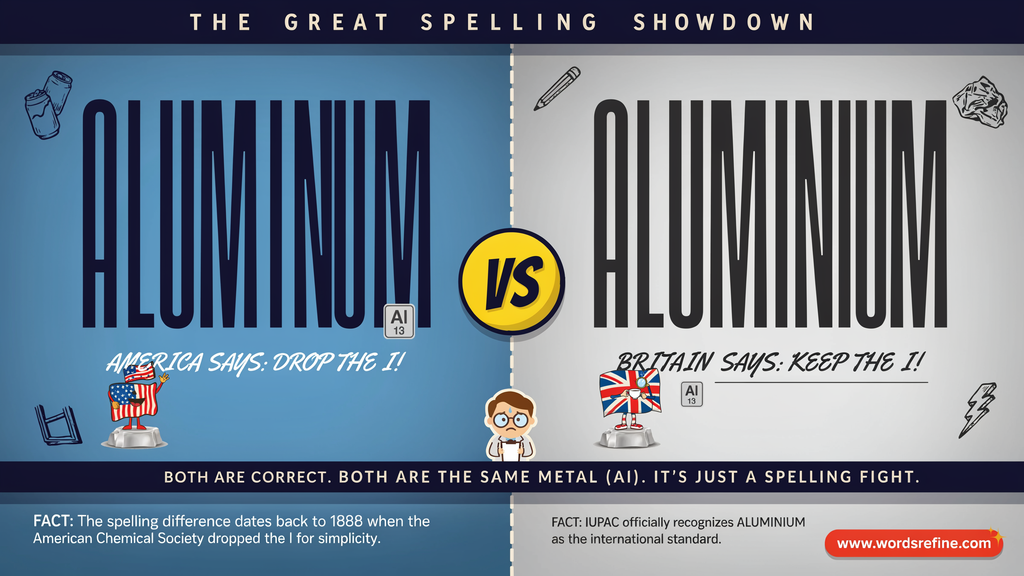
The main difference between aluminum vs aluminium is the spelling. Aluminum ends in -um, whereas aluminium ends in -ium. Despite this small variation, both words identify the same metal.
Aluminum is lightweight, conducts heat and electricity, and resists corrosion because it develops a thin protective oxide layer on its surface. These properties make it useful in everything from food packaging to aircraft manufacturing.
Moreover, neither spelling refers to a different grade of metal or a separate chemical substance. You won’t get a different material by choosing aluminium instead of aluminum. The difference is linguistic rather than scientific.
Pronunciation also varies slightly between the two forms. In American English, aluminum is generally pronounced with four syllables. In British English, aluminium typically has five syllables because of the additional vowel sound.
Although the words may sound different, their meaning remains identical. Therefore, you can confidently use either spelling as long as it matches the conventions of your intended audience.
Aluminum Spelling in American English
In American English, aluminum is the standard spelling. You’ll see it in everyday conversations, school textbooks, newspapers, product descriptions, and scientific publications throughout the United States.
For example, an American manufacturer might advertise an aluminum frame, while a chemistry textbook might describe aluminum as a lightweight metal with the atomic number 13. Although the context changes, the spelling remains the same.
Similarly, American companies generally use aluminum in product labels, technical documents, and advertising. Therefore, if you’re writing for an American audience, aluminum is the most appropriate choice. Using the familiar spelling also helps keep your writing clear and consistent.
Here are a few examples of aluminum in American English:
- The company uses aluminum to manufacture lightweight bicycle frames.
- We recycled our aluminum cans instead of throwing them away.
- The contractor installed aluminum windows in the new house.
- Aluminum foil helps keep food fresh and makes cleanup easier.
- The engineer selected aluminum because it was strong enough for the job without adding unnecessary weight.
In each example, aluminum follows standard American spelling. Consequently, if your readers are primarily in the United States, this is the form you should use in both formal and informal writing.
Aluminium Spelling in British English
In British English, aluminium is the standard spelling. You’ll also commonly find this form in Australia, New Zealand, and other countries that follow British spelling conventions.
Although aluminium contains an extra i, it refers to exactly the same metal as aluminum. The difference is purely regional, so neither spelling is more correct than the other in its respective variety of English.
For instance, a British company might advertise aluminium doors, while an Australian manufacturer might describe a product as an aluminium frame. Likewise, science textbooks and technical documents in these regions generally use aluminium.
If you’re writing for readers in the United Kingdom or another region that follows British English, use aluminium consistently. This small detail helps your writing match local conventions and feel more natural to your audience.
Here are a few examples of aluminium in British English:
- The factory produces aluminium sheets for the construction industry.
- She placed the empty aluminium cans in the recycling bin.
- The house has aluminium window frames that require little maintenance.
- Aluminium foil keeps food covered and helps prevent spills.
- The engineer selected aluminium because it is lightweight and resistant to corrosion.
As you can see, the meaning stays the same in every sentence. Only the spelling changes. Therefore, you don’t need to learn two definitions or memorize separate properties for the two forms.
Learn the difference between commonly mixed-up more words
Greatful vs Grateful Which One Is Correct?
Why Do Aluminum and Aluminium Have Different Spellings?
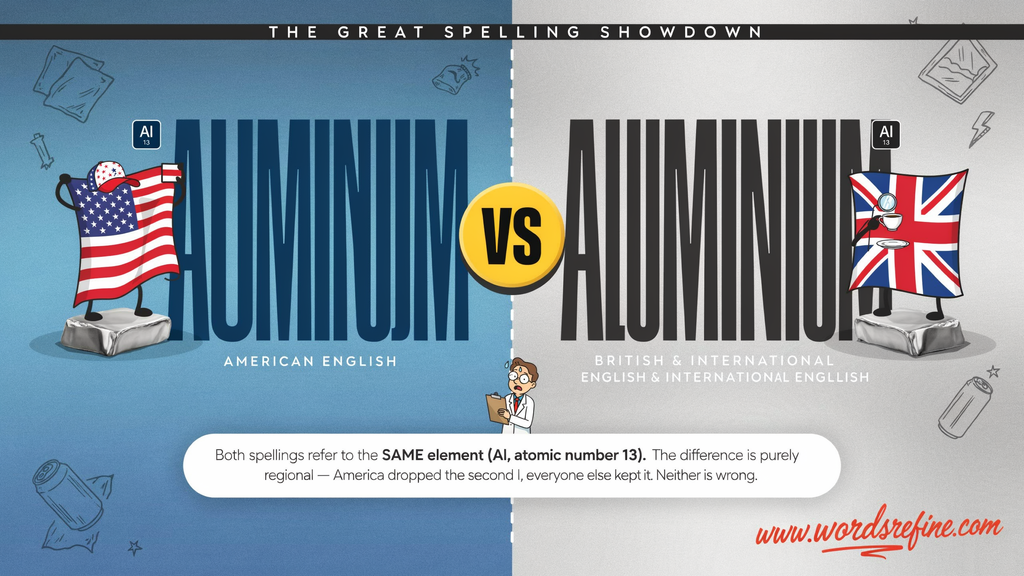
The difference between aluminum and aluminium comes from the history of the element’s name. During the early development of modern chemistry, scientists experimented with different names for the metal before the spellings became established.
British chemist Humphry Davy played an important role in naming the element. He initially considered forms such as alumium and aluminum. Eventually, aluminium became the preferred form in Britain, while aluminum gained acceptance in the United States.
Over time, both spellings became standard in their respective regions. As a result, American English retained aluminum, while British English adopted aluminium.
This difference is similar to other spelling variations between American and British English. For example, Americans generally write color, while British writers use colour. Likewise, Americans prefer center, whereas British English uses centre.
These differences don’t change the meaning of the words. Instead, they reflect how spelling conventions developed in different places. Therefore, aluminum and aluminium are both correct, provided you use the form appropriate for your audience.
Who Discovered Aluminum?
The history of aluminum involves several scientists rather than a single discovery. Humphry Davy helped establish the idea of the element and experimented with compounds containing it. However, he did not successfully isolate pure aluminum metal.
Danish physicist Hans Christian Ørsted later produced a small amount of aluminum through a chemical process. German chemist Friedrich Wöhler subsequently improved the method and helped scientists better understand the metal’s properties.
These developments gradually made aluminum easier to study and, eventually, produce on a larger scale. Today, the metal plays an important role in construction, transportation, packaging, electronics, and many other industries.
Although scientists in different countries contributed to its development, the spelling difference between aluminum and aluminium arose from the naming conventions that evolved alongside these discoveries.
How Do You Pronounce Aluminum vs Aluminium?
Although aluminum and aluminium refer to the same element, their pronunciation differs slightly.
In American English, aluminum is generally pronounced with four syllables: uh-LOO-muh-num. In British English, aluminium usually has five syllables: al-yoo-MIN-ee-um.
The extra syllable in aluminium comes from its additional vowel sound. Consequently, the British form may sound longer to American listeners, while the American form may sound unfamiliar to some British speakers.
Neither pronunciation is inherently better or more accurate in everyday English. Each follows the established conventions of its region.
For example, an American chemistry teacher will typically say aluminum, while a British chemistry teacher will generally say aluminium. Both are referring to the same element.
If you’re learning English, the easiest approach is to follow the pronunciation used by the people you communicate with most often. That way, your spelling and speech will remain consistent.
Learn the difference between tricky grammar more words
It vs Its Meaning Differences Examples and Correct ?
What Is the Chemical Symbol for Aluminum vs Aluminium?
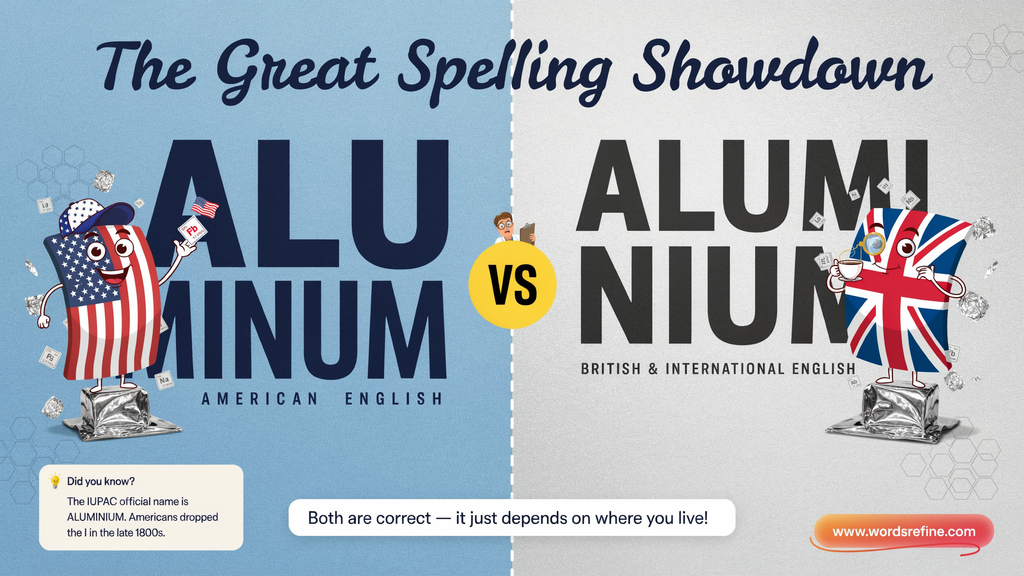
The chemical symbol for both aluminum and aluminium is Al. Its atomic number is 13, meaning that a neutral atom of the element contains 13 protons and 13 electrons.
The periodic table uses Al regardless of whether a textbook follows American or British spelling. Therefore, you won’t find separate entries for aluminum and aluminium.
This distinction matters because chemical symbols remain consistent across languages and regional spelling systems. While written names may change, scientific symbols help researchers communicate clearly around the world.
For example, a chemistry student in the United States might write aluminum, while a student in the United Kingdom writes aluminium. However, both students use Al when identifying the element in a chemical equation or scientific report.
The same principle applies to the element’s atomic number and physical properties. These scientific details don’t change with the spelling.
What Is Aluminum Used For?
Aluminum is widely used because it combines low weight with useful strength, good corrosion resistance, and excellent conductivity. Moreover, manufacturers can shape it into sheets, wires, tubes, and complex components.
Although people often associate aluminum with kitchen foil and beverage cans, its applications extend far beyond the kitchen.
Packaging and Food Storage
Aluminum is common in beverage cans, food containers, and household foil. Its low weight makes packaging easier to transport, while its ability to form a protective barrier helps preserve food and drinks.
For example, manufacturers use aluminum cans for soft drinks because the metal is lightweight, durable, and recyclable. Similarly, aluminum foil helps cover food and protect it from exposure to air and moisture.
Construction and Buildings
Builders use aluminum in window frames, doors, roofing components, and curtain walls. Because the metal resists corrosion and weighs less than many alternatives, it can be practical for a wide range of building projects.
Additionally, aluminum components are relatively easy to shape and install. However, the right material still depends on the project’s strength, cost, insulation, and maintenance requirements.
Transportation
The transportation industry uses aluminum in cars, trains, ships, and airplanes. Reducing weight can improve fuel efficiency in many vehicles, although the actual benefits depend on the design and how the vehicle operates.
For example, engineers may use aluminum alloys in vehicle panels and structural components to reduce weight without sacrificing the required performance.
Electrical Equipment
Aluminum conducts electricity and weighs considerably less than copper. As a result, electrical utilities often use it in overhead power lines, where its low weight offers practical advantages.
However, aluminum and copper have different electrical properties, so engineers must account for conductivity, connections, and other design requirements when selecting a material.
Everyday Products
You may also find aluminum in cookware, ladders, bicycles, furniture, and electronic devices. Its versatility makes it useful in products that need to balance weight, durability, appearance, and cost.
Despite these varied applications, the spelling remains straightforward: American manufacturers generally write aluminum, while British manufacturers generally write aluminium.
Learn the difference between confusing word pairs
Bicep vs Biceps Meaning Grammar Spelling and Correct Usage?
Do Aluminum and Aluminium Have Different Properties?
No. Aluminum and aluminium are two spellings of the same chemical element, so their basic properties are identical.
The metal is lightweight, silvery in appearance, and capable of conducting heat and electricity. It also forms a thin oxide layer that helps protect its surface from further corrosion under many ordinary conditions.
However, pure aluminum is relatively soft compared with many structural metals. For this reason, manufacturers often combine it with other elements to create aluminum alloys with specific strength, durability, or manufacturing characteristics.
These alloys appear in products ranging from beverage cans to aircraft components. Their exact properties depend on their composition and treatment, not on whether someone writes aluminum or aluminium.
Therefore, if a technical document describes aluminium as corrosion-resistant or lightweight, an American document can make the same statement about aluminum.
Which Countries Use Aluminum vs Aluminium?
Spelling preferences generally follow regional English conventions. Although individual organizations may adopt their own style guides, the following patterns are common.
| Country or region | Common spelling |
|---|---|
| United States | Aluminum |
| United Kingdom | Aluminium |
| Canada | Aluminium is common |
| Australia | Aluminium |
| New Zealand | Aluminium |
| Ireland | Aluminium |
Canada deserves a little attention because Canadian English combines features of British and American spelling. Although aluminium is widely used, you may encounter different conventions in particular industries or publications.
Similarly, international companies may follow a corporate style guide rather than the spelling commonly used in a particular country. Therefore, it’s wise to check the organization’s established terminology when preparing formal documents.
Nevertheless, the general rule is simple. Use aluminum for American English and aluminium for British English. If your audience spans several countries, choose a consistent style and explain any terminology that might confuse readers.
Which Spelling Should You Use in Scientific and Technical Writing?
In scientific and technical writing, consistency is essential. The spelling you choose should follow the style guide, publication requirements, or regional convention that applies to your work.
For an American university assignment, aluminum is generally the appropriate choice. For a British textbook or report, aluminium is usually preferred. If you’re submitting research to a journal, check its author guidelines before finalizing your manuscript.
More importantly, don’t switch between the two forms without a clear reason. Using aluminum in one paragraph and aluminium in the next can make your writing look inconsistent, even though both spellings are correct.
Chemical notation, however, remains unchanged. The symbol is Al, and the atomic number is 13 in both American and British publications.
For international communication, a short clarification may help if your readers aren’t familiar with the regional difference. Once you’ve established which form you’re using, maintain it throughout the document.
Learn the difference between often confused words
Discard vs Disgard Meaning Differences Examples and Correct ?
Common Mistakes When Using Aluminum vs Aluminium
Although the difference is easy to understand, writers sometimes make avoidable mistakes when choosing between the two spellings.
Assuming One Spelling Is Incorrect
One common mistake is believing that aluminium is wrong because an American dictionary or textbook uses aluminum, or vice versa.
In reality, both forms are accepted. The correct choice depends on the variety of English you’re using.
Mixing Regional Spellings
Another mistake is switching between aluminum and aluminium within the same document. Although readers will understand both forms, inconsistent spelling can distract them and weaken the overall presentation.
Choose your preferred regional convention before you begin writing. Then apply it consistently.
Using Different Chemical Symbols
Some writers mistakenly assume that the two spellings require different chemical symbols. They don’t. Both refer to the element Al, which has atomic number 13.
Remember that the spelling difference affects the written name only.
Treating the Words as Different Materials
Aluminum and aluminium do not identify two separate metals. They have the same chemical identity, properties, and applications.
Therefore, a product described as aluminium in Britain isn’t made from a different element than a comparable product described as aluminum in the United States.
Confusing Regional Preferences With Scientific Accuracy
Scientific facts don’t change according to spelling conventions. Aluminum and aluminium have the same chemical symbol, atomic number, and elemental properties.
However, a publication may require one spelling for consistency. Following that requirement is a matter of editorial style, not proof that the other form is incorrect.
How to Remember the Difference Between Aluminum vs Aluminium
The simplest way to remember the difference is to connect each spelling with its regional convention.
- Aluminum: Use this spelling for American English.
- Aluminium: Use this spelling for British English and other varieties that follow the British convention.
You can also remember the difference by thinking about the ending. American English uses the shorter -um ending, while British English generally uses -ium.
If you’re writing for a US audience, aluminum is the natural choice. If you’re writing for a British audience, aluminium is usually the better option.
Most importantly, don’t let the extra i make the decision more complicated than it needs to be. Both words describe the same metal, so you only need to match your spelling to your audience.
Aluminum vs Aluminium Example Sentences
The following examples show how both spellings work in ordinary sentences.
- The manufacturer uses aluminum to produce lightweight vehicle parts.
- The British company imports aluminium sheets for construction projects.
- Aluminum is widely used in beverage cans because it is lightweight and recyclable.
- The engineer selected aluminium for the building’s window frames.
- Both aluminum and aluminium have the chemical symbol Al.
- The student learned about aluminium during a chemistry lesson.
- The American textbook explains how aluminum conducts electricity.
- The factory recycles aluminium to reduce material waste.
- Aluminum alloys are used in many transportation applications.
- The laboratory report identifies aluminium as the element with atomic number 13.
Notice that the spelling changes according to the context, but the meaning remains the same. Once you understand the regional difference, using either form becomes much easier.
Learn the difference between basic English word mistakes
Expense vs Expenditure Meaning Differences and Correct Usage?
Practice Session Aluminum vs Aluminium
1. In the United States, manufacturers commonly use ______ to make beverage cans.
2. In the United Kingdom, ______ foil is a common household product.
3. The chemical symbol for ______ is Al.
4. The American textbook explains the properties of ______.
5. Australian manufacturers often use ______ to produce window frames.
6. The British engineer ordered sheets of ______ for the construction project.
7. In American English, the standard spelling is ______.
8. In British English, the preferred spelling is ______.
9. The periodic table lists the element with atomic number 13 as ______.
10. The factory in London recycles ______ cans.
11. The American company produces lightweight ______ bicycle frames.
12. In Australia, people generally spell the metal’s name as ______.
13. The scientist studied the properties of ______ in the laboratory.
14. The British packaging company manufactures ______ containers.
15. Both aluminum and aluminium refer to the same chemical ______.
16. The American manufacturer selected ______ because of its low weight.
17. In British English, kitchen foil is commonly called ______ foil.
18. The Canadian company uses ______ in several of its products.
19. The chemical symbol Al represents ______ in both American and British English.
20. The construction company installed ______ window frames in its new building.
21. American writers generally use ______ in technical documents.
22. British scientific publications commonly use the spelling ______.
23. The metal’s resistance to corrosion makes ______ useful in many applications.
24. The Australian student wrote ______ in a chemistry assignment.
25. Although the spellings differ, aluminum and aluminium have the same chemical ______.
Answers
- Aluminum
- Aluminium
- Aluminum or aluminium
- Aluminum
- Aluminium
- Aluminium
- Aluminum
- Aluminium
- Aluminum or aluminium
- Aluminium
- Aluminum
- Aluminium
- Aluminum or aluminium
- Aluminium
- Element
- Aluminum
- Aluminium
- Aluminium
- Aluminum or aluminium
- Aluminium
- Aluminum
- Aluminium
- Aluminum or aluminium
- Aluminium
- Identity
Here’s a trusted source for clear word meanings:
FAQs
What does vinegar do to aluminum?
Vinegar contains acetic acid, which can react with aluminum, especially if the metal remains in contact with it for a long time. This reaction may dull the surface, cause discoloration, or gradually damage the metal. Brief contact is less likely to cause significant damage, but prolonged soaking is best avoided.
Do the Brits spell aluminum differently?
Yes. British English generally uses aluminium, with an extra i before the final -um. American English uses aluminum. Both spellings refer to the same chemical element.
What does China call aluminum?
In Chinese, aluminum is called 铝, written as lǚ in Mandarin Pinyin. The character refers to the same chemical element known as aluminum in American English and aluminium in British English.
What do British people call aluminum foil?
In British English, it is usually called aluminium foil. In everyday conversation, people may also simply call it foil when the context is clear.
Why do Americans pronounce aluminum differently?
Americans generally use the pronunciation associated with the American spelling, aluminum. British English typically uses aluminium, which has an additional syllable. The difference reflects the distinct naming and pronunciation conventions that developed in the two varieties of English.
How do Australians say aluminum?
Australians generally use the British-style spelling, aluminium, and pronounce it accordingly. The word typically has five syllables, although individual accents can affect the exact sounds.
How do Canadians say aluminum?
Canadians commonly use the spelling aluminium, particularly in formal and technical contexts, although usage can vary. In pronunciation, Canadians may use forms influenced by both American and British English, so the exact sound can differ from speaker to speaker.
What is the old name of aluminium?
Early names for the element included alumium and aluminum. British chemist Humphry Davy used these forms while developing the terminology for the metal. Aluminium later became the established British spelling, while aluminum became standard in the United States.
How do Americans say aluminium?
Americans generally say aluminum, using the American spelling and pronunciation. If an American encounters the British spelling aluminium, they may still pronounce it using familiar American speech patterns. However, the standard American form remains aluminum.
Learn the difference between commonly misused words
Onstage vs On Stage Meaning Differences and Correct Usage ?
Conclusion
The difference between aluminum vs aluminium is simple once you understand the regional spelling conventions. American English uses aluminum, while British English and Australian English generally use aluminium. Despite the extra i, both words refer to the same lightweight metal, with the chemical symbol Al and atomic number 13.
The most common mistake is assuming that one spelling is correct and the other is wrong. However, both are accepted in their respective varieties of English. The key is to choose the spelling that suits your audience and use it consistently throughout your writing.
After all, that extra i doesn’t make the metal stronger, lighter, or shinier! It simply changes how you spell its name. So, whether you write aluminum or aluminium, remember that the real goal is clear, accurate communication. Once you understand the difference, you can leave the spelling confusion behind and get back to what really matters.

Diora AJS she is an experienced blogger and passionate English language enthusiast at Words Refine. With a keen eye for language and a love for clear communication, she writes practical content about grammar, word meanings, usage, and commonly confused terms. Her goal is to make English easier to understand through clear explanations and relatable examples, helping readers write accurately and communicate with confidence.