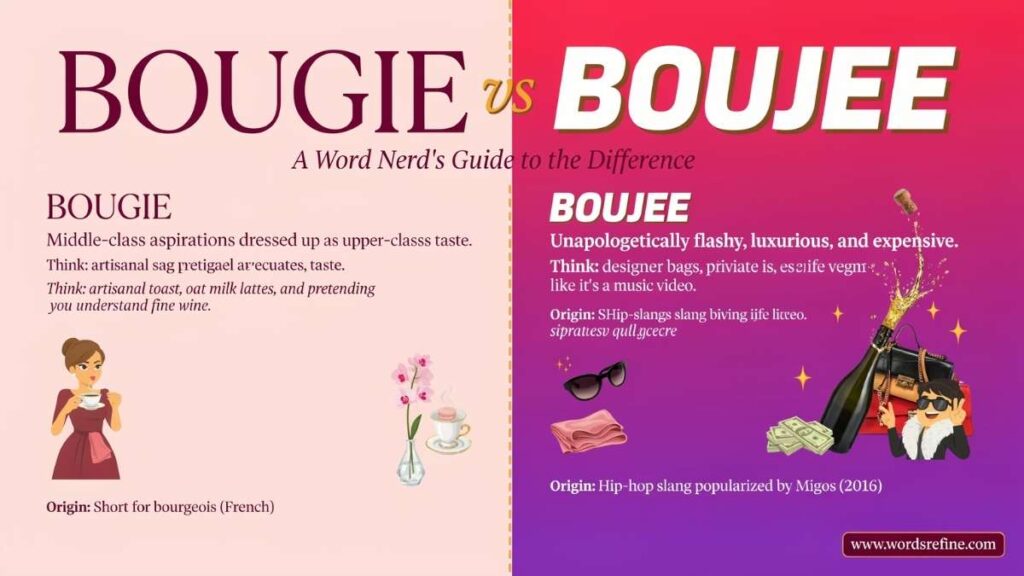
Have you ever wondered whether to write bougie vs boujee when describing someone who loves luxury, designer brands, and fancy experiences? You are not alone. These spellings often confuse writers because they share similar meanings but carry slightly different cultural associations. Both can describe someone who enjoys the finer things in life, but their usage varies depending on context and style. Whether you are describing a friend who insists on gourmet coffee or someone who treats every shopping trip like a celebrity event, choosing the right word can make your writing clearer. Let’s explore bougie vs boujee understand how each spelling works, and avoid common mistakes with confidence.
Quick Answer Bougie vs Boujee
Bougie vs boujee both describe someone or something associated with luxury, expensive tastes, an upscale lifestyle, or a desire to appear sophisticated. Depending on the situation, either word can express admiration, playful teasing, or criticism.
The main distinction involves spelling, cultural associations, and tone rather than a strict difference in meaning.
| Feature | Bougie | Boujee |
|---|---|---|
| Basic meaning | Fancy, upscale, or sometimes pretentious | Fancy, luxurious, or status-conscious |
| Spelling | More established form | Popular informal variant |
| Cultural association | Connected to bourgeois and class-related slang | Strongly associated with contemporary slang and hip-hop culture |
| Tone | Can be positive, playful, or critical | Can be positive, playful, aspirational, or critical |
| Typical use | Everyday conversation and informal writing | Casual speech, social media, music, and internet slang |
| Example | That coffee shop is bougie. | We’re having a boujee brunch. |
For most general writing, bougie is a sensible choice. However, if you’re deliberately using contemporary slang or reflecting a particular informal voice, boujee may fit better.
Neither word automatically means that someone is wealthy. A person can have expensive tastes without having a large bank account. Likewise, someone with considerable wealth might prefer a simple lifestyle.
Learn the difference between confusing more English words
Shined vs Shone Which One Is Correct?
What Does Bougie Mean?
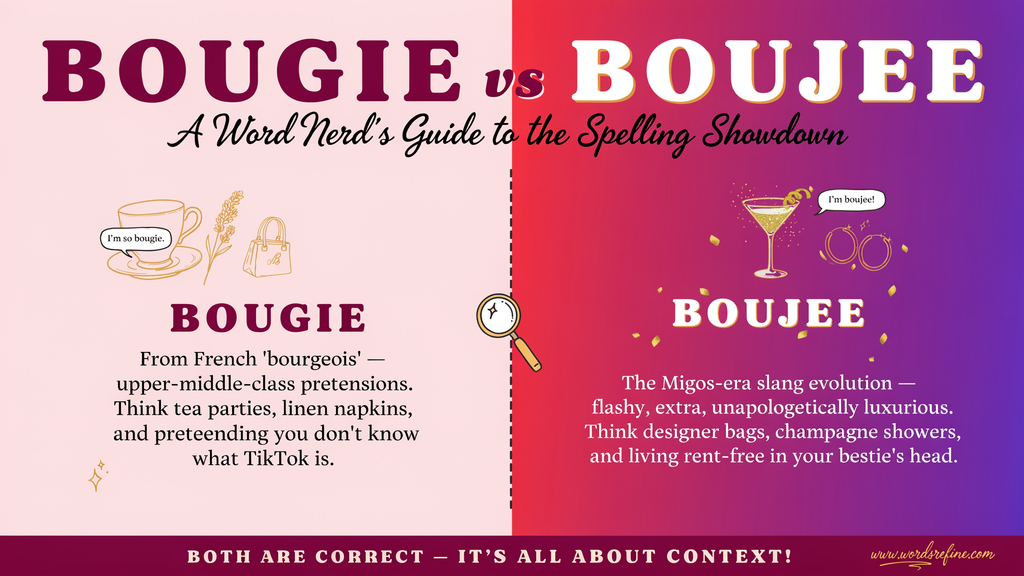
The word bougie generally describes luxury, upscale preferences, and the appearance of sophistication. People use it for restaurants, clothing, homes, habits, and even attitudes that seem fancy or expensive.
However, the word often carries a little extra attitude. Calling something bougie can suggest that it feels unnecessarily luxurious, pretentious, or overly concerned with social status.
Imagine a friend who refuses to drink ordinary coffee because it doesn’t come from a specialty café. You might jokingly call that friend bougie. The comment doesn’t necessarily mean your friend is rich. Instead, it suggests that their tastes have become particular, expensive, or a little high-maintenance.
Bougie Definition and Everyday Meaning
In informal American English, bougie usually has three related meanings.
First, it can describe something upscale or luxurious. A fancy hotel, an expensive restaurant, or a beautifully decorated apartment might all seem bougie.
Second, it can describe pretentious or status-conscious behavior. Someone who constantly mentions designer labels or treats ordinary experiences as beneath them might come across as bougie.
Finally, the word can describe middle-class aspirations or a desire to appear more affluent. In this sense, it suggests an interest in the comforts, habits, and status symbols associated with a higher social position.
The intended meaning depends on context. A bougie hotel might simply be elegant and expensive. A bougie attitude, on the other hand, might suggest snobbery or the belief that ordinary things aren’t good enough.
Consider these examples:
“That hotel has a bougie rooftop pool and an expensive restaurant.”
“He’s getting bougie about his coffee and won’t drink anything without oat milk.”
“She has bougie taste in furniture, but she finds great deals online.”
“Don’t get bougie just because you got a promotion.”
Notice how the meaning changes with each situation. In the first sentence, bougie describes luxury. and In the second, it gently mocks a particular preference. In the last, it criticizes someone for acting superior.
What Does Bougie Mean in Slang?
In slang, bougie means more than simply rich. It often describes people who enjoy fancy experiences, favor expensive products, or behave as though they have more refined tastes than others.
For example, someone might call a restaurant bougie because it serves tiny portions on oversized plates. Another person might use the same word approvingly because the restaurant offers excellent food, thoughtful service, and a beautiful setting.
The word can also poke fun at changes in someone’s lifestyle. A person who once celebrated finding a cheap meal might jokingly describe their new obsession with premium dining as becoming bougie.
Still, the term doesn’t always carry a negative meaning. Friends can use it affectionately, and someone might proudly describe their own lifestyle as bougie.
What Does It Mean When Someone Calls You Bougie?
Usually, the person is commenting on your tastes, behavior, or lifestyle rather than making a factual statement about your finances.
They might mean that you enjoy expensive restaurants, designer clothing, or premium products. Perhaps you have particular preferences about food, travel, or home décor. Alternatively, they might think you care too much about appearances or social status.
Tone makes all the difference. If someone says, “Look at you with your fancy coffee! You’ve become bougie,” they may be teasing you affectionately. However, if they say, “You’re too bougie to eat here now,” the remark may express genuine criticism.
To understand the comment, consider your relationship with the speaker, the situation, and the way they deliver the words.
Learn the difference between commonly mixed-up more words
Stint vs Stent Meaning Differences Examples and Correct Usage ?
What Does Boujee Mean?
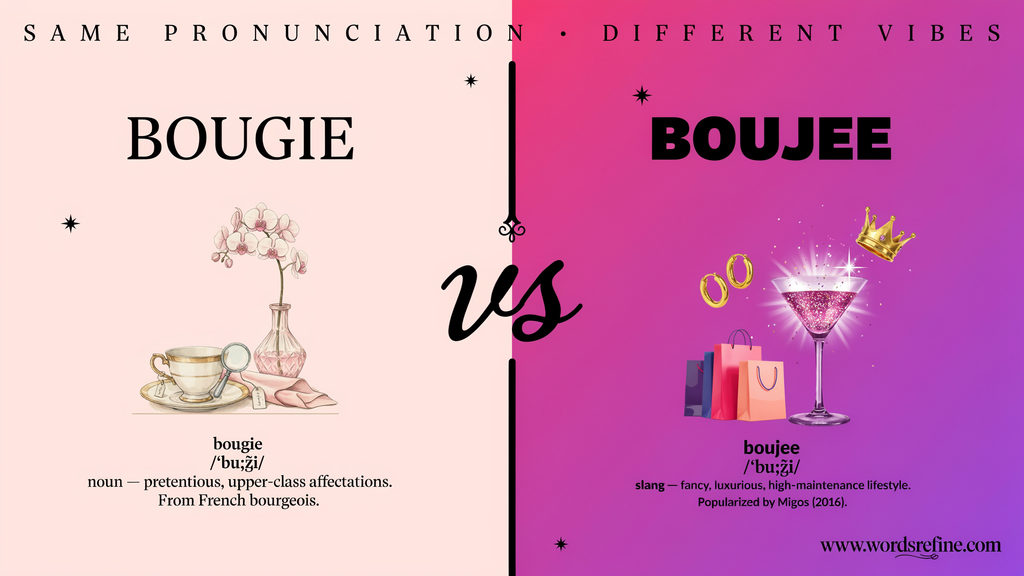
Boujee has a meaning closely related to bougie. It describes someone or something associated with luxury, expensive tastes, status, or an upscale lifestyle. However, boujee often feels more explicitly connected to contemporary slang and popular culture.
People use it to describe everything from stylish outfits to extravagant vacations. It can also express the pleasure of enjoying something fancy, even when the experience is temporary.
For instance, you might say, “I’m feeling boujee today,” when you decide to order an expensive meal instead of cooking at home. You’re not necessarily claiming to be wealthy. You’re simply describing the mood or experience.
Boujee Definition and Slang Meaning
In modern slang, boujee generally refers to being luxurious, fashionable, status-conscious, or interested in the finer things in life.
People use it in several ways.
1It can celebrate luxury: “We’re staying at a boujee resort this weekend.”
2It can describe personal style: “Her boujee fashion sense includes designer bags and elegant accessories.”
3It can tease someone: “You won’t drink regular water anymore? That’s boujee!”
The third example shows why the word can be humorous. It exaggerates an ordinary preference to make it sound extravagant.
What Does Boujee Mean in Slang?
The slang meaning of boujee often emphasizes the enjoyment of luxury, the appearance of success, and the desire to experience something upscale. It can describe someone who appreciates expensive products or enjoys displaying signs of success.
However, boujee doesn’t necessarily mean rich. A person can act boujee for one evening without living an extravagant life. Someone might wear a borrowed designer outfit, book a luxury hotel for a special occasion, or treat themselves to a fancy dinner while remaining careful with money the rest of the time.
The word can also communicate pride in personal progress. Someone who grew up with limited resources might use boujee humorously or positively to celebrate being able to afford experiences that once seemed out of reach.
That distinction matters. Depending on the speaker, the term can express self-confidence, aspiration, playful exaggeration, or criticism of materialism.
What Does It Mean When Someone Calls You Boujee?
When someone calls you boujee, they’re usually commenting on your lifestyle, taste, or behavior.
Perhaps you enjoy luxury brands and high-end experiences. Maybe you prefer fancy restaurants and stylish hotels. You might appreciate premium products, exclusive services, or fashionable clothing.
However, the word can also suggest that you’re acting as though ordinary options aren’t good enough.
Whether the comment is a compliment or an insult depends on the situation. “Your apartment looks so boujee!” might praise your interior design. On the other hand, “You need a boujee hotel just to sleep for one night?” might question your priorities.
The same word can celebrate a taste for luxury or tease someone for taking that taste too far.
Learn the difference between tricky grammar more words
Appendices vs Appendixes Meaning Difference and Usage ?
Bougie vs Boujee Understanding the Key Differences
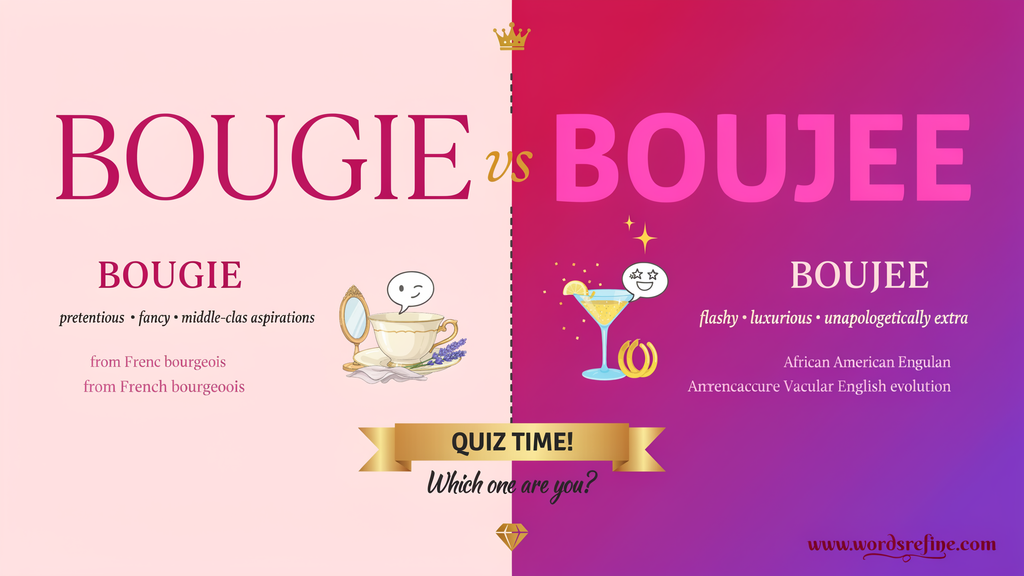
The difference between bougie and boujee is subtle because the words share much of the same meaning. They aren’t two completely separate concepts with rigid definitions.
Instead, the spellings reflect different patterns of informal usage and cultural association. Understanding those patterns helps you choose a word that suits your audience.
Bougie vs Boujee Meaning
Bougie often describes something upscale, fancy, or pretentious. It can also suggest middle-class aspirations or a concern with appearing sophisticated.
Boujee commonly conveys a similar idea but has a stronger association with contemporary slang, hip-hop, and social media. Depending on the speaker, it may sound more playful, aspirational, or fashionable.
Compare these examples.
“That restaurant is bougie.” The speaker might be commenting on its upscale atmosphere or suggesting that it feels pretentious.
“That restaurant is boujee.” The speaker may be emphasizing its fashionable, luxurious, or extravagant appeal.
These interpretations aren’t fixed rules. Both spellings can express admiration or criticism, and many speakers use them interchangeably.
Bougie vs Boujee Spelling
The spelling difference is straightforward. Bougie ends in gie, while boujee ends in jee.
The more important issue is how each spelling functions in informal English.
Bougie is the more established spelling associated with the word’s connection to bourgeois. It appears in dictionary discussions of the informal term.
Boujee is a recognizable slang variant that gained considerable mainstream visibility through hip-hop and popular culture. Its spelling reflects a contemporary form of the expression rather than a universal rule for how the word must be written.
Neither spelling is the exclusive choice in every casual context. The appropriate form depends on the tone you want and the conventions of the publication or conversation.
Bougie and Boujee Cultural Differences
The words share a linguistic background, but cultural context helps explain why their spellings can feel different.
Bougie has a long-standing connection to class-related language. It can describe the tastes, habits, and social aspirations associated with the middle class or with people who want to appear more affluent.
Boujee is strongly associated with modern slang and hip-hop culture. In that context, it can describe luxury, visible success, and the enjoyment of material rewards. It can also poke fun at conspicuous consumption.
These associations are tendencies rather than strict boundaries. People from different backgrounds use both terms, and neither spelling belongs exclusively to one group.
Understanding this context is especially useful when discussing African American Vernacular English, commonly known as AAVE. AAVE is a systematic language variety with its own grammatical and linguistic patterns, not simply a collection of slang terms. Words that become popular through AAVE and hip-hop can spread widely while retaining cultural histories worth acknowledging.
Is Bougie vs Boujee the Correct Spelling?
If you’re wondering whether to write bougie or boujee, the practical answer is that both are used, but bougie is the more established spelling.
Choose bougie when you want a broadly recognized spelling for general informal writing. Choose boujee when you intentionally want the contemporary slang form or are reflecting a particular voice, cultural reference, or style.
For example, a lifestyle article might describe a café as bougie. A casual social media caption might say, “A little boujee brunch never hurt anyone.” Meanwhile, an article discussing slang could use both spellings to explain their differences.
The goal isn’t to label one form universally correct and the other universally wrong. Instead, make a deliberate choice that fits the context.
Learn the difference between confusing word pairs
Hustle vs Hussle Which One Is Correct?
Where Did the Words Come From?
The origin of bougie and boujee begins with a French word and develops through changing ideas about social class, taste, and status.
Although the spellings look different, their histories are connected through the word bourgeois.
The French Word Bourgeois
The French word bourgeois historically referred to a member of the middle class, particularly someone associated with a town or the social class of townspeople. Over time, the word developed broader social and political meanings.
In English, bourgeois can refer to the middle class or to values associated with conventional respectability, property ownership, and material comfort. In some contexts, it also carries a critical meaning, suggesting conventional or materialistic attitudes.
The related noun bourgeoisie refers to the middle class or, particularly in political and economic discussions, a class defined by its relationship to property and capital.
The informal word bougie developed from bourgeois. Its modern slang meaning narrows the idea into a more casual description of upscale tastes, middle-class aspirations, or pretentious behavior.
Bougie Word Origin and the Shift in Meaning
Language often shortens long words and gives them new shades of meaning. Bougie illustrates this process.
Rather than discussing social class in a formal or political sense, speakers began using bougie to describe recognizable everyday behaviors: preferring expensive coffee, choosing designer labels, visiting fashionable restaurants, or making a point of buying premium products.
The word became a flexible way to comment on the appearance of luxury. Sometimes it described genuine extravagance. At other times, it poked fun at modest luxuries that someone treated as essential.
For example, calling a café bougie might refer to its high prices, carefully designed interior, or specialty drinks. Calling a person bougie might suggest that they have developed expensive tastes or care too much about appearances.
Boujee Word Origin and Hip-Hop Culture
The exact development of boujee into its current slang form isn’t tied to one universally established moment. However, hip-hop culture played an important role in bringing the spelling to a wider audience.
A major milestone was the 2016 song “Bad and Boujee” by Migos, featuring Lil Uzi Vert. The track became a mainstream hit and helped make the spelling familiar to listeners who might not previously have encountered it.
The song’s title connects the term with fashionable lifestyles, money, relationships, and displays of success. Its popularity helped establish boujee as a recognizable expression in American popular culture.
However, Migos popularized the spelling; the song shouldn’t be treated as the confirmed origin of the word itself. The term emerged from a broader linguistic and cultural history.
Bougie and Hip-Hop Culture
Hip-hop has long explored themes of wealth, ambition, social mobility, designer fashion, and the celebration of success. These themes help explain why boujee fits naturally into conversations about luxury and status.
For some speakers, the word celebrates enjoying the rewards of hard work or escaping financial hardship. For others, it humorously exaggerates the importance of expensive products and fashionable experiences.
Both interpretations can coexist. A person can celebrate success while also recognizing that material possessions don’t define personal worth.
Does Bougie Mean Candle in French?
Yes, but there’s an important distinction.
In French, une bougie means “a candle.” The French word bougie also has specialized meanings in certain technical and medical contexts.
This is separate from the English slang term describing luxury or pretentiousness. The fact that the words look identical doesn’t mean the English slang definition comes from the French word for candle.
For example, a French speaker might say, “J’ai acheté une bougie parfumée,” meaning, “I bought a scented candle.” In English slang, someone might say, “That restaurant is bougie,” to describe a place that seems fancy or upscale.
This distinction matters because searching for bougie in French may produce dictionary entries about candles rather than the slang usage.
Learn the difference between often confused words
Igniter vs Ignitor Which One Is Correct?
Bougie vs Boujee Pronunciation How Do You Say Them?
Although the spellings differ, bougie and boujee are commonly pronounced the same way in American English. Both usually sound like “BOO-zhee,” with the stress on the first syllable.
The ending sounds like the zh in measure, not the hard g in garden.
How to Spell Bougie
The spelling is bougie: B-O-U-G-I-E.
A useful way to remember it is to connect the word to bourgeois, its historical relative. The spelling may look unusual if you expect the letter g to sound like the one in garden, but the pronunciation uses a softer sound.
How to Spell Boujee
The spelling is boujee: B-O-U-J-E-E.
The letters j-e-e make the spelling look more closely aligned with the way many English speakers hear the word. This spelling is especially recognizable in informal slang and references to contemporary popular culture.
Is There a Bougie vs Boujee Pronunciation Difference?
In ordinary American slang, there is generally no meaningful pronunciation difference between the two spellings. The main distinction is visual and cultural, not phonetic.
| Word | Common American pronunciation | Syllables |
|---|---|---|
| Bougie | BOO-zhee | Two |
| Boujee | BOO-zhee | Two |
Pronunciation can vary among individual speakers, so these examples describe the common reading rather than an absolute rule.
Learn the difference between basic English word mistakes
ECT vs ETC Which One Is Correct?
Bougie in American English vs Boujee in American English
Both spellings appear in American English, particularly in casual conversations, entertainment, lifestyle writing, and social media.
However, their associations can differ slightly.
Bougie in American English often appears in expressions about fancy tastes, expensive preferences, and behavior that seems pretentious. It can describe a luxury hotel, an upscale restaurant, or a person who has become particular about everyday comforts.
Boujee in American English is especially recognizable in contemporary slang. It appears in captions, jokes, song references, and discussions of fashionable or luxurious experiences.
Neither word follows a strict American-versus-British spelling rule. American and British speakers may encounter both forms, and neither spelling belongs exclusively to one country.
Bougie vs Bourgeois
Although bougie comes from bourgeois, the words don’t mean exactly the same thing in everyday English.
Bourgeois is a more formal word used to describe the middle class or attitudes associated with that class. It can also appear in political, economic, and historical discussions.
Bougie is the informal slang form that people often use to describe luxury, pretentiousness, or expensive tastes.
For example, “The article examines the bourgeoisie during the Industrial Revolution” is a discussion of social class. By contrast, “That restaurant is bougie” is a casual comment about its atmosphere, prices, or style.
The term bourgeoisie is particularly important in historical and political writing, where it can refer to a social class associated with ownership of capital and productive property. It shouldn’t automatically be reduced to “rich people.”
Boujee vs Bourgeois
Boujee shares a historical connection with bourgeois, but it functions differently in modern slang.
Someone might use boujee to celebrate a luxurious vacation, a fashionable outfit, or an expensive dinner. Someone using bourgeois might be discussing class structure, social attitudes, or economic systems.
The distinction is largely one of tone and context. Boujee is informal and conversational, while bourgeois has established uses in formal writing and academic discussion.
When Should You Use Bougie Instead of Boujee?
Choosing between the words becomes easier when you consider your audience and purpose.
Use bougie when you want the more established spelling for a general informal context. Use boujee when the slang spelling better matches the voice, cultural reference, or tone you’re trying to convey.
Neither spelling automatically makes a sentence more correct, more stylish, or more authentic.
In Casual Conversation
Both words work naturally in everyday speech.
For instance, you might tell a friend, “This coffee shop is too bougie for my budget.” Alternatively, you could say, “Let’s have a boujee dinner to celebrate your promotion.”
You might even joke, “You’re getting bougie about your weekend plans.”
These sentences communicate a recognizable idea without requiring a detailed explanation. When speaking, the listener won’t usually know which spelling you have in mind because the words sound alike. The distinction matters more when you write them.
On Social Media
Social media encourages playful language, exaggeration, and short expressions that communicate a mood quickly.
Both words can work in captions, but boujee may feel especially natural when you’re deliberately drawing on contemporary slang.
Here are a few caption ideas:
“Boujee brunch, sensible budget.”
“Living fancy without forgetting my roots.”
“Expensive taste, careful spending.”
“Today’s mood: coffee shop bougie.”
“Feeling boujee, staying grounded.”
These examples also show that a luxury aesthetic doesn’t require pretending to be wealthy. Humor often comes from contrasting an upscale experience with an ordinary budget.
In Professional and Academic Writing
Neither word is usually the best choice when precision and formality matter.
Instead, choose a term that describes the specific quality you’re discussing.
| Intended meaning | More precise alternative | Example |
|---|---|---|
| Expensive and luxurious | Luxurious | The hotel offers luxurious accommodations. |
| Stylish and expensive | High-end | The store specializes in high-end furniture. |
| Elegant and refined | Sophisticated | The restaurant has a sophisticated interior. |
| Showy and extravagant | Ostentatious | The building’s ostentatious design attracts attention. |
| Acting superior | Pretentious | His pretentious comments irritated the group. |
| Concerned with social status | Status-conscious | The brand appeals to status-conscious consumers. |
The best alternative depends on what you mean. A luxurious object isn’t necessarily pretentious, and an expensive product isn’t automatically ostentatious.
Learn the difference between commonly misused words
Smokey vs Smoky Which One Is Correct?
Bougie vs Boujee Examples in Everyday Conversation
Examples make the difference easier to understand because both words can describe similar situations while carrying slightly different tones.
Bougie Coffee
Coffee provides a simple example of how people use luxury-related slang.
Someone who orders a specialty drink with a particular milk, a specific roast, and an elaborate preparation method might jokingly be described as bougie. The word isn’t a technical description of the drink. Instead, it comments on the preference.
For example, you might say, “That café is so bougie that it serves coffee in handmade ceramic cups.” You could also joke, “He’s become bougie about coffee and refuses to buy instant.”
The humor comes from treating an ordinary purchase as a sign of luxury.
Boujee Fashion and Lifestyle
Fashion offers another natural setting for the word boujee.
Designer labels, premium accessories, and carefully coordinated outfits can all contribute to a boujee aesthetic. However, the term describes a perception or style rather than a person’s actual financial situation.
Consider these examples:
“Her boujee outfit made the casual dinner feel like a red-carpet event.”
“We’re planning a boujee vacation, but we’re comparing prices first.”
“He wants the boujee hotel experience without the luxury price tag.”
A boujee lifestyle doesn’t have to mean constant extravagance. Someone might save money for a single special trip while living modestly the rest of the time.
Bougie vs Fancy
Fancy is a broad word that can describe anything from an elegant dinner to a complicated coffee order. Bougie often adds a social or humorous judgment.
“That’s a fancy restaurant” simply describes an upscale place.
“That’s a bougie restaurant” may suggest that the place is upscale, overpriced, pretentious, or unusually concerned with appearances.
The distinction isn’t absolute. In some contexts, the words are nearly interchangeable.
Boujee vs Classy
Classy usually expresses approval of elegance, good taste, or polished behavior. Boujee focuses more on luxury, status, or the enjoyment of expensive experiences.
“Her outfit looks classy” praises its elegance.
“Her outfit looks boujee” emphasizes its fashionable or luxurious appearance.
Something can be both classy and boujee. However, a flashy designer outfit might look boujee without looking classy to every observer.
Bougie vs Snobby
Snobby is more clearly negative. It describes someone who acts as though they’re superior to others because of wealth, background, education, taste, or social standing.
Bougie can carry that implication, but it doesn’t always.
1He prefers high-end restaurants” describes a preference.
2He acts too bougie to eat with his old friends” suggests social distance or pretentiousness.
3He is snobby and refuses to speak to people he considers beneath him” directly criticizes his attitude.
The distinction matters because expensive tastes alone don’t prove that someone looks down on others.
Bougie vs Boujee on Social Media
Social media has helped informal expressions spread beyond the communities and settings in which they first gained attention. Both spellings now appear in captions, lifestyle posts, fashion discussions, memes, and entertainment content.
The appeal is easy to understand: these words communicate a recognizable attitude in very little space.
A picture of a luxury hotel might have a caption that celebrates a boujee vacation. A photo of an elaborate coffee order might inspire a joke about being bougie. In both cases, the word adds personality beyond a straightforward description.
Learn the difference between everyday English mistakes
Complement vs Compliment Meaning Differences and Examples?
Bougie Social Media Captions and Boujee Instagram Captions
When writing a caption, consider the mood you want to convey.
1For a playful tone, try “Five-star attitude, two-star budget.”
2For a celebratory tone, try “Enjoying the little luxuries I’ve worked for.”
3For a self-aware tone, try “Bougie taste, practical spending habits.”
4For a fashion-focused post, try “A little boujee, a lot of confidence.”
5For a coffee-themed post, try “My coffee order has officially become bougie.”
These captions use the words as informal expressions rather than formal classifications.
What Online Dictionaries and Discussions Can Tell You
Searching for user-submitted definitions or Reddit discussions can reveal how people interpret bougie and boujee in particular situations. However, these sources reflect individual opinions and community usage rather than a universal definition.
Likewise, an online discussion shouldn’t be treated as definitive proof of a word’s origin. Slang changes over time, and different speakers may use the same term in different ways.
For a reliable explanation, distinguish between dictionary definitions, documented cultural history, and personal interpretations found in online discussions.
Bougie vs Boujee Synonyms and Alternatives
If neither spelling fits your sentence, choose a word that communicates the exact meaning you intend.
| Word | Meaning | Example |
|---|---|---|
| Luxurious | Offering great comfort or expense | They booked a luxurious suite. |
| Upscale | Associated with a higher-priced market or social level | It’s an upscale neighborhood. |
| Fancy | Elaborate, stylish, or special | We’re going to a fancy restaurant. |
| High-end | At the premium end of a market | She buys high-end skincare products. |
| Sophisticated | Refined or developed in style or understanding | The room has a sophisticated design. |
| Pretentious | Trying to appear more important or cultured than one is | His pretentious remarks annoyed everyone. |
| Ostentatious | Designed to attract attention through conspicuous display | The mansion has an ostentatious entrance. |
| Snobbish | Showing a sense of superiority toward others | His snobbish attitude pushed people away. |
These alternatives aren’t interchangeable in every sentence. Use luxurious for comfort and expense, sophisticated for refinement, and pretentious when you want to criticize someone for trying too hard to impress.
Bougie vs. Boujee: Practice Session
Complete each sentence with “bougie” or “boujee.” Both spellings can describe luxury, expensive tastes, or an upscale lifestyle. Although the two terms often overlap, “bougie” is the more established spelling, while “boujee” is common in modern slang.
Learn the difference between more words people mix up
Too vs To Meaning Differences Examples and Grammar Rules?
Practice Session Bougie vs Boujee
1. My sister loves designer handbags and luxury hotels, so her friends call her ______.
2. He ordered the most expensive meal on the menu because he wanted to look ______.
3. Their ______ lifestyle includes first-class flights and exclusive restaurants.
4. She bought a ______ coffee machine even though she rarely drinks coffee.
5. My friend enjoys fine dining and luxury shopping, so she has a ______ taste in fashion.
6. That restaurant looks too ______ for our casual dinner plans.
7. He joked that his new designer watch made him look ______.
8. The influencer showed off her ______ apartment on social media.
9. You don’t need to be wealthy to enjoy a ______ lifestyle.
10. My cousin prefers luxury brands and has a ______ sense of style.
11. They planned a ______ weekend at a five-star resort.
12. She called her brother ______ because he refused to shop anywhere but designer stores.
13. His friends teased him for being too ______ to eat at a neighborhood diner.
14. The singer’s lyrics celebrated a glamorous, ______ lifestyle.
15. That hotel looks so ______ that even its lobby feels luxurious.
16. He enjoys fancy dinners and expensive clothes, so his friends describe him as ______.
17. Her ______ fashion choices make even simple outfits look luxurious.
18. They laughed when he called his ordinary coffee order a ______ experience.
19. My uncle thinks buying designer shoes is ______, but I believe comfort matters more.
20. She playfully described her new skincare routine as a ______ upgrade.
21. The couple chose a ______ restaurant for their anniversary dinner.
22. His friends call him ______ because he always looks for premium products.
23. She enjoys the finer things in life, but she doesn’t act ______ toward others.
24. The comedian joked about his neighbor’s ______ habits and expensive preferences.
25. Whether you spell it “bougie” or “boujee,” the word can describe someone who enjoys ______ things.
Answers
- Bougie
- Boujee
- Bougie
- Boujee
- Bougie
- Boujee
- Bougie
- Boujee
- Bougie
- Boujee
- Bougie
- Boujee
- Bougie
- Boujee
- Bougie
- Boujee
- Bougie
- Boujee
- Bougie
- Boujee
- Bougie
- Boujee
- Bougie
- Boujee
- Bougie
Here’s a trusted source for clear more words Comparison:
FAQs
Can bougie mean fancy?
Yes. “Bougie” can mean fancy, luxurious, or upscale. People often use it to describe someone who enjoys expensive restaurants, designer clothes, or other high-end experiences.
Is it bougie or boujee?
Both spellings appear in informal English. “Bougie” is the more established spelling, while “boujee” is a popular slang variant often associated with hip-hop culture and social media. Both can describe a fancy lifestyle or expensive tastes.
What do Gen Z call pretty girls?
Gen Z slang includes terms such as “baddie,” “it girl,” and “queen.” A “baddie” usually describes an attractive, stylish, and confident person, while an “it girl” suggests someone with standout style, charm, and social appeal. Usage varies by community and context.
What is a boujee girl?
A boujee girl is someone who enjoys luxury, fashionable outfits, upscale restaurants, or other fancy experiences. The term can describe her taste and lifestyle rather than her actual wealth. Depending on the tone, it can sound playful, complimentary, or critical.
What’s a better word for boujee?
The best alternative depends on the meaning. Use “stylish,” “sophisticated,” “glamorous,” or “luxurious” for a positive description. If you mean someone who tries too hard to appear wealthy or important, “pretentious” or “showy” may fit better.
Why do people say boujee?
People use “boujee” as a casual way to describe luxury, expensive tastes, or an upscale lifestyle. The word also appears frequently in music, online conversations, and social media. Depending on the context, it can express admiration, playful teasing, or criticism.
Is it rude to call someone boujee?
Not necessarily. Calling someone “boujee” can be a compliment if you mean they have great style or enjoy the finer things in life. However, it may sound insulting if you suggest they are snobbish, materialistic, or trying too hard to look wealthy. Your tone and the relationship you have with the person matter.
Why do people say I’m bougie?
People may call you “bougie” because you enjoy upscale experiences, prefer high-quality products, or have particular tastes. They might be complimenting your style or teasing you about your spending habits. Consider the situation and their tone before deciding what they mean.
Can a guy be boujee?
Yes. “Boujee” is gender-neutral and can describe anyone who enjoys luxury, stylish clothing, expensive products, or upscale experiences. A guy who prefers designer sneakers, fine dining, and premium accessories might be described as boujee, regardless of how much money he actually has.
Learn the difference between commonly mixed-up more words
Lay Down vs Lie Down Meaning and Examples ?
Conclusion
When choosing between bougie vs boujee both spellings can describe someone who enjoys luxury, expensive tastes, and the finer things in life. However, bougie is the more established spelling, while boujee is popular in modern slang and pop culture. Although the words often share the same meaning, context determines whether they sound complimentary, playful, or slightly judgmental.
For example, calling your friend boujee because she loves designer handbags might be a compliment. But if she refuses to drink coffee unless it comes in a fancy cup, you might have a more convincing reason to call her bougie!
Ultimately, the right spelling depends on your writing style and the impression you want to create. Remember, enjoying luxury doesn’t automatically make someone wealthy or pretentious. You can be bougie on a budget, appreciate the finer things without acting superior, and use boujee without a billionaire’s bank account. After all, good grammar is always in style, even when your budget isn’t luxurious.

Diora AJS she is an experienced blogger and passionate English language enthusiast at Words Refine. With a keen eye for language and a love for clear communication, she writes practical content about grammar, word meanings, usage, and commonly confused terms. Her goal is to make English easier to understand through clear explanations and relatable examples, helping readers write accurately and communicate with confidence.