
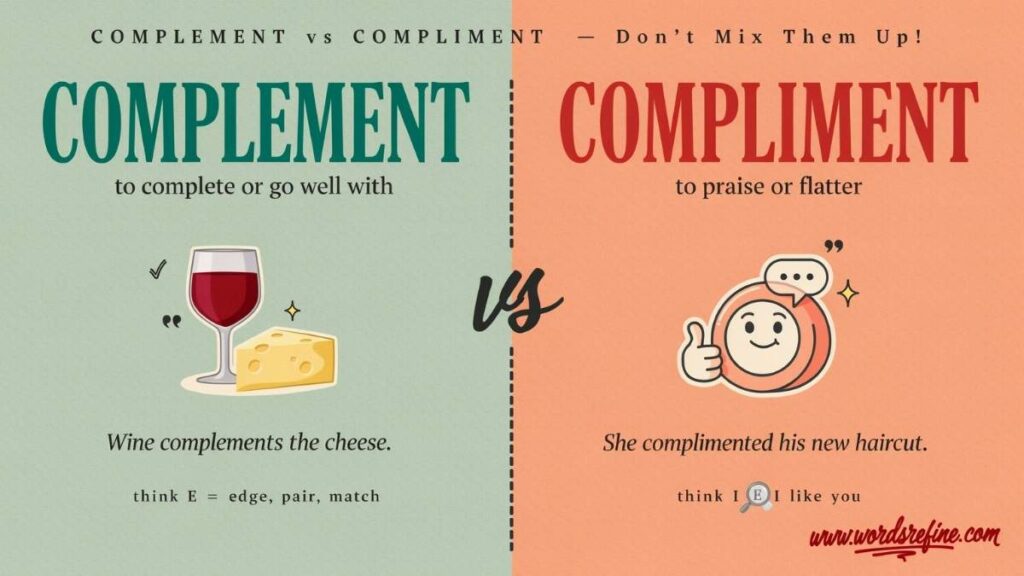
Have you ever mixed up complement vs compliment? You’re not alone! These words sound identical, but each has a distinct meaning. Knowing the difference between complement vs. compliment can help you avoid awkward wording and make your writing clearer. Complement means to complete, enhance, or go well with something, while compliment means to praise someone or express admiration. For example, a pair of shoes can complement your outfit, but telling someone their shoes look fantastic is a compliment. The distinction is simple once you know what to look for. Let’s explore their meanings, everyday examples, and common mistakes so you can use both words correctly.
Complement vs Compliment The Quick Answer
Complement means something that completes, enhances, or goes well with something else. Compliment means an expression of praise or the act of praising someone or something.
Consider these examples:
The blue scarf complements her black coat.
Her friend complimented her on the blue scarf.
In the first sentence, the scarf enhances the coat by creating an attractive combination. In the second, her friend expresses admiration for the scarf.
| Feature | Complement | Compliment |
|---|---|---|
| Meaning | To complete, enhance, or go well with something | To praise or express admiration |
| As a noun | Something that completes or enhances another thing | An expression of praise |
| As a verb | To enhance or complete | To praise someone or something |
| Example | The sauce complements the meal. | The chef complimented the sauce. |
| Memory trick | Think of complete. | Think of praise. |
| Related adjective | Complementary | Complimentary |
Both spellings are correct in American English. The right choice depends on what you want to say, not on regional spelling differences.
Learn the difference between confusing more English words
Dork vs Nerd Meaning Differences Examples?
What Does Complement Mean?
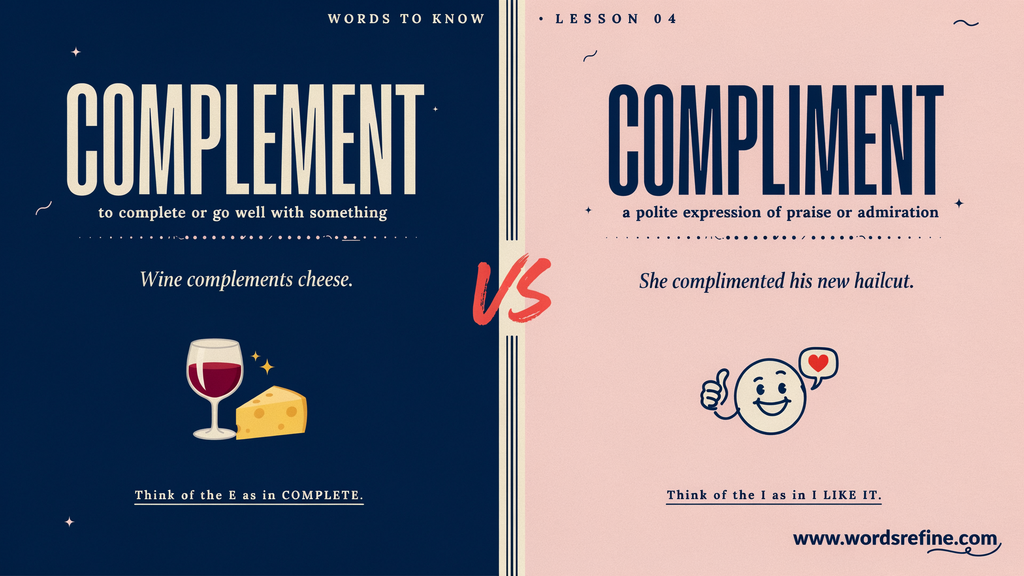
Complement refers to something that completes, enhances, balances, or works well with something else. It can describe colors that look attractive together, colleagues whose skills fit together, or an additional feature that makes a product more useful.
The central idea is completion or enhancement. However, something doesn’t have to be incomplete before another thing can complement it. Two things can simply improve each other when combined.
For example, tomato soup can taste delicious on its own. A grilled cheese sandwich complements it by adding a contrasting texture and flavor. Neither item is incomplete, yet they make a satisfying combination.
Complement as a Noun
As a noun, complement refers to something that completes, enhances, balances, or works well with another thing.
Consider these examples:
The fresh herbs were a perfect complement to the roasted vegetables.
Her attention to detail is an excellent complement to his creative thinking.
The new training program provides a useful complement to the company’s existing resources.
The wooden furniture is a natural complement to the room’s neutral colors.
In each example, the complement adds something valuable to the overall combination.
The expression perfect complement describes something that fits especially well with another thing or enhances it effectively. For instance, a crisp white shirt might be the perfect complement to a navy suit.
However, complement doesn’t apply only to physical objects. Skills, personalities, ideas, services, and features can complement one another, too.
Complement as a Verb
As a verb, complement means to enhance, complete, or improve something through a suitable combination.
For example, the silver necklace complements her evening dress. A short introduction can complement a detailed research report. His patience complements her enthusiasm, while the new application complements the software the company already uses.
Notice how the verb describes the relationship between two things. It explains how one item adds value, balance, or harmony to another.
To use complement correctly, ask yourself whether the sentence describes something that fits with, enhances, or completes something else. If it does, complement is likely the right choice.
Common Expressions With Complement
Several expressions use complement in familiar ways. Learning them can help you recognize the word in different situations.
| Expression | Meaning | Example |
|---|---|---|
| A perfect complement to | Something that pairs especially well with another thing | The salad is a perfect complement to the pasta. |
| Complement each other | To work well together or enhance one another | Their strengths complement each other. |
| Complementary skills | Skills that work well together | The partners bring complementary skills to the project. |
| A full complement of | The complete number or set required or expected | The hospital has a full complement of nurses on duty. |
The expression a full complement of has a slightly different meaning. Rather than describing harmony, it refers to a complete set or number of people or things.
For example, a ship may carry its full complement of crew members. In this case, complement refers to the complete number of people assigned to the ship.
Learn the difference between commonly mixed-up more words
Too vs To Meaning Differences Examples and Grammar Rules?
What Does Compliment Mean?
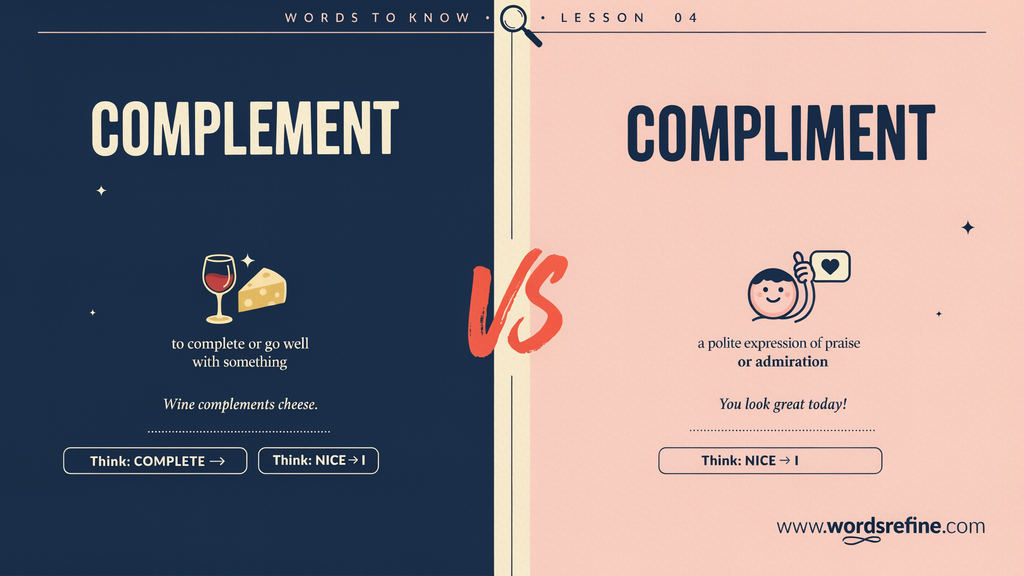
A compliment is an expression of praise, admiration, approval, or appreciation. You might compliment a coworker’s presentation, a friend’s new haircut, or a student’s thoughtful answer.
The main idea behind compliment is expressing something positive about a person, an action, an achievement, or an object. A compliment can take the form of a spoken remark, a written message, or a gesture that communicates appreciation.
For example, telling a colleague, “Your explanation made that difficult topic easy to understand,” is a compliment. You’re recognizing the quality of their communication.
A compliment doesn’t have to sound grand or formal. Sometimes, a simple “You handled that well” means more than an elaborate speech.
Compliment as a Noun
As a noun, compliment refers to the praise itself.
For example, she gave me a compliment on my presentation. His thoughtful feedback was a welcome compliment. The teacher’s compliment encouraged the student to keep improving, and I received a lovely compliment about my cooking.
These examples show how a compliment can communicate recognition, respect, or appreciation.
The expressions give someone a compliment, pay someone a compliment, and receive a compliment are especially common.
For instance, you can give a colleague a compliment on her clear writing, pay a waiter a compliment on his excellent service, or receive a compliment for solving a problem quickly.
A compliment can also be a flattering remark. However, praise isn’t always sincere. Someone might flatter another person to gain approval or influence a decision. Context and intent help distinguish genuine appreciation from insincere praise.
Compliment as a Verb
As a verb, compliment means to praise someone or something.
For example, the manager complimented the team on its excellent work. I complimented her on the way she handled a difficult conversation. The guests complimented the chef on the meal, while he complimented his colleague’s presentation skills.
One useful grammatical pattern is compliment someone on something.
For instance, you can say, “I complimented Maya on her presentation.” Maya is the person receiving the praise, and her presentation is the thing being praised.
You can also use compliment with a direct object. She complimented his honesty, they complimented the design, and the teacher complimented the student’s progress.
To use compliment correctly, check whether the sentence expresses praise, approval, or admiration. If it does, compliment is the appropriate choice.
Learn the difference between tricky grammar more words
Lay Down vs Lie Down Meaning and Examples ?
Common Expressions With Compliment
| Expression | Meaning | Example |
|---|---|---|
| Pay someone a compliment | Praise someone | He paid her a compliment on her presentation. |
| Take it as a compliment | Interpret a remark as praise | If they say you ask good questions, take it as a compliment. |
| Return the compliment | Respond to praise with praise | She returned the compliment by praising his work. |
| Compliments of the chef | Something provided by the chef, often as a courtesy | The restaurant sent us a dessert, compliments of the chef. |
| Compliments of | Provided by or associated with someone or an organization | The refreshments were compliments of the sponsor. |
The expression compliments of the chef deserves special attention. In a restaurant, it usually means the chef has provided a dish or treat as a courtesy, often without charging the guest separately.
Here, compliments doesn’t mean the chef is praising the diners. Instead, the expression indicates that something comes courtesy of the chef.
Complement vs Compliment Key Differences
The difference between complement vs compliment becomes easier to understand when you compare them in similar sentences. Both words can describe something positive, but they express different ideas.
A complement describes how things fit together or enhance one another. A compliment communicates praise.
Consider these examples:
| Complement | Compliment |
|---|---|
| The earrings complement her dress. | He complimented her dress. |
| The side dish is a complement to the main course. | The customer gave the chef a compliment. |
| Their personalities complement each other. | They complimented each other’s personalities. |
| The new feature complements the existing software. | The reviewer complimented the software’s design. |
| Her analytical skills complement his creativity. | Her manager complimented her analytical skills. |
The final pair illustrates the distinction clearly. Analytical skills can complement another person’s creativity by working well alongside it. Meanwhile, a manager can compliment someone for having those same skills by expressing praise.
In other words, complement describes a relationship between things, while compliment describes an expression of approval.
The Difference Between Praise and Completion
Imagine a dinner party. The host serves spicy curry with cooling yogurt sauce. The sauce complements the curry because it balances the flavors. Later, a guest tells the host that the meal was delicious. That remark is a compliment.
The same distinction applies to professional writing. A chart can complement a report by making its findings easier to understand. A supervisor can compliment the employee who created the chart.
If something completes, balances, or enhances another thing, use complement. If someone expresses praise, use compliment.
Learn the difference between confusing word pairs
Internet vs Internet Which One Is Correct?
Complement vs Compliment Examples in Everyday English
Real-life situations make these commonly confused words easier to remember. The following examples show how context determines the correct spelling.
Food and Cooking
Food offers some of the clearest examples because flavors and ingredients often complement one another.
The lemon dressing complements the grilled fish.
Fresh basil is a wonderful complement to tomato sauce.
The guests complimented the chef on the dessert.
She complimented her friend on the homemade bread.
In the first two examples, the words describe how ingredients work together. In the last two, they describe praise.
Clothing, Colors, and Design
Fashion provides another useful way to understand the difference between complement vs compliment.
The brown belt complements the tan shoes.
The gold earrings complement her black dress.
Her friend complimented her on the elegant outfit.
The designer received compliments on the collection.
If you’re deciding whether to write complement vs compliment a dress, consider what the sentence means.
“The jacket complements the dress” means the two garments look good together. “She complimented the dress” means she praised it.
Work, School, and Professional Communication
In professional settings, the distinction helps you communicate clearly and avoid awkward wording.
Her project management skills complement his technical expertise.
The new training materials complement the existing employee handbook.
The director complimented the team on its careful research.
The professor complimented the student on a well-supported argument.
In workplace communication, compliment often conveys positive feedback or recognition. Complement, on the other hand, describes how roles, resources, ideas, or abilities work together.
For example, a manager might write, “Your design skills complement the team’s engineering expertise.” This describes a productive combination of skills.
If the manager writes, “I compliment you on your design skills,” the meaning shifts to praise. However, “I commend you for your design skills” may sound more natural in formal workplace communication.
Relationships and Everyday Conversation
People often use complement to describe compatibility between personalities or qualities.
Their personalities complement each other.
His calm attitude complements her enthusiasm.
She complimented him on his thoughtful advice.
He paid her a compliment on her sense of humor.
The expression complement each other refers to two or more people or things whose qualities fit together or help balance one another. It doesn’t mean that the people must be alike. In fact, different strengths can make a combination especially effective.
A patient listener and an energetic storyteller, for example, may complement each other because each brings something different to the conversation.
Writing, Grammar, and Technical Contexts
These words also appear in academic and technical writing.
The diagram complements the written explanation.
The introduction provides a useful complement to the detailed analysis.
The teacher complimented the student on a clear thesis statement.
The editor complimented the author on the article’s organization.
In these examples, complement describes the relationship between parts of a larger work, while compliment expresses praise for someone’s work.
Learn the difference between often confused words
Greatful vs Grateful Which One Is Correct?
How to Remember Complement vs Compliment
You can remember the difference without learning a complicated grammar formula. The key is to connect each spelling with a familiar word or idea.
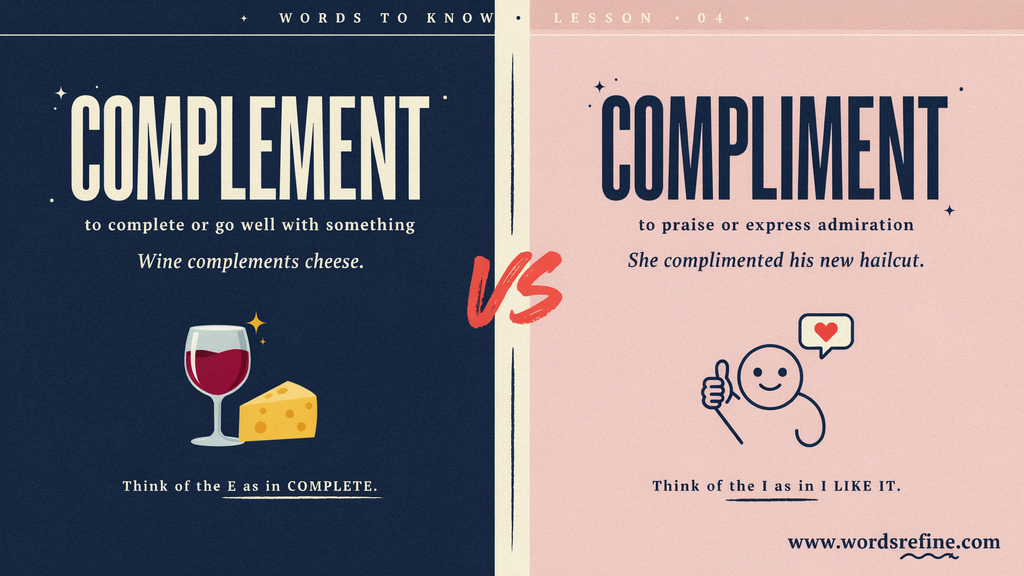
Complement Think of Complete
The easiest spelling trick is to associate complement with complete.
Both words contain the letters comple in the same order. A complement completes or enhances something by adding a suitable element.
For example, the final chapter complements the rest of the book. The sauce complements the meal, and the additional data complements the research findings.
Ask yourself, “Does this thing help complete or enhance something else?” If the answer is yes, complement is likely correct.
Compliment Think of Praise
For compliment, connect the word with praise, appreciation, and kind words.
Imagine telling a friend, “You did a fantastic job!” You’re giving that person a compliment. You aren’t completing anything; you’re expressing admiration.
For example, she complimented him on his presentation, he received a compliment about his cooking, and the customer paid the employee a compliment on her helpful service.
The spelling contains an i, just as the word I appears in the sentence, “I admire your work.” This isn’t a formal linguistic rule, but it can serve as a helpful memory aid.
A Quick Practice Test
Choose the correct word for each sentence.
The curtains complement the furniture.
The teacher complimented the student on her progress.
The new chapter is a useful complement to the textbook.
He received a compliment on his speech.
The answers are complement, complimented, complement, and compliment.
The trick works because it focuses on meaning rather than sound. Since the words sound alike, pronunciation alone can’t tell you which spelling to use.
Learn the difference between basic English word mistakes
It vs Its Meaning Differences Examples and Correct ?
What’s the Difference?
The confusion doesn’t end with complement vs compliment. Their adjective forms, complementary and complimentary, create another common spelling challenge.
Complementary describes things that complete, enhance, balance, or work well with each other.
Complimentary can mean expressing praise or provided free of charge.
| Word | Meaning | Example |
|---|---|---|
| Complementary | Working well together or enhancing each other | The two colors create a complementary combination. |
| Complimentary | Expressing praise | The reviewer made complimentary remarks about the film. |
| Complimentary | Provided without charge | The hotel offers complimentary breakfast. |
The most important distinction is that complimentary has a common meaning related to free goods or services.
Does Compliment Mean Free?
Not by itself. The noun compliment means praise. The adjective complimentary can mean free of charge.
For example, a hotel might offer complimentary coffee, a company might provide complimentary tickets, and a restaurant might serve a complimentary dessert.
In each case, the item or service is provided without a separate charge to the recipient. However, that doesn’t mean the item has no value or costs the business nothing.
By contrast, a complementary service is one that works well with another service. It might be free, but the word complementary doesn’t establish that.
Compare these sentences:
The hotel provides complimentary airport transportation. The transportation is offered without charge.
The transportation service is complementary to the hotel’s other guest services. It works well with those services.
This distinction is particularly useful when reading advertisements, booking hotels, or writing business communications.
Complement vs Compliment Pronunciation
One reason people confuse these words is that they are homophones in standard English. Homophones are words that sound alike but have different meanings and spellings.
Both complement vs compliment are commonly pronounced /ˈkɑːmpləmənt/ in American English, although vowel quality can vary by speaker and accent.
Because their pronunciation is the same, you can’t rely on sound alone to determine which spelling someone intends. Instead, you must use the context.
For English learners, this is a useful reminder that spelling and pronunciation don’t always have a one-to-one relationship. English contains many words that sound the same but have different meanings, including pair and pear, right and write, and brake and break.
When you’re writing, pause to identify the intended meaning before selecting the spelling. When you’re listening, use the surrounding sentence to work out which word the speaker means.
Learn the difference between commonly misused words
Bicep vs Biceps Meaning Grammar Spelling and Correct Usage?
Complement vs Compliment Synonyms
Synonyms can help you understand the difference between these words, but they don’t always work as exact replacements. The best choice depends on the sentence and the meaning you want to convey.
Synonyms for Complement
Common synonyms for complement include enhance, complete, supplement, match, balance, and accompany.
| Synonym | Meaning | Example |
|---|---|---|
| Enhance | Improve the quality or appeal of something | The lighting enhances the room’s atmosphere. |
| Complete | Make something whole or finished | The final section completes the report. |
| Supplement | Add something extra to improve or extend something | The guide supplements the training course. |
| Match | Go well with or correspond to something | The shoes match the dress. |
| Balance | Create a more even or harmonious combination | The acidity balances the sweetness. |
| Accompany | Go with or be present alongside something | Rice accompanies the curry. |
These words overlap with complement, but they have different shades of meaning. For example, supplement often emphasizes adding extra material, while complement emphasizes how one thing works with or enhances another.
Therefore, the best synonym depends on the context.
Synonyms for Compliment
Common synonyms for compliment include praise, commend, applaud, admire, flatter, and congratulate.
| Synonym | Meaning | Example |
|---|---|---|
| Praise | Express approval or admiration | The manager praised the team’s work. |
| Commend | Formally recognize someone for a positive action | The principal commended the student for her honesty. |
| Applaud | Show approval or admiration | Critics applauded the director’s creative approach. |
| Admire | Regard someone or something with respect or approval | I admire her dedication. |
| Flatter | Offer praise, sometimes excessively or insincerely | He flattered his boss to gain favor. |
| Congratulate | Acknowledge an achievement or happy occasion | We congratulated her on the promotion. |
Although these words can replace compliment in certain sentences, their meanings aren’t identical. Congratulate, for instance, usually recognizes an achievement or occasion, whereas compliment can praise someone’s appearance, personality, work, or ability.
What Is the Opposite of Compliment?
There isn’t one perfect opposite of compliment for every situation.
Depending on the context, possible opposites include insult, criticize, disparage, and belittle. An insult expresses disrespect or offense, while criticism evaluates something and can be either constructive or negative.
For example, “She complimented his presentation” expresses praise. “She criticized his presentation” expresses an unfavorable evaluation.
However, criticism isn’t always the opposite of a compliment because constructive criticism can help someone improve without insulting them.
Complement vs Compliment Etymology Where Do the Words Come From?
The history of these words helps explain why their spellings look similar even though their modern meanings differ.
Complement comes from the Latin word complementum, meaning something that fills up or completes. It developed through French and entered English with the idea of making something complete or supplying what is needed.
Compliment entered English through French compliment and Italian complimento, words associated with expressions of courtesy and respect. Over time, its meaning developed toward an expression of praise or admiration.
Their shared historical background helps explain their similar forms. Nevertheless, their modern uses have distinct meanings.
Understanding their origins can make the words easier to remember, but the practical rule remains more important: use complement for completion or enhancement and compliment for praise.
Complement vs Compliment in Grammar
Both words can function as nouns and verbs. Their grammatical roles determine how they fit into a sentence, but their core meanings remain different.
Complement as a Noun and Verb
As a noun, complement identifies something that completes or enhances another thing.
Example: The side dish is a complement to the main course.
As a verb, it describes the action of enhancing or completing something.
Example: The side dish complements the main course.
The noun names the thing, while the verb describes what that thing does.
Compliment as a Noun and Verb
As a noun, compliment identifies an expression of praise.
Example: Her remark was a compliment.
As a verb, it describes the act of praising.
Example: She complimented the speaker.
Again, the noun names the expression, while the verb describes the action.
Complement in Grammar Subject Complement vs Object Complement
In formal grammar, complement has a broader meaning than the everyday idea of something that enhances another thing. A grammatical complement is an element that completes the meaning or structure of another part of a sentence.
A subject complement follows a linking verb and describes or identifies the subject.
Examples include:
The soup tastes delicious.
Maya is a teacher.
The room became quiet.
Here, delicious describes the soup, a teacher identifies Maya, and quiet describes the room.
An object complement provides additional information about a direct object.
Examples include:
They elected Maya president.
The committee found the proposal acceptable.
The news made everyone happy.
In these sentences, president identifies Maya’s role, acceptable describes the proposal, and happy describes everyone’s resulting state.
These grammatical uses relate to the broader idea of completing meaning, but they aren’t the same as the everyday noun complement in a sentence about matching clothes or food.
Learn the difference between everyday English mistakes
Discard vs Disgard Meaning Differences Examples and Correct ?
Complement in Mathematics and Color Theory
The word complement also has specific meanings in technical fields.
In mathematics, the complement of a set consists of the elements outside that set within a defined universal set. For example, if the universal set contains the numbers 1 through 5 and a set contains 1 and 2, its complement contains 3, 4, and 5.
In color theory, complementary colors are colors positioned opposite each other on a particular color wheel. In the traditional artist’s color wheel, red and green are complementary colors. and In the RGB color model used for light and digital displays, red and cyan form a complementary pair.
These examples reinforce the idea that complement describes a relationship between elements, although its precise meaning depends on the field.
Learn the difference between more words people mix up
Expense vs Expenditure Meaning Differences and Correct Usage?
Complement vs Compliment Practice Session
- The blue scarf beautifully ______ her black dress.
- My teacher gave me a wonderful ______ on my writing.
- The chef’s special sauce is the perfect ______ to the grilled chicken.
- He ______ his colleague on her excellent presentation.
- The hotel offers ______ breakfast to all its guests.
- Your skills ______ mine, making us an effective team.
- She received several ______ on her new hairstyle.
- The warm lighting ______ the cozy atmosphere of the room.
- The restaurant served a ______ dessert with our meal at no extra charge.
- His sense of humor is a great ______ to her serious personality.
- I wanted to ______ him on his outstanding performance.
- The two colors ______ each other perfectly.
- The manager ______ the employee for handling the difficult situation well.
- A sincere ______ can brighten someone’s day.
- The hotel provides ______ coffee in the lobby every morning.
- Her calm attitude is a perfect ______ to his energetic personality.
- The teacher ______ the student on her thoughtful answer.
- These curtains ______ the furniture in the living room.
- The restaurant offers a ______ drink with every lunch special.
- His practical experience is an excellent ______ to her academic knowledge.
- She smiled when her friend paid her a kind ______.
- The necklace ______ her elegant evening dress.
- The coach ______ the players on their teamwork.
- The company provides ______ snacks during the training session at no additional cost.
- A little encouragement and a genuine ______ can make someone feel appreciated.
Answers
- Complements
- Compliment
- Complement
- Complimented
- Complimentary
- Complement
- Compliments
- Complements
- Complimentary
- Complement
- Compliment
- Complement
- Complimented
- Compliment
- Complimentary
- Complement
- Complimented
- Complement
- Complimentary
- Complement
- Compliment
- Complements
- Complimented
- Complimentary
- Compliment
Here’s a trusted source for clear more words Comparison:
FAQs
What does it mean to complement someone?
To complement someone means to have qualities, skills, or characteristics that work well with theirs. For example, one colleague’s creativity may complement another colleague’s attention to detail, helping them work effectively as a team.
What are the four types of complements?
In English grammar, four commonly discussed types are subject complements, object complements, verb complements, and prepositional complements. Each serves a different grammatical function, and classifications may vary depending on the grammar framework.
Do you give someone a compliment or a complement?
You give someone a compliment when you praise them. A complement describes something that completes, enhances, or works well with something else. For example, telling a friend that you love their outfit is a compliment, while saying their shoes complement their outfit describes how the items work together.
What is another word for complement?
Depending on the context, synonyms for complement include enhance, complete, supplement, balance, and match. For example, a colorful scarf can enhance an outfit, while two colleagues’ skills can complement each other.
When should you use the word complement?
Use complement when something completes, improves, or works well with something else. For example, “The sauce complements the pasta” means the sauce enhances the dish. When you want to express praise or admiration, use compliment instead.
How many types of complements are there?
The number of complement types depends on the grammatical framework being used. Common categories include subject complements, object complements, verb complements, and prepositional complements. Some grammar resources divide these categories further.
Is a gift complimentary or complementary?
A gift is complimentary if it is provided free of charge. For example, a hotel may offer guests a complimentary welcome gift. Complementary describes things that work well together, so it would not normally describe a free gift.
Is it better to say free or complimentary?
Both words are correct, but they suit different situations. Free is direct and easy to understand, while complimentary often sounds more polished in professional or hospitality settings. For example, a hotel might advertise free parking or complimentary parking. Both phrases mean guests do not have to pay for it.
Is it complimentary breakfast or complementary breakfast?
Complimentary breakfast is correct when you mean breakfast provided at no extra charge. For example, a hotel may offer complimentary breakfast to its guests. Complementary breakfast would suggest that the meal pairs well with something else rather than indicating that it is free.
Learn the difference between often confused words
Onstage vs On Stage Meaning Differences and Correct Usage ?
Conclusion
Complement vs compliment may sound identical, but they serve different purposes. Complement means to complete, enhance, or work well with something, while compliment means to express praise or admiration. For example, your shoes may complement your outfit, but telling someone their shoes look amazing is a compliment. Mix up the two, and your grammar might need a little makeover!
The easiest way to remember the difference is to associate complement with complete and compliment with praise. Also, remember that complementary things work well together, while complimentary gifts or services are usually provided free of charge. With a little practice, you’ll choose the right word with confidence. After all, a genuine compliment can brighten someone’s day, and the right word can perfectly complement your sentence!

Diora AJS she is an experienced blogger and passionate English language enthusiast at Words Refine. With a keen eye for language and a love for clear communication, she writes practical content about grammar, word meanings, usage, and commonly confused terms. Her goal is to make English easier to understand through clear explanations and relatable examples, helping readers write accurately and communicate with confidence.