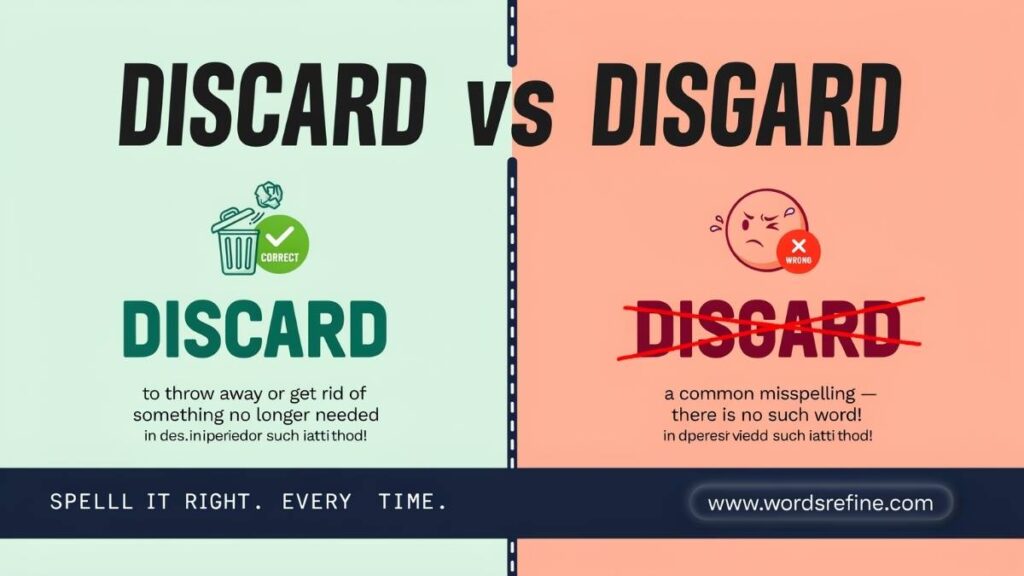
The difference between discard vs disgard comes down to one easily overlooked spelling mistake. Only discard is correct when you mean to throw something away, reject an idea, or stop using something. Disgard is a misspelling that can slip into your writing when you’re typing in a hurry. Fortunately, remembering the correct form is simple. In this guide, you’ll learn what discard means, explore practical examples, identify common spelling mistakes, and discover an easy way to remember the correct spelling. After all, discarding unwanted items is useful, but discarding good spelling habits is a mistake worth avoiding!
Discard vs Disgard Which Spelling Is Correct?
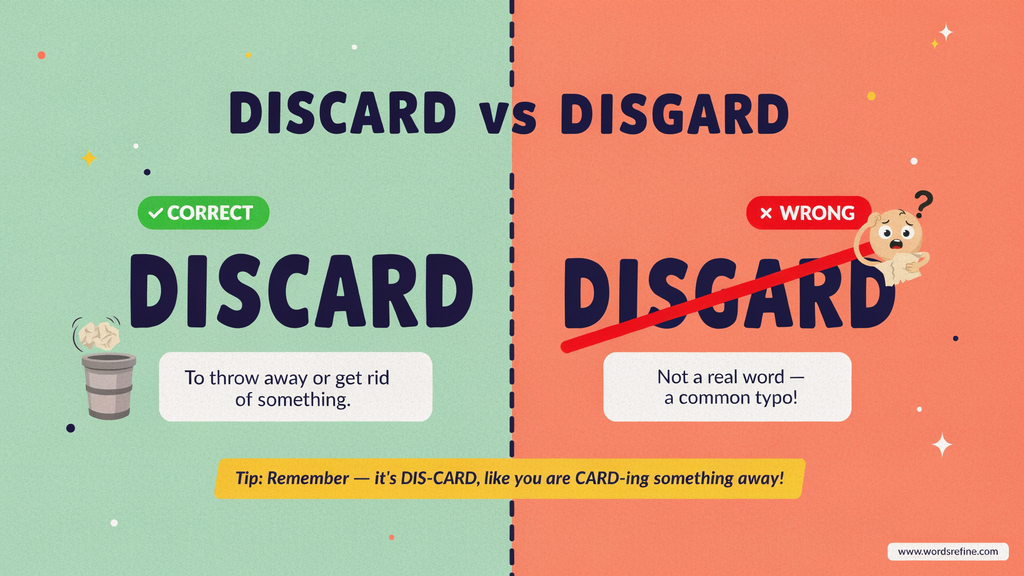
Discard is the correct spelling. Use it whenever you mean to throw something away, reject it, or stop using it because it is no longer needed or wanted.
Disgard is an incorrect spelling of discard in standard English. It doesn’t have a recognized standard meaning that makes it interchangeable with the correct word.
Consider these examples:
| Incorrect spelling | Correct spelling |
|---|---|
| Please disgard the damaged package. | Please discard the damaged package. |
| She decided to disgard the old proposal. | She decided to discard the old proposal. |
| The player will disgard one card. | The player will discard one card. |
As these examples show, the correction is simple. Replace the g with a c, and the word becomes correct.
If you’re wondering which spelling to use, the answer is straightforward: choose discard whenever you mean to get rid of something or reject it.
This rule applies to school assignments, business emails, academic papers, online articles, and everyday conversations. Moreover, both American and British English use discard. Neither variety recognizes disgard as a standard alternative.
Learn the difference between confusing more English words
Peak vs Pique Differences Examples and Correct Usage ?
What Does Discard Mean?
Discard means to get rid of something, reject it, or decide that it is no longer useful or desirable. The exact meaning depends on the situation and the object involved.
For example, you might discard a broken chair because it cannot be repaired. Similarly, you might discard an idea because it doesn’t solve a problem. In a card game, you might discard a card because it doesn’t help your hand.
In each situation, you decide not to keep or use something.
Discard as a Verb
The most common use of discard is as a verb. It describes the action of throwing something away, rejecting it, or no longer using it.
For instance, Maya discarded the cracked mug because it leaked whenever she poured coffee into it. Here, discard describes getting rid of a physical object.
However, the word isn’t limited to things you can touch. A design team might discard an idea that doesn’t work, while an editor might discard a paragraph that repeats information unnecessarily.
Consider a few more examples:
| Context | Example sentence |
|---|---|
| Physical objects | She discarded the damaged papers. |
| Ideas | The team discarded its original plan. |
| Documents | Please discard the outdated form. |
| Options | We discarded the route with the highest tolls. |
| Old practices | The company discarded its paper-based filing system. |
Notice that discard doesn’t always mean putting something in a trash can. Sometimes, it describes a decision rather than a physical action.
Discard as a Noun
Although people primarily use discard as a verb, it can also function as a noun, especially in card games.
In this context, a discard refers to a card that a player has thrown away. The term also appears in the expression discard pile, which describes the place where players put discarded cards when the rules require it.
For example, a player might say, “I picked up a card from the discard pile.”
In everyday writing, however, the noun form is less common than the verb. When discussing unwanted household items, outdated documents, or rejected proposals, using discard as a verb will usually sound more natural.
Learn the difference between commonly mixed-up more words
Labor Day vs Labour Day Meaning and Usage ?
What Does Discard Something Mean?
The phrase discard something means to get rid of it, reject it, or stop using it.
The object helps readers understand the intended meaning. For example, discarding a receipt means getting rid of it, while discarding a theory means rejecting an explanation.
You might discard a card, discard an application from consideration, or discard old belongings you no longer need. In each case, the word describes a decision not to keep or use something.
Furthermore, discard often suggests a deliberate choice. If you accidentally drop your wallet, you have lost it rather than discarded it. However, if you deliberately throw it away, discard may describe your action.
Discard Pronunciation
In American English, discard is commonly pronounced dih-SKARD, with the stress on the second syllable.
The word has two syllables, and the final r is pronounced in standard American speech. Learning how to say the word can help you recognize it, although pronunciation alone doesn’t always reveal the correct spelling.
When writing, remember the letters: d-i-s-c-a-r-d.
What Does Disgard Mean?
Disgard is not a standard English spelling of discard. In ordinary writing, it should be treated as a spelling mistake rather than a separate word with its own established meaning.
For example:
Incorrect: The supervisor told us to disgard the obsolete files.
Correct: The supervisor told us to discard the obsolete files.
Although readers will probably understand the intended meaning, the spelling still needs correction.
There is one important distinction. Someone might use Disgard as a fictional name, username, or invented brand name. Such names can have unusual spellings. However, that doesn’t make disgard an accepted alternative to the standard verb discard.
Is Disgard a Word?
In standard English usage, disgard is not a recognized alternative spelling of discard. Therefore, if you encounter it in an ordinary sentence, it is best to treat it as a misspelling.
Of course, context matters. A fictional character or company could use Disgard as a deliberately invented name. Nevertheless, that special use doesn’t establish it as a standard English word with the meaning of discard.
When you’re uncertain about an unfamiliar spelling, consult a reputable dictionary instead of relying on appearance alone.
Is Discard a Word?
Yes, discard is a standard English word. It functions mainly as a verb, although it can also serve as a noun in certain contexts.
The word appears in everyday conversations, business communication, technology, research, and games. Although its precise meaning changes with context, the central idea remains the same: getting rid of something or deciding not to keep or use it.
For example, a restaurant might discard spoiled ingredients, an editor might discard an unnecessary paragraph, and a player might place a card in the discard pile.
These examples demonstrate how the same word works naturally in different situations.
Learn the difference between tricky grammar more words
Traveled vs Travelled Which one Is Correct in English?
Discard vs Disgard Key Differences
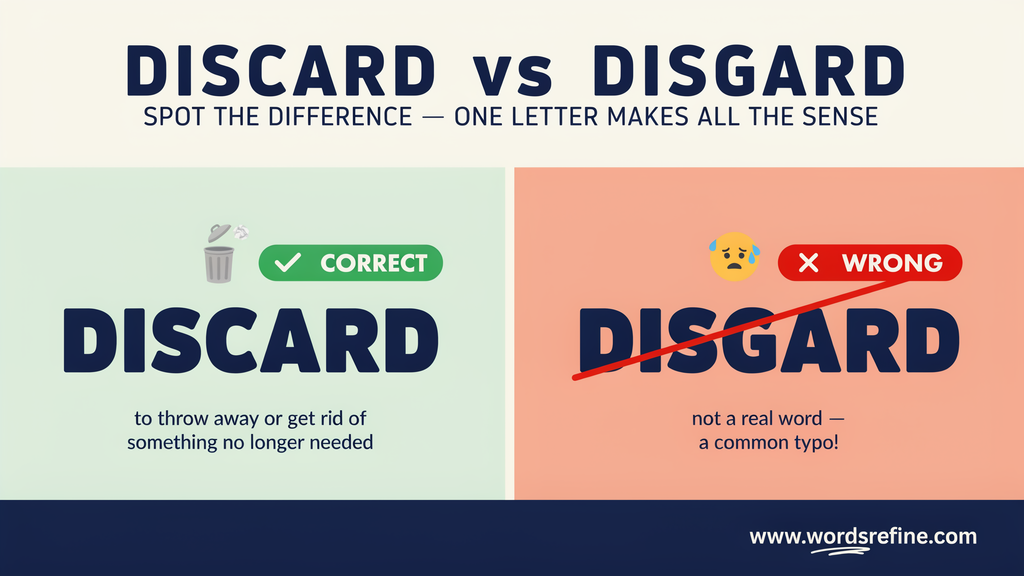
The comparison between discard vs disgard isn’t a contest between two words with different meanings. One is correct, while the other is a misspelling in the intended context.
| Feature | Discard | Disgard |
|---|---|---|
| Spelling status | Correct standard English spelling | Misspelling of discard |
| Meaning | To throw away, reject, or stop using something | No standard alternative meaning for the intended use |
| Part of speech | Primarily a verb; also a noun in certain contexts | Not a standard spelling of the intended word |
| American English | Correct | Incorrect |
| British English | Correct | Incorrect |
| Example | Please discard the old receipt. | Please disgard the old receipt. |
| Formal writing | Appropriate when the meaning fits | Incorrect unless reproducing an intentional name or quoted error |
As the table makes clear, the difference isn’t regional, grammatical, or stylistic. It comes down to choosing the correct letters.
Whether you encounter the comparison as discard vs. disgard or disgard vs. discard, the answer remains the same. Discard is the correct spelling.
When editing a document, search for disgard and replace it with discard wherever the writer intends the standard word. At the same time, review the surrounding sentence to ensure that the verb fits the intended meaning.
Why Do People Confuse Discard vs Disgard?
English contains many commonly misspelled words, and not every spelling error results from a complicated grammar rule. Sometimes people remember a word incorrectly or type the wrong letter without noticing.
The confusion between discard vs disgard is a straightforward example. The two forms look similar, but only one follows standard spelling conventions.
Mixing Up C and G
The most obvious difference is the letter in the middle of the word. Discard contains a c, while disgard substitutes a g.
A writer who remembers the general shape of the word but not its exact spelling might choose the wrong letter. This can happen while typing quickly or writing from memory.
The best solution is to learn the complete spelling rather than relying on how the word looks at a glance.
Typing Errors and Autocorrect
Typing quickly can lead to missing letters, extra letters, and substitutions. Unfortunately, if you don’t reread your work, an incorrect form may remain in the final draft.
Spell-checking software can help identify mistakes. However, it shouldn’t be your only line of defense because different tools use different dictionaries and settings.
For that reason, make proofreading a regular habit. Pay particular attention to unfamiliar words in headings, email subject lines, reports, and published articles.
Remembering the Word Incorrectly
Familiarity doesn’t always guarantee accuracy. A spelling you’ve seen several times may begin to look correct even when it isn’t.
If you repeatedly encounter disgard online, you might start questioning the standard spelling. Rather than guessing, consult a reputable dictionary or established spelling reference.
This approach is useful for many other English words. Whenever two forms seem plausible, verify the spelling before choosing one.
Learn the difference between confusing word pairs
Absence vs Absense Correct Spelling Meaning and Usage ?
How to Spell Discard Correctly
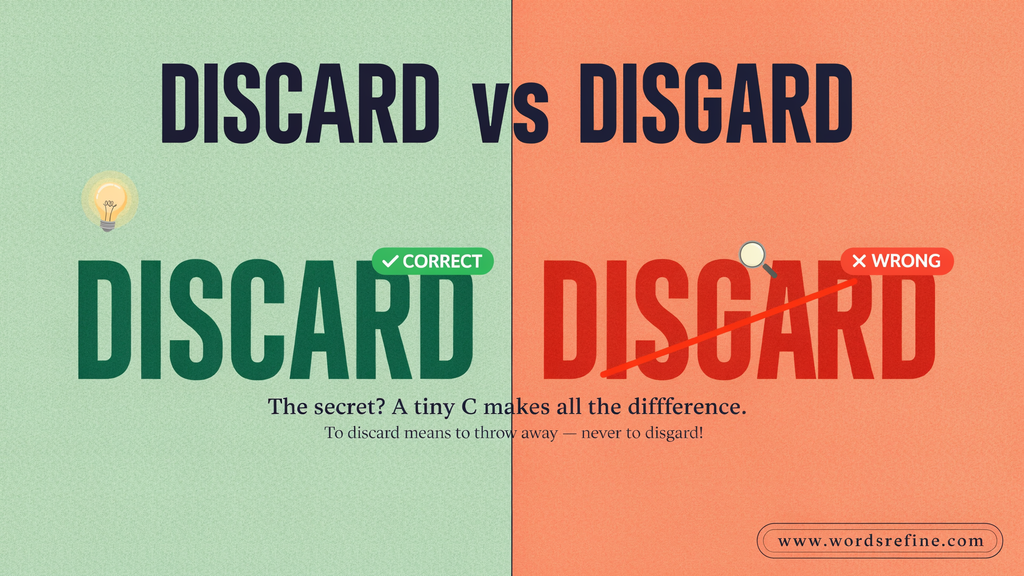
If you’re unsure how to spell discard correctly, focus on the letters and use a simple memory aid.
The correct spelling is D-I-S-C-A-R-D. Remember the c after dis, and don’t replace it with a g.
Remember the Word Card
One easy way to remember discard is to notice the familiar word card at the end.
Imagine playing a card game. You draw a card that doesn’t help you, so you discard it. Connecting the spelling with a familiar action makes the word easier to recall.
This memory aid isn’t an explanation of the word’s full historical origin. Instead, it provides a practical way to remember its modern spelling.
Connect the Spelling to the Meaning
Think about a physical object you no longer need. You might discard an empty box, a broken pen, or an outdated receipt.
Next, apply the same idea to something less tangible. You might discard an ineffective plan or an unsupported argument.
In both cases, you decide not to keep or use something. Remembering the meaning alongside the spelling can help reinforce the correct form.
Use a Dictionary When in Doubt
When you’re unsure about a spelling, consult a reliable reference rather than relying on guesswork.
Merriam-Webster, Cambridge Dictionary, and Oxford Learner’s Dictionaries provide definitions, grammatical information, and examples of English word usage.
These references can help you confirm the spelling of discard and understand how it functions in different sentences. Moreover, checking a dictionary is a useful habit when you encounter unfamiliar vocabulary.
Discard in Real-Life Contexts
Understanding a definition is useful, but seeing a word in different settings shows you how to use it naturally. Discard works in everyday conversation, professional communication, academic writing, technology, and games.
Discard in Everyday Conversation
In daily conversation, discard often refers to getting rid of unwanted items. It sounds slightly more formal than throw away, although both expressions can describe the same action.
For example, you might say, “I discarded the expired coupons,” or “She discarded the cracked flowerpot.”
Similarly, a family might discard old belongings that no longer serve a purpose. Someone might also discard an idea about driving through a storm after considering the risks.
As these examples show, the word applies to both physical objects and decisions.
Discard in Workplace and Business Writing
In professional settings, discard can describe removing outdated documents, rejecting proposals, or stopping the use of an old process.
For instance, a manager might ask employees to discard the previous draft and review the revised report. A department might discard obsolete forms after introducing a new system.
The word works well because it communicates a clear decision. However, a more specific verb may be appropriate when the situation requires it. Delete, for example, can be more precise when discussing a digital file.
Discard in Academic and Research Writing
Researchers sometimes use discard when describing data, responses, samples, or hypotheses they don’t retain for further analysis.
Consider this sentence: “The researcher discarded incomplete responses according to the study’s predefined exclusion criteria.”
Here, discard describes a specific research decision. However, discarding data should follow an appropriate method rather than personal preference.
A researcher shouldn’t remove inconvenient results simply because they contradict an expected conclusion. The word describes what happened, but it doesn’t automatically justify the decision.
Similarly, a student might discard an initial outline and develop a clearer argument, while a laboratory might discard damaged samples according to its safety procedures.
Learn the difference between often confused words
Want vs Wont Meaning Differences and Usage ?
Discard in Technology and Digital Files
In software, discard often means rejecting changes that you haven’t saved or committed.
For example, a document editor might ask whether you want to save or discard your changes. Choosing discard generally means you don’t want to retain those edits.
Likewise, an application might allow users to discard an unfinished draft or reject temporary settings.
However, always check the software’s instructions before confirming an action. Depending on the application, discarding changes may be difficult or impossible to reverse.
Discard in Card Games
In card games, discard means removing a card from your hand according to the rules.
For example, a player might discard a card that doesn’t fit their strategy. In games with a discard pile, players place unwanted cards in a designated area.
The exact rules vary from one game to another. Some games allow players to draw from the discard pile, while others restrict or prohibit that action.
This example also provides a helpful way to remember the correct spelling. Think of the c in card when you discard a playing card.
Discard vs Similar Words Choosing the Right Alternative
Although discard is correct, it isn’t always the best word for every situation. English offers several alternatives that overlap in meaning but differ in tone or emphasis.
| Word or phrase | Main meaning | Example |
|---|---|---|
| Discard | Get rid of or stop using something | Discard the outdated instructions. |
| Throw away | Get rid of something, often a physical object | Throw away the empty bottle. |
| Dispose of | Get rid of something, often through a suitable method | Dispose of the waste safely. |
| Reject | Refuse to accept something | The committee rejected the proposal. |
| Abandon | Give up a plan, activity, or effort | They abandoned the original design. |
| Delete | Remove digital text, data, or files | Delete the duplicate file. |
| Eliminate | Remove or rule something out | The test eliminated several possibilities. |
Discard vs Throw Away
The difference between discard and throw away is mainly one of tone and context.
Both expressions can describe getting rid of an unwanted object. However, throw away often sounds more conversational, while discard can sound more formal or precise.
For example, “Throw away the empty packaging” sounds natural in everyday conversation. By contrast, “Discard the empty packaging before storing the equipment” may fit a workplace instruction better.
Both sentences are correct. Choose the expression that suits your audience and situation.
Discard vs Reject
The difference between discard and reject depends on what you’re doing.
Use discard when you stop keeping or using something. Use reject when you refuse to accept something, such as an application, offer, or proposal.
For example, a designer might discard old sketches, while a client might reject the final design.
The designer stops using the sketches, whereas the client refuses to approve the design. Although the actions are related, the verbs emphasize different decisions.
Discard vs Dispose Of
Both expressions can describe getting rid of something, but dispose of often emphasizes the act or method of removal.
For instance, you might discard unnecessary notes but dispose of hazardous materials according to applicable safety rules.
The second sentence is more appropriate for hazardous waste because safe handling and proper removal matter. In that situation, discard alone may not communicate the required procedure.
Discard vs Abandon
Use discard when you reject or stop using something. Use abandon when you give up a plan, effort, project, or undertaking.
For example, a team might discard its original logo but abandon the entire rebranding project.
The first sentence describes rejecting one element, while the second describes giving up the broader project.
Discard vs. Delete
Discard and delete sometimes overlap in digital settings, but they aren’t always interchangeable.
You might discard unsaved changes while keeping the original document. By contrast, deleting a file generally means removing it from its current location, although the software may retain it in a recovery folder or trash.
Therefore, consider what the action actually does in the application you’re using before choosing the verb.
Learn the difference between basic English word mistakes
Mortality vs Fatality Meaning Differences and Correct Usage ?
Common Mistakes With Discard vs Disgard
A spelling error can slip into an otherwise excellent sentence. Fortunately, you can prevent many problems by checking the spelling and choosing words that fit the context.
Using Disgard Instead of Discard
This is the central spelling mistake addressed in this guide.
Incorrect: The assistant was asked to disgard the duplicate documents.
Correct: The assistant was asked to discard the duplicate documents.
The correction requires only one letter, but it brings the sentence in line with standard English spelling.
Assuming Disgard Is a British Spelling
Some English words have different American and British spellings. For example, American English generally uses color, while British English generally uses colour.
However, discard doesn’t follow that pattern. Both varieties use the same spelling.
If you write disgard because you believe it is a British alternative, you’ll introduce an error rather than a regional variation.
Confusing Discard With Delete
The words sometimes overlap, especially when you’re working with digital content. However, deleting a file and discarding unsaved changes can be two different actions.
For example, you might discard your latest edits while keeping the original document. Using delete in that situation could suggest a different action.
Choose the verb that accurately describes what happened.
Using Discard When Reject Is More Precise
Consider this sentence: “The university discarded her application.”
Readers can understand the intended meaning, but rejected her application is usually more natural when the university formally refuses to approve it.
By contrast, discarded the application might suggest that someone removed a physical document or stopped considering it.
Correct word choice involves more than spelling. It also requires understanding the differences between related words.
Learn the difference between commonly misused words
skepticism vs scepticism Meaning Spelling and Correct Usage
Practice Session Discard vs Disgard
- Please ______ the damaged packaging before storing the new products.
- She decided to ______ the old documents she no longer needed.
- The company ______ outdated equipment to make room for new machines.
- He is ______ the files that contain incorrect information.
- You should never ______ important receipts without checking them first.
- The team chose to ______ the original plan and try a different approach.
- We ______ the broken chair because it was beyond repair.
- The player had to ______ a card during the game.
- Please check the folder before you ______ any files.
- They are planning to ______ the products that failed the quality test.
- The editor asked the writer to ______ the unnecessary paragraphs.
- She has ______ several ideas that did not fit the project.
- Never ______ useful materials simply because they look old.
- The store will ______ expired products from its shelves.
- He accidentally ______ his unsaved changes.
- The manager told the staff to ______ damaged items immediately.
- After reviewing the proposal, the committee decided to ______ it.
- The factory ______ defective products before shipping the remaining items.
- Instead of repairing the device, they chose to ______ it.
- The player picked up a new card after making a ______.
- The team is reviewing which outdated procedures to ______.
- She refused to ______ the letter because it held sentimental value.
- The system automatically ______ temporary files after the process ends.
- The designer ______ the first draft and created a new version.
- Remember to spell the word correctly: ______, not “disgard.”
Answers
- discard
- discard
- discards
- discarding
- discard
- discard
- discarded
- discard
- discard
- discard
- discard
- discarded
- discard
- discard
- discarded
- discard
- discard
- discarded
- discard
- discard
- discard
- discard
- discards
- discarded
- discard
Here’s a trusted source for clear more words Comparison:
FAQs
What does discard mean?
To discard means to throw something away, reject it, or stop using it because you no longer need or want it. For example, you might discard an old receipt or abandon an idea that no longer seems useful.
What is another word for discard?
Common synonyms for discard include reject, dispose of, abandon, eliminate, and throw away. The best choice depends on the context. For instance, you can reject an offer, dispose of damaged materials, or abandon an outdated plan.
What is a seven-letter word for so-so in a crossword puzzle?
A possible seven-letter answer is mediocre, which describes something of average or less-than-satisfactory quality. However, the exact answer depends on the other clues and intersecting letters in the puzzle.
What is another word for discarded?
Words such as rejected, abandoned, unwanted, and disposed of can replace discarded, depending on the sentence. For example, “She threw away the discarded papers” could become “She threw away the unwanted papers.”
What is the noun form of discard?
Discard can also function as a noun, particularly in card games. It refers to a card that a player throws away or removes from their hand. In other contexts, disposal, rejection, or elimination may express the related idea more naturally.
What is the opposite of discard?
The opposite of discard depends on the intended meaning. Keep, retain, and preserve are common antonyms. For example, if you discard an old document, you throw it away; if you retain it, you keep it for future use.
What is a stronger word for disregard?
Ignore or dismiss may work when someone pays no attention to something or treats it as unimportant. For a stronger sense of deliberate refusal to follow a rule or warning, defy may fit. The best word depends on the context.
What is the adjective form of discard?
Discarded is the past participle of discard and can function as an adjective. It describes something that someone has thrown away, rejected, or no longer uses, as in “discarded packaging.” There isn’t a commonly used standalone adjective formed directly from discard.
Does discard mean delete?
Yes, discard can mean to delete or remove something when the context involves digital content, such as discarding an unsaved draft or unwanted changes. However, the words aren’t always interchangeable. Delete specifically means to remove data or text, while discard can also mean to reject an idea, throw away an object, or stop using something.
Learn the difference between basic English word mistakes
Moustache vs Mustache Meaning Spelling and Usage ?
Conclusion
When comparing discard vs disgard, remember that discard is the correct spelling. It means to throw something away, reject an idea, or stop using something you no longer need. Disgard is simply a misspelling, so don’t let an extra letter or a typing slip fool you.
Here’s an easy way to remember: discard contains the word card. Picture yourself tossing an unwanted playing card into a discard pile. That simple trick can help you remember the correct spelling.
Whether you’re discarding old files, rejecting an unsuitable proposal, or throwing away expired food, use discard with confidence. You can discard unwanted items, outdated ideas, and even bad habits. Just don’t let the misspelling disgard sneak into your writing!

Diora AJS she is an experienced blogger and passionate English language enthusiast at Words Refine. With a keen eye for language and a love for clear communication, she writes practical content about grammar, word meanings, usage, and commonly confused terms. Her goal is to make English easier to understand through clear explanations and relatable examples, helping readers write accurately and communicate with confidence.