
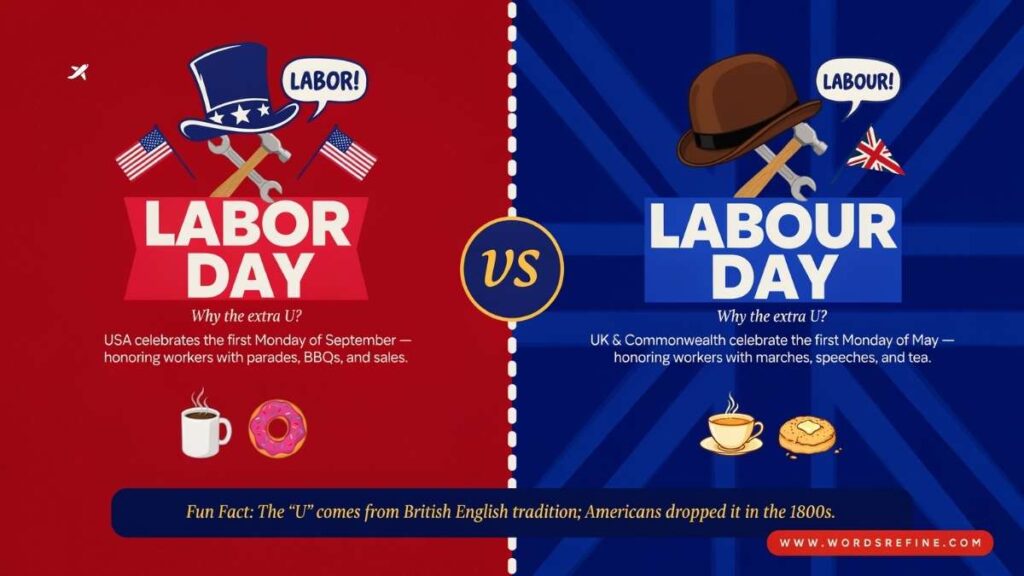
Labor Day vs Labour Day can trip up writers who assume that one spelling must be wrong. After all, why does one version include a “u” while the other leaves it out? The answer lies in regional spelling conventions. “Labor Day” is the standard American spelling, whereas “Labour Day” is commonly used in British English and countries such as Canada. Still, the distinction goes beyond a single letter. Different countries may use different holiday names, dates, and traditions. Once you understand these differences, you can avoid common spelling mistakes, choose the appropriate form for your audience, and write about the holiday with confidence.
Labor Day vs Labour Day Quick Answer
Labor Day is the standard American English spelling, while Labour Day is commonly used in British, Canadian, and Australian English. Both spellings refer to the recognition of workers and their contributions.
However, the holiday’s name and date depend on the country. In the United States, Labor Day falls on the first Monday in September. Canada observes Labour Day on the same day, while Australia follows different dates across its states and territories. Many other countries recognize workers on May 1 as part of International Workers’ Day.
The easiest way to remember the difference is to follow the spelling conventions of your audience and check the official holiday name when referring to a particular country.
What Does Labor Day Mean?
Labor Day is an American holiday that recognizes workers and their contributions to society. It also reflects the history of the labor movement, which sought better working conditions, fair treatment, and reasonable working hours.
The word labor refers to work, effort, or the activities people perform to produce goods and provide services. It can describe physical work, skilled trades, professional responsibilities, and the broader workforce.
For example, a company might recognize the labor of its employees after completing a demanding project. Similarly, labor unions represent workers and advocate for better employment conditions.
In the United States, Labor Day gives people an opportunity to appreciate the individuals who keep businesses, communities, and essential services running. Teachers, construction workers, nurses, factory employees, drivers, and countless other professionals contribute to society in different ways.
The holiday also has a historical purpose. During the nineteenth century, many workers faced long hours and difficult conditions. Labor organizations campaigned for improvements, and their efforts helped establish the traditions associated with Labor Day.
Today, Americans celebrate the holiday with family gatherings, outdoor activities, parades, and community events. For many people, it also marks the unofficial end of summer.
Learn the difference between confusing more English words
Simular vs Similar Which One Is Correct?
Why Is Labor Day Celebrated?
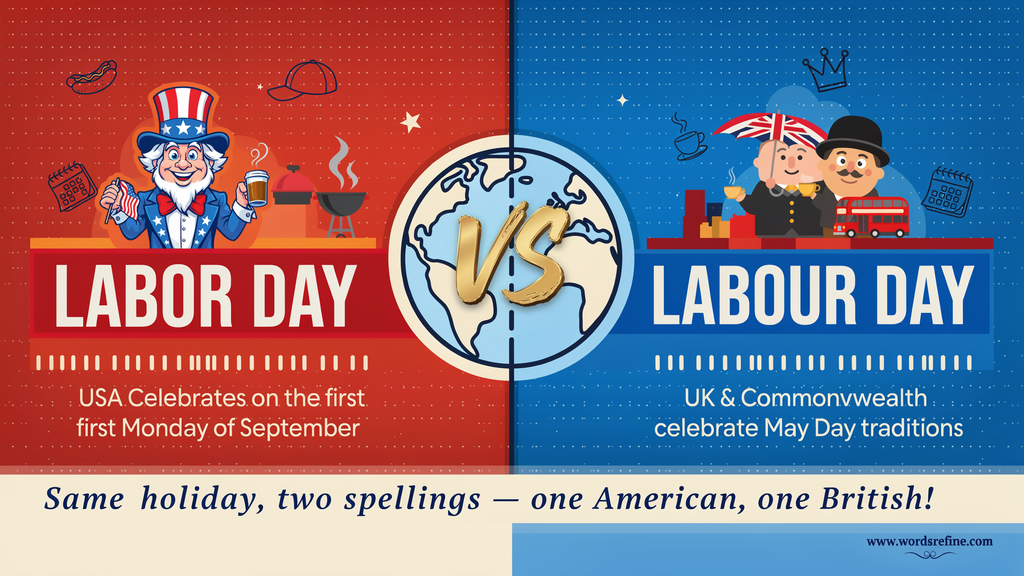
Labor Day celebrates the contributions of American workers and recognizes the achievements of the labor movement. Its history reflects efforts to improve working conditions and give employees a stronger voice in the workplace.
During the growth of industrial America, many workers spent long hours in factories and other demanding jobs. Workplace protections were limited, and labor organizations pushed for safer conditions, shorter working hours, and fairer treatment.
As a result, Labor Day became more than an opportunity to enjoy a long weekend. It developed into a national observance that recognizes the importance of work and the people who perform it.
Although modern celebrations often focus on relaxation and family time, the holiday still carries this historical meaning.
What Does Labour Day Mean?
Labour Day has the same basic meaning as Labor Day. The difference is spelling rather than meaning.
Labour is the standard British English form of the word. Canadian and Australian English also commonly use this spelling, along with other varieties influenced by British spelling conventions.
The word can refer to physical effort, employment, or the work people perform in different industries. For example, labour rights concern the rights and protections of workers, while the labour market describes the relationship between employers and people seeking work.
Labour Day recognizes the contributions workers make to society and acknowledges the historical efforts to improve employment conditions. However, its traditions and dates vary from one country to another.
In Canada, Labour Day falls on the first Monday in September. and In Australia, the date depends on the state or territory. In many other countries, workers celebrate International Workers’ Day on May 1.
Therefore, Labour Day doesn’t have one universal date. Although the holiday shares a common theme, each country follows its own calendar and traditions.
Why Is Labour Day Celebrated?
Labour Day celebrates workers, their achievements, and the efforts that helped improve working conditions. Depending on the country, the holiday may recognize organized labor, workers’ rights, fair employment practices, or the broader contributions of employees.
The observance also reminds people that many workplace protections developed through years of negotiation, public campaigns, and collective action.
Today, Labour Day celebrations may include parades, public gatherings, family activities, and events organized by labor groups. Some people use the occasion to learn about workers’ rights and the history of employment laws.
Although the activities differ across countries, the central idea remains consistent: workers play an important role in building and maintaining society.
Labor Day vs Labour Day The Main Differences
The difference between Labor Day vs Labour Day becomes clearer when spelling and holiday traditions are considered separately.
Labor Day is the standard spelling in American English. Labour Day is common in British, Canadian, and Australian English. Both forms express the same basic idea, but their official holiday names and dates depend on local customs.
For example, an American newspaper might report that businesses will close for Labor Day in September. A Canadian newspaper would normally use Labour Day for the same September holiday.
However, a report about Australia needs additional context because Labour Day dates vary across the country. Likewise, an article about a May 1 celebration should identify the relevant international or national observance rather than assume that every country uses the same holiday name.
The spelling difference follows a familiar pattern in English. Americans generally write labor, color, honor, and neighbor. British writers usually prefer labour, colour, honour, and neighbour.
These variations don’t change the basic meaning of the words. Instead, they reflect different regional spelling conventions.
Learn the difference between commonly mixed-up more words
Loosing vs Losing Which Is Correct? Meaning, Spelling, and Usage
Labor Day vs Labour Day History and Origins
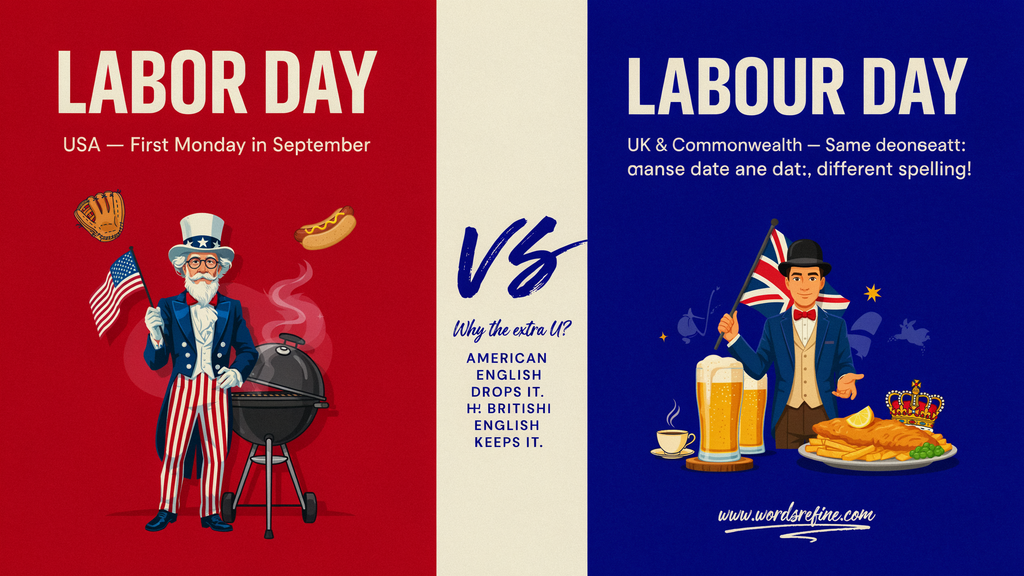
The history of these holidays is closely connected to the growth of the labor movement during the nineteenth century. As industrial economies expanded, workers organized to address long hours, unsafe workplaces, and limited employment protections.
Over time, labor celebrations became a way to recognize workers’ contributions and remember the campaigns that helped improve working conditions.
Labor Day History in the United States
One of the earliest major Labor Day celebrations took place in New York City on September 5, 1882. The Central Labor Union organized a parade and other activities to recognize working people.
The idea gradually spread to other parts of the country. Oregon became the first state to establish a Labor Day law in 1887, and other states followed.
On June 28, 1894, President Grover Cleveland signed legislation establishing the first Monday in September as a federal legal holiday.
Historians have debated whether Matthew Maguire, a machinist, or Peter J. McGuire, a carpenter and labor leader, first proposed the holiday. Both men have been associated with its early development, so the question of a single founder remains unsettled.
Today, Labor Day is a federal holiday in the United States. Many government offices and businesses close, although private employers determine their own schedules according to applicable rules.
The holiday remains a reminder of the workers and labor organizations that helped shape American employment practices.
Labour Day History in Canada
Canada’s Labour Day history also reflects the growth of organized labor and campaigns for better working conditions.
During the nineteenth century, workers organized demonstrations and pushed for changes in employment practices. These efforts helped bring workers’ rights into public discussion and contributed to the development of labor celebrations.
Canada now observes Labour Day on the first Monday in September. The holiday provides an opportunity to recognize workers’ contributions and reflect on the history of employment and labor organizations.
Although Canada and the United States celebrate their respective holidays on the same day, they use different official spellings. Americans write Labor Day, while Canadians generally write Labour Day.
The distinction is a useful example of how regional English conventions influence official holiday names.
International Labour Day History
International Labour Day, commonly known as International Workers’ Day or May Day, has a related but distinct history.
Its modern significance grew out of international campaigns for workers’ rights, particularly the movement for an eight-hour working day. During the late nineteenth century, May 1 became an important date for labor demonstrations and international solidarity.
Many countries now observe International Workers’ Day on May 1. Depending on the location, the holiday may be called Labour Day, International Labour Day, or International Workers’ Day.
Although these observances share themes with the September holidays in the United States and Canada, they developed through different historical traditions.
Understanding this difference helps explain why the same general idea of honoring workers can appear on different dates around the world.
Learn the difference between tricky grammar more words
Inclusivity vs Inclusiveness Which One Is Correct?
American English vs British English Labor vs Labour?
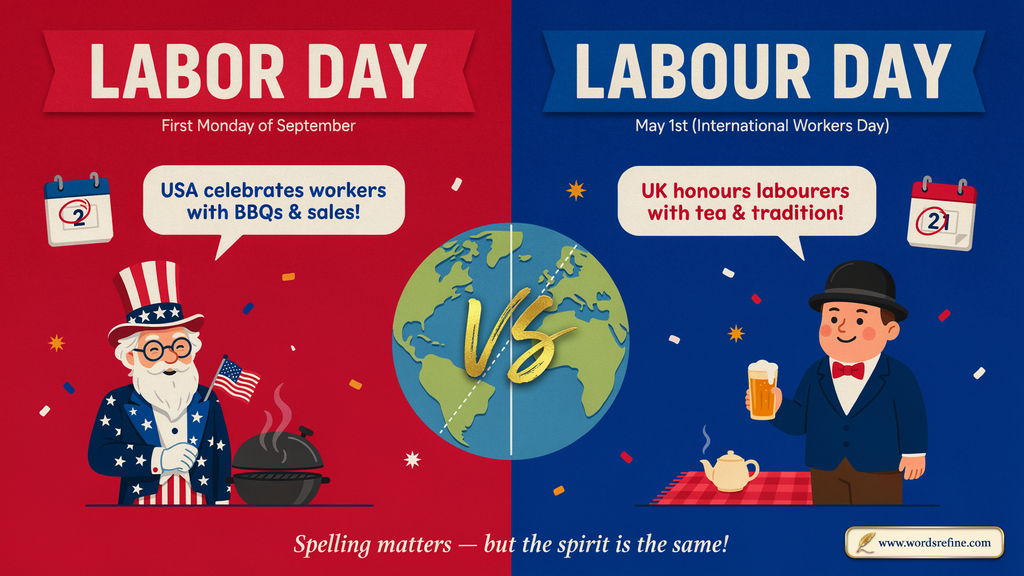
English spelling varies by region, and the difference between labor and labour is a familiar example.
American English generally uses the shorter ending -or in words such as labor, color, honor, and neighbor. British English usually retains the -our ending in labour, colour, honour, and neighbour.
Canadian English commonly follows the British pattern for these words. Australian English also generally uses labour and colour.
These differences rarely affect meaning. Instead, they reflect established spelling conventions that readers recognize in different parts of the world.
Why Does America Spell It Labor Day?
American spelling conventions favor labor without the additional u. This form became standard in the United States and appears in the official name of the national holiday.
The same convention applies to everyday expressions. An American writer might discuss labor shortages, labor laws, or labor unions.
A British or Canadian writer would generally use labour shortages, labour laws, or labour unions.
Both versions communicate the same information. The important thing is to use the form that suits your audience.
Why Do British Writers Use Labour Day?
British English traditionally retains the u in words such as labour, colour, and honour. This spelling also appears in Canadian and Australian English.
However, using British spelling doesn’t mean every country has an official holiday with the same name.
For example, the United Kingdom uses labour in ordinary writing, but it doesn’t have a nationwide public holiday called Labour Day that matches the American holiday in September. Instead, its bank-holiday calendar includes observances such as the Early May bank holiday.
Consequently, spelling conventions and public-holiday arrangements should be treated as separate matters.
Labor Day in America, Labour Day in Canada, and Labour Day in Australia
Although these countries share a common interest in recognizing workers, their holiday traditions and dates differ.
Labor Day in America
In the United States, Labor Day falls on the first Monday in September. It honors workers and recognizes the history of the American labor movement.
Many Americans spend the holiday with family and friends. Popular activities include outdoor meals, parades, sporting events, and short trips.
Businesses may offer special promotions, while public offices and some workplaces close for the day. However, schedules vary, and essential services may continue operating.
Despite its association with the end of summer, Labor Day has a deeper historical purpose. It recognizes the contributions workers make to the economy and acknowledges the efforts that helped improve employment conditions.
Learn the difference between confusing word pairs
Labelled vs Labeled Which one Is Correct?
Labour Day in Canada
Canada observes Labour Day on the first Monday in September, just as the United States does. However, Canadians use the spelling Labour Day.
The holiday recognizes workers and the history of organized labor. Many people enjoy a long weekend, attend local events, or spend time with family.
Businesses and public services may follow holiday schedules, although employment entitlements and rules depend on the relevant jurisdiction.
For Canadian readers, Labour Day is the natural spelling. Using Labor Day in a Canadian article may create inconsistency unless the writer is specifically discussing the American holiday.
Labour Day in Australia
Australia also uses Labour Day, but the date varies across states and territories.
Some jurisdictions observe the holiday in March, others in May, and others in October. As a result, there isn’t one national date that applies to every Australian worker.
This difference matters when preparing workplace notices, school calendars, travel plans, or public announcements. A statement that says all Australian offices will close for Labour Day on a particular date could be inaccurate.
The best approach is to check the relevant state or territory calendar before publishing a date.
Labor Day vs International Workers’ Day Are They the Same?
Labor Day and International Workers’ Day share a broad purpose: recognizing workers and their contributions. However, they differ in their historical development, common dates, and traditions.
In the United States, Labor Day falls on the first Monday in September. International Workers’ Day is associated with May 1 and is observed in many countries.
The September holiday developed as an American observance recognizing workers. International Workers’ Day grew from international labor activism, including campaigns for shorter working hours.
Both holidays reflect the importance of workers and the history of labor movements. Nevertheless, they aren’t interchangeable in every context.
For example, an American company announcing its September holiday should use Labor Day. An organization planning an event for May 1 might use International Workers’ Day or the official name adopted in its country.
The distinction becomes especially important in international communication, where readers may associate different dates and traditions with similar holiday names.
How to Use Labor Day vs Labour Day Correctly
Choosing the right spelling doesn’t require complicated grammar rules. Instead, consider the audience, the country, and the purpose of the sentence.
When writing for American readers, use Labor Day for the U.S. holiday and labor for general references to work. When writing for Canadian or Australian readers, Labour Day is usually appropriate for the holiday, while labour is the standard spelling in general contexts.
For international audiences, check the official holiday name. This step is particularly important when writing about a specific country or preparing a workplace announcement.
Consistency also matters. If a document uses American spellings such as color and honor, it should generally use labor. If it follows British spelling conventions, labour is usually the better choice.
Finally, remember capitalization. Write Labor Day vs Labour Day when referring to the named holiday. Use lowercase labor or labour when discussing work in general.
Examples of Correct Usage
In American English, you might write:
“Our office will remain closed on Labor Day.”
“Many Americans travel during the Labor Day weekend.”
“Labor Day recognizes the contributions of American workers.”
In Canadian or Australian English, the wording might be:
“Our Canadian office will close for Labour Day.”
“Labour Day recognizes the contributions of workers.”
“Australian employees should check their local Labour Day calendar.”
In each example, the spelling matches the intended audience and context.
Learn the difference between often confused words
Flyer vs Flier Which one Is Correct?
Common Mistakes With Labor Day vs Labour Day
One common mistake is assuming that only one spelling is correct. In reality, Labor Day vs Labour Day follow different regional conventions. Neither form is universally correct in every English-speaking country.
Another mistake is assuming that every country celebrates the holiday in September. The United States and Canada observe their holidays on the first Monday in September, but Australian dates vary. Many countries celebrate International Workers’ Day on May 1.
Writers sometimes confuse Labour Day with International Workers’ Day as well. Although both recognize workers, their histories and dates aren’t identical. Checking the local holiday name prevents confusion.
Capitalization can also cause problems. Official holiday names take capital letters, but general references to work usually don’t. For example, “Labour Day” is correct as a holiday name, while “labour rights” is correct in an ordinary sentence.
Finally, avoid mixing American and British spelling conventions without a reason. A document that uses labor, color, and honor should generally remain consistent. Similarly, a document using labour, colour, and honour should follow the relevant regional style.
Labor Day vs Labour Day Real World Examples
Consider a company with offices in New York, Toronto, and Sydney. The human resources team wants to announce upcoming public holidays.
For the New York office, the notice should refer to Labor Day. For Toronto, it should use Labour Day. In Sydney, the company should check the applicable state or territory calendar because the local holiday date may differ from the September observance in North America.
This example shows why spelling and local context both matter. Even when two countries use different spellings for a similar holiday, they may share the same date. In other cases, the spelling may remain the same while the date changes.
Here are a few more examples:
A U.S. newspaper might report, “The company will close for Labor Day.”
A Canadian business might announce, “Our offices will reopen after Labour Day.”
An Australian employer might write, “Please check the state public-holiday calendar for Labour Day arrangements.”
An international organization might announce, “The event will recognize workers’ contributions on International Workers’ Day.”
Each sentence uses a name that fits its context. That simple attention to detail helps readers understand exactly which holiday an announcement describes.
Labor Day vs Labour Day Pronunciation
Although the spellings differ, labor and labour generally have the same pronunciation within a comparable regional accent. The additional u in labour doesn’t create an extra syllable.
However, American, British, Canadian, and Australian accents may differ in their vowel sounds. These differences reflect regional pronunciation rather than the spelling itself.
For everyday writing, the most important point is that the two spellings share the same basic meaning. You don’t need to change the intended meaning when switching from one regional form to the other.
Learn the difference between basic English word mistakes
Reoccurrence vs Recurrence Which One Is Correct ?
Practice Session Labor Day vs Labour Day
- In the United States, people celebrate ______ Day on the first Monday in September.
- In British English, the preferred spelling is usually ______ Day.
- ______ Day honors the contributions of workers to society.
- The American spelling of the holiday is ______ Day.
- Canada celebrates ______ Day on the first Monday in September.
- In the United Kingdom, the word ______ is commonly used instead of the American spelling.
- Many workers enjoy a day off on ______ Day.
- The spelling ______ is standard in American English.
- The spelling ______ is common in Canadian English.
- Australia uses the spelling ______ in the names of many worker-related holidays.
- In the United States, ______ Day is a federal holiday.
- The British spelling of the word is ______.
- Workers’ achievements are recognized on ______ Day.
- The American spelling is ______, while the British spelling is Labour.
- Many countries observe International Workers’ Day in May, but the American ______ Day takes place in September.
- In Canada, ______ Day is a public holiday.
- The word ______ is preferred in Australian English.
- American newspapers generally use the spelling ______ Day.
- The holiday recognizes the importance of ______ in building communities and economies.
- In British English, the word ______ contains the letter combination “our.”
- In the United States, schools and government offices may close for ______ Day.
- The Canadian holiday is spelled ______ Day, even though it falls on the same day as the American holiday.
- The correct American spelling is ______, not Labour.
- The spelling ______ is often used in countries that follow British English conventions.
- Although the spellings differ, Labor Day vs Labour Day both relate to workers and ______.
Answers
- Labor
- Labour
- Labor
- Labor
- Labour
- Labour
- Labor
- Labor
- Labour
- Labour
- Labor
- Labour
- Labor
- Labor
- Labor
- Labour
- Labour
- Labor
- Labor
- Labour
- Labor
- Labour
- Labor
- Labour
- Labour
Here’s a trusted source for clear more words Comparison:
FAQs
Why doesn’t the United States celebrate May Day?
The United States does not observe May Day as its national Labor Day. Instead, it celebrates Labor Day on the first Monday in September. The September holiday developed as a separate American tradition focused on workers and their contributions.
Is it okay to say “Happy Labour Day”?
Yes, “Happy Labour Day” is appropriate in countries that use this name for the holiday, such as Canada. In the United States, “Happy Labor Day” is the standard greeting because American English uses the spelling “labor.”
What is the proper greeting for Labor Day?
“Happy Labor Day!” is a common and friendly greeting in the United States. You can also say, “Wishing you a relaxing Labor Day weekend,” or “Thank you for all you do to support your community.”
What holidays no longer exist?
Some historical holidays have been discontinued, renamed, or replaced over time. However, Labor Day remains an official federal holiday in the United States. Whether a holiday still exists depends on the country and the specific holiday being discussed.
Is the United States the only country that celebrates Labor Day?
No. Many countries recognize a holiday honoring workers, although the name, date, and traditions vary. The United States celebrates Labor Day in September, while many countries observe International Workers’ Day on May 1.
Why is Labor Day so late in 2026?
Labor Day falls on September 7 in 2026 because the United States observes it on the first Monday in September. Since the weekday changes the date each year, the holiday can fall anywhere from September 1 through September 7.
What can you say instead of “Happy Labor Day”?
You can say “Have a relaxing Labor Day,” “Enjoy your holiday weekend,” or “Wishing you a wonderful Labor Day.” For a more thoughtful message, try “Thank you for the hard work and dedication you bring to your community.”
Is Labor Day mentioned in the Bible?
No, the modern Labor Day holiday is not mentioned in the Bible. It developed as a workers’ holiday in the nineteenth century. However, the Bible includes passages about work, rest, fairness, and treating workers justly, which some people may connect with the holiday’s themes.
Why do many countries celebrate May 1?
Many countries observe May 1 as International Workers’ Day to recognize workers’ rights and the labor movement. The date is closely associated with the campaign for an eight-hour workday and the labor demonstrations that took place in the nineteenth century.
Learn the difference between everyday English mistakes
Waving vs Waiving Which One Is Correct ?
Conclusion
Choosing between Labor Day vs Labour Day becomes much easier when you understand the difference between American and British English. “Labor Day” is the standard spelling in the United States, while “Labour Day” is common in British English and countries such as Canada. Both spellings are correct in their respective contexts, so neither deserves a red pen simply for looking different.
However, spelling is only part of the story. The holiday’s name, date, and traditions can vary from one country to another. Americans celebrate Labor Day on the first Monday in September, while many countries recognize workers on May 1 through International Workers’ Day.
To avoid confusion, consider your audience and the holiday you’re discussing before choosing a spelling. Remember, that extra “u” in “labour” isn’t an unwanted guest. It’s simply following a different English tradition. Once you understand the distinction, you can write confidently, greet others appropriately, and save your grammar corrections for mistakes that actually need fixing.

Diora AJS she is an experienced blogger and passionate English language enthusiast at Words Refine. With a keen eye for language and a love for clear communication, she writes practical content about grammar, word meanings, usage, and commonly confused terms. Her goal is to make English easier to understand through clear explanations and relatable examples, helping readers write accurately and communicate with confidence.