
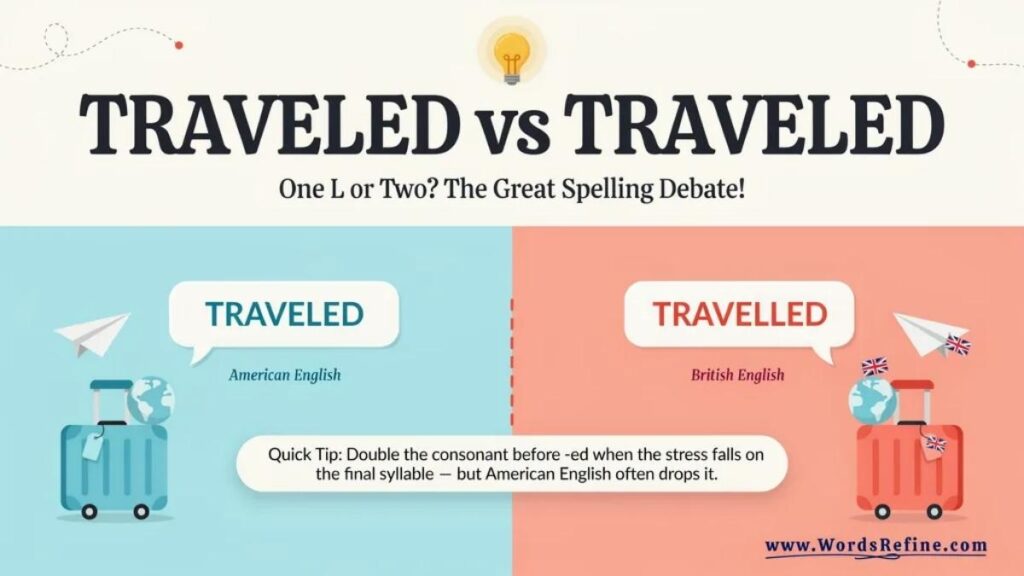
Have you ever paused over traveled vs travelled and wondered whether one extra L could really make a difference? You’re not alone. The question of traveled or travelled often confuses writers because both spellings are correct, but the preferred form depends on the variety of English you’re using. American English generally favors “traveled,” while British English commonly uses “travelled.” So, is one spelling wrong? Not at all. In this guide, you’ll learn the difference between traveled and travelled, understand why the spelling changes, and discover which form works best in different contexts. By the end, this spelling puzzle will feel like a smooth, worry-free journey.
Traveled vs Travelled The Quick Answer
Traveled and travelled are both correct spellings of the past tense and past participle of the verb travel.
American English generally uses traveled.
British English generally uses travelled.
For example:
American English: She traveled to Boston last summer.
British English: She travelled to London last summer.
The two sentences communicate the same basic idea. The only difference is the spelling.
This regional difference also appears in related forms. American English generally uses traveling and traveler, while British English generally uses travelling and traveller.
Therefore, there isn’t a universal winner in the traveled or travelled debate. Instead, you should choose the form that matches your variety of English.
Traveled vs Travelled What Is the Difference?
The traveled vs travelled difference is primarily a matter of spelling. Both forms come from the same verb, travel, and both describe movement from one place to another.
Consider these two sentences:
I traveled across the country.
I travelled across the country.
The meaning remains the same. Neither sentence suggests a different type of journey.
The spelling changes because American and British English developed different conventions for handling certain words when suffixes are added.
Here is the basic comparison:
| Form | American English | British English |
|---|---|---|
| Base verb | travel | travel |
| Past tense | traveled | travelled |
| Past participle | traveled | travelled |
| Present participle | traveling | travelling |
| Person who travels | traveler | traveller |
As you can see, the base word stays the same. The spelling changes when endings are added.
That distinction is important because it shows why this isn’t really a grammar disagreement. Grammar tells you how the verb functions in a sentence. Regional spelling tells you whether you write traveled or travelled.
Learn the difference between tricky grammar more words
Fiancé vs Fiancée What’s the Difference and which is Correctly?
Traveled Meaning and Definition
The word traveled is the American English form of the past tense and past participle of travel.
To travel means to move from one place to another. The journey might be short or long. You might travel for work, education, relaxation, family reasons, or simply because you want to see somewhere new.
For example:
We traveled to Florida last weekend.
She traveled by train.
They traveled across the country during their vacation.
He has traveled extensively for work.
The package traveled several hundred miles before reaching its destination.
In each example, traveled refers to movement or a journey.
However, travel doesn’t always involve a person physically moving. The word can sometimes describe something that moves or spreads from one place to another.
For example:
The sound traveled through the hallway.
Here, traveled describes the movement of sound rather than a person.
The central idea remains the same: something moved from one location to another.
Travelled Meaning and Definition
Travelled has the same meaning as traveled. The only major difference is the spelling convention.
In British English, travelled is the usual past tense and past participle form of travel.
For example:
We travelled to Manchester by train.
She travelled throughout Europe.
They travelled abroad several times.
He has travelled extensively for his career.
The message travelled quickly through the office.
Again, nothing mysterious is happening here. The extra l doesn’t give the word a new meaning.
In fact, a British speaker and an American speaker can say the same sentence while spelling the verb differently:
American English:
She traveled to Paris.
British English:
She travelled to Paris.
The journey is the same. Only the spelling takes a slightly different route.
Learn the difference between more words people mix up
Any time vs anytime meaning Difference with Examples ?
Why Does Traveled Have One L?
Many readers ask why traveled is spelled with one l in American English.
The answer comes from differences in spelling conventions between American and British English.
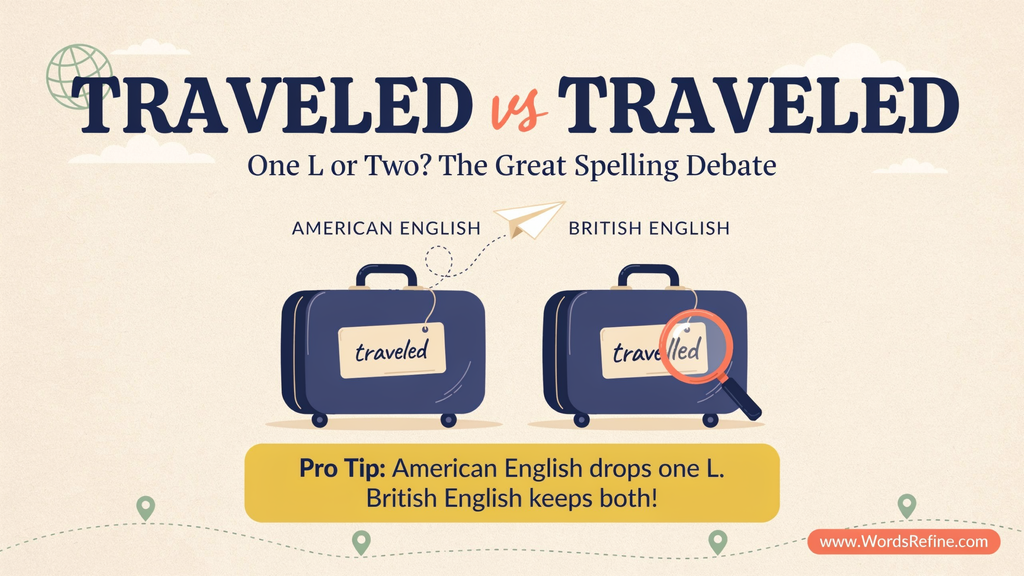
American English generally uses one l in forms such as traveled, traveling, and traveler.
British English generally keeps the double l in travelled, travelling, and traveller.
This difference is part of a broader pattern in English spelling. American English often uses somewhat shorter forms in certain words, while British English retains spellings that reflect older or different conventions.
For example, American English commonly writes:
canceled
labeled
modeled
traveled
British English commonly writes:
cancelled
labelled
modelled
travelled
However, English spelling doesn’t follow one perfectly simple rule. It would be misleading to say that every British word doubles a consonant while every American word uses one.
Instead, think of traveled and travelled as established regional spellings that belong to different spelling systems.
Why Does Travelled Have Two L’s?
If you’re asking why travelled is spelled with two l’s, the answer is closely connected to British spelling conventions.
British English generally retains the doubled l when travel takes endings such as -ed, -ing, and -er.
That produces:
- travel → travelled
- travel → travelling
- travel → traveller
American English generally uses:
- travel → traveled
- travel → traveling
- travel → traveler
This difference can look strange when you first encounter it. After all, the pronunciation doesn’t suddenly gain another syllable because another l appears on the page.
That is the important point: spelling and pronunciation don’t always have a one-to-one relationship.
Learn the difference between everyday English mistakes
Choose vs Chose Difference and which one is Correct?
Traveled vs Travelled in American English
When writing American English, traveled is the standard choice.
For example:
I traveled to Chicago for a meeting.
She traveled across the United States by train.
They traveled abroad during their vacation.
The same spelling convention continues in related words:
traveling
traveler
traveled
Therefore, if an American publication uses traveled, it would normally also use traveling and traveler.
Mixing regional spellings isn’t a serious grammar error, but it can make a piece of writing look inconsistent.
Imagine reading this sentence:
She traveled across the country while travelling with her family.
The meaning is perfectly clear. Still, the spelling switches from American to British conventions halfway through the sentence.
For polished writing, consistency is the better choice.
Traveled vs Travelled in British English
British English generally uses travelled instead of traveled.
For example:
She travelled to Edinburgh last month.
They travelled by train.
He has travelled throughout Europe.
The related forms are also normally written with two l’s:
- travelling
- traveller
- travelled
This convention appears in everyday British writing as well as professional and academic contexts.
Therefore, if you’re writing for a British audience, travelled is usually the natural choice.
Is It Traveled vs Travelled in American English?
If you’re asking, “Is it traveled or travelled?” because you’re writing for an American audience, choose traveled.
For example:
- She traveled to New York.
- We traveled by plane.
- He traveled extensively for work.
American English generally does not use the double-l form in these words.
So, the American pattern is easy to remember:
travel → traveled → traveling → traveler
Once you remember that group, the spelling becomes much easier.
Learn the difference between misused words
Discrete vs Discreet What the Difference and which is Correctly?
Is Travelled Correct in British English?
Yes, travelled is correct in British English.
For example:
They travelled across England by train.
She has travelled to several countries.
He travelled alone for the first time.
British English generally follows this pattern:
travel → travelled → travelling → traveller
Therefore, the spelling isn’t an error simply because American English uses traveled.
Both forms belong to standard varieties of English.
Traveled vs Travelled in Canada
Canadian English has influences from both British and American English, which can make Canadian spelling especially interesting.
In Canadian English, travelled is commonly used. The same applies to travelling and traveller.
For example:
She travelled across Canada by train.
However, Canadian English doesn’t follow British spelling in every single situation. It has its own established conventions and sometimes falls between British and American practices.
Consequently, Canadian writers should follow the style requirements of their employer, school, publisher, or other intended audience when a specific standard is required.
For the word travel, however, travelled is a widely accepted Canadian form.
Traveled vs Travelled in Australia
Australian English generally follows British-derived spelling conventions for words such as travelled.
For example:
We travelled around Australia during our holiday.
She has travelled extensively throughout the country.
Australian English also commonly uses travelling and traveller.
Once again, the spelling doesn’t change the meaning. It simply reflects the regional form of English being used.
Therefore, Australian writing will generally look more natural with travelled than traveled.
Traveled vs Travelled Grammar What Role Does the Word Play?
The traveled or travelled grammar question becomes much easier when you separate spelling from grammar.
Both forms can serve as the simple past and past participle of travel.
Consider the simple past:
She traveled to Denver yesterday.
British English:
She travelled to London yesterday.
Now consider the present perfect:
She has traveled to several countries.
British English:
She has travelled to several countries.
The grammar is identical.
The auxiliary verb has creates the present perfect construction. Traveled or travelled functions as the past participle.
This is why the difference between traveled and travelled isn’t a tense difference. Both forms perform the same grammatical job.
What Is the Past Tense of Travel?
The past tense of travel has two standard regional spellings.
In American English, it is traveled.
In British English, it is travelled.
For example:
American English:
I traveled yesterday.
British English:
I travelled yesterday.
Because travel is a regular verb, the past tense is formed by adding an -ed ending. The regional spelling convention determines whether the l is doubled.
What Is the Past Participle of Travel?
The past participle of travel is also traveled in American English and travelled in British English.
For example:
American English:
She has traveled extensively.
British English:
She has travelled extensively.
The past participle often appears with helping verbs such as has, have, or had.
For example:
- She has traveled abroad.
- They have traveled by train.
- He had traveled for several hours before stopping.
In British English, the same sentences use travelled.
Traveling vs Travelling The Related Spelling Difference
The distinction doesn’t stop with traveled and travelled. It also appears in traveling and travelling.
American English generally uses traveling.
British English generally uses travelling.
For example:
American English:
She is traveling to Boston tomorrow.
British English:
She is travelling to London tomorrow.
Likewise, the noun changes:
American English:
He is an experienced traveler.
British English:
He is an experienced traveller.
These words form a useful spelling family:
| American English | British English |
|---|---|
| traveled | travelled |
| traveling | travelling |
| traveler | traveller |
Once you understand this pattern, several related spelling questions become much easier.
Traveler vs Traveller Which One Is Correct?
Both traveler and traveller are correct.
Traveler is the usual American English spelling.
Traveller is the usual British English spelling and is also common in Canadian and Australian English.
For example:
The traveler missed the train.
British English:
The traveller missed the train.
The meaning doesn’t change.
This is another example of how regional English can use different spellings for the same word without creating a difference in grammar or meaning.
Learn the difference between basic English word mistakes
Capital vs Capitol Which One Is Correct?
18. Traveled vs Travelled Examples in Everyday Writing
Real examples are often more useful than memorizing rules.
Consider the following situations.
Vacation
American English:
We traveled to California for our vacation.
British English:
We travelled to Spain for our holiday.
Work
American English:
She traveled frequently for business.
British English:
She travelled frequently for work.
Education
American English:
The students traveled to Washington for the competition.
British English:
The students travelled to London for the competition.
Family
American English:
My grandparents traveled across the country after retirement.
British English:
My grandparents travelled around Europe after retirement.
Long-distance movement
American English:
The train traveled more than 500 miles.
British English:
The train travelled more than 500 miles.
In every pair, the meaning stays the same.
Traveled vs Travelled in Formal Writing
Neither spelling is too casual for formal writing.
You can use traveled or travelled in:
- Academic papers
- Business reports
- Resumes
- Cover letters
- Professional emails
- News articles
- Essays
- Websites
- Reports
- Official documents
The key is to follow the spelling convention appropriate for your audience.
For example, an American resume might say:
Traveled internationally to meet clients and support business operations.
A British resume might say:
Travelled internationally to meet clients and support business operations.
Both versions are professional.
The difference is regional rather than formal versus informal.
Learn the difference between often confused words
Loose vs Lose Difference and which is Correctly?
Traveled vs Travelled in Professional Writing
Professional writing benefits from consistency.
Suppose a company based in the United States uses American English throughout its website. It would normally choose traveled, traveling, and traveler.
Now imagine a British company. It would normally use travelled, travelling, and traveller.
The worst approach isn’t choosing the “wrong” regional form. It’s changing styles without a clear reason.
For example:
She traveled extensively while working as a traveller.
That sentence mixes conventions.
A consistent version would be:
She traveled extensively while working as a traveler.
Or, in British English:
She travelled extensively while working as a traveller.
Consistency makes writing easier to read and gives the text a more polished appearance.
Common Mistakes With Traveled and Travelled
Several mistakes appear again and again.
Assuming One Form Is Always Wrong
Some people believe traveled is wrong because they learned British English. Others believe travelled is wrong because they learned American English.
Neither assumption is accurate.
Both spellings are standard in their respective varieties.
Mixing Spelling Systems
A writer might use traveled in one paragraph and travelled in the next.
The reader will still understand the writing, but the inconsistency can look careless.
Spelling the Base Verb as Travell
The standard base verb is travel.
The double l appears in forms such as travelled and travelling in British English.
Therefore:
travel = correct base form
travell = not the standard base form
Assuming the Extra L Changes Pronunciation
The additional l in travelled doesn’t normally add a syllable.
Both traveled and travelled have essentially the same pronunciation.
Treating Spelling as a Grammar Rule
The difference isn’t about whether a sentence is grammatically correct.
Instead, it concerns which regional spelling convention you’re following.
Traveled vs Travelled Pronunciation
The pronunciation of traveled and travelled is essentially the same.
The additional l in travelled doesn’t create an additional spoken syllable.
Both forms are commonly pronounced roughly like:
TRAV-uhld
Accent can affect the exact sound, especially the vowel, but the spelling difference itself doesn’t normally change the pronunciation.
This is a good reminder that English spelling can be surprisingly quirky. Sometimes a letter gets extra attention on the page without making much noise when you say the word aloud.
Traveled vs Travelled Spelling Rules
There isn’t one universal rule that says every English speaker must spell the word one particular way.
Instead, regional spelling conventions determine the standard form.
American English generally uses:
1.travel → traveled
2.travel → traveling
3.travel → traveler
British English generally uses:
1.travel → travelled
2.travel → travelling
3.travel → traveller
These differences belong to the larger group of American and British spelling differences.
Similar patterns appear in words such as canceled and cancelled or labeled and labelled.
However, each word should still be checked according to the style being followed. English spelling has plenty of exceptions and historical quirks.
Learn the difference between tricky grammar more words
Vender vs Vendor Which one Is Correct?
Traveled vs Travelled in Different Tenses
The spelling remains consistent when the verb appears in different tense constructions.
Simple Past
American English:
They traveled yesterday.
British English:
They travelled yesterday.
Present Perfect
American English:
They have traveled extensively.
British English:
They have travelled extensively.
Past Perfect
American English:
They had traveled for six hours before stopping.
British English:
They had travelled for six hours before stopping.
Past Progressive
The progressive form changes the ending:
American English:
They were traveling across the country.
British English:
They were travelling across the country.
The grammar remains the same. The spelling follows the regional convention.
Learn the difference between commonly mixed-up more words
Lay vs Lie Difference and which is correct?
A Simple Comparison of Traveled and Travelled
| Feature | Traveled | Travelled |
|---|---|---|
| Main variety | American English | British English |
| Meaning | Moved from one place to another | Moved from one place to another |
| Past tense | Yes | Yes |
| Past participle | Yes | Yes |
| Pronunciation | Essentially the same | Essentially the same |
| Number of l’s | One | Two |
| Related form | traveling | travelling |
| Person noun | traveler | traveller |
The table makes the main point clear: the difference is surprisingly small.
One extra letter carries an entire regional spelling convention with it.
How to Remember Traveled vs Travelled
If you regularly forget which version to use, keep the rule simple.
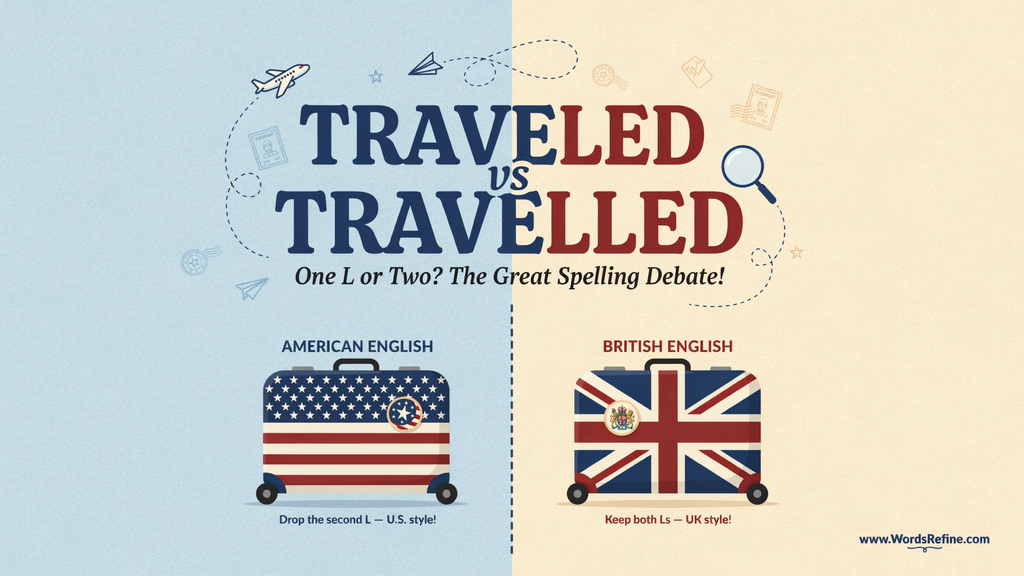
American English uses one l:
traveled, traveling, traveler
British English uses two l’s:
travelled, travelling, traveller
You can think of it as two spelling families.
The American family keeps one l.
The British family keeps two.
That memory trick won’t explain every English spelling difference in the world, but it works nicely for this group of words.
Which Spelling Should You Use?
If you’re still wondering which spelling should I use, consider your audience first.
1.If you’re writing for readers in the United States, use traveled.
2.If you’re writing for readers in the United Kingdom, use travelled.
3.If you’re writing for Canadian or Australian readers, travelled is generally the expected form.
4.If you’re writing for an international audience, either spelling can work. However, choose one regional style and use it consistently throughout the piece.
A style guide may also settle the question for you. Newspapers, universities, companies, publishers, and professional organizations often have their own preferred style.
A Practical Example of Regional Consistency
Imagine a travel company creates two versions of its website.
The American version says:
“Our customers traveled across the country while enjoying flexible travel options. Many travelers chose train routes because they wanted a comfortable journey.”
The British version says:
“Our customers travelled across the country while enjoying flexible travel options. Many travellers chose train routes because they wanted a comfortable journey.”
Both versions sound natural to their intended readers.
Now imagine combining them:
“Our customers traveled across the country while many travellers chose train routes.”
The sentence isn’t incomprehensible. Still, the mixture is noticeable.
This small example demonstrates why consistent writing style matters. Readers may not consciously identify every spelling difference, but inconsistent language can make a document feel less carefully edited.
Traveled vs Travelled The Main Rule to Remember
The easiest rule is this:
American English uses traveled.
British English uses travelled.
Canadian and Australian English commonly use travelled as well.
Both forms mean the same thing.
Both function as the past tense and past participle of travel.
Neither spelling is universally superior.
The correct choice depends on the regional English convention you’re following.
Learn the difference between confusing more English words
Whoever vs Whomever How to Use Each Word Correctly?
Practice Session Traveled vs Travelled
- We ________ across Europe last summer.
- She has ________ to several countries for work.
- In American English, “________” is the standard spelling.
- In British English, “________” is the standard spelling.
- My brother is ________ to Canada next week.
- The ________ asked for directions to the train station.
- She has always enjoyed ________ by train.
- They ________ more than 2,000 miles during their vacation.
- He has ________ extensively throughout Australia.
- The experienced ________ carried only a small backpack.
- We are ________ through the countryside this weekend.
- In British English, “________” is spelled with two L’s.
- In American English, “________” is spelled with one L.
- She ________ to London for a business meeting last month.
- They have ________ around the world several times.
- The young ________ wrote about his journey in a journal.
- I enjoy ________ when I have enough time to explore.
- We ________ by car because the train was unavailable.
- He is ________ across the country with his family.
- The ________ arrived at the hotel late at night.
- She has ________ farther than anyone else in her family.
- In American English, “traveling” has one L, while British English uses “________.”
- In American English, “traveler” has one L, while British English uses “________.”
- They ________ through several small villages during their trip.
- Whether you write “traveled” or “travelled,” the meaning remains the ________.
Answers
- traveled / travelled
- traveled / travelled
- traveled
- travelled
- traveling / travelling
- traveler / traveller
- traveling / travelling
- traveled / travelled
- traveled / travelled
- traveler / traveller
- traveling / travelling
- travelled
- traveled
- traveled / travelled
- traveled / travelled
- traveler / traveller
- traveling / travelling
- traveled / travelled
- traveling / travelling
- traveler / traveller
- traveled / travelled
- travelling
- traveller
- traveled / travelled
- same
Here’s a trusted source for clear more words Comparison:
FAQs
Is traveled or travelled correct?
Both “traveled” and “travelled” are correct spellings. “Traveled” is the standard form in American English, while “travelled” is commonly used in British English and other varieties that follow British spelling conventions.
Why do we double the L in travelled?
“Travelled” uses two L’s because British English spelling conventions generally double the final L in this word before certain endings. American English typically uses one L, giving us “traveled.”
Is traveller spelled with one L or two?
“Traveller” is spelled with two L’s in British English. American English usually uses “traveler,” with one L. Both spellings have the same meaning.
Can I say “Have you traveled?”
Yes, “Have you traveled?” is grammatically correct. It uses “traveled” as the past participle of “travel.” In British English, the same question is commonly written as “Have you travelled?”
Which is correct: “I love travelling” or “I love to travel”?
Both are correct. “I love travelling” uses the -ing form of “travel,” while “I love to travel” uses the infinitive. Both sentences naturally express enjoyment of traveling.
Which is correct: “well travelled” or “well traveled”?
Both spellings are correct, depending on the variety of English. British English commonly uses “well-travelled,” while American English generally uses “well-traveled.”
How do Brits spell traveling?
British English spells it “travelling,” with two L’s. The same spelling pattern appears in “travelled” and “traveller.”
Is travelled correct in Canada?
Yes. “Travelled” is a standard and widely accepted spelling in Canadian English. Canadian English has influences from both British and American English, so spelling preferences can vary in some cases.
What is the difference between Canadian and British spelling?
Canadian English shares many spelling conventions with British English, but it also has significant American influence. As a result, Canadian spelling sometimes follows British conventions and sometimes differs from them.
What is another word for traveled?
Depending on the context, synonyms for “traveled” include “journeyed,” “toured,” “explored,” “visited,” and “voyaged.” The most suitable synonym depends on what kind of travel you mean.
What does “I traveled” mean?
“I traveled” means that you went from one place to another. It is the simple past form of “travel,” as in, “I traveled to Italy last summer.”
Which is correct: “I have travelled” or “I had travelled”?
Both are grammatically correct, but they describe different time relationships. “I have travelled” is the present perfect, while “I had travelled” is the past perfect. The correct choice depends on when the travel happened in relation to another event.
Is travelled spelled with two L’s?
Yes. “Travelled” is spelled with two L’s. It is the standard spelling in British English and is also commonly used in Canadian and Australian English.
Is it correct to say “travelled” or “traveled” in Canada?
Both spellings can be found in Canadian English, but “travelled” is a standard Canadian spelling and is widely accepted. Canadian writing can reflect both British and American spelling conventions, so usage may vary by writer or style guide.
Conclusion
The difference between “traveled” and “travelled” may seem like a tiny spelling mystery, but thankfully, you don’t need a passport to solve it. Both spellings are correct; the choice depends mainly on the variety of English you’re using. American English generally prefers “traveled,” while British English commonly uses “travelled.” Canadian and Australian English often use “travelled” as well, although usage can vary.
The key is consistency. If you’re writing in American English, use “traveled,” “traveling,” and “traveler.” If you’re following British English, choose “travelled,” “travelling,” and “traveller.” Once you understand the regional difference, the choice becomes simple. So, whether your words travel with one L or two, just make sure they stay on the same spelling journey throughout your writing.

Diora AJS she is an experienced blogger and passionate English language enthusiast at Words Refine. With a keen eye for language and a love for clear communication, she writes practical content about grammar, word meanings, usage, and commonly confused terms. Her goal is to make English easier to understand through clear explanations and relatable examples, helping readers write accurately and communicate with confidence.