English has a talent for turning one simple word into a surprisingly tricky spelling question, and skepticism vs scepticism proves the point. If you’ve ever stared at the two forms and wondered which one belongs in your sentence, you’re certainly not alone. The good news is that neither spelling is wrong. “Skepticism” is the standard American form, while “scepticism” is commonly used in British English. Both words carry the same meaning and pronunciation. In this guide, you’ll discover their meanings, spelling differences, regional usage, pronunciation, and practical examples. Once you understand the pattern, this spelling mystery becomes much easier to solve without second-guessing yourself.
Skepticism vs Scepticism
Both skepticism and scepticism are accepted English spellings. They express the same idea and work in the same grammatical way.
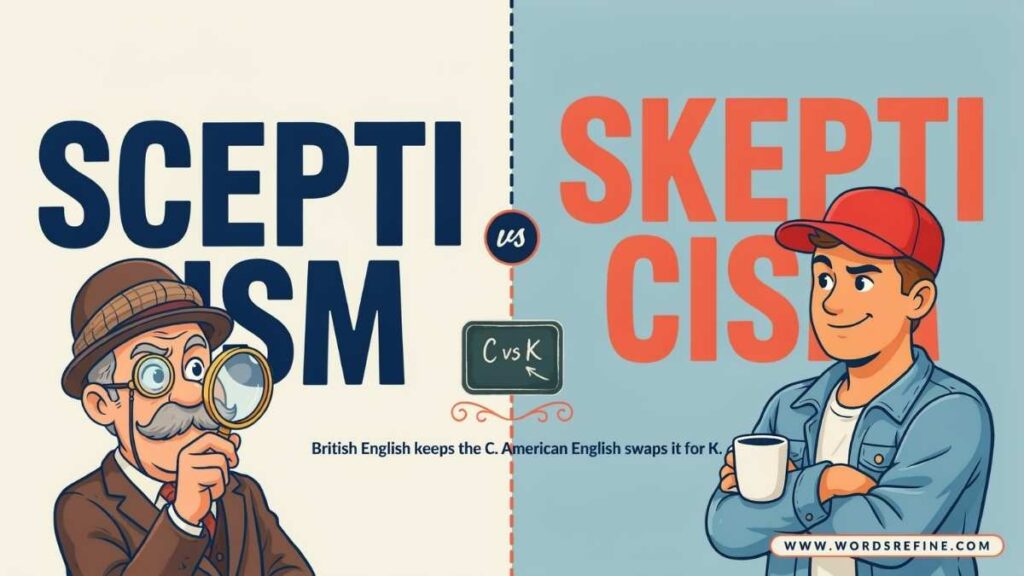
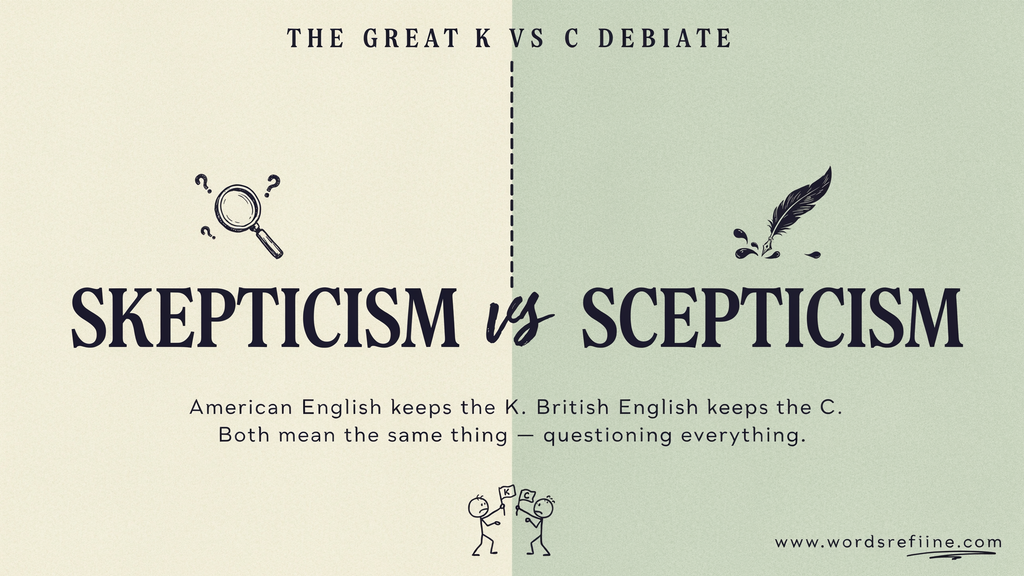
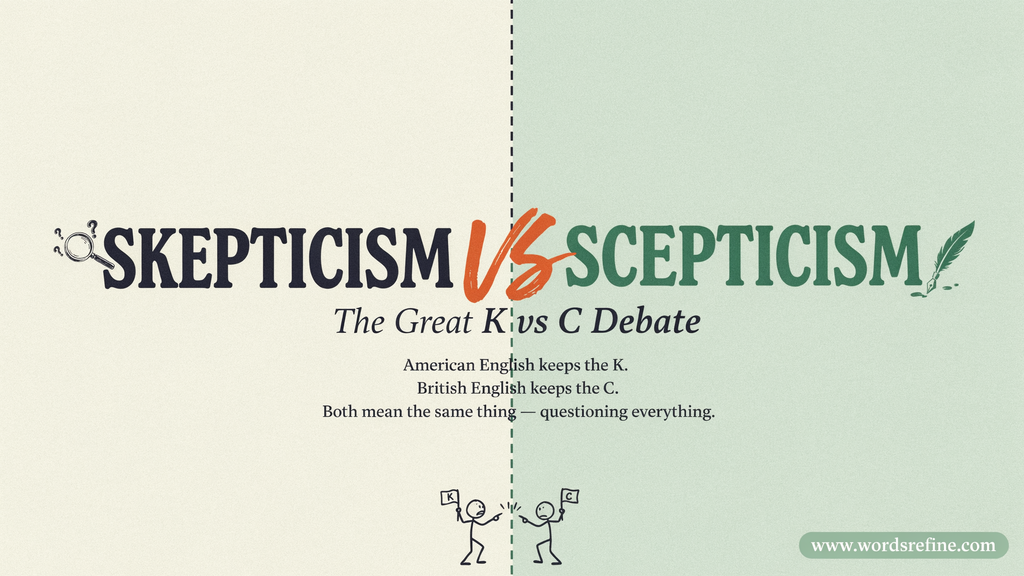
American English generally prefers skepticism. British English generally prefers scepticism. The difference is similar to other regional spelling pairs such as color and colour or center and centre.
For example, an American writer might say:
The researcher approached the claim with skepticism.
A British writer might write:
The researcher approached the claim with scepticism.
The meaning does not change. Only the spelling does.
Therefore, neither version is universally “more correct.” The right choice depends on the variety of English you are using.
What Does Skepticism vs Scepticism Mean?
Skepticism means having doubts about whether something is true, accurate, reliable, or likely to happen. It often involves questioning a claim instead of accepting it immediately.
In simple terms, skepticism means asking, “How do we know?”
Imagine someone tells you that a new product can make you twice as productive overnight. You might not immediately believe the claim. Instead, you could ask for evidence, look for reliable information, or compare the product with alternatives.
That is skepticism.
It does not necessarily mean saying, “This is false.” Instead, it can mean saying, “I am not convinced yet.”
The same explanation applies to scepticism. The British spelling represents the same idea.
Learn the difference between confusing more English words
Vaccum Vs Vacuum Which One Is Correct and Why It Matters ?
Skepticism vs Scepticism Have the Same Meaning
There is no major difference between the meanings of skepticism and scepticism.
Both words describe an attitude of doubt, questioning, or careful examination. They can describe a person’s reaction to a claim, a general approach to information, or a broader intellectual attitude.
For example:
Her skepticism about the proposal was reasonable.
The British version would be:
Her scepticism about the proposal was reasonable.
In both sentences, the person isn’t necessarily rejecting the proposal. She simply wants stronger reasons or evidence before accepting it.
That distinction is important because skepticism is often confused with disbelief. Doubt and disbelief can overlap, but they aren’t always the same thing.
Learn the difference between confusing more English words
Mortality vs Fatality Meaning Differences and Correct Usage ?
Why Are Skepticism vs Scepticism Spelled Differently?
The spelling difference comes from the history of English and the development of regional spelling conventions.
The word traces back to Greek philosophical terminology associated with questioning and inquiry. English eventually developed both skeptic and sceptic as spelling forms. Over time, American English came to favor the spelling with k, while British English generally retained the spelling with c.
That pattern continues today.
American English uses skeptic, skeptical, and skepticism.
British English generally uses sceptic, sceptical, and scepticism.
So, if you have wondered why skepticism is spelled with a k in American writing, the answer is largely historical. Likewise, the c in scepticism reflects the traditional British spelling.
The difference isn’t the result of one spelling being careless or incorrect. English simply developed more than one standard regional form.
Skepticism in American English
In American English, skepticism is the normal spelling.
You would typically write:
The audience showed skepticism toward the unusual claim.
She approached the advertisement with skepticism.
The scientist maintained a healthy skepticism about the results.
The related forms follow the same pattern. American writers generally use skeptic and skeptical.
For example:
The skeptical customer asked several questions.
The spelling stays consistent throughout the sentence.
If you are writing for an American audience, skepticism is the safest and most natural choice.
Scepticism in British English
British English generally uses scepticism.
For example:
The audience showed scepticism toward the unusual claim.
She approached the advertisement with scepticism.
The scientist maintained a healthy scepticism about the results.
The related forms also use c:
The sceptical customer asked several questions.
This spelling is common in British English and in several other varieties of English that have historically followed British spelling conventions.
Therefore, if your audience expects British English, scepticism is the natural choice.
Learn the difference between more words people mix up
Mama vs Mamma Meaning Spelling and Usage?
Skepticism British or American?
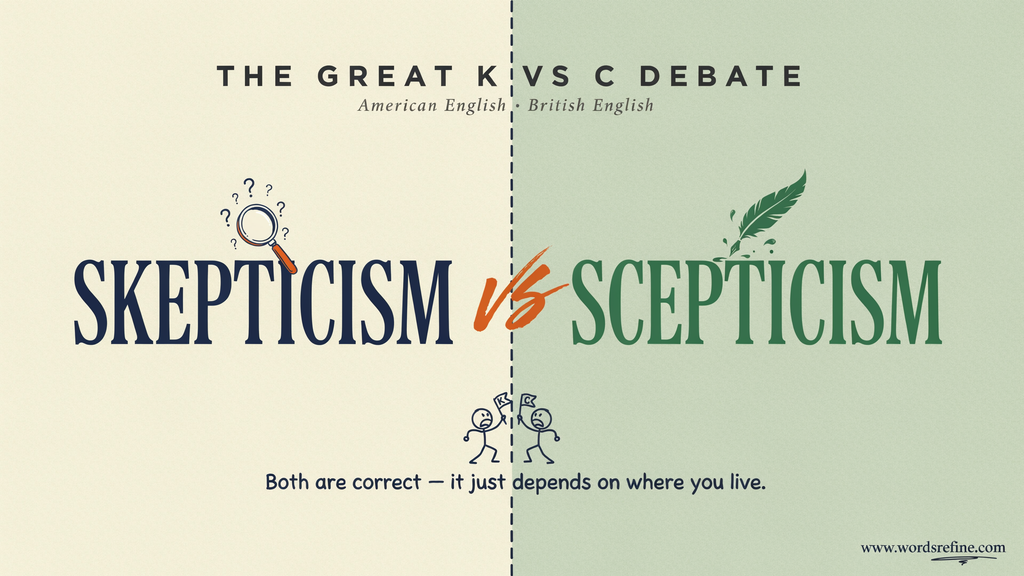
If you are asking whether skepticism is British or American, the short answer is that it is primarily the American spelling.
British English readers will understand it without difficulty. However, British writing normally favors scepticism.
The same distinction appears in the related words:
American English: skeptic, skeptical, skepticism
British English: sceptic, sceptical, scepticism
This makes the spelling pattern easy to remember once you notice it.
Scepticism American or British?
Scepticism is primarily the British spelling.
American readers will understand it, but standard American English normally uses skepticism instead.
So, when deciding between the two, think about your audience first. If the writing follows US English conventions, choose skepticism. If it follows UK English conventions, choose scepticism.
That simple habit will prevent most spelling inconsistencies.
Skepticism vs Scepticism Pronunciation
Fortunately, the pronunciation doesn’t create the same problem as the spelling.
Skepticism and scepticism are generally pronounced the same way. The change from k to c affects the written form rather than creating a meaningful difference in pronunciation.
A simple pronunciation guide is:
SKEP-tuh-siz-um
The related adjectives skeptical and sceptical also have essentially the same pronunciation.
So, if you already know how to say skepticism, you don’t need to learn a completely different pronunciation for scepticism.
Learn the difference between confusing word pairs
Stripes vs Strips Meaning Differences and Correct Usage ?
How to Use Skepticism in a Sentence
Skepticism works naturally in everyday, professional, academic, and scientific contexts.
For example:
The customer viewed the extraordinary claim with skepticism.
Here, the customer doubts the claim and wants more evidence.
Another example is:
The researchers approached the unexpected results with skepticism.
This doesn’t mean the researchers rejected the findings. Instead, they wanted to examine the results carefully before accepting the conclusion.
You can also use the word when describing a general attitude:
Healthy skepticism can help people avoid misleading claims.
In each case, the word expresses thoughtful doubt rather than automatic rejection.
How to Use Scepticism in a Sentence
The British spelling works in exactly the same way.
For example:
The customer viewed the extraordinary claim with scepticism.
Or:
The researchers approached the unexpected results with scepticism.
The meaning remains unchanged.
You can also write:
Healthy scepticism can help people avoid misleading claims.
The only difference is the regional spelling convention.
Skepticism and Critical Thinking
Skepticism often works hand in hand with critical thinking.
When you think critically, you don’t simply accept information because someone presents it confidently. Instead, you consider the evidence, examine the reasoning, and look for possible weaknesses.
For example, imagine that a company announces that its new supplement produces remarkable results. A skeptical reader might ask how the company reached that conclusion.
Was the product tested properly? Were enough people involved? Was the research independent? Could another explanation account for the results?
Those questions demonstrate healthy skepticism.
However, good skepticism also requires an open mind. If convincing evidence supports the claim, a reasonable skeptic should be willing to reconsider an earlier opinion.
That is what separates skepticism from stubborn disbelief.
Healthy Skepticism Does Not Mean Negativity
Skepticism sometimes gets an unfair reputation because people associate it with negativity.
In reality, healthy skepticism can protect you from poor reasoning and unsupported claims.
Suppose a friend tells you that a particular investment is guaranteed to make money. Instead of immediately accepting the promise, you might ask how the investment works and what risks it carries.
That isn’t pessimism. It’s careful judgment.
Likewise, a scientist who questions an unexpected result isn’t necessarily trying to disprove the research. The scientist may simply want stronger evidence.
In many situations, skepticism encourages better questions, better research, and better decisions.
Learn the difference between often confused words
Nevertheless vs Nonetheless Meaning and Usage?
Skepticism vs Doubt
Skepticism and doubt are closely related, but they aren’t identical.
Doubt can describe a simple feeling of uncertainty.
For example:
I doubt that the package will arrive today.
The sentence expresses uncertainty about one event.
Skepticism can involve a broader and more deliberate process of questioning.
For example:
The journalist approached the company’s claims with skepticism.
Here, the journalist isn’t merely uncertain. The journalist is examining whether the claims deserve to be believed.
In other words, doubt can be a feeling, while skepticism often involves investigation and critical judgment.
Skepticism vs Cynicism
Skepticism and cynicism can look similar at first glance, but they describe different attitudes.
A skeptic questions a claim and looks for evidence.
A cynic often assumes that people are motivated by selfishness, dishonesty, or bad intentions.
Imagine that a company announces a new environmental program.
A skeptic might say:
I’d like to see evidence that the program actually reduces pollution.
A cynic might say:
They’re only doing this to improve their reputation.
The skeptic questions the effectiveness of the claim. The cynic questions the company’s motives.
That difference is worth remembering because calling someone cynical when they are simply skeptical can misrepresent their attitude.
Learn the difference between commonly misused words
Attorneys vs Attornies Which one Is Correct?
Skepticism in Academic Writing
Academic writing often relies on careful questioning. Researchers regularly examine evidence, challenge assumptions, and consider alternative explanations.
For that reason, skepticism has an important place in academic discussion.
A student might write:
The findings should be interpreted with some skepticism because the study involved a limited sample.
The sentence doesn’t dismiss the research. Instead, it points out a limitation that readers should consider.
In academic writing, skepticism can encourage careful examination of:
Research methods
Evidence
Sources
Assumptions
Sample sizes
Alternative explanations
Limitations
Conclusions
When used properly, skepticism supports intellectual honesty.
Skepticism in Scientific Writing
Scientific skepticism takes the same basic idea into a more evidence-focused setting.
Suppose researchers announce a surprising discovery. Other scientists may examine the methods, repeat the experiment, compare the findings with previous research, and look for alternative explanations.
That process isn’t an attack on the original researchers.
It’s part of how reliable knowledge develops.
Scientific skepticism asks whether the evidence supports the conclusion. It doesn’t demand that every unusual idea be rejected.
A surprising claim may eventually prove correct. Until the evidence becomes strong enough, however, skepticism encourages researchers to keep asking questions.
Philosophical Skepticism
Philosophical skepticism goes beyond everyday doubt.
Philosophers have long questioned what humans can genuinely know and how we can justify our beliefs. Some philosophical approaches examine whether certainty about knowledge, perception, or reality is possible.
This form of skepticism is more specialized than the everyday use of the word.
When someone says, “I’m skeptical about that advertisement,” they probably aren’t making a philosophical argument about the limits of human knowledge.
They simply want better evidence.
That difference becomes important when the word appears in academic or philosophical discussions.
Learn the difference between commonly mixed-up more words
Skiddish vs Skittish Which One Is Correct and Why It Matters
Skeptic, Sceptic, Skeptical, and Sceptical
The spelling difference doesn’t stop with skepticism.
The same regional pattern appears in its related forms.
| American English | British English |
|---|---|
| skeptic | sceptic |
| skeptical | sceptical |
| skepticism | scepticism |
| skeptically | sceptically |
The pattern is consistent enough to make the words easier to remember.
If you choose American English, keep the k forms together. If you choose British English, keep the c forms together.
For example, an American sentence would naturally say:
The skeptical skeptic expressed skepticism about the claim.
A British version would say:
The sceptical sceptic expressed scepticism about the claim.
The sentences sound a little repetitive, but they make the spelling pattern obvious.
Common Mistakes With Skepticism and Scepticism
One common mistake is assuming that one spelling must be wrong.
It isn’t.
Another mistake is mixing regional forms within the same document. A writer might use skeptical in one paragraph and scepticism in another without realizing that the spelling systems have been mixed.
A cleaner approach is to choose one regional convention and stick with it.
Another mistake involves treating skepticism as complete disbelief. Someone can be skeptical while remaining open to evidence.
Finally, skepticism shouldn’t automatically be confused with cynicism. Questioning a claim doesn’t necessarily mean distrusting the person making it.
Which Spelling Should You Use?
The answer depends on your audience.
1For American English, use skepticism.
2For British English, use scepticism.
3For formal writing, check the relevant style guide if one exists. A university, publisher, journal, employer, or organization may have its own spelling preferences.
If no specific guide applies, the intended variety of English should make the decision fairly easy.
The key is consistency.
If you begin a document using American spelling, continue using American spelling throughout. Likewise, if you choose British spelling, maintain the British forms throughout the document.
Consistency makes your writing look deliberate rather than accidental.
Quick Comparison of Skepticism and Scepticism
| Feature | Skepticism | Scepticism |
|---|---|---|
| Main variety | American English | British English |
| Meaning | Doubt or questioning | Doubt or questioning |
| Pronunciation | Essentially the same | Essentially the same |
| Related noun | skeptic | sceptic |
| Related adjective | skeptical | sceptical |
| Used in US English | Preferred | Less common |
| Used in UK English | Less common | Preferred |
Learn the difference between commonly misused words
Expiry vs Expiration Which One Is Correct?
Practice Session Skepticism vs scepticism
Fill in each blank with the correct word.
- American English generally uses the spelling __________.
- British English generally uses the spelling __________.
- Maria approached the unusual claim with healthy __________.
- The British newspaper described his __________ attitude toward the proposal.
- A person who questions claims and asks for evidence may be called a __________.
- In British English, the corresponding word is usually spelled __________.
- The researcher remained __________ until she could verify the results.
- The British professor was __________ of the unsupported conclusion.
- The two spellings have the same basic __________.
- “Skepticism” is the standard spelling in __________ English.
- “Scepticism” is the standard spelling in __________ English.
- His natural __________ made him question the advertisement’s exaggerated promises.
- The journalist expressed strong __________ about the accuracy of the report.
- A good scientist should remain __________ of extraordinary claims until the evidence supports them.
- The British editor was __________ about the company’s impressive sales claims.
- A __________ does not necessarily reject every claim; instead, they may ask for reliable evidence.
- The British spelling of “skeptic” is __________.
- American English spells the adjective as __________.
- British English commonly spells the adjective as __________.
- Her healthy __________ encouraged her to check the source before sharing the information.
- The professor’s __________ led him to examine the evidence more carefully.
- Although Daniel was __________ about the product’s claims, he agreed to examine the test results.
- The British reviewer remained __________ until the company provided convincing evidence.
- “Skepticism” and “scepticism” are different spellings of the same __________.
- When writing for an American audience, choose __________ and use it consistently throughout the article.
Answers
- skepticism
- scepticism
- skepticism
- sceptical
- skeptic
- sceptic
- skeptical
- sceptical
- meaning
- American
- British
- skepticism
- scepticism
- skeptical
- sceptical
- skeptic
- sceptic
- skeptical
- sceptical
- skepticism
- scepticism
- skeptical
- sceptical
- word
- skepticism
Here’s a trusted source for clear more words Comparison:
FAQS
How do Canadians spell skeptical?
Canadian English commonly uses both American and British spelling conventions. The spelling “skeptical” with a k is widely used in Canada, although “sceptical” also appears. For formal or professional writing, the best approach is to follow the spelling style required by your organization, publication, or chosen style guide.
What did Socrates say about skepticism?
Socrates is well known for questioning assumptions and examining what people claim to know. His approach encouraged careful questioning rather than accepting ideas without examination. Although the famous statement “I know that I know nothing” is commonly associated with him, it is better understood as a popular summary of his philosophy rather than a direct quotation from a surviving work.
What is the difference between American and British spelling?
American and British English sometimes spell the same word differently. For example, American English uses “skepticism,” while British English generally uses “scepticism.” The meaning stays the same. These differences usually reflect regional spelling conventions rather than differences in grammar or definition.
Is scepticism a noun?
Yes, “scepticism” is a noun. It describes an attitude of questioning, doubt, or careful examination rather than accepting a claim immediately. For example, “Her scepticism encouraged the team to examine the evidence more carefully.” In American English, the corresponding noun is spelled “skepticism.”
What does God say about skepticism?
Religious views on skepticism vary depending on the tradition and interpretation. In Christianity, several biblical passages encourage people to examine claims carefully and distinguish truth from false teaching. For example, 1 John 4:1 encourages believers to test what they hear. Therefore, thoughtful questioning and discernment are not necessarily presented as negative qualities.
What are the two types of skepticism?
There is no single universally accepted system that divides skepticism into only two types. However, a useful broad distinction is practical skepticism and philosophical skepticism. Practical skepticism involves questioning everyday claims and checking evidence, while philosophical skepticism examines deeper questions about knowledge, certainty, and whether people can truly know something.
Are scepticism and skepticism the same?
Yes. “Scepticism” and “skepticism” have the same basic meaning. The main difference is spelling. “Skepticism” is the standard spelling in American English, while “scepticism” is the traditional spelling in British English and several other varieties of English. Both forms are correct within their respective spelling conventions.
Is scepticism correct spelling?
Yes, “scepticism” is a correct spelling. It is the standard British English form of the word. American English generally uses “skepticism” instead. The difference is simply a regional spelling variation, so neither form is inherently more correct than the other.
What is the opposite of scepticism?
The opposite of scepticism can be certainty, confidence, acceptance, or unquestioning belief, depending on the context. For example, someone who accepts a claim without asking for evidence may show confidence or unquestioning belief rather than scepticism. The most suitable opposite depends on what kind of doubt or questioning is being discussed.
What is a famous example of skepticism?
A classic example of skepticism is questioning a claim until sufficient evidence supports it. Scientific investigation often demonstrates this approach: a researcher does not accept a surprising result simply because it sounds convincing. Instead, they test it, examine the evidence, and consider alternative explanations before reaching a conclusion.
What is a synonym for scepticism?
Common synonyms for “scepticism” include doubt, uncertainty, suspicion, reservation, and distrust. However, these words are not always interchangeable. “Doubt” often refers to uncertainty, while “suspicion” can suggest concern that something may be wrong. In many contexts, “scepticism” specifically suggests a habit of questioning claims and looking for evidence.
Is scepticism a good thing?
Scepticism can be useful when it encourages careful thinking, evidence-based decisions, and healthy questioning. It can help you avoid accepting unreliable information too quickly. However, excessive scepticism can become unproductive if someone rejects every claim regardless of the evidence. Healthy scepticism leaves room for conclusions when reliable evidence supports them.
What’s a stronger word for skeptical?
Depending on the context, stronger alternatives to “skeptical” include doubtful, unconvinced, suspicious, distrustful, or incredulous. “Cynical” can sound stronger, but it has a different meaning because it often suggests expecting selfish or dishonest motives. Therefore, choose the word that best describes the specific kind of doubt you want to express.
Do skeptics believe in God?
Skepticism does not automatically determine a person’s religious beliefs. Some skeptics believe in God, while others do not. A person may apply skeptical thinking to religious claims while still maintaining religious faith. In other words, being skeptical means questioning or examining claims carefully; it does not, by itself, define someone’s religious position.
What causes a person to be skeptical?
People may become skeptical because they encounter conflicting information, unreliable sources, exaggerated claims, or experiences that make them question what they hear. Personal experience, education, critical-thinking skills, and a desire for strong evidence can also influence skepticism. In many cases, skepticism develops from the simple habit of asking, “How do we know this is true?”
Learn the difference between more words people mix up
Dork vs Nerd Meaning Differences Examples?
Conclusion
The choice between skepticism vs scepticism may look like a tiny spelling puzzle, but the answer is surprisingly simple. Both forms are correct. “Skepticism” is the standard spelling in American English, while “scepticism” is preferred in British English and other varieties that follow British conventions.
More importantly, the meaning stays exactly the same. Both words describe a thoughtful habit of questioning claims, examining evidence, and avoiding quick conclusions. Healthy skepticism doesn’t mean refusing to believe anything. It means asking sensible questions before accepting something as true.
When writing, simply match your spelling to your audience and stay consistent. Use “skepticism” for American English and “scepticism” for British English. Once you know that small regional difference, there’s no need to lose sleep over the extra c. The real skill is knowing when to question a claim, not questioning your spelling every five minutes.

Diora AJS she is an experienced blogger and passionate English language enthusiast at Words Refine. With a keen eye for language and a love for clear communication, she writes practical content about grammar, word meanings, usage, and commonly confused terms. Her goal is to make English easier to understand through clear explanations and relatable examples, helping readers write accurately and communicate with confidence.