Choosing between similar English words can be tricky, especially when one small letter changes the meaning. Stripes vs strips is a clear example. Although these words look nearly alike, they describe different things. A stripe usually means a line, band, or marking that appears on a surface, while a strip generally means a long, narrow piece or section of something. This difference matters when you’re describing clothes, fabric, paper, roads, or other familiar objects. Using the wrong word can make a sentence unclear or give it an unintended meaning. Fortunately, understanding the difference between strip vs stripe makes the choice much easier and helps you write with greater accuracy and confidence.
Stripes vs Strips Quick Answer
The simplest way to understand the difference between strip vs stripe is to focus on what each word describes.
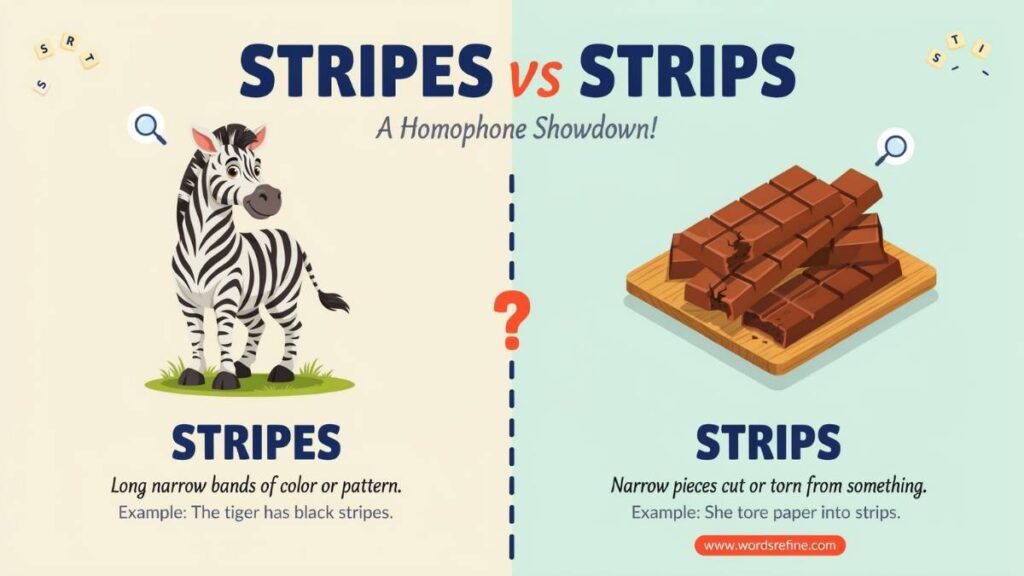
A stripe is generally a long, narrow line or band that appears on a surface. It often has a different color or appearance from the area around it. You can find stripes on clothing, animals, flags, roads, walls, and many other surfaces.
A strip, on the other hand, is usually a long, narrow piece, section, or area of something. It may be made from paper, cloth, metal, wood, plastic, or another material. A strip can also refer to a narrow section of land or another physical area.
So, the basic distinction is simple:
A stripe is usually a marking.
A strip is usually a piece or section.
This is a useful rule, although it isn’t an absolute rule for every meaning of the words. English has a habit of stretching words into new meanings, so the surrounding sentence always matters.
Learn the difference between commonly misused words
Ingenuine vs Ungenuine Which One Is Correct ?
Stripe Meaning and Definition
A stripe is a long, narrow line or band that differs from the surface around it. The difference may come from color, texture, pattern, or another visible characteristic.
For example, imagine a white shirt with three blue lines running across it. Those blue lines are stripes.
You might say:
“The shirt has blue stripes.”
“The flag contains several red and white stripes.”
“The zebra’s stripes make it easy to recognize.”
In each sentence, stripe refers to a visible marking rather than a separate piece of material.
A stripe can be horizontal, vertical, diagonal, curved, thick, thin, bright, or subtle. It can also appear naturally, as with the markings on a zebra, or it can be added intentionally, as with stripes painted on a wall.
Stripe as a Noun
As a noun, stripe refers to the marking itself.
For example:
“The cat has a dark stripe along its back.”
“The racing car has a silver stripe.”
“The curtains have narrow green stripes.”
Here, the stripes remain part of the surface. You are describing what you see rather than describing separate pieces of material.
Stripe as a Verb
Stripe can also function as a verb. When you stripe something, you mark it with stripes.
For example:
“The artist striped the wall with two contrasting colors.”
“The team striped the field before the game.”
“The designer striped the fabric with thin lines.”
This use is less common in everyday conversation than the noun, but it is still a valid use of the word.
Strip Meaning and Definition
A strip usually means a long, narrow piece or section of something.
You can cut a strip from a larger piece of material. For example, you can cut strips of paper, strips of cloth, strips of metal, or strips of cardboard.
Consider this sentence:
“She cut the paper into narrow strips.”
The paper has been divided into separate pieces. Those pieces are strips.
Similarly:
“He attached a strip of leather to the bag.”
“The recipe requires a strip of lemon peel.”
“They used strips of tape to hold the box together.”
In each example, strip refers to a physical piece rather than a decorative marking.
Strip as a Noun
As a noun, strip can describe a narrow piece, section, or area.
For example:
“I need a strip of fabric.”
“She placed a strip of tape across the package.”
“There is a narrow strip of land between the two properties.”
Strip can also refer to a particular area. A landing strip, for example, is a long, narrow area used by aircraft for takeoff and landing.
Likewise, a commercial strip can describe an area along a road where several businesses are located.
Strip as a Verb
Strip has another important meaning when it functions as a verb. It can mean to remove something.
For example:
“The workers stripped the old paint from the door.”
“She stripped the wallpaper from the wall.”
“The mechanic stripped the damaged wire.”
In these sentences, strip has nothing to do with a narrow piece. Instead, it describes removing something.
This meaning appears in many everyday expressions. You can strip something of its covering, remove a layer, take away decorations, or even remove someone’s possessions or privileges, depending on the context.
Learn the difference between confusing more English words
Cadaver vs Corpse Which One Is Correct ?
The Difference Between Strip vs Stripe
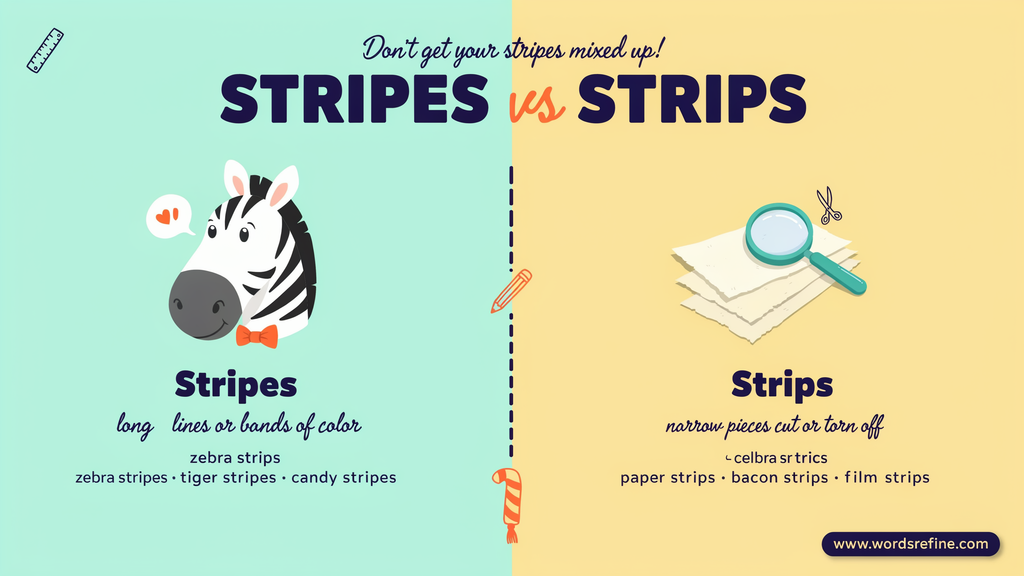
1.The difference between strip and stripe becomes clearer when you compare what each word represents.
A stripe is normally something you see on a surface. A strip is normally something you can identify as a piece, section, or narrow area.
Imagine a roll of fabric.
If the fabric has red lines printed across it, those lines are stripes.
If you cut the fabric into long, narrow pieces, those pieces are strips.
The fabric itself has not changed in meaning. What changes is the thing you are describing.
This distinction works in many situations. You might see stripes on a flag, while you might cut strips of paper for a school project. You might wear a striped shirt, while a tailor might use strips of fabric to make part of a garment.
Learn the difference between everyday English mistakes
Ironic vs Unironic Meaning, Differences, and Correct Usage
Stripes vs Strips in Clothing
Clothing is one of the easiest places to see the difference.
When a shirt has a repeated pattern of lines, you call it a striped shirt. You can also say that the shirt has stripes.
For example:
“She bought a shirt with blue and white stripes.”
“The dress has thin vertical stripes.”
“He wore a black-and-white striped sweater.”
In these examples, stripe describes the appearance of the clothing.
However, if you cut a piece of clothing into narrow sections, you would call those pieces strips.
For example:
“She cut the fabric into long strips.”
“The designer used strips of leather to decorate the jacket.”
“The craft project requires several strips of cloth.”
The difference is straightforward. Stripes are part of the pattern. Strips are pieces of material.
Strips vs Stripes in Everyday Examples
Everyday objects provide plenty of examples of this distinction.
A zebra has Stripes vs strips because the black and white areas create a pattern on its body.
A craft project may require strips of colored paper because the paper needs to be cut into separate pieces.
A flag can have stripes because the colors appear as bands across its surface.
A package can have a strip of tape because the tape forms a narrow piece attached to the package.
A road can have painted stripes because the markings appear on the road surface.
A garden may contain a narrow strip of land because the area itself is long and narrow.
Notice how the meaning changes depending on whether you are talking about a marking or a physical section.
Strip vs Stripe Examples
The best way to understand the difference is to look at complete sentences.
“The shirt has red stripes.”
Here, stripes describe the shirt’s pattern.
“She cut the red fabric into strips.”
Here, strips describe separate pieces of fabric.
“The flag has horizontal stripes.”
The word stripe refers to the visible bands of color.
“He used strips of paper to decorate the wall.”
The word strip refers to pieces of paper.
“The road has white stripes.”
The white lines are markings on the road.
“They placed a strip of metal along the edge.”
The metal is a narrow physical piece.
These examples may look simple, but they show the central distinction clearly.
Learn the difference between everyday English mistakes
Enflamed vs Inflamed Which One Is Correct ?
Stripes vs Strips in Practical Writing
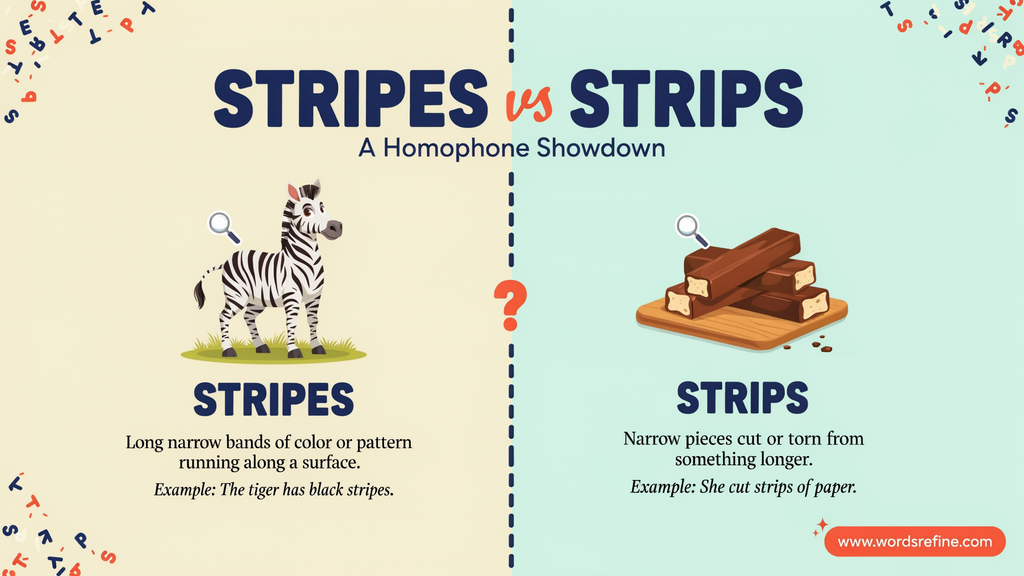
The difference matters when you write instructions because the wrong word can change the meaning of a sentence.
Suppose a craft instruction says:
“Cut the paper into six strips.”
The reader knows that the paper should become six separate pieces.
Now imagine the instruction says:
“Draw six stripes on the paper.”
The reader will understand that the paper should remain intact and receive six lines or bands.
The two sentences describe completely different actions.
The same principle applies to technical instructions. If you tell someone to remove a strip, you are usually referring to a physical piece or section. If you tell them to remove a Stripes vs strips you may be referring to a visible marking.
Precision matters because readers shouldn’t have to guess what you mean.
Strip vs Stripe vs Strap
Strip vs stripe are sometimes confused with strap because all three words can describe something long and narrow. However, their meanings are different.
A stripe is generally a line or band that appears on a surface.
A strip is generally a narrow piece, section, or area.
A strap is usually a narrow band used to hold, support, fasten, or carry something.
For example, a shirt may have blue stripes. A package may have a strip of tape across it. A backpack may have a shoulder strap.
The three objects can look somewhat similar, but they perform different roles.
This distinction becomes especially useful when describing clothing, bags, tools, packaging, and other physical objects.
Learn the difference between commonly mixed-up more words
Suffix vs Postfix Which One Is Correct?
Strip vs Stripe Pronunciation
Pronunciation provides another helpful way to distinguish these words.
In American English, strip is pronounced /strɪp/, while stripe is pronounced /straɪp/.
The beginning and ending sounds are similar. The main difference is the vowel sound.
Strip has the short i sound, similar to the vowel in “sit.”
Stripe has the long i sound, similar to the vowel in “time.”
So, when thinking about strip vs stripe pronunciation, listen carefully to the middle of the word.
Strip sounds like “strip.”
Stripe sounds like “stripe.”
The spelling reflects this difference as well. Stripe contains the final silent e that changes the vowel sound.
Striped vs Stripped
One of the most common sources of confusion is the difference between striped vs stripped.
Striped means marked with stripes.
Stripped means that something was removed.
For example:
“She wore a striped dress.”
“The workers stripped the old paint from the door.”
The first sentence describes a pattern. The second describes removal.
These words may look and sound similar, but their meanings are very different.
You can remember them by connecting striped with stripe and stripped with strip.
A striped shirt has stripes.
A stripped wall has had something removed.
That small spelling difference carries a completely different meaning.
Striping vs Stripping
The same distinction appears with striping and stripping.
Striping generally refers to adding or creating stripes.
Stripping generally refers to removing something.
For example:
“The workers are striping the parking lot.”
This means they are adding painted lines or markings.
“The workers are stripping the old paint from the walls.”
This means they are removing paint.
The extra “p” in striping also matters. The word strip becomes striping when the final p remains and the ending is added.
By contrast, stripping contains a double p.
These spellings can be confusing, especially when you are writing quickly. However, remembering the meanings makes the spelling easier to control.
Strip in Medical and Testing Contexts
Strip also appears in medical and testing language.
A test strip is a narrow physical device used to perform a test. For example, some glucose tests use test strips that interact with a sample and produce a measurable result.
In this context, strip refers to the physical piece of testing material. It does not mean a stripe or colored marking.
A test strip may contain chemicals or testing areas that react to a sample. The device itself is a strip because it is a narrow piece of material designed for a specific purpose.
This is another useful reminder that strip often refers to a physical object rather than a visual pattern.
Different Meanings of Stripe
Although stripe commonly refers to a line or band, it has other meanings too.
Stripe can describe a particular type or category. For example, the phrase “people of every stripe” refers to people of different kinds or backgrounds.
The word can also appear in descriptions of rank or status. In some contexts, a stripe on a uniform can indicate a particular position or level.
These meanings may seem far removed from the basic idea of a colored line, but they developed from the same general concept of a distinguishing mark.
Therefore, stripe does not always mean a literal line. Context determines the intended meaning.
Different Meanings of Strip
Strip also has several meanings beyond the idea of a narrow piece.
As a noun, it can refer to a narrow piece of material, a narrow area of land, or a particular area containing businesses.
As a verb, strip can mean remove something.
For example:
“They stripped the old wallpaper.”
“The storm stripped the tree of its leaves.”
“The company stripped the product of unnecessary features.”
In each case, something is being removed.
The word can also appear in phrases where someone loses a right, privilege, possession, or position. Again, the central idea is removal.
Learn the difference between commonly mixed-up more words
Trebled vs Tripled Which One Is Correct?
Why People Confuse Strips vs Stripes
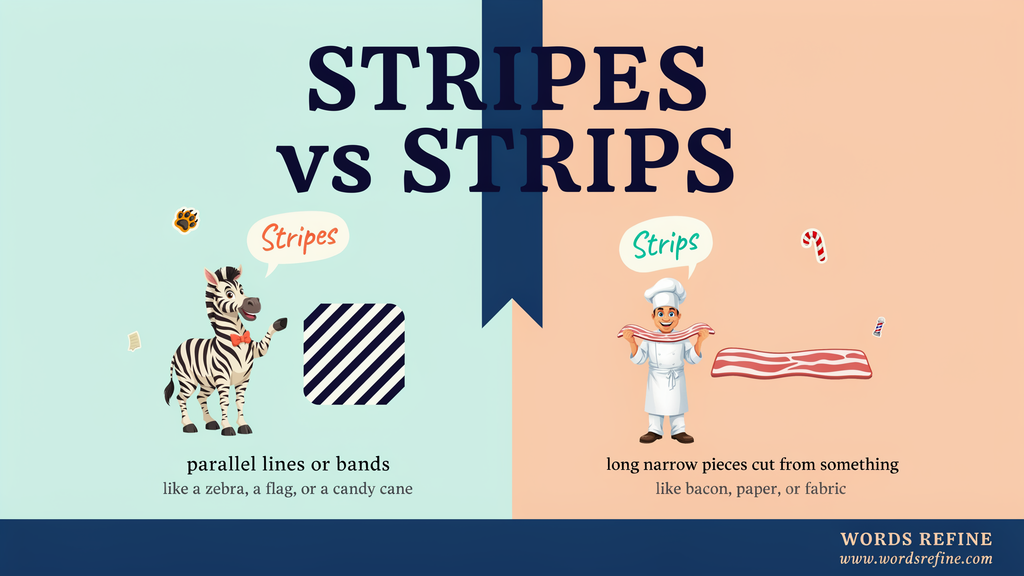
The confusion usually comes from their similar spelling and their shared association with long, narrow shapes.
A stripe is often long and narrow. A strip is also often long and narrow. That similarity makes it easy to choose the wrong word.
The important difference is what that shape represents.
A stripe is generally a marking on something.
A strip is generally a piece or section of something.
Think about a piece of paper with a blue line drawn across it. The blue line is a stripe.
Now cut the paper into several narrow pieces. Each piece is a strip.
The shape may be similar, but the relationship to the larger object is different.
A Simple Way to Remember the Difference
If you struggle to remember strip and stripe, use this simple mental rule:
Stripe means a marking.
Strip means a piece.
You see a stripe.
You can cut or use a strip.
A zebra has stripes.
A craft project may need strips of paper.
A shirt can have stripes.
A tailor can cut strips of fabric.
This memory trick won’t cover every possible dictionary meaning, but it works well for the most common uses.
Common Mistakes With Strip vs Stripe
One common mistake is using strip when you mean a visual marking.
For example, saying “a shirt with blue strips” can suggest separate pieces of blue material rather than blue lines printed or woven into the shirt.
The more natural sentence is:
“A shirt with blue stripes.”
Another common mistake is using Stripes vs strips when you mean a physical piece.
For example:
“Cut the paper into three stripes.”
That sentence suggests that the paper should contain three markings. If you mean three separate pieces, the correct word is strips.
The corrected sentence is:
“Cut the paper into three strips.”
Similarly, “a strip of tape” refers to a piece of tape, while “a stripe on the wall” refers to a visible marking.
British and American English
The basic difference between strip and stripe remains the same in both British and American English.
You can talk about stripes on clothing, stripes on animals, and strips of paper in either variety of English.
There may be differences in pronunciation, spelling preferences, or vocabulary in other areas of English, but these two words keep their basic meanings.
Therefore, you generally don’t need to choose strip or stripe based on whether you are writing for an American or British audience. Instead, choose the word that matches the meaning you intend.
How to Choose the Right Word
When you’re unsure whether to use strip or stripe, look at the noun you are describing.
If it is a visible line, band, or pattern, stripe will usually be correct.
If it is a narrow piece, section, or area, strip will usually be correct.
For example, ask yourself what you mean in the sentence:
“The fabric has several ___.”
If you mean colored lines, use stripes.
“The fabric was cut into several ___.”
If you mean separate pieces, use strips.
This quick test can solve most everyday cases.
Learn the difference between confusing word pairs
Hierarchical vs Hierarchal Which One Is Correct?
Quick Comparison of Strip vs Stripe
| Word | Common meaning | Example |
|---|---|---|
| Strip | A long, narrow piece or section | She cut a strip of paper. |
| Stripe | A long, narrow marking or band | The shirt has a blue stripe. |
| Strips | More than one narrow piece or section | He used strips of cloth. |
| Stripes | More than one marking or band | The flag has red stripes. |
| Stripped | Had something removed | The wall was stripped of paint. |
| Striped | Marked with stripes | She wore a striped shirt. |
| Stripping | Removing something | They are stripping the old paint. |
| Striping | Adding or creating stripes | They are striping the parking lot. |
The table highlights the most important differences without making the words seem more complicated than they are.
Learn the difference between often confused words
Taylored vs Tailored Which One Is Correct?
Practice Session Stripes vs Strips
- The zebra has black-and-white ______ across its body.
- Please cut the paper into several narrow ______.
- She wore a blue shirt with thin white ______.
- The worker removed the old paint by ______ the wall.
- The designer created a ______ pattern on the fabric.
- He cut a long ______ of leather for the project.
- The road crew is ______ the parking lot with fresh lines.
- The old wall was completely ______ of its paint.
- The flag has three horizontal ______.
- Use two ______ of tape to secure the package.
- The dress has colorful ______ running from top to bottom.
- She used a narrow ______ of fabric to repair the bag.
- The workers are ______ the old wallpaper from the room.
- The parking lot needs new ______ before it can reopen.
- The shirt is ______ with red and white lines.
- He cut the cardboard into thin ______ for the craft project.
- The artist painted a bright yellow ______ across the wall.
- The mechanic used several metal ______ to repair the structure.
- The team is ______ the field before the game.
- The workers ______ the old coating from the surface.
- The tiger’s distinctive ______ make it easy to recognize.
- She attached a narrow ______ of leather to the bag.
- The wall was ______ down to its original surface.
- The fabric contains several dark blue ______.
- The instructions say to cut three ______ of paper and place them beside the ______ on the design.
Answers
- stripes
- strips
- stripes
- stripping
- striped
- strip
- striping
- stripped
- stripes
- strips
- stripes
- strip
- stripping
- striping
- striped
- strips
- stripe
- strips
- striping
- stripped
- stripes
- strip
- stripped
- stripes
- strips, stripe
Here’s a trusted source for clear more words Comparison:
FAQs
Can a stripe be a piece of material?
Usually, no. A stripe generally describes a line, band, or marking on a surface. If you mean a separate narrow piece of material, strip is usually the correct word.
How can I remember the difference between strip and stripe?
A simple way to remember it is: a stripe is something you see, while a strip is usually something you can cut, hold, or separate. A shirt has stripes, but a piece of fabric can be cut into strips.
What does a striped shirt mean?
A striped shirt is a shirt with lines or bands of color forming a pattern on its surface. The stripes may run horizontally, vertically, diagonally, or in another direction.
Can you use “stripe” as a verb?
Yes. Stripe can function as a verb meaning to mark or decorate something with stripes. For example, “The designer striped the wall with alternating colors.”
Can you use “strip” as both a noun and a verb?
Yes. As a noun, strip can mean a long, narrow piece or section. As a verb, it can mean to remove something, such as paint, clothing, or a covering.
What is the plural of stripe?
The plural of stripe is stripes. For example, “The flag has several colorful stripes.”
What is the plural of strip?
The plural of strip is strips. For example, “Cut the paper into thin strips.”
What is the difference between striped and stripped?
Striped means marked with stripes, while stripped means that something has been removed. A striped shirt has a pattern, whereas a stripped wall has had paint or another covering removed.
What is the difference between striping and stripping?
Striping generally means adding or creating stripes. Stripping means removing something. For example, workers may stripe a parking lot by adding painted lines, while they strip a wall by removing old paint.
Are stripes always made of different colors?
No. Stripes often differ in color from the surrounding surface, but they can also differ through texture, material, or another visible characteristic. Color is common, but it isn’t required in every use.
Can a stripe be vertical or horizontal?
Yes. Stripes can run vertically, horizontally, diagonally, or in other directions. Their direction depends on the design or the surface where they appear.
What is a strip of land?
A strip of land is a long, narrow section of land. For example, a narrow piece of land between two properties can be described as a strip of land.
What is a strip of fabric?
A strip of fabric is a long, narrow piece cut or separated from a larger piece of cloth. It can be used for sewing, decoration, crafts, or other purposes.
What does “strip” mean in “test strip”?
In “test strip,” strip refers to a narrow physical piece used to perform a test. Some medical and diagnostic tests use strips containing materials that react to a sample.
When should I use “strip” instead of “stripe” in a sentence?
Use strip when you mean a narrow piece, section, or area. Use stripe when you mean a visible line, band, or marking. For example, “a strip of paper” and “a stripe on a shirt” use the words correctly.
Can “stripe” refer to something other than a physical line?
Yes. Stripe can also refer to a particular type, group, or category in certain expressions. Its meaning depends on the context in which it appears.
Why do strip and stripe sound similar?
Both words begin with the same consonant sounds and end with the same “p” sound. Their main pronunciation difference comes from the vowel: strip has a short “i” sound, while stripe has a long “i” sound.
Is “strip” always related to removing something?
No. Strip can be a noun meaning a narrow piece or section. As a verb, it can mean removing something, but the noun meaning has no connection to removal.
Is “stripe” only used for clothing?
No. Stripes can appear on animals, flags, roads, walls, vehicles, signs, artwork, and many other surfaces. Clothing is simply one of the most familiar examples.
What is the easiest way to use strip and stripe correctly?
Think about whether you’re describing a marking or a piece. If you’re describing a line or band on a surface, choose stripe. If you’re describing a narrow piece or section, choose strip.
Learn the difference between basic English word mistakes
Siked vs Psyched Which One Is Correct?
Conclusion
The difference between stripes vs strips is easier to understand than it first appears. A stripe is usually a line, band, or visible marking on a surface, while a strip is generally a long, narrow piece or section of something. That’s why a zebra has stripes, but a craft project might call for strips of paper.
The real trick is to focus on meaning rather than letting the similar spelling fool you. If you’re describing a pattern or marking, choose stripe. If you’re describing a narrow piece, section, or area, choose strip. The context usually makes the right choice clear.
It’s also worth remembering the related forms. Striped means marked with stripes, while stripped means something has been removed. Likewise, striping usually involves adding stripes, whereas stripping involves taking something away. One paints the lines; the other reaches for the paint remover.
Once you connect each word with its meaning, the confusion fades quickly. Think of stripe as a marking you see and strip as a piece you can cut, hold, or remove. Keep that simple distinction in mind, and choosing between strip and stripe will become second nature.
After all, English already gives you plenty of confusing word pairs. There’s no need to let one extra letter turn a simple stripe into a full-blown strip of confusion.

Diora AJS she is an experienced blogger and passionate English language enthusiast at Words Refine. With a keen eye for language and a love for clear communication, she writes practical content about grammar, word meanings, usage, and commonly confused terms. Her goal is to make English easier to understand through clear explanations and relatable examples, helping readers write accurately and communicate with confidence.