
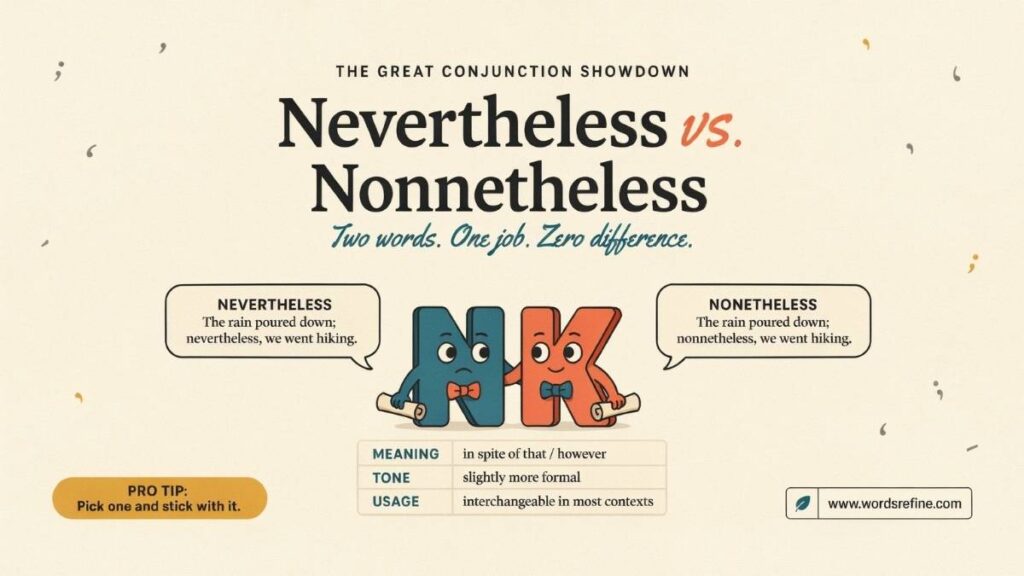
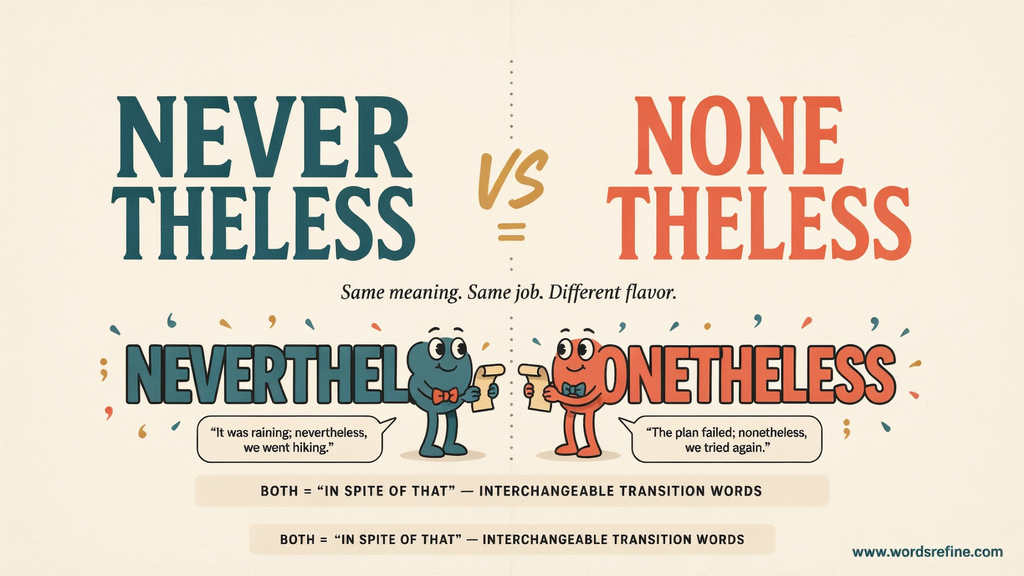
English loves to turn tiny word choices into surprisingly big grammar questions. Nevertheless vs nonetheless is a perfect example. These two words often make writers stop, reread a sentence, and wonder whether they’ve chosen the right one. Fortunately, the answer is simpler than it looks. Nevertheless vs nonetheless have virtually the same meaning and can usually be used interchangeably. Both express contrast and can mean “despite that,” “even so,” or “in spite of that.” The real confusion comes from knowing where to place them, how to punctuate them, and which sounds more natural in context. Once you understand their role, this grammar puzzle becomes far less puzzling.
Nevertheless vs Nonetheless
Both nevertheless vs nonetheless are correct standard English words. Neither is a misspelling of the other, and neither is considered grammatically wrong simply because the other word appears in the same sentence.
Both words function primarily as adverbs. They can also work as conjunctive adverbs when they connect contrasting ideas.
For example:
The apartment was small. Nevertheless, it was comfortable.
The first sentence gives you a reason to expect a drawback. The second sentence presents an idea that goes against that expectation.
The same thing happens here:
The apartment was small. Nonetheless, it was comfortable.
The meaning barely changes.
In other words, when you’re asking whether nevertheless or nonetheless is correct, you don’t need to pick a winner. Both belong in standard English.
The more useful question is which one sounds smoother in the sentence you’re writing.
What Does Nevertheless Mean?
Nevertheless means “despite that,” “even so,” or “in spite of what was just mentioned.”
The word introduces an idea that remains true even though the previous information might suggest otherwise.
Consider this example:
The exam was extremely difficult. Nevertheless, Maria remained confident.
The difficult exam creates an obstacle. However, Maria’s confidence remains unchanged.
Another example makes the same point:
The restaurant was expensive. Nevertheless, we decided to eat there.
The high price could have stopped the decision. It didn’t.
That’s the central idea behind nevertheless. Something happens or remains true despite another fact.
Learn the difference between commonly mixed-up more words
Nevertheless Definition in Simple English
A simple definition is:
Nevertheless means that something is true, happens, or continues despite a previous fact or difficulty.
You can often understand nevertheless through expressions such as “even so,” “despite this,” “in spite of that,” and “all the same.”
For example:
The journey was exhausting. Nevertheless, it was worth it.
The journey was exhausting, but that fact didn’t make it worthless.
Likewise:
He had very little experience. Nevertheless, he handled the situation well.
His lack of experience might have caused problems. Despite that, he performed successfully.
How Nevertheless Works in a Sentence
Nevertheless can appear in several places within a sentence. Its position can affect the rhythm and emphasis, but the basic meaning remains the same.
At the beginning, it often creates a clear transition:
The plan was risky. Nevertheless, the company approved it.
In the middle, it can interrupt the sentence:
The plan, nevertheless, had several advantages.
At the end, it can add a slightly more emphatic or literary touch:
The company approved the plan nevertheless.
The beginning position is especially common when nevertheless connects two separate thoughts.
What Does Nonetheless Mean?
Nonetheless has almost the same meaning as nevertheless. It can mean “despite that,” “even so,” or “in spite of this.”
For example:
The road was dangerous. Nonetheless, the rescue team continued.
The dangerous conditions created a serious obstacle. The rescue team continued anyway.
Now compare that sentence with:
The road was dangerous. Nevertheless, the rescue team continued.
There is no important difference in the message.
Nonetheless Definition in Simple English
A straightforward definition is:
Nonetheless means that something remains true or happens despite a previous fact, condition, or difficulty.
For instance:
The instructions were confusing. Nonetheless, everyone completed the task.
The instructions created a problem. Despite that problem, the task was completed.
Similarly:
The movie received poor reviews. Nonetheless, audiences enjoyed it.
The poor reviews didn’t prevent audiences from enjoying the movie.
Learn the difference between confusing more English words
Expiry vs Expiration Which One Is Correct?
How Nonetheless Works in a Sentence
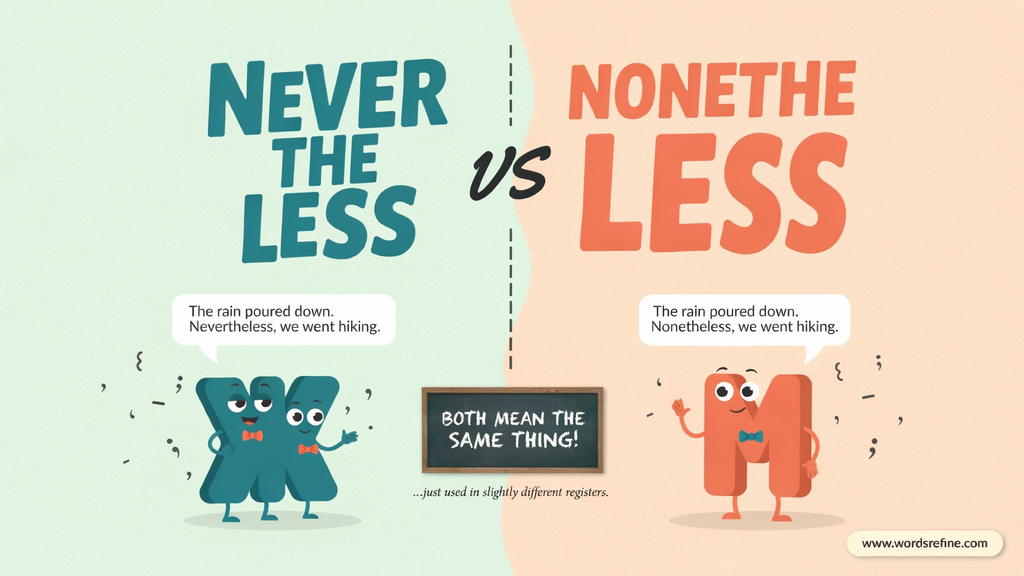
Nonetheless can appear at the beginning, middle, or end of a sentence just like nevertheless.
At the beginning:
The weather was unpleasant. Nonetheless, the event continued.
In the middle:
The event, nonetheless, attracted a large crowd.
At the end:
The event continued nonetheless.
Again, placement can affect the style and rhythm of a sentence, but it doesn’t create a major difference in meaning.
Difference Between Nevertheless vs Nonetheless
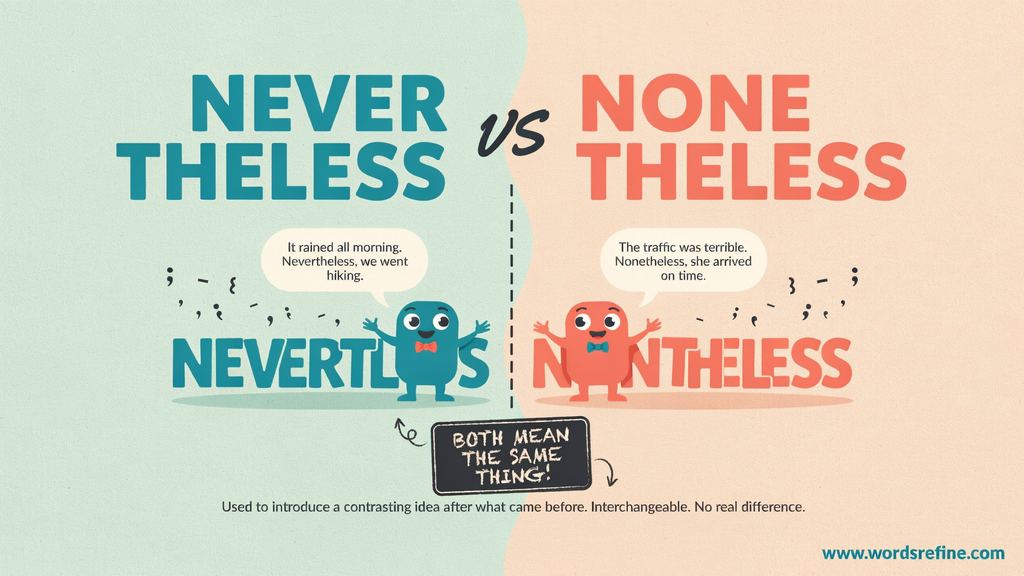
The difference between nevertheless vs nonetheless is mainly stylistic rather than semantic.
Both words express contrast. and Both can show that one fact doesn’t prevent another fact from being true. Both work in formal writing and everyday English.
For example:
The house needed extensive repairs. Nevertheless, we bought it.
And:
The house needed extensive repairs. Nonetheless, we bought it.
The reader receives essentially the same message.
This is why questions such as “are nevertheless and nonetheless the same?” often have a simple answer. They aren’t identical words in spelling or sound, but they are very close in meaning and grammatical function.
Likewise, is nevertheless the same as nonetheless? For most ordinary uses, yes. You can generally substitute one for the other without changing the central idea.
Are Nevertheless vs Nonetheless Interchangeable?
In most contexts, yes.
You can usually use nevertheless instead of nonetheless and nonetheless instead of nevertheless.
For example:
The project was expensive. Nevertheless, the company approved it.
You could also write:
The project was expensive. Nonetheless, the company approved it.
Both sentences are grammatically sound.
However, interchangeable doesn’t mean that every sentence will sound equally natural after a direct substitution. Language is more flexible than a mathematical equation. Rhythm, tone, and personal writing style can influence word choice.
One writer may prefer nevertheless throughout an essay. Another may naturally reach for nonetheless.
Neither choice automatically makes the writing better.
Nevertheless vs Nonetheless Grammar
Understanding the grammar becomes much easier once you recognize what these words actually do.
Nevertheless and nonetheless are adverbs. More specifically, they can function as conjunctive adverbs when they connect ideas and show a logical relationship between them.
They aren’t coordinating conjunctions such as and, but, or, yet, and so.
That distinction becomes particularly important when two independent clauses appear together.
Consider this sentence:
The project was difficult; nevertheless, the team finished it on time.
The first clause can stand on its own:
The project was difficult.
The second clause can also stand on its own:
The team finished it on time.
Because both are independent clauses, the semicolon provides the appropriate connection. Nevertheless then signals the contrast.
The same structure works with nonetheless:
The project was difficult; nonetheless, the team finished it on time.
Learn the difference between tricky grammar more words
Dork vs Nerd Meaning Differences Examples?
Why a Comma Alone Can Cause Trouble
A common mistake occurs when writers place only a comma between two independent clauses.
For example:
The project was difficult, nevertheless, the team finished it on time.
This creates a comma splice.
A clearer version is:
The project was difficult. Nevertheless, the team finished it on time.
You can also write:
The project was difficult; nevertheless, the team finished it on time.
Both versions work well.
The important point is that nevertheless and nonetheless don’t magically turn a comma into a proper connection between two independent clauses.
How to Use Nevertheless
Learning how to use nevertheless becomes easier when you focus on its purpose rather than memorizing rules.
Use it when the second idea remains true despite the first idea.
For example:
The instructions looked complicated. Nevertheless, they were easy to follow.
The first sentence creates an expectation. The second sentence challenges it.
Similarly:
The team had very little time. Nevertheless, they completed the project.
The lack of time created a difficulty, but the team succeeded anyway.
Nevertheless in a Sentence
Nevertheless can introduce an unexpected result:
The restaurant was nearly empty. Nevertheless, the service was excellent.
1It can also show persistence:
The hikers were exhausted. Nevertheless, they continued toward the summit.
2It can acknowledge a weakness while maintaining an argument:
The study had a limited sample size. Nevertheless, its findings were useful.
3It can even appear in ordinary conversation:
I don’t usually enjoy horror movies. Nevertheless, that one was surprisingly good.
The word doesn’t belong exclusively to academic or formal writing.
How to Use Nonetheless
The same basic rule applies to how to use nonetheless.
Use it when you want to show that something remains true despite an earlier fact or difficulty.
For example:
The journey was long. Nonetheless, everyone enjoyed it.
The length of the journey could have made the trip unpleasant. It didn’t.
Another example:
The proposal had several weaknesses. Nonetheless, the board approved it.
The weaknesses mattered, but they didn’t prevent approval.
Nonetheless in a Sentence
Nonetheless works particularly well when you want to emphasize an unexpected outcome.
The weather forecast looked terrible. Nonetheless, the outdoor concert went ahead.
It can also show persistence:
She was nervous about speaking in public. Nonetheless, she gave an excellent presentation.
In academic writing, it can help acknowledge limitations:
The evidence was incomplete. Nonetheless, the results provided useful information.
Once again, nevertheless could replace nonetheless in each example.
Nevertheless vs Nonetheless Sentence Examples
Seeing both words in similar situations makes their relationship easier to understand.
Consider a difficult task:
The assignment was challenging. Nevertheless, the students completed it.
Now change the transition:
The assignment was challenging. Nonetheless, the students completed it.
Both sentences show that the students succeeded despite the difficulty.
Consider another example:
The hotel was far from the city center. Nevertheless, we enjoyed our stay.
Or:
The hotel was far from the city center. Nonetheless, we enjoyed our stay.
The message remains unchanged.
Nevertheless Examples in Different Contexts
1In everyday English:
It was raining heavily. Nevertheless, we went for a walk.
2In business writing:
The first proposal exceeded the budget. Nevertheless, the company approved the revised version.
3In academic writing:
The sample was relatively small. Nevertheless, the findings revealed a clear pattern.
4In professional communication:
The first attempt failed. Nevertheless, the team learned valuable lessons from the process.
5In storytelling:
He knew the journey would be difficult. Nevertheless, he packed his bag and left before sunrise.
Each sentence uses nevertheless to connect a difficulty or expectation with what happened afterward.
Nonetheless Examples in Different Contexts
1In everyday English:
I was tired. Nonetheless, I stayed until the end of the movie.
2In business writing:
The supplier experienced delays. Nonetheless, the order arrived before the deadline.
3In academic writing:
Previous studies produced mixed results. Nonetheless, the current research identified a consistent trend.
4In professional communication:
The software had several limitations. Nonetheless, it remained useful for the project.
5In storytelling:
She had never traveled alone. Nonetheless, she boarded the train with a smile.
The pattern stays consistent. The second idea survives the first.
Learn the difference between confusing word pairs
favour vs Favor Meaning Differences Spelling and Examples ?
Nevertheless vs Nonetheless in Formal Writing
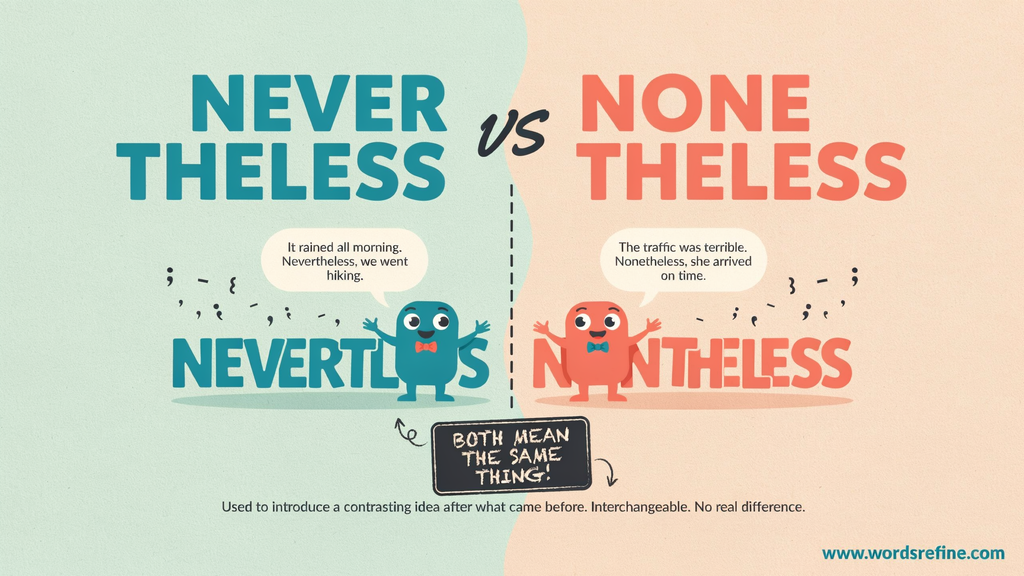
Both words are perfectly acceptable in formal writing.
They can appear in reports, essays, research papers, business documents, articles, and professional correspondence.
For example:
The initial results were inconclusive. Nevertheless, further testing produced promising evidence.
Or:
The initial results were inconclusive. Nonetheless, further testing produced promising evidence.
Neither version is grammatically inferior.
Some writers may feel that nevertheless sounds slightly more traditional. Others may prefer nonetheless because it feels a little more compact. These are matters of style and perception rather than strict grammar.
Therefore, there’s no reliable rule that says one word belongs to formal writing while the other belongs to informal writing.
Nevertheless vs Nonetheless in Academic Writing
Academic writing often involves balancing two truths.
A researcher might acknowledge a limitation while explaining why the overall findings still matter.
For example:
The study included a relatively small sample. Nevertheless, the results showed a consistent pattern.
Here, the writer doesn’t ignore the limitation. Instead, the transition shows that the limitation doesn’t completely undermine the conclusion.
Nonetheless works in exactly the same way:
The study included a relatively small sample. Nonetheless, the results showed a consistent pattern.
These words are particularly useful when discussing limitations, opposing ideas, unexpected results, or conclusions that survive an objection.
However, academic writing doesn’t require a fancy transition in every paragraph. Sometimes a simple “but” or “however” makes the relationship clearer.
Good writing isn’t about collecting impressive words. It’s about choosing the word that helps the reader follow the thought.
Nevertheless vs Nonetheless in Professional Writing
Professional communication often needs to acknowledge a problem without losing sight of the result.
For example:
The first phase took longer than expected. Nevertheless, the team completed the project on schedule.
This sentence quickly communicates both the problem and the outcome.
Similarly:
The supplier raised its prices. Nonetheless, the company continued working with the supplier because of its reliability.
The transition makes the logic easy to follow.
In business writing, clarity matters more than sounding sophisticated. If nevertheless or nonetheless makes the relationship between ideas clearer, use it. If “however” or “still” sounds more natural, choose that instead.
Nevertheless vs Nonetheless vs However
However is another word that often enters the conversation because it also introduces contrast.
Compare these sentences:
The plan was expensive. However, the board approved it.
The plan was expensive. Nevertheless, the board approved it.
The plan was expensive. Nonetheless, the board approved it.
All three are correct.
However often provides a straightforward contrast. Nevertheless and nonetheless can place slightly more emphasis on the fact that the second idea remains true despite the first.
For example:
The weather was terrible. However, the event continued.
This simply contrasts the weather with the event.
Now:
The weather was terrible. Nevertheless, the event continued.
The wording more strongly suggests that the event continued despite the bad weather.
The distinction is subtle rather than absolute. In many sentences, however, nevertheless, and nonetheless can overlap.
Learn the difference between commonly misused words
Sited vs Cited Meaning Differences Examples and Correct Usage
Nevertheless vs Nonetheless vs Notwithstanding
Notwithstanding is related to nevertheless and nonetheless because it can also express the idea of “despite” or “in spite of.”
However, its grammatical behavior differs.
Consider:
Notwithstanding the delay, the meeting continued.
Here, notwithstanding introduces the noun phrase “the delay.”
You could instead say:
The meeting was delayed. Nevertheless, it continued.
Or:
The meeting was delayed. Nonetheless, it continued.
These sentences communicate a similar idea, but the sentence structures differ.
That distinction matters.
You can’t simply replace notwithstanding with nevertheless in every construction.
For example:
Notwithstanding the difficult conditions, the expedition continued.
This works naturally.
But:
Nevertheless the difficult conditions, the expedition continued.
This does not work in standard English.
So, although these words share some meaning, they don’t have identical grammatical functions.
British English and American English
Neither nevertheless nor nonetheless belongs exclusively to British English or American English.
Both words are used in both varieties of English.
American writers use nevertheless in formal, professional, academic, and literary contexts. British writers do the same. Nonetheless also appears across both varieties.
There can be differences in frequency depending on the publication, writer, period, or style. However, those differences don’t create a firm American-versus-British grammar rule.
If you’re writing in US English, you can confidently use either word.
Common Mistakes With Nevertheless vs Nonetheless
Most mistakes involving these words don’t come from choosing the wrong one. Instead, they come from using them where they aren’t needed or punctuating them incorrectly.
Treating the Words as Opposites
Nevertheless and nonetheless aren’t opposites.
They don’t express two different types of contrast. In most situations, they communicate essentially the same relationship between ideas.
Using Both at Once
Avoid combining them unnecessarily.
For example:
The plan was risky; nevertheless nonetheless, we approved it.
Both words perform the same job. Using them together creates repetition rather than emphasis.
Choose one.
Adding a Transition Without a Contrast
A transition should earn its place.
Consider:
The store opened at nine. Nevertheless, customers entered at nine.
The relationship between the two statements doesn’t contain a meaningful contrast.
A better example would be:
The store opened late. Nevertheless, customers waited outside.
Now there is a clear contrast between the delay and the customers’ decision to wait.
Using Too Many Transition Words
Even correct transitions can become distracting when they appear in every other sentence.
If a paragraph contains however, nevertheless, nonetheless, still, yet, and despite this within a few lines, the writing can start to feel mechanical.
Use transitions when they clarify the relationship between ideas. Don’t add them simply because a paragraph seems to need a “smart” word.
Learn the difference between everyday English mistakes
T- Shirt vs Tee Shirt Which One Is Correct and Why?
How to Choose Between Nevertheless vs Nonetheless
When both words work, you don’t need a complicated decision-making process.
First, identify the contrast.
Ask yourself whether the second idea remains true despite the first.
If it does, nevertheless or nonetheless may fit.
Next, read the sentence aloud.
Sometimes one word simply sounds better.
For example:
The evidence was limited. Nevertheless, the conclusion remained convincing.
This may sound more natural to one writer than:
The evidence was limited. Nonetheless, the conclusion remained convincing.
Another writer may prefer the second version.
Neither choice changes the fundamental meaning.
Finally, consider the surrounding paragraph. If you’ve already used nevertheless several times, nonetheless can provide some stylistic variety. Just make sure the change feels natural rather than forced.
A Simple Way to Remember the Difference
If these two words still seem confusing, remember one simple idea:
Both words tell the reader, “That may be true, but this is true too.”
The weather may be terrible. Nevertheless, the match continues.
The instructions may be confusing. Nonetheless, the students finish the assignment.
The product may be expensive. Nevertheless, customers continue buying it.
The journey may be exhausting. Nonetheless, it may be worth taking.
That is the heart of their meaning.
Learn the difference between more words people mix up
Envisage vs Envision Meaning Differences Examples ?
Practice Session Nevertheless vs Nonetheless
- The road was flooded; __________, the rescue team continued its work.
- She was nervous about the presentation. __________, she spoke confidently.
- The restaurant was crowded; __________, we managed to find a table.
- He had very little time. __________, he completed the assignment before the deadline.
- The instructions seemed complicated. __________, I managed to assemble the equipment.
- The weather forecast predicted rain; __________, they decided to hold the event outdoors.
- The book received mixed reviews. __________, it became a bestseller.
- The journey was long and tiring; __________, everyone enjoyed the experience.
- She knew the position would be demanding. __________, she accepted the job.
- The project faced several delays; __________, the team finished it successfully.
- The apartment was small. We liked the location, __________.
- He didn’t have much experience; __________, he performed remarkably well.
- The test was challenging. __________, most students completed it on time.
- The evidence was limited; __________, the researchers continued their investigation.
- They knew the plan carried some risks. __________, they decided to move forward.
- The laptop was expensive. It was worth the investment, __________.
- The team lost its best player; __________, it managed to win the match.
- The first attempt failed. __________, she refused to give up.
- The instructions were unclear; __________, we found a way to complete the task.
- He was exhausted after working all day. __________, he helped his colleague finish the report.
- The weather was unfavorable. The hikers continued their journey, __________.
- The proposal had several weaknesses; __________, the committee approved it.
- She didn’t agree with the decision. __________, she respected the committee’s choice.
- The course was difficult. __________, he learned a great deal from it.
- The deadline was extremely tight; __________, the team delivered the project on time.
Answers
- Nevertheless
- Nonetheless
- Nevertheless
- Nonetheless
- Nevertheless
- Nonetheless
- Nevertheless
- Nonetheless
- Nevertheless
- Nonetheless
- nonetheless
- Nevertheless
- Nonetheless
- Nevertheless
- Nonetheless
- nonetheless
- Nevertheless
- Nonetheless
- Nevertheless
- Nonetheless
- nonetheless
- Nevertheless
- Nonetheless
- Nevertheless
- Nonetheless
Here’s a trusted source for clear more words Comparison:
FAQs
What is another way of saying “nonetheless”?
Another way of saying “nonetheless” is “nevertheless,” “even so,” “despite that,” “in spite of that,” or “still.” The best choice depends on the sentence and the level of formality.
What does “nonetheless” mean?
“Nonetheless” means “despite that,” “even so,” or “in spite of what was just mentioned.” It introduces a contrasting idea or an outcome that continues despite a difficulty or opposing fact.
Is it grammatically correct to say “but nevertheless”?
Yes, “but nevertheless” can be grammatically correct when the sentence needs both a contrast and the meaning of “despite that.” However, the combination can sometimes sound repetitive because both words signal contrast. In many sentences, using “but” or “nevertheless” alone is cleaner.
Can I use nevertheless instead of however?
Usually, yes. “Nevertheless” and “however” can both introduce a contrast, but they aren’t identical in every context. “Nevertheless” often emphasizes that something remains true despite an opposing fact, while “however” more generally signals a contrast between ideas.
What does “nevertheless” really mean?
“Nevertheless” means that something is true or happens despite what was previously stated. For example, “The task was difficult; nevertheless, she finished it” means the difficulty did not prevent her from finishing.
Can I end a sentence with “nonetheless”?
Yes. “Nonetheless” can appear at the end of a sentence when it emphasizes that something remains true despite a previous point. For example, “The journey was exhausting. We enjoyed it nonetheless.”
What is another word for “nevertheless”?
Common alternatives include “nonetheless,” “even so,” “still,” “despite that,” “in spite of that,” and “all the same.” The most suitable synonym depends on the sentence and its tone.
What are 5 examples of sentences with nevertheless and nonetheless?
Here are five examples:
The weather was terrible; nevertheless, we continued the trip.
He had little experience. Nonetheless, he handled the project well.
The apartment was expensive; nevertheless, they decided to rent it.
She knew the exam would be difficult. Nonetheless, she felt prepared.
The plan had several weaknesses. We supported it nonetheless.
When should we use “nonetheless”?
Use “nonetheless” when you want to show that an action, fact, or result remains true despite a previous difficulty, objection, or contrasting point. It works especially well when the second idea is somewhat unexpected.
Where do you use “nevertheless”?
You can use “nevertheless” at the beginning, middle, or end of a sentence, depending on the structure. It commonly appears as a transition between contrasting ideas, such as “The evidence was limited; nevertheless, the researchers continued.”
Why is “nonetheless” one word?
“Nonetheless” developed as a single compound word from the expression “none the less.” Modern English generally treats “nonetheless” as one word with the meaning “despite that” or “even so.”
Are nonetheless and nevertheless interchangeable?
Yes, in most situations. “Nonetheless” and “nevertheless” have essentially the same meaning and grammatical function. Your choice usually depends on personal preference, rhythm, and context rather than a difference in meaning.
What is a better word for “nonetheless”?
There isn’t one universally better replacement. “Nevertheless” is the closest equivalent, while “even so,” “still,” or “despite that” may sound more natural in certain sentences. Choose the option that fits the surrounding context.
What is a more formal word for “nevertheless”?
“Nevertheless” is already a relatively formal transition. “Nonetheless” has a similar level of formality. In some contexts, “notwithstanding” can express a related idea, but it doesn’t always work as a direct replacement because its grammatical structure differs.
Learn the difference between tricky grammar more words
Remediated vs Remedied Which One Is Correct ?
Conclusion
Nevertheless vs nonetheless may look like two words waiting for a grammar showdown, but there’s no real winner to declare. In most situations, they mean the same thing: despite that, even so, or in spite of what was just mentioned. Both can introduce a contrast when one fact doesn’t stop another fact or action from being true.
The biggest confusion comes from assuming that these words have different meanings. They don’t. The real difference usually comes down to style, rhythm, and personal preference. Nevertheless can sound slightly more traditional, while nonetheless often feels equally polished and natural in modern writing.
You should also watch the punctuation. When nevertheless or nonetheless connects two independent clauses, a comma alone can create a comma splice. A semicolon or a period will usually keep the sentence on solid grammatical ground.
So, when you’re stuck between nevertheless or nonetheless, don’t let the two words turn a simple sentence into a grammar mystery. Pick the one that sounds natural, check the punctuation, and keep your contrast clear. Once you understand their shared meaning, choosing between them becomes much easier. After all, English already has enough confusing words. These two don’t need to join the troublemakers’ club.

Diora AJS she is an experienced blogger and passionate English language enthusiast at Words Refine. With a keen eye for language and a love for clear communication, she writes practical content about grammar, word meanings, usage, and commonly confused terms. Her goal is to make English easier to understand through clear explanations and relatable examples, helping readers write accurately and communicate with confidence.