A single extra letter can create an oddly persistent spelling question. That’s exactly what happens with mama vs mamma. Both words can refer to a mother, and both are used as affectionate terms, yet their spelling and usage can vary across languages, regions, and writing styles. So, when you are unsure whether to write mama vs mamma which one should you choose? Fortunately, you don’t need to turn the question into a family debate. Understanding the meaning, pronunciation, and context of each form makes the choice much easier. In this guide, we’ll clear up the confusion and show you when each spelling works best in everyday writing.
Mama vs Mamma Quick Answer
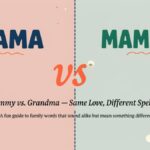
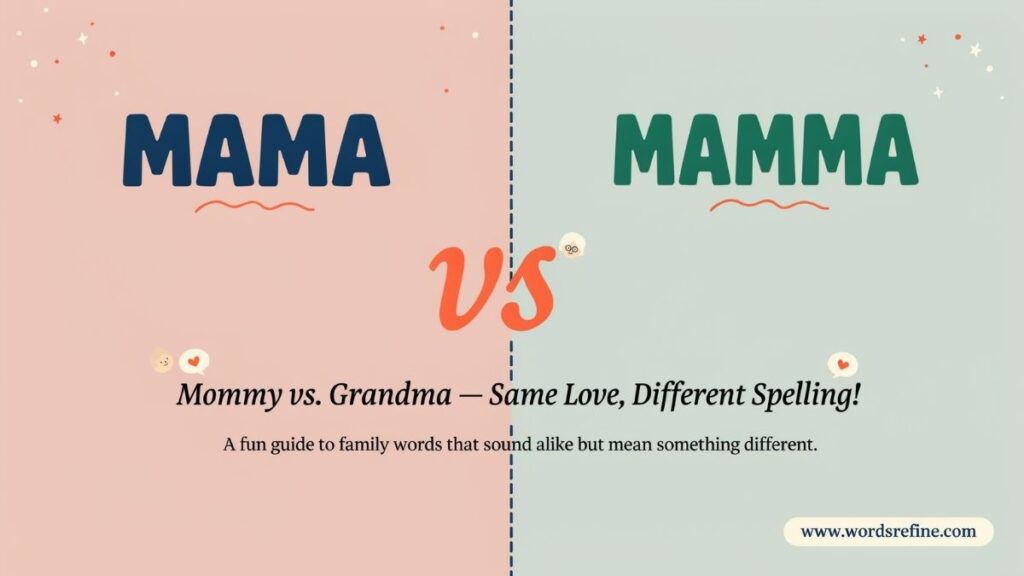
The basic difference between mama vs mamma is not their core meaning. Both words can refer to a mother or serve as a familiar way of addressing her.
Mama is common in informal English, particularly American English. It can sound warm, natural, and conversational. A child might call out, “Mama!” A grown person might also use the word when talking about their mother in a personal or affectionate way.
Mamma carries much the same basic meaning, but its spelling can create a different impression. In English, it may sound somewhat traditional or old-fashioned. It can also appear in literary writing or in contexts influenced by other languages and cultures.
Consider these two sentences:
“Her mama lives across the street.”
“Her mamma lives across the street.”
Both sentences can be grammatically correct. The first feels more familiar in modern American English. The second has a slightly more traditional flavor.
That difference is subtle, but it can matter when you’re choosing words for a particular audience or style.
Mama Meaning and Definition
The mama meaning is simply “mother,” especially when the word is used informally or affectionately.
Mama is a familiar term rather than a formal one. It often appears in conversations between family members, in children’s language, and in situations where the speaker wants to express closeness.
For example:
“Mama made my favorite dinner.”
Here, mama refers to the speaker’s mother.
The word can also be used when speaking directly to a mother:
“Mama, can you help me?”
In this sentence, mama functions as a form of address.
The mama definition therefore centers on the idea of a mother while also carrying a sense of familiarity. It doesn’t have the neutral, formal quality of mother. Instead, it sounds personal and close.
Learn the difference between confusing more English words
Ambassador vs Embassador Which Spelling Is Correct?
Mama as an Informal Word for Mother
English has several familiar terms for mother. Mom, mommy, momma, mama, mum, and mummy all appear in different varieties of English or different social and family settings.
Mama is especially interesting because it crosses linguistic and cultural boundaries. You can find similar forms in many languages, although their meanings, pronunciations, and histories aren’t necessarily identical.
In American English, mama can sound perfectly natural in everyday conversation.
“My mama always kept a garden.”
“She called her mama before leaving town.”
“The little boy ran toward his mama.”
The word doesn’t make these sentences childish. Instead, it gives them a familiar and personal tone.
Mama as a Form of Address
When you speak directly to your mother, mama can function almost like a name.
For example:
“Mama, where are my shoes?”
“Thank you, Mama.”
In such cases, capitalization depends on how the word functions in the sentence and on the style being followed. When the word acts like a name or direct form of address, writers often capitalize it.
However, when the word simply refers to a mother, lowercase is generally appropriate.
“She asked her mama for advice.”
This distinction is similar to the difference between using a family title as a name and using it as an ordinary noun.
Mamma Meaning and Definition
The mamma meaning is also “mother.” Like mama, mamma can serve as an affectionate or familiar term for a mother.
The mamma definition overlaps closely with the definition of mama. The main difference lies in usage, spelling, and the impression the word creates.
For example:
“Mamma waited by the window.”
There is nothing grammatically wrong with the sentence. However, many American readers may find mamma less common than mama or mom.
That doesn’t make mamma an incorrect spelling. It simply means that readers encounter it less often in some varieties of modern English.
Mamma in English
Is mamma an English word? Yes.
Mamma has a history of use in English as a familiar word for mother. It can appear in older writing, literature, family language, and particular cultural settings.
Because mama is now more familiar to many American readers, some people assume mamma must be a mistake. It isn’t.
A spelling can be less common without being wrong. English contains plenty of such examples.
Mamma in Italian
Mamma has an especially important role in Italian.
In Italian, mamma is the ordinary word for mother. Therefore, if you’re discussing the Italian language, mamma isn’t an unusual alternative. It’s the standard form.
This explains why the word can sometimes feel distinctly European or Italian to English speakers.
The Italian spelling also appears in familiar expressions and cultural references. However, it should not be confused with the English usage of mamma. The same written word can belong to more than one language, and its pronunciation or grammatical behavior may differ accordingly.
Learn the difference between commonly mixed-up more words
Simular vs Similar Which One Is Correct?
Mama vs Mamma Spelling Which One Is Correct?
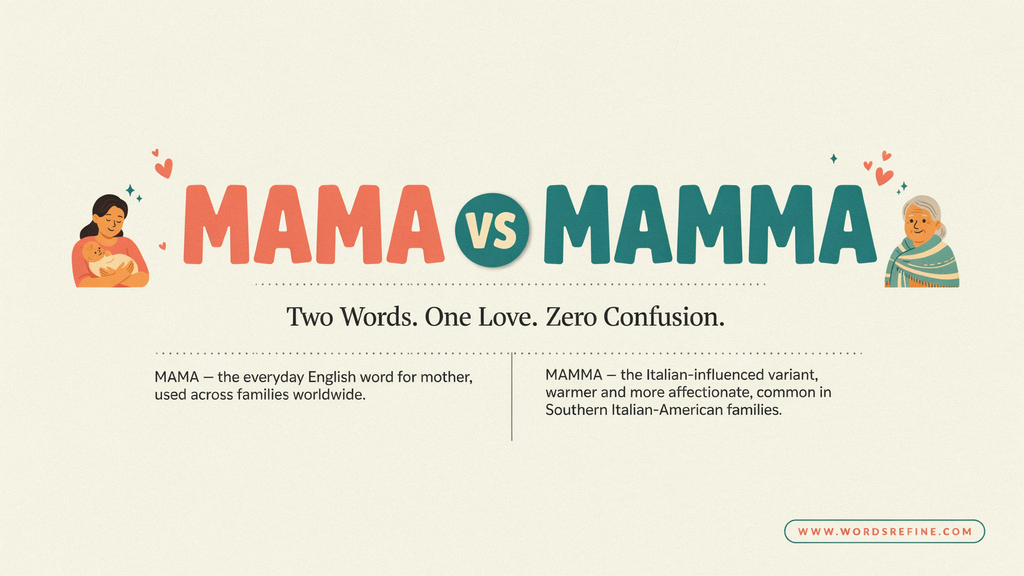
The mama vs mamma spelling question has a straightforward answer: both spellings can be correct.
Mama is a standard spelling for an informal word meaning mother.
Mamma is also a legitimate spelling with established usage.
Therefore, if someone asks, “Is mama or mamma correct?” the answer shouldn’t simply be “mama.” That would leave out an important part of the story.
Instead, think about context.
If you’re writing contemporary American English and want a familiar informal term for mother, mama will usually feel more natural.
If you’re writing in a traditional or literary voice, following a family’s established spelling, or using the Italian word for mother, mamma may be the better choice.
The correct spelling of mama is mama.
The correct spelling of mamma is mamma.
Neither one is a typo when used intentionally and appropriately.
Mama vs Mamma Pronunciation
The mama pronunciation and mamma pronunciation can be very similar in English.
In many cases, speakers pronounce the two words almost identically. The additional “m” in mamma doesn’t necessarily add another syllable or create a completely different sound.
Accent and regional speech can affect the exact pronunciation. Family pronunciation can also play a role, especially with affectionate names.
This is a useful reminder that spelling and pronunciation don’t always move in perfect lockstep. English spelling is full of historical baggage. Sometimes a letter stays on the page even when it doesn’t dramatically change what you hear.
Are Mama and Mamma Pronounced the Same?
Often, yes.
An English speaker may pronounce mama and mamma in essentially the same way. Another speaker may give mamma a slightly different quality because of regional or cultural influence.
Italian mamma follows Italian pronunciation patterns, so its pronunciation should be considered separately from English.
Consequently, when comparing mama vs mamma pronunciation, it is important to identify the language and accent rather than assuming that every speaker says the words exactly alike.
Mama vs Mamma Origin and Etymology
The mama vs mamma origin connects with a broader pattern found across human languages.
Words for parents often contain simple sounds such as m, p, and b. These sounds are relatively easy for young children to produce. As a result, forms resembling mama, mamma, papa, and similar family words appear in many unrelated languages.
That doesn’t mean every language borrowed its word from another language. Similar sounds can develop independently because children tend to experiment with certain sounds early in speech development.
This is one reason parent-child language has produced such familiar forms around the world.
Mama Origin
The mama origin is associated with this broader pattern of child-directed and family language.
Over time, a simple childhood expression can become a conventional word. Families repeat it. Communities adopt it. Writers record it. Eventually, dictionaries recognize it as part of the language.
That process helps explain why mama feels both simple and deeply established.
Mamma Origin
The mamma origin follows a related path, although the spelling has also been shaped by historical language traditions.
Mamma appears in English and in several other languages. Its connection with Italian is especially strong because mamma remains the standard Italian word for mother.
The spelling therefore has a long history rather than being a modern invention or a careless variation of mama.
Learn the difference between tricky grammar more words
Inclusivity vs Inclusiveness Which One Is Correct?
Mama vs Mamma in American English
When it comes to mama in American English, the spelling is widely familiar.
You’ll often find mama in personal writing, dialogue, children’s stories, family conversations, and affectionate references to a mother.
For example:
“Mama, look at this!”
“My mama taught me how to cook.”
“She went home to see her mama.”
Mamma is still understandable to American readers, but it isn’t usually the first spelling that comes to mind in everyday contemporary writing.
Instead, it may suggest an older voice, a literary setting, a particular family tradition, or a cultural connection.
That distinction doesn’t come from a strict grammar rule. It comes from patterns of usage and the associations readers develop over time.
Mamma vs Mama in British English
British English brings another layer to the discussion.
Mum and mummy are especially familiar British terms for mother. Because of that, mama may not carry exactly the same everyday association in British English that it does in American English.
Still, English speakers don’t stay neatly inside national borders. Books, television, music, travel, families, and the internet constantly move vocabulary from one variety to another.
Therefore, neither mama nor mamma should be treated as a word that belongs exclusively to one country.
Regional English affects preference rather than creating an absolute grammar rule.
Mama vs Mamma vs Momma
Once mama and mamma are clear, momma enters the picture and makes the spelling shelf a little more crowded.
Momma is another informal word for mother. It is particularly associated with American English and can have a strongly conversational or regional quality.
Compare the following:
1.My mama always supported me.”
2.My momma always supported me.”
3.My mamma always supported me.”
All three can communicate the same basic idea. Yet they don’t necessarily sound identical from a stylistic perspective.
Mama tends to feel broadly familiar.
Momma often sounds more conversational or regionally marked.
Mamma may feel traditional, literary, or culturally influenced.
The best choice depends on the voice you want.
Mama vs Momma?
If you’re deciding between mama vs momma, consider the setting.
Mama is generally the more neutral of the two in contemporary informal American English.
Momma can work well when you’re representing a speaker’s natural speech or preserving a particular regional voice.
For example, dialogue may use momma because the writer wants the character to sound authentic rather than formally edited.
Mamma vs Momma?
The mamma vs momma comparison is slightly different.
Mamma often carries associations with traditional or European usage.
Momma clearly connects with the American word mom.
Both can mean mother, but they can create different impressions in a reader’s mind.
Learn the difference between confusing word pairs
Labelled vs Labeled Which one Is Correct?
Mama vs Mamma Difference in Everyday Usage
The mama and mamma difference becomes easier to understand when you stop looking only at spelling and start looking at context.
Imagine a modern American family. A child might say:
“Mama, can I have some juice?”
That sounds completely natural.
Now imagine a historical story:
“Mamma waited beside the fire while the children played.”
The writer may have chosen mamma deliberately to create a traditional atmosphere.
Neither choice is automatically better. Each one suits a different voice.
This is why the difference between mama and mamma is more about usage and style than grammar.
When Should You Use Mama?
When should you use mama? In most contemporary American informal contexts, it is a safe and natural choice.
Use mama when you want an affectionate or familiar word for mother in everyday language.
It works particularly well in dialogue:
“Mama, are you coming?”
It also works when talking about a mother:
“Her mama lived nearby.”
It can appear naturally in children’s language, family messages, personal stories, and informal writing.
If you aren’t trying to create a historical, literary, or culturally specific effect, mama will often be the more familiar choice for an American audience.
When Should You Use Mamma?
When should you use mamma? The answer depends on the context.
Mamma can be appropriate when a family specifically uses that spelling. It can also fit literary or traditional writing, historical settings, and certain cultural contexts.
Most importantly, use mamma when you are writing Italian and mean “mother.”
For example:
“Mamma is waiting at home.”
The spelling isn’t being used as an English stylistic choice in that case. It is simply the Italian word.
Likewise, if a story establishes that a character calls their mother Mamma, changing the spelling just because mama is more common could weaken the character’s established voice.
Mama vs Mamma for Grandma
People sometimes wonder whether mama or mamma can refer to a grandmother.
There is no universal English rule that makes either word mean grandmother.
Both mama and mamma primarily refer to a mother.
However, families often create their own names for grandparents. A grandmother might be called Mama, Mamma, Nana, Mimi, Grandma, Mamaw, or something completely unique.
That is family language rather than a general dictionary definition.
So, if a particular grandmother goes by Mamma, the family isn’t necessarily using the word incorrectly. They’re using a personal family name.
Learn the difference between often confused words
Flyer vs Flier Which one Is Correct?
Mama vs Mamma in Writing
The choice between mama or mamma in writing depends on the kind of writing you’re producing.
In casual writing, mama is often a natural choice:
“Mama made dinner tonight.”
In dialogue, either form can work:
“Mama, I need to tell you something.”
“Mamma, I need to tell you something.”
The second sentence can feel more traditional, depending on the surrounding context.
In formal academic writing, however, mother will usually be more appropriate when you simply mean the parent.
For example:
“The mother accompanied the child to the clinic.”
Using mama in that sentence would make the writing unnecessarily informal unless the writer is discussing the word itself or quoting someone.
Mama vs Mamma in Literature and Stories
Literature gives these words room to breathe.
A writer may choose mama, mamma, momma, mother, mum, or another family term to reveal something about a character.
The choice can suggest age, location, family background, historical period, or emotional closeness.
For example, a children’s story might use mama because the word sounds warm and familiar.
A historical novel might use mamma because the spelling fits the period or narrative voice.
A story featuring an Italian family might use Mamma because it reflects the family’s language and culture.
In each case, the spelling contributes to characterization.
That is why editors should be careful about changing family terms automatically. Sometimes what looks like a spelling variation is actually part of the writer’s intended voice.
Common Mistakes With Mama vs Mamma
One common mistake is thinking that mama and mamma have completely different meanings. In most cases, both words refer to a mother, so the real difference comes from spelling, region, and style.
Another mistake is assuming that mamma is the more proper or formal form. In everyday American English, mama is usually the more natural choice, while mamma may sound more traditional or regional.
Some writers also change the spelling without considering context. When a name, quotation, cultural expression, or personal preference uses mama or mamma, keep the original spelling.
The easiest way to avoid confusion is to consider your audience and the style of English you’re using. In casual American writing, mama is generally the safer choice.
Assuming Mamma Is Always Wrong
The most common mistake is treating mamma as a misspelling of mama.
It isn’t.
Mamma has established English usage and is also the standard Italian word for mother.
Assuming Mama Is the Only Correct Choice
The opposite mistake is equally misleading.
Mama is common and correct, but its popularity doesn’t make mamma incorrect.
English can have multiple accepted forms for similar words.
Confusing Mamma With Momma
Mamma and momma may look like tiny variations, but their associations differ.
Mamma can feel traditional or culturally influenced.
Momma is strongly associated with informal American speech.
Thinking Informal Means Incorrect
Informal words aren’t automatically bad English.
Mom, mama, mommy, mum, mummy, and momma all belong to different parts of everyday vocabulary.
The key is matching the word to the situation.
Assuming Every Spelling Has a Different Meaning
Mama and mamma generally overlap in meaning when they refer to a mother.
Their differences often involve style, regional preference, history, and cultural context rather than completely separate definitions.
Mama vs Mamma in Formal and Academic Writing
Formal writing usually favors mother because it is neutral and precise.
That doesn’t mean mama and mamma have no place in academic writing.
They can appear when a writer discusses language, analyzes literature, quotes dialogue, or examines cultural vocabulary.
For example, an academic paper about family terminology might naturally discuss the words mama and mamma.
Similarly, a literary analysis might explain why an author chose mamma instead of mother.
The important point is that the informal nature of a word doesn’t make it unusable. It simply means the writer needs a reason for choosing it.
Mama vs Mamma in Songs and Stories
Songs often use family words because they carry emotional force.
Mama can sound intimate and familiar. Mamma can create a traditional or cultural feeling. Momma can reproduce conversational American speech.
Writers may also choose one spelling because it fits the rhythm, character voice, or established title of a work.
The same principle applies to stories.
When a character says “Mama,” readers may hear a particular kind of family relationship. When another character says “Mamma,” the spelling may suggest something different.
The meaning remains connected to mother, but the emotional and cultural coloring can shift.
Is Mama vs Mamma Correct in American English?
For someone writing ordinary contemporary American English, mama is generally the more familiar choice.
However, mamma is also legitimate.
If you’re writing a casual sentence and simply want an informal term for mother, mama is usually the easiest option.
If you’re quoting someone, following a family tradition, creating a historical voice, or using an Italian term, mamma may be more appropriate.
So, the answer isn’t “one is right and one is wrong.”
The better answer is “choose the form that fits your context.”
Is Mamma an Older Spelling?
Mamma can have an older or traditional feel in English, especially to modern American readers.
However, describing it only as an older spelling would be misleading.
Mamma remains an active word in Italian, where it is the standard word for mother. It also continues to appear in English in particular contexts.
Therefore, less common does not mean obsolete.
English vocabulary often keeps older forms alive alongside newer or more popular alternatives.
Learn the difference between basic English word mistakes
Reoccurrence vs Recurrence Which One Is Correct ?
Is Mama the Correct Spelling for Mother?
Yes, mama is a correct informal word for mother.
It can refer to a mother or be used when directly addressing her.
For example:
“I called my mama after work.”
“Mama, can you hear me?”
The word is especially natural in informal American English.
Still, it isn’t the only informal term for mother. Mom, mommy, momma, mum, mummy, and other family terms are also used.
Is Mamma the Correct Spelling for Mother?
Yes, mamma can also be a correct spelling for mother.
It has established English usage and can appear in traditional, literary, regional, family, or cultural contexts.
It is also the standard Italian word for mother.
Therefore, anyone asking “is mamma the correct spelling for mother?” should receive a contextual answer rather than a simple yes-or-no verdict.
Which Spelling Is More Common Mama vs Mamma?
For contemporary American informal English, mama is generally more familiar than mamma.
That doesn’t mean every family, region, or writer follows the same pattern.
A person may have grown up calling their mother Mamma. Another may use Mama. Someone else may use Momma or Mom.
Family vocabulary can be surprisingly personal. Two families living on the same street can use completely different names for the same relationship.
That’s why frequency can help guide your choice, but it shouldn’t override context.
Quick Comparison of Mama vs Mamma
| Question | Mama | Mamma |
|---|---|---|
| Does it mean mother? | Yes | Yes |
| Is it a valid word? | Yes | Yes |
| Is it informal? | Yes | Usually |
| Is it common in American English? | Yes | Less common |
| Can it be affectionate? | Yes | Yes |
| Can it be used in direct address? | Yes | Yes |
| Can it appear in literature? | Yes | Yes |
| Can it represent family language? | Yes | Yes |
| Is it the Italian word for mother? | No | Yes |
| Does it have a traditional feel in English? | Sometimes | More often |
Learn the difference between commonly misused words
Rosin vs Resin Which One Is Correct and What’s the Difference?
Practice Session mama vs mamma
- The little boy ran to his ______ after school.
- “I missed you, ______,” she said as she hugged her mother.
- In Italian, ______ is the usual word for “mother.”
- The child began crying and called for his ______.
- The story uses the word “______” to create a warm, traditional family atmosphere.
- My ______ always encouraged me to follow my dreams.
- “Goodnight, ______,” the little girl whispered before going to sleep.
- In everyday American English, ______ is a familiar term for mother.
- The character’s use of “______” reflects the cultural setting of the story.
- She smiled when her ______ walked into the room.
- The baby reached toward her ______ as soon as she entered.
- “Thank you, ______, for helping me,” the boy said.
- The novel uses “______” instead of “mother” to make the dialogue sound more personal.
- Her ______ packed everything she needed for the trip.
- Although the spellings differ, both “mama” and “______” can refer to a mother.
- The child proudly introduced his ______ to his teacher.
- “Where are you, ______?” the toddler called from the bedroom.
- The Italian song uses the word ______ when referring to a mother.
- In a formal essay, “mother” is usually more appropriate than ______ or “mamma.”
- The character lovingly called her ______ before leaving home.
- The family chose “______” as an affectionate name for the grandmother.
- The writer used “______” to give the character’s speech a traditional feel.
- The little girl held her ______’s hand while crossing the street.
- “Mama” and “mamma” can have similar meanings, although their usage may vary by language and context.
- For casual American English, ______ is generally the more familiar choice.
Answers
- Mama
- Mama
- Mamma
- Mama
- Mamma
- Mama
- Mama
- Mama
- Mamma
- Mama
- Mama
- Mama
- Mamma
- Mama
- Mamma
- Mama
- Mama
- Mamma
- Mama
- Mama
- Mama
- Mamma
- Mama
- Mamma
- Mama
Here’s a trusted source for clear more words Comparison:
FAQs
What is the correct spelling of mama?
“Mama” is a correct spelling. It is a familiar and affectionate term for a mother and is especially common in informal American English.
Which is correct, mama or mamma?
Both “mama” and “mamma” are correct. “Mama” is generally more familiar in contemporary American English, while “mamma” can sound more traditional, literary, or culturally specific.
Is mama a flirty word?
Not usually. “Mama” normally refers to a mother or works as an affectionate form of address. However, like many informal terms, its meaning can depend on the speaker, relationship, and context.
What is a fancy name for a mother?
“Mother” is the standard formal term. Depending on the context, words such as “matriarch” or “maternal figure” can also describe a mother in a more distinctive or formal way.
What does “Mamma Mia” literally mean?
“Mamma mia” literally means “my mother” in Italian. In everyday Italian, however, the expression can also work as an exclamation of surprise, frustration, excitement, or disbelief.
What is the plural of mama?
The standard plural of “mama” is “mamas.” For example, you might write, “Several mamas gathered at the playground with their children.”
How do you pronounce mamma?
In English, “mamma” is generally pronounced with two syllables, with the emphasis on the first syllable. Its pronunciation can vary slightly depending on the speaker’s accent and the language being used.
What does “tutto pepe” mean?
“Tutto pepe” is an Italian expression that literally relates to “all pepper” or something being full of pepper. Depending on context, it can also describe someone or something lively, spirited, or full of energy.
What do Italians say instead of OK?
Italians commonly use “OK” in everyday conversation. They may also say “va bene,” which can mean “all right,” “okay,” or “that’s fine,” depending on the situation.
Why do Italians say allora?
“Allora” is a versatile Italian word. Depending on the context, it can mean “so,” “then,” “well,” or “in that case.” Italians also frequently use it to introduce a thought or move a conversation forward.
What do Cajuns call their mom?
Cajun families may use affectionate terms such as “Mama” or “Momma” for their mothers. However, there is no single term used by every Cajun family. Personal preference, family tradition, and regional background can all influence the choice.
Why won’t a toddler say mama?
Toddlers develop speech at different rates. Although “mama” is made from relatively simple sounds, a child may still take longer to say it. Language exposure, individual development, and the ability to form particular sounds can all influence early speech.
Why do Southern people say daddy?
“Daddy” is a familiar and affectionate word for a father in many English-speaking communities, including parts of the American South. Its use often reflects family tradition and regional speech rather than a strict Southern rule.
Is there LGBT representation in Mamma Mia?
Yes. Mamma Mia! has a strong LGBTQ+ following and has been discussed in connection with themes such as chosen family, friendship, love, and self-expression. However, the central storyline is not specifically an LGBTQ+ narrative.
What does “donna mia” mean in Italian?
“Donna mia” literally means “my woman” or, depending on context, “my lady.” “Donna” means “woman” or “lady,” while “mia” means “my.”
How do Italians feel about Mario?
There is no single Italian opinion about Mario or the way Italian culture appears in the franchise. Mario is a fictional character created in Japan, and reactions to his exaggerated Italian speech and cultural references naturally vary from person to person.
What does “I dinna fash” mean?
“I dinna fash” is a Scots expression that generally means “I don’t worry,” “I don’t bother,” or “don’t worry,” depending on the context. “Dinna” represents “don’t,” while “fash” can mean to worry, bother, or trouble.
How do Scots say “I love you”?
Scots has several regional varieties, so spelling and pronunciation can differ. A commonly written Scots form is “Ah loe ye,” meaning “I love you.”
What does “muckle coo” mean?
“Muckle coo” uses two Scots words. “Muckle” means “big” or “large,” while “coo” means “cow.” Together, the phrase means “big cow.”
What do hillbillies call their grandma?
There is no single name used by all people described as “hillbillies.” Depending on the family and region, grandmothers may be called Grandma, Granny, Nana, Mamaw, Mawmaw, or another family-specific name.
What do Irish people call grandma?
“Granny” and “Grandma” are common English terms in Ireland. In the Irish language, “mamó” is a familiar word for grandmother. Usage can vary between families and regions.
What is a cool name instead of grandma?
If “Grandma” feels too traditional, families often choose alternatives such as Nana, Mimi, Gigi, Grammy, or Gran. Some families even create a unique name based on a child’s pronunciation or a grandmother’s personal preference.
Learn the difference between commonly misused words
Waving vs Waiving Which One Is Correct ?
Conclusion
The mama vs mamma question may look like a minor spelling mystery, but that extra “m” can make writers stop and wonder. Fortunately, the answer is straightforward: both “mama” and “mamma” are correct.
In American English, “mama” is generally the more familiar choice in casual, everyday writing. “Mamma” is also perfectly valid, although it can give a sentence a more traditional, literary, or cultural feel. The right choice, therefore, depends on the context rather than a simple right-or-wrong rule.
If you’re writing a personal message, story, or piece of dialogue, either form may work naturally. However, when you need a neutral or formal term, “mother” is usually the better choice.
So, the next time you hesitate over mama or mamma, don’t let one extra letter turn into a full-blown grammar crisis. Check the context, choose the form that fits, and move on. After all, English has much bigger spelling battles to fight than one little “m.”

Diora AJS she is an experienced blogger and passionate English language enthusiast at Words Refine. With a keen eye for language and a love for clear communication, she writes practical content about grammar, word meanings, usage, and commonly confused terms. Her goal is to make English easier to understand through clear explanations and relatable examples, helping readers write accurately and communicate with confidence.