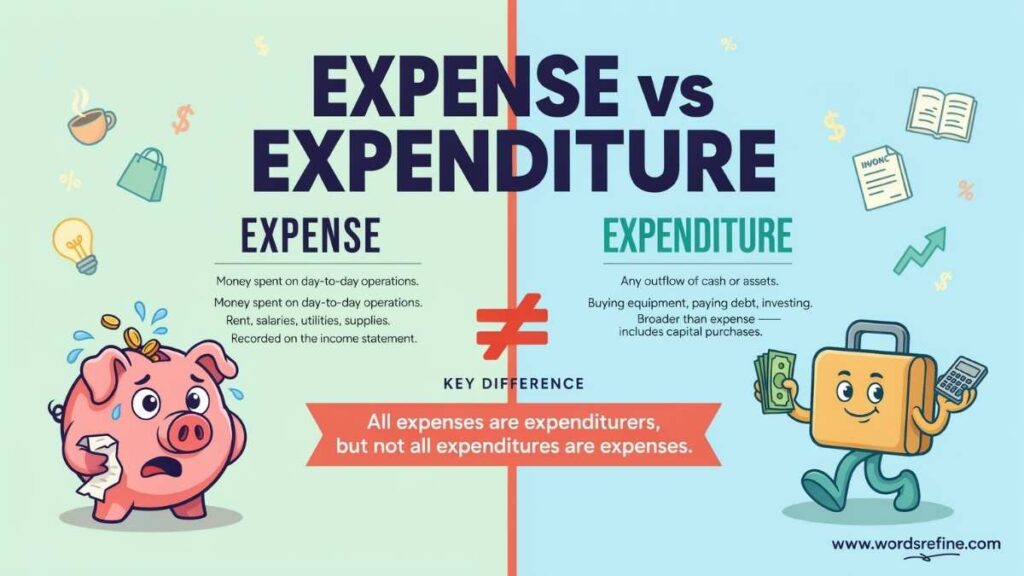
Expense vs expenditure might look like a simple case of two words doing the same job. However, accounting gives each term a different role. An expenditure refers to money spent on goods, services, or assets, while an expense represents a cost recognized during a specific accounting period. For instance, buying a company vehicle is an expenditure, but its depreciation becomes an expense over time. Mixing up these terms can create confusion when reading financial statements or managing business costs. Fortunately, you don’t need an accounting degree to understand the difference. With a few clear explanations and practical examples, you’ll know when to use each term correctly.
Expense vs Expenditure The Key Difference
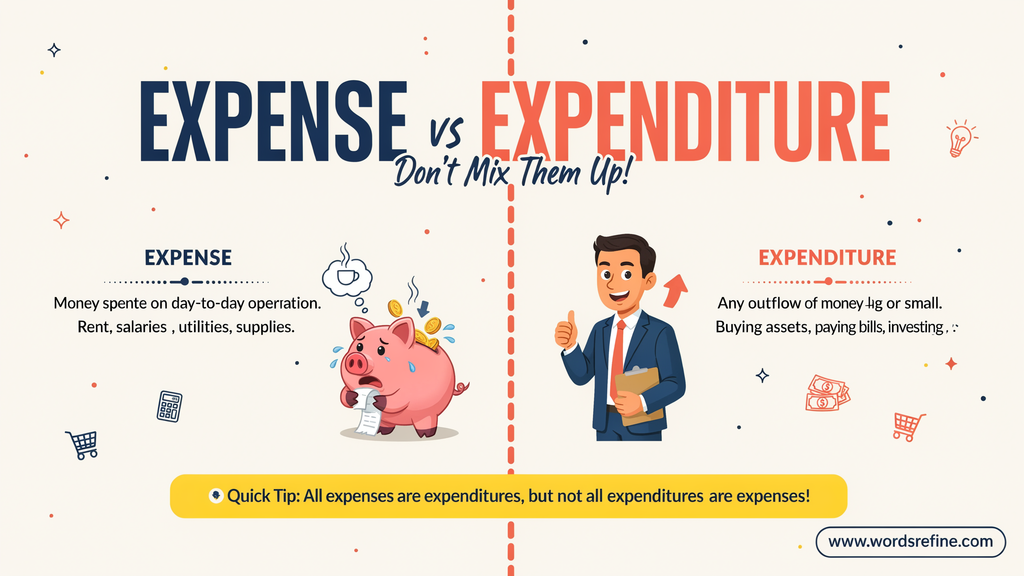
The main difference between expense vs expenditure lies in what each word emphasizes. An expense focuses on a cost incurred or recognized for a particular period, whereas expenditure emphasizes spending money or committing funds to a purchase or purpose.
Consider a small business that spends $12,000 on office rent and $60,000 on a delivery truck. Both transactions involve spending, but their accounting treatment differs.
The office rent generally becomes an expense for the period in which the business uses the space. The delivery truck, however, may qualify as a long-term asset. In that case, the business records the truck as an asset and recognizes its depreciable cost over its useful life.
The timing of the payment also matters. If the business pays immediately, its cash balance decreases. If it buys the truck on credit, it may record a liability instead.
| Feature | Expense | Expenditure |
|---|---|---|
| Basic meaning | A cost incurred or recognized for a period | Money spent or a financial outlay |
| Main focus | The cost associated with a period or activity | The amount spent or the purpose of spending |
| Accounting role | Generally affects profit when recognized | May result in an expense, an asset, or another accounting entry |
| Income statement | Recognized expenses appear when calculating profit | Not every expenditure appears immediately as an expense |
| Balance sheet connection | May relate to an asset, liability, or reduction in equity through profit | May result in an asset or settle a liability |
| Common examples | Rent, salaries, utilities | Equipment purchases, construction projects, government spending |
| Everyday usage | Common when discussing costs | Common when discussing budgets and financial outlays |
These differences describe typical usage rather than strict rules for every situation. In everyday English, the terms sometimes overlap. In accounting, however, the nature of the transaction determines the appropriate treatment.
What Does Expense Mean?
An expense is a cost incurred by an individual or organization. In accounting, it generally refers to a cost recognized against revenue or otherwise charged to an accounting period under the applicable rules.
For a business, expenses include the resources consumed while running operations. Rent, employee salaries, electricity, insurance, and advertising are common examples. These costs help a company operate and generate revenue, although not every expense directly produces a particular sale.
Learn the difference between confusing more English words
Temporary vs Temporarily Meaning Difference and Correct Usage?
Expense Meaning in Everyday English
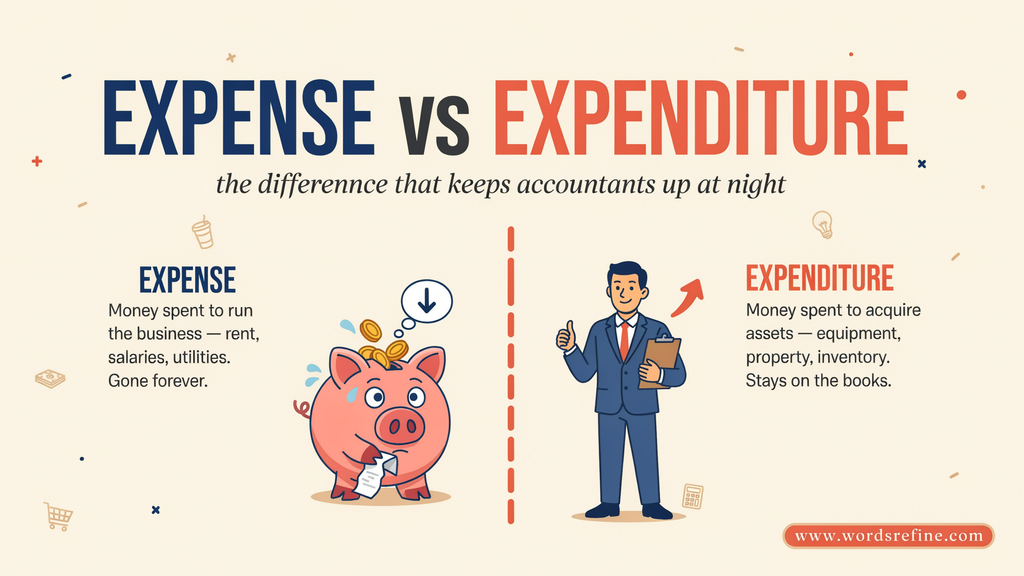
In everyday English, an expense is the cost of doing, buying, maintaining, or achieving something.
For example, the cost of traveling to a conference might exceed the original budget. A family’s monthly expenses may include rent, groceries, and transportation. Similarly, a company might reduce its operating expenses by negotiating a better lease.
In each case, the word emphasizes the cost or financial burden associated with an activity.
Expense in Accounting With Examples
In accounting, an expense generally represents a cost recognized during a particular reporting period. Expenses reduce profit when the business recognizes them, although the related cash payment may happen earlier or later.
Common types of expenses include operating expenses, cost of goods sold, depreciation, amortization, interest, and certain non-operating costs.
Operating expenses include rent, salaries, utilities, insurance, office supplies, and routine maintenance. Cost of goods sold represents the cost of inventory sold to customers, including applicable production or acquisition costs.
Depreciation allocates the depreciable cost of a tangible asset over its useful life. Similarly, amortization allocates the cost of a qualifying intangible asset over its useful life. Interest expense generally relates to borrowing costs, while non-operating expenses may include certain losses or costs outside a company’s core activities.
The classification depends on the business and the applicable accounting framework. For example, vehicle costs may form part of a delivery company’s core operating expenses, while interest expense generally relates to financing.
Expense Recognition in Accounting
A business doesn’t necessarily recognize an expense when it hands over cash. Instead, it follows the applicable accounting rules to determine when the cost belongs in its financial records.
Under accrual accounting, businesses generally recognize expenses when they incur the relevant costs or consume the related resources, rather than simply when they pay.
Suppose a company receives an electricity bill for September but pays it in October. Because the company used the electricity in September, it generally records the utility expense in September and recognizes the amount owed as a liability. In October, the payment settles that liability.
This approach helps financial statements show the costs associated with the correct accounting period.
Learn the difference between tricky grammar more words
Saucey vs Saucy Meaning Differences and Correct Usage ?
What Does Expenditure Mean?
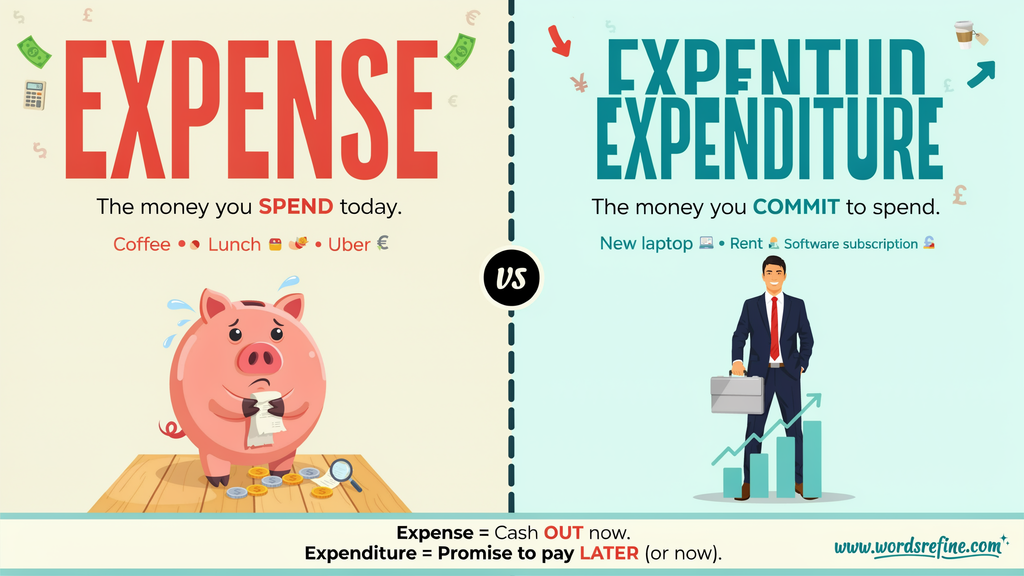
An expenditure is money spent or a financial outlay made to acquire goods and services, support operations, purchase assets, or achieve another objective. The word often emphasizes the spending itself rather than the period in which accounting recognizes a cost.
For example, a company might report $250,000 in annual expenditure on equipment, employee training, software, and office operations. That figure describes spending across several categories. It doesn’t automatically mean the company recorded $250,000 in expenses on its income statement during the year.
Expenditure Meaning in Everyday English
In everyday English, expenditure refers to the use of money for a particular purpose. The word often appears in formal reports, public budgets, financial planning, and discussions of major purchases.
A university might increase its expenditure on laboratory equipment. A family could reduce its annual household expenditure. Likewise, a government might approve additional expenditure on public transportation.
In each example, the word emphasizes how money is spent or allocated.
Expenditure in Accounting With Examples
In accounting, an expenditure may relate to an immediate expense, the acquisition of an asset, a prepaid cost, or the settlement of a liability. The correct treatment depends on the transaction and the applicable accounting framework.
Capital expenditure involves spending on acquiring, constructing, or improving qualifying long-term assets. Revenue expenditure generally relates to current operations or the maintenance of existing assets. Operating expenditure covers routine business activities, such as rent, wages, utilities, and supplies.
Public expenditure refers to government spending on services, infrastructure, administration, and other public purposes.
These categories can overlap. For instance, a government may make capital expenditures on a new highway, while a private company may incur operating expenditure on electricity and routine maintenance.
Learn the difference between confusing word pairs
Stary vs Starry Meaning Differences Examples and Correct ?
Expenditure Recognition and Accounting Treatment
The Expenditure recognition describes how a financial transaction enters the accounting records. However, recording an expenditure doesn’t mean that the entire amount becomes an expense immediately.
Suppose a business buys a machine for $40,000 and pays in full. If the machine qualifies for recognition as property, plant, and equipment, the business generally records a $40,000 asset rather than charging the entire purchase to the income statement immediately.
By contrast, if the business pays $2,000 for electricity already consumed, it generally recognizes a $2,000 utility expense.
The difference depends on what the business receives and how the transaction should be accounted for.
Expense vs Expenditure in Accounting
The distinction between expense vs expenditure becomes particularly important when preparing financial statements. Accounting separates transactions according to what they represent, when they occur, and how they affect the business.
Two widely used reporting frameworks are Generally Accepted Accounting Principles in the United States and International Financial Reporting Standards in many other jurisdictions. Their detailed requirements differ in some areas, but both distinguish between recognizing an asset and recognizing an expense.
Expense vs Expenditure Under Accrual Accounting
Accrual accounting records revenue and expenses in the periods to which they relate, rather than relying solely on cash receipts and payments.
Imagine a business purchases $6,000 of office supplies in December. By December 31, it has used $4,000 worth of supplies and has $2,000 remaining.
Assuming the unused supplies meet the applicable asset-recognition requirements, the business may account for the transaction as follows.
| Item | Amount | Typical accounting treatment |
|---|---|---|
| Total purchase | $6,000 | Record the purchase |
| Supplies consumed in December | $4,000 | Recognize an expense |
| Supplies remaining at year-end | $2,000 | Retain as an asset, subject to applicable rules |
The company spent $6,000, but only $4,000 represents supplies consumed during December in this example.
The matching principle helps explain why businesses recognize costs in the appropriate periods. However, not every expense must match a specific sale. Some costs, such as administrative salaries and office rent, support the business as a whole and are recognized according to the applicable accounting rules.
Learn the difference between often confused words
Scrapped vs Scraped Differences Examples and Correct Usage?
Expense vs Expenditure Under Cash Basis Accounting
Cash basis accounting records transactions primarily when money changes hands. This approach can simplify bookkeeping for certain small organizations, although eligibility and reporting requirements vary.
Suppose a freelancer pays $1,200 for an annual software subscription on January 1. Under a simple cash-basis system, the payment may be recorded when the money leaves the bank account, subject to the rules governing that system.
Under accrual accounting, however, the cost generally relates to the period during which the subscription service is provided. The freelancer may therefore recognize the cost over the subscription period when the applicable requirements call for that treatment.
This example illustrates why a cash outflow and an expense aren’t always the same thing. The date of payment and the period of expense recognition can differ.
Expense vs Expenditure Accounting Treatment A Practical Comparison
| Transaction | Spending or expenditure | Typical accounting treatment |
|---|---|---|
| Paying monthly rent | Cash payment or amount owed for rent | Recognize rent expense for the relevant period |
| Buying a qualifying delivery truck | Capital expenditure | Record an asset and recognize depreciation over its useful life |
| Paying an electricity bill for electricity already used | Operating expenditure | Recognize utility expense and reduce cash or settle a payable |
| Paying insurance in advance | Cash expenditure | Initially record a prepaid asset when appropriate, then recognize expense over the coverage period |
| Buying inventory for resale | Purchase expenditure | Record inventory as an asset until the applicable rules require recognition of its cost, often when sold |
| Paying an outstanding supplier invoice | Cash outflow | Reduce cash and accounts payable without recording the same expense twice |
These examples show that accounting treatment depends on the substance of each transaction, not merely on whether money changed hands.
Learn the difference between basic English word mistakes
Teams vs Teams Meaning Differences Accounts and Features ?
Expense vs Expenditure in Financial Statements
Financial statements show different aspects of a company’s financial activity. To understand the distinction, it’s helpful to examine the income statement, balance sheet, and cash flow statement.
How Expenses Appear on the Income Statement
The income statement, also called the profit and loss statement, reports revenue and expenses over a particular period. It helps readers understand how a business performed financially.
Consider this simplified example.
| Income statement item | Amount |
|---|---|
| Revenue | $200,000 |
| Cost of goods sold | $80,000 |
| Gross profit | $120,000 |
| Operating expenses | $65,000 |
| Operating income | $55,000 |
| Other expenses, including interest | $5,000 |
| Income before tax | $50,000 |
In this example, the business reports $50,000 in income before tax. The expenses reduce the amount remaining from revenue.
Actual financial statements may include additional categories, and the presentation depends on the business and reporting framework.
Does Expenditure Appear on the Balance Sheet?
An expenditure doesn’t automatically appear as a separate line on the balance sheet. Its accounting treatment determines what the balance sheet reports.
For example, when a business purchases a qualifying machine, it generally records the machine under property, plant, and equipment. The expenditure creates an asset rather than an immediate expense for the full purchase price.
Other transactions have different effects. A prepaid insurance payment may create a prepaid asset. A purchase on credit may increase accounts payable. A payment to settle an existing supplier invoice reduces cash and accounts payable.
Meanwhile, an expense recognized during the period generally reduces net income and ultimately affects retained earnings, subject to the other accounting entries.
The distinction between the balance sheet and the income statement is essential. The balance sheet shows assets, liabilities, and equity at a particular date. The income statement shows financial performance over a period.
How Expenses and Expenditures Affect Cash Flow
A cash flow statement tracks cash entering and leaving a business. It separates cash movements from the recognition of revenue, expenses, assets, and liabilities.
Buying a machine might produce a large cash outflow classified as an investing activity. The machine’s depreciation expense, however, generally affects accounting profit over several periods without causing an equivalent cash outflow in each period.
That distinction explains why a profitable company can still experience cash shortages. Profit and cash flow measure different things.
Learn the difference between commonly misused words
Tinder vs Tender Differences Examples and Correct Usage?
Expense vs Expenditure Examples in Real Life
Real-world examples make the difference easier to understand. The same transaction can qualify as an expenditure in the broad sense and also produce an expense, but the timing and amount may differ.
Monthly Office Rent
A business pays $3,000 in monthly rent for its office.
If the payment relates to the current month, the business generally recognizes $3,000 in rent expense for that month. The payment is also part of the business’s overall expenditure.
However, if the business pays rent before the rental period begins, the initial payment may create a prepaid asset. The company then recognizes rent expense as it receives the right to use the space over time.
Buying Office Equipment
A company buys computers for $15,000 and expects to use them for several years.
If the computers meet the relevant capitalization requirements, the business generally records the purchase as capital expenditure and recognizes the equipment as an asset. It then records depreciation over the assets’ useful lives, as applicable.
The $15,000 purchase isn’t necessarily a $15,000 immediate expense. Instead, the accounting treatment reflects the equipment’s expected use over time.
Paying Employee Salaries
A company owes employees $8,000 for work completed during June but pays them in July.
Under accrual accounting, the company generally records the salary expense in June because employees performed the work during that period. It also records a liability for the unpaid amount.
When the company pays employees in July, it reduces cash and clears the liability. It doesn’t record the same $8,000 salary expense again.
Building a New Factory
A manufacturer spends $500,000 constructing a new factory that meets the applicable asset-recognition requirements.
The construction spending generally qualifies as capital expenditure. The company records the qualifying costs as part of the asset’s carrying amount and begins depreciation when the factory is available for use, following the applicable accounting rules.
The factory’s cost then affects profit over time through depreciation rather than becoming an immediate $500,000 expense simply because the company paid for construction.
Capital Expenditure vs Expense
The difference between capital expenditure and expense is one of the most important concepts in financial accounting. It explains why businesses don’t automatically charge every purchase to the income statement.
Capital expenditure involves spending to acquire, construct, or improve a qualifying long-term asset. An expense, by contrast, generally represents a cost recognized in a particular accounting period.
For example, buying a delivery van for $35,000 may qualify as capital expenditure. Paying $250 for routine maintenance on that van will generally qualify as an expense when the service is received.
| Feature | Capital expenditure | Expense |
|---|---|---|
| Purpose | Acquire or improve a qualifying long-term asset | Recognize a cost for the relevant period |
| Initial accounting treatment | Generally recorded as an asset | Generally recorded on the income statement |
| Effect on profit | Usually indirect at first | Reduces profit when recognized |
| Examples | Machinery, buildings, qualifying equipment | Rent, utilities, routine repairs |
| Long-term effect | May create benefits across multiple periods | Generally relates to current operations or another recognized cost |
Not every large purchase qualifies as capital expenditure. The business must consider the asset’s nature, expected benefits, applicable accounting standards, and capitalization policy.
Revenue Expenditure vs Expense
Revenue expenditure generally refers to spending associated with day-to-day business operations or maintaining existing assets. Examples include electricity bills, routine repairs, office rent, and employee wages.
In many cases, revenue expenditure becomes an expense in the period in which the business receives the relevant goods or services. However, the terms aren’t perfectly interchangeable in every accounting context. Inventory purchases, for instance, may initially be recorded as assets and recognized as expenses when the inventory is sold.
Learn the difference between everyday English mistakes
Jibe vs Jive What’s the Difference?
How Depreciation Converts Capital Expenditure Into Expense
Depreciation allocates the depreciable cost of a tangible asset over its useful life. It doesn’t represent a new cash payment each time the business records depreciation.
Suppose a company buys equipment for $24,000, estimates a useful life of four years, and expects no residual value. Under the straight-line method, assuming the equipment is available for use for the full four years, annual depreciation would be $6,000.
The original purchase represents capital expenditure. The annual depreciation charge represents the recognition of part of the asset’s depreciable cost as an expense.
Amortization follows a similar allocation concept for qualifying intangible assets, although the rules differ by asset type and accounting framework.
Government Expenditure vs Expense
Government expenditure and expense can overlap, but public-sector accounting introduces additional distinctions.
Governments spend money on schools, hospitals, roads, public safety, social programs, and administration. Budget documents often use expenditure to describe the amounts allocated or spent on these activities.
However, governmental accounting doesn’t always treat an expenditure as an expense in the same way that a private business does.
For example, a government might purchase a vehicle for a public works department. Depending on the accounting framework and the type of financial statement, the transaction may be reported as an expenditure in a governmental fund while the government-wide statements recognize a capital asset and depreciation expense.
Governmental funds under US GAAP generally use modified accrual accounting, which has its own recognition rules. Government-wide financial statements use the economic resources measurement focus and accrual accounting.
Therefore, the distinction depends partly on the public-sector reporting system being used. Readers should avoid applying private-sector accounting rules mechanically to every government budget.
Cost vs Expense vs Expenditure in Accounting
Although people sometimes use cost, expense, and expenditure interchangeably, each term can emphasize a different aspect of a transaction.
A cost represents the amount associated with acquiring a resource, producing a product, or providing a service. An expenditure emphasizes money spent or a financial outlay. An expense represents a cost recognized in determining profit for a reporting period.
Consider a retailer that purchases 100 chairs for $50 each.
The total purchase cost is $5,000. The retailer has made an expenditure of $5,000 when it buys the chairs. If the chairs remain unsold at the end of the period, the cost generally remains in inventory, assuming the applicable recognition requirements are met.
When the retailer sells 60 chairs, it generally recognizes $3,000 in cost of goods sold, assuming each chair retains its $50 cost and no other adjustments apply.
The remaining $2,000 stays in inventory until the retailer sells the remaining chairs or another accounting event requires an adjustment.
This example shows why cost, expense, and expenditure aren’t simply interchangeable labels. Each term helps explain a different stage of the financial transaction.
Learn the difference between more words people mix up
Foward vs Forward Meaning Spelling and Correct Usage
Common Mistakes When Using Expense vs Expenditure
Even experienced business owners can confuse these terms when discussing budgets, payments, and profit. A few common mistakes are worth avoiding.
Treating Every Payment as an Expense
A cash payment doesn’t automatically become an expense. A business might use cash to purchase inventory, acquire equipment, pay off a loan, or settle an existing bill.
Each transaction has its own accounting treatment. Before recording a payment, identify what it represents and whether the business has received a service, acquired an asset, or settled an obligation.
Recording Every Asset Purchase as an Immediate Expense
A qualifying long-term asset generally appears on the balance sheet when the business acquires it. The business then recognizes depreciation or amortization where applicable.
Therefore, determine whether the purchase should be capitalized or expensed under the relevant accounting rules instead of automatically charging the entire amount to the income statement.
Confusing an Expense With a Liability
An expense and a liability describe different things. An expense represents a recognized cost, while a liability represents an obligation.
For example, a company may record salary expense when employees perform work and record a liability until it pays them. Both entries can exist at the same time.
The key is to record the cost and the related obligation separately when the accounting requirements call for both.
Assuming Expenditure Always Means Capital Investment
Expenditure doesn’t automatically mean investment in long-term assets. A company also spends money on wages, utilities, rent, and routine supplies.
Use capital expenditure when discussing qualifying asset investment. Use operating expenditure when discussing routine business spending and when that classification fits the context.
Using Formal Language When a Simple Word Works Better
In everyday writing, expenditure can sound unnecessarily formal when expense or spending communicates the idea more naturally.
For example, “My monthly expenses increased” is usually more natural in conversation than “My monthly expenditure increased.” Both can be correct, but the best choice depends on the intended meaning and tone.
How to Choose Between Expense and Expenditure
The simplest way to choose between the words is to identify what you want to emphasize.
Use expense when discussing a recognized cost, the costs of running a business, or amounts reported in a profit and loss statement.
Use expenditure when discussing money spent, budget allocations, capital investment, or overall financial outlays.
Consider these examples.
When discussing the cost of electricity used last month, use utility expense if you’re referring to the recognized accounting cost. When discussing a company’s purchase of new machinery, use capital expenditure if the purchase qualifies as capital investment.
Similarly, use government expenditure when describing public spending in a budget. For a family’s spending on groceries and transportation, household expenses or household expenditure may both fit, depending on the context.
Finally, if a business pays a bill after recording the expense, describe the payment as settling the liability rather than recognizing the expense again.
In financial reporting, precision matters more than choosing the word that sounds more formal. In ordinary conversation, clarity and natural usage should guide your choice.
Expense vs Expenditure Quick Summary
The difference between expense and expenditure comes down to their scope and accounting treatment.
An expense generally represents a cost recognized in determining profit for an accounting period. Expenditure describes money spent or a financial outlay more broadly.
An expenditure may become an immediate expense, create an asset, or settle a liability. For example, electricity used during the current month generally becomes an expense, while the purchase of qualifying machinery generally creates an asset whose depreciable cost is recognized over time.
Remember this practical rule: spending money and recognizing an expense aren’t always the same event. Once you understand that distinction, you can use both terms more accurately in everyday writing, business reports, and accounting.
Learn the difference between often confused words
Broke vs Broken Meaning Differences and Correct Usage ?
Practice Session Expense vs Expenditure
1. Money spent or committed to acquire goods, services, or assets is called an __________.
2. A cost recognized during a specific accounting period is called an __________.
3. Buying machinery for long-term business use is an example of __________ expenditure.
4. Rent and utility bills are common examples of __________ expenses.
5. Expenditure on the day-to-day running of a business is known as __________ expenditure.
6. Spending money on a new office building is an example of __________ expenditure.
7. Employee wages are generally recorded as an __________.
8. Another word for expenditure is __________.
9. Expenses that generally remain stable over a given period are called __________ expenses.
10. Expenses that change according to business activity are called __________ expenses.
11. Buying office supplies creates an __________ for the business.
12. The cost of electricity used by a business is usually recorded as an __________.
13. Capital expenditure usually involves purchasing or improving __________ assets.
14. Revenue expenditure generally covers routine business __________.
15. Money spent on advertising is an example of a business __________.
16. The gradual recognition of a fixed asset’s cost over its useful life is called __________.
17. Government grants and certain benefit payments are examples of __________ expenditure.
18. Spending on activities outside a company’s main operations may be classified as __________ expenditure.
19. Rent is usually a __________ expense because it generally stays the same during the lease period.
20. Shipping costs that increase with the number of orders are an example of __________ expenses.
21. An expenditure does not always become an immediate __________ in accounting.
22. The purchase of a delivery vehicle is generally classified as __________ expenditure.
23. Groceries, transportation, and housing payments are examples of personal __________.
24. The terms expense and expenditure are related, but they are not always __________.
25. In everyday language, expenditure generally means __________ money.
Answers
1. Expenditure
2. Expense
3. Capital
4. Operating
5. Operating
6. Capital
7. Expense
8. Spending
9. Fixed
10. Variable
11. Expenditure
12. Expense
13. Long-term
14. Operations
15. Expense
16. Depreciation
17. Transfer
18. Non-operating
19. Fixed
20. Variable
21. Expense
22. Capital
23. Expenses
24. Interchangeable
25. Spending
Here’s a trusted source for clear more words Comparison:
FAQs
What are the four types of expenditure?
Four common types of expenditure are capital expenditure, revenue expenditure, operating expenditure, and non-operating expenditure. Capital expenditure covers long-term assets, while revenue expenditure includes costs related to maintaining business operations. Operating expenditure supports daily activities, whereas non-operating expenditure comes from activities outside a company’s main operations.
What are three types of expenditure?
Three common types of expenditure are capital expenditure, revenue expenditure, and transfer expenditure. Capital expenditure funds long-term assets, such as buildings and equipment. Revenue expenditure covers routine costs, including rent and utilities. Transfer expenditure involves payments such as government benefits or grants made without receiving goods or services directly in return.
What are five examples of expenses?
Five common examples of expenses are rent, utility bills, employee wages, office supplies, and advertising costs. Businesses record these costs as they incur them to keep operations running. Individuals also have expenses, such as groceries, transportation, housing, and medical bills.
What is the difference between an expenditure and an expense?
An expenditure is money spent or a financial commitment made to acquire goods, services, or assets. An expense is a cost recognized when a business uses resources to earn revenue or operate. For example, buying a delivery vehicle is a capital expenditure, while recording depreciation on that vehicle is an expense.
What are the two types of expenses?
Two broad types of expenses are fixed expenses and variable expenses. Fixed expenses generally remain stable over a given period, such as monthly rent. Variable expenses change with activity or usage, such as shipping costs or production materials. The exact classification depends on how a business organizes its financial records.
What is another name for expenditure?
Another name for expenditure is spending or outlay. In financial contexts, the best alternative depends on the situation. Spending is common in everyday language, while outlay often refers to a specific amount of money spent. However, expenditure and expense are not always interchangeable in accounting.
What is meant by expenditure?
Expenditure refers to money spent or committed to obtain goods, services, or assets. It can include everyday purchases, business operating costs, or investments in long-term assets. For example, a company incurs expenditure when it buys office equipment, pays for repairs, or purchases supplies.
What is another name for expenses?
Expenses may also be called costs or operating costs, depending on the context. In accounting, an expense is a cost recognized during a particular period. However, not every cost becomes an expense immediately. For instance, a business may record equipment as an asset before recognizing its cost gradually through depreciation.
Does expenditure just mean spending?
Yes, expenditure generally means spending money, but accounting uses the term more precisely. It can refer to payments for everyday needs, business operations, or long-term assets. An expenditure does not always become an immediate expense. For example, purchasing machinery involves expenditure, but the business usually recognizes its cost over time through depreciation.
Learn the difference between commonly misused words
Cloth vs Clothe Differences Examples and Correct Usage ?
Conclusion
The difference between expense vs expenditure comes down to how accounting records money spent. An expenditure occurs when you spend money on goods, services, or assets, while an expense is a cost recognized in a specific accounting period. For example, purchasing equipment is a capital expenditure, but the cost recorded through depreciation becomes an expense over its useful life.
The trick is not to treat these terms as perfect synonyms. They’re related, but each has a different purpose in financial reporting. Understanding the distinction helps you read financial statements, track business costs, and avoid common accounting mistakes. So, the next time money leaves the business account, remember that spending it is only half the story. Accounting still has to figure out exactly where it belongs!

Diora AJS she is an experienced blogger and passionate English language enthusiast at Words Refine. With a keen eye for language and a love for clear communication, she writes practical content about grammar, word meanings, usage, and commonly confused terms. Her goal is to make English easier to understand through clear explanations and relatable examples, helping readers write accurately and communicate with confidence.