Scrapped vs scraped? These two words may look like close cousins, but they certainly do not mean the same thing. Scrapped means canceled abandoned, or discarded, while scraped refers to rubbing against a surface, removing material, or gathering something with difficulty. For instance, a company might have scrapped its latest project, but you might have scraped your knee while rushing to catch the bus. Confusing these words can turn an otherwise clear sentence into a grammatical puzzle. Fortunately, the difference is easy to remember once you know the rules. Let’s explore their meanings, common mistakes, and practical examples so you can choose the right word with confidence.
Scrapped vs Scraped The Quick Answer
The easiest way to understand the difference between scrapped vs scraped is to focus on the action.
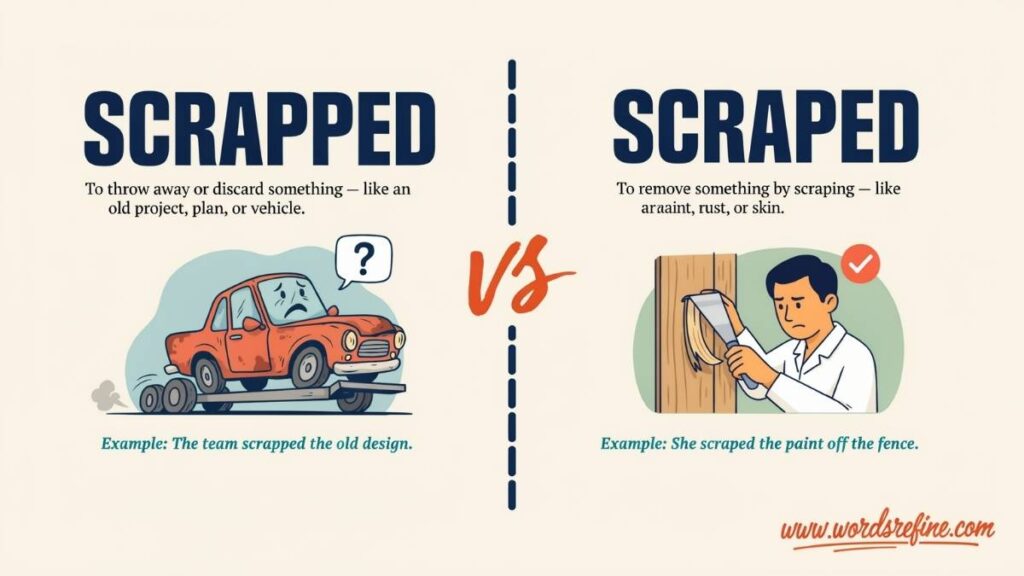
Scrapped means abandoned, canceled, or discarded. For example, the company scrapped its plan to open a new office.
Scraped means rubbed against a surface, removed something through friction, or gathered something with effort. For example, Maya scraped her knee when she fell on the sidewalk.
You might also scrape frost off a windshield or scrape together enough money to pay a bill.
In short, use scrapped when someone abandons or discards something. Use scraped when someone rubs, removes, or gathers something.
What Does Scrapped Mean?
Scrapped is the past tense and past participle of scrap. The verb usually means to abandon a plan, cancel a proposal, reject an idea, or discard something that is no longer useful.
Imagine a restaurant owner planning to introduce a new menu. After reviewing the costs and testing the recipes, the owner realizes that the new dishes aren’t practical. Instead of moving forward, the owner decides to abandon the idea.
You could say, “The restaurant scrapped its new menu before the launch.”
Here, scrapped makes it clear that the restaurant decided not to proceed with the plan.
Learn the difference between confusing more English words
favour vs Favor Meaning Differences Spelling and Examples ?
The Meaning of Scrapped in Different Situations
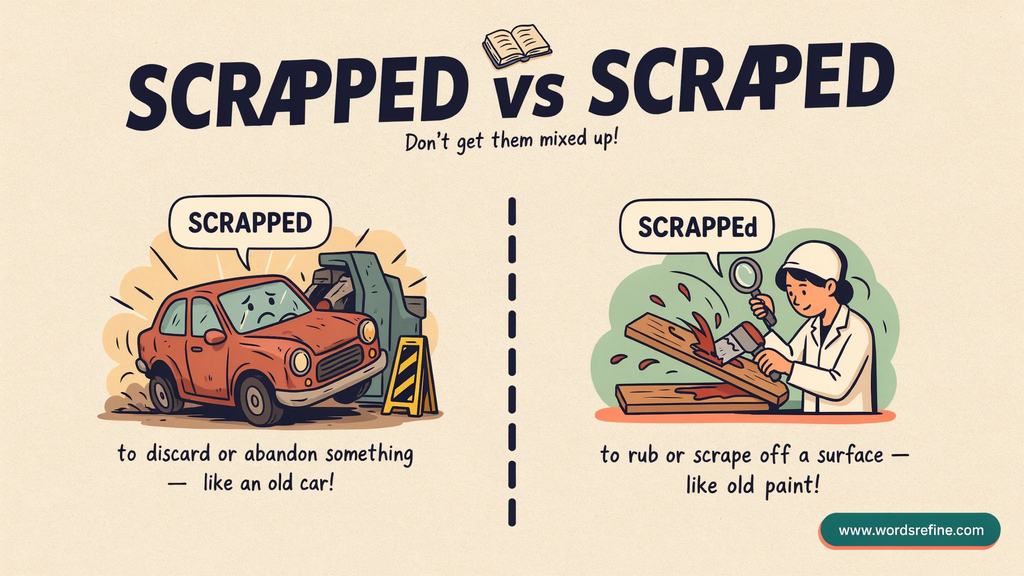
Scrapped has several related uses, depending on the context.
When someone abandons or cancels something, the word often refers to plans, projects, proposals, or ideas.
For example, the school scrapped its proposal to shorten lunch breaks. Similarly, the manufacturer scrapped the original design after several failed tests. In both cases, someone decided not to continue with an existing plan.
However, scrapped can also describe throwing away an unwanted object, especially when someone intends to recycle its materials or recover useful parts.
For example, the mechanic scrapped the damaged car. The factory also sold the scrapped metal to a recycling company.
In these situations, the word refers to discarding something rather than canceling an idea.
What Does Scrapped Mean in a Sentence?
The surrounding words usually make the meaning clear.
“The council scrapped the proposal.”
This means the council abandoned or canceled the proposal.
“The owner scrapped the old refrigerator.”
This means the owner discarded the appliance, possibly for recycling or parts.
“The engineers scrapped the first design.”
This means the engineers rejected the original design and decided not to use it.
Notice that scrapped doesn’t always involve throwing something into a trash can. A business can scrap an idea without producing any physical waste. Likewise, someone can scrap a vehicle even if some of its parts remain valuable.
Is Scrapped a Correct Word?
Yes, scrapped is a standard English word. It is the correct past-tense and past-participle form of scrap.
You can use it to describe canceled projects, abandoned plans, rejected designs, and discarded objects.
For example, a company scraps outdated products as a regular practice. Yesterday, it scrapped another product. By the end of the year, it may have scrapped several products.
These sentences show how the same verb works in different tenses.
Although passive sentences are also correct, active sentences often sound more direct. For example, “The committee scrapped the proposal after reviewing the costs” clearly identifies who made the decision.
Learn the difference between commonly mixed-up more words
Sited vs Cited Meaning Differences Examples and Correct Usage
What Does Scraped Mean?
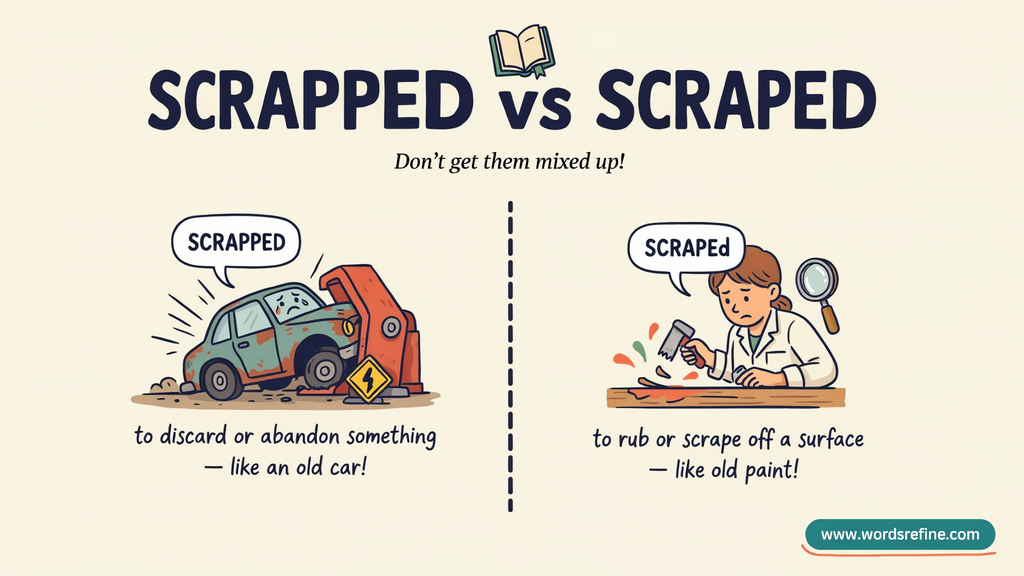
Scraped is the past tense and past participle of scrape. It usually describes rubbing something against a surface, removing material with friction or a tool, or gathering something with difficulty.
Unlike scrapped, which often involves abandoning or discarding something, scraped usually focuses on an action. Nevertheless, it also appears in expressions such as scraped together enough money and scraped through an exam.
The Meaning of Scraped in Different Situations
One common use of scraped involves rubbing against a rough or hard surface. This action can produce a harsh sound, leave marks, or cause a minor injury.
For example, Liam scraped his knee on the pavement. The chair scraped against the floor. She scraped her hand against a rough brick wall.
In each sentence, scraped describes contact between surfaces.
Another common use involves removing something from a surface. You might scrape dried mud off your boots, scrape burnt food from a pan, or scrape frost off a windshield.
Here, the word describes using friction or a tool to remove unwanted material.
Scraped can also describe gathering something when resources are limited. For example, a family might scrape together enough money for a deposit, or a student might scrape together the supplies needed for a school project.
In these cases, the word emphasizes the effort required to collect enough of something.
What Does Scraped Mean in a Sentence?
Consider these examples.
“The driver scraped the side of the car against a concrete pillar.”
The car rubbed against the pillar and probably suffered surface damage.
“Jordan scraped the mud off his shoes.”
Jordan removed the mud from his shoes.
“The family scraped together enough money for the repairs.”
The family managed to collect the necessary money despite limited resources.
“The candidate scraped through the interview process.”
The candidate barely succeeded in passing through the selection process.
As these examples show, scraped can describe physical actions as well as figurative situations. The surrounding words help you understand which meaning applies.
Learn the difference between tricky grammar more words
Envisage vs Envision Meaning Differences Examples ?
Is Scraped a Correct Word?
Yes, scraped is a standard English word. It is the correct past-tense and past-participle form of scrape.
The verb has several forms, depending on the sentence.
In the present tense, you might say, “I scrape the ice off the window.” When describing another person, you could write, “She scrapes the paint off the door.”
For an ongoing action, you might say, “He is scraping the mud away.”
However, when the action has already happened, use scraped: “He scraped the mud away.”
You can also use scraped with a helping verb, as in “He has scraped the mud away.”
These forms follow standard English grammar and help you describe actions at different times.
Scrapped vs Scraped Key Differences
Although scrapped vs scraped share several letters, their meanings and spelling patterns differ.
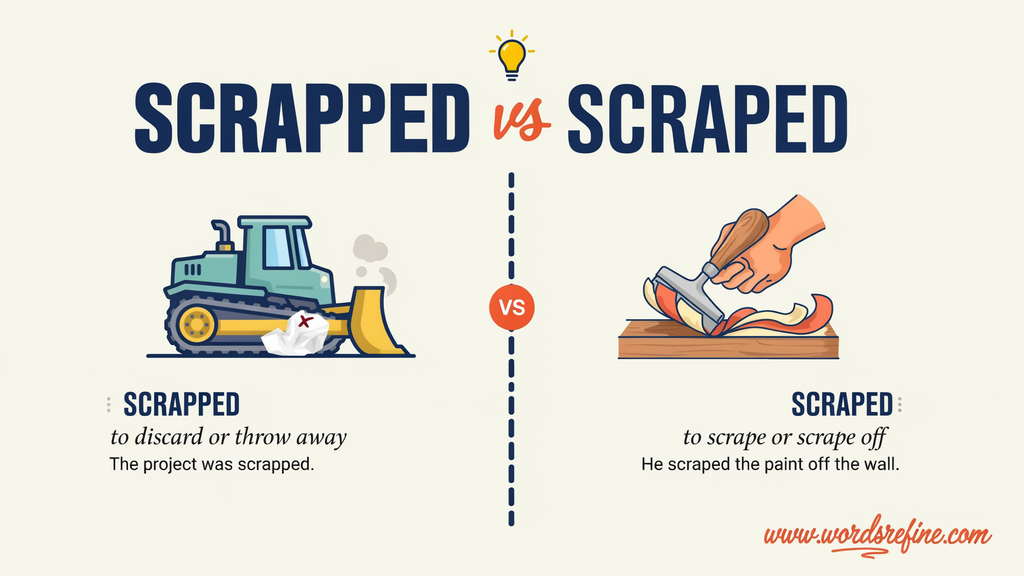
Scrapped comes from scrap and usually means abandoned, canceled, or discarded. Scraped comes from scrape and generally means rubbed, removed, or gathered with difficulty.
For example, “The company scrapped its proposal” means the company abandoned the proposal. In contrast, “The worker scraped the paint off” means the worker physically removed the paint.
The words also differ in pronunciation. Scrapped has the short vowel sound heard in wrapped, while scraped has the long vowel sound heard in shaped.
Most importantly, neither word can replace the other without changing the meaning.
Scrap vs Scrape Understanding the Original Verbs
To understand scrapped and scraped fully, it helps to look at the base verbs. Once you know what scrap and scrape mean, their past-tense forms become much easier to remember.
What Does Scrap Mean as a Verb?
The verb scrap means to abandon, cancel, reject, or discard something. It can also describe breaking an object down so its materials can be reused.
For example, a company might scrap an outdated strategy, a school might scrap a proposed schedule, or an owner might scrap a broken washing machine.
Scrap can also function as a noun. It may refer to a small leftover piece of material, such as a scrap of paper, or discarded material collected for recycling.
For example, she wrote the address on a scrap of paper. Similarly, the recycling center buys scrap metal.
In informal English, scrap can also refer to a fight. The intended meaning depends on the context.
Learn the difference between confusing word pairs
Apprised vs Appraised Which One Is Correct and Why It Matters ?
What Does Scrape Mean as a Verb?
The verb scrape generally means to rub something against a surface, remove material with a tool, or gather something with effort.
For example, you might scrape mud off your shoes, hear a knife scrape against a plate, or scrape together enough money for a trip.
Scrape can also function as a noun. It may describe a shallow injury or a difficult situation.
For instance, he had a small scrape on his elbow. Likewise, someone might say they got into a scrape after missing the last bus.
Although these meanings are related, they aren’t interchangeable with the meanings of scrap.
What Is the Difference Between Scrap vs Scrape?
The distinction is straightforward.
Scrap means to abandon or discard something. Scrape means to rub, remove material from a surface, or gather something with difficulty.
For example, in the present tense, you might say, “They scrap the plan.” In the past tense, that becomes, “They scrapped the plan.”
Similarly, “They scrape the paint off the door” becomes “They scraped the paint off the door.”
Therefore, when deciding which word to use, identify the action first. If someone is canceling a project, choose scrap. If someone is removing paint, choose scrape.
Scrapped vs Scraped Understanding the Spelling Rules
English spelling can sometimes seem confusing. However, these two words follow familiar spelling patterns. The key is to examine the final letters of each base verb.
Why Does Scrapped Have Two P’s?
The correct spelling of scrapped contains two p’s because the base verb scrap ends in a consonant-vowel-consonant pattern.
When a one-syllable verb ends in a single consonant preceded by a single short vowel, English commonly doubles the final consonant before adding -ed.
As a result, scrap becomes scrapped.
The same pattern appears in other words. Stop becomes stopped, plan becomes planned, drop becomes dropped, and clip becomes clipped.
Doubling the final consonant helps preserve the short vowel sound in the base verb.
Although English has exceptions to this rule, scrap follows the pattern directly.
Learn the difference between often confused words
Remediated vs Remedied Which One Is Correct ?
How Do You Spell Scraped Correctly?
The correct spelling of scraped contains one p. It comes from scrape, which ends in a silent e.
When adding -ed to a verb that ends in a silent e, English generally drops the final e before adding the ending.
Therefore, scrape becomes scraped.
The same pattern appears in words such as hope and hoped, bake and baked, dance and danced, and escape and escaped.
The silent e helps signal the long vowel sound in the base verb. When you add -ed, you remove the final e while retaining the vowel sound.
This explains why scraped has one p while scrapped has two.
Why Is Scraped Spelled With One P?
Scraped comes from scrape, not scrap. Since scrape already ends in a silent e, the usual spelling rule calls for removing that e before adding -ed.
Writing scrapped when you mean scraped changes the base verb and therefore changes the meaning.
Remember the distinction: scrap becomes scrapped by doubling the final consonant, while scrape becomes scraped by dropping the silent e before adding -ed.
Once you recognize these patterns, the correct spelling becomes much easier to remember.
Scrapped vs Scraped Pronunciation
Scrapped and scraped don’t sound the same, even though their spellings look similar. Their vowel sounds provide a useful clue.
Scrapped has the short a sound heard in trap and map. Scraped has the long a sound heard in shape and tape.
In standard American English, their pronunciations can be represented as /skræpt/ for scrapped and /skreɪpt/ for scraped.
The final consonant sounds are alike. The main difference lies in the vowel sound.
To practice pronouncing scrapped, say wrapped and focus on the short vowel. For scraped, use shaped as a guide.
Listening for this difference can help you recognize the words in conversation. However, context remains important, especially when someone speaks quickly or has an accent that affects vowel sounds.
Which Is Correct for a Knee?
If you’re describing a minor injury caused by falling or rubbing your skin against a rough surface, scraped knee is correct.
For example, “I scraped my knee when I fell off my skateboard.”
The phrase scrapped my knee isn’t the standard expression for this type of injury. Since scrap means to abandon or discard something, it doesn’t communicate the intended meaning.
A scraped knee usually refers to a superficial skin injury caused by friction. It can happen when someone falls on concrete, slides across a playground, or brushes a knee against a rough surface.
For example, “After falling off her bike, Emma scraped her knee and washed the dirt away.”
Here, scraped describes the action that caused the injury. It doesn’t automatically mean the wound is serious.
The same distinction applies to other body parts. Someone might scrape an elbow against a wall, scrape a hand while moving a rough wooden box, or scrape a shin during a fall.
Whenever you describe this kind of injury, use scraped.
Learn the difference between basic English word mistakes
Vaccum Vs Vacuum Which One Is Correct and Why It Matters ?
Scrapped vs Scraped in Everyday Situations
Sometimes, choosing the correct word can feel tricky because both words appear plausible at first. However, looking at the action usually clears up the confusion.
Scrapped vs Scraped a Project?
Use scrapped a project when someone abandons it or decides not to continue.
For example, “The company scrapped its expansion project after reviewing the costs.”
The company decided not to proceed.
However, scraped can describe a physical action connected with a project or the effort required to gather resources.
For example, “The team scraped the old paint off the model before rebuilding it.”
Similarly, “The team scraped together enough funding to finish the project” means the team managed to collect the necessary money despite limited resources.
Scrapped vs Scraped an Old Car?
The correct word depends on what happened to the vehicle.
Scrapped an old car means the owner discarded it, often for its metal or reusable parts.
For example, “After the repair costs exceeded the car’s value, the owner scrapped it.”
On the other hand, scraped an old car means someone rubbed it against something or damaged its surface.
For example, “I scraped the side of my old car against the garage door.”
One action disposes of the vehicle. The other damages its surface. A car can be scraped without being scrapped, and a scrapped car doesn’t need to have scrape marks.
What Does It Mean?
The expression scraped off means removing something from a surface through friction or by using a tool.
For example, you might scrape frost off a windshield, scrape dried glue off a table, scrape burnt food off a pan, or scrape mud off your boots before entering the house.
The word off emphasizes that the material comes away from the surface.
You can also use scraped away when describing the gradual removal of a substance.
For example, “The worker scraped away the old paint before applying a fresh coat.”
In these situations, scraped is the correct word because the action involves removing material. Scrapped off doesn’t serve as the standard expression for physically removing frost, glue, dirt, or paint.
Scraped Together What Does It Mean?
The expression scraped together means gathering enough of something, often money or resources, despite difficulty.
For example, “After weeks of saving, the family scraped together enough money to replace the broken refrigerator.”
The family managed to collect the necessary amount, probably by combining small savings or finding extra funds.
Similarly, you might scrape together enough money for a deposit, gather supplies for a fundraiser, or prepare a meal from the few ingredients left in the kitchen.
This expression often suggests that resources were limited. The speaker emphasizes the effort required to collect enough.
Remember that you scrape together what you need, but you scrap a plan you no longer want.
Scraped Through What Does It Mean?
The expression scraped through means barely succeeding or managing to get through a difficult situation.
For example, a student might scrape through an exam with a passing grade. A team might scrape through the semifinal after a close match. Someone might also scrape through a difficult selection process despite a challenging interview.
The phrase doesn’t necessarily mean the person performed well. Instead, it emphasizes that success came narrowly or with considerable difficulty.
This meaning is figurative, unlike scraped off or scraped against, which usually describe physical actions.
For instance, “The student scraped through the exam” means the student barely passed. However, “The student scrapped the exam” suggests that the student canceled or abandoned the exam, which expresses a completely different idea.
Learn the difference between commonly misused words
Effort vs Affort Which One Is Correct and How to Use It?
Scrapped vs Scraped Examples in Real Sentences
Looking at complete sentences can make the difference between these words easier to understand.
The company scrapped its plan to hire more staff because its budget had changed. The word scrapped indicates that the company abandoned the plan.
I scraped my knee on the sidewalk while running to catch the bus. Here, scraped describes a minor injury caused by friction.
The mechanic scrapped the damaged vehicle because repairing it would have cost too much. The word indicates that the vehicle was discarded.
She scraped the sticker off her notebook before lending it to her friend. The word describes physically removing the sticker.
We scraped together enough money for the trip after saving for several weeks. The expression emphasizes the effort required to gather the money.
The city scrapped the proposed road expansion after residents raised concerns. The word means the city abandoned the proposal.
He scraped frost off the windshield before driving to work. The word describes removing frost from the glass.
The factory recycled the scrapped metal rather than sending it to a landfill. Here, scrapped describes metal that had been discarded.
The chair scraped loudly against the floor as someone dragged it across the room. The word describes friction between the chair and the floor.
The student scraped through the final exam with a passing grade. The expression means the student barely succeeded.
A Practical Example One Letter, Two Different Meanings
Imagine a project manager writing a report after a product launch goes wrong.
Consider these sentences:
“The company scraped its new product line.”
“The company scrapped its new product line.”
The first sentence doesn’t clearly communicate the likely business decision. It suggests a scraping action but doesn’t explain what was rubbed or removed. The second sentence clearly means that the company abandoned or discontinued the product line.
Now consider a situation involving vehicle damage.
“The driver scrapped the side of the car against a concrete wall.”
“The driver scraped the side of the car against a concrete wall.”
The second sentence correctly describes surface damage caused by friction. The first uses a verb associated with abandoning or discarding something.
These examples show why proofreading requires more than checking spelling. A spell-checker may accept both words because both are legitimate English words. However, it may not recognize that one word doesn’t fit the context.
Scrapped vs Scraped in American and British English
American and British English use both scrapped and scraped. The distinction doesn’t depend on regional spelling preferences.
In both varieties, scrapped is the past-tense form of scrap, while scraped is the past-tense form of scrape.
For example, an American writer might say, “The city scrapped its plan to rebuild the bridge.” A British writer might write, “The council scrapped the proposed development.”
Similarly, an American might say, “She scraped ice off her car windows,” while a British speaker might say, “He scraped the mud off his boots.”
The vocabulary and grammar remain the same, even when surrounding words differ by region. For instance, American writers commonly use sidewalk, while British writers often use pavement. That difference doesn’t affect the choice between scrapped and scraped.
Therefore, you don’t need to memorize separate American and British spellings for these words. You simply need to choose the one that matches your intended meaning.
Learn the difference between everyday English mistakes
Octopus vs Octopi Which Plural Is Correct and Why?
Scrapped vs Scraped in Professional and Technical Writing
Choosing the correct word matters in professional writing because a small spelling error can change the meaning of a report, instruction, or project update.
Scrapped in Business and Project Management
Business writers use scrapped when a company, team, or organization decides not to proceed with something.
For example, the management team scrapped the proposed merger. Developers scrapped the original feature after testing revealed major problems. An agency scrapped its advertising campaign because it failed to reach the intended audience.
In these situations, scrapped communicates a decision to abandon, cancel, or discontinue something.
However, a project might be scrapped for many reasons, including budget limits, changing priorities, safety concerns, or new information. The word doesn’t necessarily mean the original idea was worthless.
Scraped in Maintenance and Instructions
Technical instructions often use scraped to describe removing unwanted material from a surface.
For example, instructions might tell a worker to scrape away loose paint before applying primer. A technician might scrape residue from a metal component, or someone might scrape frost off a windshield with an appropriate ice scraper.
These instructions describe physical actions. Using scrapped instead could make the meaning unclear or misleading.
Scraped in Technology and Web Scraping
In computing, scraped can describe collecting information from websites through a process known as web scraping.
For example, “The research team scraped publicly accessible product details from several websites.”
This sentence means the team collected information from web pages, often with automated software.
Web scraping can support legitimate activities such as gathering public product prices, organizing research data, or monitoring information that changes frequently. However, the process should respect applicable laws, privacy requirements, website terms, and technical access restrictions.
The distinction remains the same: a team might scrape information from a website and later scrap a project if the results don’t justify the cost.
How to Choose Between Scrapped vs Scraped
When deciding which word to use, ask yourself one simple question: What happened to the object, plan, or material?
Use scrapped when someone cancels a plan, abandons a project, rejects an idea, or discards an unwanted object.
Use scraped when someone rubs against a rough surface, causes a minor skin injury through friction, removes paint or dirt, gathers money with difficulty, or barely succeeds in a challenging situation.
A simple substitution test can help. If canceled or discarded fits your sentence, scrapped is probably the right choice. If rubbed, removed, or gathered with difficulty fits better, choose scraped.
For example, consider the sentence, “The company __ the proposal.”
Try replacing the missing word with canceled. The sentence becomes, “The company canceled the proposal.” The meaning works, so scrapped is the correct choice.
Now consider, “She ___ the mud off the floor.”
Replace the missing word with removed. The sentence becomes, “She removed the mud from the floor.” The meaning works, so scraped is the correct choice.
This method is simple, but it can prevent many common spelling mistakes.
Learn the difference between more words people mix up
Drily vs Dryly Which One Is Correct?
Practice Session Scrapped vs Scraped
- The company __________ its plan to open a new office.
- I accidentally __________ my knee while riding my bicycle.
- The mechanic __________ the damaged car for spare parts.
- She __________ the old paint off the wooden door.
- The school __________ the outdoor event because of heavy rain.
- He __________ his elbow against the rough wall.
- The team __________ the original design and started again.
- I __________ the burnt food from the bottom of the pan.
- The government __________ the proposal after reviewing its costs.
- She __________ together enough money to buy a used laptop.
- The driver __________ the side of his car against a concrete pillar.
- The manager __________ the outdated system and introduced a better one.
- He __________ his shoe against the pavement and damaged its surface.
- The studio __________ the movie project before filming began.
- I __________ the sticker off the glass window.
- The workers __________ the broken machine and recycled its metal parts.
- She __________ her hand while opening a rusty metal box.
- The company __________ its plans to expand into another country.
- We __________ the mud off our boots before entering the house.
- The coach __________ the team’s original strategy and developed a new one.
- He __________ his fingers while trying to remove the sharp lid.
- The developers __________ the faulty feature from the application.
- The child __________ his knee when he fell on the sidewalk.
- The restaurant __________ its new menu idea after receiving customer complaints.
- After searching for hours, she __________ together enough information to complete the report.
Answers
- Scrapped
- Scraped
- Scrapped
- Scraped
- Scrapped
- Scraped
- Scrapped
- Scraped
- Scrapped
- Scraped
- Scraped
- Scrapped
- Scraped
- Scrapped
- Scraped
- Scrapped
- Scraped
- Scrapped
- Scraped
- Scrapped
- Scraped
- Scrapped
- Scraped
- Scrapped
- Scraped
Here’s a trusted source for clear more words Comparison:
FAQs
What does “scrapped” mean?
“Scrapped” means canceled, abandoned, or discarded. For example, the company scrapped its plan to open a new office.
What does “scraped” mean?
“Scraped” is the past tense of “scrape.” It describes rubbing against a surface, removing something from it, or gathering something with difficulty. For example, she scraped the mud off her boots.
What is the difference between “scrapped” and “scraped”?
“Scrapped” means canceled or discarded, whereas “scraped” refers to rubbing, removing material, or collecting something with effort. For example, the team scrapped its original plan, but the worker scraped the old paint off the wall.
Which is correct: “scrapped” or “scraped”?
Both spellings are correct, but they have different meanings. Use “scrapped” when something is abandoned or discarded. Use “scraped” when something rubs against a surface or material is removed.
What is the past tense of “scrape”?
The past tense of “scrape” is “scraped.” For example, he scraped the dirt off his shoes before entering the house.
What is another word for “scrapped”?
Depending on the context, alternatives include canceled, abandoned, discarded, rejected, and dropped. For example, “The manager canceled the proposal” conveys a similar meaning to “The manager scrapped the proposal.”
What is a synonym for “scraped”?
Possible synonyms include rubbed, scratched, shaved, removed, and gathered. The best choice depends on the sentence. For example, “She removed the paint from the table” can replace “She scraped the paint off the table.”
What does “scraped it” mean?
“Scraped it” usually means rubbing something against a surface, removing material, or gathering something with difficulty. For example, “He scraped it off the plate” means he removed something from the plate.
What does “scraped” mean in slang?
In informal English, “scraped” can suggest managing with limited resources or obtaining something with difficulty. However, it is not a universal slang term, so the intended meaning depends on the context.
What does “scrapped” mean in slang?
In some informal contexts, “scrapped” means fought or engaged in a physical altercation. It can also mean abandoned or discarded, as it does in standard English. The surrounding conversation helps clarify the intended meaning.
What does “scrap” mean in slang?
As a slang term, “scrap” can mean a fight or physical altercation. For example, “The rivals had a scrap” means they had a fight. Outside slang, “scrap” can refer to discarded material or a small remaining piece of something.
What is the difference between “scrap” and “scrape”?
“Scrap” can refer to discarded material, a small piece, or a fight in informal speech. As a verb, it means to abandon or discard something. “Scrape,” on the other hand, means to rub against a surface, remove material, or gather something with difficulty.
What does it mean when something is scrapped?
When something is scrapped, it is abandoned, canceled, or discarded instead of being continued or used. For example, a company might scrap a product idea because development costs are too high.
How do you spell “scraped”?
The correct spelling is “scraped,” with one “p” and a final “d.” It comes from the verb “scrape.” In contrast, “scrapped” has two “p” letters and comes from “scrap.”
What is another word for “scraping”?
Depending on the context, alternatives include rubbing, scratching, shaving, removing, and collecting. For example, “removing the paint” can replace “scraping the paint” when the emphasis is on getting rid of it.
What is a scraped knee?
A scraped knee is a superficial skin injury caused by friction against a rough surface. It commonly happens when someone falls on pavement or concrete. The injury may cause redness, stinging, and minor bleeding.
What is a better word for “scrapped”?
“Canceled” is often a clear alternative when a plan or event will no longer happen. “Discarded” works when something is thrown away, while “abandoned” suggests giving up an idea, plan, or project.
What does “scraped together” mean?
“Scraped together” means gathered or obtained something with difficulty, often because resources are limited. For example, “They scraped together enough money to repair the car” means they managed to collect the money despite financial difficulties.
Can “scraped” mean barely managing to succeed?
Yes. In expressions such as “scraped through the exam,” it suggests succeeding with difficulty or by a narrow margin. For example, “He scraped through the final exam with a passing grade.”
Learn the difference between often confused words
Annual vs Anual Which one Is Correct?
Conclusion
Scrapped vs scraped may look like spelling twins, but their meanings couldn’t be more different. Scrapped means canceled, abandoned, or thrown away, while scraped describes rubbing a surface, removing material, or managing to collect something with difficulty. For instance, a company can scrap an outdated plan, but you might scrape your knee after an unfortunate meeting with the sidewalk. The trick is to remember that scrapped has a double “p,” while scraped has only one. With this simple distinction in mind, you’ll make fewer spelling mistakes and write more clearly. So, scrap the confusion, keep your spelling sharp, and save the scraping for paint, pans, and the occasional scraped knee!

Diora AJS she is an experienced blogger and passionate English language enthusiast at Words Refine. With a keen eye for language and a love for clear communication, she writes practical content about grammar, word meanings, usage, and commonly confused terms. Her goal is to make English easier to understand through clear explanations and relatable examples, helping readers write accurately and communicate with confidence.