
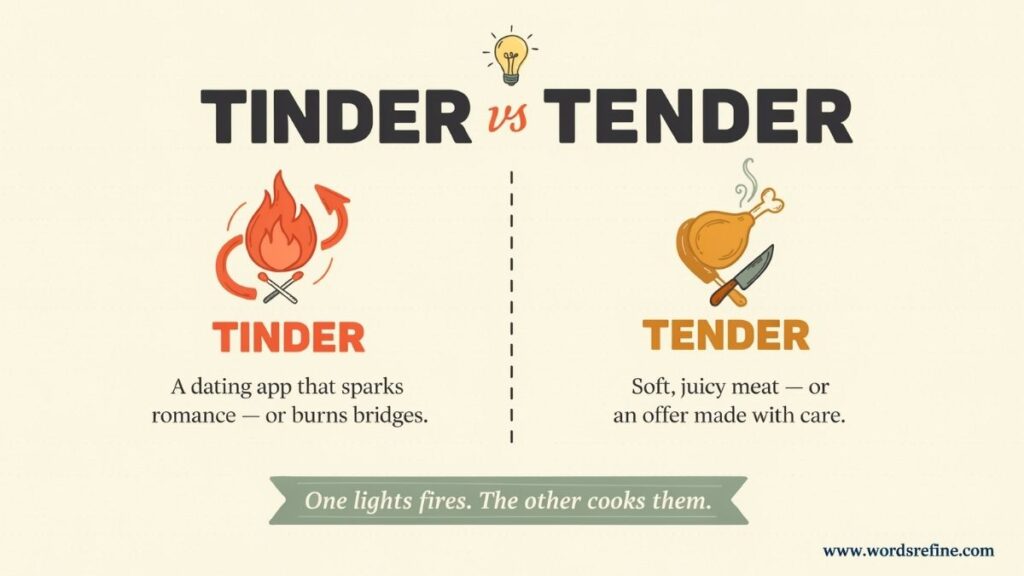
Have you ever written a word that looked right but conveyed an entirely different meaning? Tinder vs tender can cause exactly that kind of confusion. Although they differ by only one letter, tinder refers to material used to start a fire, while tender can describe softness, gentleness, soreness, or a formal offer. One small spelling slip can turn a perfectly ordinary sentence into a grammatical mix-up worth a chuckle! In this guide to tinder vs. tender, you’ll learn what each word means, explore examples of correct usage, and discover common mistakes to avoid. By understanding the difference, you’ll write more clearly, communicate accurately, and keep your grammar from going up in flames.
What Does Tinder Mean?
Tinder refers to dry, easily ignited material used to start a fire. People have relied on tinder for centuries to create fires for cooking, warmth, and survival.
Imagine trying to light a campfire with thick logs alone. The flame from a match might disappear before the logs catch fire. Tinder makes the process easier because it catches a spark or small flame quickly and helps ignite larger pieces of wood.
Common examples of tinder include dry grass, fine bark fibers, dry leaves, and wood shavings. Some commercial fire starters also serve the same purpose.
However, tinder differs from kindling and firewood. Each plays a separate role in building a fire.
Tinder catches the initial spark or flame. Kindling consists of small sticks and twigs that help the fire grow. Firewood includes larger pieces of wood that sustain the fire once it becomes established.
For example, you might gather dry grass for tinder, arrange thin twigs as kindling, and add larger logs after the flames grow stronger.
Moisture also matters. Wet leaves and damp wood can make fire-starting difficult because the heat must remove moisture before the material burns effectively. Therefore, dry tinder generally works better than damp material.
Tinder in Everyday English
Beyond its literal meaning, tinder can describe something that makes a larger event more likely to happen. This figurative use often appears when people discuss arguments, conflicts, or public anger.
For example, years of disagreement provided tinder for a bitter family dispute. Similarly, a controversial announcement might become tinder for public outrage.
In these sentences, tinder doesn’t refer to material that burns. Instead, it suggests that existing tension could quickly develop into something more serious.
The related word tinderbox has both a literal and a figurative meaning. Historically, a tinderbox held materials used to start a fire. Today, people often use the word to describe a tense situation that could erupt into conflict at any moment.
For instance, a community struggling with deep divisions might be described as a tinderbox waiting for a spark.
Learn the difference between confusing more English words
Instinctually vs Instinctively Which One Is Correct ?
What Does Tinder Mean as a Dating App?
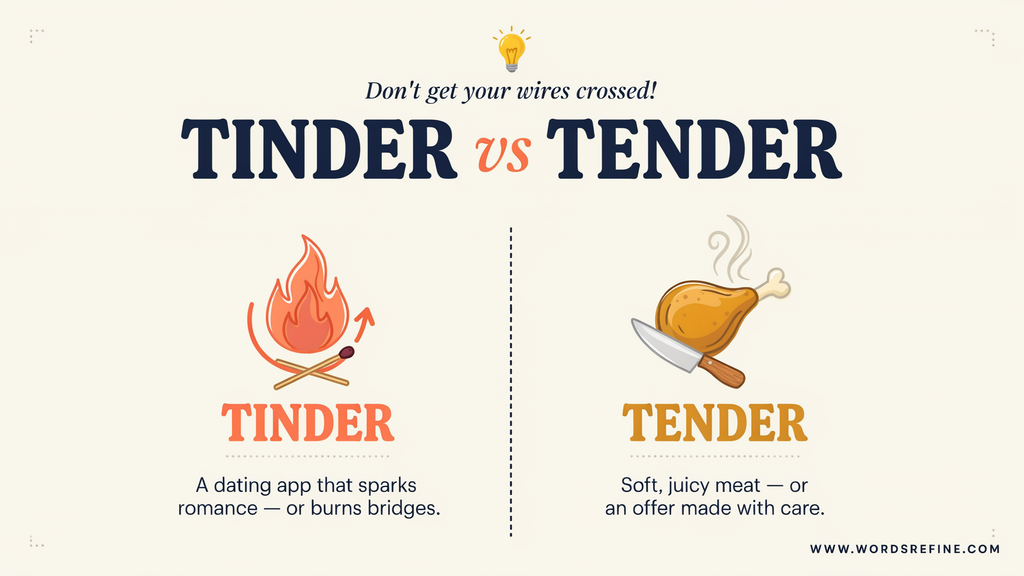
Tinder is also the name of a dating application that helps people discover potential romantic matches. Users create profiles, view other profiles, and express interest in people they would like to meet.
When two users express mutual interest through the app’s matching system, they can connect and communicate.
For example, someone might say, “My friend met her partner through Tinder.”
In this context, Tinder is a proper noun and takes a capital letter. By contrast, tinder remains lowercase when it refers to material used to start a fire.
Although the two uses share the same spelling, their meanings depend entirely on context.
What Does Tender Mean?
Tender has several meanings and can function as an adjective, a verb, or a noun. It can describe a gentle person, sensitive skin, soft food, or a formal business offer.
Because the word serves different purposes, the surrounding sentence usually tells you which meaning applies.
Tender as an Adjective
As an adjective, tender often means gentle, caring, delicate, soft, or sensitive. It can describe emotions, physical conditions, and food.
When you describe someone as tender, you may mean that the person treats others with kindness and affection. A tender moment might involve a parent comforting a child or a friend offering support during a difficult time.
For example, her father spoke in a tender voice as he reassured her. The sentence suggests warmth, kindness, and affection.
The expression tender loving care, often shortened to TLC, refers to attentive and compassionate treatment. People use it when discussing relationships, caregiving, pets, and even objects that need careful handling.
However, tender can also describe physical sensitivity. A person might have tender skin after a minor injury or a tender knee after an intense workout.
Consider this example: “My shoulder feels tender after yesterday’s exercise.”
Here, tender means sore or sensitive rather than gentle or affectionate. The same word describes two different experiences, so context matters.
Learn the difference between commonly mixed-up more words
Ingenuine vs Ungenuine Which One Is Correct ?
Tender When Describing Food
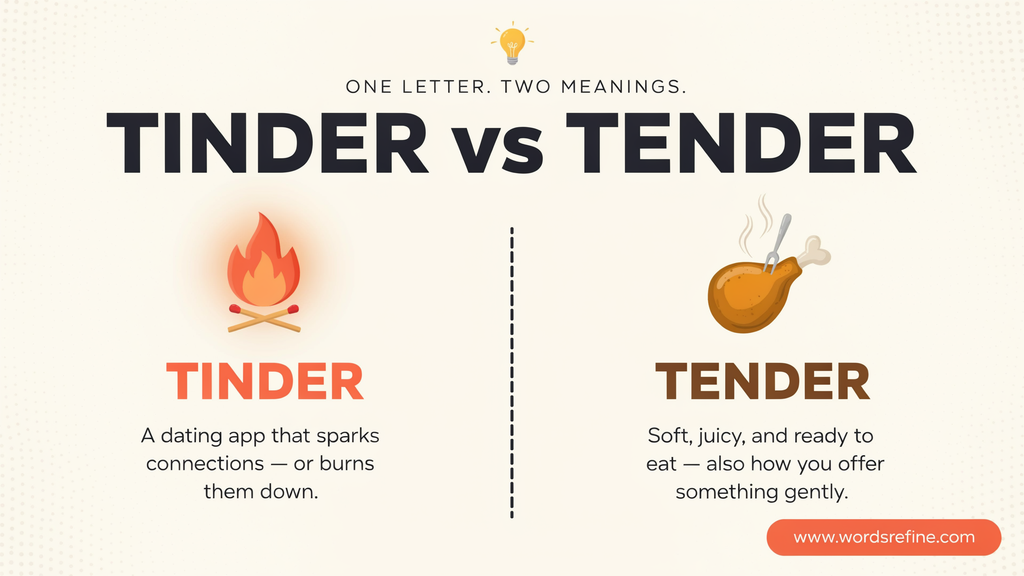
In cooking, tender describes food that feels soft and is easy to chew. Tender meat usually requires less effort to chew than tough meat.
For example, the beef became tender after several hours of slow cooking. Similarly, a chef might prepare chicken in a way that keeps the meat moist and tender.
The word describes texture rather than kindness or physical pain.
Several factors affect meat tenderness, including the cut, the amount of connective tissue, preparation, and cooking method. Some cuts benefit from slow cooking, while others remain tender with shorter cooking times.
However, tenderness and food safety aren’t the same thing. Meat can feel soft without necessarily reaching a safe internal temperature.
Tender as a Verb
As a verb, tender means to offer, present, or formally submit something. You’ll often encounter this meaning in business, finance, legal documents, and official communication.
For example, a contractor might tender a bid for a construction project. A supplier might tender a proposal in response to a procurement notice.
In these situations, tender means to submit something formally rather than to describe softness or sensitivity.
The expression tender a payment means to offer payment for an amount owed. For instance, a customer might tender payment for an outstanding invoice.
However, offering payment doesn’t automatically mean that the recipient has accepted it or that every legal obligation has been fulfilled. The outcome depends on the circumstances and any applicable rules.
Another common expression is tender a resignation. This means formally submitting notice that you intend to leave a position.
For example, the director tendered her resignation after the board meeting.
Although the phrase sounds more formal than simply saying someone resigned, both expressions communicate the person’s decision to leave a position.
Tender as a Noun
As a noun, tender can refer to a formal offer or bid. It also has established meanings in transportation and maritime contexts.
In business, a tender is often a formal proposal submitted in response to a request for goods, services, or work. For example, a government agency might invite contractors to submit tenders for road repairs.
The contractors may provide prices, qualifications, schedules, and other required information. The organization then evaluates the submissions according to its procurement rules and selection criteria.
Depending on the process, the successful bidder may later enter into a contract.
Tender also has a maritime meaning. A tender boat is a smaller vessel used to transport people or supplies between a larger ship and shore. Cruise ships and yachts may use tenders when they cannot dock directly at a suitable pier.
For example, passengers might board a tender boat to reach an island where their cruise ship cannot dock.
In railway terminology, a tender can also refer to a vehicle attached to a locomotive to carry fuel and water. This use is particularly associated with steam locomotives.
Although these technical meanings are less common in everyday conversation, they remain established uses of the word.
Learn the difference between tricky grammar more words
Cadaver vs Corpse Which One Is Correct ?
Tinder vs Tender Key Differences

The main difference between tinder vs tender lies in their meanings and grammatical roles.
Tinder primarily refers to fire-starting material, although it can also describe something that may trigger conflict. Tender has a wider range of meanings, including gentleness, physical sensitivity, food texture, and formal offers.
Both words are correctly spelled in American and British English. Neither is a regional spelling variant of the other.
Their differences become clearer when you compare their common uses.
| Feature | Tinder | Tender |
|---|---|---|
| Main meaning | Dry material that catches fire easily | Gentle, sensitive, sore, soft, or formally offered |
| Grammatical role | Primarily a noun | Noun, verb, and adjective |
| Common contexts | Camping, fire-starting, figurative conflict | Emotions, food, physical sensitivity, business |
| Example | We gathered tinder for the fire. | The meat became tender. |
| Business use | Not normally used for formal bids | Refers to a formal offer or submission |
| Capitalization | Tinder when naming the dating app | Tender in ordinary usage, unless standard capitalization rules apply |
The surrounding words provide useful clues. Expressions such as dry tinder, campfire tinder, and tinderbox usually relate to fire or potential conflict. Meanwhile, tender feelings, tender skin, tender meat, and tender a bid point toward different meanings of tender.
Therefore, the best way to choose between them is to consider what you want the sentence to communicate.
Tinder vs Tender Pronunciation
Tinder vs tender look similar, but they aren’t pronounced the same way.
In standard American English, the first vowel in tinder sounds like the vowel in sit. The first vowel in tender sounds like the vowel in ten.
Both words have two syllables, with the stress on the first syllable. However, their different vowel sounds help distinguish them when spoken aloud.
Tinder is commonly transcribed as /ˈtɪn.dɚ/ in American English, while tender is commonly transcribed as /ˈtɛn.dɚ/. Pronunciation may vary slightly by accent.
Because the words sound different, they aren’t homophones. Homophones are words that sound alike but have different meanings, such as right and write.
Instead, tinder vs tender are commonly confused words because their spellings and pronunciations are similar enough to cause mistakes.
Paying attention to the first vowel can help you distinguish them when speaking, while understanding their meanings helps you choose the correct spelling when writing.
Tinder vs Tender Synonyms
Synonyms can make the distinction easier to understand, but you must choose them according to context.
Tinder synonyms include fire-starting material and, in some contexts, kindling. However, these terms aren’t always interchangeable. Tinder catches the initial spark or flame, while kindling usually helps that flame grow.
The word combustible is broader still. It describes something capable of burning, but not every combustible material makes suitable tinder.
Tender has several groups of synonyms because it carries multiple meanings.
| Meaning of tender | Possible synonyms |
|---|---|
| Gentle or caring | Kind, gentle, affectionate, compassionate |
| Soft food texture | Soft, succulent, easy to chew |
| Sore or sensitive | Painful, sensitive, sore |
| Formal business offer | Bid, proposal, submission |
| To offer formally | Present, submit, offer |
The opposite of tender also depends on its meaning. When tender describes someone’s behavior, possible opposites include harsh, cruel, and unkind. When it describes food, tough is a natural opposite.
For physical sensitivity, insensitive may work in some contexts, although it doesn’t always mean the same thing as painless.
Since tender has several meanings, no single synonym or antonym works in every sentence.
Learn the difference between confusing word pairs
Enflamed vs Inflamed Which One Is Correct ?
Why Do People Confuse Tinder vs Tender?
The words are easy to mix up because they share similar spelling patterns and differ by only one vowel. When people type quickly, they may remember the general appearance of a word without recalling the exact spelling.
Unfamiliar vocabulary can also cause confusion. Someone who regularly reads business documents may recognize tender as a formal offer but feel less familiar with its other meanings. Similarly, a person who rarely camps might not know that tinder refers to fire-starting material.
Autocorrect can contribute to the problem. Since both words are correctly spelled, a spell-checking tool may accept the wrong choice if it doesn’t recognize the intended meaning.
For example, consider the sentence, “We collected dry tender to light the campfire.”
A basic spelling checker might not flag tender because the word exists. However, the sentence requires tinder because the writer is describing material used to start a fire.
The same problem appears in the sentence, “The beef became tinder after cooking.”
Here, tender is the correct choice because the writer is describing the texture of the meat.
These examples show why proofreading involves more than checking spelling. You must also confirm that each word expresses the intended meaning.
How to Remember When to Use Tinder vs Tender
A simple memory trick can help you choose the correct word without stopping to think about complicated grammar rules.
Associate tinder with fire. Picture dry grass catching a spark and helping a campfire grow. Whenever you think about fire-starting material, remember tinder.
Associate tender with tenderness. Think of a gentle hug, a caring voice, sensitive skin, or soft meat. These examples connect tender with its common meanings.
For business writing, remember the expression tender a bid. When a company formally submits an offer, tender is the appropriate word.
Before choosing a spelling, ask yourself what the sentence describes.
If the sentence concerns fire-starting material, use tinder. If it describes gentleness, soreness, food texture, or a formal offer, use tender.
This simple habit can prevent many common spelling mistakes.
Learn the difference between basic English word mistakes
Trebled vs Tripled Which One Is Correct?
Common Mistakes With Tinder vs Tender
Even experienced writers sometimes choose the wrong word when typing quickly. Recognizing a few common mistakes can help you avoid them.
Using Tender for Fire-Starting Material
The correct word is tinder when you mean dry material that catches fire easily.
Incorrect: The campers gathered dry tender before lighting the fire.
Correct: The campers gathered dry tinder before lighting the fire.
Using Tinder to Describe Food
When food is soft and easy to chew, use tender.
Incorrect: The chef cooked the beef until it became tinder.
Correct: The chef cooked the beef until it became tender.
Using Tinder to Describe Affection
When describing kindness or a gentle gesture, choose tender.
Incorrect: He gave his daughter a tinder hug.
Correct: He gave his daughter a tender hug.
Confusing Tender With a Business Bid
In business writing, tender can refer to a formal bid or proposal. Tinder doesn’t have this standard meaning.
Incorrect: The contractor submitted a tinder for the construction project.
Correct: The contractor submitted a tender for the construction project.
Treating the Words as Regional Spellings
Tinder vs tender aren’t alternative spellings of the same word. Both exist in American and British English, and their meanings remain distinct.
Changing from American to British English won’t make them interchangeable.
Capitalizing Tinder Unnecessarily
Use lowercase tinder when referring to fire-starting material in ordinary sentences.
For example, “The guide explains how to prepare tinder for a campfire.”
Capitalize Tinder when referring to the dating app. Otherwise, follow standard capitalization rules, such as capitalizing a word at the beginning of a sentence.
Learn the difference between commonly misused words
Hierarchical vs Hierarchal Which One Is Correct?
Tinder vs Tender in Everyday and Professional Writing
The right word depends on both meaning and context. Although the difference is easy to understand, using each word correctly becomes especially important in professional communication.
In everyday conversation, tinder often appears in discussions about camping, fire-starting, and survival skills. It can also appear in figurative descriptions of conflict.
For example, “The dry grass made excellent tinder for our campfire.”
Tender, on the other hand, frequently appears when people describe food, relationships, physical discomfort, or caring behavior.
For example, “Her grandmother’s tender words helped her feel better.”
Professional writing introduces another important use of tender. Businesses and public organizations often use the word when discussing procurement, construction projects, and formal offers.
A sentence such as “The agency invited qualified contractors to submit tenders for the bridge renovation” uses tender in its formal business sense.
The word can also appear in financial and legal expressions, including tender a payment and tender a resignation. In these situations, precise wording matters because the phrase may describe a specific formal action.
Academic writers sometimes use tinder metaphorically to explain how existing conditions can trigger a larger event. For example, a historian might describe economic hardship as tinder for social unrest.
In each case, the surrounding words help establish the intended meaning. A little attention to context can make your writing more accurate and easier to understand.
Examples of Tinder vs Tender in Sentences
The following examples show how each word works in different situations.
Examples of Tinder
We collected dry leaves and bark to use as tinder.
The camper stored the tinder in a waterproof container to keep it dry.
The sparks caught the tinder and started a small flame.
Damp weather made it difficult to find suitable tinder in the forest.
The speaker’s inflammatory remarks became tinder for public anger.
Years of resentment provided tinder for a bitter family argument.
She learned to identify natural fire-starting tinder during her wilderness course.
My friend met his current partner through Tinder.
These sentences show how tinder can refer to fire-starting material, a potential trigger for conflict, or the dating application when capitalized.
Examples of Tender
The nurse used a gentle touch when examining the tender skin around the wound.
The slow-cooked beef was tender and flavorful.
He spoke in a tender voice while comforting his younger brother.
The child gave her mother a tender hug.
The contractor submitted a tender before the deadline.
The customer tendered payment for the outstanding balance.
The executive tendered her resignation after accepting another position.
The passengers traveled to shore in a tender boat.
The steam locomotive carried fuel and water in a tender.
The company invited qualified suppliers to tender proposals for the project.
Each sentence demonstrates a different use of tender. The adjective describes a quality or condition, the verb describes a formal action, and the noun identifies an offer or supporting vehicle.
A Practical Example of the Difference
Imagine a writer preparing a camping guide that includes instructions for building a fire and cooking dinner.
The original draft reads:
“Gather dry tender before arranging the kindling. Once the fire grows, cook the meat until it becomes tinder.”
Both sentences contain errors, even though readers can probably guess what the writer means.
The corrected version reads:
“Gather dry tinder before arranging the kindling. Once the fire grows, cook the meat until it becomes tender.”
The first correction identifies the material needed to start the fire. The second describes the texture of the cooked meat.
This example illustrates an important principle: the correct word depends on the meaning you want to communicate. Similar spelling doesn’t mean similar meaning.
Is Tinder Related to Tender?
Although tinder vs tender look similar, you shouldn’t assume they share the same origin or meaning simply because they differ by one letter.
Tinder developed as a word for combustible material used to start a fire. Tender has a separate history and several meanings associated with softness, sensitivity, and formal offering.
Their modern definitions remain distinct. The resemblance between their spellings makes them easy to confuse, but it doesn’t make them interchangeable.
This distinction also explains why the words aren’t homophones. Homophones share a pronunciation, whereas tinder vs tender have different vowel sounds in standard American English.
When you’re unsure about a word’s meaning, checking a reputable dictionary can help you confirm its definition, pronunciation, and usage.
Learn the difference between everyday English mistakes
Taylored vs Tailored Which One Is Correct?
Practice Session Tinder vs tender
1. The campers gathered dry leaves and small twigs to use as ______ for starting a fire.
2. The nurse was gentle and ______ while treating the injured child.
3. He used a match to ignite the ______ and start the campfire.
4. The chef cooked the beef until it became soft and ______.
5. The bruised area on her arm felt ______ when she touched it.
6. Dry grass and bark can serve as ______ when starting a fire outdoors.
7. The construction company submitted a competitive ______ for the new highway project.
8. The mother gave her baby a ______ kiss on the forehead.
9. The steak was so ______ that it was easy to cut with a fork.
10. He gathered dry wood and ______ before lighting the fireplace.
11. The company reviewed the contractor’s ______ before awarding the project.
12. My feet became sore and ______ after walking for several hours.
13. The hikers collected dry leaves and bark to use as ______ for their campfire.
14. She spoke in a ______ voice to comfort her frightened dog.
15. The government invited construction firms to submit a ______ for the bridge project.
16. His skin felt ______ after he spent too much time in the sun.
17. The dry pine needles made excellent ______ for starting the campfire.
18. The chef used a slow-cooking method to make the meat more ______.
19. The child felt ______ about leaving his parents for the first time.
20. They collected enough ______ to start a fire during their camping trip.
21. The business owner submitted a formal ______ to purchase the property.
22. The doctor examined the ______ area around the patient’s injured knee.
23. A spark quickly ignited the dry ______ near the fireplace.
24. The grandmother gave her grandson a ______ hug before he left.
25. Before awarding the contract, the committee compared the ______ submitted by the bidders.
Answers
- Tinder
- Tender
- Tinder
- Tender
- Tender
- Tinder
- Tender
- Tender
- Tender
- Tinder
- Tender
- Tender
- Tinder
- Tender
- Tender
- Tender
- Tinder
- Tender
- Tender
- Tinder
- Tender
- Tender
- Tinder
- Tender
- Tenders
Here’s a trusted source for clear more words Comparison:
FAQs
What is the difference between tinder vs tender?
Tinder refers to dry material that helps start a fire, while tender describes something gentle, soft, sensitive, or sore. As a noun, tender can also mean a formal offer or bid for a project.
What does tinder mean besides fire-starting material?
Besides its traditional meaning, Tinder is the name of a dating app that helps people connect with potential romantic partners. The intended meaning depends on the context.
Can tender be used as a noun?
Yes. As a noun, tender can refer to a formal bid for a contract or project. It can also describe a small boat used to transport people or supplies to and from a larger vessel.
What does tender mean when describing food?
When describing food, tender means soft and easy to chew. For example, slow-cooked beef often becomes tender after several hours of cooking.
What does tender mean when describing a person?
Tender describes someone who shows kindness, affection, or gentleness. For example, a tender response can comfort someone who feels upset or anxious.
What is the difference between tender and tenderness?
Tender can function as an adjective, verb, or noun, depending on the sentence. Tenderness is a noun that describes gentleness, affection, sensitivity, or physical soreness.
Is tinder the same as kindling?
No. Tinder consists of easily ignited materials, such as dry grass and fine bark, that help a fire catch. Kindling usually consists of small sticks or pieces of wood that help the fire grow.
How can you remember the difference between tinder vs tender?
Connect tinder with starting a fire and tender with tenderness, softness, or sensitivity. This simple memory trick can help you choose the correct word and avoid confusion when writing.
Learn the difference between more words people mix up
Siked vs Psyched Which One Is Correct?
Conclusion
Although tinder vs tender differ by just one letter, their meanings couldn’t be more different. Tinder helps start a fire, while tender describes softness, gentleness, sensitivity, or a formal offer. Confusing these words can turn an ordinary sentence into an unexpected comedy. After all, tender meat belongs on your plate, while tinder belongs near a carefully controlled fire!
To avoid this common grammar mistake, remember the simple distinction: tinder starts fires, while tender describes softness, care, or an offer. With a little practice and attention to context, you’ll choose the right word with confidence. Good grammar keeps your meaning clear and your writing on point. There’s no need to let one misplaced letter turn a helpful sentence into a linguistic bonfire.

Diora AJS she is an experienced blogger and passionate English language enthusiast at Words Refine. With a keen eye for language and a love for clear communication, she writes practical content about grammar, word meanings, usage, and commonly confused terms. Her goal is to make English easier to understand through clear explanations and relatable examples, helping readers write accurately and communicate with confidence.