Have you ever mixed up jibe vs jive while writing a sentence? You are certainly not the only one. These words look similar, yet their meanings and uses differ. Jibe generally means to agree, match, or be consistent with something, while jive is commonly associated with music, dancing, or slang for nonsense and misleading talk. However, things get a little tricky because some speakers use jive informally to mean agree. This overlap can leave even confident writers second-guessing themselves. By understanding their meanings, differences, and correct usage, you’ll avoid common mistakes and choose the right word without letting grammar confusion throw you off beat.
Jibe vs Jive Quick Answer ?
Both jibe vs jive are correct English words, but their meanings differ.
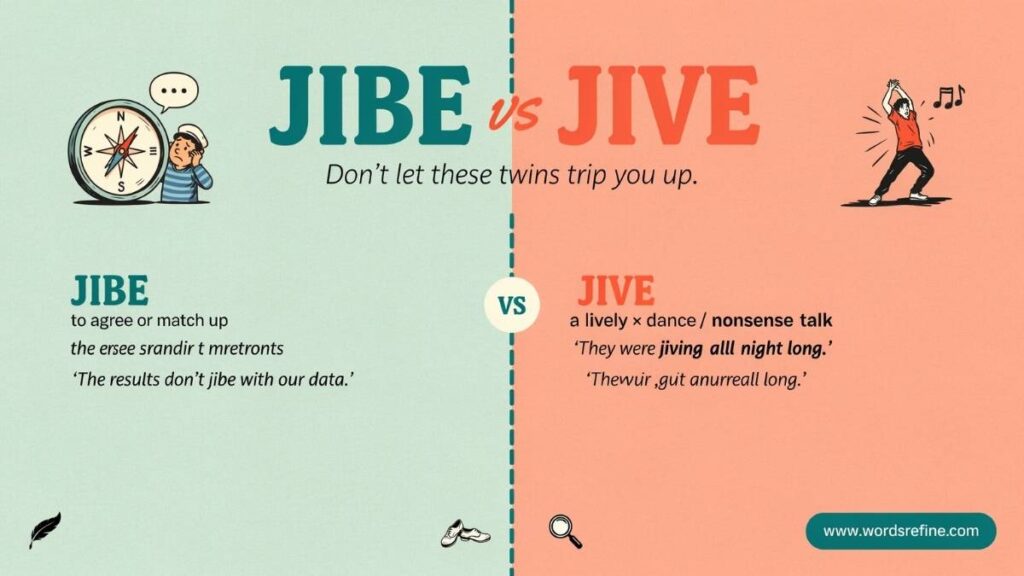
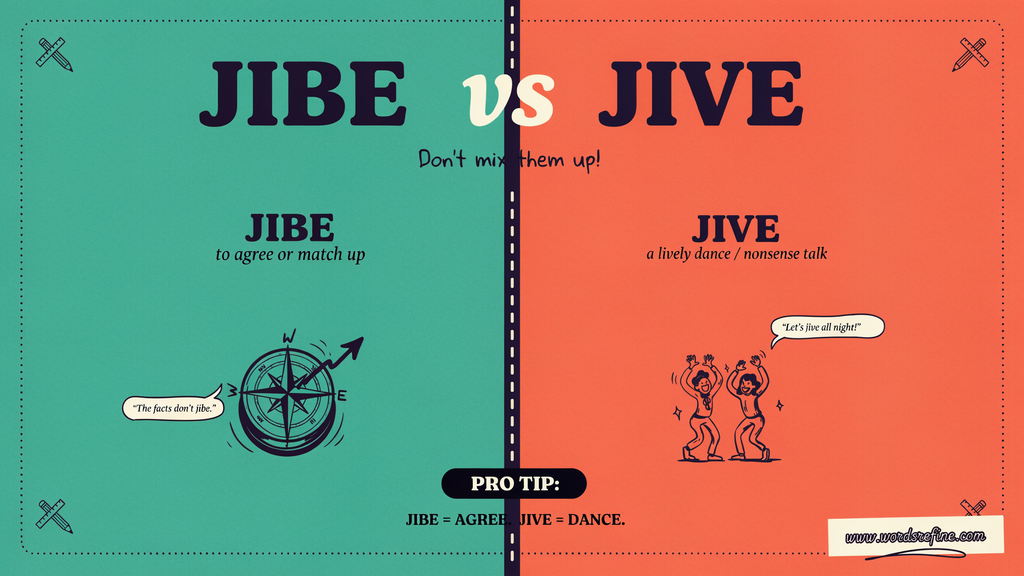
Jibe means to agree, match, or be consistent with something. For example, “Her explanation doesn’t jibe with the available evidence.”
Jive commonly refers to a style of music or dancing, as well as slang or misleading talk. For example, “The dancers performed an energetic jive.”
However, jive also appears informally with the meaning agree or correspond. You might hear someone say, “Those numbers don’t jive.” Although the meaning is clear, jibe remains the traditional choice in formal writing.
A simple way to remember the distinction is to associate jibe with agreement and jive with music, dancing, or slang.
Jibe vs Jive Key Differences
The main difference between jibe vs jive lies in their meanings and typical uses. Although some informal expressions overlap, the words aren’t interchangeable in every situation.
| Feature | Jibe | Jive |
|---|---|---|
| Main meaning | To agree, match, or be consistent | Music, dancing, slang, or misleading talk |
| Parts of speech | Primarily a verb; also a noun in other senses | Noun, verb, and adjective |
| Common expression | Jibe with the facts | Jive music or jive talk |
| Agreement meaning | Traditional and widely accepted | Used informally by some speakers |
| Formal writing | Preferred for agreement or consistency | Usually reserved for its established meanings |
| Example | The figures jibe with the report. | The couple learned the jive. |
As the table shows, context determines which word fits. For instance, if you’re checking whether a witness’s account matches the evidence, jibe is the conventional choice. However, if you’re describing a dance performance, jive is the appropriate word.
Even so, everyday English doesn’t always follow a strict divide. Some speakers use jive to mean agree or correspond, and readers generally understand what they mean. Nevertheless, jibe remains the safer choice for academic papers, professional reports, and carefully edited writing.
Learn the difference between confusing more English words
Broke vs Broken Meaning Differences and Correct Usage ?
Jibe vs Jive Pronunciation
The Jibe and jive look alike, but they don’t sound exactly the same.
The word “jibe” rhymes with “bribe and “vibe,” while the word “jive” rhymes with “five” and “dive.”
Both words begin with the same consonant sound, but jibe ends with a b sound and jive ends with a v sound.
Therefore, jibe and jive aren’t homophones in standard American English. Homophones are words that sound alike but have different meanings or spellings, such as write and right.
Their similar appearance and overlapping informal usage help explain why people confuse them. However, paying attention to pronunciation and context makes it easier to select the right spelling.
What Does Jibe Mean?
Jibe commonly functions as a verb meaning to agree, correspond, match, or be consistent with something. When two pieces of information jibe, they fit together without an obvious contradiction.
For example, imagine that a company reports $50,000 in monthly revenue. Its sales records show the same amount. In this case, the figures jibe because they agree.
Now suppose the company reports $50,000 in revenue, but its records show only $35,000. The numbers don’t jibe. The difference suggests that someone needs to investigate the discrepancy.
This meaning makes jibe useful when discussing facts, stories, evidence, reports, expectations, and explanations.
Jibe Meaning and Examples
The word jibe often appears when people compare information or determine whether different accounts agree. Here are some examples that show how it works in everyday English.
“The witness’s account doesn’t jibe with the security footage.” This means the witness’s account conflicts with what the video shows.
“Her explanation jibes with the investigation’s findings.” In this sentence, the explanation agrees with the available results.
“The budget doesn’t jibe with our original plan.” This means the available money doesn’t match the plan.
“His actions don’t jibe with his promises.” Here, what he does conflicts with what he says.
“The new figures jibe with the annual report.” This means the figures are consistent with the report.
“Her expectations didn’t jibe with reality.” In other words, what she expected differed from what actually happened.
Notice how jibe connects two things and describes their relationship. When the details agree, they jibe. When they conflict, they don’t.
Learn the difference between commonly mixed-up more words
Cloth vs Clothe Differences Examples and Correct Usage ?
What Does “Jibe With” Mean?
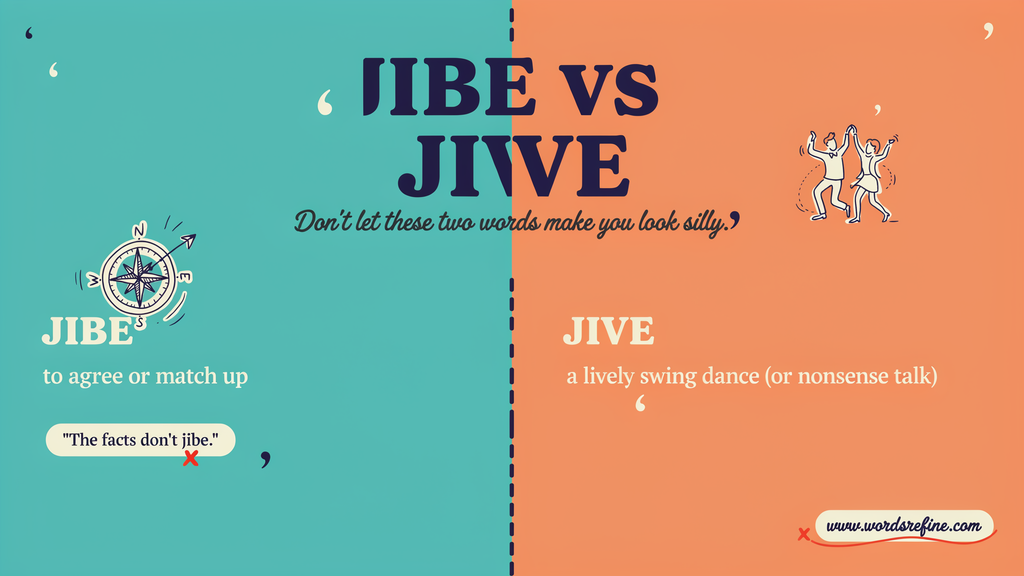
The phrase jibe with means to agree with, match, or be consistent with something. It connects one fact, claim, or idea to another.
For example, you might use these expressions in everyday conversation:
1.Jibe with the facts” means to agree with the facts.
2.Jibe with the evidence” means to be consistent with the available evidence.
3.Jibe with the report” means to match the information in the report.
4.Jibe with expectations” means to match what someone expected.
5.Jibe with someone’s account” means to agree with what that person said.
Each expression describes a relationship between two things. However, agreement doesn’t necessarily mean that two things are identical. They only need to match in the relevant way.
For instance, a researcher might write, “The findings jibe with earlier studies.” This means the new findings align with previous research. Although that agreement may support a conclusion, it doesn’t automatically prove that the conclusion is correct.
Similarly, a manager might say, “Those numbers don’t jibe with the quarterly report.” The figures don’t match, so the manager may need to investigate further.
Can Jibe Mean a Taunt or Mocking Remark?
Yes. Jibe also has a less common meaning related to a taunt or mocking remark. In this sense, it overlaps with gibe, a word that more directly describes an insulting comment or verbal jab.
For example, “The politician ignored the jibes from the audience.”
Here, jibes means mocking remarks rather than statements that agree with one another.
However, this meaning appears less often in everyday writing than the meaning associated with agreement. When you want to describe an insult, gibe is often the clearer choice because readers may otherwise interpret jibe as a reference to consistency.
What Does Jive Mean?
Jive has several established meanings. It can refer to music, dancing, slang, or misleading talk. Depending on the sentence, it can function as a noun, verb, or adjective.
Unlike jibe, which commonly describes agreement or consistency, jive often brings music, movement, performance, or informal speech to mind.
Jive Meaning in Music and Dance
One of the best-known uses of jive relates to jazz, swing music, and dancing. The word is associated with lively musical styles and dance traditions that developed alongside jazz and swing culture.
The jive dance style features energetic movements, quick steps, and rhythmic footwork. Competitive ballroom dancing also includes a dance called the jive, which draws on earlier swing-era dance traditions.
For example, a couple might perform an energetic jive at a dance competition. A band might play lively music that inspires people to dance, or a student might spend weeks learning the basic jive steps.
In these situations, jive refers to a dance or a musical context. Replacing it with jibe would change the meaning and make the sentence incorrect for the intended sense.
The word also appears in descriptions of jazz culture and historical slang. Therefore, its musical associations make it useful when discussing rhythm, performance, and dance.
Jive as a Noun
As a noun, jive can refer to a dance, a music-related style of movement, or insincere and misleading talk.
For example, “The dancers practiced the jive” refers to the dance. However, “I’m tired of hearing that jive” means the speaker is tired of hearing nonsense or untrustworthy talk.
Similarly, “The performer mixed humor with old-fashioned jive” refers to a style of slang or speech.
The surrounding words usually make the intended meaning clear. A dance instructor discussing steps is probably referring to the dance, while someone complaining about a dishonest sales pitch is using the slang meaning.
Jive as a Verb
As a verb, jive can mean to perform or engage in jive dancing. It can also describe speaking in a particular slang style.
For instance, performers might jive across a dance floor, or dancers might jive to lively music. A writer might also describe characters using exaggerated slang as they joke with each other.
In informal American English, some speakers use jive to mean agree or correspond. For example, “His explanation doesn’t jive with the evidence” means that his explanation doesn’t match the available evidence.
This informal use explains much of the confusion between jibe and jive. Although the meaning is established in everyday speech, jibe remains the traditional choice in formal and carefully edited writing.
Jive Slang Meaning Nonsense, Deception, and Empty Talk
The slang word jive can describe talk that sounds convincing but lacks honesty, substance, or credibility. Depending on the context, it may suggest nonsense, exaggeration, a false excuse, or misleading language.
For example, “Don’t give me that jive” means the speaker doesn’t believe or accept the explanation.
“He’s talking jive” suggests that his words are nonsense or misleading.
“Stop jiving me” is an informal expression that can mean stop fooling me, misleading me, or giving me an insincere story.
The exact tone depends on the situation. Someone might use these expressions jokingly with a friend or sharply when challenging another person’s honesty.
Because these phrases are informal, they generally work better in dialogue and casual conversation than in academic papers or formal reports.
It’s also worth recognizing the word’s history in African American speech and jazz culture. Jive isn’t simply a generic synonym for slang. Its meanings developed through particular musical and cultural traditions, so its tone can vary depending on the speaker and setting.
Is Jive a Slang Word?
Jive isn’t exclusively slang. It has established meanings related to music and dancing. However, expressions such as “that’s jive” and “stop jiving me” are informal and may sound dated or context-specific.
Therefore, choose the word according to your intended meaning and audience. In a dance review, jive is perfectly appropriate. In a financial report, jibe is generally the better option when you mean that two sets of figures agree.
Learn the difference between tricky grammar more words
Teams vs Teams Meaning Differences Accounts and Features ?
Jibe vs Jive Examples in Sentences
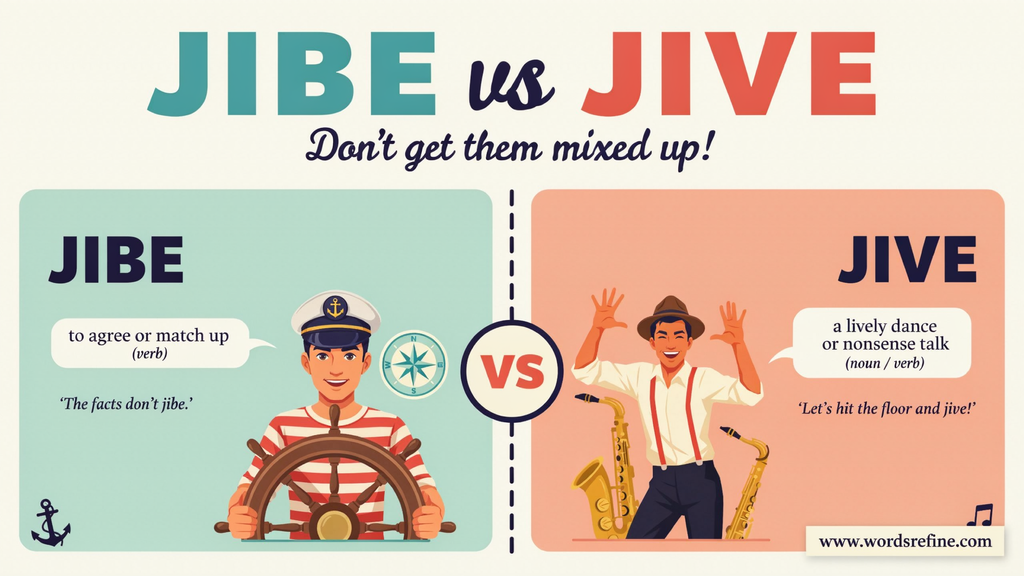
Sometimes, the easiest way to understand the difference between jibe and jive is to see the words in realistic situations. The following examples cover everyday conversation, workplace communication, research, and informal speech.
Jibe vs Jive in Everyday Sentences
| Sentence | Correct word | Explanation |
|---|---|---|
| Her explanation doesn’t ___ with the facts. | Jibe | The explanation needs to agree with the facts. |
| The couple learned the ___ before their dance competition. | Jive | The sentence refers to a dance style. |
| His account doesn’t ___ with the security footage. | Jibe | The account conflicts with the available evidence. |
| The band played lively ___ music. | Jive | The word describes a musical style. |
| I’m not buying that ___ about your missing homework. | Jive | The speaker means a dubious excuse or nonsense. |
| The results ___ with our initial expectations. | Jibe | The results match what people expected. |
| They practiced the ___ for weeks before the show. | Jive | The sentence describes dance practice. |
| The witness’s story doesn’t ___ with the report. | Jibe | The two accounts appear inconsistent. |
These examples show why it’s important to identify the intended meaning before choosing a spelling.
Jibe Examples in Professional and Academic Writing
In professional writing, jibe helps explain whether information supports a claim or matches another source. The word is especially useful in research, finance, journalism, and legal discussions.
In research, a writer might say, “The experimental results jibe with the findings of earlier studies.” The new results agree with previous research. That consistency may strengthen the case for a conclusion, although agreement alone doesn’t prove that the conclusion is correct.
In finance, someone might write, “The numbers don’t jibe with the report submitted last quarter.” The figures differ from those in the earlier report. An accountant might investigate whether the discrepancy resulted from an error, a change in reporting methods, or an incomplete record.
In journalism, a reporter might write, “The official statement doesn’t jibe with eyewitness accounts.” The statement conflicts with what witnesses reported. A responsible journalist would investigate the discrepancy rather than assume either account is automatically correct.
In workplace communication, a manager might say, “The proposed timeline doesn’t jibe with the resources available to the team.” The schedule doesn’t match the team’s capacity, which points to a practical conflict between expectations and resources.
In each example, jibe describes the relationship between pieces of information. It doesn’t automatically establish which statement is true. Two claims can agree and still be inaccurate.
When the Numbers Don’t Jibe
Imagine a small business owner reviewing a monthly sales report. The report lists $24,000 in revenue, but the payment records show only $21,500 in completed transactions.
The owner might write, “The reported revenue doesn’t jibe with the payment records.”
That sentence identifies a mismatch without accusing anyone of dishonesty or assuming the report contains an error. It simply states that the two sources don’t agree.
The next step is to investigate the $2,500 difference. Perhaps the report includes unpaid invoices, a refund was recorded incorrectly, or someone used a different reporting period.
This example shows why jibe is useful in analytical writing. It describes an inconsistency without jumping to conclusions about its cause.
Learn the difference between confusing word pairs
Peak vs Pique Differences Examples and Correct Usage ?
When Jive Fits Better
Imagine a dance instructor preparing students for a swing-themed performance. The instructor explains the rhythm, demonstrates the footwork, and asks the group to practice the jive.
A suitable sentence would be, “The students practiced the jive until their movements matched the music.”
Here, jive identifies the dance. The sentence has nothing to do with whether two reports or statements agree.
The distinction becomes straightforward once you identify the subject. If the sentence concerns consistency, consider jibe. If it concerns dancing, music, or an established slang meaning, jive may be the right choice.
Jibe With vs Jive With Which Is Correct?
One of the most common questions about these words is whether to write jibe with or jive with. The traditional answer is jibe with when you mean that something agrees, matches, or corresponds with something else.
For example, the testimony jibes with the physical evidence. Her explanation doesn’t jibe with the timeline. The figures jibe with the published report. Their plans don’t jibe with the available budget.
In these sentences, jibe with expresses consistency or agreement.
However, you’ll also encounter jive with in informal American English. Many speakers use it in the same way, particularly in casual conversation.
For example, someone might say, “Your explanation doesn’t jive with what you told me yesterday.”
Most readers will understand the intended meaning. Nevertheless, if you’re writing an academic paper, formal business report, or carefully edited article, jibe with is the more conservative choice.
Doesn’t Jibe or Doesn’t Jive?
Both expressions appear in real-world usage, but traditional editorial guidance doesn’t treat them equally.
“Doesn’t jibe” is the conventional choice when something doesn’t agree or correspond. “Doesn’t jive” is an informal alternative used by some speakers to express the same idea.
Compare these sentences:
“The witness’s statement doesn’t jibe with the recording.”
“The witness’s statement doesn’t jive with the recording.”
Both communicate a mismatch. The first follows the traditional recommendation, while the second reflects informal usage.
If you’re unsure which form to choose, use doesn’t jibe. It communicates the intended meaning clearly and avoids distracting readers who prefer the traditional distinction.
Do the Facts Jibe vs Jive?
When you want to ask whether facts agree with each other, “Do the facts jibe?” is the conventional choice.
For example, “The figures from both departments jibe with each other” means the two departments reported matching figures.
You could also write, “The figures from both departments don’t jibe.” This signals a discrepancy without explaining why the numbers differ.
Although you may hear “Do the facts jive?” in conversation, jibe is the safer choice for formal or carefully edited writing.
Jibe, Jive, and Gibe What’s the Difference?
The word gibe adds another layer to the spelling question. All three words are real, but they carry different meanings. Understanding the distinction helps you avoid confusing agreement with music or mockery.
| Word | Main meaning | Example |
|---|---|---|
| Jibe | To agree, match, or be consistent | The story doesn’t jibe with the evidence. |
| Jive | Music, dance, slang, or misleading talk | The dancers performed the jive. |
| Gibe | A mocking or insulting remark | She ignored the audience’s gibes. |
Gibe Meaning and Usage
A gibe is a taunt, sneer, or mocking comment intended to ridicule or provoke someone. As a verb, gibe means to make such a remark.
For example, a comedian might respond to the audience’s gibes with a joke. Coworkers might exchange good-natured gibes about their favorite sports teams, or someone might refuse to gibe at an opponent during a debate.
The word often describes verbal mockery rather than a serious argument. Depending on the context, a gibe might be playful, sarcastic, or deliberately insulting.
Jibe vs Gibe
The difference between jibe and gibe depends on the intended meaning.
Use jibe when you mean that something agrees or corresponds with something else. Use gibe when you mean a taunt or mocking remark.
For instance, “The report doesn’t jibe with the facts” describes an inconsistency. However, “The report attracted several gibes” means people mocked it.
Because jibe can also carry the less common meaning of a taunt, the words overlap somewhat. Still, gibe is often the clearer choice when mockery is the intended meaning.
Learn the difference between often confused words
Labor Day vs Labour Day Meaning and Usage ?
What Does Jibe Mean in Sailing?
In sailing, jibe has a separate technical meaning. It describes a maneuver in which a sailboat turns its stern through the wind, causing the sail to move from one side of the boat to the other.
The maneuver is also spelled gybe, particularly in British sailing terminology. Both spellings refer to the same basic action.
A jibe can happen during a downwind turn. Because the boom may swing quickly across the boat, sailors must manage the maneuver carefully.
For example, “The skipper prepared the crew for a jibe as the boat changed direction.”
In this context, jibe has nothing to do with agreement, and jive wouldn’t be an appropriate substitute. The sailing meaning is another reason to consider context before deciding which spelling fits.
How to Remember Jibe vs Jive
Remembering the difference between jibe vs jive doesn’t require a complicated grammar rule. A simple association can make the choice easier.
Jibe means agreement. Think of two pieces of information that fit together. When a story jibes with the evidence, the details agree.
Jive brings music, dancing, and slang to mind. Picture dancers moving to lively music or someone dismissing an excuse as nonsense.
Try these examples:
The facts jibe with the witness’s account.
The couple danced the jive.
His excuse sounds like jive.
The results don’t jibe with the prediction.
When you encounter a confusing sentence, ask yourself what it describes. Is it about matching facts, or is it about dancing, music, or slang? That question usually points you toward the right word.
Common Mistakes With Jibe vs Jive
Even experienced writers confuse these words because everyday usage doesn’t always follow traditional recommendations. Fortunately, a few simple corrections can help.
Using Jive When Jibe Is the Better Choice
For traditional formal usage, “The evidence doesn’t jive with the claim” isn’t the preferred form.
A better choice is “The evidence doesn’t jibe with the claim.”
The first sentence reflects informal usage that many people understand. The second is the conventional choice for formal writing.
Assuming Jive Is Always Incorrect
It’s incorrect to assume that jive isn’t a real word. Jive is an established English word with musical, dance-related, and slang meanings. It also appears informally with the meaning agree or correspond.
The important point isn’t that one spelling is always correct. Instead, the words have different primary meanings and shouldn’t be treated as interchangeable in every context.
Confusing Jibe With Gibe
If you want to avoid ambiguity when describing an insult, consider using gibe.
For example, “He made a cruel gibe at her appearance” clearly describes a mocking remark.
Although jibe can also mean a taunt, gibe makes the intended meaning more obvious to many readers.
Ignoring the Context
Consider these two sentences: “The figures don’t jibe” and “The band played jive.”
The first concerns agreement, while the second concerns music. Choosing a word simply because it looks familiar can lead to mistakes, so always check the intended meaning.
Learn the difference between basic English word mistakes
Want vs Wont Meaning Differences and Usage ?
Practice Session Jibe vs Jive
- Her explanation doesn’t ______ with the evidence.
- The dancers learned how to ______ to the upbeat jazz music.
- His excuse doesn’t ______ with what he told us yesterday.
- The band played a lively tune, and everyone began to ______.
- The financial report doesn’t ______ with the figures in the spreadsheet.
- Stop giving me that ______ and tell me the truth.
- The witness’s statement didn’t ______ with the security footage.
- The performers entertained the crowd with music and ______ dancing.
- Your actions don’t ______ with your promises.
- He dismissed the criticism as nothing but ______.
- The details in her story don’t ______ with the facts.
- The musicians played jazz while the dancers ______ across the floor.
- The manager noticed that the sales figures didn’t ______ with the final report.
- He told his friend to stop talking ______ and explain what had happened.
- The research findings don’t ______ with the original theory.
- The dancers practiced their ______ routines before the performance.
- His version of events doesn’t ______ with the other witness’s account.
- She refused to believe his ______ about why he missed the meeting.
- The budget estimates don’t ______ with the company’s actual expenses.
- The audience enjoyed watching the performers ______ to the music.
- The facts in the article don’t ______ with the information in the official report.
- He suspected that the salesperson was giving him a lot of ______.
- The evidence should ______ with the conclusion if the argument is sound.
- The couple learned to ______ together during their dance lessons.
- Before publishing the report, the editor checked whether all the details ______ with the available evidence.
Answers
- jibe
- jive
- jibe
- jive
- jibe
- jive
- jibe
- jive
- jibe
- jive
- jibe
- jived
- jibe
- jive
- jibe
- jive
- jibe
- jive
- jibe
- jive
- jibe
- jive
- jibe
- jive
- jibed
Here’s a trusted source for clear more words Comparison:
FAQs
What Does Jive Mean in African American Vernacular English?
In African American Vernacular English, “jive” has been used to describe nonsense, misleading talk, or insincere behavior. Its meaning depends on the context, and some expressions may sound dated today.
Do People Still Use the Word Jive?
Yes, people still use “jive,” although its popularity varies by age, region, and context. You may hear it in conversations about music and dancing or in informal expressions that describe nonsense or dishonesty. However, some slang uses sound old-fashioned to modern speakers.
How Do You Use Jive in a Sentence?
You can use “jive” when discussing music, dancing, or informal speech. For example, “The band played a lively tune while the dancers jived across the floor.” In casual conversation, you might also hear, “I’m not buying that jive,” meaning you don’t believe what someone is saying.
What Does Jive Mean in Slang?
In slang, “jive” can refer to nonsense, deceptive talk, or insincere behavior. For example, “Stop giving me that jive” means “Stop making excuses or trying to mislead me.” The expression is informal and may sound dated, depending on the audience.
Are Jibe and Jive the Same Word?
No, “jibe” and “jive” have different traditional meanings. “Jibe” means to agree, match, or be consistent with something, as in “His explanation doesn’t jibe with the facts.” “Jive” usually relates to music, dancing, or misleading talk. Although some speakers use “jive” informally to mean “agree,” “jibe” remains the conventional choice in formal writing when describing consistency.
Learn the difference between commonly misused words
Councillor vs Counsellor Difference Spelling and Usage ?
Conclusion
Although jibe vs jive look and sound similar, they have different meanings that can change your sentence completely. Use jibe when something agrees with the facts or matches an explanation. Choose jive when you’re talking about music, dancing, or slang for nonsense and misleading talk. For instance, if someone’s excuse doesn’t jibe with the evidence, you might suspect they’re giving you a load of jive!
The trick is to pay attention to the context rather than letting these confusing words trip you up. While some speakers use jive informally to mean agree, jibe remains the standard choice in formal writing when describing consistency. Keep this simple distinction in mind, and you’ll avoid a common grammar mistake. After all, your words should jibe with your meaning, even when your sentences have a little jive!

Diora AJS she is an experienced blogger and passionate English language enthusiast at Words Refine. With a keen eye for language and a love for clear communication, she writes practical content about grammar, word meanings, usage, and commonly confused terms. Her goal is to make English easier to understand through clear explanations and relatable examples, helping readers write accurately and communicate with confidence.