
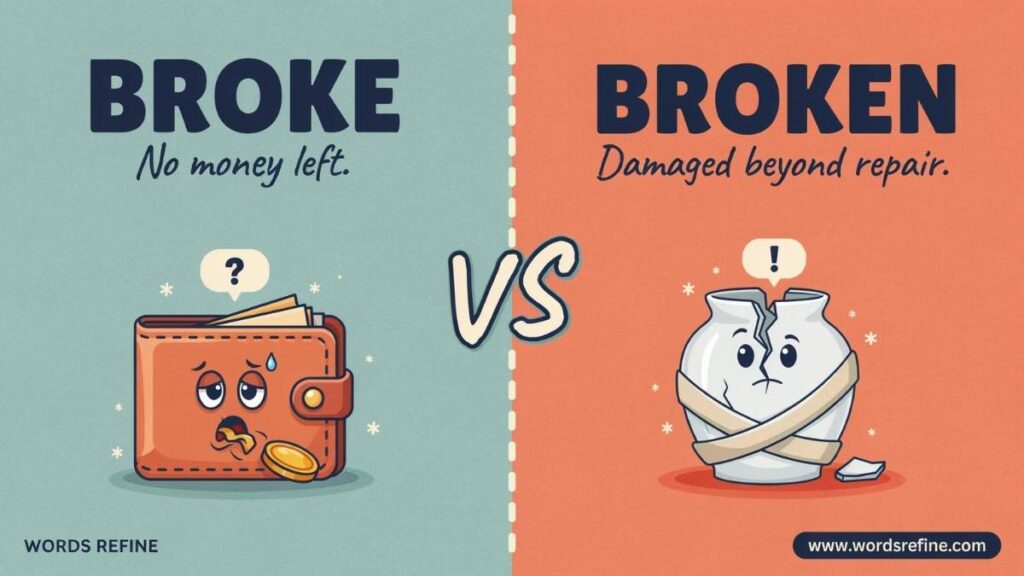
Choosing between broke vs broken can be surprisingly tricky. Although both words come from the verb “break,” they don’t work the same way in a sentence. Understanding broke vs. broken starts with recognizing their grammatical roles. “Broke” describes a past action, while “broken” often describes something damaged or appears with helping verbs. There’s one more twist: saying “I’m broke” means you’re short on money, not that you’ve been smashed like a dropped phone! By learning their meanings, differences, common mistakes, and correct usage, you’ll avoid confusing sentences and express yourself more clearly in everyday conversations and writing.
Broke vs Broken Quick Answer
The main difference between broke vs broken lies in their grammatical roles.
“Broke” is the simple past tense of “break.” It describes an action that happened in the past. For example, “She broke the glass.”
“Broken” is the past participle of “break.” It appears in perfect tenses and passive constructions. It can also function as an adjective describing a damaged condition. For example, “She has broken the glass” or “The glass is broken.”
Meanwhile, “broke” can serve as an informal adjective meaning that someone has little or no money. For instance, “I’m broke until payday.”
In simple terms, you broke vs broken something, and now it may be broken. However, if you have no money left, you can simply say, “I’m broke.”
What Does Broke Mean?
The word “broke” has two common uses in everyday English. It serves as the simple past tense of “break,” and it also functions as an informal adjective meaning that someone has little or no money. The surrounding sentence helps you determine which meaning applies.
Learn the difference between confusing more English words
Instalments vs Installments Which one Is Correct?
Broke as the Past Tense of Break
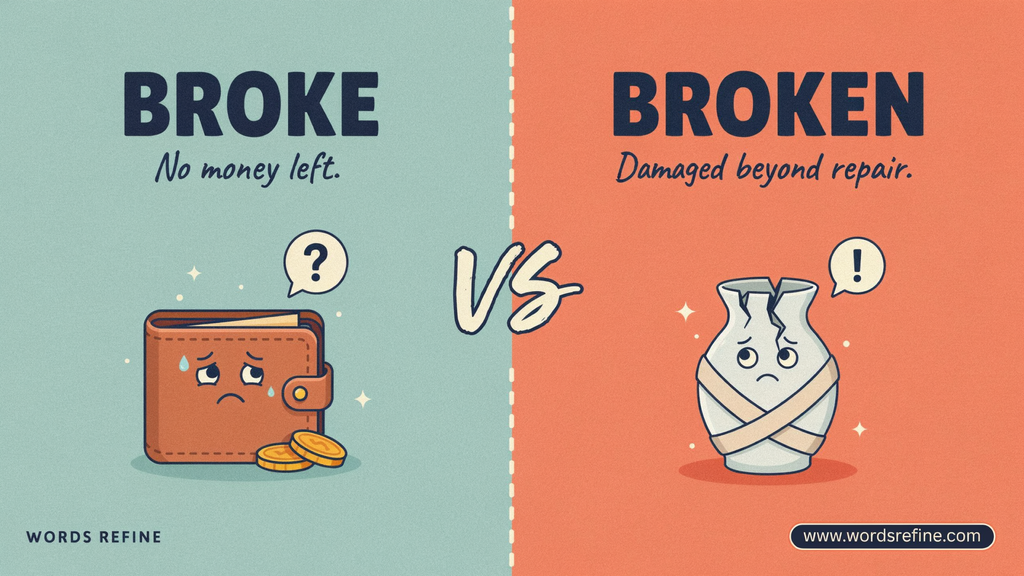
When you describe an action that happened and finished in the past, use “broke.” It’s an irregular verb form, so you cannot create it by simply adding “-ed” to “break.”
Consider these examples:
Maria broke her favorite coffee mug this morning.
The strong wind broke a branch off the tree.
Someone broke the classroom window during the storm.
He broke his promise to arrive on time.
The news broke just before the meeting began.
In each sentence, “broke” describes a past event. It tells you what happened rather than simply describing the current condition of something.
Notice that “broke” doesn’t need a helping verb in the simple past tense. You can write “The handle broke” or “They broke the handle.” Both sentences are correct, although the first focuses on what happened to the handle while the second identifies who caused the damage.
This distinction is useful when learning simple past tense verbs and other irregular verb forms in English grammar.
Broke as an Adjective Meaning Having No Money
Apart from its role as a verb, “broke” has another familiar meaning in American English. It describes someone who has little or no money available to spend.
For example, you might say, “I’m broke until Friday” or “We were broke after paying the rent.”
Similarly, someone might explain, “He can’t afford concert tickets because he’s broke.” In each case, the word describes a financial situation rather than physical damage.
This expression is informal, so it fits naturally into conversations with friends and family. However, in a professional report, you might choose a more precise phrase, such as “short on cash,” “experiencing financial hardship,” or “insolvent,” depending on the circumstances.
These expressions aren’t always interchangeable. Someone who is temporarily broke may simply have no spending money until payday. By contrast, an insolvent person or business cannot meet financial obligations. Therefore, context matters when choosing the most accurate expression.
Broke Definition and Examples
The following examples show how “broke” works in different situations.
| Sentence | Meaning | Grammatical role |
|---|---|---|
| I broke the plate. | Damaged the plate in the past | Verb |
| The branch broke during the storm. | Snapped or separated | Verb |
| She broke her promise. | Failed to keep a commitment | Verb |
| I’m broke this week. | Have little or no money | Informal adjective |
| The company went broke. | Failed financially | Informal expression |
As these examples show, “broke” doesn’t always describe physical damage. Its meaning depends on the context in which you use it.
Learn the difference between commonly mixed-up more words
Copyright vs Copywrite Which One Is Correct?
What Does Broken Mean?
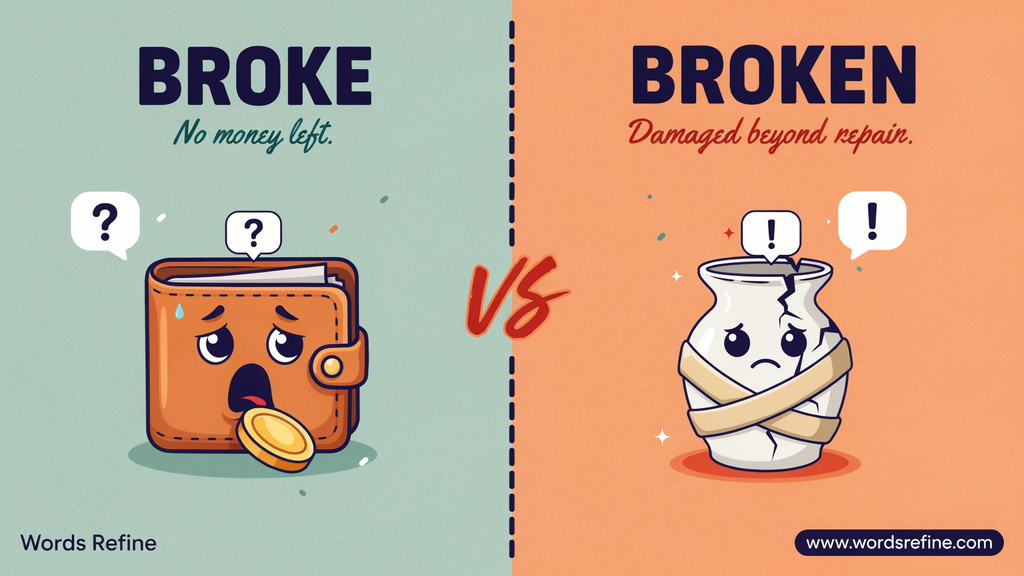
Unlike “broke,” “broken” is the past participle of “break.” It can also function as an adjective that describes a condition or state.
You’ll often encounter “broken” with helping verbs such as “have,” “has,” “had,” “is,” and “was.” For example, “I have broken the handle” uses the past participle in the present perfect tense. Meanwhile, “The handle is broken” describes the handle’s condition.
Although the same word appears in both sentences, its grammatical role differs.
Broken as a Past Participle
A past participle is a verb form used in perfect tenses and many passive constructions. Because “break” is irregular, its main forms don’t follow the usual pattern of adding “-ed.”
| Verb form | Word | Example |
|---|---|---|
| Base form | Break | I break things when I’m careless. |
| Third-person singular present | Breaks | The machine breaks down frequently. |
| Present participle | Breaking | She is breaking the chocolate into pieces. |
| Simple past | Broke | He broke the handle yesterday. |
| Past participle | Broken | He has broken the handle. |
These forms matter because English uses different verb structures to express when an action happens and how it relates to other events.
For example, “She broke the vase” places the action in the simple past. However, “She has broken the vase” uses the present perfect to connect the past event to the present. Similarly, “She had broken the vase before I arrived” uses the past perfect to show that one past event happened before another.
Therefore, “broken” isn’t simply another past-tense form of “break.” It’s the past participle, although it can also function as an adjective.
Broken as an Adjective
When “broken” functions as an adjective, it describes something that has been damaged, fractured, interrupted, or rendered unusable.
For example, you might say, “The broken chair needs to be repaired” or “My phone has a broken screen.” Likewise, “The washing machine is broken” tells someone that the appliance isn’t working properly.
The word can describe different kinds and degrees of damage. A broken phone screen might have a small crack or extensive damage. Similarly, a broken machine might malfunction without having any visibly damaged parts.
In other words, “broken” doesn’t always mean shattered into pieces. It can describe anything that no longer works or functions as intended.
Broken in Emotional and Figurative Expressions
English also uses “broken” to describe emotional pain, damaged trust, and failed relationships.
For instance, someone might say, “She felt broken after losing someone she loved.” Another person might explain, “Years of dishonesty left their friendship broken.”
In these examples, the word has a figurative meaning. It expresses emotional distress or damage to a relationship rather than a literal physical fracture. Likewise, a “broken heart” commonly refers to grief, disappointment, or the pain of a relationship ending.
However, these expressions don’t automatically mean that someone has a mental health condition. They describe feelings in everyday language, and their precise meaning depends on the situation.
Broken Definition and Examples
| Sentence | Meaning | Grammatical role |
|---|---|---|
| The window is broken. | The window is damaged. | Adjective |
| I have broken the seal. | A completed action with present relevance | Past participle |
| The rules were broken. | Someone violated the rules. | Past participle in a passive construction |
| She bought a broken laptop. | The laptop doesn’t work properly. | Adjective |
| He felt emotionally broken. | He felt deeply distressed. | Figurative adjective |
These examples demonstrate why you should consider both meaning and sentence structure when deciding whether to use “broke” or “broken.”
Learn the difference between tricky grammar more words
Dreamt vs Dreamed Which One Is Correct?
Broke vs Broken Key Differences
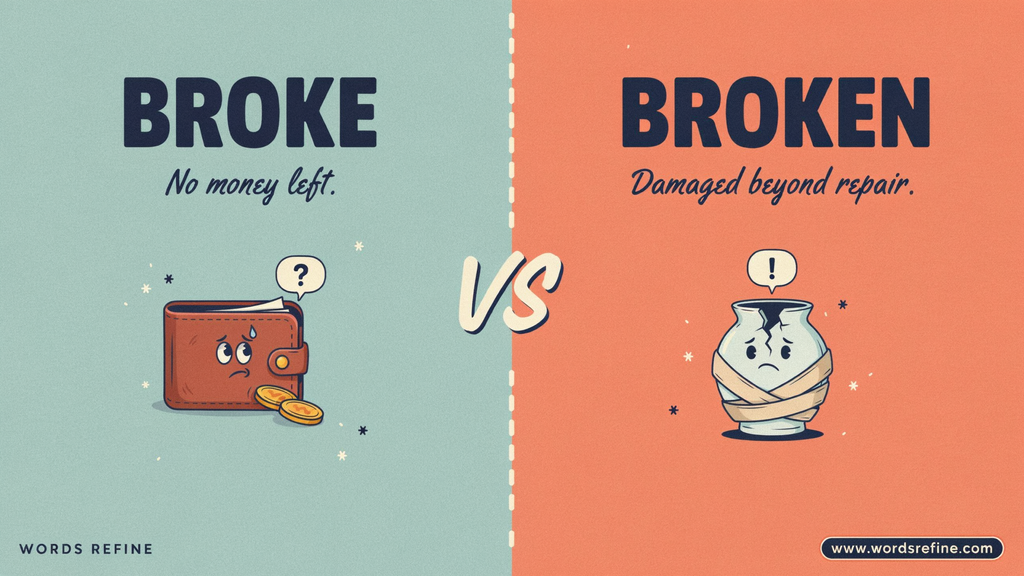
The difference between broke vs broken becomes clearer when you compare their grammatical roles. Both words relate to “break,” but they don’t fit into the same sentence patterns.
| Feature | Broke | Broken |
|---|---|---|
| Main grammatical role | Simple past-tense verb | Past participle; also an adjective |
| Basic meaning | An action happened in the past | An action has occurred or a condition exists |
| Perfect tenses | Not used as the standard past participle | Used with have, has, and had |
| Describing damage | Usually describes the past event | Commonly describes the damaged condition |
| Financial meaning | Informal adjective meaning having little or no money | Doesn’t normally mean having little or no money |
| Example | I broke the remote. | The remote is broken. |
Consider three sentences describing the same general situation.
“I broke the remote yesterday.”
“I have broken the remote.”
“The remote is broken.”
The first describes a past action. The second uses the present perfect and presents the past action as relevant to the present. The third describes the remote’s current condition.
Although the sentences relate to the same event, each emphasizes something different. Choosing the correct form helps readers understand exactly what you mean.
When to Use Broke in a Sentence
Use “broke” when you need the simple past tense of “break.” It works when a past action is complete and you aren’t using a perfect-tense construction.
Describing a Past Action
The most common sentence pattern is subject + broke + object.
For example, “I broke my glasses while playing basketball” describes an action that happened in the past. Similarly, “The child broke the toy by accident” explains what happened to the toy.
You can also use “broke” in expressions that don’t involve physical damage. Someone might break a rule, break a promise, break a habit, or break the silence.
Consider these sentences:
She broke the chocolate bar into four pieces.
The driver broke the speed limit.
He broke the silence with a joke.
In each example, “broke” describes a past action or event.
Using Broke Without an Object
You can also use “broke” without a direct object when the sentence focuses on the event itself.
For instance, “The glass broke when it hit the floor” describes what happened to the glass. Likewise, “The old branch broke in the wind” explains how the branch snapped.
You might also say, “The washing machine broke in the middle of a cycle” or “The news broke early that morning.”
Here, the subject undergoes a change or the verb describes an event. You don’t need to identify an object that someone deliberately broke.
Using Broke for Financial Situations
When “broke” means having little or no money, it functions as an informal adjective.
For example, “I’m broke, so I’ll cook dinner at home” is a natural expression in everyday conversation. Similarly, “After the unexpected car repair, we were broke for the rest of the month” describes a temporary financial problem.
The phrase “went broke” can also describe financial failure. However, use more specific financial language when the distinction matters. Being short on spending money isn’t necessarily the same as being bankrupt or unable to pay debts.
Learn the difference between confusing word pairs
Mobil vs Mobile Which one Is Correct?
When to Use Broken in a Sentence
Use “broken” when the sentence requires a past participle or when you want to describe a condition. The correct choice depends on the helping verb and the meaning you intend to express.
With Have, Has, and Had
Perfect tenses require the past participle “broken,” not the simple past “broke.”
For example, “I have broken my favorite mug” uses the present perfect. Similarly, “She has broken her glasses again” describes a past action with relevance to the present.
You can also use “broken” in the past perfect, as in “They had broken the lock before the security guard arrived.”
The present perfect combines “have” or “has” with “broken.” Meanwhile, the past perfect combines “had” with “broken.”
This is why “I have broke the mug” is incorrect in standard English. The auxiliary verb “have” requires the past participle in this construction.
With Is, Are, Was, and Were
When “broken” describes a condition, it commonly follows a linking verb.
For example, “My phone is broken” describes the phone’s current condition. Likewise, “The chairs are broken” tells you that the chairs are damaged.
You might also say, “The window was broken when we arrived” or “Several machines were broken after the power surge.”
In these sentences, “broken” tells you about the condition of the subject. The sentence doesn’t necessarily identify who caused the damage or exactly when it occurred.
In Passive Constructions
The past participle also appears in passive-voice sentences.
For instance, “The window was broken by a baseball” focuses on the window and what happened to it. Similarly, “The rules were broken during the competition” emphasizes the violation rather than the person responsible.
Other examples include “The record has been broken twice” and “The equipment had been broken before the technicians inspected it.”
Passive voice shifts attention toward the affected person or thing rather than the person who performed the action. It can be useful when the cause is unknown or unimportant.
Notice that “broken” doesn’t always function as an adjective in these examples. In a passive construction, it forms part of the verb phrase.
Broke vs Broken in Different Sentence Structures
Understanding sentence structure is one of the easiest ways to master the difference between broke vs broken these words. Instead of memorizing isolated definitions, pay attention to the words surrounding each form.
Simple Past Tense
Use “broke” to report a past action.
Correct: “Tom broke the window last night.”
Incorrect: “Tom broken the window last night.”
The second sentence lacks the grammatical structure needed for “broken.” In the simple past, the verb itself expresses the past meaning.
Present Perfect Tense
Use “have” or “has” with “broken.”
Correct: “Tom has broken the window.”
Incorrect: “Tom has broke the window.”
The present perfect often connects a past event to the present. For instance, the broken window may still need repair, or the speaker may be explaining why the room is cold.
Past Perfect Tense
Use “had broken” when you want to show that one event happened before another past event.
Correct: “Tom had broken the window before the neighbors arrived.”
Incorrect: “Tom had broke the window before the neighbors arrived.”
The past perfect helps establish the order of events. Tom broke the window first, and the neighbors arrived later.
Adjective Usage
Use “broken” to describe a damaged condition.
Correct: “The window is broken.”
Nonstandard in edited English: “The window is broke.”
The first sentence describes the window’s condition. The second uses “broke” where standard written English generally requires “broken.”
Passive Voice
Use a form of “be” with “broken” to create a passive construction.
For example, “The window was broken during the storm,” “The rules were broken by several competitors,” and “The record has been broken.”
These sentences focus on what happened to the subject. The person or force responsible may be unknown, unimportant, or mentioned separately.
Broke vs Broken Examples in Everyday English
Real-life examples help you understand how the distinction works in different broke vs broken situations.
| Situation | Correct sentence | Why it works |
|---|---|---|
| Damaged object in the past | I broke my headphones yesterday. | “Broke” describes a completed past action. |
| Current condition | My headphones are broken. | “Broken” describes the condition. |
| Recent past action | She has broken her glasses. | “Has” takes the past participle. |
| Earlier past action | He had broken the lock before we arrived. | “Had broken” is past perfect. |
| Financial difficulty | I’m broke until payday. | “Broke” means having little or no money. |
| Damaged screen | The phone has a broken screen. | “Broken” modifies the noun “screen.” |
| Failed agreement | They broke their promise. | “Broke” describes a past action. |
| Emotional distress | He felt broken after the loss. | “Broken” describes a figurative emotional state. |
| Machine failure | The printer broke during the meeting. | “Broke” describes the failure event. |
| Machine condition | The printer is broken. | “Broken” describes its current condition. |
A Real-Life Example A Broken Phone and an Empty Wallet
Imagine that Alex drops a phone on the kitchen floor. The screen cracks, and the device stops responding.
Alex tells a friend, “I broke my phone this morning.”
That sentence is correct because Alex is describing the event. Later, when someone asks why the phone won’t turn on, Alex replies, “My phone is broken.” This time, the sentence describes the phone’s condition.
After visiting a repair shop, Alex discovers that replacing the screen will cost more than expected. Alex then says, “I’m broke until payday.”
All three sentences use the same word family, but each communicates a different idea.
“I broke my phone” describes a past action.
“My phone is broken” describes physical damage or a resulting condition.
“I’m broke” describes a financial situation.
This simple example captures the central difference between the words. The context determines the meaning, while the sentence structure helps determine the correct form.
Learn the difference between more words people mix up
Fiancé vs Fiancée What’s the Difference and which is Correctly?
Is “My Phone Is Broke” Correct?
If you’re writing standard American English, use “My phone is broken” to describe a damaged phone.
The reason is grammatical. “Broken” works naturally as an adjective after “is,” telling the reader that the phone is damaged or not functioning as intended.
Compare these examples:
1“My phone broke yesterday” describes when the problem occurred.
2“My phone is broken” describes the phone’s condition.
3“My phone has broken” uses the present perfect and can describe a recent failure or a result that matters now.
4“My phone is broke” is generally nonstandard in edited English when you mean the phone is damaged.
People sometimes use nonstandard forms in casual speech. However, a phrase’s appearance in conversation doesn’t automatically make it the best choice for formal writing, school assignments, or professional communication.
Is “Got Broken” Grammatically Correct?
Yes, “got broken” can be grammatically correct. It often uses “got” as a form of the verb “get” in a construction that describes something happening to a person or object.
For example, “My phone got broken during the trip” and “The window got broken when the ball hit it” are understandable constructions. You might also say, “Several items got broken while the movers unloaded the truck.”
However, the passive construction with “was” often sounds more neutral or formal.
Compare “The window was broken during the storm” with “The window got broken during the storm.” Both can be correct. The first uses a conventional passive construction, while the second sounds more conversational and emphasizes the event or change in condition.
Remember that “got broken” differs from “got broke” in standard English when you’re describing damage. The past participle “broken” is the appropriate form in this construction.
Learn the difference between often confused words
Any time vs anytime meaning Difference with Examples ?
Broke vs Broken in American and British English
The basic distinction between “broke” and “broken” remains the same in American and British English. Both varieties use “broke” as the simple past tense of “break” and “broken” as the past participle.
For example, an American speaker might say, “I broke my glasses yesterday,” while a British speaker could use exactly the same sentence.
Likewise, “My glasses are broken” is standard in both varieties.
Regional differences may affect pronunciation, expressions, or preferences in certain contexts. However, “broke” and “broken” aren’t competing American and British spellings. They’re distinct grammatical forms of the same irregular verb.
Common Mistakes to Avoid
Even confident English speakers sometimes mix up these forms, particularly when using helping verbs or describing damaged objects.
| Incorrect or confusing sentence | Correct sentence | Explanation |
|---|---|---|
| I have broke my watch. | I have broken my watch. | “Have” requires the past participle. |
| She has broke the record. | She has broken the record. | Use “has broken” in the present perfect. |
| They had broke the rules. | They had broken the rules. | “Had” takes the past participle. |
| The door is broke. | The door is broken. | “Broken” is the standard adjective for a damaged condition. |
| I broken the glass yesterday. | I broke the glass yesterday. | Use the simple past without a helping verb. |
| My computer has broke. | My computer has broken. | The present perfect requires “broken.” |
| I’m broken until payday. | I’m broke until payday. | “Broke” is the usual informal adjective for having little money. |
One useful strategy is to identify the word’s role before choosing it. If you’re reporting a completed past action, “broke” will often fit. If you’re using “have,” “has,” or “had,” you generally need “broken.” and If you’re describing a damaged object, “broken” is usually the natural choice.
There’s one important qualification: “broken” can appear in a sentence without a helping verb when it modifies a noun. For example, “The broken chair stood in the corner.” Here, “broken” is an adjective, so it doesn’t need “is” or “was.”
Learn the difference between basic English word mistakes
Discrete vs Discreet What the Difference and which is Correctly?
Practice Session Broke vs Broken
- Emma accidentally ______ her favorite coffee mug yesterday.
- The glass was ______ during the heavy storm.
- My brother has ______ his phone twice this year.
- I ______ my watch while playing soccer.
- The washing machine is ______, so we need to repair it.
- He ______ his promise and upset his friends.
- The old toy is completely ______ and no longer works.
- We ______ the wooden chair while carrying it downstairs.
- Our car has ______ down on the way to work.
- She ______ the exciting news to her family yesterday.
- The laptop screen is ______, making it difficult to read anything.
- Daniel ______ his arm after falling off his bicycle.
- I have never ______ a bone in my body.
- The front door was already ______ when we got home.
- The athlete ______ the world record last year.
- My headphones are ______, and I can hear sound through only one side.
- He ______ a glass while washing the dishes.
- The window has been ______ for several days.
- They ______ the old rules and introduced a better system.
- She felt as though her heart was ______ after the breakup.
- I ______ my favorite pen during the examination.
- The mechanic explained that the engine was ______.
- The swimmer has ______ several records throughout her career.
- The printer ______ again, so I couldn’t print my homework.
- I’m completely ______ after paying my monthly bills.
Answers
- Broke
- Broken
- Broken
- Broke
- Broken
- Broke
- Broken
- Broke
- Broken
- Broke
- Broken
- Broke
- Broken
- Broken
- Broke
- Broken
- Broke
- Broken
- Broke
- Broken
- Broke
- Broken
- Broken
- Broke
- Broke
Here’s a trusted source for clear more words Comparison:
FAQs
What is the difference between “broke” vs “broken”?
“Broke” is the simple past tense of “break,” while “broken” is the past participle and can describe something damaged or no longer working. For example, “I broke my phone yesterday” describes an action, while “My phone is broken” describes its condition.
Is it correct to say “I’m broke”?
Yes, “I’m broke” is a common, grammatically correct expression meaning you have little or no money available. People often use it casually when they cannot afford something or have spent most of their money.
Can you be broke without being poor?
Yes. Being broke usually means you have little or no money available at a particular moment, while being poor generally refers to having limited financial resources over a longer period. Someone with a good salary can be temporarily broke after paying bills or covering unexpected expenses.
What does “I got broke” mean?
“I got broke” is generally incorrect if you mean you ran out of money. The natural expression is “I went broke” or “I became broke.” If you’re talking about a damaged object, use “It broke” or “It got broken,” depending on the context.
How do you politely say you’re broke?
You can say, “I’m a little short on money right now,” “My budget is tight this month,” or “I can’t afford that at the moment.” These expressions communicate financial limitations without sounding overly blunt or uncomfortable.
What are some alternatives to the word “broke”?
When referring to money, you can use phrases such as “short on cash,” “low on funds,” “financially strapped,” or “on a tight budget.” In formal situations, “experiencing financial difficulties” may be more appropriate. The best alternative depends on the context and tone.
What is a more formal word for “broke”?
“Financially strained,” “cash-strapped,” and “insolvent” are possible alternatives, but they have different meanings. “Cash-strapped” describes a shortage of available money, while “insolvent” refers to being unable to pay debts. For everyday writing, “experiencing financial difficulties” is often a suitable formal choice.
What does “broke” mean in slang?
In casual speech, “broke” usually means having little or no money to spend. For example, someone might say, “I can’t go out tonight because I’m broke.” The word can also appear in phrases such as “go broke,” meaning to lose your money or financial stability.
What is Gen Z slang for having no money?
Some younger speakers use expressions such as “broke,” “broke as hell,” or “down bad” to describe financial struggles. However, “down bad” can also refer to other difficult situations, so it doesn’t always mean being short on money. Slang varies by community and context.
What does it mean when someone says they’re emotionally broken?
When someone describes themselves as “broken,” they may mean they’re feeling deeply hurt, overwhelmed, or emotionally exhausted. The word is figurative in this context, not a literal description. It can express intense feelings, but it doesn’t automatically mean the person is unable to recover or feel better.
What does it mean when a man says he’s broken?
If a man says he’s broken, he may be expressing emotional pain, disappointment, grief, or exhaustion. The exact meaning depends on his circumstances and what he says around that statement. Rather than assuming what he feels, it’s usually better to listen and ask what he means.
How can you tell if someone feels emotionally broken?
Someone experiencing emotional distress may describe feeling hopeless, withdrawn, overwhelmed, or unable to cope with everyday challenges. However, these signs don’t prove that someone is emotionally broken. A compassionate conversation is more helpful than labeling the person.
Can “broken” describe something other than a damaged object?
Yes. “Broken” can describe physical damage, interrupted systems, violated promises, or emotional pain. For example, you can have a broken phone, a broken rule, a broken promise, or a broken heart. The meaning depends on how the word is used.
Which sentence is correct: “The phone broke” or “The phone is broken”?
Both sentences are correct, but they express different ideas. “The phone broke” describes the event in which the phone stopped working or became damaged. “The phone is broken” describes its current condition.
Can you use “broken” without a helping verb?
Yes. “Broken” can appear directly before a noun as an adjective, as in “a broken window” or “a broken chair.” It can also appear in participial phrases, such as “Broken during the move, the vase could no longer be used.”
Learn the difference between commonly misused words
Further vs Farther The Simple Difference and Each Correctly?
Conclusion
Although “broke” vs “broken” share the same root, each has a different job in a sentence. Use “broke” to describe a past action, as in “I broke my laptop yesterday.” Use “broken” to describe something damaged, as in “My laptop is broken.” However, “I’m broke” has nothing to do with damaged electronics. It simply means you have little or no money to spend.
The easiest way to avoid confusion is to consider the meaning and grammar of each sentence. A broken laptop needs a technician, while a broke person might be waiting for payday. Mix up the two, and you might leave your readers wondering whether something stopped working or someone ran out of cash! Fortunately, once you understand the difference, choosing the right word becomes much easier. Keep practicing, and your writing will stay clear and accurate, even when your wallet is empty or your favorite gadget gives up on you.

Diora AJS she is an experienced blogger and passionate English language enthusiast at Words Refine. With a keen eye for language and a love for clear communication, she writes practical content about grammar, word meanings, usage, and commonly confused terms. Her goal is to make English easier to understand through clear explanations and relatable examples, helping readers write accurately and communicate with confidence.