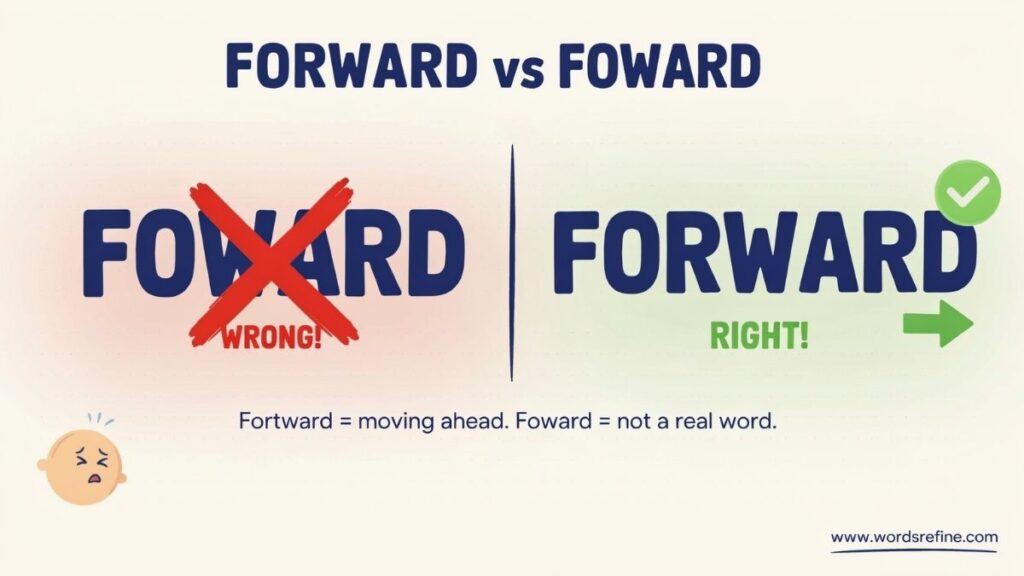
The difference between foward vs forward might seem small but that missing letter can make a noticeable difference in your writing. Whether you’re forwarding an email, talking about future plans, or expressing excitement about an upcoming meeting, spelling the word correctly helps you communicate clearly. Forward is the correct spelling, while foward is a common misspelling. However, the confusion doesn’t stop there. Phrases such as “looking forward to seeing you” and “too forward” follow different grammatical rules and convey different meanings. Fortunately, understanding these expressions is easier than it seems. Let’s examine their meanings, correct usage, and common mistakes with practical examples.
Foward vs Forward Quick Answer
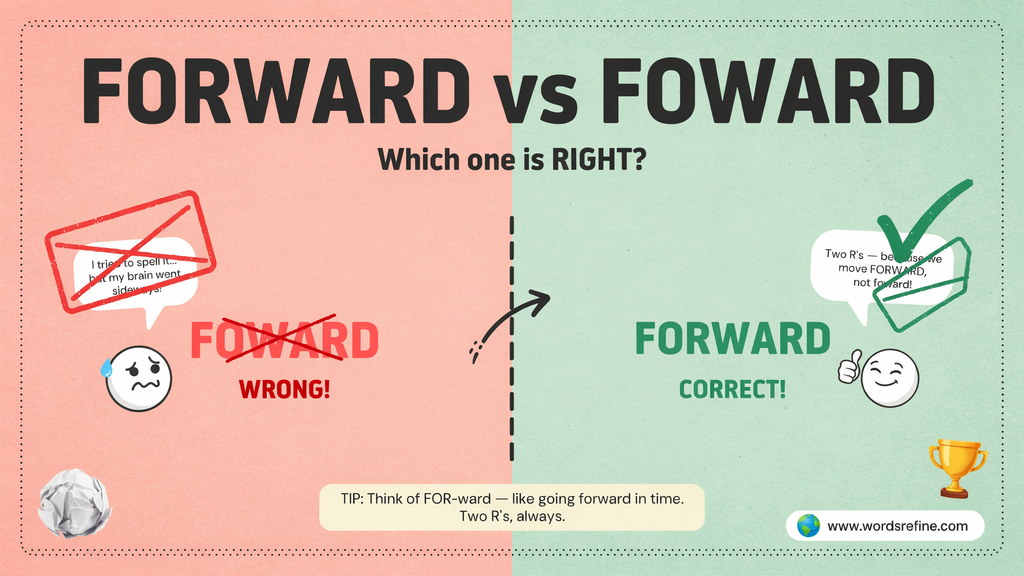
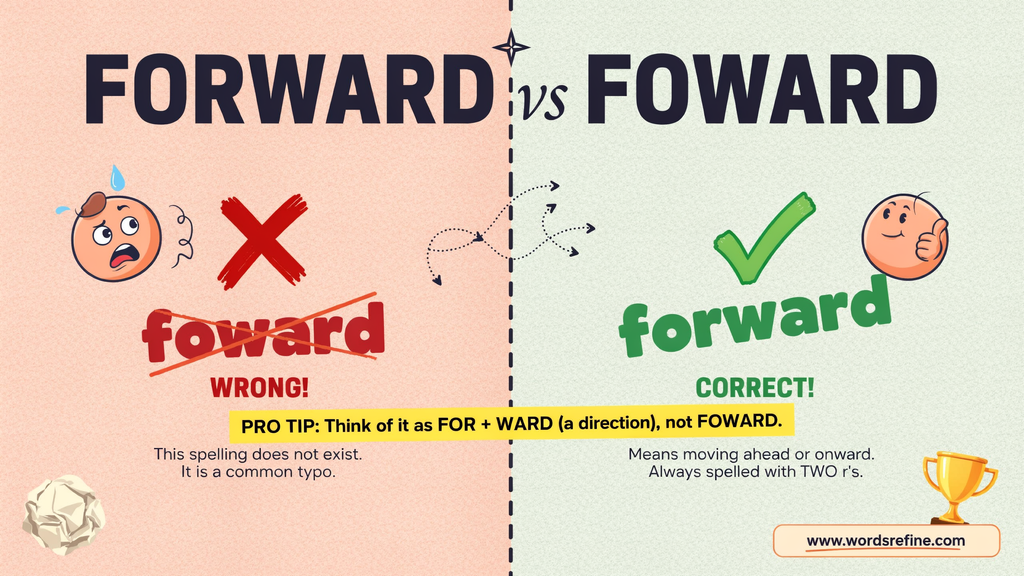
The correct spelling is forward, with two r’s. foward vs forward is a common spelling mistake that occurs when someone accidentally leaves out the first r. Although the difference seems small, using the correct spelling makes your writing clearer and more professional.
For example, you should write, “I look forward to hearing from you,” rather than “I look foward to hearing from you.”
Whether you are writing an email, completing a school assignment, or sharing a message with a friend, forward is the spelling you should use. Once you understand its meaning and remember its correct letter sequence, avoiding this mistake becomes much easier.
What Does Forward Mean?
The word forward has several meanings in English. Depending on the context, it can describe movement, direction, progress, communication, or a position in sports. Understanding these different uses will help you choose the word naturally in everyday conversations and formal writing.
Forward as an Adverb
As an adverb, forward describes movement toward the front or in the direction of progress. It can refer to physical movement or a figurative step toward a goal.
For example, a person might step forward to speak at a meeting. Similarly, a student might move forward with an assignment after overcoming a difficult problem. In both cases, the word describes movement toward something.
Consider these examples:
The child leaned forward to see the stage.
Please move forward so everyone can enter the room.
After reviewing the feedback, the team moved forward with its plan.
She stepped forward to accept the award.
In everyday conversation, move forward can also describe progress after a setback. For instance, two colleagues who have resolved a disagreement might decide to move forward rather than continue arguing about the past.
Forward as an Adjective
As an adjective, forward describes something positioned toward the front or associated with future progress.
For example, a forward-facing seat points in the direction of travel. Likewise, a forward position in a line is closer to the front than a position farther behind.
Here are a few examples:
The passengers chose the forward seats on the boat.
The driver checked the forward-facing camera.
The company adopted a forward-thinking approach.
The coach explained the team’s forward positions.
In expressions such as forward-thinking, the word suggests planning ahead, considering future needs, and remaining open to new ideas. However, context can change its meaning. A forward comment, for example, may describe a remark that seems overly bold or familiar in a particular situation.
Forward as a Verb
Another common use of forward appears in email and digital communication. As a verb, forward means to send a message, document, or other item to another person or destination.
For example, you might forward an email to your manager, send a document to a colleague, or forward a customer request to the appropriate department.
Consider these sentences:
Please forward the invoice to the accounting team.
I forwarded your message to the project manager.
Could you forward the meeting details to everyone?
The office assistant will forward the application to the director.
The word also changes form according to the tense. You can forward a message today, forwarded a message yesterday, or be forwarding several messages right now.
Regardless of the sentence, the spelling remains forward. The word foward is incorrect when you intend to describe sending something onward.
Forward as a Noun
Forward can also function as a noun, particularly in sports. A forward is a player whose position generally focuses on attacking or scoring.
In soccer, forwards often play near the opponent’s goal. In basketball, a forward usually has offensive and defensive responsibilities, although the exact role depends on the team’s playing style.
For example, the forward scored the winning goal. Similarly, a basketball coach might move a forward into a different position to strengthen the team’s defense.
Although the responsibilities vary by sport, the spelling stays the same.
Learn the difference between confusing more English words
Moustache vs Mustache Meaning Spelling and Usage ?
Foward vs Forward Understanding the Difference
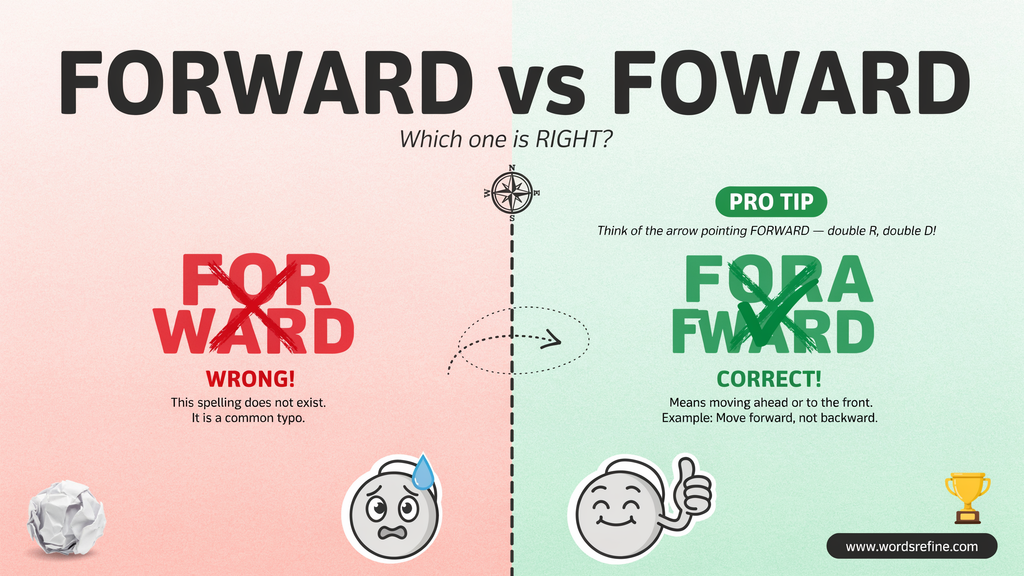
The main difference between foward vs forward is spelling accuracy. Forward is the standard English word, while foward is a misspelling of that word in ordinary writing.
The two forms do not have separate meanings. Instead, one is correct and the other contains a letter omission.
| Feature | Forward | Foward |
|---|---|---|
| Spelling | Correct | Incorrect |
| Standard English usage | Accepted | Not an accepted alternative spelling |
| Meaning | Direction, progress, sending, or a sports position | No standard meaning intended in this context |
| Formal writing | Appropriate | Should be corrected |
| American English | Correct | Incorrect |
| British English | Correct | Incorrect |
When people search for foward vs forward meaning, they may expect two different words with separate definitions. However, this is not a case of two competing English words. Forward is the correct spelling, and foward is a mistake.
The same rule applies regardless of which spelling appears first in a comparison. Reversing the order does not change the answer.
Is Foward a Word?
People sometimes wonder whether foward is a word because they have encountered it in an email, online post, or other written material.
In standard English, foward is not an accepted alternative spelling of forward. It may appear in a username, a special name, or user-generated content, but such appearances do not make it a standard spelling.
For ordinary writing, always use forward.
For example, “We need to foward the documents before Friday” contains a spelling mistake. The correct sentence is, “We need to forward the documents before Friday.”
The second sentence communicates the intended action using standard English spelling.
How to Spell Forward Correctly
If you sometimes forget how to spell forward, focus on the complete sequence of letters rather than relying only on how the word sounds.
The correct spelling is F-O-R-W-A-R-D.
The word contains seven letters, including two r’s. The first r appears immediately after the opening letters f and o, while the second appears after the a near the end.
This detail matters because the common misspelling removes the first r.
Does Forward Have One R or Two?
Forward has two r’s. The easiest way to remember them is to check the entire word rather than count its letters from memory.
Compare the two forms:
Forward: F-O-R-W-A-R-D
Foward: F-O-W-A-R-D
The incorrect form leaves out the r immediately after the first o.
A simple memory trick can help. Remember that forward begins with the letters for. When writing the word, check that the opening sequence is f-o-r rather than f-o.
Although this may seem like a small detail, a quick mental check can prevent a common typing mistake.
Learn the difference between confusing more English words
Mortality vs Fatality Meaning Differences and Correct Usage ?
Why Is Foward Spelled Incorrectly?
The most likely explanation is letter omission. When people type quickly, they sometimes skip a letter without noticing. This often happens with familiar words because the brain recognizes their general shape instead of checking each character individually.
Several factors can contribute to the mistake.
Fast typing is one common cause. Your fingers may skip a letter while you concentrate on the meaning of the sentence.
Poor proofreading can also contribute. Sometimes, you read what you intended to write rather than what actually appears on the screen.
Pronunciation habits may create additional confusion. In ordinary conversation, certain sounds can blend together or become less noticeable. As a result, the spoken word may not remind you of every letter in its written form.
Repeated exposure to errors can make matters worse. Seeing a misspelling online may make it look familiar, even though it remains incorrect.
Finally, autocorrect does not catch every mistake. Depending on the software and context, a spelling tool may overlook the error or fail to suggest the intended word.
These factors explain why someone might write foward without realizing the mistake. However, they do not make the spelling acceptable.
Foward vs Forward Pronunciation How Do You Say It?
Pronunciation can make English spelling confusing. However, foward vs forward has established pronunciations in both foward vs forward American and British English, and neither variety requires the spelling foward.
The important distinction is that pronunciation varies across accents, while the standard written form remains unchanged.
Forward Pronunciation in American English
In American English, forward is commonly pronounced with two syllables, with the main stress on the first syllable. The exact vowel sounds can vary slightly by region and speaker.
You can hear the word in everyday expressions such as “Please move forward,” “I’ll forward the email,” and “We’re looking forward to the trip.”
Depending on the speaker’s accent and speaking speed, the word may sound slightly different. Nevertheless, the written form remains forward.
Forward Pronunciation in British English
British English also uses forward as the standard spelling. However, pronunciation differs across British accents.
Many speakers with non-rhotic accents do not pronounce r in certain positions unless a vowel follows. By contrast, speakers in many Scottish and Irish accents pronounce r more consistently.
Consequently, forward may sound different from one region to another. These differences reflect pronunciation patterns rather than alternative spellings.
Learn the difference between tricky grammar more words
Mama vs Mamma Meaning Spelling and Usage?
Why Does Forward Sometimes Sound Like Foward?
Some people may not clearly notice every consonant when they hear a word in rapid conversation. Others may remember the spelling incorrectly and reproduce that mistake when typing.
In linguistics, dissimilation describes a sound change in which similar sounds become less alike. However, there is no need to classify every omitted letter in foward as dissimilation. In ordinary writing, a typing error or an incorrect memory of the spelling offers a more straightforward explanation.
The distinction between spoken and written English is important here. Pronunciation can help you recognize a word, but it does not always reveal its complete spelling. English contains many words whose written forms preserve letters that speakers pronounce differently or do not pronounce in some accents.
For reliable writing, remember the full spelling instead of trying to spell the word by sound alone.
Looking Forward vs Foward Which Is Correct?
The correct phrase is looking foward vs forward not looking foward.
The expression usually means that you feel pleased, hopeful, or excited about something that will happen in the future. It appears frequently in conversations, personal messages, workplace emails, and professional correspondence.
For example, you might write, “I am looking forward to the weekend,” or “We’re looking forward to meeting your team.”
Similarly, someone might say, “She looks foward vs forward to visiting her family.” In each case, forward expresses anticipation rather than physical movement.
How to Use Looking Forward To Correctly
One grammar rule often causes confusion: when look forward to is followed by a verb, that verb usually takes the -ing form.
For example, “I look forward to meeting you” is correct, while “I look forward to meet you” is incorrect.
The reason is that to functions as a preposition in this expression rather than as part of an infinitive. Therefore, it takes a noun or a gerund, which is a verb form ending in -ing.
Consider these examples:
Looking forward to seeing you.
I look forward to hearing from you.
We look forward to working together.
She looks forward to meeting the team.
Each expression uses the correct verb form. This rule applies in both American and British English.
Learn the difference between confusing word pairs
Stripes vs Strips Meaning Differences and Correct Usage ?
Is Looking Forward to Hearing From You Correct?
Yes. Looking forward to hearing from you is a standard expression used to show that you expect or welcome a response.
In a formal email, you might write, “Thank you for your time. I look forward to hearing from you.”
For a friend, you could say, “I’m looking forward to catching up soon.”
Both sentences use the correct spelling and grammar. The choice depends on your relationship with the reader and the tone you want to convey.
Ultimately, looking forward is correct, while looking foward contains a spelling mistake. The missing r does not change the intended meaning, but it can make your writing look less carefully edited.
What Is the Difference?
Although forward and foreword look similar, they are two different English words with different meanings. Unlike foward, which is a misspelling of forward in ordinary usage, foreword is a correctly spelled word.
Understanding the difference can help you avoid another common spelling error.
What Does Foreword Mean?
A foreword is an introductory section at the beginning of a book. Someone other than the author often writes it to introduce the work, explain its importance, or share a perspective on the author or subject.
For example, a professor might write the foreword to introduce a book’s research and explain why the subject matters.
A foreword differs from the main introduction, although the two can serve related purposes. A foreword often offers an outside perspective, while an introduction typically explains the book’s subject, scope, or organization.
Learn the difference between often confused words
Nevertheless vs Nonetheless Meaning and Usage?
Forward vs Foreword Examples
| Word | Meaning | Example |
|---|---|---|
| Forward | Toward the front or ahead | The hikers moved forward along the trail. |
| Forward | Send something onward | Please forward the invitation to your colleagues. |
| Forward | A sports position | The forward scored twice during the match. |
| Foreword | An introductory section of a book | The author invited a historian to write the foreword. |
The easiest way to remember the difference is to connect foward vs forward with a book’s opening words. By contrast, forward often relates to movement, progress, direction, or sending something onward.
Although the spellings look alike, their meanings determine which word belongs in your sentence.
How to Use Forward in a Sentence
The best way to understand a word is to see how it works in different situations. The following examples show how forward fits naturally into everyday conversation, workplace communication, and formal writing.
Forward in Everyday Conversation
People frequently use forward when discussing movement, progress, or future plans.
The child took a step forward.
The car moved forward slowly.
We need to move forward instead of arguing about the past.
She leaned forward to hear the announcement.
I’m looking forward to the holiday.
In the first two examples, forward describes physical movement. and In the next two, it describes movement or progress in a broader sense. In the final sentence, it expresses anticipation.
Forward in Emails and Messages
Email forwarding is another common use of the word. When you forward an email, you send an existing message to another recipient rather than writing an entirely new message containing the same information.
For example, you might write, “Please forward the meeting invitation to the entire department.”
Other examples include:
Could you forward that message to the customer service team?
I will forward the receipt once the payment clears.
She forwarded the original email to her supervisor.
When forwarding a message, make sure the recipient should see the original content. Emails may contain private information, internal discussions, or attachments that were not intended for everyone.
Therefore, correct spelling matters, but responsible communication matters just as much.
Learn the difference between commonly misused words
Attorneys vs Attornies Which one Is Correct?
Forward in Business and Academic Writing
In professional and academic settings, forward often appears in expressions related to progress, planning, and communication.
The committee agreed to move forward with the proposal.
Please forward your completed application to the admissions office.
The researcher presented a forward-looking plan for future studies.
The department developed a strategy to support forward planning.
These examples demonstrate why understanding forward is useful beyond everyday conversation. The word can describe an action, a direction, or a broader approach to achieving future goals.
Common Mistakes With Foward vs Forward
A small spelling error can slip into a sentence even when the rest of the writing is correct. Recognizing common mistakes will help you catch them before sending a message or submitting an assignment.
Writing Foward Instead of Forward
This is the main mistake.
Incorrect: The manager asked me to foward the report.
Correct: The manager asked me to forward the report.
The correction requires only one letter, but that letter belongs in the standard spelling. When proofreading, pay particular attention to familiar words that you may type automatically.
Using Forward Incorrectly in a Sentence
Although forward is the correct spelling, a sentence can still use it incorrectly.
For example, “I look forward to meet your team” contains the correct spelling but the wrong verb form.
The correct sentence is, “I look forward to meeting your team.”
This example highlights an important distinction: spelling accuracy and grammatical accuracy are related, but they are not the same thing.
Confusing Forward With Foreword
Consider this sentence: “The editor asked the professor to write the forward of the book.”
If the writer means the introductory section, the correct sentence is, “The editor asked the professor to write the foreword of the book.”
Here, foreword refers to the book’s introductory section. Forward does not express that meaning.
Assuming British English Uses Foward
British English and American English sometimes differ in spelling. For example, British English generally favors colour, while American English uses color.
However, forward does not follow that pattern. Both varieties use forward as the standard form.
Writing foward is not a regional preference. It is a spelling mistake.
A Practical Example Catching a Forward Spelling Mistake
Consider a workplace situation in which an employee writes the following email:
Hello Sarah,
Could you foward the revised report to the finance team? I am looking foward to reviewing their feedback.
Thank you.
The message communicates its purpose clearly. Nevertheless, the employee has made the same spelling mistake twice.
After proofreading, the corrected version reads:
Hello Sarah,
Could you forward the revised report to the finance team? I am looking forward to reviewing their feedback.
Thank you.
The revision changes no meaning. Instead, it restores the correct spelling in both places.
This example illustrates a useful proofreading lesson: repeated errors can make a message look less polished even when the reader understands it perfectly. A quick review can catch these mistakes before they reach a client, colleague, teacher, or manager.
How to Avoid the Common Misspelling of Forward
You don’t need an elaborate study routine to remember this word. A few practical habits can improve your spelling accuracy.
First, memorize the complete spelling: F-O-R-W-A-R-D. Pay particular attention to the first r, which often disappears in the incorrect form.
Next, use the word in several sentences. Write move forward, forward an email, and looking forward to meeting you. Different examples reinforce the same spelling in different contexts.
Additionally, proofread important messages before sending them. Read the actual words on the screen instead of relying on what you intended to type.
Finally, use a spellchecker when appropriate. Modern writing tools can identify many spelling mistakes, but they do not catch every error. You should still review your writing, especially when a mistake appears in a formal document.
These simple habits can also help you avoid other common English spelling errors.
Learn the difference between everyday English mistakes
Skiddish vs Skittish Which One Is Correct and Why It Matters
Practice Session Forward vs Foward
- The correct spelling is ______. (forward / foward)
- I am looking ______ to seeing you next week. (forward / foward)
- Please ______ this message to your supervisor. (forward / forwarded)
- Sarah ______ the email to her coworkers yesterday. (forward / forwarded)
- We look forward to ______ you at the event. (see / seeing)
- I look forward to ______ with you again. (work / working)
- The teacher asked the students to move ______ in the line. (forward / backward)
- The opposite of forward is ______. (backward / ahead)
- He is very ______ and openly shares his opinions. (forward / forwards)
- I ______ forward to hearing your decision. (look / looking)
- We are ______ forward to our vacation. (look / looking)
- I will ______ the documents to you this afternoon. (forward / forwarded)
- The invitation was ______ to the wrong address. (forward / forwarded)
- His personal questions made him seem too ______. (forward / forwards)
- I wish you the best ______ in your new career. (forward / forwards)
- She isn’t ______ forward to taking the difficult exam. (looking / look)
- The manager asked me to ______ the report to the director. (forward / forwarded)
- I look forward to ______ from you soon. (hear / hearing)
- The team decided to move ______ with the plan. (forward / backward)
- Complete the sentence: “I look forward to ______ you.” (meet / meeting)
- ______ forward to the holiday, he booked his tickets early. (Looking / Look)
- Choose the correct sentence: “I am looking forward to it” or “I am looking forwards to it.”
- Choose the correct contraction: “I ______ be able to join you tomorrow.” (won’t / wont)
- My colleague asked me to ______ the announcement to the entire team. (forward / foward)
- Complete the sentence: “Thank you for your email. I look forward to ______ from you.” (hear / hearing)
Answers
- Forward
- Forward
- Forward
- Forwarded
- Seeing
- Working
- Forward
- Backward
- Forward
- Look
- Looking
- Forward
- Forwarded
- Forward
- Forward
- Looking
- Forward
- Hearing
- Forward
- Meeting
- Looking
- I am looking forward to it.
- Won’t
- Forward
- Hearing
Here’s a trusted source for clear more words Comparison:
FAQs
Why do some people spell “forward” vs“foward”?
Some people accidentally leave out the second “r” when typing or spelling the word from memory. However, “forward” is the correct spelling, while “foward” is a misspelling.
How do you spell forward correctly?
The correct spelling is “forward.” It contains one “w” and two “r” letters. Remember to include the second “r” to avoid the common mistake of writing “foward.”
What does forward mean?
“Forward” can mean toward the front, onward, or toward future progress. As a verb, it means to send something, such as an email, message, or document, to another person.
How do you use forward in a sentence?
You can use “forward” to describe movement, progress, or the act of sending information. For example, “We need to move forward with the plan” describes progress, while “Please forward this email to your manager” means to send the email to someone else.
What is another word for forward?
The best synonym depends on the context. “Ahead,” “onward,” and “forth” can describe movement or progress. When referring to sending information, “send” or “transmit” may be suitable alternatives.
Which is correct: “to forward” vs “too forward”?
Both expressions are correct, but they have different meanings. “To forward” means to send something to another person, while “too forward” describes someone who behaves in an excessively direct, bold, or familiar way.
What does it mean when a woman is forward?
A forward woman is often described as direct, confident, or open about expressing her thoughts and feelings. Depending on the context, the word can also suggest that she is overly bold or familiar. The intended meaning depends on the situation and the speaker’s tone.
Is it “looking foward” or “looking forward”?
“Looking forward” is correct. “Looking foward” is a misspelling because it leaves out the second “r.” For example, write, “I’m looking forward to the weekend.”
Is “I forwarded” correct?
Yes. “Forwarded” is the simple past tense of “forward.” For example, “I forwarded the documents to my supervisor yesterday” correctly describes an action completed in the past.
When should you use “forwarded”?
Use “forwarded” when describing something you sent to another person in the past. For example, “She forwarded the invitation to her colleagues this morning.” For a future action, you can say, “I will forward the invitation tomorrow.”
What can I say instead of “I am looking forward to”?
You can say “I’m excited about,” “I’m eager to,” or “I can’t wait to,” depending on the context. For example, instead of saying, “I’m looking forward to the concert,” you could say, “I’m excited about the concert.”
Is it correct to say “I look forward to see you” or “I look forward to seeing you”?
“I look forward to seeing you” is correct. In this expression, “to” is a preposition, so it must be followed by a noun or a verb ending in “-ing.” Therefore, use “seeing” rather than “see.”
Is “looking forward” grammatically correct?
Yes. “Looking forward” is grammatically correct when used in a suitable sentence. For example, “I’m looking forward to our vacation” is correct. You may also see “Looking forward to hearing from you” as a friendly closing in emails.
Is it “I look forward to meet you” or “I look forward to meeting you”?
“I look forward to meeting you” is correct. The word “meeting” follows the preposition “to” in this expression. This phrase is polite and commonly used in professional emails, interviews, and business conversations.
Is it correct to say “I’m looking forward to seeing you”?
Yes. “I’m looking forward to seeing you” is natural, grammatically correct, and commonly used to express excitement about a future meeting or visit.
Should I say “I look forward to” or “I’ll look forward to”?
Both expressions are correct, but they suit different contexts. “I look forward to hearing from you” is a common professional expression. “I’ll look forward to seeing you” emphasizes anticipation about a future event.
What is another way to say “not looking forward to”?
You can use “dreading,” “not eager to,” “reluctant to,” or “not excited about.” For example, “I’m dreading the long journey” expresses that you expect the experience to be unpleasant.
What is the opposite of backwards?
The opposite of “backwards” is “forwards.” Both words describe direction, but “forwards” indicates movement toward the front or ahead.
What is the difference between “forward” vs “forwards”?
Both words can describe movement toward the front. “Forward” is standard in American English, while “forwards” is also common in British English. When using the word as a verb meaning to send something, use “forward,” as in “Please forward the email.”
Can “forward” describe someone’s personality?
Yes. When someone is described as “forward,” it often means they are confident, outspoken, or willing to approach others directly. However, the word can have a negative meaning when it suggests excessive boldness or inappropriate familiarity.
Learn the difference between more words people mix up
Expiry vs Expiration Which One Is Correct?
Conclusion
Mastering forward vs foward doesn’t require a grammar degree, just a little attention to spelling and usage. Always remember that “forward” is correct, while “foward” is a misspelling that should move straight to the delete key! When discussing past actions, use “forwarded,” and when expressing excitement about a meeting, write “I look forward to seeing you.” If you say “I look forward to see you,” your grammar needs a small course correction. Likewise, calling someone “too forward” means they’re being overly bold or familiar, not that they’re moving in the right direction. Keep these simple rules in mind, and your writing will move forward without taking a wrong turn!

Diora AJS she is an experienced blogger and passionate English language enthusiast at Words Refine. With a keen eye for language and a love for clear communication, she writes practical content about grammar, word meanings, usage, and commonly confused terms. Her goal is to make English easier to understand through clear explanations and relatable examples, helping readers write accurately and communicate with confidence.