
English can make even a simple space feel like a major grammar decision. Take Onstage vs On Stage both forms are correct, but knowing when to use each one can leave writers scratching their heads. Should you write about a singer performing onstage or an actor stepping on stage? The answer depends on how the phrase functions in your sentence. Fortunately, you don’t need a theater degree to master this distinction. In this guide, you’ll learn what onstage vs on stage mean, see how they work in everyday examples, and discover common mistakes to avoid. Let’s put this grammar confusion behind the curtain!
Onstage vs On Stage The Quick Answer
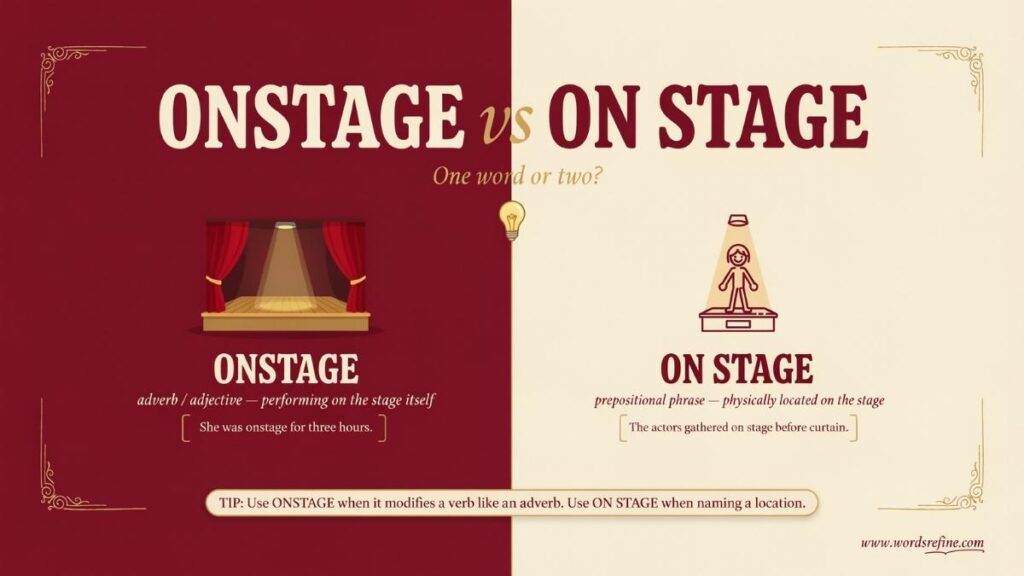
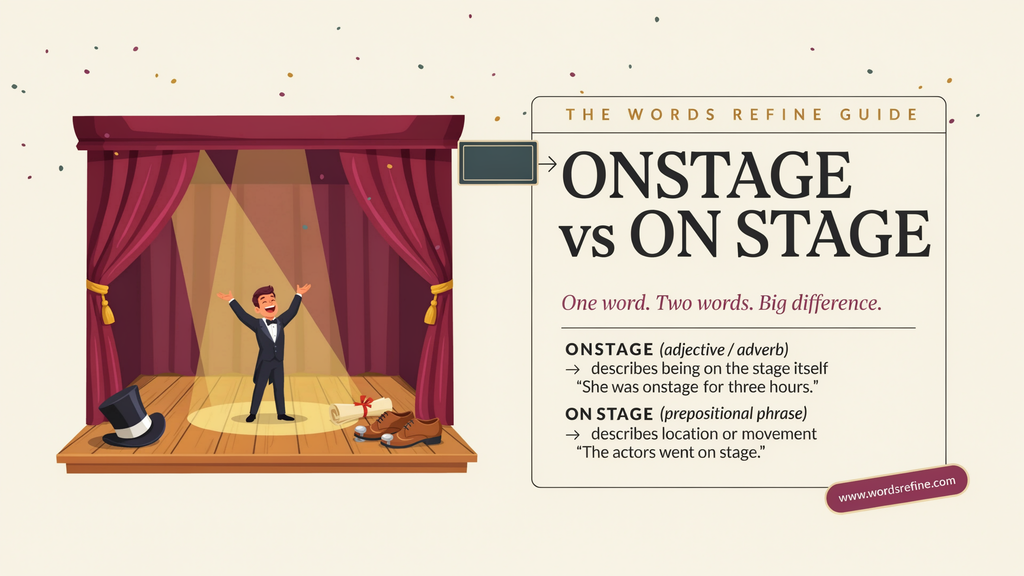
Onstage is one word. It commonly functions as an adjective or adverb when describing a stage performance or an action associated with a stage.
Onstage vs On Stageconsists of two words: the preposition on and the noun stage. It often describes the physical location of a person or object.
Both forms can be correct, and their meanings frequently overlap.
| Form | Common use | Example |
|---|---|---|
| Onstage | Adverb | The singer walked onstage. |
| Onstage | Adjective | Her onstage presence impressed the audience. |
| On stage | Prepositional phrase | The singer stood on stage. |
| On the stage | Prepositional phrase with an article | The singer stood on the stage beside the piano. |
The easiest way to choose between Onstage vs On Stage them is to consider how the sentence works. For example, onstage fits naturally before nouns in expressions such as onstage performance and onstage presence. Meanwhile, on stage works well when you want to describe where someone or something is located.
However, this distinction isn’t an absolute rule. Both forms can describe actions, locations, and activities connected with a stage.
What Does Onstage Mean?
The word onstage describes something that happens on a stage or relates to a performance presented before an audience. You’ll often encounter it in theater reviews, concert reports, interviews, and discussions about acting, dancing, or music.
For instance, when a reviewer praises an actor’s onstage presence, the reviewer means the actor’s ability to command attention during a performance. The expression describes more than physical location. It also refers to the performer’s confidence, movement, expression, and connection with the audience.
Consider these examples:
- The actor made a dramatic entrance onstage.
- The singer’s onstage persona was bold and energetic.
- The director praised the dancers’ onstage behavior.
- The comedian forgot a line during his onstage appearance.
- The band’s onstage performance earned a standing ovation.
Notice how the word works differently in these sentences. In the first example, onstage describes where the actor made an entrance. In the second, it helps describe the singer’s public image. and In the final example, it identifies the kind of performance the band delivered.
Therefore, onstage can refer to an action, a quality, or an aspect of a live performance.
Learn the difference between confusing more English words
Saucey vs Saucy Meaning Differences and Correct Usage ?
Onstage as an Adverb
An adverb modifies a verb, an adjective, or another adverb. In the sentence “The dancer moved onstage,” the word onstage describes where the dancer moved.
Here are some more examples:
- The dancers moved onstage as the music began.
- A nervous actor stepped onstage and delivered his opening line.
- The musicians returned onstage after a short break.
- The award winner hurried onstage to accept her trophy.
- The magician appeared onstage beneath a bright spotlight.
In each example, onstage relates to an action. It helps readers picture what happened without adding unnecessary words.
However, remember that not every adverb ends in -ly. English includes many adverbs that follow different patterns, such as here, there, home, and onstage.
Onstage as an Adjective
An adjective describes a noun. When onstage functions as an adjective, it identifies a quality or activity associated with a performance.
For example:
- The actor’s onstage confidence impressed the director.
- Her onstage personality differed from her quiet nature offstage.
- The band’s onstage chemistry made the concert memorable.
- The review criticized the singer’s onstage behavior.
- The performer’s onstage appearance attracted considerable attention.
These expressions describe how people act, appear, or interact during a public performance.
Consider the difference between an onstage persona and someone’s everyday personality. An actor may portray a confident, outgoing character onstage while behaving quietly in private. The adjective helps readers distinguish the public performance from life away from the spotlight.
For this reason, onstage often works naturally before nouns such as performance, presence, personality, behavior, and appearance.
What Does On Stage Mean?
The phrase on stage consists of two separate words. On is a preposition, while stage is a noun. Together, they commonly form a prepositional phrase that identifies a location.
Imagine a theater with a raised platform, curtains, lights, and rows of seats. If a piano stands on that platform, you can say, “The piano is on stage.”
In this sentence, the phrase answers a simple question: Where is the piano?
On Stage Meaning and Usage
The phrase on stage usually refers to a person or object occupying a stage or to a situation connected with a stage performance.
For example:
- The actors stood on stage while the audience applauded.
- A grand piano remained on stage throughout the concert.
- The speaker placed her notes on stage before the presentation.
- Three dancers waited on stage for their cue.
- The host invited the finalists on stage to announce the winner.
In these examples, the phrase establishes a physical relationship between a person or object and the performance area.
However, on stage can also describe an experience rather than a precise physical position. For example, “She feels nervous on stage” describes how someone feels while performing in front of an audience.
This overlap explains why the difference between onstage vs on stage isn’t always obvious. Context and grammatical structure both matter.
Learn the difference between commonly mixed-up more words
Stary vs Starry Meaning Differences Examples and Correct ?
How to Use On Stage in a Sentence
When choosing on stage, look at the verb and consider what you want to express.
For example:
- The microphone is on stage beside the lectern.
- The lead actor remained on stage after the final scene.
- The principal appeared on stage to congratulate the graduates.
- The performers waited on stage while a technician adjusted the lights.
- The orchestra was already on stage when the audience entered the hall.
Each sentence uses on stage to describe a location or situation connected with the performance.
You can also write on the stage when the sentence calls for the definite article the.
For example, “She left her notebook on the stage” is grammatically correct. The article can point to a particular stage that the reader already knows about.
Compare these sentences:
- The notebook is on stage.
- The notebook is on the stage beside the curtain.
Both are correct. However, the second sentence identifies a more specific setting through the additional detail.
Onstage vs On Stage Understanding the Difference
The difference between onstage vs on stage becomes clearer when you compare their grammatical roles. Although they often communicate similar ideas, they don’t always fit into a sentence in the same way.
| Feature | Onstage | On stage |
|---|---|---|
| Spelling | One word | Two words |
| Word structure | Closed compound word | Preposition plus noun |
| Common grammatical role | Adjective or adverb | Prepositional phrase |
| Example | The performers moved onstage. | The performers waited on stage. |
| Before a noun | Her onstage presence was impressive. | Her presence on stage was impressive. |
| General meaning | On or related to a stage performance | On a stage or in a stage-related situation |
This comparison provides a useful guide, but it shouldn’t be treated as an inflexible rule. Both forms can describe a performer’s location, and some sentences allow either version without changing the intended meaning.
For example:
“The actor walked onstage.”
“The actor walked on stage.”
Both sentences are natural English. The first uses the closed form to describe the actor’s movement, while the second uses a prepositional phrase to express essentially the same idea.
However, consider the expression onstage presence. Here, onstage works as an adjective. You can rewrite the sentence as “The director praised the actor’s presence on stage,” but the grammatical structure changes.
In the first sentence, the adjective appears directly before the noun. In the second, the noun comes first, followed by a prepositional phrase.
Therefore, two expressions can communicate the same idea without being interchangeable in every grammatical position.
Can Onstage vs On Stage Be Used Interchangeably?
Sometimes, yes. However, the choice depends on the sentence.
For example, both of these sentences are correct:
- The singer walked onstage.
- The singer walked on stage.
Likewise, you can write, “The dancers performed onstage” or “The dancers performed on stage.” Both versions communicate that the dancers performed on a stage.
However, the forms don’t always work identically. Consider these examples:
- The director praised the actor’s onstage presence.
- The director praised the actor’s presence on stage.
Both sentences are grammatical, but their structures differ. The first uses onstage as an adjective, while the second uses a prepositional phrase to describe the actor’s presence.
Consequently, you should consider both meaning and grammar rather than assuming that one spelling always replaces the other.
Learn the difference between tricky grammar more words
Scrapped vs Scraped Differences Examples and Correct Usage?
When to Use Onstage vs On Stage
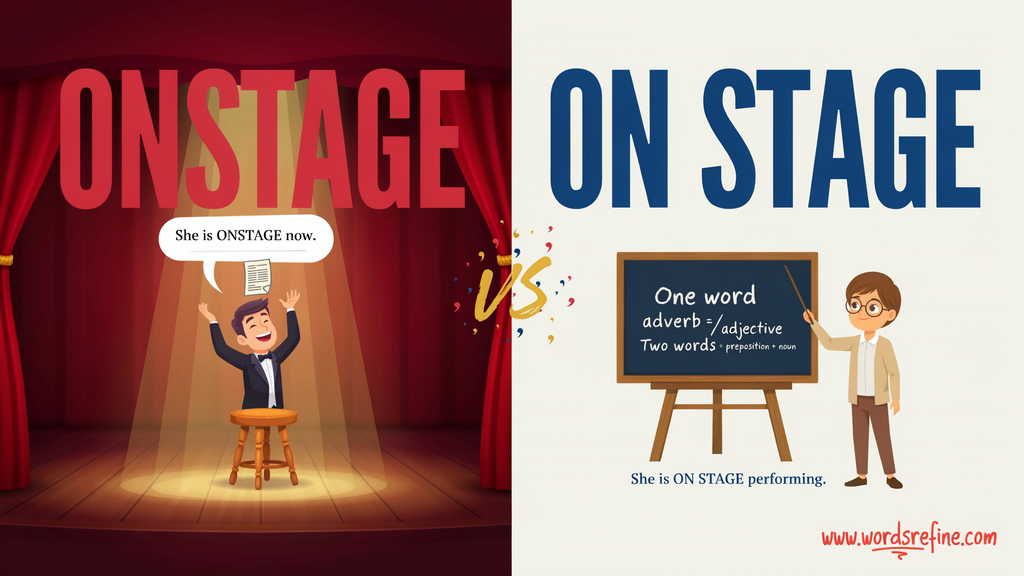
Choosing the right form doesn’t require a complicated grammar test. In most cases, you can make a sensible choice by looking at how the sentence is built.
Use Onstage for Actions Connected With a Performance
The closed form often works naturally when an actor, musician, dancer, or speaker enters a performance space or carries out an action there.
For example:
- The singer stepped onstage as the band began playing.
- The dancers performed onstage beneath blue lights.
- The comedian returned onstage after the intermission.
- The actor moved onstage without making a sound.
- The orchestra appeared onstage for the final number.
The closed form keeps these sentences compact and easy to read. It also appears naturally in writing about theater, music, dance, and other live performances.
Nevertheless, on stage is also acceptable in many of these situations. For example, “The singer stepped on stage” is correct. Choose the form that fits your preferred writing style and remain consistent.
Use Onstage Before a Noun
When you need an adjective to describe a performance-related quality, onstage is often the most natural choice.
Examples include:
- The actor developed a distinctive onstage persona.
- Her onstage presence drew the audience’s attention.
- The performers showed excellent onstage chemistry.
- The singer’s onstage behavior surprised the crowd.
- The director wanted more natural onstage movement.
These expressions describe the way performers act, appear, or interact during a public performance.
For example, an onstage persona may differ greatly from someone’s everyday personality. A comedian might appear fearless in front of thousands of people but feel nervous during an ordinary conversation.
Similarly, onstage confidence describes confidence displayed during a performance. It doesn’t necessarily mean the performer feels confident in every situation.
Use On Stage When Describing Location
The two-word phrase is especially natural when you want to identify the physical position of a person or object.
For example:
- The chair remained on stage after the rehearsal.
- The actors stood on stage for the curtain call.
- The speaker left her water bottle on stage.
- The musicians gathered on stage before the concert.
- A small table sat on stage beside the main character.
These sentences focus on placement rather than on a performance-related quality.
Still, don’t force a distinction where English doesn’t require one. “The actors gathered onstage” is also natural. The choice often comes down to rhythm, context, and editorial preference.
Follow Your Chosen Style Guide
If you’re writing for a newspaper, magazine, university, theater company, or business, check whether it has a house style.
A style guide may prescribe a particular spelling even when another form is accepted. Following that rule keeps your writing consistent and helps editors avoid unnecessary corrections.
For instance, a theater review might use onstage presence throughout the article, while a report about stage equipment might use on stage to describe the position of props and instruments.
Neither approach automatically makes the other incorrect. The important thing is to use the form that fits your sentence and follow any relevant editorial requirements.
Learn the difference between confusing word pairs
Tinder vs Tender Differences Examples and Correct Usage?
Onstage vs On Stage Examples in Everyday Situations
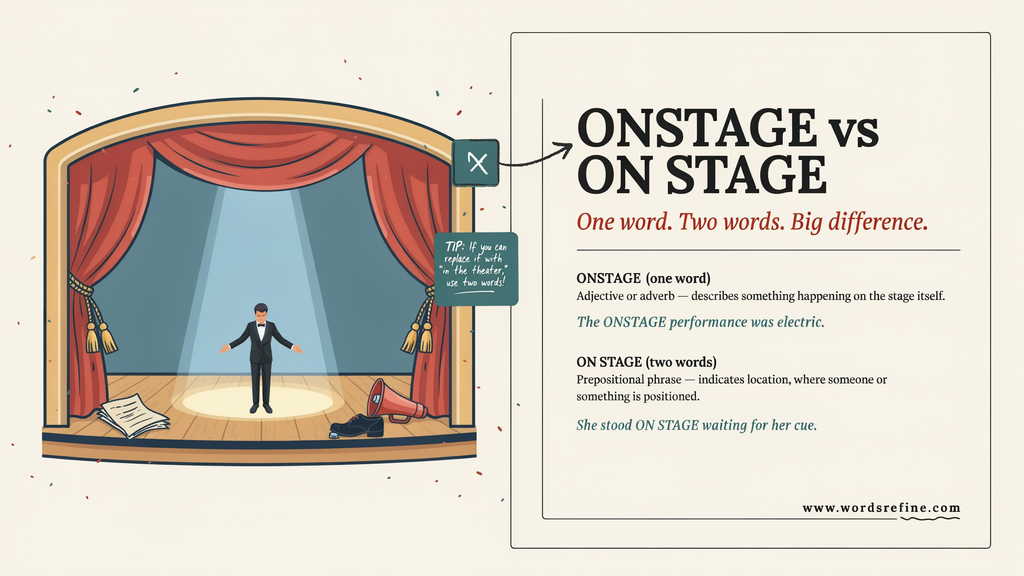
Grammar rules are easier to remember when you see how people use them in real situations. and Theater, concerts, public speaking, and performance reviews all provide useful examples.
Theater and Acting
The Theater offers plenty of opportunities to use both forms because actors move between the stage and the areas behind the scenes.
| Sentence | Explanation |
|---|---|
| The actor walked onstage during the final scene. | Onstage describes the actor’s movement. |
| The actors stood on stage for the curtain call. | On stage identifies their location. |
| The director praised her onstage performance. | Onstage modifies performance. |
| A wooden chair remained on stage throughout the play. | The phrase describes the chair’s position. |
| His onstage presence made the character believable. | Onstage describes a quality of the performance. |
When writing a theater review, expressions such as onstage performance, onstage presence, and onstage chemistry often sound natural. However, when describing the exact position of a prop, on stage is equally appropriate.
Music and Concerts
Concert reports frequently use both forms to describe musicians, entrances, and live performances.
- The guitarist rushed onstage for the final song.
- A grand piano stood on stage beside the drum kit.
- The singer’s onstage energy kept the crowd engaged.
- The musicians returned onstage for an encore.
- The lead vocalist remained on stage while the crew removed the equipment.
These examples illustrate a common pattern rather than a strict rule. The adjective onstage works well before a noun, while on stage clearly expresses location. However, either form may work when describing a performer’s movement or presence.
Public Speaking and Ceremonies
The same principles apply outside entertainment. Graduation ceremonies, conferences, award shows, and business presentations all involve people appearing on a stage.
For example:
- The keynote speaker walked onstage to deliver her address.
- The graduates stood on stage as the dean announced their names.
- His onstage confidence helped him deliver a strong presentation.
- The host invited the finalists on stage to receive their awards.
- The presenter made an unexpected onstage appearance.
Even when an event isn’t a theatrical performance, the same general conventions apply.
Rehearsals and Stage Directions
Scripts and rehearsal notes often need to distinguish between movement, location, and performance behavior.
Consider these examples:
- Enter onstage from the left.
- The actor remains on stage until the lights fade.
- The dancer moves onstage when the music begins.
- Keep the chair on stage during the second scene.
These are illustrative directions rather than a universal notation system. Actual scripts may use specific formatting and terminology depending on the playwright, production, or publisher.
The main goal is clarity. A stage direction should help performers understand what to do without making them guess.
Learn the difference between often confused words
Foward vs Forward Meaning Spelling and Correct Usage
Onstage vs On Stage in American and British English
Does American English prefer onstage while British English prefers on stage? It’s tempting to turn the difference into a simple regional rule, but that would be misleading.
Both forms appear in English-language writing, including American and British contexts. The distinction concerns compound-word spelling and grammatical usage rather than a straightforward difference like American color versus British colour.
Onstage in American English
American writers commonly use onstage as an adjective in expressions such as:
- Onstage presence
- Onstage performance
- Onstage behavior
- Onstage appearance
The word also works as an adverb, as in “The singer walked onstage.”
When writing for an American audience, you can use these constructions naturally. If your publisher has a style guide, follow its instructions for consistency.
Onstage in British English
British English also uses onstage, while the open form on stage appears naturally in many contexts.
For example:
- The performer made an onstage appearance.
- The actors waited on stage for the curtain call.
These examples are compatible with British usage. There is no sound basis for claiming that one spelling belongs exclusively to American English and the other exclusively to British English.
Does the Region Determine the Correct Spelling?
Not by itself. When choosing between onstage vs on stage, pay attention to the dictionary or style guide relevant to your audience.
Consider these questions:
- Does the form fit the sentence’s grammar?
- Does it express the intended meaning?
- Does the publication specify a preferred spelling?
- Have you used the form consistently?
These questions will help you make a better choice than relying on an oversimplified American-versus-British rule.
What Do Dictionaries and Style Guides Say About Onstage vs On Stage?
Dictionaries help establish whether a word is recognized and explain how people use it. Style guides serve a different purpose: they offer editorial conventions for consistent writing.
That distinction matters because a dictionary may recognize a word without requiring every publication to use it in every context.
Merriam-Webster’s Onstage Definition
You can consult Merriam-Webster’s entry for onstage to review its definition and grammatical usage.
When checking a dictionary, look at the part-of-speech labels and example sentences. These details can help you determine whether a word works as an adjective, an adverb, or both.
For this topic, the most useful evidence is how the dictionary treats the closed form and illustrates its relationship to a stage or performance.
Cambridge Dictionary and Collins Dictionary
The Cambridge Dictionary and Collins Dictionary are also useful resources for checking English vocabulary.
Search for onstage in each reference and compare the definitions and examples. If you’re researching a particular grammatical construction, examine the complete example rather than relying on a short search-result snippet.
You can also consult WordReference for dictionary information and related discussions. For more specialized questions, English Stack Exchange may offer explanations of usage, although community answers should be evaluated rather than treated as official editorial rules.
Onstage vs On Stage AP Style
Writers often wonder whether AP Style prefers onstage vs on stage because they want a definite answer for professional writing.
The Associated Press provides editorial guidance for journalists and other writers who follow its conventions. However, a specific preference should not be attributed to AP Style without checking its current entry.
If you’re writing for a publication that follows AP style, consult the current stylebook or the publication’s own editorial guidance. Don’t assume that a general grammar explanation automatically represents AP policy.
Chicago Style and Compound Words
The Chicago Manual of Style offers guidance on spelling, compounds, hyphenation, and editorial consistency.
Its general approach to compound words can help writers understand why some expressions appear as one word, two words, or hyphenated forms. However, broad rules about compounds don’t automatically settle every individual spelling question.
For onstage, check the relevant entry or an authoritative dictionary recommendation rather than inventing a rule based on the word’s structure alone.
The main takeaway is simple: dictionaries establish recognized usage, while style guides help you apply consistent editorial choices. Use both when the spelling matters for professional or academic writing.
Learn the difference between basic English word mistakes
Broke vs Broken Meaning Differences and Correct Usage ?
Common Mistakes With Onstage vs On Stage
Even experienced writers can hesitate over a compound word when both forms look reasonable. Fortunately, a few common mistakes are easy to avoid.
Assuming Onstage Is Always Correct
The fact that onstage is a recognized word doesn’t mean you should use it in every sentence involving a stage.
For example:
“The technician placed the speaker on stage beside the curtain.”
This sentence is clear and grammatically correct. You could use onstage in some comparable contexts, but there’s no need to replace a natural prepositional phrase simply because a closed form exists.
Assuming On Stage Is Always Correct
The opposite mistake occurs when writers separate the words even when they want the established adjective.
Consider these sentences:
- Preferred: The performer’s onstage performance earned enthusiastic reviews.
- Alternative: The performer gave a memorable performance on stage.
Both are grammatical, but the structure differs. In the first, onstage modifies performance. In the second, the prepositional phrase follows the noun.
Avoid writing on stage performance when you intend the standard compound adjective.
Confusing Onstage With On the Stage
The expressions onstage, on stage, and on the stage overlap in meaning, but their grammatical structures differ.
Compare these examples:
- The actor walked onstage.
- The actor waited on stage.
- The actor waited on the stage beside the curtain.
All three can be correct. The last sentence uses the to refer to a particular stage.
When choosing between on the stage and onstage, consider whether you need the article and whether the closed form fits the sentence naturally. Don’t add or remove the article mechanically.
Switching Spellings Without a Reason
Inconsistent spelling can distract readers, especially in a long article or formal report.
For example, a theater review might use onstage presence in one paragraph and on stage presence in another. If the writer intends the same adjective construction, the inconsistency may look like an editing mistake.
Choose a suitable form, follow your publication’s style guide, and check the final draft for consistency.
Onstage vs Offstage and Backstage vs Back Stage
Related theater terms can create similar spelling questions. However, each expression has its own usage patterns.
Onstage vs Offstage
Onstage relates to the stage or a public performance. Offstage refers to being away from the stage or to aspects of a performer’s life outside the performance.
For example:
- The actor was confident onstage but quiet offstage.
- The singer’s offstage personality differed from her concert persona.
- The dancers rehearsed offstage before their entrance.
The open form off stage can also appear in appropriate grammatical constructions. When you need a specific editorial rule, consult the relevant dictionary or style guide instead of assuming that every rule for onstage automatically applies.
Backstage vs Back Stage
Backstage commonly refers to the area behind the performance space or to activities that take place away from the audience.
Examples include:
- The musicians waited backstage before the concert.
- A backstage interview revealed how the production worked.
- The actor returned backstage after the final bow.
The phrase back stage may occur when the words have a separate grammatical function, but backstage is the conventional choice for the familiar theater-related meaning.
These related terms demonstrate a broader lesson about English compound words: spelling depends on established usage and grammatical context, not merely on whether the words seem as though they could be joined.
Learn the difference between commonly misused words
Cloth vs Clothe Differences Examples and Correct Usage ?
Practice Session Onstage vs On Stage
- The singer walked ______ to thunderous applause.
- The actors performed confidently ______.
- The magician amazed the audience with an incredible trick ______.
- The band will appear ______ at the music festival tonight.
- The dancers practiced their routine before stepping ______.
- Her ______ presence captured the audience’s attention.
- The comedian entertained the crowd while performing ______.
- The director asked the actors to wait before going ______.
- The young performer felt nervous about stepping ______ for the first time.
- The actor delivered a powerful speech ______.
- The crew checked the equipment before the performers went ______.
- The singer’s ______ energy impressed everyone in the theater.
- The orchestra played beautifully while performing ______.
- The aspiring actor dreamed of performing ______ on Broadway.
- The director praised the cast for their excellent ______ performance.
- The dancer bowed after spending nearly an hour ______.
- The stage manager checked the props before the actors stepped ______.
- His ______ confidence helped him stand out during the talent competition.
- The actress forgot one line while performing ______.
- The students will present their play ______ next Friday.
- The performer received a standing ovation while ______.
- The director gave the actors final instructions before they stepped ______.
- Her ______ experience helped her handle unexpected problems during the show.
- The musicians looked excited as they prepared to go ______.
- The actor’s ______ performance made the entire audience laugh.
Answers
- onstage
- onstage
- onstage
- onstage
- onstage
- onstage
- onstage
- on stage
- on stage
- onstage
- on stage
- onstage
- onstage
- on stage
- onstage
- onstage
- on stage
- onstage
- onstage
- on stage
- onstage
- on stage
- onstage
- on stage
- onstage
Here’s a trusted source for clear more words Comparison:
FAQs
Is “onstage” one word or two?
Both onstage vs on stage are correct. Onstage is commonly used as an adverb or adjective to describe a performance or something related to the stage. On stage is a two-word phrase that often emphasizes a performer’s physical location.
Does “on stage” have a hyphen?
No. The standard forms are on stage and onstage, without a hyphen. For example, “The actor walked on stage” and “Her onstage performance impressed the audience” are both correct.
What does it mean to be on stage?
Being on stage means standing or performing in a designated area in front of an audience. It can refer to acting, singing, dancing, giving a speech, or taking part in another live event.
What is another word for “onstage”?
Depending on the context, you could use before an audience, performing live, or in the spotlight. For example, “The band performed live” conveys a similar idea to “The band performed onstage,” although the emphasis shifts slightly toward the live nature of the performance.
What is another word for a performance on stage?
A performance on stage may be called a live show, stage act, theatrical performance, or stage production. The best term depends on the event. A play is a theatrical performance, while a musician’s appearance may be called a concert or live show.
What is a person who performs on stage called?
A person who performs on stage is generally called a performer or entertainer. More specific terms include actor, singer, dancer, musician, and stage artist. The appropriate word depends on the person’s role.
What is a dramatic performance on stage called?
A dramatic performance on stage is usually called a play or theatrical production. A short, humorous performance may be called a skit, while a musical combines acting with songs and often dancing.
What is the difference between “at the stage” vs “on the stage”?
On the stage means physically standing or performing on the stage itself. At the stage usually refers to a location near the stage or a particular point in a process, depending on the context. For example, “The actor stood on the stage” describes the actor’s position, while “The technician waited at the stage entrance” identifies a nearby location.
What can I say instead of “perform”?
You can use act, entertain, present, sing, play, or deliver, depending on the context. For example, an actor acts in a play, a musician plays a concert, and a speaker delivers a presentation.
What is an old-fashioned word for “actor”?
Thespian is a traditional, somewhat formal word for an actor. The term comes from Thespis, a figure associated with the origins of Greek drama. Today, people sometimes use thespian humorously or when discussing theater.
What is another way to say “set the stage”?
Depending on the meaning, you can say lay the groundwork, pave the way, prepare the ground, or create the conditions. For example, “The early success paved the way for future growth” expresses the figurative meaning of setting the stage.
What is another way to say “at this stage”?
You can use at this point, for now, at this moment, or at this phase. For example, “At this point, we need more information” sounds natural in both everyday and professional writing.
Should “on screen” be hyphenated?
Usually, on screen is written as two words when it follows a verb, as in “The message appeared on screen.” When it modifies a noun, some style guides use the hyphenated form on-screen, as in “an on-screen message.” Follow your chosen style guide consistently.
Should I say “on page” or “in page”?
Use on the page when referring to text, images, or information printed or displayed there. For example, “The answer appears on page five.” In page is not the standard expression for this meaning.
Do I need a hyphen for “in person”?
Usually, no. Write in person when it follows a verb or functions as an adverbial phrase: “We met in person.” Use in-person when the phrase acts as an adjective before a noun: “We arranged an in-person meeting.”
Should “work from home” be hyphenated?
Write work from home without hyphens when describing where someone works: “I work from home.” When the phrase modifies a noun, work-from-home may be used as a compound adjective, as in “a work-from-home arrangement.” Follow the style guide used for your publication.
Is it “onsite” or “on site”?
Both onsite and on site appear in standard usage. On site is traditionally written as two words in sentences such as “The engineer is on site.” Onsite is also widely used, particularly before a noun, as in “onsite training.” Choose a form that fits your style guide and use it consistently.
Learn the difference between everyday English mistakes
Teams vs Teams Meaning Differences Accounts and Features ?
Conclusion
The difference between onstage vs on stage may look small, but using the right form can make your writing clearer and more natural. Use onstage to describe a performance or something related to being on stage, and use on stage when referring to a performer’s physical position or movement. Both forms are correct, so there’s no need to turn a simple spelling choice into a full-blown theatrical production!
As you explore other tricky expressions, such as in person, on screen, and onsite, remember that context matters. Some phrases change their form depending on how you use them in a sentence, while others follow different style conventions. When doubt creeps in, check a reliable dictionary or style guide instead of letting guesswork steal the spotlight. With a little practice, you’ll keep these common grammar mistakes behind the curtain and let your writing take center stage.

Diora AJS she is an experienced blogger and passionate English language enthusiast at Words Refine. With a keen eye for language and a love for clear communication, she writes practical content about grammar, word meanings, usage, and commonly confused terms. Her goal is to make English easier to understand through clear explanations and relatable examples, helping readers write accurately and communicate with confidence.