
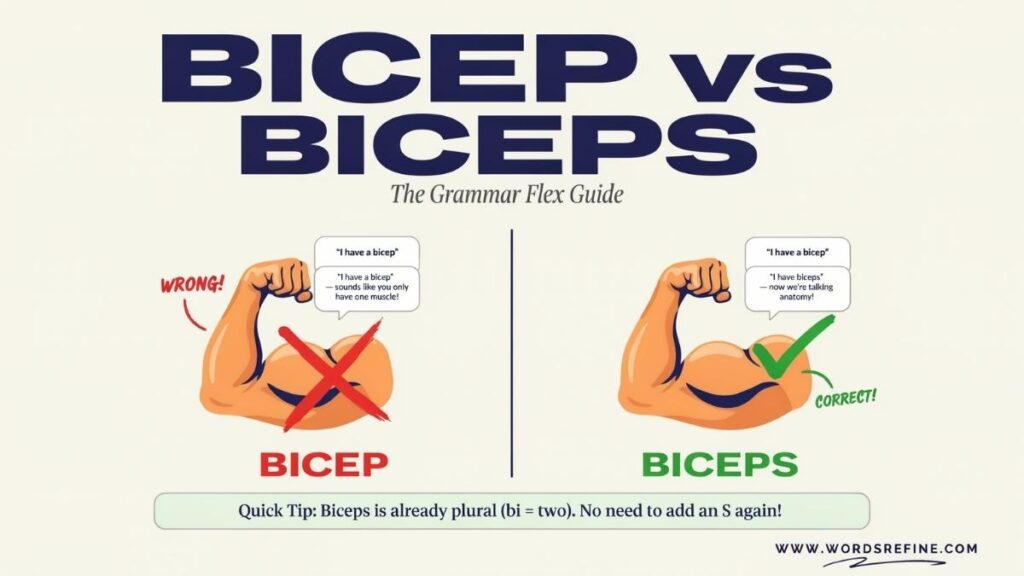
Bicep vs biceps which spelling should you use? The answer might seem like a small detail, but it can make a difference when you’re writing about fitness or human anatomy. Many people use these terms interchangeably, yet biceps is the standard anatomical term, while bicep is common in everyday conversation. Mixing them up won’t ruin your workout, but it can weaken your writing! Understanding bicep vs. biceps helps you avoid confusing word choices and communicate with confidence. In this guide, you’ll learn what each term means, explore practical examples, and identify common mistakes so you can strengthen your grammar without lifting a single dumbbell.
Bicep vs Biceps The Quick Answer
Both bicep vs biceps appear in modern English, but they have slightly different uses.
Biceps is the standard anatomical term for a two-headed muscle. It can function as a singular noun when referring to one muscle. In contrast, bicep is a common informal variant used in everyday conversations and fitness discussions.
Biceps can refer to the muscle in one arm or to the corresponding muscles in both arms. Meanwhile, biceps brachii is the specific anatomical name for the muscle at the front of the upper arm. Biceps femoris refers to a different muscle at the back of the thigh.
| Sentence | Usage | Explanation |
|---|---|---|
| My bicep hurts after yesterday’s workout. | Informal | Bicep is a common everyday variant. |
| My biceps hurts after yesterday’s workout. | Anatomical | Biceps refers to one muscle and takes a singular verb. |
| Both biceps are sore today. | Plural | The sentence refers to the muscles in both arms. |
| The biceps brachii helps flex the elbow. | Anatomical | The specific muscle name takes a singular verb. |
The key point is that the final s in biceps doesn’t automatically make the noun plural. Instead, the surrounding sentence determines its meaning and the correct verb form.
Learn the difference between confusing more English words
Buy vs Bye Meaning Differences Examples ?
What Does Bicep Mean?
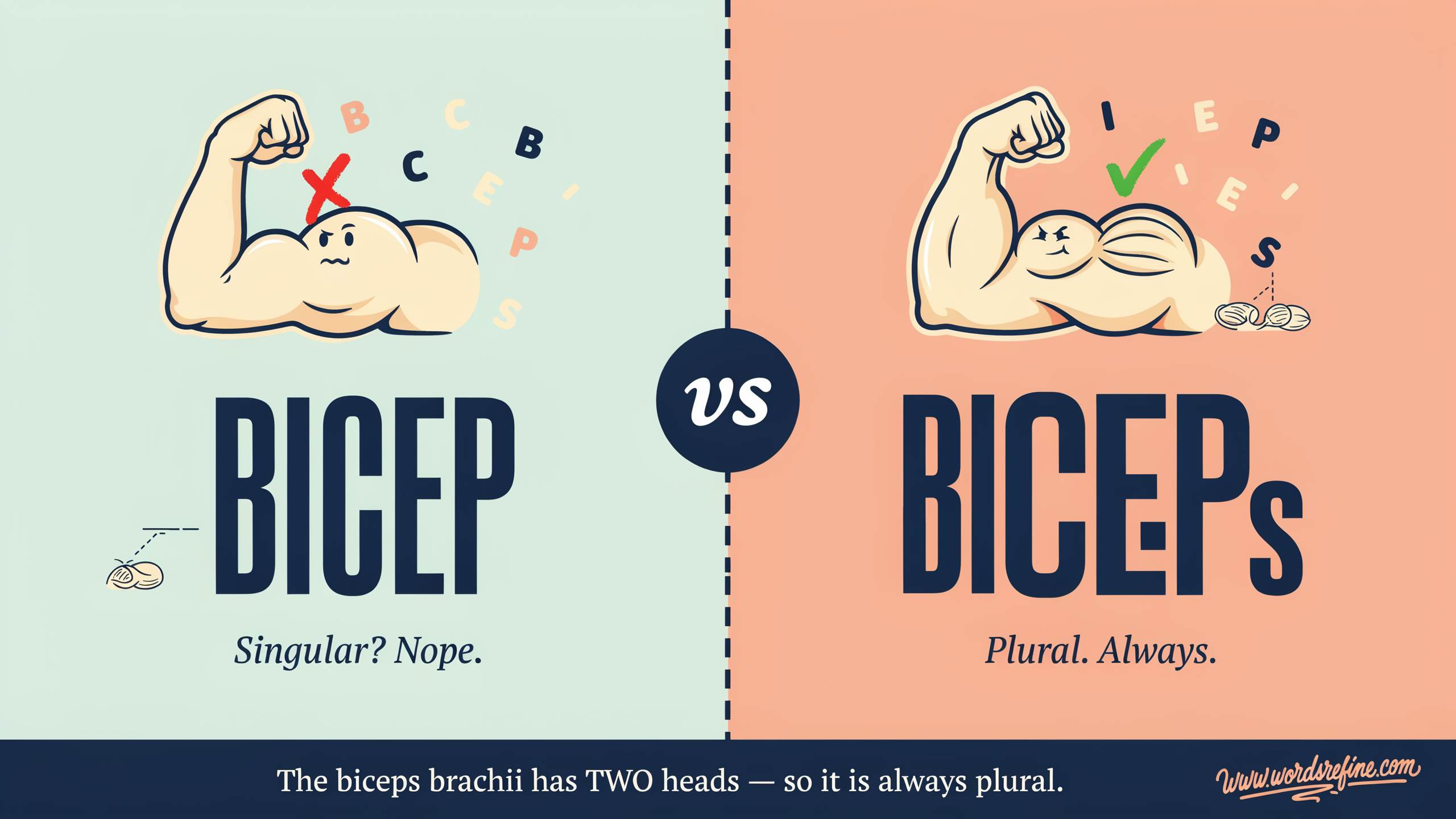
The word bicep refers to the muscle commonly associated with the front of the upper arm. You’ll often hear it in casual conversations, gym instructions, workout plans, and fitness articles.
For example, someone might say, “I felt a pull in my bicep while lifting weights.” Most people will understand exactly which muscle the person means.
Is Bicep a Word?
Yes, bicep is a recognized English word. It’s commonly used as a shortened form of biceps, and dictionaries record its use.
The word is particularly popular in informal speech because it sounds natural and straightforward. People often prefer shorter expressions when discussing exercise or body parts.
For example, someone might say, “He injured his bicep during a weightlifting session,” or “This exercise targets your bicep.” Both sentences communicate the intended meaning clearly.
However, when writing about anatomy in a formal or educational setting, biceps is generally the better choice. Although bicep is widely understood, biceps is the established anatomical term.
Is Bicep Grammatically Correct?
Yes, bicep is acceptable in ordinary English, particularly in informal contexts. It isn’t simply a spelling mistake.
However, anatomical writing generally favors biceps or the complete name biceps brachii. Medical professionals, anatomy instructors, and scientific writers often use precise terminology to avoid confusion.
Think of it as the difference between a casual expression and a technical term. Both may identify the same thing, but one is more suitable for a particular situation.
Learn the difference between commonly mixed-up more words
T- Shirt vs Tee Shirt Which One Is Correct and Why?
Understanding the Meaning of Bicep in Everyday English
In everyday English, bicep usually refers to the prominent muscle at the front of the upper arm. People associate it with lifting weights, flexing their arms, and building upper-body strength.
However, the term is less precise than the full anatomical name. The upper arm contains several muscles, including the biceps brachii, brachialis, and triceps brachii. Although people commonly talk about bicep exercises, those movements may involve other muscles as well.
Therefore, understanding the context is important, especially when discussing exercise techniques or explaining how muscles work.
What Does Biceps Mean?
The word biceps is the standard anatomical term for a muscle with two heads. A muscle’s heads are distinct points of origin that contribute to the same muscle structure.
In everyday conversation, biceps usually brings to mind the muscle at the front of the upper arm. However, the word also appears in the names of muscles in other parts of the body.
Understanding the Biceps Muscle
The biceps brachii is a skeletal muscle located at the front of the upper arm. It crosses the shoulder and elbow and helps bend the elbow and rotate the forearm so that the palm faces upward.
The muscle has two heads. The long head originates from the supraglenoid tubercle of the scapula, near the shoulder joint. The short head originates from the coracoid process of the scapula.
These heads join to form the muscle belly and contribute to a common tendon that attaches to the radius in the forearm.
The biceps brachii performs several important functions. First, it assists with elbow flexion, which brings the forearm toward the upper arm. Second, it helps with forearm supination, the movement that turns the palm upward. Additionally, it contributes to shoulder movement and stability.
Although people often associate the biceps with lifting weights, the muscle also supports everyday activities such as carrying a bag, turning a doorknob, and bringing food toward the mouth.
Learn the difference between tricky grammar more words
Envisage vs Envision Meaning Differences Examples ?
What Does Biceps Mean in Latin?
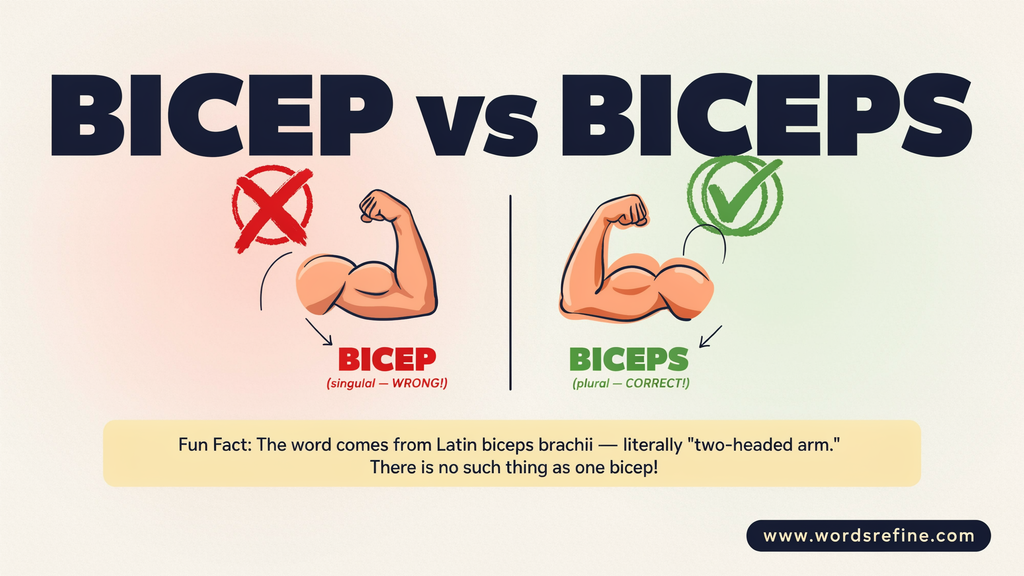
The word biceps comes from Latin. It combines bis, meaning twice or two, with caput, meaning head. Together, these elements describe something with two heads.
This origin explains why the name fits the muscle’s structure. The term refers to the muscle’s two heads rather than the number of muscles a person has.
For example, each upper arm has its own biceps brachii. The word biceps can therefore describe a single muscle despite ending in s.
The Origin of Bicep vs Biceps
The relationship between bicep vs biceps also illustrates a process called back-formation.
Back-formation occurs when speakers create a shorter word by removing what they interpret as an ending from an existing word. English has several examples of this process. For instance, edit developed from editor, while donate developed from donation.
Similarly, speakers formed bicep from biceps by treating the final s as though it were a plural ending. However, the original anatomical term already describes a two-headed muscle. It doesn’t need to lose its final s to become singular.
This process helps explain why bicep feels natural to many English speakers, even though biceps remains the standard anatomical form.
Is Biceps Singular or Plural?
This is the central question behind the confusion between bicep vs biceps. Fortunately, the answer becomes easier once you separate the word’s appearance from its grammatical function.
In English, many nouns form their plurals by adding s or es. For example, one arm becomes two arms, and one muscle becomes two muscles. However, some words already end in s in their singular form.
Biceps is one such word. It can function as either a singular or plural noun, depending on the meaning.
Biceps as a Singular Noun
When you refer to the muscle in one arm, biceps can take a singular verb.
For example, “My right biceps is sore after lifting weights” refers to one muscle. Similarly, “The biceps helps rotate the forearm” describes the function of a single muscle.
You might also write, “Her left biceps looks stronger after months of training.”
In each case, the sentence refers to one muscle, so the singular verb agrees with the subject.
Although my bicep hurts sounds more natural to some people, my biceps hurts is also grammatically possible when biceps refers to one muscle.
Biceps as a Plural Noun
When you refer to the corresponding muscles in both arms, biceps takes a plural verb.
For example, “Both of my biceps are sore after the workout” clearly refers to two muscles. Likewise, “His biceps look more developed than they did last year” describes the muscles in both arms.
You could also say, “The athlete’s biceps have grown stronger with consistent training.”
Here, the plural verbs are correct because the sentences refer to more than one muscle.
Learn the difference between confusing word pairs
Weighed vs Weighted Which One Is Correct ?
Understanding Singular and Plural Forms
| Feature | Singular use | Plural use |
|---|---|---|
| Number of muscles | One | Two or more |
| Noun form | Biceps | Biceps |
| Typical verb | Is, has, looks | Are, have, look |
| Example | The biceps is injured. | Both biceps are injured. |
Notice that the spelling stays the same. Instead, the surrounding words and the verb reveal whether the noun refers to one muscle or several.
What Is the Singular Form of Biceps?
The standard anatomical singular is biceps. You don’t need to remove the final s to make the word singular.
However, bicep is commonly used as an informal singular form. The choice depends on your intended tone and audience.
Learn the difference between often confused words
Apprised vs Appraised Which One Is Correct and Why It Matters ?
What Is the Plural of Bicep?
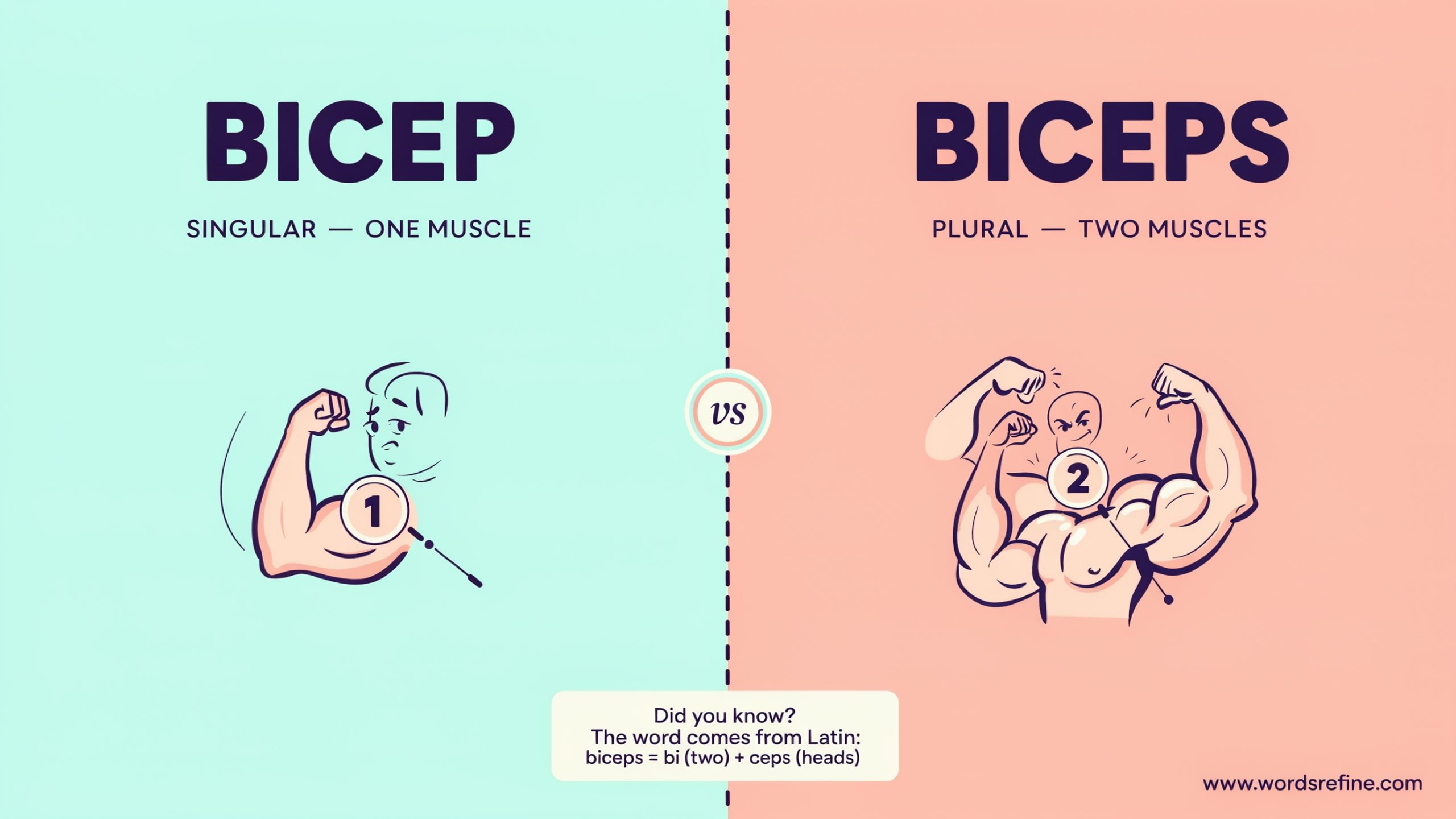
When bicep is used as a singular noun, its usual plural is biceps. For example, “She trained both biceps today” is a natural sentence.
Some dictionaries also record bicepses as a plural form of biceps. Nevertheless, that form is uncommon in everyday writing. When discussing the muscles in both arms, biceps is generally sufficient.
Bicep vs Biceps Differences
The main difference between bicep vs biceps concerns standard anatomical usage and informal English. The words don’t refer to two different muscles simply because their spellings differ.
| Comparison | Bicep | Biceps |
|---|---|---|
| Meaning | A muscle, usually the upper-arm muscle | A two-headed muscle, commonly the upper-arm muscle |
| Grammatical use | Common informal singular | Standard anatomical singular and plural |
| Formal anatomy | Generally less preferred | Preferred |
| Casual conversation | Common | Also common |
| Referring to one arm | Natural in informal speech | Correct in anatomical usage |
| Referring to both arms | Less common | Common |
| Example | I strained my bicep. | My left biceps is sore. |
So, which is grammatically correct: bicep vs biceps? Both have established uses, but biceps is the safer choice when anatomical precision matters.
However, dictionary guidance can vary. Some dictionaries accept bicep without qualification, while others discourage it in favor of the traditional anatomical term. For practical writing, biceps is the better choice for anatomy lessons, educational articles, and medical discussions. Bicep works well when the informal tone suits your audience.
Why Do People Say Bicep Instead of Biceps?
The popularity of bicep makes sense when you consider how English speakers naturally handle unfamiliar word endings.
The Influence of Informal Speech
Many speakers interpret the final s in biceps as a plural marker. They remove it to create what seems like a logical singular form: bicep.
This process is known as back-formation. It can produce words that feel natural even when they don’t follow the original word’s historical structure.
People also tend to favor short, direct expressions in conversation. Saying “I hurt my bicep” feels straightforward, especially when discussing a workout or a minor strain.
Fitness Culture and Everyday Language
Fitness culture has helped make bicep familiar to a wide audience. In gym conversations and exercise descriptions, you’ll often encounter phrases such as bicep curls, bicep exercises, bicep training, and bicep strength.
These expressions are easy to understand. However, the standard anatomical term still appears in formal exercise science and medical writing.
The distinction is similar to using a casual term for a body part while a textbook uses its precise anatomical name. The casual version may communicate the idea clearly, but technical writing often requires greater consistency.
Learn the difference between basic English word mistakes
Remediated vs Remedied Which One Is Correct ?
Why the Final S Causes Confusion
English has no universal rule that every noun ending in s must be plural. Consider species and series. Both words can refer to one thing or several, depending on the context.
Biceps works similarly. You can say, “The biceps is sore,” when discussing one muscle, or “Both biceps are sore,” when referring to the muscles in both arms.
Therefore, don’t decide whether a noun is singular or plural by looking at its final letter alone. Instead, consider its meaning and how it functions in the sentence.
Common Mistakes With Bicep vs Biceps
Most mistakes involving bicep vs biceps occur when writers confuse spelling, grammatical number, and anatomical terminology. Fortunately, a few simple corrections can prevent these errors.
Assuming Biceps Is Always Plural
The final s makes biceps look plural, but the word can refer to one muscle.
For example, “The biceps are responsible for bending my right elbow” uses a plural verb even though the sentence refers to one muscle.
A better version is, “The biceps is one of the muscles that helps bend my right elbow.”
However, if the sentence refers to both arms, a plural verb is appropriate.
Assuming Bicep Is Always Incorrect
The word bicep is widely used and appears in dictionaries. It isn’t merely a typo.
For example, “I strained my bicep while lifting a dumbbell” is natural informal English. In a formal anatomy paper, “I strained my biceps brachii” would be more precise if that specific muscle had been identified.
The correction depends on the context, not simply on whether the word appears in a dictionary.
Writing Bicepses When Biceps Will Do
English sometimes adds es to form a plural, but that doesn’t mean every noun ending in s requires the same treatment.
“Both biceps are sore” is the usual expression. “Both bicepses are sore” is unnecessary in ordinary writing.
Although bicepses appears in some dictionaries as an accepted plural form, biceps remains the common choice when referring to the muscles in both arms.
Confusing the Biceps With the Triceps
The biceps and triceps are different muscles with different primary roles.
The biceps brachii lies at the front of the upper arm and helps flex the elbow. The triceps brachii lies at the back of the upper arm and primarily extends the elbow, straightening the arm.
A biceps curl primarily trains the elbow flexors, including the biceps. In contrast, a triceps pushdown primarily targets the triceps.
Calling both muscles biceps is anatomically incorrect, even in casual conversation.
Using Imprecise Anatomical Language
In everyday conversation, “I hurt my bicep” usually communicates the general idea. However, a medical report may need to distinguish the biceps brachii from another muscle or identify a specific tendon.
For example, pain near the front of the shoulder could involve the long-head biceps tendon rather than the muscle belly itself. A healthcare professional must assess the symptoms before identifying the injured structure.
This is why precise anatomical terminology matters in medical writing. The goal isn’t to sound complicated. It’s to describe the correct structure.
Bicep vs Biceps Examples in Everyday English
Examples make the difference between these words easier to remember. Notice how the level of formality and the number of muscles affect the wording.
| Context | Example sentence | Explanation |
|---|---|---|
| Casual conversation | My bicep hurts after the workout. | Common informal singular |
| Anatomy | The biceps is a two-headed muscle. | Singular anatomical use |
| Both arms | My biceps are sore today. | Plural meaning |
| Exercise instruction | Perform three sets of biceps curls. | Conventional fitness terminology |
| Medical writing | The biceps brachii crosses the shoulder and elbow. | Specific anatomical name |
| Muscle function | The biceps assists with forearm supination. | Singular subject and verb |
| Fitness progress | Both of his biceps have become stronger. | Plural subject |
| Injury discussion | The clinician examined the biceps tendon. | Anatomical terminology |
Talking About a Workout
Imagine that Jordan finishes a strength-training session and tells a friend, “My bicep is exhausted.”
The sentence sounds natural in everyday conversation. Jordan means that the muscle in one upper arm feels tired.
Now imagine Jordan is writing an anatomy assignment. A more suitable sentence would be, “The biceps brachii assists with elbow flexion and forearm supination.”
Both sentences communicate useful information. The difference lies in their purpose and level of precision.
Describing Both Arms
Suppose a trainer compares the muscles in a client’s left and right arms.
The trainer might say, “Your biceps are developing evenly.”
Here, biceps refers to the muscles in both arms. The plural verb are matches that meaning.
If the trainer examines only the right arm, the sentence could be, “Your right biceps is developing well.” The noun stays the same, but the singular subject changes the verb.
These examples demonstrate why meaning matters more than the final letter when choosing between singular and plural verb forms.
Bicep vs Biceps in Fitness and Anatomy
Fitness language and anatomical writing overlap, but they don’t always use terminology in the same way.
Biceps Brachii The Upper-Arm Muscle
The biceps brachii is the muscle most people picture when they flex their arm. It has a long head and a short head, both of which originate from the scapula, or shoulder blade.
The biceps contributes to three main functions.
First, it assists with elbow flexion, which bends the elbow and brings the forearm toward the upper arm. Second, it helps with forearm supination, which rotates the palm upward. Finally, it contributes to certain shoulder movements and helps stabilize the joint.
However, the biceps doesn’t work alone. The brachialis also contributes significantly to elbow flexion, while the brachioradialis helps bend the elbow, particularly in certain forearm positions.
This explains why a curl can involve several muscles even when the exercise is described as a biceps workout.
Long Head vs Short Head of the Biceps
The long and short heads are two parts of the same biceps brachii muscle. They have different origins but come together to form the muscle belly.
The long head passes through the shoulder region and contributes to shoulder stability. Meanwhile, the short head originates from a different part of the scapula.
You may encounter fitness advice claiming that a particular curl completely isolates one head. In practice, both heads participate in elbow flexion, although grip, shoulder position, and exercise technique can change the demands placed on the muscle.
The anatomical terms long head and short head describe structures within one muscle. They don’t mean a person has two separate biceps muscles in the same arm.
Biceps Femoris The Muscle in the Thigh
The biceps femoris is a different muscle located at the back of the thigh. It belongs to the hamstring muscle group and helps bend the knee. Its long head also contributes to hip extension.
The names biceps brachii and biceps femoris share the word biceps because both muscles have two heads. Their second words identify their anatomical regions. Brachii relates to the arm, while femoris relates to the thigh.
| Feature | Biceps brachii | Biceps femoris |
|---|---|---|
| Location | Front of the upper arm | Back of the thigh |
| Muscle group | Upper-arm muscles | Hamstrings |
| Main actions | Elbow flexion and forearm supination | Knee flexion; long head also assists hip extension |
| Common exercise | Biceps curl | Leg curl |
| Related joints | Elbow and shoulder | Knee and hip |
This comparison answers a common question: the biceps brachii and biceps femoris are not the same muscle. They share an anatomical naming pattern, but they perform different functions in different parts of the body.
Are Biceps and Abs the Same Thing?
No. The biceps are muscles in the arm or thigh, depending on the specific muscle being discussed. Abs refers to the abdominal muscles, especially the rectus abdominis in common fitness language.
People sometimes compare biceps and abs when discussing fitness goals, but the terms identify different muscle groups. Neither word is a grammatical alternative for the other.
Similarly, the biceps and triceps aren’t the same muscle. They work together during many arm movements, but they have different locations and functions.
American English vs British English Bicep vs Biceps?
The distinction between bicep vs biceps isn’t a major American-versus-British spelling difference. Both varieties of English use biceps as the standard anatomical term, and both use bicep in informal contexts.
For example, an American fitness instructor might say, “Let’s work your biceps,” while a British gym-goer might say, “I’ve strained my bicep.” Neither expression depends on a separate national spelling rule.
The more important distinction is formal versus informal usage.
In professional writing, choose biceps or the appropriate full anatomical name. In casual conversation, bicep is widely understood.
How to Spell Biceps and Pronounce It Correctly
If you’re unsure about the correct spelling of biceps, remember that the standard anatomical word contains a final s: b-i-c-e-p-s.
The spelling doesn’t change when you refer to one muscle or the muscles in both arms.
In American English, biceps is pronounced “BYE-seps,” with the emphasis on the first syllable.
Common expressions include biceps muscle, biceps brachii, biceps workout, biceps curl, and biceps tendon.
You may also see bicep curl in exercise descriptions. That’s a common informal construction, although biceps curl is also widely used.
One more point: biceps doesn’t have a full form in the way an acronym does. It is a complete word derived from Latin, not an abbreviation that needs to be expanded.
Learn the difference between commonly misused words
Vaccum Vs Vacuum Which One Is Correct and Why It Matters ?
How to Remember the Difference Between Bicep vs Biceps
A simple rule will help you choose the right term without overthinking it.
For formal anatomy, use biceps. For casual conversation, bicep is common.
When deciding whether biceps is singular or plural, ask yourself how many muscles the sentence describes.
If you’re talking about one arm, you can write, “The biceps is sore.” If you’re talking about both arms, write, “The biceps are sore.” For an informal singular reference, “My bicep is sore” also works.
Pay attention to the verb. Is and are often reveal the intended meaning more clearly than the noun’s spelling.
Learn the difference between everyday English mistakes
Octopus vs Octopi Which Plural Is Correct and Why?
Bicep vs Biceps Practice Session
1. The muscle at the front of the upper arm is commonly called the ______.
2. The standard anatomical term for this upper-arm muscle is ______.
3. The biceps brachii has ______ heads.
4. The two heads of the biceps brachii are called the long head and the ______ head.
5. The biceps help bend the ______ joint.
6. The biceps also help rotate the forearm so the palm faces ______.
7. The muscle group opposite the biceps is the ______.
8. Hammer curls target the biceps and the ______ muscle.
9. Incline dumbbell curls place the biceps in a more ______ position at the start of the movement.
10. A 20-pound bicep curl is appropriate when you can maintain proper ______ throughout the exercise.
11. Performing 100 bicep curls every day does not guarantee muscle ______.
12. Gradually increasing the challenge of your workouts is called progressive ______.
13. Muscles need adequate ______ after exercise to repair and grow.
14. Consuming enough ______ supports muscle repair and growth.
15. Getting enough ______ helps your muscles recover after training.
16. Lifting weights that are too heavy can lead to poor ______.
17. Swinging your body during curls reduces control over the ______.
18. The ______ are located at the back of the upper arm.
19. The biceps ______ is the muscle at the front of the upper arm.
20. Muscle growth depends on training, nutrition, and adequate ______.
21. Calves, forearms, and shoulders can be challenging muscles to ______.
22. Personal preferences vary when it comes to the most attractive ______.
23. The appearance of a 12-inch upper arm can vary depending on height and body ______.
24. Dumbbell curls, hammer curls, and incline dumbbell curls help develop the ______ and surrounding arm muscles.
25. For consistent progress, increase resistance ______ as your strength improves.
Answers
- Bicep
- Biceps
- Two
- Short
- Elbow
- Upward
- Triceps
- Brachialis
- Stretched
- Form
- Growth
- Overload
- Recovery
- Protein
- Sleep
- Technique
- Movement
- Triceps
- Brachii
- Recovery
- Grow
- Muscles
- Composition
- Biceps
- Gradually
Here’s a trusted source for clear more words Comparison:
FAQs
What does bicep mean?
Bicep is an informal term for the biceps, the muscle at the front of the upper arm. Although people commonly use “bicep” in everyday conversation, “biceps” is the standard anatomical term.
What is the most attractive muscle on a woman’s body?
Attractiveness is subjective, so there is no single muscle that everyone finds most attractive. Some people prefer defined shoulders, toned arms, strong legs, or well-developed glutes. Ultimately, personal preferences vary, and overall fitness and confidence often matter more than the size of one muscle.
Is a 12-inch bicep big for a woman?
A 12-inch upper-arm measurement can be noticeable, but whether it is considered large depends on a woman’s height, body composition, and muscle development. For a meaningful comparison, measure around the widest part of the upper arm and use the same measurement method each time.
What kills muscle gains the most?
Inconsistent training, insufficient protein, inadequate calorie intake, poor sleep, and limited recovery can all slow muscle growth. Skipping workouts or increasing training intensity without allowing muscles to recover can also hinder progress. Consistent exercise, balanced nutrition, and adequate rest are essential for building muscle.
Why do girls love biceps so much?
Some women find muscular arms attractive because they associate them with strength, fitness, or confidence. However, preferences differ from person to person. Not every woman prioritizes biceps, and personality, appearance, and individual chemistry can all influence attraction.
What are the top three hardest muscles to grow?
The calves, forearms, and shoulders can be challenging for some people to develop, although difficulty varies with genetics, training experience, and exercise selection. Consistent progressive overload, proper technique, adequate nutrition, and sufficient recovery can help these muscles grow over time.
Is a 20-pound bicep curl good?
A 20-pound bicep curl can be a solid weight, depending on your training experience and whether you use one dumbbell or two. The most important factor is maintaining proper form and controlling each repetition without swinging your body. Choose a weight that challenges you while allowing you to complete your target repetitions safely.
What are the top three bicep exercises?
Dumbbell curls, hammer curls, and incline dumbbell curls are three effective exercises for developing the biceps and surrounding arm muscles. Dumbbell curls target the biceps directly, hammer curls emphasize the brachialis and brachioradialis, and incline curls train the biceps through a stretched starting position. Combining these movements can support balanced arm development.
What will 100 bicep curls a day do?
Doing 100 bicep curls every day may improve muscular endurance, especially for beginners, but it does not guarantee bigger arms. Results depend on the weight, technique, training intensity, nutrition, and recovery. Repeating the same high volume daily can also cause soreness or overuse injuries. A structured routine with gradually increasing resistance and adequate rest is generally more effective for building muscle.
Learn the difference between more words people mix up
Sublet vs Sublease Which One Is Correct ?
Conclusion
The difference between bicep vs biceps may seem small, but getting it right can make your writing clearer and more accurate. Biceps is the standard anatomical term, while bicep is a common informal alternative. Remember, your muscles can grow with consistent training, but your grammar should not need a workout to get stronger!
Whether you’re discussing dumbbell curls, muscle growth, or your latest gym session, use the right word for the situation. After all, building bigger biceps takes time, effort, and recovery. Using the correct term takes just a little practice. Keep learning, keep lifting, and don’t let a tiny spelling difference become the biggest muscle in the room.

Diora AJS she is an experienced blogger and passionate English language enthusiast at Words Refine. With a keen eye for language and a love for clear communication, she writes practical content about grammar, word meanings, usage, and commonly confused terms. Her goal is to make English easier to understand through clear explanations and relatable examples, helping readers write accurately and communicate with confidence.