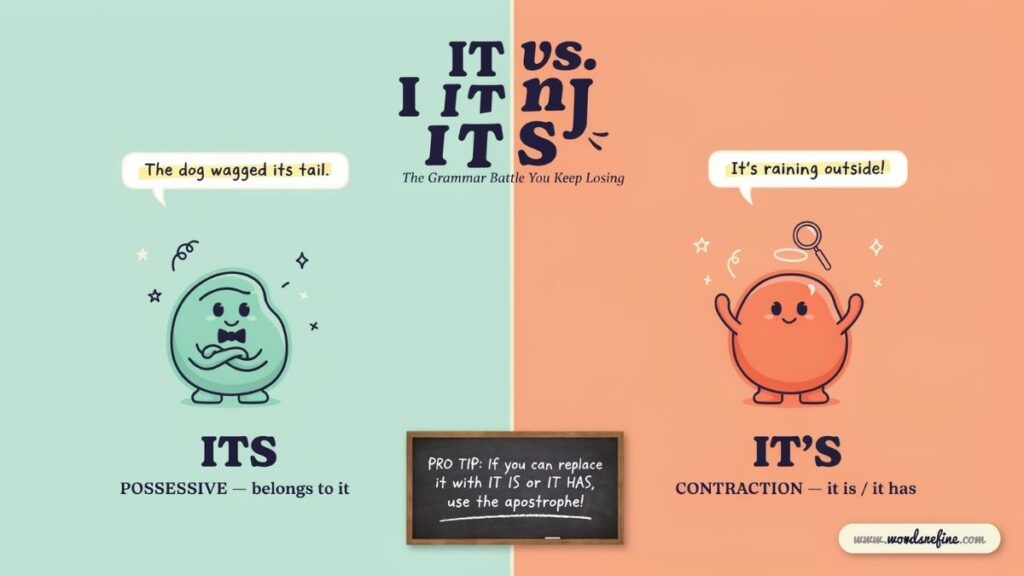
The difference between It vs Its may look minor, but these three words can cause plenty of grammar confusion. A tiny apostrophe can turn a correct sentence into a mistake, leaving even confident writers second-guessing themselves. If you’ve ever wondered whether to write “its tail” vs “it’s raining,” you are not alone. Understanding it vs. its and knowing when to use it’s can make your writing clearer and more accurate. Fortunately, the rules are simple once you understand them. This guide explains their meanings, differences, common mistakes, and correct usage with practical examples to help you write confidently and keep those tricky apostrophes in check.
It vs Its The Quick Answer
The main difference between it vs its lies in their grammatical functions. It is a pronoun, while its is a possessive determiner that identifies something belonging or relating to a noun represented by it.
Neither word is inherently more correct than the other. The right choice depends on what you want to say.
| Word | Meaning | Example |
|---|---|---|
| It | Refers to a thing, animal, idea, or situation | It looks expensive. |
| Its | Shows possession or association | The phone lost its signal. |
| It’s | Means it is or it has | It’s getting late. |
The easiest way to understand the difference is to consider what the sentence needs. If you’re referring to something, use it. If you’re describing a feature or something associated with that thing, use its. However, if the sentence requires it is or it has, use it’s.
For example, imagine you’re describing a new laptop. You might write, “It runs quickly,” to describe its performance. You could say, “Its battery lasts all day,” to explain one of its features. Finally, you might write, “It’s faster than my old laptop,” meaning “It is faster than my old laptop.”
The subject remains the same, but the grammatical role changes. Once you recognize that difference, the correct spelling becomes easier to identify.
Learn the difference between commonly mixed-up more words
Mortality vs Fatality Meaning Differences and Correct Usage ?
What Does It Mean?
The word it is a third-person singular pronoun in English. Writers use it to refer to something already mentioned, something understood from context, or a situation that doesn’t require a specific person or object as its subject.
It as a subject pronoun
When it appears as the subject of a sentence, it identifies the thing being described or the thing performing an action.
For example, consider these sentences:
The computer is old, but it still works well.
The movie was long, yet it kept everyone interested.
The cat looks hungry because it hasn’t eaten.
The plan sounds promising, so it deserves consideration.
In each example, it refers to a noun mentioned earlier. This helps writers avoid repeating the same noun throughout a paragraph.
Without pronouns, the first sentence would read, “The computer is old, but the computer still works well.” Although the sentence is grammatically correct, it sounds repetitive. Using it makes the sentence smoother and more natural.
It as an object pronoun
The word it can also function as the object of a verb or preposition. In this role, it receives an action or follows a preposition.
For example, consider these sentences:
I found the key and put it in my pocket.
She bought a new camera because she needed it for work.
We discussed the proposal before approving it.
The children looked at the painting and admired it.
In each case, it refers to something already identified in the sentence or surrounding context. Its grammatical role differs from its role as a subject, but its purpose remains the same.
Learn the difference between tricky grammar more words
Mama vs Mamma Meaning Spelling and Usage?
It in statements about time, weather, and distance
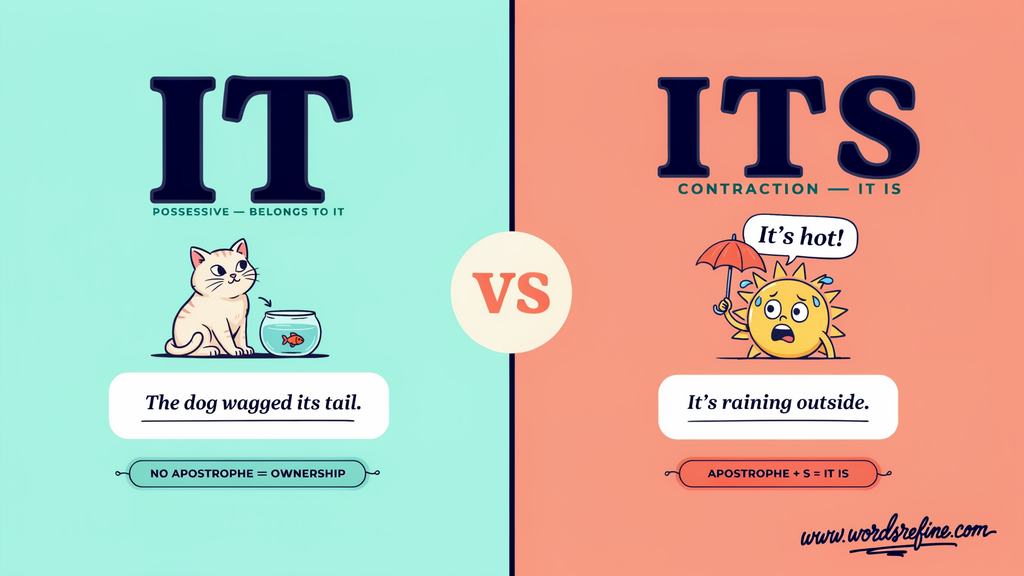
English also uses it as an impersonal subject. In these sentences, it doesn’t refer to a particular object or animal. Instead, it helps form a grammatically complete statement.
For example, we say, “It is raining heavily,” “It is almost midnight,” and “It takes two hours to reach the airport.”
Similarly, a sentence such as “It is important to read the instructions carefully” uses it to introduce a general statement.
Understanding these uses helps you recognize when it is the correct choice. After all, not every sentence involving it vs its expresses possession.
What Does Its Mean?
The word its is the possessive form of it. It shows that something belongs to, forms part of, or relates to a thing, animal, organization, place, or idea.
For example, the bird spread its wings, the company changed its policy, and the website updated its privacy settings.
In each sentence, its connects a noun to something associated with the subject.
Its as a possessive determiner
Traditional grammar sometimes describes its as a possessive adjective. Modern grammatical descriptions generally classify it as a possessive determiner because it appears before a noun and identifies the relationship between that noun and something else.
Consider these examples:
The dog chased its ball.
The engine needs its filter replaced.
The museum expanded its collection.
The tree lost its leaves during autumn.
The words ball, filter, collection, and leaves are nouns. Its tells readers which ball, filter, collection, or leaves the sentence refers to.
However, possession doesn’t always mean legal ownership. A tree doesn’t own its leaves in the same way someone owns a bicycle. Likewise, a company can have a reputation, a policy, or a public image without literally owning these things.
In such cases, its expresses a relationship, characteristic, or connection. For example, “The book has its own style” describes a quality associated with the book.
Is Its a possessive pronoun?
Many people refer to its as a possessive pronoun, but there’s a useful grammatical distinction to understand.
Words such as mine, yours, hers, and theirs can stand alone in a sentence. For example, you might say, “This book is mine” or “That jacket is hers.”
Its generally works differently because it appears before a noun.
For example, we say, “The machine has its own power source” or “The company revised its annual report.”
Standard English doesn’t commonly use its as a standalone possessive pronoun in the same way it uses hers or theirs. Instead, its normally identifies a noun connected to something already mentioned.
That’s why “The toy is its” sounds incomplete in ordinary English. Depending on the intended meaning, a more natural sentence might be “The toy belongs to it.”
Learn the difference between confusing word pairs
Stripes vs Strips Meaning Differences and Correct Usage ?
It’s vs Its Understanding the Apostrophe
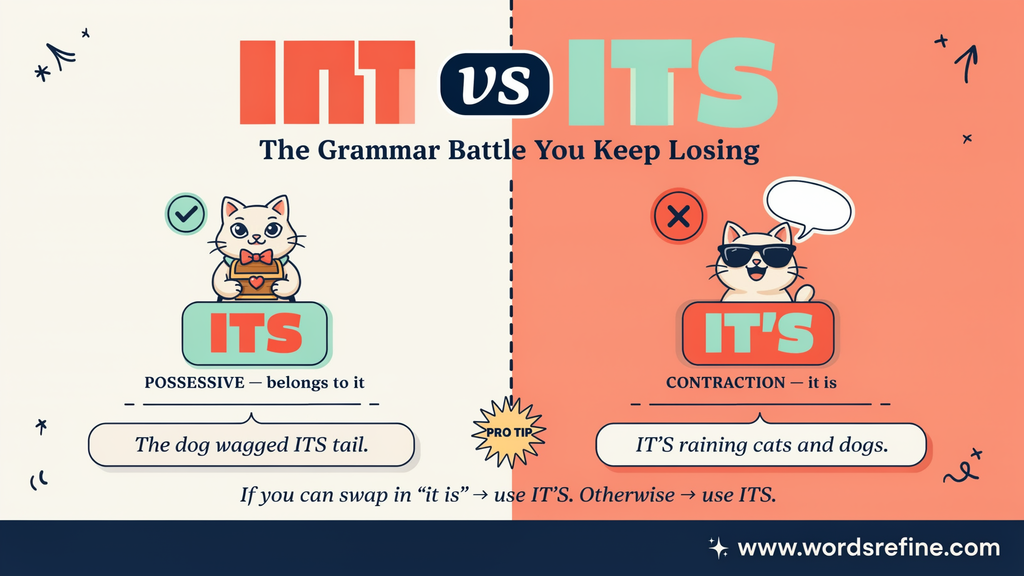
The apostrophe causes much of the confusion between it’s and its. Many English possessives use apostrophes, such as Sarah’s book or the dog’s collar. However, the possessive form of it follows a different pattern.
Its shows possession without an apostrophe, while it’s uses an apostrophe because it combines two words.
Consider this example: “The dog is limping because it’s hurt its paw.”
The first it’s means it has. The second its indicates that the paw belongs to the dog.
Although the words appear in the same sentence, they serve different grammatical purposes. The apostrophe isn’t optional when you use the contraction, and you shouldn’t add one to its when showing possession.
What Does It’s Mean?
The word it’s has two standard meanings: it is and it has. The apostrophe marks the omission of letters when these words combine.
It’s as a contraction of it is
The most common use of it’s is as a contraction of it is.
For example, we say, “It’s a beautiful morning,” meaning “It is a beautiful morning.” Similarly, “It’s difficult to solve this puzzle” means “It is difficult to solve this puzzle.”
You might also write, “It’s getting colder outside” or “It’s my favorite restaurant.”
In these examples, it’s combines the subject pronoun it with the verb is. This contraction makes sentences sound natural in everyday conversation and informal writing.
However, contractions aren’t automatically incorrect in formal writing. You can use them in professional or academic contexts when the tone and applicable style guidelines allow them. Some institutions and publications prefer writers to avoid contractions in certain types of documents, so it’s worth checking the relevant requirements.
It’s as a contraction of it has
The second meaning of it’s is it has. This use often appears in the present perfect tense, where has acts as a helping verb.
For example, “It’s been a difficult week” means “It has been a difficult week.”
Likewise, “It’s already started,” “It’s changed considerably over the years,” and “It’s taken longer than expected” all use it’s to mean it has.
Notice that has is followed by a past participle, such as been, started, changed, or taken.
This pattern offers a useful clue when you’re deciding whether to use an apostrophe. If the sentence describes something that has happened or continued over time, try expanding the contraction to it has.
However, has can also function as a main verb expressing possession. For instance, “It has a blue cover” describes a feature of something. In this sentence, replacing it has with it’s would change the meaning and structure.
Learn the difference between often confused words
Nevertheless vs Nonetheless Meaning and Usage?
Why Does It’s Have an Apostrophe?
An apostrophe often marks missing letters in a contraction. In it’s, the apostrophe indicates that letters have been omitted from it is or it has.
Other common contractions follow the same principle. She’s can mean she is or she has, he’s can mean he is or he has, and they’re means they are.
The apostrophe doesn’t automatically signal possession. Its function depends on the word and its grammatical construction.
That’s why the apostrophe rules for it’s and its differ from the rules for possessive nouns. In it’s, the apostrophe marks a contraction rather than ownership.
How to Choose Between It, Its, vs It’s
When you’re unsure which form to use, start by identifying the job the word needs to perform. Don’t focus on how it looks because it, its, and it’s can sound very similar in speech.
Does the sentence need a pronoun?
If the word refers to a thing, animal, situation, or idea, use it.
For example, “The package arrived, and it was damaged” uses it to refer to the package. Similarly, “I found the document and printed it” uses it as the object of the verb printed.
In these sentences, it doesn’t indicate possession or replace the phrase it is or it has.
Does the sentence show possession or association?
If the word introduces a noun connected to something, use its.
For example, “The package lost its label” identifies the label associated with the package. Likewise, “The printer needs its ink cartridge replaced” refers to a component of the printer.
Ask yourself whether the word identifies something belonging or relating to the subject. If it does, its is likely the correct choice.
Can you replace the word with it is vs it has?
If the sentence needs a contraction, test it’s by expanding it.
“It’s too late to call” becomes “It is too late to call.” Both versions express the same meaning.
Likewise, “It’s been a long day” becomes “It has been a long day.”
Now consider this sentence: “The company revised it’s policy.” Replacing it’s with it is produces “The company revised it is policy,” which doesn’t make grammatical sense. The sentence needs its policy because the policy belongs to or relates to the company.
This replacement trick is one of the easiest ways to check the correct form. Even so, read the entire sentence afterward to ensure that the intended meaning remains clear.
It’s vs Its Examples in Sentences
Comparing correct and incorrect sentences is a practical way to understand the difference. A small spelling change can affect grammatical correctness, even when the sentence still looks familiar.
| Incorrect sentence | Correct sentence | Explanation |
|---|---|---|
| The cat licked it’s paw. | The cat licked its paw. | Its indicates possession. |
| Its going to rain. | It’s going to rain. | It’s means it is. |
| The phone lost it’s connection. | The phone lost its connection. | Its identifies a feature of the phone. |
| Its been a busy day. | It’s been a busy day. | It’s means it has. |
| The business changed it’s hours. | The business changed its hours. | Its identifies the business’s hours. |
| Its a good idea. | It’s a good idea. | It’s means it is. |
| The car won’t start because it’s battery is dead. | The car won’t start because its battery is dead. | Its identifies the car’s battery. |
| I think its too expensive. | I think it’s too expensive. | It’s means it is. |
Everyday examples of it’s vs its
Realistic examples make these rules easier to apply in daily life.
Consider a sentence about an animal: “It’s hungry, and its food bowl is empty.” The first it’s means it is. The second its indicates that the bowl belongs to or is associated with the animal.
Now imagine describing a phone. You might write, “The phone is old, but it’s still useful because its battery holds a charge.” Here, it’s means it is, while its battery identifies a feature of the phone.
The same distinction applies when writing about a company. “The company announced that it’s opening a new office after reviewing its expansion plans.” The first it’s means it is, while the second its identifies plans associated with the company.
Finally, consider this sentence: “It’s surprising that the team finished its project early.” The contraction introduces an observation, while the possessive determiner identifies the team’s project.
These examples show why context matters more than appearance. Once you identify the grammatical role of each word, the correct spelling becomes much easier to recognize.
Learn the difference between basic English word mistakes
Attorneys vs Attornies Which one Is Correct?
Common Mistakes With It’s and Its
Even experienced writers sometimes confuse these forms. The mistake often happens because the apostrophe seems to follow the same rule as possessive nouns. However, English doesn’t use apostrophes in exactly the same way for every possessive form.
Using it’s to show possession
This is one of the most common errors.
Incorrect: The company updated it’s website.
Correct: The company updated its website.
The website belongs to or is associated with the company. The sentence doesn’t require it is or it has, so the contraction doesn’t fit.
Using its instead of it’s
Writers sometimes leave out the apostrophe when the sentence needs a contraction.
Incorrect: Its getting dark outside.
Correct: It’s getting dark outside.
The sentence means “It is getting dark outside.” Therefore, it’s is the appropriate choice.
Writing its’ with an apostrophe at the end
The spelling its’ isn’t the standard possessive form of it. Writers sometimes add an apostrophe after its because they’re familiar with plural possessives such as the teachers’ lounge.
However, it is a singular pronoun, and its is its standard possessive form.
Correct examples include “The dog wagged its tail,” “The organization changed its name,” and “The tree shed its leaves.”
There is no standard English context in which its’ serves as the ordinary possessive form of it.
Assuming every possessive word needs an apostrophe
English uses several different forms to express possession. For example, a singular noun may take an apostrophe and s, as in the dog’s bowl. A plural noun ending in s may use a final apostrophe, as in the teachers’ lounge.
However, possessive determiners such as my, your, his, her, its, our, and their generally don’t use apostrophes. Independent possessive pronouns such as mine, yours, hers, and theirs don’t use them either.
The best approach is to learn how each form works instead of applying one apostrophe rule to every word.
Relying on sound instead of meaning
Because it’s and its usually sound alike, pronunciation won’t help you distinguish them. Instead, consider the sentence’s structure and meaning.
For example, “The bird spread its wings” identifies the bird’s wings, while “It’s ready to fly” means “It is ready to fly.”
Both sentences sound natural, but each requires a different form. Reading for meaning is more reliable than relying on sound alone.
Learn the difference between commonly misused words
Expiry vs Expiration Which One Is Correct?
It vs Its in American and British English
The rules for it’s and its remain the same in standard American and British English. Unlike words such as color and colour, these forms don’t change spelling according to regional conventions.
Both varieties use it as a pronoun, its as a possessive determiner, and it’s as a contraction of it is or it has.
For example, an American writer might say, “The organization changed its policy.” A British writer would use the same spelling and grammatical construction.
Regional differences can affect vocabulary, spelling, and certain punctuation preferences. However, they don’t change the standard distinction between it’s and its.
If you’re writing for an American audience, follow standard American English conventions throughout your document. Nevertheless, don’t treat its as a regional variant or assume that adding an apostrophe is acceptable in British English.
It’s vs Its in Professional and Academic Writing
Correct word usage matters in professional and academic writing because small errors can distract readers from the message. Confusing it’s with its rarely makes a sentence impossible to understand, but repeated mistakes can make a document look poorly edited.
In academic essays
Academic writing often requires precise explanations and clear sentence structure.
Incorrect: The study examines a company’s environmental impact and it’s long-term effects.
Correct: The study examines a company’s environmental impact and its long-term effects.
The word its identifies the effects associated with the company’s environmental impact. The contraction it’s would mean it is or it has, neither of which fits the intended meaning.
In business emails and reports
Business writing frequently discusses organizations, products, policies, and performance. These subjects naturally create many opportunities to use its.
For example, “The department revised its budget after reviewing the latest figures” uses its to identify the budget associated with the department.
By contrast, “It’s important to review the budget before approving the proposal” uses it’s to mean it is.
Both forms are correct when used for their intended purposes.
In technical writing
Technical documents often describe a device’s features, a system’s behavior, or a program’s settings.
For example, “The application stores its settings locally” describes a feature of the application. Similarly, “The device displays its current temperature” identifies information associated with the device.
By contrast, “It’s possible to reset the system without losing saved files” means “It is possible to reset the system without losing saved files.”
When editing instructions or technical documentation, check each instance carefully. A misplaced apostrophe can make otherwise polished writing look rushed.
Can Grammar Checkers Catch Every It’s vs Its Mistake?
Grammar checkers can identify many incorrect uses of it’s and its. Tools such as Grammarly and built-in spelling and grammar checkers may flag a sentence when the surrounding words suggest that the writer selected the wrong form.
However, a correctly spelled word can still be grammatically wrong in context.
Consider this sentence: “The dog wagged it’s tail.”
The word it’s is spelled correctly as a contraction. The problem is that the sentence needs the possessive determiner its. A spell-checker that focuses only on spelling may not catch the error.
Likewise, “Its going to be fine” may escape a basic spelling check because its is a valid English word. A grammar checker may recognize the problem, but no automated tool guarantees that it will catch every context-dependent mistake.
When reviewing your writing, search for every occurrence of it’s and its. Replace each it’s with it is and then try it has. If neither expansion produces the intended grammatical sentence, reconsider the word.
Next, check each its to confirm that it introduces a noun or expresses an appropriate relationship. Finally, read the complete sentence to make sure it conveys the intended meaning.
This method works well for emails, school assignments, blog posts, and longer reports. It also helps you catch mistakes that automated tools might miss.
Learn the difference between everyday English mistakes
Dork vs Nerd Meaning Differences Examples?
It’s vs Its A Quick Comparison
When you need a quick reminder, the following table summarizes the difference.
| Feature | It | Its | It’s |
|---|---|---|---|
| Basic meaning | Refers to something | Shows possession or association | It is or it has |
| Grammatical role | Pronoun | Possessive determiner | Contraction |
| Uses an apostrophe? | No | No | Yes |
| Example | It looks new. | Its cover is blue. | It’s brand-new. |
| Quick test | Does it refer to something? | Does it identify a related noun? | Can you expand it to it is or it has? |
The easiest memory trick is to remember that the apostrophe in it’s marks missing letters, not possession.
Whenever you see it’s, test the full form. When you see its, look for the noun it describes. This small habit can prevent a surprising number of grammar mistakes.
Learn the difference between everyday English mistakes
favour vs Favor Meaning Differences Spelling and Examples ?
It vs Its Practice Session
- The puppy wagged _____ tail when its owner came home.
- _____ getting late, so we should leave now.
- The company changed _____ logo to match its new brand.
- _____ been a wonderful experience working with this team.
- The phone stopped working because _____ battery was dead.
- _____ important to read the instructions carefully.
- The bird spread _____ wings and flew into the sky.
- I believe _____ time to start the meeting.
- The restaurant is famous for _____ homemade desserts.
- _____ difficult to solve this puzzle without a clue.
- The school updated _____ rules for the new term.
- _____ already been two hours since the movie started.
- The old car still runs well despite _____ age.
- The team celebrated because _____ won the championship.
- The website changed _____ design to improve navigation.
- _____ been raining since early morning.
- The tree lost _____ branches during the storm.
- _____ clear that we need to reconsider our plan.
- The machine stopped because _____ motor overheated.
- _____ possible to finish the project before Friday.
- The dog returned to _____ bed after its walk.
- The weather is beautiful, and _____ perfect for a picnic.
- The museum expanded _____ collection last year.
- _____ surprising that the children finished their homework so quickly.
- The business revised _____ policies because _____ necessary to improve customer service.
Answers
- Its
- It’s
- Its
- It’s
- Its
- It’s
- Its
- It’s
- Its
- It’s
- Its
- It’s
- Its
- It
- Its
- It’s
- Its
- It’s
- Its
- It’s
- Its
- It’s
- Its
- It’s
- Its; it’s
Here’s a trusted source for clear more words Comparison:
FAQs
What Is the Difference Between It vs Its?
Use it as a pronoun to refer to a thing, animal, idea, or situation. Use its to show possession or association. For example, “The dog chased its ball” shows that the ball belongs to the dog.
Is It Correct to Use It’s in a Sentence?
Yes, it’s is correct when you mean it is or it has. For example, “It’s a beautiful day” means “It is a beautiful day.” However, when you want to show possession, use its without an apostrophe.
When Should I Use Its?
Use its when something belongs to or is associated with an animal, object, organization, or other noun. For example, “The company updated its website.” Here, its connects the website to the company.
Should I Write It Is vs It’s?
Both forms are correct. It’s is a contraction of it is or it has, while it is uses the full words. For example, “It’s raining” and “It is raining” mean the same thing. You can use either form in most writing, depending on your preferred tone and the level of formality.
Which Is Correct “It’s Eyes” vs”Its Eyes”?
“Its eyes” is correct when referring to the eyes of a person, animal, or thing. For example, “The cat closed its eyes.” The phrase “it’s eyes” is incorrect because it’s means it is or it has, which does not fit the sentence.
What Are Some Examples of Its in Sentences?
Here are a few examples of its used correctly:
- The bird built its nest in the tree.
- The laptop needs its battery replaced.
- The restaurant is known for its fresh bread.
- The plant lost its leaves during the winter.
- The school changed its opening hours.
In each example, its shows possession or a connection between two things.
How Can I Use It Correctly?
Choose the word based on what you want to express. Use it to refer to something already mentioned, as in “I bought a new phone, and it works perfectly.” and Use its to show possession, as in “The phone has a scratch on its screen.” Use it’s when you mean it is or it has, as in “It’s working perfectly.”
Is It “My Girlfriend and I” or “My Girlfriend and Me”?
Both phrases are correct, but they serve different grammatical roles. Use “my girlfriend and I” as the subject of a sentence: “My girlfriend and I went shopping.” Use “my girlfriend and me” as the object: “The waiter served my girlfriend and me.”
To check which form you need, temporarily remove “my girlfriend and.” If “I” fits the sentence, use “my girlfriend and I.” If “me” fits, use “my girlfriend and me.”
Learn the difference between confusing word pairs
Sited vs Cited Meaning Differences Examples and Correct Usage
Conclusion
The difference between it vs it’s comes down to one simple rule: each word has its own job. Use it to refer to something, its to show possession, and it’s as a contraction of it is or it has.
For example, “The dog wagged its tail” is correct because the tail belongs to the dog. Writing “it’s tail” would be a grammar mistake because it’s means it is or it has. Whenever you’re unsure, expand it’s to it is or it has. If neither version fits, you probably need its instead.
Although these words look similar, choosing the right one becomes much easier with practice. Keep the rule in mind, watch out for that sneaky apostrophe, and let your sentences do the talking without giving your readers a grammar puzzle to solve.

Diora AJS she is an experienced blogger and passionate English language enthusiast at Words Refine. With a keen eye for language and a love for clear communication, she writes practical content about grammar, word meanings, usage, and commonly confused terms. Her goal is to make English easier to understand through clear explanations and relatable examples, helping readers write accurately and communicate with confidence.