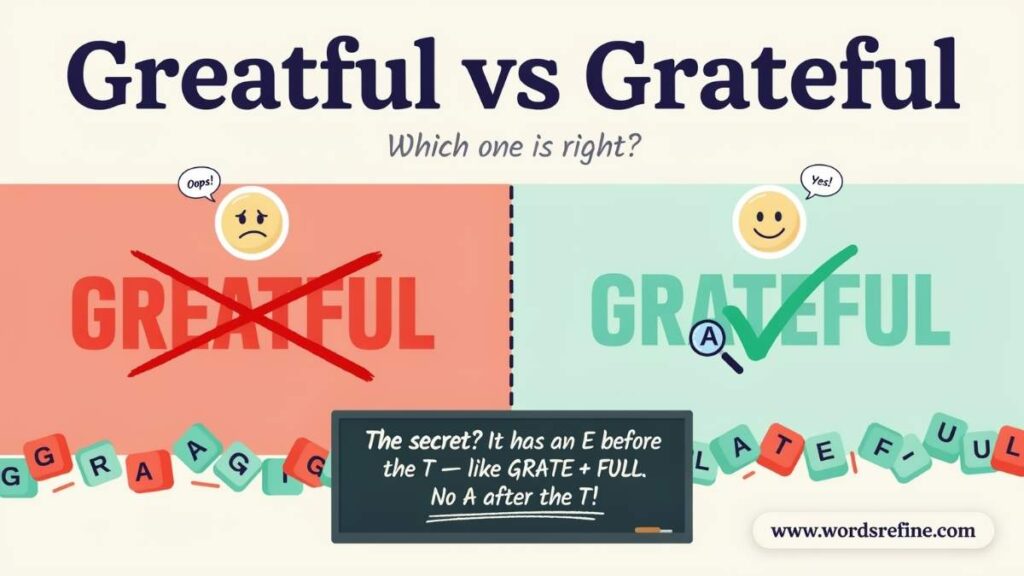
Choosing between Greatful vs Grateful may seem like a minor spelling concern, but using the correct form is essential for clear and professional communication. Although greatful might appear logical because the word often relates to appreciating something great, it is not the standard spelling. Grateful is correct in both American and British English. Fortunately, this common mistake is easy to avoid once you understand the word’s meaning and usage. In this guide, you’ll learn how to spell grateful correctly, examine practical examples, and understand why the extra “e” doesn’t belong. These simple tips will help you write with greater accuracy and express appreciation with confidence.
Greatful vs Grateful Quick Answer
If you are wondering which spelling is correct, always use Greatful vs Grateful when you want to express appreciation for someone’s kindness, help, generosity, or support.
Correct: I’m grateful for your help with the project.
Incorrect: I’m greatful for your help with the project.
Grateful is an adjective that describes feeling or expressing appreciation. Greatful is not the standard spelling of this word. Gratitude is the related noun that describes the feeling of being thankful.
Moreover, grateful has the same spelling in American and British English. You don’t need to change it depending on your audience.
What Does Grateful Mean?
Grateful means feeling or showing appreciation for something valuable that someone has done, given, or provided. It can describe your feelings toward another person, an opportunity, a positive experience, or a situation that brings relief.
For example, imagine that a coworker stays late to help you finish an important presentation. You might say, “I’m grateful for your help.” This sentence recognizes the time and effort your coworker contributed.
However, gratitude doesn’t always require a major event. You might feel grateful for a friend’s encouraging message, a teacher’s advice, or a small favor that makes a difficult day easier.
In everyday English, grateful expresses more than simply saying thank you. It can communicate that you recognize the value of someone’s kindness and appreciate the difference it has made.
Learn the difference between commonly mixed-up more words
Suffix vs Postfix Which One Is Correct?
Grateful as an Adjective
Grateful is an adjective because it describes a person’s feelings or attitude. It helps explain how someone feels about receiving kindness, assistance, or something beneficial.
Consider these examples:
Maria felt grateful for her parents’ support.
The students were grateful to their teacher for the extra guidance.
I’m grateful that everyone arrived safely.
He wrote a grateful message to the volunteers.
In each sentence, grateful describes appreciation or relief. The word also follows several common sentence patterns.
Use grateful for when identifying what you appreciate. For example, “I’m grateful for your advice.”
Use grateful to when identifying the person you’re thanking. For example, “I’m grateful to my mentor.”
Use grateful that when expressing appreciation for a situation. For example, “We’re grateful that you came.”
Understanding these patterns makes it easier to use the word naturally in both casual conversations and formal writing.
Grateful vs Thankful
Grateful and thankful have similar meanings. Both words express appreciation, although the context can give them slightly different shades of meaning.
Grateful often emphasizes recognizing the value of someone’s kindness or assistance. Thankful can express appreciation as well as relief that something unpleasant didn’t happen.
For example, “I’m grateful for my friend’s support during a difficult year” emphasizes the importance of that support.
On the other hand, “I’m thankful that the storm passed without damaging our house” emphasizes relief.
Nevertheless, these distinctions aren’t strict rules. You can say, “I’m grateful that the storm passed safely,” or “I’m thankful for my friend’s support.” Both sentences sound natural.
The best choice depends on what you want to communicate. In many everyday situations, either word works well.
Is Greatful a Word?
People sometimes ask whether greatful is a real word because they encounter it in messages, online posts, or informal writing.
In standard English, greatful is not the accepted spelling of the adjective meaning appreciative or thankful. If you use it in a school assignment, professional email, or personal message, readers will generally recognize it as a spelling error.
However, a misspelling can appear in a person’s name, a business name, a fictional character’s name, or a deliberately stylized expression. Such uses don’t make greatful the correct spelling of the ordinary adjective.
For example, “I am greatful for this opportunity” should be written as “I am grateful for this opportunity.”
What Does Greatful Mean?
When people search for the meaning of greatful, they usually intend to find the meaning of grateful. The intended meaning is generally feeling appreciation or thankfulness.
The mistake often occurs because great is a familiar word that means excellent, impressive, or considerable. As a result, writers may assume that adding ful creates greatful.
However, grateful doesn’t come from combining great with ful. Its spelling follows a different word history.
Therefore, if you encounter greatful in a sentence about appreciation, treat it as a likely spelling mistake rather than a separate adjective with that meaning.
Learn the difference between confusing more English words
Trebled vs Tripled Which One Is Correct?
Why Is It Grateful and Not Greatful?
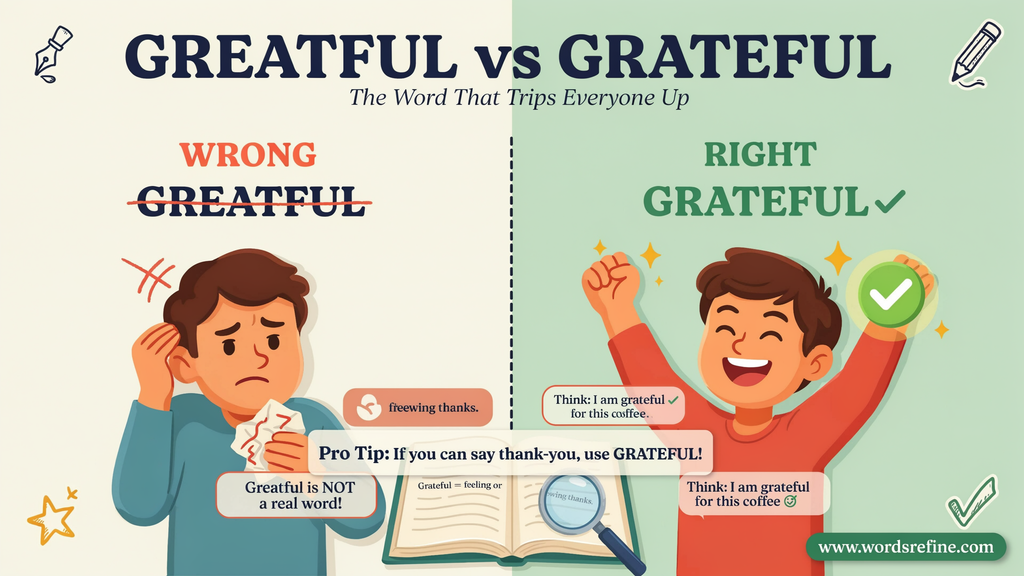
The spelling becomes easier to understand when you connect Greatful vs Grateful with gratitude rather than with great.
The correct form is grateful, without the extra e found in great. The word belongs to the same family as gratitude and gratefully, which are associated with appreciation and thankfulness.
English contains many words that resemble familiar words but have different origins or meanings. Consequently, a spelling may look logical at first glance without being correct.
Consider the difference between these examples.
Great describes something excellent or impressive: “You did a great job.”
Grateful describes appreciation: “I’m grateful for your encouragement.”
Gratitude names the feeling of appreciation: “She expressed her gratitude.”
Although the words look similar, they serve different purposes. Learning their meanings and relationships is more reliable than trying to create a spelling rule around great.
Why Do People Misspell Grateful?
Several factors can contribute to this common mistake.
First, the word great influences how people spell grateful. Because the two words look alike, writers may assume that grateful contains the complete word great followed by ful. That assumption produces the incorrect spelling.
Second, pronunciation doesn’t always help people remember the correct form. In ordinary conversation, the difference may not stand out clearly enough to remind someone which letters to write.
Additionally, hurried typing can lead to errors. When writing a quick message or email, people often rely on familiar visual patterns instead of checking every word carefully.
Finally, repeated exposure to misspellings can make them seem familiar. Seeing greatful online doesn’t make it correct, even if the error appears frequently.
Fortunately, the solution is straightforward. Learn grateful alongside gratitude. When you’re unsure which spelling to use, think of the related noun before typing the adjective.
The Origin of the Word Grateful
The history of grateful provides another useful way to remember its spelling. The word developed through French and English from Latin roots associated with being pleasing, welcome, or thankful.
The Latin word gratus means pleasing, welcome, or agreeable. It also carries a sense of thankfulness. Another related Latin word, gratia, is associated with favor, goodwill, and thanks.
These historical connections help explain the relationship between English words such as grateful and gratitude.
Grateful describes the feeling of appreciation. Gratitude names that feeling. Gratefully describes an action performed with appreciation, while gratefulness refers to the state of feeling grateful.
Notice the shared beginning in these words. This pattern provides a practical memory aid and helps distinguish them from great.
How the Latin Root Helps You Remember the Spelling
You don’t need to study Latin to spell grateful correctly. Nevertheless, knowing about the root gratus can make the spelling easier to remember.
Think of the connection between grateful and gratitude. Both words begin with grat, which provides a useful reminder of their relationship.
This connection is a memory aid rather than a complete account of how each word developed historically. The important point is that grateful belongs to a family of words associated with appreciation, not to the spelling family of great.
Whenever you write the word, picture gratitude in your mind. That simple association can help you avoid the mistake.
Learn the difference between tricky grammar more words
Hierarchical vs Hierarchal Which One Is Correct?
How to Use Grateful in a Sentence
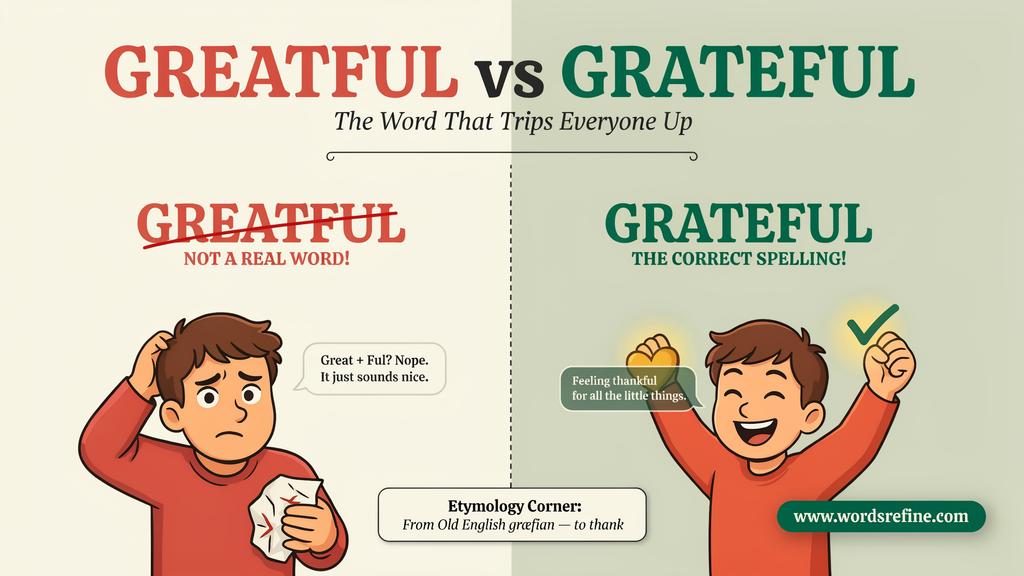
Understanding the meaning of grateful is only the first step. You also need to know how to use it correctly in a sentence.
The adjective commonly describes a person’s feelings toward someone, an action, an opportunity, or a situation. It works naturally in casual conversations, professional correspondence, academic writing, and formal expressions of thanks.
Here are some examples:
I’m grateful for the chance to learn a new skill.
We are grateful to everyone who volunteered.
She felt grateful that her friends checked on her.
The team was grateful for the manager’s guidance.
He remained grateful for the kindness he received.
I’m grateful that you took the time to explain the process.
Each sentence expresses appreciation, but the structure changes depending on what the speaker wants to emphasize.
Grateful for Something
Use grateful for when identifying the thing, action, or experience you appreciate.
For example, you might say, “I’m grateful for your honest advice,” or “She was grateful for the scholarship.”
Similarly, you can write, “We’re grateful for the support of our community” or “He felt grateful for another opportunity to try.”
The phrase can describe something tangible, such as a gift, or something less concrete, such as encouragement, patience, or peace of mind.
When writing a thank-you note, this construction helps you explain exactly what mattered to you.
Grateful to Someone
Use grateful to when identifying the person or group toward whom you feel appreciation.
For example, “I’m grateful to my parents for their encouragement” identifies the people who provided support.
Likewise, you might write, “We are grateful to our customers for their continued trust” or “She was grateful to her colleague for covering her shift.”
You can combine to and for in the same sentence. The first identifies the person, while the second explains the reason for your appreciation.
For instance, “I’m grateful to my neighbor for helping me carry the furniture” is natural and grammatically correct.
Grateful That Something Happened
Use grateful that when expressing appreciation for a situation, event, or outcome.
For example, “I’m grateful that everyone arrived safely” expresses appreciation and relief.
Similarly, “She was grateful that her application received consideration” and “We’re grateful that the problem was resolved quickly” show how the construction works.
This pattern often expresses relief as well as appreciation. It is especially useful when the outcome matters more than the person responsible for it.
How to Write Grateful for Your Help
The phrase “grateful for your help” is correct and natural English. You can use it in different situations depending on your audience and the tone you want to convey.
1In a casual message, you might write, “I’m really grateful for your help!”
2In a professional email, “I’m grateful for your help with the report” sounds polite and direct.
3In a formal acknowledgment, “We are grateful for your assistance and support” may be more suitable.
For a personal note, “I’m so grateful for everything you’ve done for me” expresses a warmer and more personal feeling.
If you want to thank a specific person, you can also write, “I’m grateful to you for your help.” Both constructions are correct.
The important thing is to choose wording that sounds natural for your relationship and situation.
Learn the difference between confusing word pairs
Taylored vs Tailored Which One Is Correct?
Grateful vs Greatful Examples and Differences
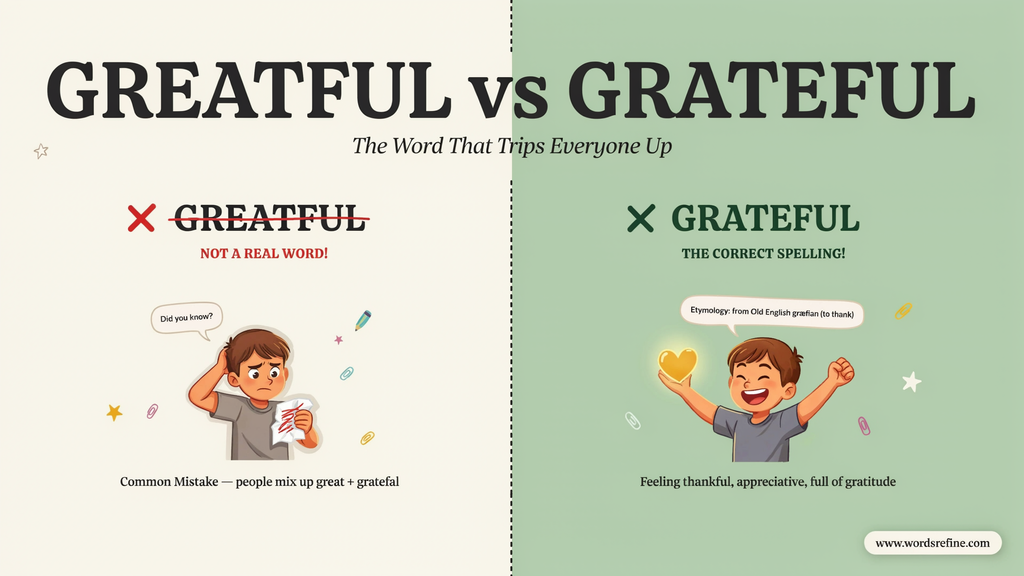
The difference between grateful vs greatful is simple once you separate spelling from meaning. Grateful is the correct adjective for expressing appreciation. Greatful is the incorrect spelling when you intend that meaning.
| Example | Correct or incorrect? | Explanation |
|---|---|---|
| I’m grateful for your kindness. | Correct | Grateful expresses appreciation. |
| She is grateful to her coach. | Correct | The adjective describes her feelings. |
| We are greatful for the invitation. | Incorrect | Use grateful instead. |
| He expressed his gratitude. | Correct | Gratitude is a noun. |
| They gratefully accepted the offer. | Correct | Gratefully is an adverb. |
| She did a great job. | Correct | Great means excellent or impressive. |
These examples show why context matters. If you’re describing appreciation, use grateful. If you’re describing something excellent, great may be the word you need.
Grateful vs Great vs Gratitude
Although the three words look similar, they serve different Greatful vs Grateful purposes.
Great is an adjective that describes something excellent, impressive, or significant. You might call a performance great or describe a useful idea as great.
Grateful is an adjective that describes a feeling of appreciation. You might feel grateful when someone offers support or gives you a thoughtful gift.
Gratitude is a noun that names the feeling itself. You might express gratitude in a letter or show gratitude through your actions.
Compare these sentences:
“Your suggestion was great.” This sentence praises the suggestion.
“I’m grateful for your suggestion.” This sentence expresses appreciation.
“I expressed my gratitude for your suggestion.” This sentence names the act of expressing appreciation.
Choosing the right word depends on the message you want to convey. A great opportunity may give you a reason to feel grateful, while gratitude describes the appreciation you feel.
Grateful and Its Related Word Forms
Learning related words helps expand your English vocabulary while reinforcing the correct spelling. The word family includes adjectives, nouns, and an adverb.
| Word | Part of speech | Meaning | Example |
|---|---|---|---|
| Grateful | Adjective | Feeling or showing appreciation | I’m grateful for your patience. |
| Gratitude | Noun | The feeling of appreciation | He expressed his gratitude. |
| Gratefulness | Noun | The state of feeling grateful | Her gratefulness was clear. |
| Gratefully | Adverb | In an appreciative manner | She gratefully accepted the gift. |
| Ungrateful | Adjective | Not showing appreciation | His response sounded ungrateful. |
Learn the difference between often confused words
Siked vs Psyched Which One Is Correct?
What Is the Noun Form of Grateful?
The most common noun associated with grateful is gratitude.
For example, “The family expressed gratitude for the community’s support” uses the noun to describe the appreciation they felt or communicated.
Gratefulness is also a valid noun. However, gratitude is often the more natural choice in everyday and formal writing.
Compare these sentences:
“She felt grateful for the opportunity.” Grateful is an adjective.
“She felt deep gratitude for the opportunity.” Gratitude is a noun.
“She gratefully accepted the opportunity.” Gratefully is an adverb.
The adjective form of gratitude is grateful. Therefore, if you want to describe a person who appreciates something, write “a grateful person,” not “a gratitude person.”
Grateful Synonyms and Antonyms
Choosing the right synonym can make your writing more precise. Several words express appreciation, but their meanings and tones differ slightly.
| Synonym | Meaning or typical use |
|---|---|
| Thankful | Appreciative, often with a sense of relief |
| Appreciative | Recognizing the value of something or someone’s effort |
| Obliged | Grateful for a favor; sometimes formal or polite |
| Indebted | Feeling that someone deserves repayment or acknowledgment for help |
| Appreciative of | Recognizing the value or importance of something |
For example, “I’m appreciative of your patience” sounds natural in a professional setting. “I’m indebted to my mentor” can suggest that the mentor’s help had a lasting impact.
However, these words aren’t always interchangeable. Someone who feels obliged may simply be responding politely, while someone who feels indebted may believe they owe another person something in return.
The main antonym of grateful is ungrateful, which describes someone who fails to show appreciation.
Other related expressions include unappreciative and thankless, although their uses differ. A thankless task, for instance, is a task that receives little or no recognition. It doesn’t necessarily describe the person doing it.
Understanding these differences helps you choose accurate words rather than repeating grateful in every sentence.
Grateful Spelling in American and British English
One important point is that grateful has the same spelling in American and British English.
You should write grateful in the United States, the United Kingdom, Canada, Australia, and other English-speaking settings where standard English spelling applies.
There is no standard British form greatful and no standard American form greatful.
Some words do have regional spelling variations. For example, American English generally uses color and favor, while British English commonly uses colour and favour. Organize and organise are also used according to different regional and style conventions.
However, grateful remains unchanged.
Therefore, if you’re writing for a British audience, use grateful. If you’re writing for an American audience, use grateful as well.
Grateful in Everyday Writing
Knowing how to spell a word is useful, but knowing when to use it makes your writing more effective. Grateful works across many situations, from a quick message to a formal acknowledgment.
In Emails and Professional Messages
In professional communication, grateful can express appreciation without sounding overly casual.
Consider this example:
Hi Jordan,
I’m grateful for your help with the client presentation. Your feedback helped me clarify the main points and improve the final draft.
Thanks again for taking the time to review it.
The message identifies the help, explains why it mattered, and expresses appreciation directly.
You can also use the word in formal requests. For example, “I’m grateful for your consideration of my application” communicates appreciation without assuming that the recipient will approve it.
In Personal Messages and Social Media
In personal writing, grateful often sounds warm and sincere.
For example, you might write, “I’m grateful to have such supportive friends,” or “Feeling grateful for the little things today.”
Similarly, “So grateful for everyone who made my birthday special” expresses appreciation in a casual way.
On social media, short expressions of gratitude are common. However, the most meaningful messages often explain what the writer appreciates instead of relying on a general statement.
For example, “Grateful for my friends” is clear. “Grateful for the friends who checked in when life got difficult” gives readers a more specific picture.
In Academic and Formal Writing
In academic and formal contexts, grateful can acknowledge assistance, feedback, or contributions.
For example, “The author is grateful to the reviewers for their constructive feedback” is appropriate in an acknowledgment.
Similarly, a student might write, “I am grateful for the guidance provided by my supervisor.”
In these settings, choose wording that matches the level of formality. Grateful is suitable for acknowledgments and professional correspondence, while “I’m super grateful” may be better suited to casual conversation.
Learn the difference between basic English word mistakes
Ambassador vs Embassador Which Spelling Is Correct?
Expressing Gratitude Without Repeating Yourself
Repeatedly writing “I’m grateful” can make a message sound repetitive. Fortunately, you can vary your wording while keeping the meaning accurate.
For example, you might write, “Thank you for taking the time to help,” “I appreciate your thoughtful advice,” or “Your support made a real difference.”
You could also say, “I value the effort you put into this” or “Please accept my sincere thanks.”
These expressions communicate appreciation, but each emphasizes something slightly different. Choose the one that fits the relationship and situation rather than replacing every instance of grateful with a synonym.
How to Remember the Correct Spelling of Grateful
If you frequently type greatful by mistake, a simple memory trick can help. The goal isn’t to memorize a complicated rule. Instead, build a connection that makes the correct spelling easier to recall.
Use the Gratitude Trick
Remember that grateful and gratitude share the same opening letters: grat.
When you’re unsure how to spell grateful, think of the connection between the two words. Both relate to appreciation, and both begin with the same four letters.
You can also remember their different meanings. Grateful means appreciative, great means excellent or impressive, and gratitude means appreciation.
Keeping these meanings separate makes it easier to avoid the greatful spelling mistake.
Practice With Short Sentences
Reading the correct spelling in context helps reinforce it. Consider these examples:
I’m grateful for your help.
She expressed her gratitude to the volunteers.
He gratefully accepted the invitation.
It was a great performance.
Notice how each word fits a different grammatical role. Practicing with short examples can make these patterns easier to remember.
Check Your Writing Before Sending It
A quick proofreading habit can prevent many spelling mistakes.
When reviewing a message, essay, or article, search for greatful and replace it with grateful wherever you intended to express appreciation. Spell-checking tools can also help, although they may not catch every error in context.
Most importantly, don’t rely entirely on autocorrect. Knowing why a spelling is correct helps you recognize mistakes even when software misses them.
Grateful Quotes and Expressions of Appreciation
People sometimes look for Greatful vs Grateful quotes when writing captions, thank-you messages, or personal reflections. The key is to use the correct spelling and choose an expression that fits the occasion.
Here are some original expressions you can use:
“Gratitude begins when you recognize the kindness behind a small gesture.”
“A grateful heart notices the good that a busy day can hide.”
“Sometimes a simple thank-you says more than a long speech.”
“Being grateful doesn’t mean every day is easy. It means recognizing what still matters.”
These expressions can work in personal notes, captions, and reflections.
You can also use everyday expressions such as “I’m truly grateful for your support,” “Thank you for your kindness,” or “I appreciate everything you’ve done.”
Whether you’re writing a personal note or a social media caption, specific and sincere wording usually communicates appreciation better than an elaborate phrase.
Learn the difference between commonly misused words
Simular vs Similar Which One Is Correct?
Practice Session Grateful vs Greatful
1. I am truly ______ for your help during a difficult time.
2. She felt ______ when her friends remembered her birthday.
3. We should express ______ to those who support us.
4. He was ______ for the opportunity to work with such a talented team.
5. I am ______ that everything worked out well.
6. The students were ______ to their teacher for her guidance.
7. She ______ accepted the gift and thanked her friend.
8. We should be ______ for our family’s love and support.
9. His ______ attitude upset the people who had helped him.
10. We expressed our ______ to everyone who attended the event.
11. I feel ______ to have such wonderful friends.
12. The customer ______ thanked the staff for their excellent service.
13. You can feel ______ even when life isn’t going as planned.
14. He was ______ for the second chance he received.
15. A sincere thank-you is a simple way to show ______.
16. She remained ______ despite facing several challenges.
17. The coach was ______ for the team’s hard work.
18. It is important not to seem ______ when someone offers help.
19. I am ______ to my parents for their constant encouragement.
20. They wrote a note to explain how ______ they were.
21. She accepted the award with a ______ heart.
22. Practicing ______ can help us appreciate the good things in life.
23. He felt deeply ______ for his friend’s kindness.
24. The child learned to be ______ and thank others for their generosity.
25. In standard English, use “grateful,” not “______.”
Answers
- grateful
- grateful
- gratitude
- grateful
- grateful
- grateful
- gratefully
- grateful
- ungrateful
- gratitude
- grateful
- gratefully
- grateful
- grateful
- gratitude
- grateful
- grateful
- ungrateful
- grateful
- grateful
- grateful
- gratitude
- grateful
- grateful
- greatful
Here’s a trusted source for clear more words Comparison:
FAQs
Does the Word Greatful Exist?
Greatful is a common misspelling of grateful when expressing appreciation. It may appear in names or creative expressions, but it isn’t the standard English spelling of the adjective meaning thankful.
Is Grateful vs Greatful the Correct Spelling in the UK?
Greatful vs Grateful is the correct spelling in the United Kingdom. British English uses the same spelling as American English, so greatful is incorrect when you mean appreciative or thankful.
What Are the Four A’s of Gratitude?
A common framework for practicing gratitude uses four A’s: awareness, acknowledgment, appreciation, and action. This approach encourages you to notice positive things, recognize their value, appreciate them, and respond with thoughtful actions. The framework can vary between sources.
What’s a Stronger Word for Grateful?
Words such as deeply appreciative, profoundly thankful, and indebted can express stronger feelings than grateful. For example, “I’m profoundly grateful for your support” conveys deep appreciation, while “I’m indebted to you” can suggest that someone’s help had a lasting impact.
Can a Person Be Grateful but Not Happy?
Yes. Gratitude and happiness are different feelings. Someone can appreciate the support they receive while experiencing sadness, stress, or disappointment. For example, a person going through a difficult time may feel grateful for caring friends without feeling happy about the circumstances.
What Are the Three Types of Gratitude?
Gratitude is often discussed in three forms: gratitude for benefits received, gratitude toward other people, and a general appreciation for life. These categories help explain how people recognize kindness, value relationships, and appreciate positive experiences. However, they aren’t a universally fixed classification.
What Is the Golden Rule of Gratitude?
A useful principle is to recognize kindness sincerely and express appreciation thoughtfully. Rather than simply saying thank you, acknowledge what someone did and explain why it mattered. For example, “Thank you for staying late to help me finish the report. Your support made a real difference.”
What Is the Opposite of Grateful?
The most direct opposite of grateful is ungrateful. It describes someone who doesn’t show appreciation for kindness, help, or benefits received. Other related words include unappreciative and thankless, depending on the context.
Is Grateful Grammatically Correct?
Yes. Grateful is a standard English adjective used to describe someone who feels or expresses appreciation. You can use it in phrases such as “grateful for your help,” “grateful to my teacher,” and “grateful that everything worked out.”
Learn the difference between more words people mix up
Loosing vs Losing Which Is Correct? Meaning, Spelling, and Usage
Conclusion
The difference between grateful vs greatful comes down to one little letter, but that tiny mistake can make your writing look less polished. Grateful is the correct spelling in both American and British English, while greatful is a common misspelling. Although being grateful for something great makes perfect sense, English spelling doesn’t always follow logic!
To remember the correct form, connect grateful with gratitude. Both words express appreciation without an extra “e.” Once you master this simple trick, you’ll have one less spelling mistake to worry about and one more reason to be grateful!

Diora AJS she is an experienced blogger and passionate English language enthusiast at Words Refine. With a keen eye for language and a love for clear communication, she writes practical content about grammar, word meanings, usage, and commonly confused terms. Her goal is to make English easier to understand through clear explanations and relatable examples, helping readers write accurately and communicate with confidence.