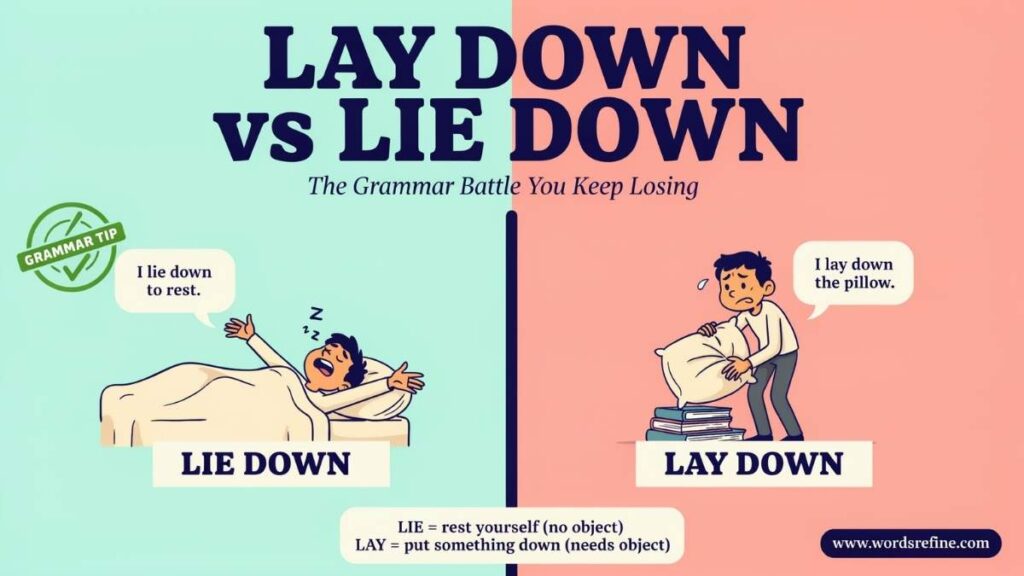
The difference between lay down vs lie down seems small, but it can trip up even careful writers. Do you lie down on the couch or lay down on the couch? The answer depends on whether you are resting your body or placing something somewhere. Although these verbs look similar, they follow different grammatical rules, especially when you change the tense. Fortunately, you do not need to memorize every rule at once. This guide explains “lay down” vs. “lie down” with simple definitions, practical examples, and common mistakes to avoid. By the end, you’ll use both expressions with confidence and give your grammar worries a well-deserved rest!
Lay Down vs Lie Down Quick Answer
The main difference between “lay down” and “lie down” is whether you are resting your body or placing something on a surface.
“Lie down” means to recline or rest your body. For example, “I need to lie down after work.”
“Lay down” means to put something or someone down. For example, “Please lay down the book.”
However, when you describe a past action, the correct form depends on the verb’s meaning. “I lay down for a nap yesterday” describes resting, while “I laid down my phone yesterday” describes placing an object somewhere.
| Expression | Meaning | Example |
|---|---|---|
| Lie down | Recline your body | I need to lie down. |
| Lay down | Place something down | Lay down your phone. |
| Lay down | Past tense of lie down | I lay down yesterday. |
| Laid down | Past tense of lay down | I laid down my phone. |
Therefore, the easiest way to choose the correct expression is to identify the action first. Are you reclining, or are you putting something somewhere? Your answer will help you select the right verb.
What Does Lie Down Mean?
The expression “lie down” means to lower your body into a horizontal or resting position. You might lie down on a bed when you’re tired, stretch out on the couch after dinner, or lie down on the floor during an exercise routine.
In this sense, the verb describes what the subject does. You don’t need a direct object because you’re simply changing your body position.
For example, you might say, “I want to lie down for a few minutes.” Similarly, “She decided to lie down after a long shift” describes someone taking a rest.
You can also use the expression when talking about animals. For instance, “The dog likes to lie down beside the fireplace” describes the dog’s resting position.
In each case, the subject reclines without placing a separate object somewhere.
Learn the difference between commonly misused words
Vender vs Vendor Which one Is Correct?
Lie Down Meaning in Everyday English
The meaning of “lie down” becomes easier to understand when you connect it with rest, relaxation, or a change in body position.
For example, you might say, “I usually lie down for twenty minutes when I get home.” This describes a regular habit.
Similarly, “You should lie down if you feel dizzy” recommends resting. Meanwhile, “She wants to lie down on the couch and read” describes a relaxing activity.
However, the verb “lie” has another meaning: to tell an untruth. For example, “He lied about his age.” That verb has different forms from the verb meaning to recline.
When discussing “lie down,” the focus is on resting your body or moving into a horizontal position.
How to Use Lie Down in a Sentence
You can use “lie down” in statements, questions, commands, and sentences describing ongoing actions.
For example, “I lie down for a short rest every afternoon” describes a routine. In contrast, “Do you want to lie down?” asks whether someone wants to rest.
When giving an instruction, you might say, “Lie down and relax.” To describe an ongoing action, you could write, “The baby is lying down in the crib.”
You can also use the infinitive form in a sentence such as “She needs to lie down before dinner.”
As you can see, the expression works naturally whenever someone takes a resting position.
What Does Lay Down Mean?
The expression “lay down” means to place something or someone on a surface. Unlike “lie down,” the verb “lay” normally takes a direct object when it means to place something.
For example, “Please lay down your bag” tells someone to put a bag somewhere. Likewise, “He laid down the keys beside the door” describes an action involving an object.
You might also say, “She is laying down a blanket for the picnic” or “The parent gently laid down the baby.”
In each example, someone places an object or another person in a particular position. This is the main difference between the two verbs.
Learn the difference between often confused words
Compair vs Compare Which One Is Correct?
Lay Down Meaning Beyond Physical Objects
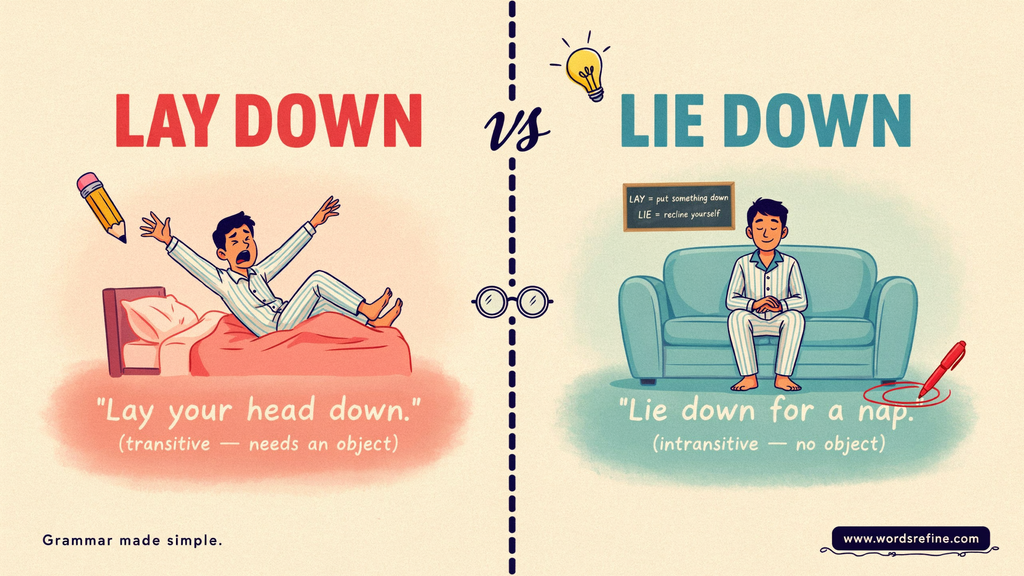
The expression “lay down” can also describe establishing rules, setting conditions, or creating the basis for something.
For instance, “The manager laid down clear rules for the team” means the manager established rules. Similarly, “The organization laid down strict safety requirements” describes setting standards that people must follow.
The phrase also appears in formal and professional contexts. A policy might lay down the conditions for membership, while an agreement might lay down the terms of payment.
In construction, the expression can describe creating a foundation for a project. For example, “The engineers laid down the foundation for the project.”
Although these examples don’t always involve placing a physical object, the verb still describes setting something in place.
How to Use Lay Down in a Sentence
The correct form of “lay down” depends on the tense and meaning of the sentence.
For example, “I lay down my phone before dinner” describes a present habit. However, “I laid down my phone before dinner yesterday” describes a completed action in the past.
To describe an ongoing action, you could say, “She is laying down a blanket.” When giving an instruction, you might say, “Lay down the book.”
The expression also works in figurative sentences, such as “The director laid down new guidelines.”
Therefore, whenever you mean to place something down or establish something, “lay down” is generally the appropriate expression.
Learn the difference between confusing more English words
Inclusivity vs Inclusiveness Which One Is Correct?
Lay Down vs Lie Down Key Grammar Differences
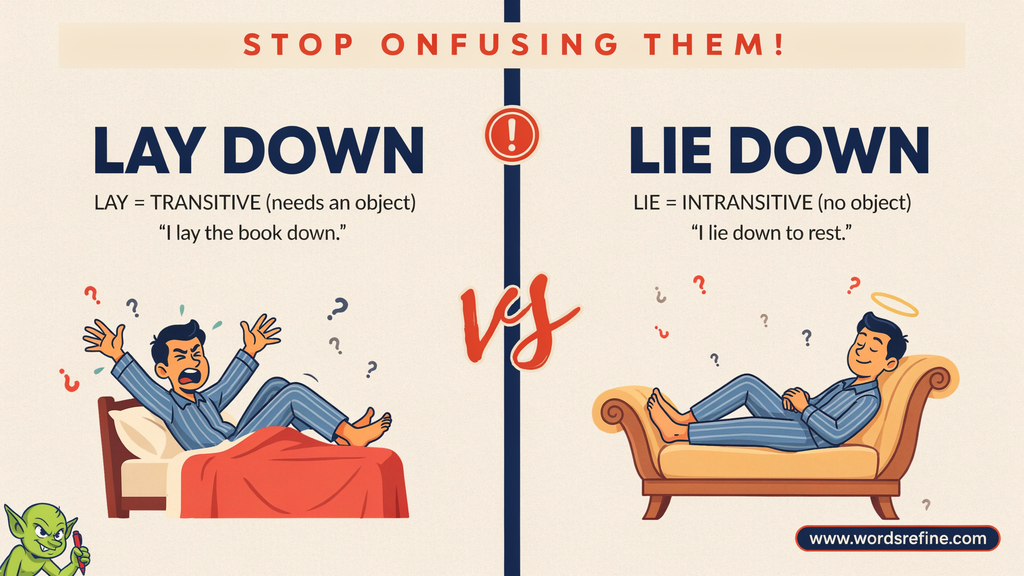
The difference between these verbs becomes clearer when you understand two basic grammar terms: transitive and intransitive verbs.
A transitive verb takes a direct object. An intransitive verb doesn’t require one.
When “lay” means to place something, it is transitive because the action affects an object. By contrast, “lie” is intransitive when it means to recline.
For example, “I want to lie down” is correct because the speaker is resting. However, “I want to lay down the blanket” is correct because the blanket is the object being placed.
| Feature | Lie down | Lay down |
|---|---|---|
| Main meaning | Recline or rest your body | Place something or someone down |
| Verb type in this meaning | Intransitive | Transitive |
| Direct object | Not required | Normally required |
| Present tense | Lie down | Lay something down |
| Simple past | Lay down | Laid something down |
| Past participle | Lain down | Laid something down |
| Present participle | Lying down | Laying something down |
However, the past tense creates confusion because “lay” can describe two different things. It can be the present tense of “lay” or the past tense of “lie.”
For instance, “I lay down yesterday” is grammatically correct when you mean that you reclined yesterday. In this sentence, “lay” is the past tense of “lie.”
Consequently, you shouldn’t choose a verb based on its spelling alone. Instead, consider its meaning, tense, and role in the sentence.
Verb Forms and Tenses
Both verbs are irregular, so their past forms don’t follow the usual pattern of adding “-ed.” Learning their forms will help you avoid mistakes.
The verb “lie,” meaning to recline, follows the pattern “lie, lay, lain.” Meanwhile, “lay,” meaning to place something, follows the pattern “lay, laid, laid.”
Lie Lay Lain Verb Forms
The verb “lie” changes according to when the action happens.
| Verb form | Correct form | Example |
|---|---|---|
| Present tense | Lie | I lie down when I need a break. |
| Simple past | Lay | I lay down after lunch yesterday. |
| Past participle | Lain | I have lain down here before. |
| Present participle | Lying | I am lying down on the couch. |
| Infinitive | To lie | I want to lie down. |
The present tense of “lie down” is used for habits, routines, and present actions. For example, “I lie down for a few minutes every afternoon” describes a regular activity.
However, the past tense is “lay down.” Therefore, “I lay down for a nap yesterday” describes a completed action.
The past participle is “lain down.” It usually appears with a helping verb such as “have,” “has,” or “had.”
For example, “I have lain down in this room before” describes an earlier experience. Similarly, “She had lain down before the storm began” describes an action that happened before another past event.
Although “lain” is grammatically correct, people rarely use it in casual conversation. Some speakers use “laid” instead, especially when speaking informally. However, traditional standard grammar uses “lain” as the past participle of “lie” when the meaning is reclining.
Learn the difference between often confused words
Labelled vs Labeled Which one Is Correct?
Lay Laid Laid Verb Forms
The verb “lay” follows a different pattern because it describes placing something down.
| Verb form | Correct form | Example |
|---|---|---|
| Present tense | Lay | I lay the book on the table. |
| Simple past | Laid | I laid the book on the table yesterday. |
| Past participle | Laid | I have laid the book on the table. |
| Present participle | Laying | I am laying the book on the table. |
| Infinitive | To lay | I need to lay the book down. |
The present tense describes an action that happens regularly or in the present. For example, “I lay down my phone before bed” describes a habit.
In contrast, the past tense is “laid down.” For instance, “I laid down my phone before bed last night” describes a completed action.
The past participle is also “laid down.” You can use it with helping verbs, as in “I have laid down the tools” or “They had laid down the rules before the meeting began.”
Therefore, remember that “lie, lay, lain” refers to reclining, while “lay, laid, laid” refers to placing something down.
Learn the difference between commonly misused words
Flyer vs Flier Which one Is Correct?
Is It Lay Down or Layed Down?
The correct spelling is “laid down,” not “layed down,” when you need the past tense or past participle of “lay.”
For example, “She laid down the blanket” is correct, while “She layed down the blanket” is not standard American English.
Although adding “-ed” might seem logical, “lay” is an irregular verb. Its past tense is “laid.”
For clarity, compare these sentences: “She lays down the blanket” describes the present, while “She laid down the blanket” describes the past. Meanwhile, “She is laying down the blanket” describes an ongoing action.
As a result, using the correct spelling will make your writing clearer and more accurate.
Lay Down vs Lie Down in the Past Tense
The past tense is where many people become confused. The word “lay” can describe placing something in the present or reclining in the past. The surrounding words help you understand which meaning the writer intends.
Consider these examples: “I lay down for a nap yesterday” and “I laid down my phone yesterday.”
Both sentences are correct, but they describe different actions. In the first, the speaker reclined. In the second, the speaker placed a phone somewhere.
What Is the Past Tense of Lie Down?
The past tense of “lie down” is “lay down.”
For example, “I lay down after work yesterday” describes resting. Similarly, “She lay down on the sofa while the children played” describes a past action.
You might also say, “We lay down on the grass to watch the stars” or “He lay down for a few minutes before dinner.”
In each sentence, the subject reclines without placing a direct object somewhere.
What Is the Past Tense of Lay Down?
The past tense of “lay down” is “laid down” when the verb means placing something or someone down.
For example, “I laid down my keys on the counter” describes putting the keys somewhere. Likewise, “She laid down the baby in the crib” describes placing the baby in a resting position.
You could also say, “They laid down a blanket on the grass” or “He laid down the law during the meeting.”
In these examples, the verb describes placing something or establishing a rule.
Learn the difference between everyday English mistakes
Reoccurrence vs Recurrence Which One Is Correct ?
Is Lay Down the Past Tense of Lie Down?
Yes. “Lay down” is the simple past tense of “lie down” when “lie” means to recline.
However, “lay down” can also be the present tense of “lay down” when it means placing something down.
Compare these sentences:
1.I lay down my bag when I get home” describes a routine involving an object.
2.I lay down when I got home yesterday” describes reclining in the past.
3.I laid down my bag when I got home yesterday” describes placing a bag down in the past.
This distinction explains why context matters. Instead of choosing a verb based on its spelling, consider the action and the tense.
Is Laid Down vs Lay Down Correct?
Both expressions are correct, but they serve different grammatical purposes.
| Sentence | Correct usage | Explanation |
|---|---|---|
| I lay down yesterday. | Correct | “Lay” is the past tense of “lie.” |
| I laid down the book yesterday. | Correct | “Laid” is the past tense of “lay.” |
| I laid down yesterday to rest. | Common in informal speech but nonstandard in traditional grammar | “Lay down” is the standard past tense for reclining. |
| I have lain down already. | Correct | “Lain” is the past participle of “lie.” |
| I have laid down the book. | Correct | “Laid” is the past participle of “lay.” |
Therefore, if you’re writing formally, pay attention to the distinction between “lay” and “laid.” Choosing the right form will make your meaning clearer.
Learn the difference between commonly misused words
Rosin vs Resin Which One Is Correct and What’s the Difference?
Lay Down vs Lie Down in Bed?
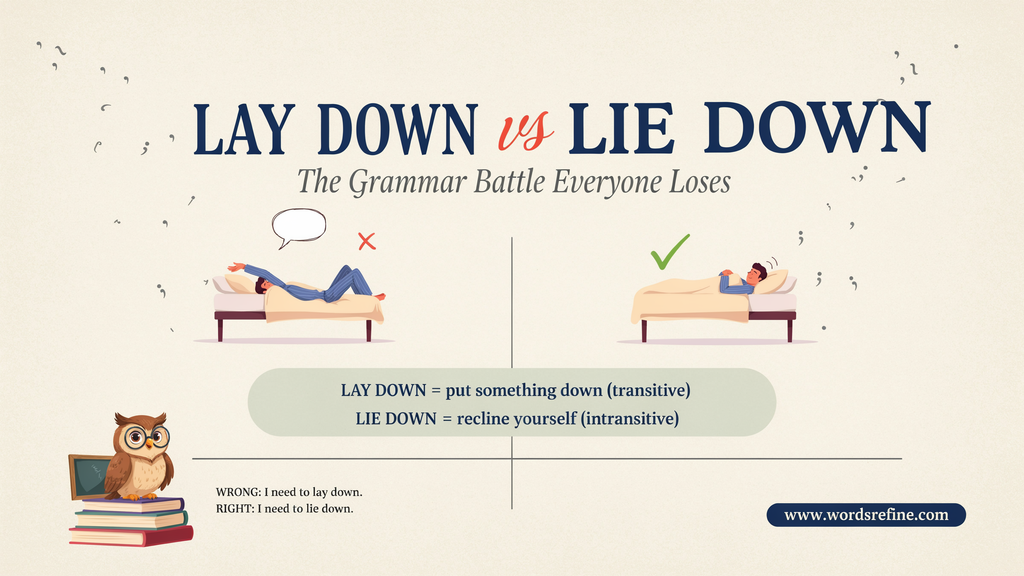
When talking about resting in bed, “lie down” is the standard choice if you’re describing your own body moving into a resting position.
For example, “I want to lie down in bed” describes a desire to rest. Similarly, “She lies down in bed whenever she feels tired” describes a habit.
You might also say, “He is lying down on the bed” to describe an ongoing action. However, “We lay down in bed after a long journey” describes a past action.
By contrast, use “lay down” when you place something on the bed. For instance, “Please lay down the blanket” describes placing a blanket on the surface.
Similarly, “She laid down her clothes on the bed” describes a completed action. You could also say, “He is laying down a pillow” to describe an action happening now.
The difference becomes clear when you identify what is moving. If you’re resting your body, use “lie down” in the present. If you’re placing an object, use “lay down.”
Should I Say Lie Down vs Lay Down in Bed?
Use “lie down in bed” when you mean to rest your body. However, use “lay down” when you mean to place something on the bed.
For example, “I need to lie down in bed” is correct because you’re describing your body position. Meanwhile, “I laid down the blanket on the bed” is correct because you’re placing an object.
Similarly, “She is lying down on the bed” describes a resting position, while “She is laying down a pillow” describes an action involving an object.
Although many Americans casually say “I need to lay down” when they mean to rest, traditional standard grammar favors “I need to lie down.” Therefore, use “lie down” in formal writing when you describe reclining.
Lay Down vs Lie Down on the Floor?
The same rule applies when you’re talking about a floor rather than a bed.
Use “lie down” when someone reclines on the floor. For example, “The child wants to lie down on the floor” describes a body position.
Similarly, “I lay down on the floor to stretch yesterday” describes a past action. You might also say, “The dog is lying down near the door” or “Please lie down on your back and relax.”
However, use “lay down” when someone places an object on the floor. For example, “Lay down the mat before exercising” gives an instruction.
Likewise, “She laid down her bag on the floor” describes a past action, while “He is laying down a protective covering” describes an ongoing action.
Therefore, when deciding whether to use “lie down” or “lay down on the floor,” ask what is being moved into position. If someone is reclining, choose the appropriate form of “lie.” If someone is placing an object, choose the appropriate form of “lay.”
Lay Down vs Lie Down as a Command
Commands often make the difference easier to understand because they usually begin with the base form of a verb.
“Lie down!” tells someone to recline, while “Lay down the book!” tells someone to put the book somewhere.
For example, you might say, “Lie down and take a break” when encouraging someone to rest. Similarly, “Lie down on the examination table” gives a clear instruction.
In contrast, “Lay down your backpack by the door” asks someone to place a backpack somewhere. Likewise, “Lay down the cards before we start” tells someone to put the cards down.
Can You Use Lay Down as a Command?
Yes. “Lay down” is grammatically correct as a command when it means to place something down. For example, “Lay down your phone” identifies the object being placed.
However, people also commonly use “Lay down!” as a standalone command when talking to dogs. Although this expression is widely understood in American English, “Lie down!” follows the traditional grammatical distinction when the intended meaning is simply to recline.
Consequently, everyday speech can differ from traditional grammar rules. Nevertheless, understanding the distinction will help you choose the appropriate expression in formal writing.
Lay Down vs Lie Down When Talking About Dogs?
Dog commands offer a useful example of the difference between traditional grammar and everyday speech.
A trainer following traditional grammar might say, “Lie down!” because the dog is being asked to recline. Another owner might say, “Lay down!” because the expression is widely understood as a dog-training command.
Both commands occur in everyday American English, although they differ grammatically.
For example, “The dog lies down beside its bed every evening” describes a regular action. Meanwhile, “The dog lay down when I called it” describes a past action.
However, “Lay down your toy, please” asks the dog to put an object down. Similarly, “The dog laid down its toy” describes the dog placing its toy on the floor.
Therefore, the important distinction is between changing body position and placing an object somewhere. When teaching traditional grammar, “lie down” is the standard choice for reclining.
Learn the difference between more words people mix up
Waving vs Waiving Which One Is Correct ?
Common Mistakes With Lay Down vs Lie Down
Even experienced English speakers sometimes mix up these verbs. The main difficulty comes from their overlapping forms, especially when describing past actions.
One common mistake is using “lay down” instead of “lie down” in the present tense. For example, “I need to lay down for a while” is common in casual conversation, but traditional standard grammar favors “I need to lie down for a while.” The speaker is describing a resting position rather than placing an object.
Another mistake involves using “lay” instead of “laid” when describing past placement. For example, “She lay down the keys yesterday” is incorrect in this context. The correct sentence is “She laid down the keys yesterday.” However, “She lay down yesterday” is correct if the intended meaning is that she reclined.
Similarly, using “layed” instead of “laid” is a spelling mistake. The correct sentence is “He laid down his jacket.” Because “lay” is an irregular verb, its past tense is “laid.”
Some writers also use “lain” as the simple past tense. For example, “I lain down after dinner” is incorrect. The correct sentence is “I lay down after dinner.” Use “lain” with a helping verb, as in “I have lain down after dinner before.”
Another common source of confusion is the difference between “laying down” and “lying down.” “Laying down” describes placing something down, while “lying down” describes reclining. Therefore, “She is laying down a blanket” and “She is lying down on the couch” have different meanings.
Finally, writers sometimes forget the direct object when using “lay” to mean placing something. If you intend to describe placing an object, make the sentence clear by naming it. For example, “Please lay down the package” is more precise than “Please lay down.” If you mean that someone should recline, use “Please lie down.”
Although context can affect how people interpret a sentence, these distinctions provide a reliable guide to correct usage.
Lay Down vs Lie Down Everyday Examples
The easiest way to understand these verbs is to see how they work in everyday situations.
| Situation | Example | Explanation |
|---|---|---|
| Resting after work | I lie down for a while after work. | The speaker reclines. |
| Resting yesterday | I lay down after work yesterday. | “Lay” is the past tense of “lie.” |
| Putting down a phone | I lay down my phone before dinner. | The phone is the direct object. |
| Putting down a phone yesterday | I laid down my phone yesterday. | “Laid” is the past tense of “lay.” |
| Taking a nap | She wants to lie down for a nap. | She rests her body. |
| Making a bed | He laid down a clean blanket. | He placed the blanket on a surface. |
| Exercising | Lie down on your back. | The command asks someone to recline. |
| Setting rules | The director laid down new guidelines. | The phrase means establishing rules. |
| Caring for a baby | She gently laid down the baby. | The baby is the direct object. |
| Describing a current position | The cat is lying down. | “Lying” describes reclining. |
A Practical Example One Sentence Two Meanings
Imagine that Jordan comes home after a long day. First, Jordan puts a phone on the table. Then Jordan stretches out on the couch.
Jordan could describe these actions by saying, “Jordan laid down the phone and then lay down on the couch.”
Both verbs are correct, even though they appear close together. The first action involves placing an object, so “laid” is the past tense of “lay.” The second action involves reclining, so “lay” is the past tense of “lie.”
Now consider this sentence: “Jordan is laying down the phone while Jordan’s friend is lying down on the couch.”
Here, “laying” describes placing the phone, while “lying” describes reclining. The continuous forms follow the same distinction as the simple forms.
This example shows why context matters more than the appearance of a single word. Once you identify the action, choosing the correct verb becomes much easier.
How to Remember the Difference Between Lay vs Lie
You don’t need to memorize a complicated grammar chart every time you write a sentence. Instead, use this simple reminder: “Lie” means recline, while “lay” means place.
When describing rest, use the appropriate form of “lie.” When describing the placement of an object, use the appropriate form of “lay.”
For example, “I want to lie down” describes resting, while “I want to lay down the book” describes placing an object.
Similarly, “I lay down yesterday” describes reclining in the past, while “I laid down the book yesterday” describes placing the book down.
However, remember that the verb forms change with tense. For reclining, the pattern is “lie, lay, lain.” For placing something, the pattern is “lay, laid, laid.”
Therefore, whenever you’re unsure, ask yourself one question: Are you resting your body, or are you putting something somewhere? That simple check will help you choose the correct verb in most situations.
Learn the difference between basic English word mistakes
Wisp vs Whisp Which One Is Correct?
Practice Session Lay Down vs Lie Down
- I usually _____ down for a few minutes after lunch.
- Yesterday, she _____ down on the couch to relax.
- Please _____ the book on the table.
- The dog is _____ down beside the fireplace.
- He _____ down the keys before leaving the room.
- I am _____ down because I feel tired.
- Every night, the baby _____ down in the crib at eight.
- She _____ down the blanket on the grass yesterday.
- If you feel dizzy, _____ down and rest.
- They were _____ down on the beach when it started raining.
- He _____ down the newspaper and answered the phone.
- I _____ awake for hours last night.
- Please _____ your bag down near the door.
- The cat is _____ down on the warm windowsill.
- We _____ down on the floor to play with the children yesterday.
- She is _____ down a clean towel for the guests.
- I often _____ down when I need to clear my mind.
- The workers _____ down the tools after finishing the job.
- He has _____ down for a short nap.
- The children are _____ down on the carpet and watching a movie.
- Yesterday, I _____ down early because I had a headache.
- She carefully _____ the baby down in the crib.
- You should _____ down if your back hurts.
- He was _____ down the dishes when the doorbell rang.
- After the long hike, we _____ down on the grass to rest.
Answers
- lie
- lay
- lay
- lying
- laid
- lying
- lies
- laid
- lie
- lying
- laid
- lay
- lay
- lying
- lay
- laying
- lie
- laid
- lain
- lying
- lay
- laid
- lie
- laying
- lay
Here’s a trusted source for clear more words Comparison:
FAQs
Do you lay or lie on the couch?
Use “lie” when describing yourself resting on the couch. For example, “I lie on the couch after work.” When describing a past action, use “lay,” as in “I lay on the couch yesterday.”
Do I lie down or lay down to sleep?
Use “lie down” when you mean to rest your body before sleeping. For example, “I lie down at 10 p.m. every night.” When describing the past, say, “I lay down early last night.”
What phrases do liars say?
Someone who lies might say, “Believe me,” “I swear I’m telling the truth,” or “I would never do that.” However, these phrases don’t prove dishonesty. Consider the context and available evidence before deciding whether someone is telling the truth.
Do you say “I am lying down” or “I am laying down”?
Use “I am lying down” when you’re reclining or resting your body. Use “I am laying down” when you’re placing something somewhere. For example, “I am laying down a blanket” describes putting a blanket on a surface.
Is it “I lie awake” or “I lay awake”?
Both are correct, depending on the tense. “I lie awake at night” describes a present habit, while “I lay awake last night” describes a past experience.
Is it correct to say “I’m lying on the bed”?
Yes, “I’m lying on the bed” is grammatically correct. The word “lying” describes your body resting in a horizontal position. You can also say “I’m lying in bed” when talking about resting or spending time in bed.
Does a dog lay down or lie down?
According to traditional grammar, “lie down” is correct when a dog reclines. For example, “The dog lies down beside its owner.” Although “lay down” is also common as a dog-training command, “lie down” follows the traditional grammatical distinction.
Do I lay or lie on the floor?
Use “lie” when describing yourself resting on the floor. For example, “I lie on the floor to stretch.” If you’re describing a past action, use “lay,” as in “I lay on the floor yesterday.”
Is “Am I lying?” correct?
Yes, “Am I lying?” is grammatically correct when asking whether you’re telling an untruth. In this sentence, “lying” comes from the verb meaning to tell a falsehood, not the verb meaning to recline.
Can I say “lying in bed”?
Yes, “lying in bed” is a natural and grammatically correct expression. For example, “She spent the morning lying in bed and reading.” Here, “lying” describes her position rather than the act of placing something down.
Is it “lying or laying around the house”?
Use “lying around the house” when you mean relaxing without doing much. For example, “We spent Sunday lying around the house.” In contrast, “laying things around the house” means placing objects in different locations.
Is it “Are you laying down” or “Are you lying down”?
Use “Are you lying down?” when asking whether someone is reclining or resting. Use “Are you laying something down?” when asking whether someone is placing an object somewhere. For example, “Are you laying down the blanket?” clearly describes the action of placing the blanket on a surface.
Learn the difference between confusing word pairs
Cancell vs Cancel Which one Is Correct?
Conclusion
The difference between lay down vs lie down comes down to one simple question: Are you resting, or are you placing something somewhere? Use “lie down” when you recline, and use “lay down” when you put an object on a surface. Remember that their past-tense forms can make things tricky, so pay attention to the context.
With a little practice, you’ll stop second guessing yourself and start using both expressions correctly. Just remember: you can lie down for a nap, but you lay down your phone before closing your eyes. Grammar might keep you on your toes, but at least it won’t make you lose sleep!

Diora AJS she is an experienced blogger and passionate English language enthusiast at Words Refine. With a keen eye for language and a love for clear communication, she writes practical content about grammar, word meanings, usage, and commonly confused terms. Her goal is to make English easier to understand through clear explanations and relatable examples, helping readers write accurately and communicate with confidence.