The words too vs to may sound identical, but using them interchangeably can lead to confusing sentences and awkward grammar mistakes. If you have ever paused while writing an email or text message, wondering which spelling belongs, you are certainly not alone. For example, “I want to come too” means you also want to join, while “I want too come” is incorrect. Fortunately, the difference between too vs to is easy to understand once you learn their meanings. With simple rules, practical examples, and a few helpful tricks, you’ll know which word to use and avoid giving your sentences an unnecessary grammar headache.
Too vs To Quick Answer
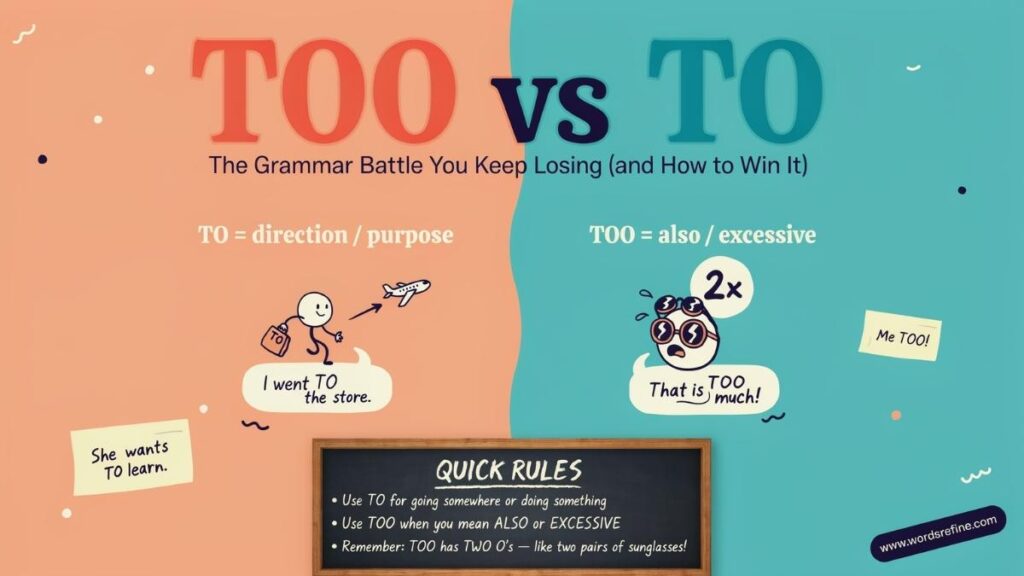
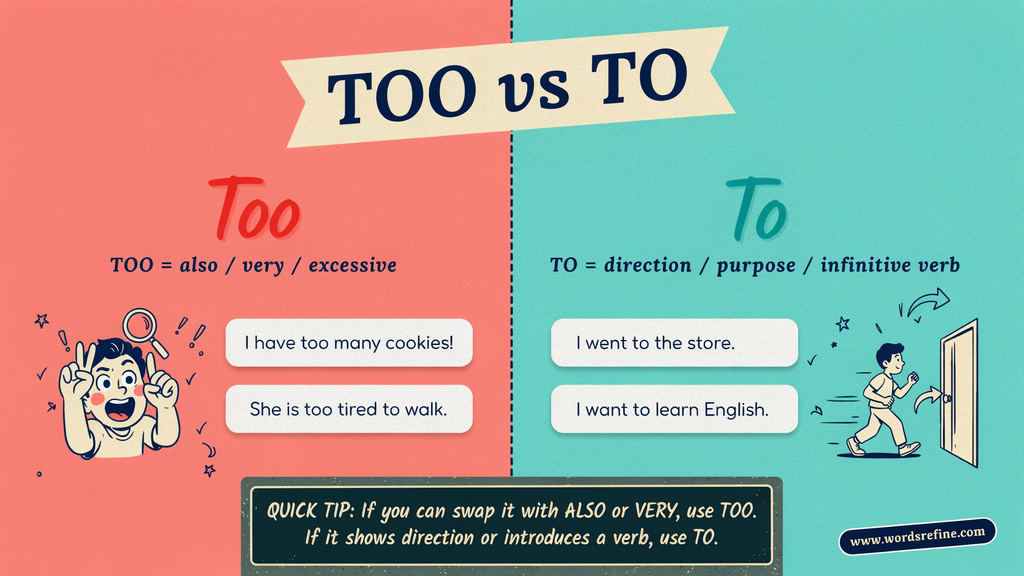
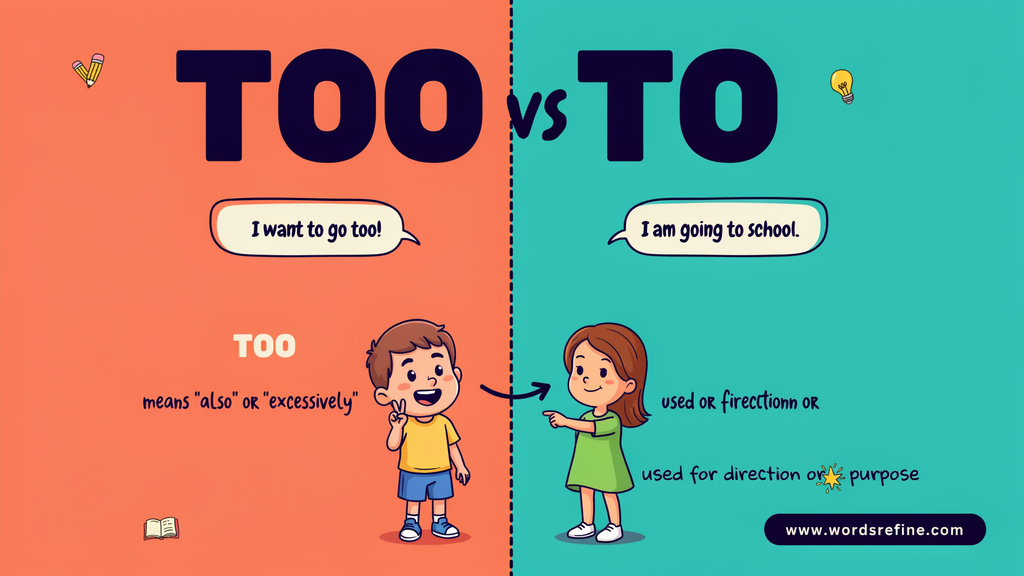
Use “too” when you mean “also” or “more than necessary.” Use “to” when you’re talking about a destination, direction, purpose, or action.
For example, “I want to come too” uses both words correctly. The first “to” introduces the action of coming, while “too” means “also.”
Although the words sound alike, their meanings are different too vs to. Therefore, understanding the role each word plays in a sentence is the easiest way to avoid mistakes.
What Does Too Mean?
The word “too” has two common meanings: “also” and “more than necessary.” The context tells you which meaning applies.
Too Means Also
Use “too” when you want to say that something applies to another person or thing. In this sense, it often appears at the end of a sentence.
For example, “I love chocolate too” means you love chocolate in addition to someone else who loves it.
Similarly, “She wants to join us too” means she also wants to join the group. You could replace “too” with “also” without changing the main meaning.
Here are a few more examples:
“I’m coming too.”
“He enjoyed the movie too.”
“We would like to participate too.”
“My sister wants to learn Spanish too.”
In each sentence, “too” adds the meaning of “also.” Therefore, if you can replace the word with “also” and the sentence still makes sense, “too” is probably the correct choice.
Learn the difference between confusing more English words
Performing vs Preforming Which One Is Correct?
Too Means More Than Necessary
The word “too” can also describe something excessive or beyond a suitable amount. It usually appears before an adjective or adverb.
For example, “The coffee is too hot” means the coffee is hotter than you would like it to be.
Likewise, “You’re driving too quickly” means the speed is higher than it should be in that situation.
Consider these examples:
“The bag is too heavy.”
“This room is too cold.”
“She speaks too softly.”
“The shoes are too expensive.”
“I arrived too late.”
In these sentences, “too” suggests a problem, an excess, or an amount beyond what is appropriate.
However, “too” doesn’t always express something negative. In the sentence “She is too kind to ignore someone in need,” the word contributes to a structure that describes a high degree of kindness. The meaning depends on the complete sentence.
Can Too Appear at the Beginning of a Sentence?
Yes, although it often appears at the end in everyday conversation. You can place it at the beginning when you want to emphasize that something applies to another person or situation.
For example, “Too, she wanted to attend the meeting” sounds unnatural in most modern contexts. A more natural version is “She wanted to attend the meeting too.”
Therefore, when you mean “also,” placing “too” near the end of a sentence is usually the clearest option.
Learn the difference between commonly misused words
Mobil vs Mobile Which one Is Correct?
What Does To Mean?
Unlike “too,” the word “to” has several grammatical functions. It commonly shows direction, destination, purpose, or a relationship between words. It also appears before the basic form of a verb.
To Shows Direction or Destination
Use “to” when someone or something moves toward a place, person, or destination.
For example, “We walked to the park” tells you where the speakers went.
Similarly, “She sent a letter to her friend” identifies the person who received the letter.
Here are some everyday examples:
“I’m going to school.”
“He drove to the airport.”
“Please give this book to Maria.”
“We traveled to Chicago last weekend.”
In each case, “to” connects the action with a destination or recipient. Since “too” doesn’t serve this grammatical purpose, using it in these sentences would be incorrect.
To Introduces an Action
The word “to” also appears before the basic form of a verb. This form is called an infinitive.
For example, “I want to learn French” uses “to” before the verb “learn.”
Likewise, “They decided to leave early” uses “to” before “leave.”
Consider these examples:
“She hopes to become a doctor.”
“We need to finish the project.”
“He plans to visit his grandparents.”
“I like to read before bed.”
“Please remember to lock the door.”
In each sentence, “to” introduces an action. Therefore, when you see a verb following the word, “to” is often the correct choice.
However, remember that “too” can appear in the same sentence as an infinitive. For example, “I want to learn French too” is correct because “to” introduces the action and “too” means “also.”
Learn the difference between commonly mixed-up more words
Inquiries vs Queries What’s the Difference ?
To Expresses Purpose
You can also use “to” when explaining why someone does something.
For example, “She went to the store to buy milk” explains the purpose of her trip.
Similarly, “He studies hard to improve his grades” tells you why he studies.
More examples include:
“I called to ask a question.”
“They saved money to buy a house.”
“She opened the window to let in fresh air.”
“We left early to avoid traffic.”
In these examples, “to” connects an action with its purpose. Using “too” instead would change the sentence incorrectly.
To Appears in Common Expressions
Many familiar expressions contain “to.” Because these phrases are so common, learning them can make correct spelling easier.
For example, people say “from Monday to Friday” when describing a period of time. They also say “listen to music,” “talk to a friend,” and “look forward to something.”
Other examples include “according to the report,” “next to the door,” and “used to live here.”
One expression deserves special attention: “look forward to.”
For example, “I look forward to meeting you” is correct. Although “meeting” is a verb form, the word “to” functions as a preposition in this expression, so it can be followed by a noun or an -ing form.
Similarly, “I’m used to waking up early” is correct because “to” is followed by “waking.”
Therefore, don’t assume that “to” must always be followed by the basic form of a verb. Its function depends on the expression and sentence structure.
Learn the difference between confusing word pairs
Lend vs Lent What’s the Difference and When to Use Each?
The Main Difference Between Too vs To
The easiest way to understand the difference between “too” vs “to” is to examine their meanings and grammatical roles.
| Word | Meaning or function | Example |
|---|---|---|
| Too | Also | I want to come too. |
| Too | More than necessary | The room is too warm. |
| To | Direction or destination | We went to the beach. |
| To | Introduces an infinitive | She wants to dance. |
| To | Expresses purpose | He called to apologize. |
As you can see, “too” usually adds the meaning of “also” or “excessively.” In contrast, “to” connects words and ideas by expressing direction, purpose, or an action.
Consequently, the correct spelling depends on what you want to say, not how the word sounds.
How to Use Too vs To in Sentences
Some sentences become easier to understand when you compare the words side by side. Although they sound identical, their meanings change depending on the spelling.
I Want to Go Too
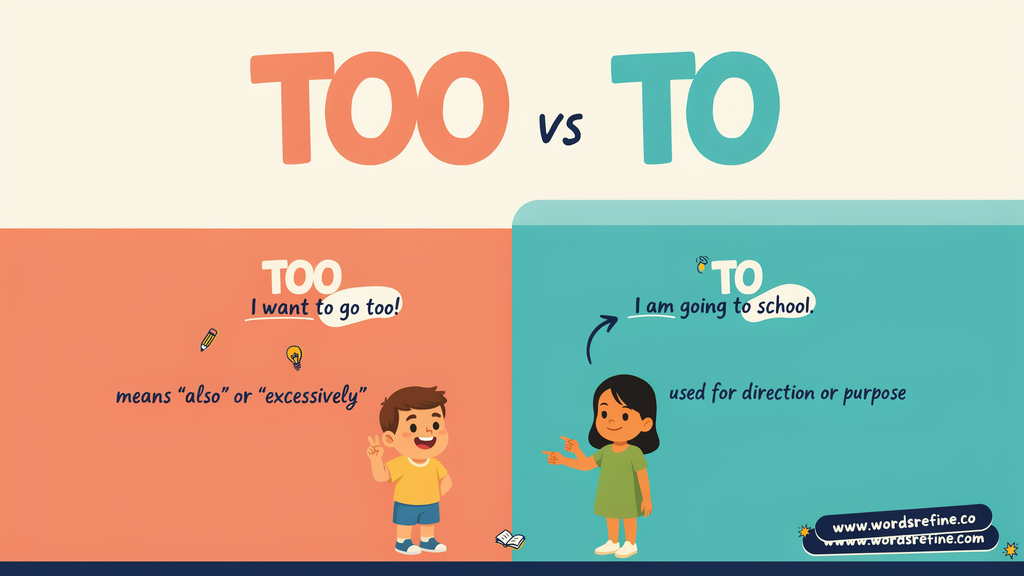
The sentence “I want to go too” is correct when you mean that you also want to go somewhere.
Here, “to” introduces the verb “go,” while “too” means “also.”
For example, imagine your friends are planning a trip. One friend says, “We’re going to the beach.” You reply, “I want to go too.”
Both words are necessary because they perform different jobs.
However, if you write “I want too go,” the sentence becomes incorrect because “too” cannot replace the infinitive marker “to.”
I Would Love To vs I Would Love Too?
The correct choice depends on what you mean and whether the sentence is complete.
For example, “I would love to” is correct when the action is understood from the conversation.
Imagine someone asks, “Would you like to join us for dinner?” You can reply, “I would love to.” The missing action is understood, so you don’t need to repeat it.
By contrast, “I would love too” is generally incorrect when you intend to use the same shortened expression. However, “too” can be correct when it means “also” and the sentence includes the appropriate structure.
For example, “I would love to join you too” means that you would also like to join.
Therefore, consider the meaning and structure before choosing the word.
You Too vs You To?
The phrase “you too” is common in everyday conversation. It means “the same to you” or “you also,” depending on the context.
For example, if someone says, “Have a wonderful day,” you can reply, “You too!”
Likewise, if a friend says, “I hope you enjoy the party,” you might respond, “You too,” if the wish applies to both of you.
However, “you to” can be correct when it appears as part of a larger sentence.
For example, “I want you to come with us” uses “to” to introduce the action “come.”
Thus, “you too” can stand alone as a response, while “you to” generally needs additional words to complete the sentence.
My Go To vs My Go Too?
The correct expression is “go-to,” not “go-too,” when you mean something reliable or frequently used.
For example, “This is my go-to recipe for chocolate cake” means it is the recipe you regularly choose.
Similarly, “She is my go-to person for writing advice” means you rely on her when you need help with writing.
The expression “go-to” can describe a favorite option, a dependable person, or a preferred solution.
By contrast, “go-too” is not the standard spelling of this expression.
Therefore, remember that the phrase uses “to,” even though it may sound like “too.”
Learn the difference between basic English word mistakes
Socialise vs Socialize Which one Is Correct ?
Too Much vs To Much?
The correct phrase is “too much” when you mean more than necessary or more than is appropriate.
For example, “There is too much sugar in this coffee” means the coffee contains more sugar than you want.
Similarly, “You spend too much time on your phone” suggests that the amount of time is excessive.
By contrast, “to much” is incorrect in this context because “to” cannot express excess.
However, “to” can appear before “much” in a different sentence structure. For example, “I need to pay much closer attention” is grammatically correct because “to” introduces the verb “pay.”
Therefore, when you mean “more than necessary,” use “too much.”
Too Late vs To Late?
Use “too late” when you mean that something happens after the appropriate or useful time.
For example, “We arrived too late to catch the train” means the train had already left or could no longer be caught.
Similarly, “It’s too late to change the reservation” means the opportunity to make the change has passed.
The phrase “to late” is incorrect when you want to express this meaning.
Remember that “too” can describe excess in time, just as it describes excess in temperature, cost, or quantity.
Learn the difference between commonly misused words
Instalments vs Installments Which one Is Correct?
What About Two To vs Too?
English has another word that sounds exactly like “to” vs “too”: “two.” Although all three words share the same pronunciation, they have different meanings.
| Word | Meaning | Example |
|---|---|---|
| To | Direction, relationship, or infinitive marker | She went to the store. |
| Too | Also or more than necessary | She came too. |
| Two | The number 2 | She bought two apples. |
For example, “I gave two books to Sam, and he gave me two books too” uses all three words correctly.
The first “two” identifies a quantity. The word “to” identifies the recipient, while the final “too” means “also.”
Although the sentence might look confusing at first, each word has a distinct purpose.
Common Mistakes When Using Too vs To
Even experienced writers sometimes mix up these words, especially when typing quickly. Fortunately, most mistakes become easy to fix once you recognize the intended meaning.
| Incorrect sentence | Correct sentence | Explanation |
|---|---|---|
| I want too leave. | I want to leave. | “To” introduces the action. |
| It is to cold outside. | It is too cold outside. | “Too” means excessively. |
| She wants to come to. | She wants to come too. | “Too” means also. |
| We went too the park. | We went to the park. | “To” indicates direction. |
| There is to much noise. | There is too much noise. | “Too much” expresses excess. |
| I arrived to late. | I arrived too late. | “Too late” describes timing. |
The key is to focus on meaning rather than sound. Since the pronunciation is identical, listening to the sentence won’t help you identify the correct spelling.
Instead, ask yourself what the word contributes to the sentence. Does it mean “also”? and Does it describe something excessive? Does it introduce an action or show direction? Once you answer that question, the correct choice usually becomes obvious.
Easy Ways to Remember the Difference
You don’t need to memorize complicated grammar rules to use “too” and “to” correctly. A few simple checks can help you make the right choice.
Replace Too With Also
When you’re unsure, try replacing “too” with “also.”
For example, “I want to come too” becomes “I also want to come.” Both sentences make sense, so “too” is correct.
Likewise, “She likes reading too” can become “She also likes reading.”
However, “I want to go to” cannot become “I want to go also” without changing the intended structure or leaving the original sentence incomplete. In that situation, the word “to” may be introducing an action or destination.
Look for Excess
If you want to describe something as more than necessary, choose “too.”
For example, “The suitcase is too heavy” means it weighs more than you can comfortably carry.
Similarly, “The movie was too long” means it lasted longer than you wanted.
This rule also works with expressions such as “too expensive,” “too noisy,” “too difficult,” and “too quickly.”
Check What Comes Next
When “to” introduces an infinitive, it usually comes before the basic form of a verb.
For example, “to read,” “to write,” “to learn,” and “to sleep” are all correct.
Therefore, if your sentence requires an infinitive, “to” is generally the right choice.
However, keep common expressions such as “look forward to meeting you” in mind because “to” can also function as a preposition.
Remember the Extra O
A simple spelling trick can help you remember the difference.
The word “too” has an extra letter O. You can associate that extra O with “extra” or “more than necessary.” It can also remind you that “too” means “also,” as in “I want to come too.”
Meanwhile, the shorter word “to” handles many basic grammatical jobs, including showing direction and introducing actions.
This memory trick isn’t a complete grammar rule, but it can help you make a quick decision while writing.
Learn the difference between everyday English mistakes
Copyright vs Copywrite Which One Is Correct?
Using Too vs To in Everyday and Professional Writing
Choosing the correct word matters in casual conversations as well as formal writing. Although readers can often understand what you mean from context, spelling mistakes can distract them from your message.
In Text Messages and Social Conversations
People often type quickly when messaging friends, so it’s easy to mix up words that sound alike.
For example, “I want to come too” is correct when you want to join your friends. Likewise, “It’s too cold to go outside” correctly uses both words.
Even in casual messages, choosing the right spelling makes your meaning clearer. After all, autocorrect doesn’t always understand what you intended to say.
In Academic Writing
Students often encounter these words in essays, reports, and assignments.
For example, “The researcher plans to examine the results” correctly uses “to” before the verb “examine.” In contrast, “The second study is too limited to support the conclusion” uses “too” to describe a limitation.
Therefore, proofreading your work for commonly confused words can improve clarity and help you catch mistakes before submitting an assignment.
Learn the difference between often confused words
Dreamt vs Dreamed Which One Is Correct?
Practice Session Too vs To
- I want ___ learn how to play the guitar.
- This coffee is ___ hot for me to drink.
- My sister wants to come ___.
- We walked ___ the nearest grocery store.
- The movie was ___ long for the children.
- He hopes ___ become a successful writer.
- Would you like ___ join us ___?
- It is ___ late to change our plans.
- Please give this message ___ your teacher.
- I enjoyed the concert ___.
- They need ___ finish their homework before dinner.
- The music is ___ loud for me to concentrate.
- She went ___ the library to borrow a book.
- I want ___ visit that museum ___.
- There is ___ much sugar in this tea.
- I look forward ___ seeing you again.
- He arrived ___ early for the appointment.
- We decided ___ leave before the rain started.
- My friends are going ___ the park, and I want ___ go ___.
- This suitcase is ___ heavy for me to carry.
- She saved money ___ buy a new laptop.
- I would love ___ help you with the project.
- Please listen ___ the instructions carefully.
- The test was ___ difficult for some students.
- I want ___ invite you ___ my birthday party ___.
Answers
- To
- Too
- Too
- To
- Too
- To
- To, too
- Too
- To
- Too
- To
- Too
- To
- To, too
- Too
- To
- Too
- To
- To, to, too
- Too
- To
- To
- To
- Too
- To, to, too
Here’s a trusted source for clear more words Comparison:
FAQs
Is “I would love to” or “I would love too” correct?
“I would love to” is correct when the intended action is clear from the conversation. For example, if someone asks whether you want to join them, you can reply, “I would love to.” However, use “too” when you mean “also,” as in “I would love to join you too.”
Is “you too” grammatically correct?
Yes, “you too” is grammatically correct and commonly used in everyday conversation. For example, if someone says, “Have a wonderful day,” you can reply, “You too!” to return the good wish.
Is it “your too late” or “you’re too late”?
“You’re too late” is correct because “you’re” means “you are,” while “too” indicates that someone has arrived after the appropriate time. In contrast, “your” shows possession, as in “your jacket,” so it doesn’t fit this sentence.
What is another way to say “too late”?
Depending on the situation, you can say “past the deadline,” “after the cutoff,” or “beyond the time limit.” For example, instead of saying, “It’s too late to submit the form,” you could say, “The submission deadline has passed.”
Is “I will be late” grammatically correct?
Yes, “I will be late” is grammatically correct. It means you expect to arrive or complete something later than planned. For example, “I will be late for the meeting because of traffic.”
Is “I too am” grammatically correct?
Yes, “I too am” is grammatically correct, although it can sound formal. For example, “I too am interested in the proposal” means “I am also interested in the proposal.” In everyday conversation, “I’m interested in the proposal too” sounds more natural.
Which is correct: “to difficult” or “too difficult”?
“Too difficult” is correct when something is more difficult than is manageable or appropriate. For example, “This question is too difficult for a beginner.” The word “too” expresses excess, whereas “to” cannot convey that meaning.
Do you say “me too” or “me to”?
“Me too” is correct when you want to express the same feeling, opinion, or preference as someone else. For example, if a friend says, “I love this song,” you can reply, “Me too!” However, “to me” is used in sentences such as “She gave the book to me.”
How do you use “too” correctly?
Use “too” when you mean “also” or “more than necessary.” For example, “I want to come too” means you also want to come, while “The box is too heavy” means it weighs more than you can comfortably carry. Consider the intended meaning to choose the correct word.
Is “I miss you too” grammatically correct?
Yes, “I miss you too” is grammatically correct. It means you also miss the person you’re speaking to. In this sentence, “too” means “also” and appears naturally at the end.
Is “Good morning too” grammatically correct?
Although people may understand “Good morning too,” it sounds unnatural as a standard greeting. If someone wishes you a good morning, you can reply, “Good morning to you too!” or simply say, “Good morning!” Both responses sound natural and polite.
Learn the difference between more words people mix up
Ambassador vs Embassador Which Spelling Is Correct?
Conclusion
The difference between too vs to comes down to meaning, not pronunciation. Use to when expressing direction, purpose, or an action. Use too when you mean “also” or “more than necessary.” Once you recognize these patterns, choosing the correct word becomes second nature.
When uncertainty strikes, take a moment to check your sentence. If you can replace the word with “also,” too is likely correct. If you’re talking about where someone is going or what they want to do, to is usually the better choice.
Most importantly, don’t let two small words cause a big grammar headache. Practice with everyday sentences, pay attention to context, and learn from your mistakes. Before long, you’ll know which word belongs where. After all, good grammar should make your writing clearer, not leave you too confused to write!

Diora AJS she is an experienced blogger and passionate English language enthusiast at Words Refine. With a keen eye for language and a love for clear communication, she writes practical content about grammar, word meanings, usage, and commonly confused terms. Her goal is to make English easier to understand through clear explanations and relatable examples, helping readers write accurately and communicate with confidence.