
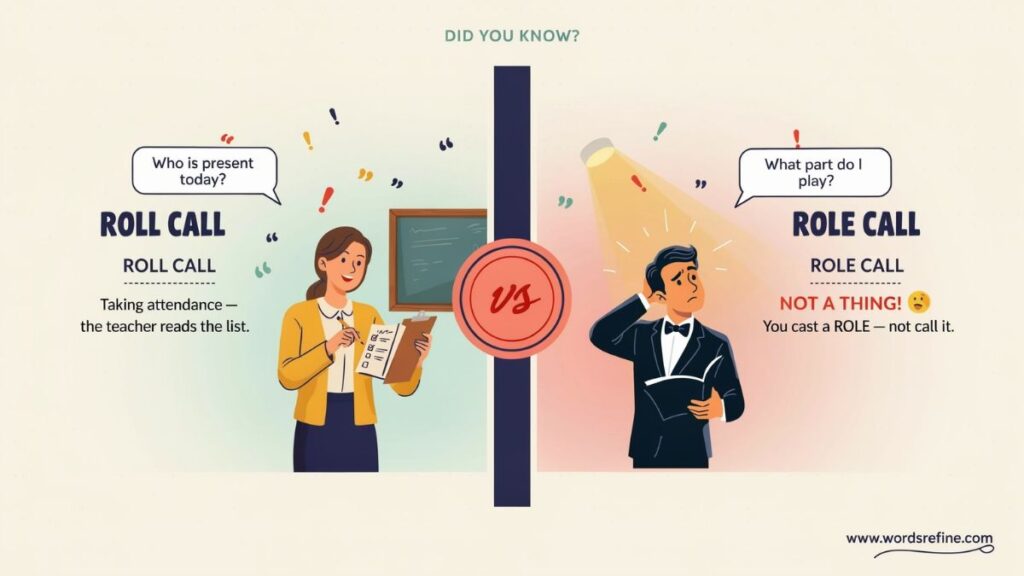
Have you ever paused while writing “roll call” and wondered whether it should be “role call”? You are not alone! These two expressions sound identical, making them easy to mix up. However, only one is correct when you are talking about attendance. “Roll call” refers to checking who’s present, while “role” describes someone’s position, duty, or function. Confusing the two can turn a simple attendance check into an unexpected grammar blunder. So, which spelling should you use, and why does the difference matter? Let’s explore roll call vs role call clear up the confusion, and look at practical examples that make the distinction easy to remember.
Quick Answer Roll Call vs Role Call
Roll Call vs Role Call is the correct expression when you mean calling names from a list to check attendance or record participation. Role call is generally a spelling mistake when used in this context.
The difference comes down to the meanings of the two words. Roll refers to a list, register, or official record of names. Role describes a person’s function, responsibility, position, or part in a particular situation.
For example:
The teacher conducted a roll call before starting the lesson.
The manager explained everyone’s role in the new project.
Notice how each word serves a different purpose. A roll call checks who’s present, while a role describes what someone does.
Remember this simple distinction: A roll contains names, while a role describes responsibilities. That small difference will help you choose the correct spelling whenever you write about attendance.
Learn the difference between confusing more English words
Peak vs Pique Differences Examples and Correct Usage ?
What Does Roll Call Mean?
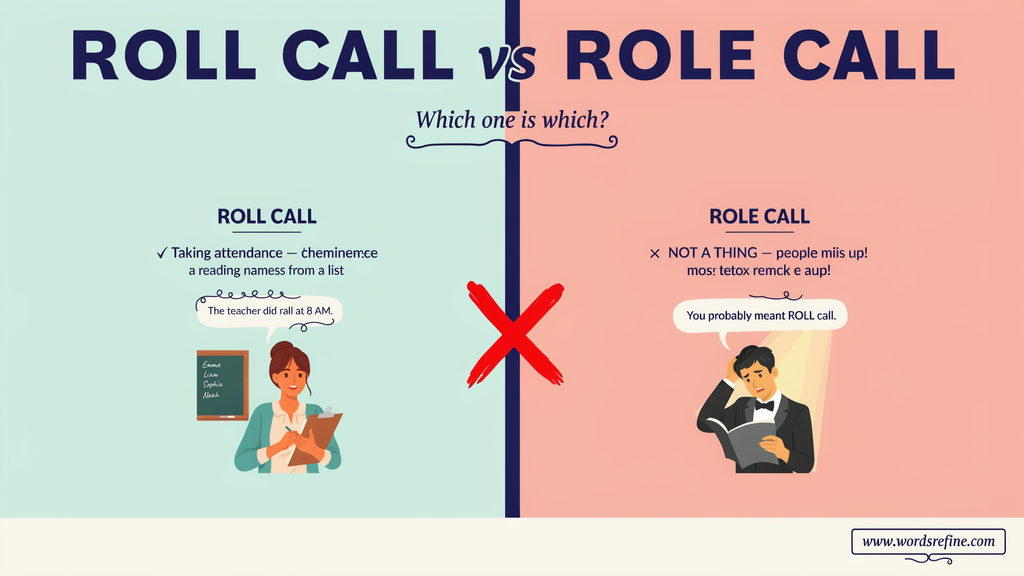
Roll call refers to the process of calling people’s names from an official list to establish who is present and who is absent.
During a typical roll call, someone reads names aloud, and each person responds when they hear their name. The person conducting the check then records attendance.
For example, a teacher might say, “Emily Carter?”
Emily responds, “Present!”
The teacher continues calling names until everyone on the class roster has been checked.
However, roll call isn’t limited to classrooms. Organizations use it in workplaces, military units, government institutions, and formal meetings. Although the setting changes, the purpose remains the same: confirming the presence of people whose names appear on a list.
Roll Call Definition and Grammatical Function
Roll call is a compound noun. It combines two words to describe one specific activity.
The word roll refers to a list or register of names. Meanwhile, call refers to announcing or reading those names aloud. Together, they describe the process of checking attendance by calling names.
You can use roll call as the subject or object of a sentence.
For example:
Roll call begins at 8:30 every morning.
The teacher requested a roll call.
Everyone must respond during roll call.
The coach conducted a roll call before practice.
The expression also appears in formal settings. For instance, a legislative body may conduct a roll call to record how individual members vote on a proposed law.
Roll Call Meaning in Attendance
In attendance records, roll call means checking whether listed individuals are present.
A school may use a class roster, while a company may maintain an employee attendance register. Both provide an official list of people whose presence needs confirmation.
A typical roll call procedure involves preparing an attendance sheet, calling each person’s name, recording their response, and marking them as present or absent.
This process creates a clear attendance record. It also helps identify missing students, employees, or participants who may need a follow-up.
Although some organizations now use digital attendance systems, the basic purpose hasn’t changed. Someone still needs to establish who has arrived and who hasn’t.
Roll Call Meaning in the Military
In the military, roll call helps officers and other responsible personnel account for members of a unit.
Depending on the circumstances, personnel may gather at an assigned location while someone checks their names against an official roster. Each member responds when called so the responsible officer can confirm their presence.
This process serves several practical purposes. It helps confirm that assigned personnel have reported, identifies missing members, supports accountability, and maintains accurate personnel records.
The exact procedure varies by military organization, unit, and situation. However, the central purpose remains the same: making sure everyone is accounted for.
Roll Call in School and the Classroom
School is probably the most familiar place to encounter roll call.
Teachers often conduct a roll call at the beginning of the school day or during a class session. They use a class roster to check which students have arrived.
For example, a teacher might announce, “Good morning, everyone. Let’s start with roll call.”
The teacher then reads the students’ names and records their responses.
Some schools use digital attendance systems instead of reading every name aloud. Even so, the underlying purpose remains unchanged: recording student attendance accurately.
Accurate attendance records help schools identify absent students, monitor attendance patterns, follow up on unexplained absences, and maintain official records.
What Does Role Mean?
Now let’s look at the other half of the confusion.
The word role refers to a person’s function, responsibility, position, or part in a particular activity. It explains what someone does or what they’re expected to contribute.
For example, Sarah plays an important role in the marketing department. A teacher’s role includes helping students understand difficult subjects. Similarly, a manager may assign each employee a specific role within a project.
Notice that none of these examples involves checking attendance. Instead, each one describes a responsibility or function.
Role Meaning and Definition
A role can describe several related ideas.
A job or function refers to the responsibility someone has within an organization. For example, his role involves managing customer accounts.
A social position describes the part someone plays in a family, community, or relationship. For instance, parents play an important role in children’s development.
A character in a performance refers to the part an actor plays in a film, television show, or theater production. For example, she received the lead role in the school play.
A responsibility in a particular situation describes someone’s contribution to a shared activity. For instance, every team member has a role in completing the project.
Therefore, role is the right word whenever you’re discussing duties, responsibilities, functions, or characters.
However, it doesn’t replace roll in the established expression roll call.
Learn the difference between commonly mixed-up more words
Labor Day vs Labour Day Meaning and Usage ?
Why Is It Roll Call Instead of Role Call?
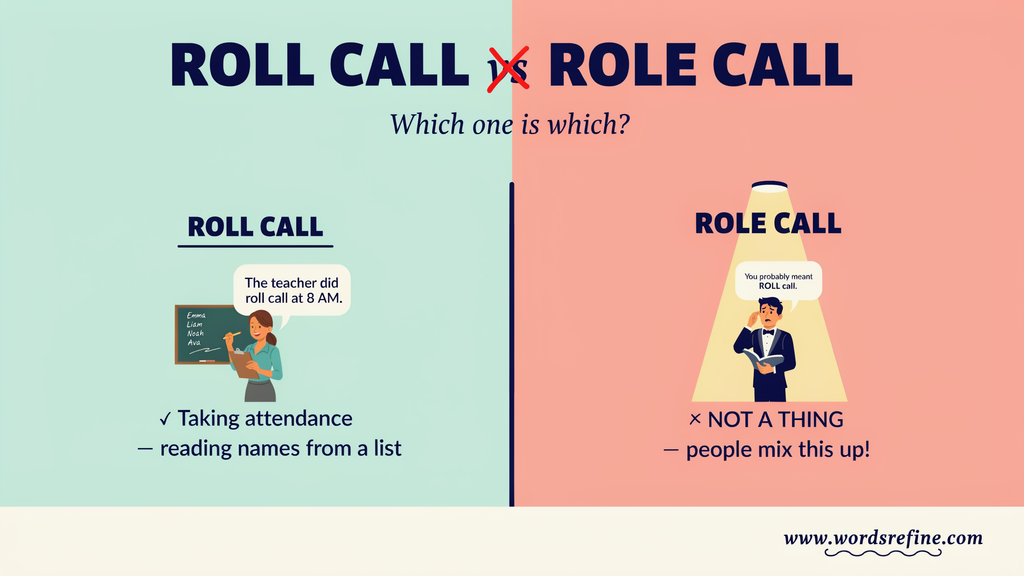
The easiest way to understand the correct spelling is to look at the meaning of roll.
Historically, a roll referred to a document made from parchment or paper that people could roll up for storage. Such documents often contained official information, including names and records.
Over time, roll also developed the meaning of a written list or register. The word call describes the action of announcing or reading the names on that list.
Put the two words together, and you get roll call.
The word role, on the other hand, refers to someone’s function or part in a situation. It has no connection to the attendance-list meaning of the expression.
Consider these examples:
The principal called the roll before announcing the day’s activities.
Every employee understood their role in the new project.
The captain conducted a roll call before the team left.
The actor prepared for his role in the upcoming production.
The difference becomes obvious when you examine the context. A list of names requires roll, while a responsibility or function requires role.
Why Do Roll vs Role Sound the Same?
roll call vs role call are homophones. Homophones are words that share the same pronunciation but have different spellings and meanings.
In standard American English, both words have the pronunciation /roʊl/. Their vowel and final consonant sounds are identical.
This explains why people sometimes write role call even when they understand the intended meaning. Speaking doesn’t reveal the spelling difference. You need context to choose the correct word.
Other familiar homophones include their and there, to and too, right and write, and principal and principle.
Like these pairs, roll and role require you to understand the sentence before choosing the spelling.
Roll Call vs Role Call Key Differences
The distinction between roll call vs role call isn’t a matter of American versus British spelling. It’s a difference in meaning.
Roll refers to a list or register. Role refers to a function or responsibility. Only the first word belongs in the established expression for checking attendance.
Here’s a closer comparison.
| Feature | Roll | Role |
|---|---|---|
| Part of speech | Noun and verb | Noun |
| Main meaning | A list, register, or act of turning | A function, duty, or part |
| Common use | Attendance lists and records | Jobs, responsibilities, and performances |
| Example | The teacher checked the roll. | She plays an important role. |
| Related expression | Roll call | Leading role |
| Pronunciation | /roʊl/ | /roʊl/ |
roll call vs role call Understanding the Difference
A useful way to remember the difference roll call vs role call is to connect each word with a familiar expression.
Roll connects with records. You might encounter it in class roll, honor roll, electoral roll, muster roll, and payroll.
In these expressions, roll refers to a list, register, or record.
Role connects with responsibilities. You might encounter it in job role, leading role, supporting role, parental role, and leadership role.
These expressions describe someone’s position, duties, or contribution.
Learn the difference between tricky grammar more words
Traveled vs Travelled Which one Is Correct in English?
Roll vs Role Difference in Everyday Sentences
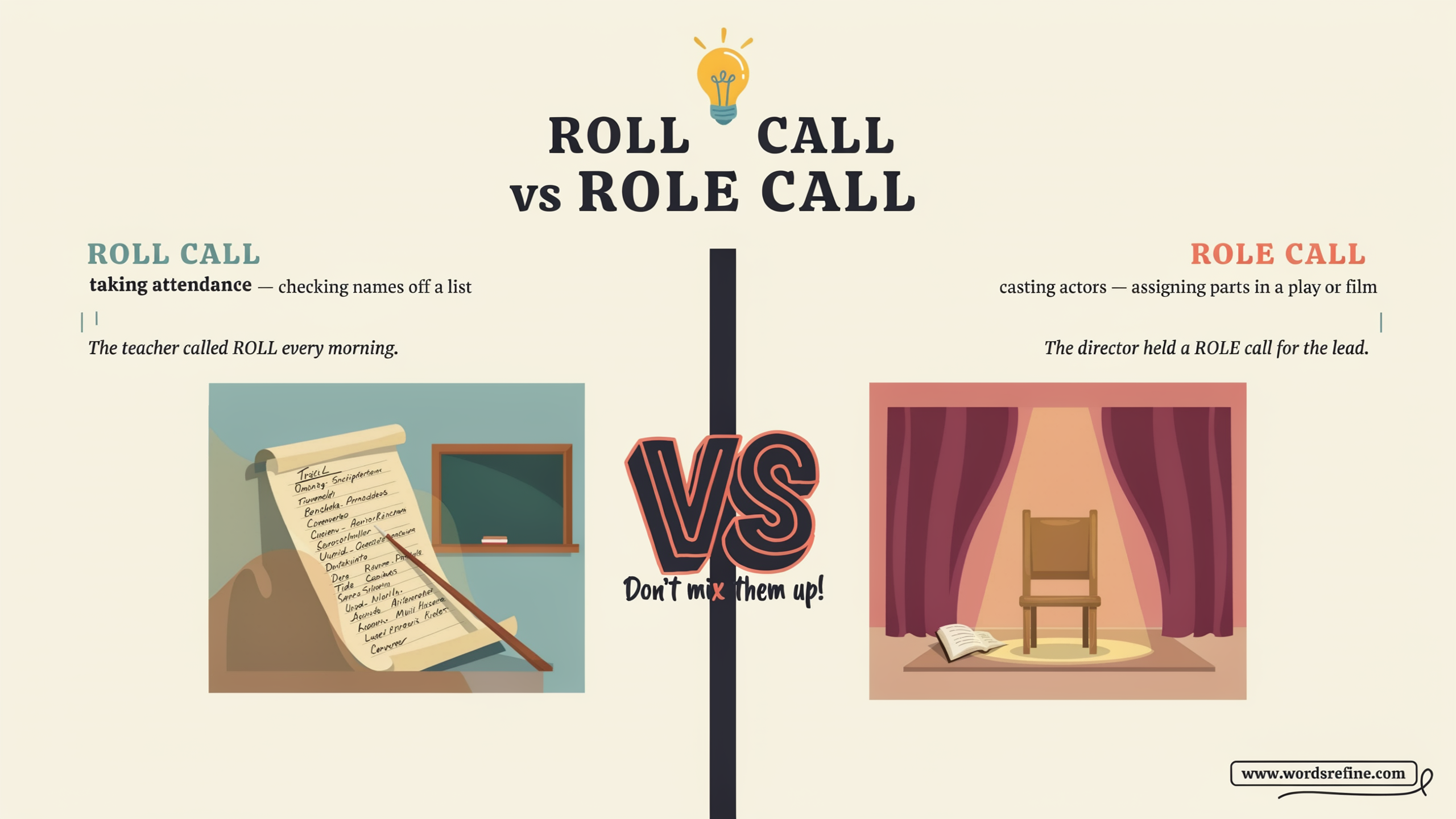
Context determines which spelling belongs in your sentence.
Consider these examples:
The school secretary updated the attendance roll.
The manager explained my role in the department.
The officer checked the military roll.
He played the role of a detective.
The teacher called the roll after lunch.
Parents have an important role in education.
Notice how changing one letter changes the meaning. A class roll identifies students, while a student’s role might involve serving as class president or helping organize an activity.
The words aren’t interchangeable, even though they sound alike.
Roll Call in Different Contexts
Roll call appears in several settings, and its purpose can vary slightly depending on the organization. Nevertheless, the central idea remains consistent: someone checks a list of names to confirm presence or participation.
Roll Call in School
In schools, teachers commonly use roll call to record student attendance.
A teacher may call each student’s name at the beginning of a lesson. Students respond with “present,” “here,” or another accepted response.
For example:
“Let’s begin with roll call. Emma?”
“Here!”
“Daniel?”
“Present!”
The teacher marks each response on an attendance sheet or enters it into a digital school system.
Schools may also use automated attendance tools, student identification cards, or online systems. These methods can replace reading every name aloud, but teachers still perform the same basic attendance-taking task.
Roll Call in a Meeting
In workplaces, roll call helps organizers confirm who has joined a meeting.
This practice can be especially useful during formal meetings, committee sessions, training events, and conferences where attendance matters.
For example, the meeting organizer might announce, “The meeting will begin after the secretary completes roll call.”
The organizer may call each participant’s name or compare the attendees against an employee roster.
However, not every workplace meeting requires a traditional roll call. A quick headcount, sign-in sheet, or digital attendance report may be enough.
For a formal meeting, roll call can also establish whether enough members are present to conduct official business. This requirement is often called a quorum.
Roll Call Meaning in the Army and Military
Military roll call focuses on accountability.
An officer or another designated person may check a unit’s personnel against an official roster. Members respond when called so the responsible person can confirm who has reported.
For example, an instruction might read, “All personnel must report for morning roll call at 0600.”
This tells members to assemble at the assigned time so someone can verify their presence.
The exact roll call procedure depends on the military organization and the situation. It may involve a physical formation, an attendance record, or another established reporting method.
In the Army, roll call may help personnel account for assigned members before or after scheduled activities. It also helps identify discrepancies between the expected and actual number of people present.
Importantly, military roll call isn’t simply a classroom attendance check with uniforms. Accountability can carry operational importance, especially when personnel must report to specific locations or complete assigned duties.
Roll Call in Congress
Government institutions also use roll call, although the process can involve more than checking who’s physically present.
In the US Congress, a roll call vote records how individual members vote on a question.
For example, the US Senate conducts a roll-call vote by having the clerk call each senator’s name. Each senator responds with “yea” or “nay,” and the clerk records the vote. A senator may also be recorded as present under applicable procedures.
The House of Representatives has also used roll calls to record votes. Today, however, it generally uses electronic voting for recorded votes. Members select their responses through voting stations, and the system records the results.
This distinction matters because a roll call vote doesn’t merely establish attendance. It creates an official record of individual voting decisions.
What Is a Roll Call Vote?
A roll call vote is a voting procedure in which officials record individual members’ votes rather than relying solely on a collective voice response.
In the Senate, the clerk calls senators by name, and each senator gives a response. The clerk then records the votes.
A roll-call vote helps establish who voted in favor, who voted against, and who did not cast a vote, where applicable.
For example, suppose a legislative body considers a proposed transportation bill. Instead of asking everyone to respond together, the clerk calls each member’s name and records the individual vote.
The resulting record shows how each member voted.
Learn the difference between confusing word pairs
Absence vs Absense Correct Spelling Meaning and Usage ?
Roll Call vs Taking Attendance Are They the Same?
Roll call and taking attendance are closely related, but they aren’t always identical.
Taking attendance is the broader process of recording who is present and who is absent. It can involve several methods, including calling names aloud, checking a sign-in sheet, scanning identification cards, using an electronic attendance system, or reviewing an online meeting’s participant list.
Roll call usually refers to calling names from a list to establish attendance.
For example, a teacher who reads every student’s name aloud conducts a roll call. Another teacher who checks students into a digital system also takes attendance, even without calling their names.
Here’s a practical comparison.
| Situation | Roll Call | Taking Attendance |
|---|---|---|
| Teacher reads student names aloud | Yes | Yes |
| Employee signs an attendance sheet | Not necessarily | Yes |
| Meeting organizer calls every member’s name | Yes | Yes |
| School uses an electronic attendance system | Not necessarily | Yes |
| Officer checks a unit’s personnel roster | Yes, if names are called | Yes |
Therefore, every traditional attendance roll call is a form of taking attendance, but not every attendance check involves a roll call.
Roll Call Examples How to Use It Correctly
Understanding a definition is helpful, but seeing a word in context makes it easier to remember. These examples show how roll call works in everyday communication.
Roll Call in a Sentence
The teacher completed the morning roll call before beginning the lesson.
Everyone must attend roll call at 9 a.m.
The captain checked the roster during the morning roll call.
Our manager conducted a roll call before the annual meeting.
Three students were absent when the teacher called the roll.
The secretary recorded everyone’s name during the meeting’s roll call.
The soldiers gathered outside for their scheduled roll call.
The committee requested a roll-call vote on the proposal.
Please answer when you hear your name during roll call.
The principal reviewed the attendance register after roll call.
Each sentence uses roll call to describe checking names, confirming attendance, or recording participation.
How to Use Roll Call in a Sentence
The expression roll call functions as a noun. You can use it in several common sentence structures.
As the subject:
Roll call begins at 8:00 every morning.
As the object:
The teacher conducted roll call before the examination.
After a preposition:
Everyone must respond during roll call.
In a compound modifier:
The committee requested a roll-call vote.
You may also encounter the expression call the roll. It means essentially the same thing as conducting a roll call.
For example, the teacher called the roll before the students started their assignments.
Similarly, the officer called the roll after the morning formation.
Both constructions are correct.
Learn the difference between often confused words
Want vs Wont Meaning Differences and Usage ?
Practical Example Roll Call in a Classroom
Imagine a teacher named Mrs. Davis who has 25 students in her classroom.
At the beginning of the school day, she opens the class roster and calls each student’s name. Twenty-three students respond, but two don’t.
Mrs. Davis records the two absences in the school’s attendance system.
Later, another teacher asks whether she completed the attendance check.
Mrs. Davis replies, “Yes, I finished roll call this morning.”
Now imagine writing that sentence as “I finished role call this morning.”
The meaning becomes incorrect because role refers to a function or responsibility, not an attendance list.
This simple example demonstrates why the correct spelling matters. One letter can change the meaning of an otherwise perfectly understandable sentence.
Learn the difference between often confused words
Councillor vs Counsellor Difference Spelling and Usage ?
Common Mistakes When Using Roll Call vs Role Call
Even experienced writers sometimes confuse homophones. Because roll and role sound identical, spelling mistakes can slip into emails, school assignments, meeting notes, and professional documents.
Here are some common mistakes to avoid.
Writing Role Call Instead of Roll Call
This is the most frequent mistake.
Incorrect: The principal announced that role call would begin at 8 a.m.
Correct: The principal announced that roll call would begin at 8 a.m.
The sentence refers to checking student attendance, so roll is the correct choice.
Confusing a List With a Responsibility
Remember that roll can refer to a list of names, while role describes someone’s function.
Incorrect: The manager explained everyone’s roll in the department.
Correct: The manager explained everyone’s role in the department.
The manager is discussing responsibilities rather than an attendance register.
Assuming Identical Pronunciation Means Identical Meaning
Homophones often cause spelling mistakes because spoken language doesn’t always reveal which word a writer intends.
For example, you can hear both roll and role as /roʊl/ in American English.
However, their meanings remain different. Always consider the context before choosing the spelling.
Writing Rollcall as One Word
The standard spelling is roll call, with a space between the two words.
Incorrect: The teacher completed the rollcall.
Correct: The teacher completed the roll call.
The two-word form is the standard choice in ordinary American English.
Using Role When Discussing Attendance Records
Another mistake occurs when writers describe an attendance procedure using role.
Incorrect: All employees must respond during the morning role call.
Correct: All employees must respond during the morning roll call.
A useful proofreading trick is to replace the expression with attendance check. If the sentence still makes sense, you probably need roll call.
The Origin and History of Roll Call
The history of roll call explains why the expression uses roll rather than role.
Historically, a roll referred to a document made from parchment or paper that people could roll up for storage. Such documents often contained official information, including names and records.
Over time, roll developed another meaning: a register or list of names.
Historical records show that the word had this meaning by the late 14th century. The expression roll call appeared around 1775, following the earlier phrase call the roll, which dates to the 1680s.
The expression developed from two simple ideas. Roll referred to an official list or register, while call described the act of announcing or summoning someone.
Together, they described the practice of calling names from a register.
This historical connection also explains why roll appears in other expressions involving lists and records.
For example, an honor roll contains the names of students who achieve a specified academic standard. An electoral roll is an official register of eligible voters. A muster roll records personnel, especially in military contexts. Similarly, a class roll contains the names of students enrolled in a class.
These expressions share the idea of a recorded list. That’s the clue that connects them to roll call.
Roll Call Pronunciation and Spelling
In American English, roll call is pronounced /roʊl kɔːl/. The first word rhymes with bowl, while the second rhymes with ball in many American accents.
The expression contains two syllables in total, with one syllable in each word.
Roll and role share the same pronunciation:
Roll: /roʊl/
Role: /roʊl/
This makes them homophones.
However, their spelling and meaning differ. You can’t rely on pronunciation alone to choose between them.
Is Roll Call One Word or Two?
The standard spelling is two separate words: roll call.
For example:
The teacher started roll call.
We missed the morning roll call.
The officer completed the roll call.
The Senate conducted a roll-call vote.
One small grammatical detail is worth remembering: writers sometimes hyphenate roll call when it modifies another noun, as in roll-call vote. However, the ordinary noun remains two words.
Learn the difference between basic English word mistakes
Moustache vs Mustache Meaning Spelling and Usage ?
Is Roll Call the Same in American and British English?
Yes. Both American and British English use roll call for the process of reading names to check attendance.
The main difference involves pronunciation. American speakers generally pronounce the first word with the vowel sound /oʊ/, while British speakers commonly use /əʊ/.
However, the spelling doesn’t change between the two varieties.
Unlike words such as color and colour or organize and organise, roll call doesn’t have separate American and British spellings.
Therefore, whether you’re writing for an American classroom, a British school, or an international workplace, roll call remains the correct expression.
Synonyms and Alternatives for Roll Call
Sometimes you may want to avoid repeating roll call throughout a document. Fortunately, several expressions can communicate a similar idea.
However, their meanings aren’t always identical.
| Alternative | Meaning | Example |
|---|---|---|
| Taking attendance | Recording who is present | The teacher is taking attendance. |
| Attendance check | Confirming who has arrived | We need an attendance check before the meeting. |
| Calling the roll | Reading names from a list | The officer started calling the roll. |
| Name check | Checking individuals against a list | The organizer completed a quick name check. |
| Attendance register | An official record of attendance | The school updated its attendance register. |
| Headcount | Counting the number of people present | The manager requested a headcount. |
The best alternative depends on your situation.
For example, headcount works when you only need to know how many people are present. It doesn’t necessarily identify each individual.
Similarly, an attendance register refers to the record itself rather than the process of calling names.
Choose the alternative that accurately describes what you’re doing.
Learn the difference between everyday English mistakes
Moustache vs Mustache Meaning Spelling and Usage ?
Practice Session Roll Call vs Role Call
1. The teacher conducted a ______ before starting the lesson.
2. Everyone must respond when their name is called during ______.
3. The principal asked the teachers to check the attendance ______.
4. The officer called the ______ to confirm that all soldiers were present.
5. We waited for the secretary to begin the ______ at the meeting.
6. The students were marked absent because they missed ______.
7. The clerk recorded each senator’s vote during the ______ vote.
8. Please make sure your name appears on the attendance ______.
9. The teacher asked the class to remain quiet during ______.
10. The manager conducted a quick ______ to see who had arrived.
11. The word “roll” in ______ refers to a list of names.
12. A person’s job or responsibility is called a ______.
13. The captain organized a morning ______ to account for the crew.
14. When the teacher called her name, Mia answered, “______!”
15. The meeting coordinator used ______ to confirm everyone’s attendance.
16. The school keeps a class ______ with the names of enrolled students.
17. The soldiers assembled for the morning ______.
18. The secretary read the names aloud during the ______.
19. The phrase “take ______” is another way to describe checking attendance.
20. A nurse’s ______ includes caring for patients and monitoring their health.
21. The teacher noticed that two students were missing from the ______.
22. The military officer checked the personnel list during ______.
23. The committee recorded each member’s response during the ______.
24. The word “role” describes someone’s function, while “______” can refer to a list.
25. Remember to write “______” as two separate words when referring to attendance.
Answers
- Roll call
- Roll call
- Roll
- Roll
- Roll call
- Roll call
- Roll call
- Register
- Roll call
- Headcount
- Roll call
- Role
- Muster
- Present
- Roll call
- Roster
- Muster
- Roll call
- Roll
- Role
- Roster
- Muster
- Roll call
- Roll
- Roll call
Here’s a trusted source for clear more words Comparison:
FAQs
What is the difference between a class roll vs a class roster?
A class roll and a class roster both refer to lists of enrolled students. However, roster is more common in modern school administration, while roll often appears in attendance-related contexts.
Can you say “take roll” instead of “take roll call”?
Yes. Take roll is a common expression for checking attendance, particularly in American schools. Both phrases describe the process of confirming which students are present.
What does it mean to be marked present during roll call?
It means the person conducting attendance has recorded you as being present. Your response confirms that you’ve arrived and are available for the scheduled activity.
What happens if someone misses roll call?
The person may be recorded as absent until someone verifies their attendance. In schools, this may involve checking with the teacher or attendance office. In military settings, personnel may follow established accountability procedures to locate missing members.
Who usually conducts a roll call?
A teacher, meeting secretary, supervisor, military officer, or another designated person may conduct roll call. The responsibility depends on the organization and the purpose of the attendance check.
What is the difference between roll call and a headcount?
Roll call identifies individuals by calling their names, while a headcount simply establishes how many people are present. A headcount doesn’t necessarily confirm everyone’s identity.
Can roll call be conducted online?
Yes. Meeting organizers can conduct an online roll call by calling participants’ names and recording their responses. This approach helps confirm attendance during virtual meetings, training sessions, and formal online gatherings.
What does it mean to answer the roll?
Answering the roll means responding when someone calls your name during an attendance check. People commonly say “present,” “here,” or “I’m here” to confirm they’ve arrived.
What is the difference between a roll call and a muster?
Both can involve checking personnel against an official list. However, a muster often refers to a formal gathering or accounting of personnel, particularly in military and naval settings. Roll call specifically emphasizes calling names from a list to confirm attendance.
Learn the difference between more words people mix up
Mortality vs Fatality Meaning Differences and Correct Usage ?
Conclusion
The difference between roll call vs role call may seem like a small spelling detail, but choosing the wrong word can change your sentence’s meaning. Remember, “roll call” is the correct expression for checking attendance, while “role” refers to someone’s job, function, or responsibility. So, when your teacher calls your name, you’re answering roll call, not auditioning for a classroom role. Keep this distinction in mind, and you’ll avoid a common writing mistake. After all, getting your spelling right is one responsibility you don’t want to miss!

Diora AJS she is an experienced blogger and passionate English language enthusiast at Words Refine. With a keen eye for language and a love for clear communication, she writes practical content about grammar, word meanings, usage, and commonly confused terms. Her goal is to make English easier to understand through clear explanations and relatable examples, helping readers write accurately and communicate with confidence.